Tag: Architektur

  • Construction of seven new buildings to begin this year

    Construction of seven new buildings to begin this year

    The Zurich Innovation Park is taking shape, as the operator announced in a recent press release. The first phase of the development, which includes the construction of seven new buildings on the apron of the site, will be launched this year. These projects were carefully selected from a total of 28 proposals submitted as part of a global architectural competition.

    The selected projects come from renowned architectural firms such as E2A, Roger Boltshauser, Mulder Zonderland, TEN from Zurich as well as Muoto from Paris and 3XN from Copenhagen. The planned use of the total floor area is divided into around 24 per cent office space, 8 per cent laboratory space and 12 per cent production space, including areas for the production of prototypes. The focus is on flexibility, with a further 36 per cent for a variety of uses and areas for utilities, services and research-related living. Catering, leisure and shopping facilities are also planned.

    The Innovation Park Zurich is pursuing an ambitious sustainability concept that is intended to lead the way for urban developments. Planned measures include the establishment of an energy grid and the installation of large solar panels on roofs and façades to ensure a reduced ecological footprint. By creating flexible and modular building typologies, the Zurich Innovation Park is aiming for long-term usability and sustainability while incorporating the latest technologies.

  • Reinforcement for the jury of the Real Estate Awards

    Reinforcement for the jury of the Real Estate Awards

    In autumn 2023, jury members Stephan Lüthi and Peter Staub decided to step down. The panel is now complete again: Anita Horner and Gaétan Kameni join long-standing Real Estate Award jury members André R. Spathelf, Karin Aeberhard and Daniel Löhr.

    Anita Horner worked at Immoveris and Swiss Prime Site Solutions, among others, before moving to Cardis Sotheby’s International Realty. In 2021, she set up her own business and founded Immo Solutions Atelier, a company specialising in property marketing. Anita Horner was also President of Wipswiss for four years and is currently President of the property information platform Immoday.

    Gaétan Kameni is Head of Finance & Services in Asset Management Real Estate at Zürcher Kantonalbank. He has over 20 years of professional experience in property investment management. Before joining ZKB, Gaétan Kameni worked at Losinger Marazzi, Mobimo and as Head of Real Estate at PKE Vorsorgestiftung. He holds degrees in architecture and business administration as well as a Master of Science in Real Estate (CUREM).

    Mara Schlumpf, Managing Director of Real Estate Award AG, is delighted with the prestigious addition: “With Anita Horner and Gaétan Kameni, we have been able to attract two exceptionally qualified and knowledgeable jurors for the Real Estate Award, which makes me very proud. I am looking forward to working with the newly composed jury and would like to thank the former jurors Stephan Lüthi and Peter Staub for their valuable commitment.”

    Companies have until the end of May to submit their projects for this year’s edition of the Real Estate Award. The projects will then be submitted to the jury, which will nominate three companies per category.

    Contact: Mara Schlumpf / mara.schlumpf@realestateaward.ch

  • CSS expands headquarters with Diener und Diener Architekten

    CSS expands headquarters with Diener und Diener Architekten

    The jury of an architectural competition organised by the CSS Group has unanimously decided in favour of the design by Diener und Diener Architekten. According to a press release, the Basel-based architecture firm has been commissioned to expand the CSS headquarters of the health, accident and property insurer in the city of Lucerne. A commercial building on Tribschenstrasse, which CSS purchased in 2015, is to be integrated into the project.

    A total of ten designs were submitted. “Lambris”, says CSS CEO Philomena Colatrella, “embodies urban elegance and best fulfils the architectural, heritage and functional requirements”.

    Originally, CSS had wanted to demolish the commercial building designed by Lucerne architect Carl Mossdorf. However, together with conservation and planning organisations, it finally agreed to preserve it. Now it is to be restored to as original a state as possible.

    In the design by Diener und Diener Architekten called Lambris, the historic building is enclosed by the new building. According to CSS, the winning project connects the different streets and squares and thus blends seamlessly into the cityscape. A bistro open to the public is to be created on the ground floor.

    The building application for the “urgently needed” office building is due to be submitted in the fourth quarter of this year. Provided no appeals are lodged against the building permit, the new building is scheduled to be occupied in the first half of 2027.

  • Innovative school project on the former barracks site in Les Vernets

    Innovative school project on the former barracks site in Les Vernets

    Construction work has begun on the school complex, which will play a central role in the social fabric of the emerging residential neighbourhood. The “Emile” project by the renowned architecture firm Liechti Graf Zumsteg (Aargau) was selected as the winner of the 2019 architecture competition. The innovative design of the school building, which presents itself as an open and inviting space, will aim to create an atmosphere of sharing and community.

    The building will not only function as a school, but also as a public facility open to the entire community. It will provide spaces for various activities such as canteen, play and sports facilities, which will be accessible via galleries and passages on the transparently designed ground floor.

    The centrepiece of the school building will be on the first floor, where classrooms will be arranged around a spacious central room that will provide space for additional learning activities. The architecture of the building will be characterised by gabled roofs equipped with photovoltaic panels to meet the school’s energy needs and improve climate comfort.

    The importance of this project for the development of the neighbourhood is emphasised by Frédérique Perler, Head of the Department of Spatial Planning, Construction and Mobility, and Christina Kitsos, Vice-President of the Board of Directors, who stress the importance of social cohesion and community development.

    The outdoor areas of the school will be carefully designed to provide pleasant and functional spaces for students and the community. The schoolyard will be organised by existing trees and complemented by new planting, while wide avenues and green spaces will create a welcoming environment.

  • Conspark and madaster provide training in circular construction management

    Conspark and madaster provide training in circular construction management

    Conspark, a consultancy firm for sustainable construction, and madaster switzerland, a platform for the circular economy in property, are joining forces to transform the construction industry into a circular one. To this end, the two partner companies are offering target group-specific training courses for manufacturers of construction products, architecture and planning offices as well as building owners and the public sector. The first course is aimed at manufacturers of construction products and will be offered for the first time on 16 April. The first courses for architecture and planning offices and building owners and the public sector are scheduled for 16 May and 6 June. After the launch, the three courses will be offered on an ongoing basis.

    “The cooperation between conspark and madaster is a perfect match,” said Florian Robineck, Managing Director and founder of conspark, in a press release issued by his company. “While conspark contributes its expertise in the circular economy, madaster offers the technological tool for implementation.” This interaction is intended to provide participants with practical skills to integrate circularity into practice in their own context.

    For manufacturers of construction products, the course will answer the question of how they can position themselves in the circular economy and utilise this as a market advantage. Architecture and planning offices will receive assistance in integrating circularity into their own designs. Building owners and the public sector, on the other hand, will learn how to create a circular property strategy with which they can increase the attractiveness of their portfolio.

  • HKG remodels traditional Aarau garage

    HKG remodels traditional Aarau garage

    The engineering and consulting firm Herzog Kull Group Holding AG (HKG) is converting the Aarhof Garage in Aarau into a modern office building and will also use it itself, according to a press release. The garage was built in 1950 and will meet modern building standards following the renovation, according to the HKG press release. 45 office workstations are to be created on the ground floor. The project is being realised by HKG together with the Aarau architectural firm Schneider & Schneider. In addition to the offices, there will also be meeting rooms, a break room and a kitchen.

    In its press release, HKG refers to a report in the “Aargauer Zeitung” newspaper, according to which the costs will amount to CHF 3.2 million. Work on the conversion is scheduled to begin in 2024, probably in late summer. The refurbishment, conversions and new buildings on the upper floor should be completed by mid-September 2025.

    According to HKG, three two-and-a-half-room loft flats with high ceilings will be built on the upper floor. As the area around the Traditionsgarage was traditionally a green spot in Aarau, a green space is to be created again in memory of the historic gardens, according to the press release.

    Founded in Aarau in 1978, HKG specialises in innovative building technology ranging from electricity planning to building automation. HKG also specialises in renewable energies such as photovoltaics.

    In addition to its headquarters in Aarau, HKG has offices in Schlieren ZH, Baden, Bern, Chur GR, Crissier VD, Lucerne, Olten SO, Pratteln BL, Rotkreuz ZG, St.Gallen and Vilters SG. HKG employs around 200 permanent staff, including 89 with higher technical qualifications, 65 with technical qualifications, 23 commercial and administrative staff and 23 apprentices.

  • “Little Marcel” leads Boudry’s road maintenance department into a new era

    “Little Marcel” leads Boudry’s road maintenance department into a new era

    In June last year, the canton of Neuchâtel launched an architectural competition to find innovative solutions for the urgently needed expansion and renovation of the road construction centre in Boudry. The aim of the challenging search was to create a future-proof infrastructure that fulfils the requirements of sustainability and efficiency. The “Little Marcel” project by Julien Dubois Architectes SA from La Chaux-de-Fonds won over the jury out of fourteen entries and took first place.

    The winning project is characterised by its holistic approach, which focuses on both architectural quality and functional excellence. In addition to the refurbishment of the existing building, the planned extension also includes the construction of new buildings that will enable the site to be utilised to the full. The sustainable concept, which emphasises the project’s commitment to the environment through the integration of solar modules and the use of timber constructions, is particularly noteworthy.

    The realisation of “Little Marcel” promises to improve work processes while at the same time enhancing the landscape and architectural quality of the site. The targeted expansion of the workshop buildings and the creation of a spacious inner courtyard will serve to optimise logistics and promote cooperation between employees.

    With a planned budget of CHF 12 million for the overall competition and a further CHF 1.5 million for the relocation of service buildings, the Government Council is laying the foundations for a modern and future-orientated infrastructure. The public exhibition of the competition entries gives the public an insight into the visionary plans for the Boudry depot.

    This project marks an important step in the development of road maintenance in the region and sets new standards in terms of sustainability and efficiency in road maintenance in the Canton of Bern. The further development and refinement of the winning project is eagerly awaited with a view to a future application for a building loan.

  • Timber Finance informs about CO2 methodology in timber construction

    Timber Finance informs about CO2 methodology in timber construction

    Timber Finance has been working since 2022 to establish timber construction on the market for CO2 storage certificates. The company recently received an ICROA CO2 certificate standard for its methodology developed for this purpose, Timber Finance announced in a press release. The competence centre for modern timber investments expects its CO2 storage technology to be finally recognised in the course of the year.

    For the pilot phase of the methodology, Timber Finance is inviting interested parties from the property development, architecture, engineering, project development and real estate sectors as well as general and total contractors to register their planned or ongoing timber buildings as pilot projects for CO2 certification. On 8 February, the Competence Centre will also be hosting an online seminar on the topic. According to the event announcement, the approach of generating financing contributions for timber construction projects via CO2 storage certificates will be explained in detail.

  • Corentin Fivet becomes the new head of the Smart Living Labs

    Corentin Fivet becomes the new head of the Smart Living Labs

    Corentin Fivet will take over as head of the Smart Living Lab at the Fribourg branch of the Swiss Federal Institute of Technology Lausanne(EPFL) in spring. He has been a professor at EPFL since 2016 and, according to a press release, has developed pioneering methods for the reuse of concrete slabs, walls and beams made of wood or steel. The Smart Living Lab celebrates its tenth anniversary in 2024.

    When Fivet took up an assistant professorship at the EPFL in Fribourg, his field of research was still in its infancy, according to the press release. “It was easy to review the literature, as hardly anything had been published,” he is quoted as saying. At that time, the reuse of load-bearing structures was not as widespread as it is today. And the Smart Living Lab itself was also in its early stages. The Smart Living Lab is a joint initiative of three Swiss universities – EPFL, the School of Engineering and Architecture Fribourg(HEIA-FR) and the University of Fribourg.

    “We now have around a dozen research groups that have achieved numerous successes – including some that have been recognised internationally. My appointment as academic director of the centre marks the beginning of the next phase,” Fivet is quoted as saying.

    Fivet will take over as Academic Director of the Smart Living Lab on 1 April 2024 and will work alongside Martin Gonzenbach, who will continue as Operational Director. Fivet will continue to pursue the Smart Living Lab’s goal of serving as a catalyst for sustainability and well-being in the built environment, according to the press release. One of its first goals will be to expand the centre’s training courses for architects, civil engineers, construction managers and property managers.

  • ETH Zurich starts construction of the digitally printed “White Tower” in Mulegns

    ETH Zurich starts construction of the digitally printed “White Tower” in Mulegns

    ETH Zurich has completed the construction of the first columns for the 30 metre high “White Tower” in Mulegns, a project that pays tribute to the historic emigration of the Graubünden confectioners. The tower will not only be an architectural masterpiece, but also an important cultural venue.

    The use of revolutionary robotic manufacturing technology will halve the amount of concrete used and offer an unprecedented variety of shapes. This modular construction method allows the tower to be erected and dismantled several times.

    The tower, which will redefine the silhouette of the village of Mulegns, is a symbol of hope for the small village on the old Julier Pass route. Mulegns, which currently has only 14 inhabitants and belongs to Savognin, is to be revitalised and protected from extinction through this project.

    The column components will be manufactured at the ETH in Zurich before being assembled in Savognin. The ground-breaking ceremony is planned for April, and the official opening by Federal Councillor Guy Parmelin and ETH President Joël Mesot is scheduled for 25 June.

    The project, which will cost CHF 4.1 million, is being financed by public funds, foundations and private sponsors. Once completed, the “White Tower” will not only be an impressive example of progressive architecture, but also a driving force for culture and tourism in the region.

  • Launch of the competition for the “Aerogel Architecture Award 2024”

    Launch of the competition for the “Aerogel Architecture Award 2024”

    The fourth “Aerogel Architecture Award” is looking for inspiring examples of the use of aerogel in architecture and construction. The competition, which takes place in the categories “Realised Solutions” and “Student Designs”, offers a unique platform to present and honour innovative ideas and projects. An expert jury will select the finalists from all submissions, who will compete for the “Aerogel Architecture Award 2024” at an event on the Empa campus in Dübendorf on 12 July 2024.

    Architecture and civil engineering firms with projects in the areas of renovation, refurbishment or new construction can take part. Students of architecture and civil engineering are also invited to submit their designs and proposals for the use of aerogel. All projects will be assessed in a selection process that will be held in English. Realised renovation projects for listed buildings that have been improved with aerogel insulation materials will be particularly recommended.

    The award ceremony on 12 July 2024 in the NEST building on the Empa campus in Dübendorf will be available as a public livestream. The winning projects will not only receive recognition and public attention, but will also be published in international journals and on online platforms.

    Interested parties are invited to submit their projects in the form of a ZIP or RAR file by the closing date. Submissions should include a PDF poster in A1 format, JPEG images of the project, details of the use of the aerogel insulation and a registration form with a detailed description of the project. By entering the competition, participants agree to the publication of their project and confirm that they respect the rights to images, graphics and drawings of their submissions.

  • The winning project for the Stockhornstrasse development has been finalised

    The winning project for the Stockhornstrasse development has been finalised

    Four architectural firms from the Thun region, all with a renowned reputation for architectural excellence, were invited to participate in this prestigious project. Each of these firms collaborated with a landscape architecture firm to provide a comprehensive and holistic vision for the site. Of note was the participation of the “up-and-coming” firm akkurat bauatelier GmbH, which emphasised the diversity and breadth of the competition.

    The designs submitted were characterised by their creative and diverse approaches, which contributed significantly to the decision-making process. After careful consideration, the committee selected the project by brügger architekten AG & extra Landschaftsarchitekten AG as the winner. The winning design impresses with its well thought-out integration into the existing landscape, its high-quality residential design and its visionary interpretation of the future development of Steffisburg.

    A particular focus of this study commission was the seamless and meaningful integration of the new building project into the existing surroundings. The challenge was to harmonise the transition between the open landscape of the floodplain and the densely populated Steffisburg. The winning project masterfully manages to achieve this balance while offering high-quality living space.

    It is important to emphasise that the result of this study commission not only sets the direction for this particular project, but also serves as a source of inspiration for future construction projects in the region.

  • Switzerland Innovation Park Basel Area receives four new buildings

    Switzerland Innovation Park Basel Area receives four new buildings

    The Switzerland Innovation Park Basel Area in Allschwil will more than double in size in stages by 2028. The private investor Senn Resources from St.Gallen is investing around 350 million Swiss francs in the four new buildings planned. Together with the main building, which opened a year ago, they will form the Main Campus site. The Switzerland Innovation Park Basel Area also has two other sites: the Jura site in Courroux and the Novartis Campus in Basel.

    As with the main building, three of the four new buildings will be designed by architects Herzog & de Meuron, according to a press release from the Innovation Park. The “radically sustainable” Hortus office building is already under construction and is scheduled for completion in 2025. The All and Cloud laboratory and office buildings are in the planning stage. The public-facing Hope building was developed in collaboration with the Swiss Tropical and Public Health Institute. Senn is building it with Basel architects Felippi Wyssen, who won the anonymous competition.

    “It is extremely gratifying that the partnership of a public and private institution has made it possible to build an innovation district of this size,” said Raymond Cron, Managing Director of the national umbrella organisation Switzerland Innovation. “This means that not only the life sciences location of Basel, but also the nationwide network of Switzerland Innovation ‘s six parks is gaining in importance.” “With Senn,” says Christof Klöpper, CEO of Basel Area Business & Innovation and CEO of Switzerland Innovation Park Basel Area, “a private partner is making a major contribution to attracting innovative companies to the region and supporting the objectives of Switzerland Innovation.”

  • New 4-star resort “La Sassa” impresses in Münstertal

    New 4-star resort “La Sassa” impresses in Münstertal

    Val Müstair is currently experiencing an increase in overnight stays and has no hotels in the upmarket 4-star segment. “La Sassa” aims to fill this market niche and both preserve existing jobs and create new ones.

    The resort is to be realised in three stages. It will offer hotel rooms, serviced holiday flats, a reception, a restaurant, a public spa and wellness area and a sports equipment shop. Once all stages have been completed, 320 beds are planned in six buildings.

    In contrast to other resorts, “La Sassa” is focussing on nature-based tourism. The resort is primarily intended for active people and families who appreciate the nature of the Swiss nature park and are prepared to make a longer journey for this experience.

    The architecture is based on the characteristics of Val Müstair. Regional, high-quality building materials will be used, which should ensure authenticity and a high quality of stay.

    Domenig Immobilien AG is investing CHF 30 million in the project in the first construction phase. The flats will be sold as managed second homes that can only be occupied by the owner for a limited period of time. The rest of the time they will be rented out, with the owners receiving a return.

    A village square in the centre of the resort will serve as a meeting zone for guests and locals. This will create an authentic and dynamic public space with a high quality of stay.

    “La Sassa” offers an ideal base for discovering Val Müstair and neighbouring areas such as the Engadin and South Tyrol. The region is characterised by its diverse nature, fresh mountain air and unique local culture.

  • Kengo Kuma in Vals more than architectural innovation

    Kengo Kuma in Vals more than architectural innovation

    Kengo Kuma, an architect known for the artistic fusion of buildings with their surroundings, has realised a building in Vals that can be interpreted as a homage to nature. The building rises organically out of the landscape and almost appears to be interwoven with the mountains. This approach of fusion is a constant theme in Kuma’s work and reaches its peak here.

    The architectural style is based on the traditional timber construction of the region, but with a modern twist. The façade combines stone, wood and glass in a way that captures light and shadow. As a result, the building changes its appearance depending on the time of day and weather, creating a dynamic atmosphere.

    Another notable element of the project is the close collaboration with the local community. This participatory approach has resulted not only in an aesthetically pleasing building, but also one that meets the needs and sense of identity of the locals. In Vals, the building stands not only as an architectural landmark, but also as a place that represents the community and its identity.

    Inside, the building fascinates with its careful use of natural materials such as wood and stone, which create a warm, welcoming atmosphere. The design is conceived in such a way that the boundaries between indoor and outdoor space almost disappear. Large windows provide breathtaking views of the surrounding mountain landscape, while at the same time promoting an inner calm and harmony.

    Functionally, the building significantly expands the village’s social and cultural offerings. It not only houses public meeting rooms and exhibition spaces, but also provides space for local art and gastronomy. In this way, regional culture is effectively integrated into the design and the building becomes a lively centre for the community.

    Finally, Kuma’s new building in Vals is not only an architectural achievement, but also a testament to the possibility of a profound connection between people, nature and the built environment. Through this seamless integration and the strong involvement of the local community, Kuma has created a monument that is significant not only locally, but far beyond its borders. It reminds us that architecture can be emotionally resonant as well as functional, and emphasises the need to take a holistic approach to modern design.

  • Architecture book about Schlieren receives award in Frankfurt

    Architecture book about Schlieren receives award in Frankfurt

    According to a media release, the book “Stadtwerdung im Zeitraffer” is one of the ten winners of the DAM Architectural Book Award 2023, which is awarded by the Frankfurt Book Fair and the German Museum of Architecture (DAM). The photographic long-term observation of Schlieren from 2005 to 2020 shows how the Swiss midlands are developing, it adds. “Stadtwerdung im Zeitraffer” is edited by Meret Wandeler, Ulrich Görlich and Caspar Schärer and is the conclusion of the study “Fotografische Langzeitbeobachtung Schlieren”.

    According to the press release, the highly acclaimed project has spent 15 years photographically investigating how building activity and urban development change the character of a typical Swiss suburban community in the agglomeration belt. The book was designed by the graphic studio Elektrosmog in Zurich. It is published by the Zurich publishing house Scheidegger & Spiess.

    In the award citation, the jury stated: “The book explains itself in its structure, explores the given topic in a multi-faceted way and at the same time carefully manages the time of its audience. The 630-page double volume ‘Stadtwerdung im Zeitraffer’ fulfils all these criteria for a good architecture book”. The book illustrates the growth in Schlieren, “where 7,000 people have been added in 15 years, where some corners have been densely built and others have hardly changed at all”.

    The jury also praised the choice of a suitable location to explore the phenomenon of urban development. The two parts of the double volume tell of their process with the appropriate means in each case. Essays and texts provide the background to the development and classify it.

  • Energy Cluster invites to one-day course on photovoltaic façades

    Energy Cluster invites to one-day course on photovoltaic façades

    The Energy Cluster network based in Bern invites interested parties to a day course on photovoltaic facades (PV facades) at the Lucerne University of Applied Sciences and Arts(HSLU) on 12 September. From 8.30 a.m. to 5 p.m., speakers will shed light on various aspects of house facades for the production of solar energy, according to a media release.

    Accordingly, David Stickelberger, Head of Market and Policy at Swissolar, will discuss the political framework conditions for PV façades from 9 a.m. onwards. From 9.30 a.m., Christoph Wangler, Product Owner PV Systems at 3S Swiss Solar Solutions, will address the question of how sustainable solar modules are.

    From 10.40 a.m., Roger Buser, lecturer in building technology and energy at the HSLU, will discuss the process steps from a rough estimate to the construction project. Pierre-Olivier Cuche, Managing Director at Solarwall, will then talk about the architecture and design of PV façades. From 11.40 a.m. Andreas Haller, Head of Innovation Solar Systems at Ernst Schweizer AG, will talk about implementation planning and installation.

    After the lunch break, the talk will continue with the topic of fire protection in a presentation by Christian Renken, Managing Director of CREnergie GmbH. From 2 p.m. Renken will be devoting himself to the topic of performance and economic efficiency.

    He will be followed by Stefan Gränicher, Project Manager Real Estate Development at Frutiger AG, with his impulse on profitability from the perspective of a real estate developer. Robin Bergamin, Consulting & Sales at Invisia AG, will then talk about energy management and the best possible use of electricity.

    The last lecture of the day is by Sina Büttner, research associate at the Institute for Building Technology and Energy at the Lucerne University of Applied Sciences and Arts, on optimal façade design with solar systems and greening in view of climate change.

  • Hochparterre discusses long-term view of Schlieren

    Hochparterre discusses long-term view of Schlieren

    The Zurich publishing house Hochparterre has published its eponymous magazine for the month of August. Among other things, it is about the large-scale project Stadtwerdung im Zeitraffer by photographer Meret Wandeler and publicist Caspar Schärer. They have documented the structural development of the city of Schlieren in photos for 15 years, according to a media release. A book on the project has been published by Scheidegger & Spiess.

    Rahel Marti also interviewed the two about their long-term photographic observation and its usefulness for spatial planning in the publisher’s new podcast Sach & Krach.

    The new issue also deals with virtual dream landscapes that 3D artists and designers develop inspired by painting and nature. The text on these pixel paradises “seriously questions our treatment of nature”.

    The issue also takes up the Architecture Biennale in Venice. It introduces readers to African architecture, which is also championed by the architect and professor at the Swiss Federal Institute of Technology Zurich(ETH), Mariam Issoufou Kamara, who has her say in an interview.

    Author Deborah Fehlmann looks at the Weiermatt housing estate in the Aargau municipality of Lupfig and “shows the Hüsli people the advantages of cooperative building”. And urban wanderer and architecture critic Benedikt Loderer calls for the creation of a second old town in Biel in the hospital area.

  • Schlieren concludes planning contract for new retirement centre

    Schlieren concludes planning contract for new retirement centre

    In March, Schlierem’s voters approved a loan of 44,317,000 Swiss francs for the construction of the retirement centre Wohnen am Stadtpark. The new building in the middle of the city is to replace the Sandbühl retirement centre. Now the city council has awarded Liechti Graf Zumsteg Architekten from Brugg AG the contract for the corresponding architectural work, the Schlieremer city administration informs in its current city council news. The volume of the planning contract is 3.7 million Swiss francs.

    Wohnen am Stadtpark is designed as a building complex with contemporary and affordable flats for older people. The concept by Liechti Graf Zumsteg Architekten envisages a two-storey base with concrete elements housing the restaurant and nursing rooms. Four upper floors for the flats for the elderly will be built in timber. According to the city administration’s information on the project, the new building will “meet the requirements of a healthy and ecological construction method according to Minergie-P ECO and be certified accordingly”. The completion of the new retirement centre is planned for 2026.

  • Modulare Einbauten für Zwischennutzungen: Erste Prototypen erstellt

    Modulare Einbauten für Zwischennutzungen: Erste Prototypen erstellt

    «Das Surren eines Akkuschraubers klingt durch das DISPO in Nidau. In der alten Fabrikhalle, die Raum bietet für Kreative, Kultur- und Gewerbetreibende, entstehen an diesem Tag vier Prototypen von Raummodulen, dank denen es künftig möglich sein soll, Zwischennutzungen von leerstehenden Gebäuden und Brachen einfach und nachhaltig umzusetzen. Ungenutzten Räumen soll damit ein ökologischer, ökonomischer und sozialer Mehrwert verliehen werden. Dieses Ziel verfolgen Forschende des Instituts für Holzbau, Tragwerke und Architektur IHTA der Berner Fachhochschule BFH gemeinsam mit Partnern aus der Wirtschaft im Innosuisse-Forschungsprojekt «àDisposition».

    Verschiedene Modullösungen getestet
    Im Projekt entwickeln die Forschenden einen modularen Baukasten für Raummodule und Innenausbauten. Eine zentrale Komponente ist ein Konfigurator, dank dem Projektideen einfach geprüft, dargestellt und zeit- und ressourcensparend umgesetzt werden können. Auf der Basis von digitalen Entwürfen erstellen die Forschenden der BFH in Zusammenarbeit mit den Projektpartnern nun Prototypen im Dispo in Nidau. Anhand von diesen untersuchen und verbessern sie verschiedene Modullösungen. Das Projektteam testet unterschiedliche Systeme, Verbindungselemente und Segmentformen und kann bereits nach kurzer Zeit vielversprechendste Strategien für ein leichtes, wiederverwendbares und einfach rekonfigurierbares, modulares System identifizieren.

    Zeit für Aufbau variiert je nach Fabrikationsgrad
    Die Anforderungen an die modularen Einbauten sind hoch: Auf- und Abbau soll für Laien möglich sein und die Bauteile sollen leicht genug sein, dass es nur zwei Personen für die Montage benötigt. Die Einbauten sollen zudem anpassungsfähig sein, sich einfach umgestalten lassen sowie gut zu transportieren und zu lagern sein. Während des Aufbaus der Prototypen zeigt sich bereits, wie wichtig es ist, den idealen Grad der Vorfabrikation auszuwählen. Werden die Rahmen der Module bereits zusammengeschraubt angeliefert, können die Einbauten in kürzester Zeit aufgestellt werden. Transport und Lagerung gestalteten sich jedoch als schwieriger. Umgekehrt dauerte der Aufbau deutlich länger, wenn die Bauteile einzeln und dadurch kompakt angeliefert werden.

    Wichtigkeit der digitalen Durchgängigkeit
    Ein weiterer Aspekt, den die Forschenden mit der Produktion und dem Aufbau der Prototypen testen, ist die digitale Kette «Design to Production». Die Module werden im Konfigurator entworfen, die Daten für die Produktion anschliessend automatisch in CadWork exportiert. Diese Dateien bildeten die Grundlage für Materialbestellungen und den Produktionsprozess. Hier zeigte sich die Wichtigkeit der digitalen Durchgängigkeit für einen schnellen und einfachen Produktionsprozess.

    In einem nächsten Schritt befassen sich die Forschenden mit der Ausstattung der Module. So sind die Wände ein weiteres Gestaltungselement und zusätzliche (Dämm)Schichten müssen den Anforderungen an die Schall- und Wärmedämmung gerecht werden. Diese Anforderungen unterscheiden sich je nach Nutzung stark. «àDisposition – Spaceship Planet Earth. Sustainable and temporary use of buildings and vacant sites through simple and modular structural measures» ist ein von der Innosuoisse gefördertes Forschungsprojekt, das bis Juni 2025 läuft. Projektpartner sind C2 Beat Cattaruzza GmbH, Beer Holzbau AG, Pius Schuler AG, Prona AG und Bauart Architekten und Planer AG.

    Quelle: www.bfh.ch

  • Bruhin Spiess und Stefan Marti Garten erhalten SuperHink 2023

    Bruhin Spiess und Stefan Marti Garten erhalten SuperHink 2023

    Die in der Berner Arbeitsgemeinschaft Pro Naturstein zusammengeschlossenen zwölf Natursteinbetriebe in der Schweiz machen sich für eine Verwendung des nachhaltigen Bau- und Werkstoffs Naturwerkstein stark. Im Rahmen dieses Engagements zeichnet Pro Naturstein alle zwei Jahres kreatives und authentisches Gestalten mit Naturwerkstein mit dem SuperHink aus. In diesem Jahr wurden die Preise in den Kategorien Architektur/Innenarchitektur und Garten- und Landschaftsarchitektur am 11. Mai am Sitz der Eidgenössischen Materialprüfungs- und Forschungsanstalt (Empa) in Dübendorf ZH vergeben, heisst es in einer Mitteilung.

    Über den SuperHink in Architektur kann sich Bruhin Spiess aus Aarau freuen. Das Architekturbüro wurde für die Gestaltung des Hauptraums beim Umbau der Schlossscheune Wildegg im Aargau ausgezeichnet. Hier wurde der fast 100 Quadratmeter grosse Boden mit 154 unterschiedlich grossen Muschelkalkplatten aus dem nahe Schloss Wildegg gelegenen Steinbruch Mägenwil belegt. „Wir haben dafür massive grossformatige Platten mit Einzelgewichten bis zu 300 Kilogramm verwendet, zusätzlich aber auch deren Reststücke, um so den Ressourcen-Verbrauch zu minimieren“, wird Architekt Martin Bruhin in der Mitteilung zitiert.

    Der SuperHink für Garten- und Landschaftsarchitektur ging an die Stefan Marti Garten AG. Das Unternehmen aus Grosswangen bekam die Auszeichnung für die Gartengestaltung eines Privathauses. Hier wurde mit eine Kombination aus Holz, Wasser und Naturstein ein Aussenraum von „einzigartigem Charakter und Charme“ geschaffen, heisst es in der Mitteilung.

  • BAU celebrates a successful comeback

    BAU celebrates a successful comeback

    “BAU has once again proven that it is and remains the most important stage for innovations and premieres in the building sector. Despite the four-year forced break, more companies presented themselves in Munich than ever before. This underpins the very positive response to trade fairs and, in particular, to leading world trade fairs, as was already evident in 2022,” say the two heads of the trade fair Reinhard Pfeiffer and Stefan Rummel, summing up BAU 2023.

    Dieter Schäfer, Chairman of the BAU Exhibitors’ Advisory Council, agrees that BAU 2023 was a great success: “We did everything right by moving BAU 2023 to April. Fully occupied halls and a high proportion of international visitors underline the relevance of BAU. It was all the more important that the fair took place again after more than four years. In future, BAU will return to its usual January date.”

    In addition to the Federal Minister of Construction, Klara Geywitz, Bavaria’s Minister of Economic Affairs, Hubert Aiwanger, also took a look at the innovations and trends in the building industry at BAU: “The largest construction and architects’ trade fair is a successful networking platform for planners and building tradesmen. We need the very innovations presented there on how to reconcile climate protection and the challenges such as affordable building and housing. The fair stands for progress, growth and competitiveness and sets the course for the future in building and urban planning.”

    For Felix Pakleppa, General Manager of the Central Association of the German Building Trade (Zentralverband des Deutschen Baugewerbes), BAU sends a trend-setting signal to the building industry after the long forced break: “With the key themes of digital transformation, the future of living, resources and recycling, as well as modular building, the biggest challenges and trends of the moment have been perfectly mapped out. This year, BAU thus once again offers a great platform for creating future perspectives.”

    Katharina Metzger, President of the Federal Association of the German Building Materials Trade, also considers the return after more than four years a success: “We are more than satisfied with BAU 2023, because such an important sector cannot afford to be without a trade fair platform for six years. Even if important manufacturers for our specialist dealers with their craftsmen were unfortunately not on board this time, we hope that we can count on the old presence of suppliers again in January in 2025.”

    Andrea Gebhard, President of the Federal Chamber of Architects, emphasised the important significance of personal exchange: “BAU 2023 reflects the current issues of the building industry. It is the ideal meeting place for architects and planners to discuss both innovative materials of the future and social issues such as affordable housing.”

    BAU project manager Matthias Strauss is already looking forward to the upcoming events in the BAU Network: “After the successful BAU, the entire team is already very much looking forward to the digitalBAU conference & networking premiere next July as well as the next digitalBAU in February 2024.”

    Internationality of visitors reaches record level
    At the top of the international visitor ranking of BAU are Austria, Italy and Switzerland. Thanks to strong growth, Poland and Turkey take fourth and fifth place. Overall, the international share is almost 80,000 visitors. This corresponds to 40 percent of the total number of visitors and marks a record figure. In percentage terms, the international share is thus still a good deal higher than the previous record result from 2019 (37 per cent).

    The number of Chinese visitors is particularly noteworthy. With 1,600 people, China is one of the top 10 visitor countries at BAU 2023, a positive surprise after the Corona restrictions on travel from China to foreign countries were only recently relaxed.

  • Neuer Campus Horw schafft Synergien

    Neuer Campus Horw schafft Synergien

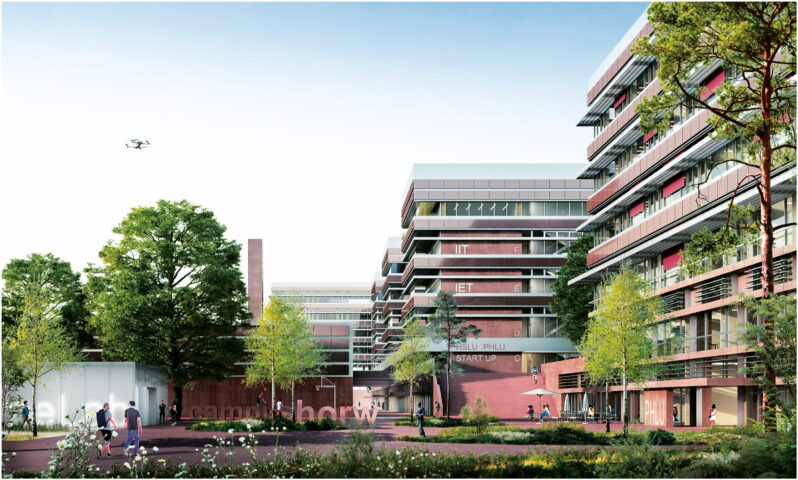
    Der Kanton Luzern zählt immer mehr Studierende – die bestehende Infrastruktur auf dem jetzigen Campus Horw hat ihre Kapazitätsgrenzen aber bereits erreicht und einige Gebäudeteile sind zudem veraltet. Dank den Erneuerungen und Erweiterungen des Hochschulcampus in Horw sollen nach Fertigstellung ab dem Jahr 2029 rund 4000 Studierende und 1000 Mitarbeitende des HSLU-Departements Technik und Architektur sowie der Pädagogischen Hochschule Luzern Platz finden.

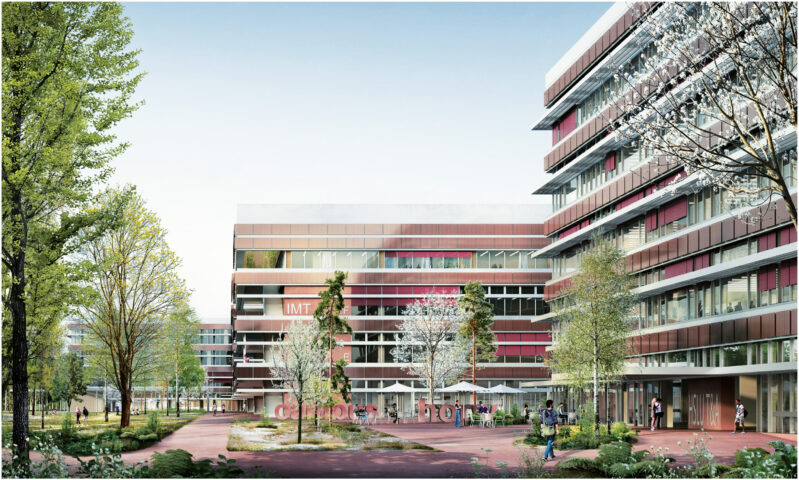
    Die beiden Institutionen bleiben dabei eigenständige Organisationen mit einer je eigenen Identität und mit unterschiedlichen Kulturen. Der Campus lässt diese Diversität zu und ermöglicht eigenständige Auftritte. Trotzdem prägt ihn Gemeinsamkeit nach innen und aussen. Die gemeinsame Nutzung von Räumen und Einrichtungen, überschneidende und komplementäre Lehr-, Forschungs- und Dienstleistungsangebote sowie die zentrale Bewirtschaftung der Campusanlage basieren auf gemeinsamen Abmachungen und bewirken Synergien. Dadurch entsteht für die Pädagogische Hochschule wie auch Technik & Architektur ein qualitativer und ökonomischer Mehrwert.Geplant sind zwei neue Baukörper: Im Norden ein sechsgeschossiges Hauptgebäude der PH Luzern und im Süden ein siebengeschossiger Bau des Departements Technik & Architektur der Hochschule Luzern. Die bestehenden Trakte II, III und IV werden saniert und um ein Geschoss erweitert. Die leicht versetzte Anordnung der neuen Bauvolumen sorgt für eine spannungsvolle Gesamtkomposition auf dem Areal. Den Zuschlag für das Projekt erhielt das Architekturbüro Penzel Valier AG aus Zürich.

    Die neuen Bauvolumen werden leicht versetzt angeordnet.

    Die Architekten haben sich für eine Hybridbauweise aus Beton und Holz entschieden. Für die Erweiterung der Bestandesbauten sowie für die aussenliegenden Raumschichten der Neubauten soll unter anderem heimisches Holz zur Verarbeitung kommen. Dieses verleiht den Unterrichtsräumen eine angenehme und warme Atmosphäre. Die innenliegenden grossen Raumbereiche werden aus Recyclingbeton konstruiert.

    Die Unterrichts- und Büroräume der beiden Neubauten entstehen rund um zentrale Atriumfiguren. Die Räumlichkeiten werden flexibel und an sich verändernde Bedürfnisse anpassbar gebaut. Die Atrien vernetzen die Institute der jeweiligen Schulen untereinander sowie mit den übergeordnet genutzten Sockelgeschossen. Diese sehen gemeinsame Nutzungen für den Gesamtcampus wie Bibliothek, Mensa, Audimax oder Campusaula vor.

    Die rötliche Farbgebung der verschiedenen Fassaden-Elemente setzt die bestehende Tradition und Identität des Campus Horw fort.

    Für die Realisierung des rund 365 Millionen kostenden Projekts sowie für den späteren Betrieb des Campus ist eine eigens dafür gegründete Aktiengesellschaft, die Immobilien Campus Luzern-Horw AG, verantwortlich. Die Realisierung ist ab 2026 vorgesehen. Die etappierte Inbetriebnahme ab 2029.

    Der neue Campus Horw entsteht in Hybridbauweise aus Beton und Holz.
  • BFH-AHB launches minor for a specialisation in studies

    BFH-AHB launches minor for a specialisation in studies

    In future, students at BFH-AHB will be able to deepen and broaden their studies in architecture, wood technology or civil engineering with an interdisciplinary minor. The minors “Circular and Sustainable Construction” and “Integral Digital Construction” are to be understood as minor subjects or small study programmes that provide students with an additional qualification. By choosing the minor, students set an individual thematic focus for their personal, specialised profile.

    Interdisciplinary, forward-looking, networked
    A minor not only increases the individualisation of studies, but also the interdisciplinarity. In the minor, students from the disciplines of architecture, wood technology and civil engineering deal with a current topic in depth across subject boundaries. In exchange with partners from business, research and politics, they look at it from different perspectives. Together, the students from the three disciplines gain new insights and develop solutions for complex future challenges. Last but not least, they gain important experience in interdisciplinary cooperation.

    With the minor, the BFH-AHB prepares students for the working world of tomorrow, because circular and sustainable construction as well as integral digital construction are becoming increasingly important. The collaboration of architects, wood engineers and civil engineers plays a central role here: together they can drive the digital transformation of construction and lead circular, sustainable building projects to success. Students deal with these future topics throughout their studies. In the minor, they delve into them and use the potential of collaboration to responsibly shape the world of construction.

  • Spherical spheres at Expo 2025 in the Swiss pavilion

    Spherical spheres at Expo 2025 in the Swiss pavilion

    From April 13 to October 13, 2025, the next World Expo will take place in Osaka, Japan. Under the motto “Designing Future Society for Our Lives”, Switzerland will present itself as an efficient and leading innovation hub and will show concrete examples from business, science and research. Nüssli, together with Manuel Herz Architekten and Bellprat Partner, won the tender for the design, construction and dismantling of the Swiss presence and is implementing the pavilion in lightweight construction and with a touch of magic. The team is completed by Robin Winogrond Landscape Architects, Studio AA-Morf, and Kyoto Design Lab.

    Swiss ideas, experience and know-how in Japan
    “We are very proud to continue our long tradition as implementation partner of the Swiss Pavilion at Expo 2025 in Osaka. Despite this long Expo experience, however, the Swiss Pavilion with its pneumatic, spherical construction will also provide us with some sticking points,” says Andy Böckli. Stefan Sekiguchi adds: “To successfully realize the architectural design together with Japanese service providers and according to the applicable guidelines in Japan requires getting to know the country and its people. That’s why we work with our local partner and can benefit from valuable knowledge.” Arnau Bellprat is looking forward to the challenges in the global environment. “In our Spheres, visitors should be able to immerse themselves in an immersive, narrative and fantastic world. They should have a sensory and emotional experience that they will remember for a long time – we call it a biographical note.” Architect Manuel Herz is particularly interested in pneumatic construction, which allows for a building of minimal weight and has a long tradition for pavilions at World’s Fairs. “We are taking an architecture that has been used before for iconic Expo buildings and reinterpreting it.”

    Pavilion embedded in nature
    The concept for the Swiss pavilion focuses on sustainability. Spheres and modular structures made of recycled recyclable materials, as well as plants that overgrow, enclose and sequesterCO2 from the building, make up the single-story barrier-free architecture and contribute to a minimal ecological footprint. The scenography takes up the light exterior appearance of the building and stages the contents in the exhibition with light and color. In the five spheres of the pavilion, visitors experience how Swiss innovation is created from the nutrients of nature as well as with Switzerland’s humanistic tradition and a little magic. They can help shape, explore and ultimately take Swiss innovation out into the world in the form of plant seeds. In the pavilion, they will also meet the mythical figure of Heidi, who acts as a link to the host country, Japan. The care and preservation of nature are also important common concerns that link Japan and Switzerland.

    Cooperation and local support
    The topic of sustainability is taken seriously in the Swiss Pavilion and carefully implemented with academic support. With researchers, lecturers and students from the Kyoto Institute of Technology – in particular with the KIT Design Lab of the Faculty of Architecture – the social, economic and ecological footprint of the appearance is to be analyzed and improved over its entire lifespan.

  • Together towards the sun

    Together towards the sun

    2021, Bearth & Deplazes Architects were able to accept this award for a multi-purpose building in Fläsch. This is the third time they have been awarded the prestigious prize, which is given for solar buildings that are convincing from an architectural point of view, take into account the careful use of resources and are designed in such a way that they generate more electrical energy than they use themselves

    The company has been dealing with the subject of energy for over 30 years. For them, it is part of designing and building, just like construction. Their buildings clearly reflect that architecture is more than aesthetics for them. That they are concerned with responsibility towards the place, society and the environment.

    They have proven this in Fläsch. The existing multi-purpose building from the 1970s was converted and extended to include a kindergarten and a community hall. The additional rooms nestle up against the existing building to the north and east and are integrated under the extended roof area. Due to seismic safety requirements, the roof had to be replaced, but its original silhouette and ridge point were retained. The orientation of the roof allowed the use of a large-scale PV system, for which the company Reech was commissioned with the planning and technical construction management. In addition to visual aspects, the company’s main focus was on meeting technical requirements. The “Sunskin Roof” in-roof system from Eternit, developed in Switzerland and manufactured in Austria, not only convinced the PV specialists with its energy efficiency, performance and quality. “The resistant double-glass solar modules can be installed even at flat angles of inclination. In addition, they can be walked on, which brings great advantages when maintaining the system,” explains Tamás Szacsvay, Head of Technology & Engineering and Partner at Reech. He also appreciates the good technical support from Eternit and the comprehensive documentation from which all connection details can be taken directly.

    The installation of the handy modules is also quick and easy, as the flexible installation allows work to be carried out from different sides at the same time

    Eternit (Schweiz) AG works closely with architects and technicians when developing new products. This pays off. In this way, constructive, functional and aesthetic aspects flow into the planning process at an early stage. Since 2010, the company has been applying its know-how specifically to the development of frameless photovoltaic systems that are fully integrated both on the roof and on the façade and replace the conventional building envelope. Thanks to well-designed detailed solutions, they also meet the high aesthetic requirements of architects

    The large-scale Eternit solar roof in Fläsch supplies 179,700 kWh/a, 175% more energy than is required for the building’s own needs. The surplus energy of 114,200 kWh/a is used by the neighbouring clinic, which can cover a third of its energy needs with it.
    Thus, through their clever design, the architects have succeeded in strengthening the local ensemble of school building, clinic and multi-purpose building, while integrating a contemporary solution for energy generation and use that is convincing in terms of design and respects the special nature of this location

    “Of course we have to achieve the energy turnaround,” says Daniel Ladner, who, along with Valentin Bearth and Andrea Deplazes, is the third office partner and overall project manager for the construction in Fläsch. “But not at the expense of the townscape. That’s why the design with energy must always be demanded and coordinated with the operator.”

  • New reuse pavilion at the FHNW Campus Muttenz

    New reuse pavilion at the FHNW Campus Muttenz

    In the spirit of the annual theme "Constructive Futures – Beyond Concrete", the students of the third year course of the bachelor's degree in architecture, under the direction of Professors Ursula Hürzeler and Shadi Rahbaran, dealt with the reuse of components. The starting point for this was the floor-to-ceiling wooden ramp, which was attached to the front facade of the Swiss Architecture Museum S AM as an urban intervention as part of the exhibition "Access for All – Architectural Infrastructure Buildings São Paulo" 2021. This ramp was dismantled again after the end of the exhibition and the components should now be used for a new purpose.

    Architectural competition for students
    For this purpose, an architecture competition was held among the students in the 2021 autumn semester. The task was to design a place to stay in the park that was protected from the wind and sun, for use and free use by the university and the district. The winning project "Silvestris" that emerged from the competition was selected for further development and implementation. The students then developed the design idea together and in the spring semester of 2022 went into more detail in an interdisciplinary elective course. At the same time, the structural design, the static dimensioning, the development of the node connections and the execution planning were carried out by the Institute of Civil Engineering under the direction of Prof. Dr. Simon Zweidler, head of the construction laboratory. From the design to the manufacture of all steel nodes, digital fabrication was used in a pioneering way: After the complete 3D modeling, the surfaces required for the fold were calculated by software and the developed surface was cut from the solid sheet by laser; the subsequent three-dimensional bending was also carried out fully automatically.

    Static Challenges
    In the course of this detailed planning, various structural and static challenges had to be mastered. The limits of the reusability of components also became apparent; In this specific case, the old wood did not have the strength required for the new arena and the planned intensive use and duration. This led to the decision to build the statically relevant components with construction wood intended for this purpose with the appropriate strength and to use some of the old wood for secondary components. This resulted in a valuable learning process regarding the complexities and challenges of reusing components. However, the original structure of the ramp is still reflected in the dimensions of the elements and the shape of the new arena.
    The arena created in this way should offer various possible uses. The roof made of light fabric creates a shady place to stay, which can not only be used for teaching and teaching at the university, but also provides space for performances and also invites residents in the neighborhood to use and help shape it. The winning project and all other project proposals developed by the students are also on public display in an exhibition in the porch of the campus building.

  • Nüssli expo pavilions have received numerous awards

    Nüssli expo pavilions have received numerous awards

    Despite the pandemic, the Nüssli project teams built ten country pavilions for the Expo in Dubai on time. As the company has now announced , they have received numerous nominations and a total of 23 awards.

    Five pavilions have been nominated for one of the Expo’s governing body’s prestigious BIE (Bureau International des Expositions) awards . The German and Kazakh received gold and silver in the Theme Interpretation category. The Japanese Expo building also won gold in the Exhibition Design category. Silver and bronze in the architecture category went to Austria and China. The pavilions of Belarus, Germany, Kazakhstan and Luxembourg received one, and the Japanese pavilion even two Honorable Mentions in the various categories.

    With its unusual and sustainable architecture, the Austrian Pavilion attracted a lot of attention. It also won the renowned Global Architecture & Design Award 2021 , the BLT Built Design Award 2021 , the Austrian Green Planet Building Award and the German Design Award 2022 .

    According to the information provided, the Austrian pavilion consumed 70 percent less energy than comparable buildings. The structure and facade of the Kazakh building can be largely recycled. And when the Baden-Württemberg house was built from wood, 200 tons of CO2 could be saved compared to conventional steel structures. According to Nüssli, these three examples are “exemplary for the innovation and sustainability of Nüssli’s pavilion range.

  • ETH Professor Kaijima receives Wolf Prize

    ETH Professor Kaijima receives Wolf Prize

    Professor of Architectural Behaviorology at the Swiss Federal Institute of Technology in Zurich ( ETH ), Momoyo Kaijima, and her partner Yoshiharu Tsukamoto have been awarded this year’s Wolf Prize for Architecture. Tsukamoto is a professor at the Tokyo Institute of Technology. Both run the Atelier Bow-​Wow together. According to the ETH media release , the jury chose the works of both professors as prizewinners because of their great sensitivity to local contexts and the social effects of architecture.

    The Wolf Prize has been awarded to scientists and artists by the Israel-based Wolf Foundation since 1978. Merits for the benefit of mankind and friendly relations between peoples are honored. According to the ETH announcement, former award winners in the architecture category include Frank O. Gehry, Jean Nouvel, Peter Eisenman and David Chipperfield. Momoyo Kaijima is only the third woman to receive the Wolf Prize for Architecture.

    After various guest professorships. at Harvard University, the Royal Danish Academy of Fine Arts and Columbia University, among others, Momoyo Kaijima came to ETH Zurich in 2017, where she established the Chair of Architectural Behaviorology.

  • New professor for analysis, design and construction brings future-oriented impulses

    New professor for analysis, design and construction brings future-oriented impulses

    From March, Friederike Kluge will be moving from the University of Applied Sciences in Konstanz to the University of Applied Sciences Northwestern Switzerland FHNW and is looking forward to this new challenge: “I’m interested in the question of what building will look like in the future. The status quo cannot work in the long term. My hope and my goal are therefore to find solutions in research and together with the students as to how we can design construction in the future. Climate-neutral and climate-positive construction must be approached in a focused manner, always taking biological diversity into account. In the first year, for example, the aim is to introduce young people to the field of architecture, to convey the basic topics to them and still leave room for development and creativity. I am interested in this tension between fixed, e.g. physical quantities, which are irrefutable, and change, which is essential for a sustainable future, and I look forward to researching and developing this further at the FHNW together with my colleagues. Always with the goal of creating architecturally high-quality buildings»

    Friederike Kluge studied architecture at the University of Karlsruhe and gained initial teaching experience at the Professorship for Building Theory and Design, Prof. Daniele Marques, and at the Institute for Fine Arts, Prof. Stephen Craig. In addition to studying architecture, she completed the interdisciplinary accompanying course “Applied Cultural Studies” with the aim of designing buildings that bring together the knowledge of many subjects and at the same time have their own unmistakable character.

    During her five years at Buchner Bründler Architects in Basel, she was able to work, among other things, on the Swiss Pavilion for the Expo in Shanghai 2010 and as project and site manager on the «Bläsiring» residential building in Basel.

    Self-employed since 2012, she founded the «Alma Maki» office in Basel together with Meik Rehrmann at the beginning of 2014. Together they share the view that architecture gains if it represents a holistic process from the first sketch to the completion of construction and the basic architectural idea is still recognizable in the details. In order to be able to control this as best as possible, the office also implements the planned projects manually whenever possible and was awarded first prize in the “Swiss Foundation Award” for this approach in 2018.

    Since 2013, Frederike Kluge has been conveying her belief in conceptual, design, performance and built stringency, among other things as part of a teaching assignment at the Professorship for Architecture and Construction, Annette Spiro, ETH Zurich and since 2019 at the HTWG Konstanz, where she teaches the subjects of building construction and design consistently focused on the topic of sustainable building. For example, she organized a workshop entitled “The architectural detail in times of climate crisis”. As a result, the group “Countdown 2030” was founded. The founding idea was to develop a guide and to install a countdown clock above the architecture museum, which would sensitize the architecture industry to take bold measures in architectural practice and to develop a sustainable building culture. The group now has over 50 active members, organizes workshops, panel discussions and exhibitions, is active on juries and municipal committees, publishes articles on various topics in specialist journals and has been awarded the “Factor 5 Audience Prize” for its work and has been nominated for awarded the Swiss Art Award.

    The Institute of Architecture is extremely pleased that such a committed and future-oriented personality could be won.

    source

    University of Applied Sciences Northwestern Switzerland FHNW
    University of Architecture, Civil Engineering and Geomatics www.fhnw.ch/habg