Tag: Architektur

  • University of Applied Sciences on the way to the future

    University of Applied Sciences on the way to the future

    Die Fachhochschule Graubünden (FHGR) – die achte öffentlich-rechtliche Fachhochschule der Schweiz – ist heute auf fünf Standorte in neun Gebäuden innerhalb der Stadt Chur verteilt. Die Anzahl Studierender sowie das Forschungsvolumen der FHGR nehmen weiterhin zu. Die bestehenden Standorte bieten zu wenig Räumlichkeiten und Ausbaumöglichkeiten, um die Hochschule in Zukunft optimal aufzustellen. Bislang fehlt beispielsweise der Raum für den Austausch zwischen den Disziplinen sowie für die informelle Kommunikation zwischen den Studierenden und den Dozierenden. Darüber hinaus sind derzeit zu wenige studentische Arbeitsplätze vorhanden, die den heutigen Anforderungen genügen. Durch die Verteilung der Gebäude über die Stadt fehlt der Hochschule zudem die architektonische Visibilität.

    Aus diesen Gründen hat der Kanton Graubünden entschieden, das Fachholschulzentrum am Standort Pulvermühle neu zu erstellen. Hier befindet sich seit 1993 der Hauptsitz der FHGR. Der Neubau soll ein zusammenhängendes Bildungs- und Forschungszentrum ermöglichen, das von der Diversität und interdisziplinären Zusammenarbeit aller Organisationseinheiten lebt. Die Projektleitung wurde dem Hochbauamt Graubünden übertragen. In einem Wettbewerbsverfahren wurde aus den 57 eingegangenen Bewerbungen ein Generalplanerteam selektioniert, welches die Vorgaben und Ziele der Regierung bezüglich Funktionalität, Ortsbau und Architektur überzeugend umsetzt und die Realisierung in der geforderten Qualität und Wirtschaftlichkeit sowie unter Einhaltung der Kosten- und Terminvorgaben garantieren kann.

    Das Siegerprojekt überzeugt mit Nachhaltigkeit und Funktionalität
    Die Entscheidung fiel auf das Team rund um das Projekt «Partenaris». Den Lead übernimmt dabei das Zürcher Architekturbüro Giuliani Hönger Architekten. Überzeugt hat das Projekt die Jury durch die gleichmässige Berücksichtigung der Kriterien Architektur, Tragwerk, Nachhaltigkeit und Funktionalität. «Partenaris» sieht eine städtebauliche Positionierung des Neubaus vor – unter Einbezug der bestehenden Gebäude und durch die sorgfältige Gestaltung eines parkähnlichen Aussenraums. So wird ein attraktives Hochschulareal geschaffen. Die Planung berücksichtigt ausserdem die gewünschte Nutzungsflexibilität.

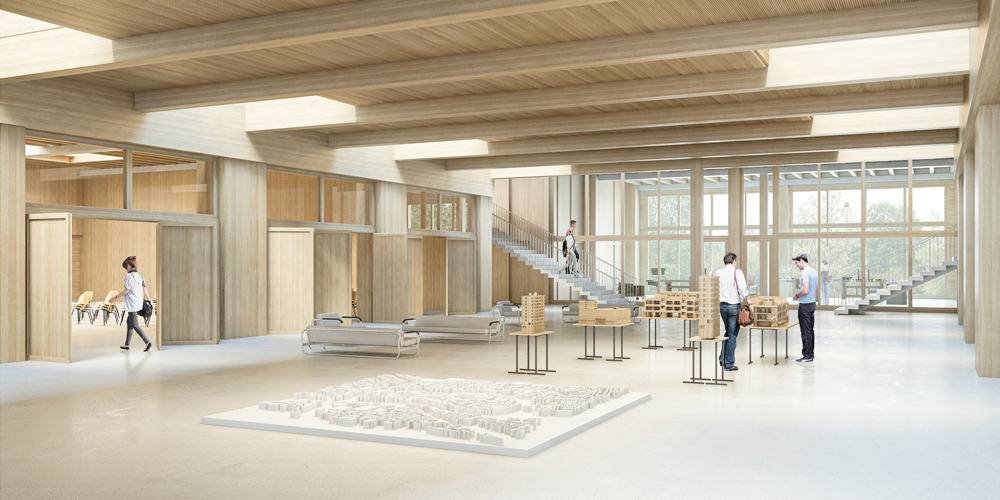
    Die erste Etappe sieht einen viergeschossigen U-förmigen Baukörper mit einer zentralen, rund 1200 Quadratmeter umfassenden Eingangshalle vor. Dabei öffnen sich die drei Gebäudeflügel nach Süden zur Pulvermühlestrasse hin und interagieren mit den bestehenden Gebäuden. Der Neubau wird als Hybrid-Skelettbau ausgeführt.

    Mittels Passerelle wird es mit dem Neubau verbunden. Die Obergeschosse sind für Nutzungen der Institute und Departemente vorgesehen, wobei der Öffentlichkeitsgrad und damit die Publikumsintensität mit jedem Stockwerk abnimmt. Das Raumprogramm wird mit vergleichsweise wenig Geschossfläche flächeneffizient umgesetzt. Dank der strukturierten Bauweise und ressourcenschonenden Materialisierung können die Werte bei der Grauen Energie auf einem guten Niveau gehalten werden. Im Westen entsteht zudem eine neue Terrasse. In der zweiten Etappe wird das bestehende Gebäude P57 in Richtung Westen erweitert.

    Aus Sicht des Kantons Graubünden ist die Realisierung des Fachhochschulzentrums hinsichtlich Bildung, Forschung und auch innovationspolitisch von grosser Wichtigkeit. Denn der Mangel an Fachkräften, insbesondere in den technisch-naturwissenschaftlichen Disziplinen, hat Auswirkungen auf die Bündner Unternehmen: Diesen fehlen das nötige Wachstum und die gewünschte Entwicklung. Die neue Fachhochschule soll junge Leute ausbilden, fördern und damit die Wettbewerbsfähigkeit der Bündner Volkswirtschaft stärken.

    Das Siegerprojekt wird in einem nächsten Schritt planerisch weiterbearbeitet. Danach muss es vom Grossen Rat genehmigt werden. Erhält «Partenaris» grünes Licht, soll Ende 2024 mit den Bauarbeiten begonnen werden. Im Jahr 2028 soll der Neubau bezugsbereit sein. Der Studienbetrieb läuft während den Umbauarbeiten weiter wie gewohnt.
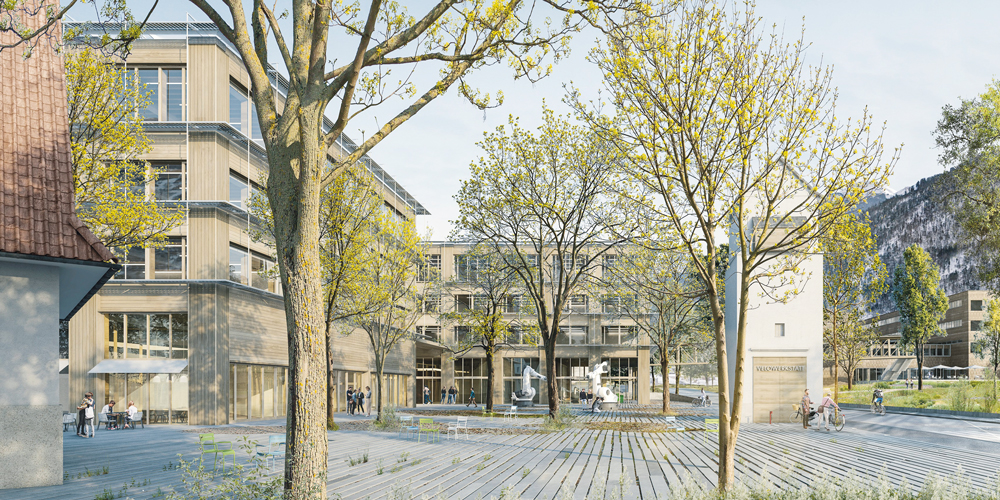
    Die Visualisierung zeigt den zukünftigen Campusplatz.
    So soll das Foyer des Neubaus dereinst aussehen.
  • FHNW gets professor for circular building

    FHNW gets professor for circular building

    For the Institute of Sustainability and Energy in the building of the University of Architecture, Building and Geomatics of the FHNW , circular economy is an important part of environmentally and resource-saving construction. In order to further develop research and education in the areas of energy-efficient and climate-neutral building, integral building technology, sustainable building and operation, resource-efficient and circular building as well as health aspects in buildings, the institute is establishing the professorship of circular building. The architect Andrea Klinge is to take over the corresponding chair.

    Klinge studied architecture at the Technical University of Berlin, the FHNW informs in a message about the new professorship. After further training in sustainable building at the London Metropolitan University, the designated professor worked in various architecture offices in London, Rome and Berlin. Klinge is currently active at ZRS Architekten Ingenieure Berlin. The architect and trained carpenter have established a research department here, according to the announcement.

    In her new position, Klinge wants to tackle “the current challenges in the construction sector”. "This is one of the most resource-intensive economic sectors in the world and contributes significantly to climate change," the professor-designate is quoted in the press release. “In order to meet the Paris climate goals, we urgently need consistent approaches that implement the necessary building turnaround in the construction sector.” According to Barbara Sintzel, Head of the Institute for Sustainability and Energy in Construction, Klinge “has specialist expertise in the use of ReUse components and renewable building materials to help achieve a breakthrough in practice with applied research and thus make the building turnaround possible ”.

  • ETH robots build hanging gardens for Zug

    ETH robots build hanging gardens for Zug

    The Tech Cluster Zug will have hanging gardens based on ancient models. The planted architectural sculpture intended for this purpose bears the name Semiramis. It is 22.5 meters high and consists of five differently sized and geometrically complex wooden bowls that are placed one on top of the other. A video presented in a media release from ETH shows how these are supported by eight slender steel supports.

    Researchers from the group of ETH architecture professors Fabio Gramazio and Matthias Kohler design and create Semiramis together with Müller Illien landscape architects , the timber construction engineers from Timbatec and other partners from industry and research. The design options come from a machine learning algorithm that was developed in collaboration with the Swiss Data Science Center .

    “The computer model enables us to reverse the conventional design process and to explore the entire scope for designing a project,” Matthias Kohler, Professor of Architecture and Fabrication at ETH Zurich, is quoted as saying. In the Immersive Design Lab , an ETH laboratory for augmented reality, the researchers were able to explore the designs in three dimensions. A software developed jointly with the Computational Robotics Lab at ETH allowed the designs to be modified. According to Kohler, this lighthouse project in architectural research is driving “key research topics such as interactive architectural design and digital fabrication”.

    The Semiramis sculpture is currently being built by four cooperating robotic arms in the robotic production laboratory at ETH Zurich. An algorithm prevents collisions if you each lift one of the wooden panels and place them in the room at the same time. The robots relieve humans of the heavy lifting and precise positioning. They also make complex scaffolding unnecessary.

    The individual shell segments each consist of 51 to 88 wooden panels. When one of them is ready, it is transported to Zug by truck. Semiramis is to be erected and planted in spring 2022.

  • EPFL exhibits Design Brain in Seoul

    EPFL exhibits Design Brain in Seoul

    The Media x Design Laboratory of the Swiss Federal Institute of Technology in Lausanne ( EPFL ) is currently exhibiting a larger-than-life design brain in the South Korean capital. The exhibit called Artificial Swissness can be seen until October 31 at the Seoul Biennale for Architecture and Urbanism .

    According to a communication from EPFL, Artificial Swissness aims to extend the epistemology of computer science to the cultural field. “Our design brain is an experiment on the question of whether machines can design structures,” laboratory director Professor Jeffrey Huang is quoted as saying. “That means whether they can not only recommend music or drive cars, but also create meaningful cultural artefacts, such as architecture with distinctive Swiss characteristics.”

    As the message goes on to say, the exhibit should be a constantly changing spatial interface that represents the inner thoughts of an artificial intelligence machine that has been trained on 10,000 images of Swiss chalets and alpine architecture. “We make the visual interferences in these layers of the neural network visible,” say the two EPFL students Frederick Kim and Mikhael Johanes. “This gives us an insight into the inner workings of our generative artificial network that creates architectural images.” The two of them set up the installation in Seoul after a 14-day quarantine.

    The digital screens of the installation show the machine-generated images of typical Swiss architecture. At the same time, an LED projection reveals the constantly evolving learning process that the machines go through while they sift through thousands of images of alpine architecture in order to distill the essence of “Swissness”.

  • Artwork produces solar power

    Artwork produces solar power

    Solar cells can also decorate buildings as objects of art. This is shown by a project that has now been implemented at the NEST research building of the Eidgenössische Materialprüfungs- und Forschungsanstalt ( Empa ) and the EAWAG water research institute. The facades of the building have been fitted with photovoltaic modules, which together result in a work of art.

    To this end, Empa implemented the project called Glasklar, on which it worked together with Zug Estates and students and lecturers from the two departments of Design & Art and Technology & Architecture at the Lucerne University of Applied Sciences and Arts. The latter designed photovoltaic modules in a two-week block event, which visually match the NEST building as design objects. The design was implemented by textile design student Lynn Balli. It was selected for use in the NEST building in an interdisciplinary design competition.

    “If we can arouse the interest of designers in the design of building-integrated photovoltaic modules, we will make an important contribution to greater acceptance of photovoltaic facades and thus promote the expansion of renewable electricity production in Switzerland,” says Björn Niesen, NEST innovation manager Message from Empa quoted.

  • FHNW trains in geodata analysis

    FHNW trains in geodata analysis

    The FHNW University of Architecture, Building and Geomantics will be offering a certificate course in spatial data analytics at its location in Olten from January. This is intended to enable specialists from the fields of data science, transport, logistics, spatial planning as well as natural and environmental sciences to digitally plan the cities of the future and evaluate the data from infrastructures. The university is responding to a need in the construction and planning industry, according to its media release .

    The Certificate of Advanced Studies (CAS) Spatial Data Analytics is intended to impart the knowledge required to model, process and interpret geodata in a targeted manner in 16 course days and in cooperation with experts from the field. For this purpose, “a balanced mix of lectures, case studies, group work and practical exercises” is planned, according to the FHNW. In addition, time blocks are planned for self-study.

    “The question of where spatially measurable events take place is no longer sufficient,” says Prof. Dr. Pia Bereuter quoted in the communication. “In the future, we also need to understand why these happen. This requires well-founded analysis processes that are integrated into the digitization strategy of companies or organizations. “This expertise represents the basis for decisions with spatial reference” in almost every industry “.

  • Student creates concept for Bündner Crotti

    Student creates concept for Bündner Crotti

    Lucas Buschauer has received recognition from the Swiss Association of Engineers and Architects ( SIA) for his semester thesis. This has the technical college Grisons now informed . The graduate of architecture studies at the University of Applied Sciences in Graubünden is planning a revival as a brewery for some unused Crotti in Bondo in Graubünden.

    The SIA specialist group for the preservation of buildings awards diploma and semester theses throughout Switzerland that present outstanding concepts for the exemplary handling of existing buildings and their preservation. This year a total of eleven works were selected.

    Buschauer's semester thesis provides for the renewed use of some Crotti that were spared from the landslide in 2017. These little houses on the shady hillside were once used as natural refrigerators. He wants to convert it into a brewery and a meeting place for the village. Different uses are planned for the individual Crotti. For example, the first crotto would catch the spring water flowing by, and two more would be converted into malthouses. Four of these crotti are intended for the brewing process. He has also planned an inn and a master brewer's apartment.

    "Lucas Buschauer's semester thesis impresses with its careful research, a captivating concept idea, which was implemented carefully and in detail and is presented convincingly," said the jury's explanation. As head of the study Christian Auer emphasizes, in addition to the architectural design, “the clarification of constructive and economic issues is one of the educational objectives of our architecture course. It was precisely this know-how that was required for this task. I am very pleased that the Graubünden University of Applied Sciences is competitive throughout Switzerland with its range of courses. "

  • JED wins design award

    JED wins design award

    The real estate development JED in Schlieren was able to convince in an international architecture competition. She received the Silver Award at theA 'Design Award and Comeptition . As part of the global competition, 2094 winners from 108 countries and in 104 design disciplines were chosen.

    JED was honored for its interior design, according to a message from real estate developer Swiss Prime Site on LinkedIn. In addition to Swiss Prime Site, the Zurich architecture firm Evolution Design is behind the design.

    JED was created on the former printing center of the “Neue Zürcher Zeitung” in Schlieren. The development offers space for workplaces and events. JED sees itself as a “center for knowledge transfer, innovation and entrepreneurship”.

    "The project shows how industrial premises can be transformed into attractive destinations that revitalize local (economic) activities and create a platform for entrepreneurship," said the jury of the A 'Design Award and Competition. The architectural concept emphasizes the special features of the individual halls and gives the original structure a contemporary profile. The jury also praised the rooms in such a way that they enable knowledge transfer, creativity and innovation.

    The aim of the A 'Design Award and Competition is to make special architectural projects from all over the world known. This is intended to inspire new projects.

  • ETH students create innovative bamboo pavilion

    ETH students create innovative bamboo pavilion

    Students in the master’s course in Advanced Studies in Architecture and Digital Fabrication at ETH have created a bamboo pavilion weighing just 200 kilograms and 40 square meters, the ETH informs in a message . For the design of the innovative pavilion, its creators developed their own digital design tools. In addition to the renewable raw material bamboo, recyclable plastic was also used in the production. All connecting pieces and shading elements were created using 3D printing.

    "The building system developed for this project aims to reduce the logistical effort of building and at the same time to use the advantages of digital production for a more sustainable building culture", Marirena Kladeftira, doctoral student at the Professorship of Digital Building Technologies at ETH, is quoted in the communication . Despite their complicated geometry and their high tolerance requirements, the tailor-made connection pieces can be 3D printed anywhere in the world due to their small size, explains the ETH. The shading elements made of recyclable plastic and Lycra textile can also be produced using 3D printing.

    “This construction method could therefore be used wherever bamboo is available and should be built inexpensively,” writes the ETH. In addition, the modular structure allows the building to be assembled and dismantled quickly. The students' bamboo pavilion was set up in Zurich within 48 hours and dismantled again in the same period of time.

  • UZH gets new center for dentistry

    UZH gets new center for dentistry

    The jury has decided: According to a statement, the new Center for Dentistry (ZZM) at the University of Zurich is to be built according to the plans of the Boltshauser Architects / Drees & Sommer consortium. 46 teams had applied for the architectural competition, 15 had been admitted. Now the winning project “Light Rack” is being further developed under the direction of the UZH together with the building department. A preliminary project that is eligible for approval is to be submitted to the government and cantonal council by 2023.

    The five-storey new building will house the seven clinics and institutes of the ZZM. If everything goes as planned, the new building should be ready for occupancy in 2029. It will be located on what is now the children's hospital in Zurich (Kispi) in Hottingen. The Kispi is expected to move to a new building in Lengg in 2022. François Chapuis, Director of Real Estate and Operations at UZH, is quoted in the press release.

    The new ZZM building is designed as a hybrid structure made of wood and concrete. "The UZH deliberately relies on wooden hybrid buildings in order to improve the CO2 balance," said Chapuis in the press release. The planning provides for a planted inner courtyard and an atrium in the entrance area. The facades and roof are to be equipped with photovoltaic elements and the roof is to be planted with a variety of species. A large part of the energy consumption is to be covered with renewable energies.

  • Dietikon chooses architecture project for school expansion

    Dietikon chooses architecture project for school expansion

    The winner in the architecture competition for the expansion of the Wolfsmatt school complex in Dietikon has been determined. The Zurich architectural office Bünzli Courvoisier was awarded the contract by the Dietiker city council. On the one hand, according to the media release, the design “In the green” was convincing by retaining the basic idea of a pavilion school with arcades between the units and a structurally enclosed playground. On the other hand, the offer was also among the cheapest, it is said.

    The school house expansion has become necessary because of the increasing number of students. The Wolfsmatt facility was built in 1962 and has become too small. Today, according to the announcement, it has to be expanded to include two more primary class trains, group, daycare and multi-purpose rooms as well as a gym. The extensions will be built to the south of the existing facility. This should also create a new access. From a landscape point of view, the current figure of pavilion buildings and surrounding open spaces will be preserved and logically supplemented, according to the announcement.

    The contract for the general planning team under the leadership of Bünzli Courvoisier Architekten AG is to be awarded in a referendum in 2022. If approved, construction is to begin in 2024. The model for the project can be viewed in the foyer of the town hall from now until February 12th.

  • New Chinese city should be completely self-sufficient

    New Chinese city should be completely self-sufficient

    The Barcelona-based architectural firm Guallart Architects has won the tender for the planning of the new Chinese city of Xiong'an. It should be resilient and 100 percent self-sufficient. According to the will of the Chinese President, it should become the “new standard for the post-COVID era”.

    According to an article by the Thomson Reuters Foundation , Xiong'an is being conceived as a self-sufficient city that produces its own energy, food and other resources. It will have rooftop farms and greenhouses, drone-friendly terraces and shared 3-D printers. In addition, apartments are planned with space for home offices so that their residents can work from home in the event of future pandemics. The city's eco-friendly design includes blocks of flats made from cross-laminated timber, renewable energy and streets reserved exclusively for pedestrians and cyclists.

    "We can no longer design cities and buildings as if nothing had happened," Vincent Guallart, founder of Guallart Architects and former chief architect of the city of Barcelona, is quoted in the article. “Our proposal arises from the need to find solutions to the different crises that are playing out on our planet at the same time. They are supposed to create a new kind of urban life based on a biological circular economy. That will make cities and municipalities stronger. "

    The present draft was strongly influenced by the experiences of the team of architects during the lockdown in Spain. “We wanted to make a case for the things that we think are important during a lockdown and in the future. If apartments enable teleworking and tele-teaching, have flexible rooms on large terraces, cities can grow food on their roofs and residents can print things in the neighborhood, we will be better prepared for the crises of the future. "

    Xiong'an is being built in Hebei Province, around 130 kilometers southwest of Beijing. According to the article, China's President Xi Jinping has described it as the "new standard for the post-COVID era". He marked Xiong'an as an urban innovation zone back in 2017.