Tag: Energie

  • Empa-Forschende entwickeln Energiesparriegel für Fenster

    Empa-Forschende entwickeln Energiesparriegel für Fenster

    Forschende der Eidgenössischen Materialprüfungs- und Forschungsanstalt (Empa) haben eine neuartige Wärmedämmung für Fenster entwickelt. Laut Medienmitteilung ist der Dämmsteg eine Art Sandwich, mit einer umweltfreundlichen Füllung. Im Inneren befindet sich aus wiederverwerteten PET-Flaschen geformter Schaumstoff mit mikroskopisch kleinen Luftbläschen. Dieser sogenannte gefüllte Energiesparriegel für Fenster hat einen sehr hohen Wärmedämmwert.

    Entwickelt wurde der Riegel von einem Empa-Team um Michel Barbezat und Giovanni Terrasi von der Abteilung Mechanical Systems Engineering zusammen mit Experten des Metallbauunternehmens Hochuli in Wigoltingen TG. Frank Hochuli hat für das Vorhaben eigens die Tochterfirma hochuli advanced gegründet. Hochuli bietet den Dämmsteg unter dem Markenzeichen Alpet an. Verglichen mit heutigen hochwertigen Ausführungen liesse sich die Wärmdämmung, etwa in einem neuen Bürogebäude, durchaus um bis zu einem Fünftel verbessern, wird Frank Hochuli zitiert.

    Das neue Produkt ist von den Empa-Forschenden auf Verschleissfestigkeit bei Dauerbeanspruchung wie auf die Eigenschaften der Wärmedämmung geprüft worden. Eine weitere Prüfung des neuartigen Dämmstegs ist beim Prüfinstitut ift im bayerischen Rosenheim vorgenommen worden. Das ift gilt laut der Medienmitteilung in der Branche seit Jahrzehnten als Referenz. Die Fachleute dort setzten laut der Empa-Mitteilung die Prototypen auch Brandversuchen, Bruchtests und anderen Belastungen aus, wie auf nicht sichtbare Mikrorisse nach 1000-stündiger Lagerung in Öl oder leichter Säure oder nach starkem Zug in Querrichtung.

    Nach Angaben von Frank Hochuli liegen offizielle Zertifizierungen zum Brandverhalten und zur statischen Belastbarkeit vor. Das Attest zur Wärmedämmung steht noch aus.

  • Sonnenenergie ist um fast 50 Prozent gewachsen

    Sonnenenergie ist um fast 50 Prozent gewachsen

    Die Statistik Sonnenenergie 2020 des Schweizerischen Fachverbands für Sonnenenergie, Swissolar, belegt, dass der Photovoltaikzubau in der Schweiz gegenüber dem Vorjahr um 48 Prozent gestiegen ist. Damit ist ein Rekordwert von 493 Megawatt erreicht. Die Leistung von nahezu 3 Gigawatt deckte 4,7 Prozent des Strombedarfs im Land.

    Laut einer Medienmitteilung von Swissolar sind die Zuwächse bei Anlagen auf Industrie-, Gewerbe- und Dienstleistungsbauten sowie bei Photovoltaik (PV)-Anlagen über 100 Kilowatt besonders hoch. Die durchschnittliche Anlage war 24,5 Kilowatt gross. Im Vorjahr waren es noch 22,5 Kilowatt. Rund 15 Prozent der PV-Anlagen auf Einfamilienhäusern werden mit einem Batteriespeicher kombiniert. Deren Verkaufszahl wuchs gegenüber dem Vorjahr um 65 Prozent.

    Weltweit wurden im vergangenen Jahr 18 Prozent mehr Gigawatt PV-Leistung installiert als im Vorjahr. Die jährliche Stromproduktion entspricht etwa der von 115 Atomkraftwerken (AKW) von der Grösse Gösgens. Sie deckte 3,7 Prozent des weltweiten Strombedarfs. Gemäss Swissolar-Statistik ist alle 20 Tage die Produktionskapazität eines AKW hinzugekommen.

    Der Verkauf von Kollektoranlagen zur Nutzung der Solarwärme ist um rund 18 Prozent gesunken. Gründe seien unter anderem in der Dominanz von Wärmepumpen im Neubau und bei Heizungssanierungen zu suchen.

    Für die Dekarbonisierung des Energiesystems und für den Ersatz von Atomkraft bedarf es laut Swissolar eines massiven Ausbaus der Solarenergie auf rund 50 Gigawatt, mit einer jährlichen Stromproduktion von 45 Terawattstunden. Dazu müsste die Schweiz jährlich etwa 1500 Megawatt zubauen. Das entspreche dem Dreifachen des jetzigen jährlichen Zubaus.

    Doch gemäss der bundesrätlichen Botschaft vom 18. Juni zum Bundesgesetz über eine sichere Stromversorgung mit erneuerbaren Energien solle dieser Zubau von 2023 bis 2035 lediglich bei 700 Megawatt pro Jahr liegen. Ausserdem enthalte die Gesetzesvorlage Elemente, die den weiteren Ausbau der Solarenergie gefährden.

    „Das Parlament muss hier rasch korrigieren“, fordert Swissolar. Als Wegweiser könne der Beschluss des österreichischen Parlaments dienen, bis 2030 eine hundertprozentig erneuerbare Stromversorgung zu erreichen. Ausserdem sei „auf unverantwortliche und den Volkswillen missachtende Bestrebungen zur Verlängerung der AKW-Laufzeiten zu verzichten“. Nach dem knappen Nein zum CO2-Gesetz sei es nun an den Kantonen, den Ausstieg aus Öl und Gas in Gebäuden zu betreiben.

  • Hibernate with solar power

    Hibernate with solar power

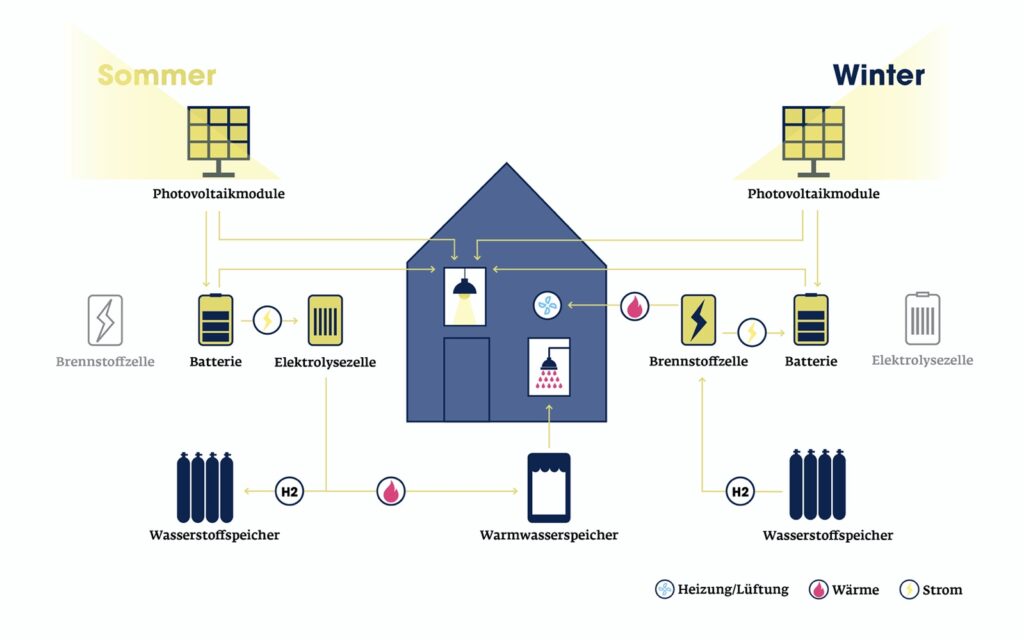
    Buildings are increasingly becoming small power plants, since photovoltaic modules capture solar energy on more and more roofs. But the sun doesn't always shine and the demand for electricity fluctuates greatly over the year. Storage technologies are therefore in demand. Geothermal probes provide heat in winter, but no electricity. Batteries, on the other hand, make technical sense, but they are short-term storage devices and therefore not seasonal electricity storage devices. With the Seebrighof development in Hausen am Albis, the electricity works of the canton of Zurich are therefore taking a different, new approach. The 28 apartments in the attached farmhouse and the new building draw solar energy from the roof of the house. So that this is also available in winter, EKZ is installing a hydrogen storage facility – one of the first of its kind in Switzerland.

    If, on summer days, the solar system delivers more electricity than the residents consume, it does not get back into the grid. Instead, the power-to-gas plant uses it to make hydrogen. In winter, when the energy requirement is higher, the system converts the hydrogen back into energy. "In the fuel cells of the plant, around 55 percent of this electricity is generated," explains Georg Putzi, Product Manager Energy Contracting at EKZ. The remaining 45 percent of the stored energy escapes as waste heat, which heats the building.

    Seasonal electricity storage offers several advantages. The system is environmentally friendly because it only needs tap water and locally produced solar power. The public power grid is relieved. A battery compensates for short-term fluctuations, so the P2G system can be operated more efficiently.

    In summer, the power-to-gas system uses solar energy to make hydrogen; in winter, it converts it back into energy.

    The system in Hausen am Albis is based on a standardized concept that EKZ developed. This makes the technology cheaper, more adaptable and scalable. It can also be used for larger residential complexes or retrofitted in old buildings. "If there is already a solar system with an association for self-consumption (ZEV), the hydrogen technology can be supplemented," says Putzi. The technology can also be easily combined with heat pump systems, as in Hausen am Albis. In winter the environment supplies the heat (e.g. geothermal probes, groundwater or air), the hydrogen storage system supplies the electricity.

    The P2G system has no particular influence on the building services; it just needs space near the heating center. In contrast, the gas storage facility is architecturally relevant. For safety reasons, it must be positioned outside the building so that the volatile hydrogen can escape in an emergency. The gas storage consists of gas cylinders, which are grouped as a bundle and covered with a housing that the architects can adapt.

    With the system, the client increases the energy self-sufficiency and saves electricity costs in winter. "The P2G system is currently not yet cost-covering," says Georg Putzi. If the electricity prices rise in the future and the costs for the system fall, it will become significantly more economical. “Such pioneering work is important in order to gain experience and develop the market further,” says Putzi. Switzerland currently imports a lot of electricity in winter. If Germany switches off the coal-fired power plants, the winter shortage will be even greater. Storage technologies based on gases and liquids are therefore given high priority in the Federal Council's Energy Strategy 2050. With a P2G system, the buildings can help alleviate the challenges in terms of power supply in winter.

  • Swissolar calls for a faster pace of solar expansion

    Swissolar calls for a faster pace of solar expansion

    The expansion of solar systems in Switzerland in 2020 was around 30 to 39 percent higher than in the previous year and thus at a record level. That is at least the estimate of the Swissolar association based on the figures already available on the statistics for solar energy 2020, which will be published in July.

    In a communication on the occasion of the National Photovoltaic Conference in Bern, Swisssolar points out that the pace of the expansion must be further accelerated. The Federal Council's Energy Perspectives 2050+ anticipate annual solar power production of 34 terawatt hours by 2050. Swissolar would even aim for 45 terawatt hours. However, the annual expansion for both goals must be increased by a factor of three to four compared to the previous year, according to Swissolar.

    According to Swissolar, the framework conditions would also have to be optimized for a faster pace of expansion. According to the association's assessment, the expansion of photovoltaic systems in Switzerland will mainly take place on the roofs and facades of buildings. An evaluation by Swissolar shows that small and medium-sized systems of less than 150 square meters on the roofs of single and multi-family houses hold almost half of the “easily accessible” solar potential. The association therefore demands that investment security should be created for these systems as a priority. In the medium term, the winter production of electricity is likely to become increasingly important. According to the association, alpine solar systems in particular are likely to play an important role here.

  • Army real estate only uses renewables

    Army real estate only uses renewables

    The properties of the Federal Department of Defense, Civil Protection and Sport (DDPS ) used by the armed forces only use electricity that is generated from renewable energies, especially hydropower, the DDPS informs in a message on the current sustainability report of the Federal Office of Armaments (armasuisse ). According to her, the CO2 emissions caused by the VBS properties have also been significantly reduced compared to the previous year. Specifically, 36,600 tons of CO2 were emitted last year.

    The current sustainability report shows "how armasuisse real estate builds resource-intensive military infrastructures sustainably and operates them economically over the entire life cycle," the press release goes on to say. The report also provides important key figures. One example is the share of expenditure on planning and construction work that is attributable to local suppliers. It is estimated in the communication at 85 percent.

    In addition, the report contains a conversation with division general Thomas Kaiser, is further explained in the communication. In this, the head of the army's logistics base presented “his vision of a sustainable future for the army's logistics base”.

  • Federal Council wants more renewable electricity in winter

    Federal Council wants more renewable electricity in winter

    The Federal Council wants to strengthen the security of the electricity supply. To this end, it passed the message on the federal law on a secure electricity supply with renewable energies. According to a statement by the Federal Council, this provides, among other things, for promoting the expansion of domestic renewable energies more strongly than previously planned. In particular, he wants to strengthen security of supply in winter.

    According to the message, 17 terawatt hours of electricity are to be generated from renewable sources in 2035, 14 terawatt hours of which from photovoltaics. So far, the target value was 11.4 terawatt hours. In 2050, production is expected to be 39 terawatt hours; the previous target was 24.2 terawatt hours.

    In order to secure the supply in winter, 2 terawatt hours of climate-neutral electricity are to be generated by 2040 in addition to the previous target values, which must be safely available in winter. This is to be achieved primarily through large storage power plants, which are compensated through a winter surcharge. In addition, a strategic energy reserve is to be established that will also secure the power supply towards the end of winter.

    The Federal Council wants to extend the financing of the current funding instruments, which are limited to the end of 2022 and 2030, until 2035. The amount of the network surcharge should be 2.3 cents per kilowatt hour.

    In addition, the electricity market is to be opened up completely, thereby strengthening decentralized electricity production. A basic supply that continues to exist is intended to protect small end consumers.

  • Enerdrape wins with climate panels for buildings

    Enerdrape wins with climate panels for buildings

    Enerdrape has 150, 000 francs under the support of Venture Kick obtained as from a message stating. The spin-off from the Swiss Federal Institute of Technology in Lausanne ( EPFL ) is developing a sustainable solution for air conditioning in buildings. The start-up's system consists of modular panels that are installed indoors. These use the existing thermal energy and waste heat to heat and cool the building.

    According to Enerdrape, heating and cooling buildings alone are responsible for around 40 percent of CO2 emissions in Europe. According to the start-up, sustainable alternatives often require a complex installation process and are also expensive. In contrast, the solution from Enerdrape is cheap and easy to implement. The company's panels are particularly intended for installation in underground garages and commercial buildings. In Europe, Enerdrape sees a potential market of CHF 40 million here.

    The Venture Kick funding initiative supports young companies from the idea to the establishment of a company. The Venture Kick Foundation mandated the institute for young companies , which is represented in Schlieren ZH, St.Gallen and Lausanne, to carry out the initiative.

  • ewz equips 70 Aldi roofs with solar modules

    ewz equips 70 Aldi roofs with solar modules

    Around 70 Aldi Suisse branches can use self-produced solar power either now or in the near future. According to a media release from Aldi, “one of the largest solar energy projects in Switzerland” is on the home straight. A total of 45,000 solar modules will then have been installed on the approximately 70 Aldi Suisse branch roofs. The photovoltaic systems are installed and operated by ewz .

    The electricity generated from around 14 million kilowatt hours corresponds roughly to the annual consumption of 5,000 households. Together with the "largest connected solar system in Switzerland" on the roof of the Aldi Suisse distribution center in Perlen ZH, a total of over 22 million kilowatt hours of electricity would then be produced. This could supply around 8,400 households for a year.

    Aldi Suisse uses the majority of this for lighting or cooling its own branches and for electric charging stations. So far, they have been built at 10 percent of the locations. Any surpluses would be fed into the grid by ewz. "We are proud", says Jérôme Meyer, Aldi Country Manager, "that with solar energy projects like this we are helping to further systematically reduce the company's own CO2 footprint".

  • Waste heat from food production will heat miles

    Waste heat from food production will heat miles

    Since the beginning of the year, Delica AG's sweets and snacks have been produced in Meilen with energy obtained from the water of Lake Zurich, explains Energie 360 ° in a press release . The Zurich energy service company implemented this project for Delica AG, which belongs to Migros. “This is a big step towards CO2-neutral production,” said Markus Müller, responsible for energy management at Delica AG in Meilen, in the message.

    The waste heat from the production process is to be used for heating in miles. For this purpose, Energie 360 ° will implement an energy network together with the municipality of Meilen. From autumn next year around 100 properties could be supplied with heating energy, explains the energy service company. Together, they would save around 1.1 million liters of heating oil each year and thus avoid up to 3,000 tons of CO2 emissions.

    Those interested can find out more about the project online and check a connection option, says Energie 360 °. The company also offers a guide price calculator there, with which a guide price offer can be obtained.

  • Swiss Life Arena produces ice in a CO2-neutral way

    Swiss Life Arena produces ice in a CO2-neutral way

    The Swiss Life Arena should be “a showpiece in terms of energy efficiency”, writes the electricity company of the city of Zurich ( ewz ) in a press release . It created the energy concept for the ice rink in Zurich Altstetten. “We have incorporated our many years of experience in the planning, implementation and technical operation of arenas such as the Hallenstadion in Zurich, the Swisspor Arena in Lucerne or the Vaudoise Arena in Lausanne,” says Christoph Deiss, Head of Energy Solutions at ewz Communication cited.

    The heart of the concept is the arena’s energy center, which produces the cold for the ice surface and the energy for the indoor climate. The waste heat produced by the four refrigeration machines is used on the one hand to heat the rooms. On the other hand, the arena is to be connected to the Altstetten and Höngg energy network. In this way, the waste heat from the refrigeration machines will contribute to the heat supply of households connected to the energy network in the future. “We decided on an energy concept from ewz that guarantees ecological sustainability,” said Peter Zahner, CEO of the ZSC Lions , in the message. “We were particularly impressed by the innovative approach to utilize synergies – not least from an economic point of view.”

    In order for the Swiss Life Arena to meet the Minergie standard for ice arenas, a photovoltaic system with an output of 400 kilowatts peak will also be installed on the roof of the stadium. Heating and cooling as well as the electricity additionally supplied by ewz are produced “100 percent CO2-free”, writes ewz. A building automation system should control the systems in a demand-oriented and energy-efficient manner.

  • AEW Energie AG puts salt battery into operation

    AEW Energie AG puts salt battery into operation

    In the future, AEW will provide its AEW myHome customers with an environmentally friendly alternative to lithium-ion batteries. For this purpose, the energy supplier in the Aarau area has added a salt battery storage system from Innovenergy GmbH to its range, according to a media release . The provider from Meiringen BE assembles and sells the battery system.

    The salt battery can be integrated into the overall AEW myHome system. This consists of a heat pump, photovoltaic system with storage, electric charging station and a smart controller. This makes the new type of battery suitable for single and multi-family house owners who want to generate, store and use their own energy. They are suitable wherever a lot of energy is produced and average power is required.

    The salt-based battery storage has an energy density similar to that of a lithium-ion battery and has a service life of at least 15 years. In addition, the salt battery is maintenance-free and 100 percent recyclable. The robust salt battery storage system can neither burn nor explode and also runs in extreme temperatures between -20 degrees and 60 degrees Celsius.

    According to a press release, 32 percent of the table salt-based battery is made up of normal table salt, which comes from Swiss salt pans. This ensures short transport routes. In addition, it contains iron, nickel and ceramics.

    All of these advantages come at a price: A salt battery costs around a third more than a conventional battery. “Nonetheless, we are feeling the growing need for ecology and sustainability. We are sure that more and more customers will consider this storage solution, ”said Patrick Seiger from the AEW myHome team in the press release.

  • Also new for heat pumps: Switzerland-wide climate bonus for replacing oil and gas heating systems is being expanded

    Also new for heat pumps: Switzerland-wide climate bonus for replacing oil and gas heating systems is being expanded

    Switzerland-wide funding with no upper limit
    This is exactly where Energie Zukunft Schweiz comes in: The climate bonus is a large-scale, Switzerland-wide funding program with no maximum amount and is expected to run until 2025. The climate bonus for wood heating systems launched in August 2020 has hit the nerve of the times: a total of around 600 funding requests have been received since then.

    Fossil heating with a total output of 12 MW is already being replaced with the help of the climate premium. For a heating center for eight apartment buildings with an output of 316 kW, for example, a subsidy of CHF 110,000 was spoken, which covered around 60% of the investment costs. With this system alone, 56,000 liters of heating oil can be saved per year, which corresponds to emissions of around 125 tons of CO₂.

    Even more attractive thanks to the expansion to include heat pumps
    Following the successful launch for wood heating systems, Energie Zukunft Schweiz is now expanding the program to include heat pumps. The subsidy for water / water and brine / water heat pumps is 1.80 francs per liter of oil or cubic meter of natural gas saved. For an air / water heat pump, the amount is 1 franc. With correctly dimensioned heating, that is around 360 francs for a brine / water heat pump and 200 francs per kilowatt of power for an air / water heat pump.

    Energie Zukunft Schweiz provides an online subsidy calculator to estimate the expected subsidy amount. The funding is financed by the KliK Foundation for Climate Protection and CO₂ Compensation. The program is regulated by the Federal Office for the Environment FOEN.

    Funding contributions for all areas – also for public buildings, office buildings and industrial companies
    The fact that there is no upper limit for funding and not only for the residential sector makes the program for large-scale heating systems – for example for community buildings, process heat in industrial companies, apartment blocks, large commercial or office buildings or entire areas – particularly attractive. A substantial proportion of the investment costs are covered and complex, multivalent systems are also eligible for funding.

    Decarbonization is accelerating
    Renewable heating systems offer many advantages: They not only protect the climate by significantly reducing CO2 emissions, they also have a positive influence on the image and value of real estate. With the generous subsidies for wood heating systems and heat pumps and the uniform processing throughout Switzerland, the climate bonus accelerates the decarbonisation of heating systems in Switzerland significantly. The investment costs are massively reduced. The dilemma that climate-damaging technologies are preferred for reasons of cost has thus been overcome.

  • Stadtwerk Winterthur pushes conversion to renewables

    Stadtwerk Winterthur pushes conversion to renewables

    Stadtwerk Winterthur is consistently pursuing the conversion of the energy supply to renewable energies, explains the energy company of the City of Winterthur in a communication on the 2020 annual financial statements . In the year under review, Stadtwerk Winterthur installed 14 new photovoltaic systems, among other things. Since April, only biogas and CO2-compensated natural gas have been offered as basic gas products.

    In order to promote the switch to district heating, the company also refrains from actively selling new gas connections. The basic supply of electricity has been offered exclusively through electricity from renewable energy sources since the beginning of 2020.

    Stadtwerk Winterthur explains in the press release that biogas is currently around 13 percent of the total sales volume. This year the share is to be increased to 33 percent. The company also plans to install 100 new photovoltaic systems by 2025. In addition, it is planned to renew incineration line 2 of the waste incineration plant in the Grüze. This means that additional areas can be supplied with district heating, writes Stadtwerk Winterthur.

    In the year under review, Stadtwerk Winterthur generated total sales of 239 million francs, slightly below the previous year's figure. The profit, on the other hand, has increased significantly to 33 million francs, explains the company. The communication cites very good purchase prices for electricity and gas as a background.

  • BKW, AEK and onyx are merging their networks

    BKW, AEK and onyx are merging their networks

    BKW Energie AG in Bern, AEK Energie AG in Solothurn and onyx Energie Mittelland AG in Langenthal will all operate under one roof on January 1, 2022. The merger of the three distribution network operators of the BKW Group is to be approved at the general meetings of AEK and onyx next year, according to a media release .

    The locations in the areas of Emmental, Oberaargau, Seeland, Oberland, Jura and Solothurn are to be retained, as are the more than 600 jobs in the areas of energy, buildings and infrastructure.

    The employees are to develop the largest distribution network in Switzerland in the future. For this purpose, a place for new, future-oriented cooperation models in the areas of energy and infrastructure will be created in Solothurn.

    The merger of the networks is a reaction of the companies to a changing market environment in the course of the energy transition, according to the media release. So there are increasingly high power peaks when owners of electric cars connect their cars for charging at the same time.

    In addition, more and more consumers who produce electricity themselves are feeding their surpluses into the grid. This leads to higher costs. These additional costs are to be cushioned through closer coordination, standardization and automation of the previously independent networks.

    The networks from BKW, AEK and onyx supply one million people with electricity. They include 425,000 connections and 22,000 kilometers of network along the Aare from the Grimsel to Solothurn and in the Jura.

  • Zurich is the most sustainable city in Switzerland

    Zurich is the most sustainable city in Switzerland

    The British IG Bank has compiled a list of the most sustainable Swiss cities. According to this, Zurich is considered the most sustainable city in Switzerland. Lausanne, Bern, Lucerne, St.Gallen, Lugano, Geneva and Basel follow Zurich.

    For its ranking, the bank used government data sources from the eight largest cities. She then combined the results with evaluations from international agencies. The focal points in determining sustainability included air quality, the use of public transport, the proportion of recreational areas, the population density and the proportion of populated areas.

    IG Bank emphasizes that Zurich is not only the most sustainable, but also the largest city in Switzerland. This makes the top position all the more impressive. Zurich did well in all areas. However, the use of public transport was particularly decisive. According to the bank, 67.1 percent of residents use some form of public transport. This is one of the main reasons for the good air quality in the city. As a further highlight, IG Bank highlights the fact that Zurich has its own government department for sustainable building. This focuses on creating a 2000 watt society.

    IG Bank is convinced that current and future investments will be strongly oriented towards sustainability. The aim of their ranking is to "highlight Switzerland's commitment to sustainability". In addition, the data should serve as an “indicator for future trends and show what other big cities could do to repeat Switzerland's success”.

  • Hotel Rotbuche: energy efficiency, ecology and comfort

    Hotel Rotbuche: energy efficiency, ecology and comfort

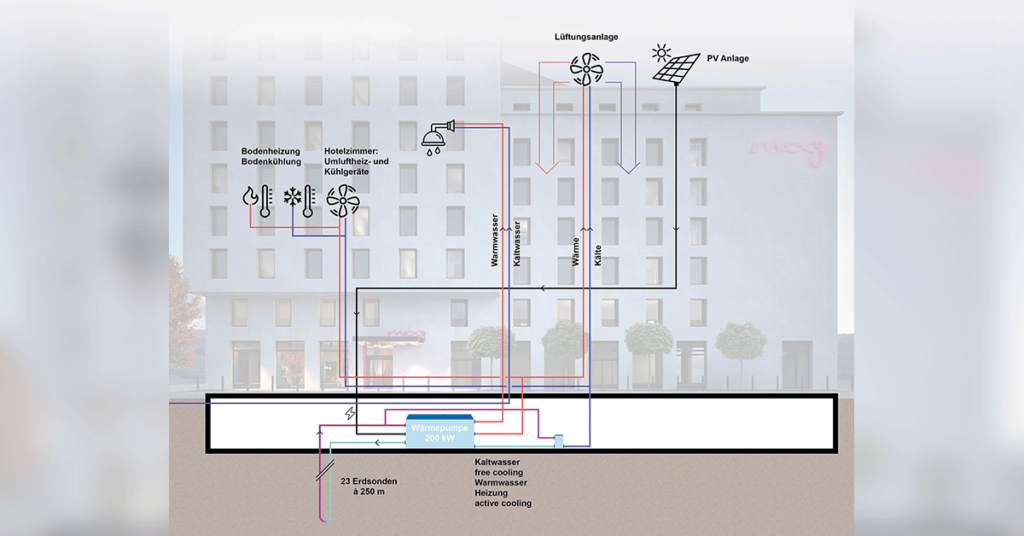
    The groundbreaking ceremony for the Hotel Rotbuche in Rapperswil-Jona took place in mid-February of last year. The three requirements and specifications for the energy supply and the energy system for the new hotel were clear: energy efficiency, ecology and comfort. In order to implement these requirements, geothermal probes were drilled as an energy source for the heat pump and a sustainable energy concept was developed in cooperation with Energie Zürichsee Linth (EZL). EZL will also operate and maintain the building technology as a contractor.

    Heat recovery measures
    "The reversible heat pump can be used to provide heat for heating purposes and for domestic hot water," explains Roman Fausch, project manager for energy services at EZL. In summer there is the possibility of cooling the building in an energy-efficient way using geothermal probes, according to the expert. If there is a high need for cooling, there is also the option of using cold from the reversible heat pump. Various heat recovery measures are also installed and, thanks to an intelligent control system, also regulated as required. "In connection with energy and sustainability, it is one of the most sustainable hotel projects that we have been able to plan and implement," says Stefano Ghisleni, general planner at Ghisleni Partner AG, based in Rapperswil, Zurich, St. Gallen and Zug.

    At the Moxy Hotel Rotbuche, the natural heat comes from a depth of around 200 to 250 meters. The 23 probes, distributed over the entire construction area, withdraw 10 to 15 degrees from the ground. The heat is fed into the heat pump in the building using a carrier fluid and converted. This is how it gets into the hotel's heating and air conditioning system. The entire length of the geothermal probe control system is more than five kilometers.

    Reduction of the room temperature by up to four degrees
    Those responsible for the project emphasize that the basic need for room cooling in the warmer seasons in the Hotel Rotbuche can be covered with the environmentally friendly free cooling system. This means that the room temperature can be reduced by up to four degrees. This has a positive side effect: the dissipated heat is in turn temporarily stored in the geothermal probes and can be used for hot water preparation or in winter for heat supply. A photovoltaic system is installed on the roof to operate the heat pump. With around thirty percent, it should provide sufficient coverage to cover part of the electricity demand. "The moderately controlled balancing of heat and cold makes a continuous room climate possible without massive temperature fluctuations," says project manager Roman Fausch. The first guests will be able to feel this for themselves from the coming autumn. At this point in time, the new “Rotbuche” hotel with its 86 rooms is due to open. ■

  • Dietiker city council presents new energy and climate strategy 2050

    Dietiker city council presents new energy and climate strategy 2050

    The Dietikon City Council has approved the new Energy and Climate Strategy 2050 with seven specific fields of action. The strategy focuses on the expansion of renewable energies, energy efficiency and security of supply, according to a media release .

    Among the seven goals named in the new strategy, the intention to reduce the city administration's energy-related greenhouse gas emissions to zero by 2030 stands out. For the population and companies, the goal of freedom from greenhouse gas emissions then applies to 2040. And by 2050, non-energy-related emissions, such as in agriculture or waste recycling, should be offset with zero emissions or with so-called negative emissions. The concrete implementation should begin immediately. The municipal energy planning will be revised by the end of the year.

    "The strategy allows us to implement climate protection and the energy transition in Dietikon in an even more targeted manner," said City Councilor Anton Kiwic, Head of Building Construction and President of the Energy Commission. Dietikon is thus making its contribution to global efforts to reduce greenhouse gas emissions and for the future quality of the location for the population and the economy.

    A small six-page brochure on the new strategy with many links on climate policy is available on the website of the City of Dietikon. There it says: Dietikon will be climate neutral. To do this, we are reducing greenhouse gas emissions to net zero by 2050 at the latest. In addition, we remain committed to the goals of the 2000-watt society and, as the energy city of gold and smart cities, play a pioneering role in national energy and climate policy.

  • New energy solutions at the start

    New energy solutions at the start

    The use of fossil fuels still dominates, especially in the area of heating living space. Thanks to innovative technologies, new climate-friendly alternatives are emerging here – for example, heating with sea thermal systems or the use of waste heat from computers. Both approaches use existing heat sources to heat buildings.

    Lake thermal energy is one of the youngest forms of energy generation and makes use of the lakes as huge heat stores. In summer, the lakes absorb the sun's warmth and give it off slowly. Even when it is below zero, the lake water retains a certain temperature in the depths – ideal for extracting heat from the water in the lower layers and using it as a natural source of heat. The water is then returned to the lake in a cooler condition. This is harmless to the ecosystem and to a certain extent even counteracts climatic warming. With this technology, the largest lake thermal project in Switzerland is successfully launched in Lucerne.

    The Paris startup “Qarnot” takes a different approach and relies on the waste heat from computers. Instead of laboriously cooling computers in large server rooms, they are built into radiators. In this way, data flows in the radiators instead of water. The decentralized computing power is sold to large companies, the digital radiators themselves to private households. After the initial investment, they no longer have any heating costs. The more heat is desired, the more data power is generated. The data is encrypted and is not saved, so it is not possible to trace which data is flowing. The same thing works with hot water boilers – an entire residential complex in Bordeaux has already been equipped with this technology. Due to the increasing amounts of data around the world, the future potential seems enormous.

    Read more about intelligent solutions here:
    https://proptechmarket.net/loesungen

  • WWZ Group defies the pandemic

    WWZ Group defies the pandemic

    According to a statement from the WWZ Group , the Zug-based energy, telecommunications and water supplier generated total net sales of CHF 227.6 million in the 2020 financial year. In a year-on-year comparison, this corresponds to a marginal decrease of 0.3 percent.

    "Despite the corona pandemic, WWZ was largely able to achieve its goals," CEO Andreas Widmer is quoted as saying in the press release. "Although energy sales fell as a result of the lockdown and the warm weather, we were still able to keep net sales at the previous year's level." In addition, the group has pushed ahead with "expanding our strategic growth areas", explains Widmer.

    The CEO particularly points out the area of district heating. In the year under review, the group's flagship project, Circulago, put the first district headquarters into operation. Circulago uses the energy of the Zug lake water to generate heat and cold.

    In the year under review, WWZ invested a total of 87.0 million francs in maintaining the infrastructure and expanding district heating and telecommunications networks. As a result of these high investments and increased depreciation, the operating result at EBIT level fell by 10.8 percent year-on-year, explains WWZ. Specifically, an operating result of 37.4 million francs was achieved. At 39.0 million francs, consolidated profit was 19.1 percent lower than in the previous year.

    For the current year, the group assumes that investments, operating costs and depreciation will remain high. "The transition from fossil natural gas to renewable district heating and the establishment of further growth areas will temporarily burden the income statement," explains WWZ CFO Andreas Ronchetti Salomon. However, the group is well equipped to continue its strategic development “even under difficult conditions”.

  • High alpine solar system works highly efficiently

    High alpine solar system works highly efficiently

    The first large high-alpine solar system was set up last summer on the Albigna dam in Graubünden's Bergell. At an altitude of 2100 meters above sea level, 1200 photovoltaic panels were installed over a length of 670 meters at an angle of 78 degrees. The steep angle serves the better processing of the winter sun and prevents snow deposits on the modules, explains the electricity company of the city of Zurich ( ewz ) as operator of the system in a message .

    In the first six months after commissioning in September 2020, the high-alpine system has already produced 223 megawatt hours of electricity, ewz further informs in the press release. This fulfilled the “high expectation”, according to which high alpine locations have significantly better production conditions for solar power than the Central Plateau. The winter months have also shown that the system on the Albigna dam works just as efficiently in winter as it does in summer. Between October and March, the efficiency of a high-alpine system is more than a quarter higher than that of a flat-roof system in the Swiss Plateau, writes ewz.

    According to calculations, the system on the Albigna dam will generate around 500 megawatt hours of electricity annually with a total output of 410 kilowatts. Ewz customers can join the project via the ewz.solarzüri public participation model. Here, the 2170 square meters of the high-alpine facility are for sale at a price of 560 francs per square meter. The buyers are credited with 180 kilowatt hours of solar power annually for 20 years.

  • Live and work in stackable towers

    Live and work in stackable towers

    The plans of the association Vision Zukunft Bösch are ambitious: 3000 jobs for 600 companies are to be created on 30 hectares in Hünenberg on the Bösch site. The aim is to upgrade the area and make it a leading location for innovative SMEs in the service, trade and industry sectors. Keeas designed the first development model in 2018 on behalf of the Zugwest Economic Region Association. At the same time the club was
    Vision of the future of Bösch founded.

    The challenge in developing the area: space is limited. So that numerous companies can still settle, three high-rise buildings are to be built. These are not classic high-rise buildings, but stackable towers: Energy self-sufficient boxes are attached to large lifts. Companies could easily grow taller here: Additional boxes can be flexibly stacked.

    Creative SMEs in particular are likely to feel addressed by this location: there are slides instead of stairs. But the topics of energy and sustainability are also taken into account. Due to its high daily consumption, Bösch offers optimal conditions for the installation of photovoltaic systems on the roofs. The waste heat from the nearby Perlen paper mill could be used as heating and cooling energy.

    A range of e-cars, car sharing and e-bikes through to pooled company and visitor parking spaces is conceivable. The so-called energy and mobility hub works with large batteries. These optimize the energy consumption of the solar systems and charge electric vehicles at the same time. Truck and commercial ramps are to be built around existing commercial buildings. In addition, an autonomous bus is planned that will provide direct access to the IT campus and the Rotkreuz train station.

    The municipality of Hünenberg owns a piece of land in the immediate vicinity of the International School im Bösch, which it would make available for the construction of a reference company. This future “Campus Bösch” is likely to lay the foundation for the overall project. The vision is constantly being developed.

  • "The city of Zug should become greener"

    "The city of Zug should become greener"

    To person
    Eliane Birchmeier (FDP) has been city councilor and head of the building department of the city of Zug since January 2019. The 58-year-old studied business administration and is federally certified. dipl. PR consultant and founded Birchmeier Communications AG based in Zug in 2005. She was a member of the Board of Directors of Kursaal-Casino AG from 2004 to 2017 and co-owner of C-Matrix Communications AG from 1992 to 2004.

    You are the head of the building department of the city of Zug. Where do you see your core tasks?
    Eliane Birchmeier: My core tasks include the classic areas of responsibility in construction: On the one hand, there are building permits and building projects for city-owned civil engineering and structural engineering projects. On the other hand, we deal with planning, design and legal aspects in town planning and urban planning. This is about the future development of the city of Zug in terms of urban development and spatial planning with settlement, landscape and traffic.

    The city of Zug is forecast to have around 10,000 population growth by 2040. What structural measures are planned to do justice to this development?
    The forecast growth depends on the development of the project by private owners and investors. We have already done our homework in many areas. For example, when it comes to infrastructure projects in the areas of drainage, energy and disposal. In education, we – like other communities in Switzerland – have a certain amount of catching up to do. Various plans are currently underway for expanded and new school facilities. But we also want to upgrade the green and open spaces and improve the network of footpaths and bike paths in the coming years.

    The economy should also continue to grow. Where do you see the greatest potential for new commercial buildings?
    There is still great potential for expansion for trade and services in various former industrial and urban areas. These include the technology cluster with the V-Zug area, urban areas east and west of the station such as Metalli, Baarerstrasse West and the LG area. Then there is the area on the Aa II, which is being developed by the Zuger Verkehrsbetriebe, the Hertizentrum and the outer Lorzenallmend. In the future, these areas will offer mixed, urban uses of living, leisure and work.

    Where in the canton can you find larger land reserves?
    As elsewhere in the canton, growth in the city of Zug will mainly take place in the interior through densification. In addition, there are a few construction areas that have not yet been built up, such as the outer Lorzenallmend, areas in the Herti and Unterfeld, in the Lüssi / Göbli and in a southerly direction in the Salesianum and in Oberwil. Actual zoning is not the focus of ongoing local planning.

    "We expect planning applications for the Lüssi / Göbli area and the area of the Salesianum country house soon"

    Which projects are planned there?
    In the outer Lorzenallmend, a development plan is being drawn up for a residential and work area and in Herti Süd one for a residential development. There are currently no plans in the Herti Nord, Unterfeld or Spielhof. In the Lüssi / Göbli and the Salesianum there are legally binding development plans for residential developments. We expect planning applications for this in the near future.

    What are currently the most important construction projects that you are involved in?
    City-owned projects are the construction of the recycling center and the Ökihof in the north of the city. School complexes are being planned and projected throughout the city. The project competition for the extension of the lido starts this year, and in summer the Zug population will be able to use the new emergency rooms in the Göbli district.

    The city of Zug is in the middle of the local plan revision process. Is there already an initial strategy for mobility and open space?
    The city's spatial development strategy will be drawn up in several stages and steps up to autumn 2021. The first thrusts based on the technical basis, the population survey and the first participation phase are clearly emerging: the city should become greener. In addition, a diverse and high-quality range of different open spaces should be available to the population.

    What does the population want?
    She would like the growth in mobility to be absorbed by expanding and promoting pedestrian and bicycle traffic as well as public transport. Traffic routing in the center is to be simplified and designed in a way that is compatible with settlement. Particular attention is paid to optimizing commuter traffic. In cooperation with the canton and neighboring communities, but also with employers, we are focusing on an increased shift towards public transport, which is already excellently developed, and non-motorized private transport.

  • Intelligent lighting convinces investors

    Intelligent lighting convinces investors

    LEDCity has secured 2 million francs in fresh capital as part of a financing round. A customer of the start-up and a group of business angels have invested, according to a media release. In addition to the financing by the investors, the company has also received a guarantee from the technology fund of the Federal Office for the Environment .

    LEDCity has developed a lighting solution that aims to reduce electricity consumption by up to 80 percent. The development is intended to replace classic motion detectors in commercial buildings. It uses up to 50 times more sensors on the same area. Algorithms also ensure that the lighting intensity is controlled automatically.

    With the fresh funds, LEDCity wants to enlarge its sales team in western Switzerland and at the same time expand to Germany. The start-up also wants to further develop its algorithms.

  • Bern is testing street lamps as charging stations

    Bern is testing street lamps as charging stations

    The municipal energy supplier Energie Wasser Bern (ewb) wants to convert street lamps in two Bern quarters into charging stations for electric vehicles. At the end of March, according to a press release, ewb will put two upgraded lanterns into operation at Thormannstrasse 62 and 64 and at Huberstrasse 16. The two masts will be equipped with type 2 sockets, the European standard for charging e-cars.

    ewb is responding to the growing demand for e-cars and thus also for charging points in Bern. The test stations are located on residential parking areas marked blue. According to the press release, this makes them particularly suitable for residents of Thormannstrasse and Huberstrasse who have an e-car and a resident parking card.

    ewb wants to expand the e-charging stations specifically in the blue zones, because this is where most people from Bern park. The energy supplier is technically supported for the project by Siemens and ubitricity as well as MOVE as an e-mobility service provider. The City of Bern and EnergieSchweiz are also involved.

    For owners of diesel and gasoline cars as well as e-vehicles that are not supposed to be charged, the areas will no longer be available until the end of the pilot phase in spring 2022. They should be able to recognize this from the corresponding signs. At the end of the test phase, ewb and its project partners want to evaluate the data and decide whether to introduce such charging lanterns across the board.

  • AEW takes a stake in the Aargau energy start-up

    AEW takes a stake in the Aargau energy start-up

    AEW Energie AG has entered into a strategic partnership with Virtual Global Trading , according to a media release . It will gradually acquire a stake of up to 35 percent in the start-up company based in Aarau.

    With eNet, Virtual Global Trading has developed a digital trading platform for the energy sector. It offers customers of energy suppliers various business models. For example, companies can present offers for battery storage or solar systems on the platform. These can then be used by private individuals – the customers of energy suppliers.

    The platform uses the daily updated data from the network operator's intelligent meters. The traded and processed energy data are automatically compared with the systems of the distribution network operator. When the platform registers a new smart meter, it creates a one-time token. Thanks to this token system developed and patented by Virtual Global Trading, the proof of origin of the energy is provided. Overall, the platform also enables all participants to react quickly to market developments.

    Together with the Liechtenstein power plants ( LKW ), the start-up is already implementing its system in Liechtenstein. The use of the platform there is also intended to serve as a model for other regions. The goal now is to roll out eNet continuously in Switzerland and Europe.

    “With our involvement in the start-up company, we are securing market experience from neighboring countries, where the regulation and liberalization of the electricity market are well advanced. We want to use this experience for our preparation for the complete liberalization of the electricity market ”, said Marc Ritter, Head of the Energy Business Unit at AEW, in an AEW announcement . Together with the start-up, AEW also wants to develop new market models for Switzerland.

  • Basler Quartier will soon have climate-neutral heating

    Basler Quartier will soon have climate-neutral heating

    Work on the construction of a heating network is allowed to start around Lehenmattstrasse from July. According to a press release , the Lehenmatt Birs AG (WVLB AG) heating network, which was founded specifically for this purpose, has now received permission from the government council of the canton of Basel-Stadt.

    In the first expansion step, the client is laying 1.2 kilometers of new heat pipes. Up to 2900 households can be connected to it, the first probably from spring 2022. The heat that WVLB AG supplies should be up to 80 percent CO2-neutral. According to a press release, it is a by-product of the treatment processes in the nearby Birs wastewater treatment plant.

    The first owners have already expressed their interest. "In the last few months we have already been able to conclude numerous heat supply contracts with large heat consumers in the Lehenmatt district," WVLB managing director Urs Hodel is quoted in the media release. WVLB AG is a joint venture between Industrielle Werke Basel ( IWB ) and the energy cooperative ADEV .

  • Portal documents the development of charging stations

    Portal documents the development of charging stations

    More than a third of energy consumption occurs in traffic, writes the Federal Office of Energy ( SFOE ) in a press release . The increased use of electric cars is intended to increase efficiency here. The communication names the expansion of the corresponding charging infrastructure as an important factor in promoting e-mobility.

    In order to be able to document the development of the charging infrastructure, providers of charging stations and the SFOE have set up a joint data infrastructure, the SFOE explains further in the communication. With their help, the availability of public charging stations in Switzerland is displayed in real time on the www.ich-tanke-strom.ch portal. This data is used by the SFOE to generate key figures for the public charging infrastructure. They are made available on the portal as data visualization. The SFOE makes the underlying data available as open data on the opendata.swiss portal.

    20 providers are now taking part in the project to document the development of the public charging infrastructure, including the largest charging networks in Switzerland, evpass, MOVE, swisscharge and Plug'n Roll. Interested providers of public charging stations are invited to join the project.

  • Geneva expands network for the use of lake water

    Geneva expands network for the use of lake water

    The Geneva public utility company SIG is laying new district heating pipes in the La Jonction district. 90 buildings are to be connected to the Genilac district heating network by 2025, the SIG wrote in a press release . Of these, 30 buildings are used by the city and the canton of Geneva. Genilac fully supplies the connected buildings with heating and cooling from Lake Geneva. The extension in La Jonction saves 10,600 tons of CO2.

    In total, Genilac is expected to deliver around 1150 gigawatt hours of cooling and 150 gigawatt hours of heat per year by 2030. By 2050, Genilac should help to reduce CO2 emissions in the canton by 70,000 tons. "Genilac is an important infrastructure with which CO2 emissions in the canton of Geneva are to be reduced and global warming is to be tackled", SIG General Director Christian Brunier is quoted in the press release.

  • ewz implement 100 climate-neutral real estate projects

    ewz implement 100 climate-neutral real estate projects

    Ewz is aiming for an ambitious goal by 2030: "Individual projects are not enough to achieve the national climate targets," ewz director Benedikt Loepfe is quoted in a media release. Instead, ewz understands the flagship Fischermätteli quarter in Burgdorf BE, which is currently under construction, "as a starting point for an ambitious goal: 100 real estate projects – 100% climate-neutral".

    Because the construction and maintenance of buildings generate a good third of all pollutant emissions, energy-efficient buildings and a climate-neutral energy supply are among the most important levers for Switzerland's climate goals, the press release said. For example, the combination of heat pumps, solar power, storage and electromobility leads to the greatest possible self-sufficiency with low resource consumption. In doing so, local, renewable energy sources are consistently used.

    "With the comprehensive implementation of such climate-neutral real estate projects – both new buildings and renovations – ewz is making a significant contribution to environmental and climate protection and the energy transition," said Loepfe. "As one of the first energy supply companies, ewz is committed to a pioneering commitment to a CO2-free Switzerland."

  • Baden Cantonal Hospital installs solar power system

    Baden Cantonal Hospital installs solar power system

    The Kantonsspital Baden (KSB) relies on renewable energy and has therefore had solar power systems installed for self-sufficiency. On an area of 2000 square meters, solar panels have been installed on the roofs of the parking garage and the heating center and also on the facade of the heating building. According to a media release from KSB, the new solar power generators have a total output of 375 megawatt hours of electricity. This corresponds to 3 percent of KSB's electricity requirements. The new solar systems are to be connected to the power supply network for the canton hospital at the end of this month.

    Cristoffel Schwarz, the chief manager (COO) of KSB, is quoted as saying: “The areas on the P2 multi-storey car park and the heating plant are predestined for the production of solar power. That is why we decided to make this investment. The KSB will thus become a small power plant itself. "