Tag: Energie

  • Refurbishment of the large Webermühle development

    Refurbishment of the large Webermühle development

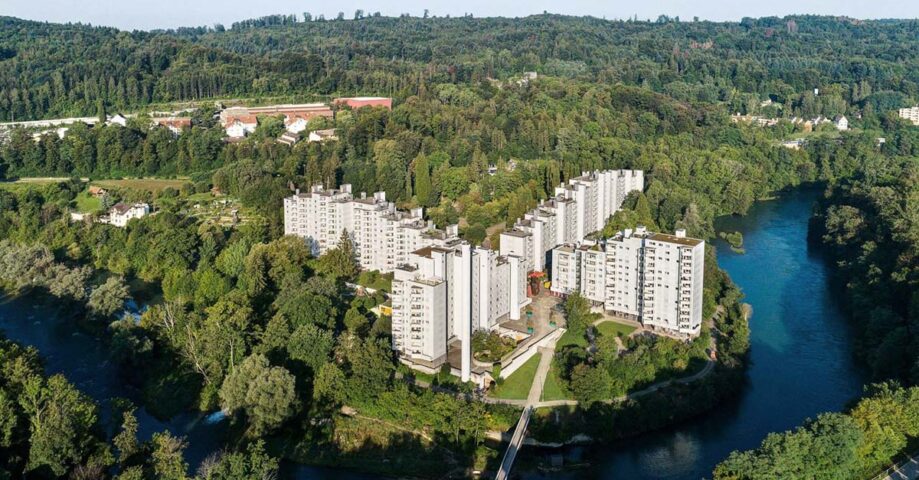
    The Webermühle development in Neuenhof houses 368 rental apartments. The settlement on a peninsula in a loop of the Limmat was built on the industrial site of a former weaving mill and was ready to move into in 1984 after ten years of construction. Planned by the architectural office Steiger Partner AG and built by Ernst Göhner AG, the Webermühle with its different volumes offers living space for up to 1,500 residents. Despite the very high density, the apartments with the four rows of high-rise buildings arranged in a cross shape are characterized by a surprising foresight. Since 2008, the buildings realized in the “Göhner 3” modular construction system have been owned by a real estate fund from Credit Suisse Asset Management.

    Ecologically and economically sustainable renovation
    A good 40 years after moving in, the apartments no longer met today’s standards – neither in terms of appearance nor in terms of comfort. With an analysis of the building structure, the client started planning an extensive partial renovation in 2009, which was implemented in stages between 2012 and 2014. Credit Suisse Asset Management’s portfolio strategy attaches great importance to ecologically and economically sustainable solutions. With the modernization of the Webermühle, one wanted to make the living and green space more attractive for the tenants and to maintain the value of the property. On the other hand, the building technology should be brought up to date and thus the energy consumption should be significantly reduced. Better connections to public transport were also an important goal: Since the construction of a new inclined lift in 2015, Wettingen train station can be reached within a few minutes on foot.
    Heat supply: switch to flow heat
    The core of the energetic renovation is the reorientation of the heat supply. To this end, the client defined a clear goal right from the start: in the future, the heat supply in the Webermühle should be at least 70% CO 2 -free. Due to the size of the facility, Credit Suisse Asset Management wanted to have the heating system replaced by a contractor instead of producing heat itself. The sustainability of the solution proposed by ewz with a river water heat pump convinced the client even after a detailed examination by specialists.

    More about the project

  • IWB joins Sympheny

    IWB joins Sympheny

    IWB takes a 30 percent stake in Sympheny . The young company based in Dübendorf has developed software that can compare possible energy solutions for buildings in a matter of seconds. IWB wants to use the knowledge gained from this in its own planning for the climate-friendly conversion of the energy supply.

    “Affordable climate protection requires optimized energy supplies,” IWB introduces a post on LinkedIn about joining Sympheny. According to him, the company for energy, water and telecommunications in the canton of Basel-Stadt wants to support the spin-off of the Federal Materials Testing and Research Institute ( Empa ) with the fresh capital in the further development of their software. IWB writes that they are looking forward to working more closely with Sympheny co-founders Andrew Bollinger, Matthias Sulzer, Boran Morvaj and Julien Marquant.

    According to a report on startupticker.ch, the software from the young company, which was only founded in 2020, has already been used in more than 20 major planning projects. Sympheny’s customers include “energy suppliers and general contractors from all over Switzerland,” it says. The energy planning software developed by Sympheny simulates the energy system to be examined with a digital twin. Algorithms and standardized geographic information data (GIS data) can be used to simulate the production, storage and consumption of energy.

  • Builder and Energie 360° team up for district heating

    Builder and Energie 360° team up for district heating

    A community connection to the district heating system is currently being built in Wipkingen. Architect Lucas Schwarz provides the necessary space for this in his newly built apartment building. Energie 360° takes care of the rest, according to the Zurich energy supplier in a report on its website. According to this, the advantage of a local network is that not every property has to be connected individually to the district heating network. More than 60 percent of homeowners would have to get involved in order for it to be worthwhile to develop a neighborhood with district heating. The more heat is supplied, the cheaper it will be for everyone.

    Schwarz is convinced that such a community connection will not only pay off ecologically but also financially in the long term: “I see the biggest advantages over heating in the small space requirement, the simple building services and the lower maintenance.” The energy verification is also simplified. In addition, the price of energy in thermal networks remains constant over the years. “That gives me more planning security and independence.” And last but not least, building owners received better financing conditions from banks thanks to certification in the canton’s building energy certificate.

    It is about completing the transformation from fossil fuels to sustainable heating energies “as quickly as possible”, Schwarz is quoted as saying. He wishes “that the entire city of Zurich will be heated sustainably by 2050. In my opinion, the expansion of the district heating network is progressing too slowly.”

  • Early participation can increase acceptance of wind power

    Early participation can increase acceptance of wind power

    An early participation of the population can increase the acceptance of new wind turbines in the vicinity of residential areas. According to a press release , researchers at the Swiss Federal Institute for Forest, Snow and Landscape Research ( WSL ) have come to this conclusion. They interviewed 500 people in areas close to the city of Bern about the plans to erect wind turbines. It has been shown that the rejection has a lot to do with the personal connection to the place and the landscape.

    Actually, everyone agrees: Renewable energies are valuable and necessary, says Matthias Buchecker from the Social Science Landscape Research Group at WSL, describing the initial situation. However, when it comes to specific investments, it often becomes difficult. So far, it has been assumed that the change in the face of a landscape caused by large wind turbines causes a knee-jerk rejection in one’s own neighborhood, Buchecker is quoted as saying. But this explanation falls short. Instead, the reasons for the rejection lie in the local ties of those affected. “People want to have a say in decisions sooner.”

    This requires a rethinking of the planning processes. Because in the survey, the opponents rejected a change in their residential area as a whole – not just the specific wind farm. Involving the population must begin with the question: How should one’s own region develop in principle – ecologically, in terms of energy, economically and in terms of landscape? Buchecker is quoted as saying that the aim should be to find a broad and overarching consensus within the framework of which renewable energy systems would also find their place.

  • digitalSTROM presents new products

    digitalSTROM presents new products

    According to a press release , digitalSTROM AG from Schlieren will present two innovations at the Light + Building 2022 trade fair. On the one hand, the networking specialist is presenting the integrated solution for access control. According to the announcement, this consists of the fully integrated Smart Video Doorbell and the interactive 10.1″ display, dS-Touch. With the video doorbell, residents can always keep an eye on who is ringing the doorbell. With the dS-Touch display, access control is integrated into the all-in-one solution from digitalSTROM for the first time. This includes fully centralized automation and control of lights, shutters, blinds, heating and ventilation systems and buttons.

    The dS Energy extension, which is also new, enables residents with a photovoltaic system to improve their energy balance. The self-generated energy is thus routed to the boiler or heat pump via an intelligent control system. This will also significantly reduce dependency on the electricity company, according to the statement.

    For the first time since 2018, digitalSTROM will be taking part in the trade fair from October 2nd to 6th in Frankfurt in order to present its range of smart home solutions and innovations to an international audience. “We benefit from the growing dynamics of home automation and the steadily increasing interest in digitalSTROM solutions,” Peter Lambrechts, Executive Chairman at digitalSTROM, is quoted as saying. In the difficult years for the entire industry, his company invested heavily in research and development and was able to present new products and solutions at Light + Building.

  • Paperi's first "2000-watt area" in the canton of Zug

    Paperi's first "2000-watt area" in the canton of Zug

    The paper mill shaped the community of Cham and the Zug West region for more than 360 years. A new living and working quarter with industrial charm is now being built on the former industrial site. Formative existing buildings are being supplemented with striking new buildings directly on the Lorze and implemented sustainably. The story continues and bridges are built between past and future, between people and nature, between living and working. “Sustainability” has played an important role as an overall topic since the beginning of the site development. As the client, the Cham Group committed itself to the goals of the 2000-watt society early on in the planning process and made the decision to use fossil-free heat supply out of conviction and even before the intention of certification. As the crowning glory of the ongoing sustainability efforts, the Papieri was the first area in the canton of Zug to be awarded the “2000 Watt Area” certificate today. On behalf of the Swiss Federal Office of Energy, Daniel Kellenberger thanked the Cham Group for their commitment and perseverance in not only talking about energy and CO 2 targets, but actually implementing them with the “2000 Watt Area” certificate, among other things.

    Zero CO2 emissions
    The Papieri area offers completely new foundations for an energy-efficient, climate-neutral and sustainable society. This makes it a pioneering project throughout Switzerland. Practically from the beginning of the development of the site, the Cham Group decided to completely dispense with fossil fuels for heat generation and to rely fully on the favorable location factors with hydropower, geothermal probe fields and photovoltaics. The highlight of the area is the completely CO 2 -free energy system. The entire energy supply on the site is based on 100% renewable energies. This is achieved by means of geothermal probes and a river water catchment, which each serve a central heating and cooling network via heat pumps. Thanks to a ZEV (association for self-consumption) with the renovated small hydroelectric power plant on the Lorze and large-scale photovoltaic systems of 6,500m2 on the new buildings, around 40% of the total energy required can be generated on site. “Moreover, other aspects of comprehensive sustainability are explored in practically every project, be it through “building recycling”, ie intelligent conversion of the existing building, the use of CO 2 -optimized construction principles such as timber construction, or through intelligent sharing offers in the field of mobility,” explains Lukas Fehr, Head of Development at the Cham Group.

    Lighthouse character for municipality and canton
    So far, only 43 areas in Switzerland have been certified with this label by the Swiss Federal Office of Energy –
    26 of them as a 2000-watt area “in development”. Government Councilor Florian Weber is also pleased that the canton of Zug is playing a role in this. “100 percent for 2000 watts: the Cham Group is opening up a new era of comprehensive and sustainable energy concepts for large-scale developments at the Papieri site,” says the construction director. As Energy City Gold, the municipality of Cham also celebrates the award of the papers as a “2000-watt area”. “The award is a seal of quality for the Cham Group’s site development, an incentive for others and at the same time corresponds to the community’s commitment to climate protection. After all, Cham wants to become climate-neutral internally by 2030; by 2050, “net zero” greenhouse gas emissions should even be achieved for the entire municipality,” explains Drin Alaj, Head of Traffic and Safety for the Cham municipality. And Mayor Georges Helfenstein adds: “We see the developments on the Papieri site as an opportunity and are pleased about this certification and about the new, vibrant and now also certified sustainable quarter”.

    Marketing start of the first office and commercial space
    On February 10, 2022, the rental of the shop, office and commercial space on the ground floors of the properties in the first construction phase, which will be ready for occupancy at the end of 2022, will start on the papieri-cham.ch website. The Papieri area offers space for every business model and company of different sizes. Not interchangeable and arbitrary, but sustainable, well thought out and in the middle of a lively district.

  • Federal Council wants to accelerate procedures for renewables

    Federal Council wants to accelerate procedures for renewables

    Switzerland is lagging behind in the expansion of wind energy. The procedures for the construction of large hydroelectric power plants also take a long time. The Federal Council now wants to speed up the planning and approval procedures for large plants, it writes in a statement . No compromises should be made when it comes to protecting nature, the environment and monuments.

    The Federal Council wants to develop a concept with the locations of the most important hydropower and wind turbines. This should serve as a guideline for cantonal structural planning. The systems listed there should then only be subject to a cantonal planning approval procedure. This should be able to issue all permits. Thus, in the event of an objection, only one appeal through the instances should be possible.

    In addition, the Federal Council wants to accelerate the installation of photovoltaics on roofs and facades. Investments in new buildings should also be tax deductible. The approval of solar systems on facades is to be regulated via a notification procedure.

    The Swiss Energy Foundation welcomes the initiative of the Federal Council. “Switzerland needs a booster for renewable energies,” said Managing Director Nils Epprecht in a statement . “The Federal Council has recognized the urgency. In doing so, he does not question the two political cornerstones of Switzerland, the balancing of interests and federalism.”

    The consultation on the Federal Council’s proposal lasts until May 23, 2022.

  • Synhelion and Cemex produce the first solar concrete

    Synhelion and Cemex produce the first solar concrete

    Synhelion and Mexico’s Cemex , the world’s fifth largest cement producer in 2020, have produced the world’s first solar clinker. As both companies write in a media release of the same name, this “revolutionary innovation” is a “first step towards the development of completely solar-powered cement plants”. dr Gianluca Ambrosetti, CEO and co-founder of Synhelion, is proud to “join with Cemex to demonstrate a concrete, industrially relevant application of our fully renewable high-temperature solar heating”.

    Synhelion emerged from the Swiss Federal Institute of Technology in Zurich in 2016. The company’s technology aims to replace all types of fossil fuels with solar fuels. According to the information, it converts concentrated heat from the sun into “the hottest process heat available on the market”. Cemex wants to supply CO2-neutral concrete worldwide by 2050. A key part of this strategy is CEMEX Ventures and its research and development center in Brügg BE.

    Research teams from both companies installed a pilot plant on the premises of the Madrid Regional Government’s Imdea Energy Research Institute . There, the solar receiver from Synhelion delivered “record-breaking” temperatures of over 1500 degrees with concentrated sunlight. A gaseous heat transfer medium is thus heated. This provided the heat needed to melt limestone, clay, and other materials together.

    The clinker obtained in this way was used to manufacture cement and then processed into concrete. In the next phase of their joint research and development project, Synhelion and Cemex intend to work towards an industrial-scale pilot plant.

  • BKW is stepping up its presence in two growth markets

    BKW is stepping up its presence in two growth markets

    In a press release , BKW announced the takeover of Arnold und Gladisch Objektplanung Generalplanung GmbH from Berlin and Dr. Blasy-Dr. Øverland Ingenieure GmbH from Eching am Ammersee announced.

    As the Bern-based energy and infrastructure company has announced, the success of the BKW Engineering network is to be continued and expanded with the new partners from Germany. In addition, company growth is important in order to successfully position oneself in competition with "multidisciplinary market leaders".

    The portfolio of the German companies promises an increase in competence for the growth markets of residential construction, safe construction, water and environment, it is said. Blasy Øverland contributes its expertise in water management, hydraulic engineering and environmental planning. The Arnold und Gladisch architectural office focuses on residential construction and safety-compliant construction.

    The BKW Group specializes in planning and consulting for energy, infrastructure and environmental projects and covers building technology, including the construction, service and maintenance of energy, telecommunications, transport and water networks. For its corporate goal of offering services for infrastructure, environmental and energy projects from a single source, BKW can draw on a network of more than 50 successful companies from Germany, Austria and Switzerland.

  • Four Aargau energy suppliers are working together

    Four Aargau energy suppliers are working together

    The utility companies in southwestern Aargau are moving closer together. tba energie ag , EW Oftringen AG , EW Rothrist AG and StWZ Energie AG want to found the energy supplier Regionale Energie AG (REAG) and the water supplier Regionale Wasser AG (RWAG) together. The city of Zofingen is said to hold just over 50 percent of REAG. The shares of Oftringen, Rothrist and Zofingen in RWAG are said to be between 27 and 33 percent. Among other things, the merger is intended to increase regional added value and secure jobs.

    The four companies expect synergies of CHF 2 million per year, they write in a statement . About half of this is to be returned to customers via the tariffs. The harmonization of tariffs will take up to ten years.

    The ball is now in the hands of the boards of directors of the four companies, the five municipalities involved and ultimately the voters. The two new companies are scheduled to start operations on January 1, 2023.

  • Canton of Jura gives electricity from geothermal energy a new chance

    Canton of Jura gives electricity from geothermal energy a new chance

    Generating electricity from deep geothermal energy in Switzerland is given another chance. As announced by the Jura government, it wants to negotiate with Geo-Energie Suisse SA about a gradual resumption of the project. Additional safety requirements are to be set. In addition, an advisory committee made up of independent experts is to ensure the transparency of the project. If security is guaranteed, the government sees many advantages in the development of renewable energies, according to a statement from the canton.

    The canton approved the Geo-Energie Suisse SA project in 2015. It provides for the production of electricity from deep geothermal energy for 6,000 households. A magnitude 5.4 earthquake triggered by a similar project in Pohang, South Korea, in November 2017 also sparked fears in the Haute-Sorne region. An analysis by Geo-Energie Suisse SA came to the conclusion that a scenario like that in Pohang in the Jura was “unthinkable” due to the safety requirements. However, the project actually came to a standstill.

    Similar projects to generate electricity from deep geothermal heat had previously led to minor earthquakes in Basel and St.Gallen. The affected projects were then stopped.

  • Energieverbund Thalwil goes to the starting position

    Energieverbund Thalwil goes to the starting position

    For the new energy network Thalwil, energy is extracted from the water of Lake Zurich in a lake water center, informs Energie 360 ° on the project page of the lake water energy network of the Zurich energy service provider. This energy is fed to the network’s energy center and fed from there into the district heating network. Peak loads are to be covered with a gas heating system integrated into the energy center.

    with the dr. Ernst Th. Jucker Foundation, Energie 360° has now found the location for this energy center. In a statement , the energy service provider announced that it would be moving into the second basement floor of a foundation property currently under construction on Gotthardstrasse in Thalwil. The ground floor and first floor are reserved for Bank Thalwil. Rental apartments are to be built on the remaining floors.

    “The space in the center of Thalwil is tight,” Foundation President Christine Burgener is quoted as saying in the statement. The former mayor has accompanied the planning of the new energy network from the start. “When Energie 360° and the municipality of Thalwil approached us, we offered a hand so that the energy center could be implemented in our building.” In return, Energie 360° will supply the property with energy at a fixed price. The new network is scheduled to start work at the beginning of the heating season this fall.

  • Switzerland launches building education offensive

    Switzerland launches building education offensive

    The shortage of skilled workers in the construction and real estate industry is to be remedied. To this end, the Swiss “Building Education Offensive” has now been launched. The starting event will take place on January 20 at 4 p.m. and will be streamed live. According to a press release from the Swiss Federal Office of Energy , a “roadmap with 32 measures and four fields of action” will be presented.

    Ultimately, the building sector in Switzerland should make a significant contribution to reducing CO2 emissions. To do this, “hundreds of thousands of fossil-based heating systems would have to be replaced by renewable ones, a large number of buildings would have to be renovated in terms of energy, intelligent control systems would have to be installed and the power supply of the buildings would have to be completely converted to renewable energies”. However, there is already a shortage of skilled workers. At the same time, the number of those who decide to do an apprenticeship in this industry is declining.

    The education offensive was developed by all relevant representatives of the building and education sector. They were supported by EnergieSchweiz , the Swiss Federal Office of Energy’s program for renewable energy and energy efficiency. The State Secretariat for Education, Research and Innovation , the Federal Office for the Environment and the State Secretariat for Migration were also involved.

  • The Federal Office of Energy is funding significantly more projects

    The Federal Office of Energy is funding significantly more projects

    In 2021, the Federal Office of Energy funded a total of 79 new projects and 13 new programs as part of competitive tenders to save electricity in the industrial and service sectors and in households. The number of subsidized projects was thus significantly higher than in 2020, according to a press release . In 2020, the number of funded projects was 39 and the number of funded programs was 15.

    According to the Federal Office of Energy, this increase in projects is “at least partly due to the softened selection process in 2021”. It was introduced as an "immediate measure for projects due to the Covid 19 pandemic". In 2021, the beneficiaries received a total of 40 million francs.

    The subsidies were used, among other things, to optimize shaft heating for snowmaking systems in terms of energy, to replace a production system for drawers at a furniture manufacturer and to replace vacuum pumps in a paper production machine.

    Taken together, the funded projects and programs save 90 gigawatt hours of electricity per year. "That corresponds to the annual electricity consumption of 16,000 households," says the press release.

    The competitive tenders for 2022 have meanwhile already begun. Interested parties can submit programs until May 2nd. Applications for projects can be submitted at any time throughout the year. The entry is made online. The participants will receive confirmations and rejection of funding after four weeks at the latest.

  • Canton releases 2.5 million Swiss francs for Uri energy funding program

    Canton releases 2.5 million Swiss francs for Uri energy funding program

    Residents of the canton of Uri can access a total of 2.5 million francs from the Energy Uri 2022 funding program this year. The government council recently passed this sum, according to a media release . This is intended to renovate and insulate buildings, replace old heating systems and finance photovoltaic systems and charging stations for e-cars.

    Building owners can have the insulation of the roof and facade subsidized at 60 francs per square meter. According to the press release, this covers a large part of the total costs. Applicants who also opt for a photovoltaic system integrated into the façade or roof can receive an additional CHF 200 per square meter occupied by modules.

    What is new in this funding period is that the plants must be designed for electricity production in the winter months. "The angle of the modules must be 60 to 90 degrees and thus optimized for the production of valuable winter electricity." The canton wants to increase the spread of photovoltaic systems in facades, "where the electricity production is higher in the winter months with the appropriate orientation". , contribute.

    The funding program also provides for subsidies for consultations. After a free initial consultation at the Energy Office, interested parties can receive 700 francs for more detailed advice on the façade, roof, windows and other parts of the building envelope. The funding amount was increased by CHF 300 this year. Advice on replacing oil heating systems with more sustainable types of heating is CHF 350 for buildings with fewer than five apartments. Owners of six or more apartments receive a subsidy of CHF 700.

    Owners of apartment buildings who want to equip at least ten parking spaces with charging options for electric cars will be supported with a flat-rate amount of CHF 2,000. This is intended to cover part of the cost of a load management system. This is necessary if several e-cars are to be charged at the same time.

    The canton has been supporting energy-efficient refurbishments in buildings since 2000 with the funding programme. "In the last two years, the funding budget has been fully utilized, which can be seen as a success," says the press release. It proves that owners take their responsibility seriously and make a contribution to the energy transition and climate protection.

  • An algorithm controls thermostats

    An algorithm controls thermostats

    Two researchers from the Urban Energy Systems Lab at the Swiss Federal Laboratories for Materials Testing and Research ( Empa ) have created a self-learning algorithm for heating thermostats. According to an Empa report , it can be integrated into conventional intelligent or smart thermostats via a cloud connection and regulate the room temperature in a predictive manner.

    "The potential is enormous," says Felix Bünning, co-founder of the Empa spin-off viboo, which markets this algorithm. "Our experiments at NEST have shown that energy savings of between 26 and 49 percent can be achieved with this approach."

    To create a model of the building, building data such as valve positions and room temperature measurements from just two weeks are sufficient. In combination with forecasts for the local outside temperature and global solar radiation, the algorithm then independently calculates the ideal amount of energy required to heat or cool the building up to twelve hours in advance.

    According to the information, a first partner is the Danish company Danfoss . The internationally active thermostat manufacturer is currently testing in a pilot project together with viboo how high the savings potential is in conventional existing buildings. In addition, the start-up is already in talks with other industrial partners. For example, it will integrate the algorithm directly into the central building automation system in a Zurich office building.

  • Building cooperative receives 40,000 francs from the climate fund Stadtwerk Winterthur

    Building cooperative receives 40,000 francs from the climate fund Stadtwerk Winterthur

    The municipal energy supplier Stadtwerk Winterthur has given the building cooperative 40,000 francs more than housing from its climate fund. It wants to finance the pilot operation of a self-learning heating controller in two houses on the 2000-watt Hobelwerk area in Oberwinterthur, according to a media release .

    The heating controller was developed by the Federal Materials Testing and Research Institute ( Empa ) in Dübendorf. It is supposed to optimize the heating systems in a climate-friendly way, "by including solar power production on the roof, the interaction between main heating (heat pump) and peak load (pellet boiler) as well as the load on the power grid," the media release said. This offers knowledge for the climate-friendly use of energy with the lowest possible load on the power grid in buildings.

  • Baden promotes charging stations for electromobility

    Baden promotes charging stations for electromobility

    The city of Baden financially supports the construction of new charging stations as part of its energy promotion program. According to a press release , half of all new registrations are already electric or hybrid vehicles. The city of Baden wants to make the switch easier. That is why new charging stations for electric vehicles will be funded with 25 percent of the investment costs from now on.

    According to the city, the offer applies to existing apartment buildings and condominiums with three or more residential units. Shared garages of individual units are also taken into account. The expansion of the electrical infrastructure will also be promoted, according to the press release. Not only could the applicant install a charging station in the underground car park, but others could also be added. That can be done at the same time or later. The aim of this funding is that tenants can also become electromobile.

    The funding program is broken down on the city's special website for electromobility. For electric charging stations, there is a subsidy of 25 percent of the investment costs, but no more than 1,000 francs per charging point. To develop the charging infrastructure, there are also 25 percent of the investment costs in communal underground car parks, but no more than CHF 500 per parking space. The development costs include the creation of power and communication lines to the parking lots.

    The application for funding can be downloaded by clicking on this page and on the city's environmental blog.

  • Watt d'Or honors innovative companies

    Watt d'Or honors innovative companies

    The Swiss Watt d'Or 2022 Energy Prize was awarded on January 6th. The Federal Office of Energy ( SFOE ) has been presenting this seal of approval for energy excellence every year since 2007 on the occasion of its New Year's event. The prizes are not endowed. They should motivate business, politics and the general public to discover the advantages of innovative energy technologies for themselves.

    Schaerraum ag received the award in the building and space category. In just eight months of construction, she built a climate-neutral multi-storey residential and office building made of regional wood in Horw LU. According to a press release by the SFOE, it produces 50 percent more electricity than it needs. In addition, the rental prices are around 20 percent below the local average. This is made possible by the modular planning principle RaumRaster.

    In the renewable energies category, Verora AG is awarded to a group of farmers from the Zug mountain region. Since 2012, it has been producing biochar from tree and shrub cuttings with a pyrolysis system that has been further developed in-house. As a feed additive, it reduces the formation of gas during the digestion of cows and the smell of ammonia in the barn. It also increases the nutrient content of fertilizer and compost and binds CO2 for centuries.

    No winner was chosen in the mobility category this year. SBB receives the Watt d'Or 2022 in the energy technologies category. It has developed intelligent load management software that replaces the construction of new, expensive electricity production plants. In the event of peak loads, for example when many trains are accelerating at the same time, it switches off the train car and point heating for a short time. In this way, SBB can flexibly control 70 megawatts by 2023, according to the SFOE: "It is thus assuming a role model for the general electricity grid in Switzerland."

  • Shared micromobility harms the climate

    Shared micromobility harms the climate

    Shared micromobility is more harmful to the climate than expected. This is shown by a study by the Swiss Federal Institute of Technology in Zurich ( ETH ). This becomes clear if the evaluation of the climate impact of micromobility also includes how electric scooters and bicycles are actually used: “At first glance, e-scooters and e-bikes are climate-friendly because they do not have internal combustion engines,” says Daniel Jan Reck from the Institute for Transport Planning and Systems at ETH Zurich in a report by ETH. “Ultimately, however, what is decisive for their carbon footprint is which modes of transport they typically replace.”

    The transport researchers working with Reck were able to show in their study that shared e-scooters and e-bikes in the city of Zurich mainly replace sustainable modes of transport: walking, using local public transport and cycling. They do more harm than good to the climate. “I think the sharing principle makes sense,” said Reck. “With micromobility and its climate impacts, however, the situation actually seems to be the other way around.”

    The picture is different for privately used e-scooters and e-bikes. These replace more frequent journeys with one’s own car. This is why private micromobility reduces CO2 emissions “and benefits the climate on balance”. That is why it makes sense for authorities to promote commuting by means of private micromobility.

    For his research, Reck received the Young Researcher of the Year Award from the International Transport Forum of the OECD in summer 2021. The think tank of the industrialized countries, based in Paris, awards the prize to young researchers whose work is important in matters of transport policy.

  • Canton of Lucerne increases funding for energy

    Canton of Lucerne increases funding for energy

    The canton of Lucerne is increasing its contribution to the Energy 2022 funding program by CHF 3.5 million compared to the previous year to CHF 5.5 million. Together with the basic amount and the federal supplement, a total of around 23 million francs is available. Private individuals can submit their applications for grants to increase energy efficiency and the use of renewable energy in their own four walls from January 10th.

    As stated in a communication from the canton, the funding program has been checked and optimized after five years of experience. The inclusion of important interest groups was helpful. “Cooperation with the trade, with the various associations and with the university is important so that we can continue the success story of the energy funding program,” said Fabian Peter, the government councilor responsible for construction, the environment and energy.

    The most important changes for the year 2022 include new funding measures such as connection to a heating network with renewable energies, non-automatic wood firing and charging infrastructure for e-mobility in existing apartment buildings. There were also adjustments to the funding rates. Renewals of building insulation are now subsidized with 60 instead of 40 francs per square meter. The subsidy rates for solar thermal systems will be doubled. In addition, there are now flat-rate subsidy rates for building services up to 15 kilowatts, for example for a heat pump, a wood-burning stove or a district heating connection.

  • Multifunctional building boards reduce energy

    Multifunctional building boards reduce energy

    Multifunctional building panels made from fiberglass-polymer composites could significantly reduce the energy consumption of buildings. This is the conclusion reached by researchers from the Laboratory for Heat Technology for the Built Environment ( TEBEL ) at the Swiss Federal Institute of Technology in Lausanne ( EPFL ). Such composite materials could become the most important building materials alongside concrete, steel and wood, according to a press release from EPFL.

    "With the current construction methods, each building element only fulfills a single function", the assistant professor at the EPFL faculty for architecture, civil and environmental engineering and TEBEL director, Dolaana Khovalyg, is quoted as saying. This is "out of date and labor-intensive and time-consuming". As a result, the conventional construction method is associated with a high proportion of bound energy. Alternative solutions are modular, prefabricated, multifunctional building elements. They could reduce the embodied energy of buildings.

    Engineers from TEBEL and the Composite Construction Laboratory have shown that panels made of fiberglass-polymer composites can be used as structural elements in buildings. The team has developed a system in which water circulates through the hollow structures and the panels become elements for underfloor heating. It is also possible to use the hollow cells for electrical lines and ventilation ducts. This would also improve the use of the building space.

    Computer simulations on a building in the EPFL Innovation Park have shown that the panels guarantee sufficient thermal efficiency and structural fire resistance. In addition, their construction offers the same room comfort as conventional underfloor heating. Because of the lower water temperature, it would use much less energy.

  • Implenia is building district heating tunnels in Hamburg

    Implenia is building district heating tunnels in Hamburg

    Implenia will build a 1.2 kilometer long tunnel for Wärme Hamburg , the construction and real estate company from Opfikon informs in a press release . The tunnel is to connect the north of Hamburg to a new heating network. To do this, it will cross under the Elbe around 2 kilometers west of the Elbe tunnel for the motorway.

    The work is divided into two phases, with the planning phase starting in October. Implenia has now received the order for further planning and construction work from the beginning of 2022, according to the announcement. The total order volume there is estimated at around 75 million francs.

    The work should be completed by the first quarter of 2025. To this end, Implenia will first create diaphragm walls for the start and finish shafts with a depth of up to 42 meters. A tunnel measuring 1.16 kilometers long and around 4.5 meters in diameter is then to be drilled between them and lined with precast concrete elements. Implenia is also responsible for planning and installing the operating technology for the district heating pipeline.

    "We are very pleased that we are able to create this large and complex infrastructure project for our customer Wärme Hamburg", Erwin Scherer, Head of Tunneling at Implenia, is quoted in the press release. "The fact that we are making a contribution to improving the sustainability of heat generation gives us additional motivation, because sustainability is an Implenia corporate value that we will also live by in this project."

  • FHNW gets professor for circular building

    FHNW gets professor for circular building

    For the Institute of Sustainability and Energy in the building of the University of Architecture, Building and Geomatics of the FHNW , circular economy is an important part of environmentally and resource-saving construction. In order to further develop research and education in the areas of energy-efficient and climate-neutral building, integral building technology, sustainable building and operation, resource-efficient and circular building as well as health aspects in buildings, the institute is establishing the professorship of circular building. The architect Andrea Klinge is to take over the corresponding chair.

    Klinge studied architecture at the Technical University of Berlin, the FHNW informs in a message about the new professorship. After further training in sustainable building at the London Metropolitan University, the designated professor worked in various architecture offices in London, Rome and Berlin. Klinge is currently active at ZRS Architekten Ingenieure Berlin. The architect and trained carpenter have established a research department here, according to the announcement.

    In her new position, Klinge wants to tackle “the current challenges in the construction sector”. "This is one of the most resource-intensive economic sectors in the world and contributes significantly to climate change," the professor-designate is quoted in the press release. “In order to meet the Paris climate goals, we urgently need consistent approaches that implement the necessary building turnaround in the construction sector.” According to Barbara Sintzel, Head of the Institute for Sustainability and Energy in Construction, Klinge “has specialist expertise in the use of ReUse components and renewable building materials to help achieve a breakthrough in practice with applied research and thus make the building turnaround possible ”.

  • New professor for circular building at the Institute for Sustainability and Energy in Building at the FHNW

    New professor for circular building at the Institute for Sustainability and Energy in Building at the FHNW

    The Institute for Sustainability and Energy at the University of Architecture, Building and Geomatics FHNW is actively involved in research, training and further education as well as services in the areas of energy-efficient and climate-neutral construction, integral building technology, sustainable construction and operation, resource-efficient and circular construction as well as health aspects in buildings. One of the fundamental concerns of this strategy is to strengthen building in the circular economy. In the area of training and further education as well as in research, the institute makes an important contribution to ensuring that more energy- and resource-efficient and sustainable construction methods are implemented in Swiss building practice. The expertise of the researchers working at the FHNW is in demand both nationally and internationally as well as within the FHNW.

    In order to strengthen this highly qualified team, the Institute for Sustainability and Energy in Building has succeeded in recruiting Andrea Klinge from ZRS Architekten Ingenieure Berlin as professor for circular building.

    Andrea Klinge studied architecture at the Technical University of Berlin and specialized in sustainable building at the London Metropolitan University. She worked in various architectural offices in London, Rome and Berlin, and has been with ZRS Architects since 2013, where she established the research department. Her main research interests are a holistic approach to building and include circular, low-tech building as well as the use of natural building materials (clay, wood, natural fibers) to improve the quality of the interior space in buildings.

    Due to her background as a carpenter, Andrea Klinge always works practically to bring research results into direct application. To this end, she has implemented several projects with wood, clay and bamboo with students from different universities but also with international colleagues.

    At the FHNW University of Architecture, Building and Geomatics, Andrea Klinge wants to make a difference: “What I associate with the professorship and want to address are the current challenges in the construction sector. This is one of the most resource-intensive economic sectors in the world and contributes significantly to climate change. In order to meet the Paris climate goals, consistent approaches are urgently needed to implement the necessary building turnaround in the construction sector. “

    Andrea Klinge has been a member of the Life Cycle and Circular Building Advisory Board of the German Society for Sustainable Building since September 2021. Since October 2021, together with Eike Roswag-Klinge, she has also headed the DIN Circular Economy Standardization Roadmap working group, Structures and Municipalities working group .

    Prof. Barbara Sintzel, Head of the Institute for Sustainability and Energy in Buildings, is looking forward to working with Andrea Klinge: “Andrea Klinge stands for the turnaround in construction. She brings the enthusiasm and versatility that this topic needs. She has technical expertise to help the use of ReUse components and renewable building materials in practice with applied research to achieve a breakthrough and thus make the building turnaround possible. We look forward to your active support in research and teaching. “

  • BKW's market-oriented remuneration for solar power pays off for return deliverers

    BKW's market-oriented remuneration for solar power pays off for return deliverers

    An increasing number of BKW customers with basic supplies are operating their own electricity production plant and feeding excess energy into the BKW network. For every kilowatt hour (kWh) of energy fed into the grid, they receive a remuneration that is at least equal to the current market value of electricity. It is determined retrospectively on a quarterly basis.

    This market value has risen sharply in the past few weeks and months. This is why BKW’s return deliverers receive a correspondingly higher remuneration for the electricity fed into the grid. Between
    In the fourth quarter of 2020 and the third quarter of 2021, the remuneration increased from under 5 to over 10 cents per kilowatt hour (without guarantees of origin, which BKW also pays for if feed-in
    Customers wish). There is no guarantee that electricity prices will remain at the current level over the long term. However, current market expectations indicate that the return delivery remuneration will be higher than the low prices of recent years for the foreseeable future.

    Prompt passing on of higher prices
    The return deliveries benefit twice from this market-oriented remuneration system: BKW not only increases the remuneration when the market price rises, but also passes this development on promptly,
    by adjusting their return delivery fees quarterly. In this way, the remuneration paid reflects the market value of the electricity and, in particular, creates incentives for increased winter production. From BKW’s point of view
    In this respect, the market-based remuneration proves to be more efficient than the frequently raised demand for a fixed return delivery remuneration.

  • Aepli Metallbau establishes a new location in Gossau

    Aepli Metallbau establishes a new location in Gossau

    Aepli Metallbau normally builds metal construction for others – especially modern and energy-efficient facades made of glass and metal. The company's major projects include the HSG Learning Center in St. Gallen, the Basel Biozentrum and the Quadrolith in Baar. Today the family business, which has been based in Gossau for 108 years, has around 200 employees.

    The previous headquarters on Industriestrasse is reaching its capacity limits despite extensions and the production halls spread over three locations. The third generation of the company's boss, Roman Aepli, decided to build a new headquarters. This is being built on the Sommerau-Nord site – right next to the Gossau motorway junction. Aepli was able to buy the 100,000 square meter land from the Migros Ostschweiz cooperative around two years ago.

    The office building and a two-part production hall can be found on 35,000 square meters. The office building has five floors and a glass facade that tapers from top to bottom. This builds on the protruding and recessed Aepli Air Control facade elements. This is to ensure maximum energy efficiency. Photovoltaic systems on the flat roof of the production hall ensure sustainable electricity production. An underground car park with 166 parking spaces offers space for the service vehicles.

    In this way, not only can Aepli Metallbau's production be bundled in one place, but the long-term future of the company in Gossau can also be ensured, as Roman Aepli says. Investments in the latest production technologies and digitization are planned. The automation in particular will take up a lot of space, which is why Sommerau-Nord is the ideal location. Thanks to the planned production lines, new processes are to be optimized, thereby increasing efficiency and quality.

    The new building is the largest investment in the company's history. It is planned that production on the Sommerau can start in autumn 2022. The office space should also be ready for occupancy at the beginning of 2023.

    Of the remaining 65,000 square meters of land, Aepli has kept 6,000 square meters as a reserve. The rest of the land was divided into three parcels and sold to three companies: The new owners are Huber Kunststoff AG, the powder coater Gema Switzerland GmbH and the cooperative butcher shop St. Gallen and the surrounding area.

    But there are not only changes in the location, but also in the management: Since January 1, 2021, the new management team has consisted of long-term employees Matthias Elmer (Managing Director), Michael Röthenmund (Technical Director), Thierry Knöpfel (Head of Sales) and Marcel Rechsteiner (Head of Finance and HR). Aepli is concentrating on his duties as Chairman of the Board of Directors and on realizing the new company headquarters.

  • Aesch gets a sustainable heating network

    Aesch gets a sustainable heating network

    Primeo Energie and the municipality of Aesch are planning to set up “a large and sustainable district heating network”, the Basel-based energy service provider informs in a message. It is supposed to supply large parts of the municipality with “renewable wood district heating”. The investment required for this is estimated in the communication at CHF 20 million.

    In a first step, the partners want to develop the north of Aesch. After that, the network will gradually cover the remaining areas, according to the announcement. The existing heating networks of Primeo Energie and the community and residents’ community in Aesch are to be renewed and merged in the new network.

    The plans also provide for the establishment of a new heating center. It will be built in the Weidenring and, in addition to two boilers, will also have a heat pump, explains Primeo Energie. Wood chips from the Aesch forest and the Angenstein district are primarily used as fuel. The peak load is absorbed by an oil boiler.

    In total, the planned heat generation amounts to around 16 gigawatt hours, writes Primeo Energie. According to the company, the share of renewable energy in heat production will be over 80 percent. In this way, more than 3000 tons of CO2 emissions could be avoided each year.

    The planning application for the association should be submitted by the end of this year. The first heat supplies could be realized at the beginning of the heating period 23/24, writes Primeo Energie. Interested property owners can already set up a connection.

  • Basler Stadtwerke get involved in Energie Ausserschwyz

    Basler Stadtwerke get involved in Energie Ausserschwyz

    Energie Ausserschwyz AG wants to supply renewable heat and electricity for 7,000 households in the villages of Siebnen, Galgenen, Lachen, Altendorf, Pfäffikon and Freienbach in the Schwyz districts of March and Höfe by 2030. To this end, it is currently building a wood-fired thermal power station at its existing Bodenwies energy center in Galgenen. It should be heated with old, residual and forest wood from the region.

    Now, as part of a capital increase, IWB are also joining the shareholders of Energie Ausserschwyz AG. According to a press release , Basler Stadtwerke now holds 20 percent of the capital. The regional energy supplier EW Höfe will remain the main shareholder. Brugg Group AG and Züger Unternehmerungen AG are also involved in the district heating operator.

    IWB sees their participation as a continuation of their previous strategy. “Energie Ausserschwyz focuses on a heat supply from regional, renewable sources”, its CEO Claus Schmidt is quoted in the announcement. “IWB can bring its experience from climate-friendly district heating supply to Energie Ausserschwyz and benefits from its strong presence in the Upper Lake Zurich region. IWB had already joined Agro Energie Schwyz AG at the beginning of 2021 , which operates a district heating network in the Schwyz basin.

  • Empa is researching underground storage

    Empa is researching underground storage

    Empa is setting up an experimental, seasonal energy storage facility under its new research campus in Dübendorf, the research institute informs in a message . The waste heat from ventilation and laboratory equipment is to be stored in the ground below the area. The aim is to supply the entire Empa area with energy, writes Empa.

    A geothermal probe field with a temperature gradient serves as a heat store, in which 144 geothermal probes anchored up to 100 meters deep in the ground are installed. With their help, the Empa researchers want to set an optimal mix between temperature, efficiency and energy storage. The temperatures in the underground storage can fluctuate by up to 50 degrees in the center and 10 degrees in the peripheral areas. At a depth of 100 meters, the storage system works particularly effectively and loses very little heat to the environment, explains Empa.

    The research institute can use the heat storage system for ten years, primarily for its own research purposes. On the one hand, an underground storage facility is very effective, but due to its large mass it is also sluggish, according to the press release. The researchers assume that it will take about three to four years to set the final operating temperature.