Tag: Immobilienbranche

  • Introduction of the Swiss circularity indicator for sustainable construction projects

    Introduction of the Swiss circularity indicator for sustainable construction projects

    In order to comply with the principles of the circular economy, which aims to minimise resource consumption, waste and emissions through the circular use of materials, the measurable circularity of construction projects is of crucial importance. The newly introduced guidelines create a basis for objectively assessing and increasing circularity in the construction and property sector in Switzerland. It aims to make the effectiveness of measures to achieve resource efficiency comparable and invites all industry participants to actively contribute feedback and implement the guidelines in their projects.

    The guidelines, which can be used for both new buildings and renovations, offer planners and architects a practice-orientated methodology for estimating the material circularity of their construction projects. It is based on European standards and the specific requirements of the Swiss market and supports the industry in implementing circular construction methods.

    The application of the guideline in initial pilot projects has already shown how material flows can be optimised and disposal routes made more efficient as early as the planning phase. Based on this experience, building owners can now include quantifiable circularity requirements in tenders, which enables architects and planners to evaluate different construction alternatives in terms of their sustainability. The guide also makes it easier for authorities and legislators to quantify and systematically demand circular economy principles in the construction sector.

    The guide was developed through the initiative of the Madaster Switzerland association in collaboration with a wide range of stakeholders, including the Federal Office for the Environment (FOEN), property owners, standardisation and certification organisations as well as experts from science and practice. The Madaster platform serves as a central tool for calculating and analysing the circularity data.

    The open invitation to feedback from the industry ensures a continuous improvement process and promotes the further development of the guideline. This approach underlines the joint endeavour to make the construction and real estate industry in Switzerland more sustainable and to effectively implement the principles of the circular economy.

  • The property sector in Switzerland: challenges and opportunities in the age of the 10 million population

    The property sector in Switzerland: challenges and opportunities in the age of the 10 million population

    Switzerland’s permanent resident population is expected to pass the 9 million mark in the first half of 2024 and could reach the magical 10 million mark by the mid-2030s. This rapid increase is historically unprecedented and is mainly driven by international migration, while construction activity cannot keep pace.

    Since the rise from Switzerland’s 5 million in 1955, more housing has been created and transport infrastructure has been massively expanded, helping to keep rents rising only moderately in relation to wages. However, this era of falling housing costs, greater consumption of space per person and more comfortable living seems to be over. Due to the decline in construction activity, there could be a shortfall of at least 150,000 flats by 2034 in order to keep space consumption stable.

    This is likely to result in rents rising faster than incomes. Rents on offer could rise by a total of 25 to 30 per cent in real terms by the mid-2030s, similar to the situation between 2002 and 2012. Rents in central locations in particular will rise even more sharply than in the periphery due to high immigration.

    Residential property prices, whether for owner-occupied homes or multi-family houses, are also expected to rise faster than incomes at moderate interest rates. Prime locations will continue to be in high demand due to growth, and the agglomerations around the major centres will also gain in importance, which will increase the willingness to pay in these areas. Residential property could therefore build on or even exceed past increases in value.

    However, there are also risks. If the housing situation deteriorates for many households, politicians could introduce additional regulations, which would exacerbate the situation. In such a scenario, construction activity could decline further and the building fabric and sustainability could suffer, as there are no incentives for comprehensive and energy-efficient renovations. The future of the property sector in Switzerland therefore depends on a balanced political and economic development.

  • Face to face: Construction industry in Switzerland

    Face to face: Construction industry in Switzerland

    Swissbau will take place from 16 to 19 January 2024 in the halls of Messe Basel, which will offer 85,000 square metres of exhibition space this year. In contrast to the special edition in 2022, which was restricted due to the pandemic, the 2024 trade fair will be presented in its entirety. With comprehensive subject areas such as shell construction, building envelopes, building technology and interior fittings, the extensive expertise of the Swiss planning, construction and property industry will be brought together in one place.

    The trade fair offers a unique platform for personal dialogue and experiencing products and solutions. Events such as Swissbau Focus, Swissbau Lab, Trendworld Bathroom and Swissbau Inside take centre stage and enable participants to obtain information efficiently and holistically. Swissbau 2024 emphasises the importance of personal exchange, with Rudolf Pfander, Brand Director Swissbau, highlighting the trade fair as a central location for gathering knowledge and exchanging ideas.

    The Swissbau City concept divides the trade fair into various neighbourhoods and central marketplaces that focus on the main thematic areas. The Bathroom Trend World, an integral part of the trade fair, presents the latest products and designs for bathrooms in Hall 2.2. Swissbau Inside provides a platform for interior design products, while the special show “Handwerk live” in Hall 1.0 offers insights into the everyday work of craftsmen and women.

    In addition, the Security Congress, which focuses on security endeavours in the professional environment, will take place in the Congress Center Basel at the same time as the trade fair. Overall, Swissbau 2024 promises to be a holistic trade fair experience and a central platform for professionals from the construction and real estate sectors to jointly tackle the current challenges facing the industry, such as the circular economy, digitalisation and climate change.

  • This is the new Real Estate Award

    This is the new Real Estate Award

    The new website is intuitive, informative and works on all end devices. An area for media professionals, newsletter registration and the integration of social media reinforce the interactive component of the website.

    The award categories have also been refreshed. “I’m particularly pleased about the new ‘Sustainability’ category, which didn’t exist at the award before,” says Mara Schlumpf. “Sustainability is multifaceted. It is becoming increasingly important in the property and construction industry. The topic deserves its own category.”

    Following the comprehensive rebranding, the date for the next Real Estate Award has now also been set: the coveted awards will be presented on 24 October 2024 at the Trafo in Baden (AG). Various innovations await the guests at the awards ceremony. “We have reviewed, revised and adapted the concept. It was important for us to respond to feedback from partners and guests,” says Mara Schlumpf. “That’s why the event will now take place in autumn instead of summer. We have also chosen a more exclusive venue with the Trafo Baden.”

  • Introduction of BIM in facility management: a paradigm shift

    Introduction of BIM in facility management: a paradigm shift

    In the property sector, where various stakeholders – from owners to facility management – have specific requirements for a property, access to up-to-date and detailed information about the building structure and technical systems is essential. Effective utilisation and linking of this data makes a significant contribution to increasing efficiency. The increasing use of technology in property increases the complexity of the data, which in turn requires sophisticated data management.

    Synchronisation of planning and operation
    BIMtoFM, or BIM2FM, stands for the seamless transition of BIM data from the planning and construction phase to the operational phase of a property. This enables an efficient flow of information and the automation of operational processes, which leads to a significant increase in efficiency and a reduction in costs. The benefits of integrating BIM into FM processes are manifold and include easier access to building-related data, support for preventive maintenance and the minimisation of operating costs and downtime. These aspects are particularly important for strictly regulated areas such as hospitals or critical infrastructures. The introduction of BIM2FM creates the basis for automated administrative processes, solid budget planning and advanced order management in facility management. For property owners, this means access to up-to-date information that supports efficient yield planning and target definition. BIM2FM is thus establishing itself as an indispensable tool in the modern property sector.

  • ETH and Climate Foundation cooperate on innovations in construction

    ETH and Climate Foundation cooperate on innovations in construction

    The Chair of Building Technology and Construction(BUK ETHZ) at ETH Zurich and the Swiss Climate Foundation will be working together in future on climate-friendly building materials and methods. According to a joint press release, the cooperation includes the assessment of funding applications received by the Swiss Climate Foundation as well as publicising the funding opportunities and the innovations being supported.

    New climate-friendly materials and construction methods are necessary for the climate adaptation of the property sector. Innovative solutions need to be tested and demonstrated in pilot projects in order to make them marketable and publicised. The BUK ETHZ will assess the practicability of innovations in addition to the Swiss Climate Foundation and thus help to minimise the residual risk. The Climate Foundation could compensate for financial weaknesses.

    “Initial applications in the construction sector are always a difficult and risky phase for new products and methods,” the two lecturers Daniel Studer and Daniel Mettler from BUK ETHZ are quoted as saying. “With this collaboration, we can make an important contribution to the transformation of the construction industry. This is demonstrated by spin-offs such as FenX or Oxara from the ETH environment, which were supported by the Climate Foundation.”

    FenX transforms mineral waste into high-performance and sustainable insulating materials for the construction industry. Oxara develops cement-free admixtures and binder technology that enables the upcycling of construction waste and excavated materials in a variety of concrete and block applications.

  • Record attendance at the 9th Real Estate Summit

    Record attendance at the 9th Real Estate Summit

    On Tuesday, 4 July 2023, the 9th Real Estate Summit took place at The Hall in Dübendorf, organised by FRZ Flughafenregion Zürich – Wirtschaftsnetzwerk & Standortentwicklung. Under the motto “Mobile. Sustainable. Collaborative.” experts and interested parties from the construction and real estate sector met to discuss the future of the industry and exchange views on current trends and challenges. With 640 registered guests, the 9th Real Estate Summit had a record turnout.

    The event began with “meet & match” talks and a barbecue lunch, which provided ideal opportunities to make contacts and network: 434 1:1 conversations took place. The Real Estate Summit opened at 1:30 p.m. with a musical warm-up featuring Carole Brunner (singer of the band Ginger and the Alchemist).

    André Ingold, President of the FRZ Zurich Airport Region and Mayor of Dübendorf, gave an overview of current topics and the largest construction projects in the region. In an interview with the new FRZ Managing Director Rahel Kindermann Leuthard, the future focus topics of the FRZ Zurich Airport Region were discussed.

    Sylwina Spiess (Ringier AG) moderated the FRZ flagship event. The guests enjoyed exciting presentations by experts from various fields, such as real estate market analysis, construction projects, green urban development and digitalisation.

    The future of the real estate market
    Ursina Kubli, Head of Real Estate Analytics at Zürcher Kantonalbank, opened the expert presentations with an insight into the current demand and supply trends in the real estate market. The following three topics would shape the real estate market: Digitalisation, demographics and decarbonisation. Office buildings with high accessibility – such as in the airport region – are comparatively well utilised. Overall, the major consolidation on the office market in the canton of Zurich has so far failed to materialise.

    In the airport region, office space in older buildings is increasing more strongly than those in the middle age range of 10 to 30 years. But new buildings are also increasingly remaining empty. Another trend: residential space is becoming increasingly scarce – also in the airport region. Conversion of offices into living space is therefore increasingly being examined.

    According to Kubli, measures against climate change are more topical than ever. Even if artificial intelligence (AI) is asked for the three driving factors for office real estate in the next 75 years, sustainability is one of the top three topics – along with technological progress and new working environments. The long-term increase in demand for office space results from a growing global economy. Kubli: “Companies prefer the proximity to Zurich Airport for international business travel and access to global markets.”

    New forms of collaboration in the construction sector
    Marco Faiss, co-founder of em2, shed light on new forms of collaboration in the construction sector. Innovative strategies and practices improve the efficiency and effectiveness of construction projects. Special emphasis is placed on teamwork, communication and tapping the potential of all participants. Inspiring organisations and individuals think, communicate and act in the same way – they operate from the “inside out”. This implies emphasising the “why” over the “how” and the “what”. He refers to Simon Sinek’s Golden Circle concept.

    According to Faiss, the interaction of people, values and concerns creates unpredictable new, emergent phenomena. Established patterns of thought are replaced in the process. Marco Faiss refers to methodical phase thinking, a process for partner acquisition, role development, a remuneration model (open book), and communication at eye level serve as instruments for structuring the process. His advice: “Run a construction project like a business.”

    The method includes identifying specific requirements, finding the best partners for these requirements, unrestricted investment in these partners without unilateral hedging, communication at eye level, investment in the organisation, and alignment with the principle that those who can do something best should do it. Everyone defines their own service specifications, every hour worked is paid for and successes are celebrated together.

    The lever of neighbourhood mobility
    Bernd Hofer, CEO of Freo Switzerland AG, and Sophie Stigliano, Director at Urban Standards GmbH, then spoke about “Green Only Development and the lever of neighbourhood mobility”. FREO focuses on sustainable construction and operation of buildings with a focus on the needs of future generations and respect for planetary impact limits. Their “Green Only Development” concept significantly reduces energy demand and greenhouse gas emissions and optimises costs by focusing on climate architecture and efficient, tailor-made solutions. It also integrates advanced mobility management that optimises traffic flow and promotes sustainable transport options, and uses a digital platform to manage these services.

    Involving users at an early stage
    After an extended coffee break, Hannes Pichler, Director of Real Estate at ETH Zurich, continued the series of lectures and spoke about integrated project management in the context of the circular economy and digitalisation. He presented the Real Estate department of ETH Zurich, which manages a real estate portfolio worth around 5 billion Swiss francs, including around 200 buildings with a main usable floor space of approximately 540,000 m². Between 2022 and 2029, a new physics building will be constructed on the Hönggerberg campus.

    Pichler spoke about the advantages of integral project delivery models and the challenges that can arise due to information asymmetries and different goals between client and contractor, also known as the principal-agent problem. He presented approaches to minimise these problems, including the early involvement of users and the definition of a functional specification.

    He also emphasised the importance of an early, integral approach to overcome the challenges posed by the megatrends of circular economy and digitalisation. Pichler showed various examples of successful projects and emphasised the need for integrated planning across all life cycles of a project and the importance of digitalisation to improve transparency and error analysis.

    Reset strategies in the decade of radical change
    The last presentation of the day came from Jens-Uwe Meyer, MBA Meyer, a book author and digital entrepreneur. He spoke about “Reset! Strategies for the Decade of Radical Change”. Today, more than ever, we would live in a “VUCA world”. VUCA stands for “Volatility, Uncertainty, Complexity, Ambiguity”. New artificial intelligence tools promote this ambiguity. Meyer highlights both positive and negative aspects – from its role in education and business to its potential dangers and impact on jobs. He provides an overview of the development of AI technology and applications from 2011 (with IBM’s Watson) to 2023 (with ChatGPT4).

    Among the most pressing issues are climate change and sustainability per se. Due to the demographic situation, the fight for the best talent is intensifying. In order to remain competitive, innovation management is crucial. He points to innovation barriers, including lack of processes, lack of strategies, openness and enthusiasm, and lack of courage and creativity. Meyer appeals to “discontent” – as an incentive for continuous improvement and innovation.

    The information part of the summit ended with another performance by Carole Brunner and then offered space for further exchange at the concluding Apéro Riche.

  • FRZ Airport Region Zurich invites to the 9th Real Estate Summit

    FRZ Airport Region Zurich invites to the 9th Real Estate Summit

    The Economic and Location Promotion FRZ Airport Region Zurich, based in Glattbrugg, invites you to the 9th Real Estate Summit in Dübendorf. On 4 July, speakers from the construction and real estate industry will deal with new forms of cooperation, sustainability, energy and mobility, according to a media release.

    Accordingly, Ursina Kubli, head of real estate analytics at the Zürcher Kantonalbank, will speak from 1.30 p.m. about the development from abundance to scarcity on the real estate market and how the demand for office space is shaping up in times of home office. Afterwards, Marco Faiss, co-founder at em2, will show new ways of cooperation in construction projects.

    Bernd Hofer, CEO of Freo Switzerland, and Sophie Stigliano, Director at Urban Standards, will address sustainable building and the question of climate-friendly mobility as an integral part in their presentation “Green Only Development and the Leverage of Neighbourhood Mobility”.

    After a coffee break and opportunities for networking, the second part of the programme continues at 4.30 pm. Here Hannes Pichler, Director of Real Estate at the Swiss Federal Institute of Technology Zurich(ETH), will speak about integrated project management against the background of the circular economy and digitalisation.

    Jens-Uwe Meyer, management mastermind, book author and digital entrepreneur, will address the audience with the last paper of the day, “Reset! Strategies for the Decade of Radical Change”, he looks to the future. The evening will conclude with an aperitif and the opportunity to network.

    Admission to The Hall is from 11 am. Registration for participation is possible online.

  • ESG platform for efficient management of sustainability data

    ESG platform for efficient management of sustainability data

    Die Arealentwicklung «Pra Roman» der Genossenschaft Codha und des Vereins «Sur le Pra» hat den Binding Preis für Biodiversität 2023 gewonnen, weil die Überbauung die ökologischen wie sozialen Vernetzungsfunktionen für das Quartier und die Stadt äusserst vorbildhaft übernimmt und das Projekt von Anfang an partizipativ angegangen wurde. Der Preis 2023 war zum Jahresthema «wegweisende Arealentwicklungen» ausgeschrieben worden.

    Die Formulierung von Absenkungszielen und die nachvollziehbare Berichterstattung über deren Erreichung wird von Investoren und Politik gefordert. Wincasa begleitet seine Kundinnen und Kunden proaktiv auf dem Weg hin zu Netto-Null. Als Immobiliendienstleister verfügt Wincasa über viele Daten aus dem Betrieb von Immobilien und dank einem dedizierten Team über sehr viel Know-how im Bereich Nachhaltigkeit. Die Quantifizierung und das Reporting von Nachhaltigkeitsthemen ist aufgrund der Vielzahl an unterschiedlichen Datenquellen komplex. Eine weitere grosse Herausforderung ist zudem die Qualität der Daten und der manuelle Aufwand, der zu ihrer Überprüfung und Verbesserung erforderlich ist. Zudem existieren verschiedene ESG-Frameworks und Berichtstandards, wie z.B. die Global Real Estate Sustainability Benchmark (GRESB), deren Messkriterien und Anforderungen sich voneinander unterscheiden. Diese Herausforderungen machen es für die Kundinnen und Kunden von Wincasa schwierig, die gestiegenen Anforderungen an die Nachhaltigkeit und deren transparente Berichterstattung zu erfüllen.

    Integrierte Aufbereitung von ESG-Daten
    Als führender Schweizer Immobiliendienstleister möchte Wincasa gemeinsam mit dem Data Science PropTech-Unternehmen Novalytica Nachhaltigkeits-Reportings einfacher und transparenter machen – so die Vision. Zu diesem Zweck wurde eine Plattform zum Management von ESG-Daten entwickelt. Mit dieser wird unter anderem die Erstellung eines GRESB-Reportings deutlich erleichtert. Dr. Niklas Naehrig, Leiter Strategie & Nachhaltigkeit Wincasa sagt dazu: «Unsere Plattform erlaubt es, unterschiedlichste Datenquellen zu integrieren und Daten nach internationalen Reporting-Standards auszuwerten. Neben der Nutzung von Datenquellen aus der Bewirtschaftung ermöglicht die ESG-Plattform auch die Einbindung von öffentlich verfügbaren Daten und die automatisierte Prüfung der Datenqualität mit einer smarten Verbindung aus künstlicher und menschlicher Intelligenz.»

    Automatisierte Prüfung der Datenqualität
    Derzeit wird die von Wincasa und Novalytica entwickelte Lösung als Pilotprojekt im Portfolio eines namhaften Schweizer Immobilieneigentümers erprobt. Für den Eigentümer ist Nachhaltigkeit ein bedeutender Bestandteil der Unternehmensstrategie. Der Einsatz der Plattform wird den Aufwand zur Erhebung und Auswertung der Nachhaltigkeitsdaten für die verschiedenen Benchmarks und Standards beträchtlich verringern und die Datenqualität signifikant erhöhen. Zugleich ermöglicht die Plattform detailliertere Einblicke in das Nachhaltigkeits-Potenzial des Portfolios.

    Quelle www.wincasa.ch

  • Data protection and real estate – more topical than ever before

    Data protection and real estate – more topical than ever before

    What is data protection and what is not?
    There is no regulation on the handling of factual data, such as the use of defined data formats or specifications on data consistency in construction projects. Unfortunately, such a regulation is largely lacking today, ultimately to the detriment of property owners. The Data Protection Act (DSG) regulates the processing of personal data by private individuals and companies, among others. In principle, every person should be able to determine the use of their data themselves. Swiss data protection law is designed in such a way that the processing of personal data by private individuals is generally permitted, provided that the principles laid down in the FADP (e.g. purpose limitation, data minimisation) are observed. The revised FADP will enter into force on 1 September 2023. In a real estate cycle, there are numerous starting points for handling personal data. Some areas are highlighted below:

    Marketing by estate agents
    Through their activities, estate agents come into contact with interested parties whose customer and personal data they process. Brokers are therefore now legally obliged to draw up a data protection declaration. In it, they must inform the data subject, among other things, about what data is collected or processed for what purpose, what the processing modalities are and what rights he or she is entitled to. The declaration can be published on the website or in the GTC. If tenant profiles are used for the sales process, caution is required. Either personal data must be blacked out or the tenants must explicitly agree to the disclosure to prospective buyers or the tenancy agreements contain clauses that allow the disclosure in the sales process.

    Management data
    Data is often processed as part of the management process: Tenant checks before conclusion of the contract, user data on the operation of a property, data from access controls (outside the property or to the tenant unit), network data, electronic concierge or smart solutions offered by the landlord (such as tablets in rented rooms, smart homes, etc.). The DPA creates an obligation for every service provider to account for the data they process and to ensure that it is handled in accordance with the law. It is therefore recommended to conduct an individualised data protection analysis. Such an analysis must take into account, among other things, the specific circumstances and data flows, the type of data and service provision, as well as the storage locations. The tenants must be informed of all processing of their personal data, unless there is a corresponding basis in the tenancy agreement.

    Offer abroad
    If offers for sale are also made to persons in the EU area, the provisions of the European Data Protection Regulation (GDPR) must be observed. These are much stricter in some points than the regulations of the DSG. If necessary, the use of geo-blockers should be examined.

    Seidel & Partner Rechtsanwälte AG specialises in legal issues for construction, planning and real estate. Our focus is on value-added and solution-oriented support for SMEs, investors, cooperatives and authorities. We strive for economically sensible solutions; litigation typical of lawyers is only a last resort for us.

    Contact
    Dr. Wolf S. Seidel &
    Lic. iur. Simon Kohler
    Seidel & Partner Rechtsanwälte AG
    Balz-Zimmermann-Strasse 7
    8302 Kloten
    Phone 044 590 20 12
    info@seidelpartner.ch
    www.seidelpartner.ch

  • CEO Yonas Mulugeta Resignation at the end of September 2023

    CEO Yonas Mulugeta Resignation at the end of September 2023

    CSL Immobilien has already begun the search for a suitable successor to ensure a smooth transition and uninterrupted business operations.

    “On behalf of the Board of Directors, I would already like to thank Yonas Mulugeta for his many years of tireless commitment to CSL Immobilien. He has done an outstanding job together with the management and has made the company a leading player in the real estate industry,” says Markus Schawalder, VRP of CSL Immobilien. “We are confident that we will find a suitable successor who will further develop the company into the next phase on the successful path that Yonas Mulugeta has taken. Our goal is to continue to drive innovation and growth at CSL Properties.”

    Yonas Mulugeta will remain closely connected to the real estate industry after his retirement as an active entrepreneur and will take on new entrepreneurial challenges.

  • Resilience through data – real estate companies can defy multi-crises

    Resilience through data – real estate companies can defy multi-crises

    Act instead of react – always one step ahead of the next crisis
    The world is changing differently and faster than expected. Various crises are developing in parallel and at different speeds: For example, the shortage of skilled workers is accompanied by higher raw material and energy costs, inflation and rising interest rates. The JLL Victor value development index for top office buildings, for example, has fallen more sharply than ever before in the major German cities. Values have fallen by 11.2 per cent over the course of 2022. Real estate companies have been permanently in crisis mode since Corona. “Whether it’s rising prices or a shortage of materials, as a company I have to be able to react to this quickly and flexibly. What does that mean for internal structures? Only if I have my documents and data at hand in high quality at all times without major searches can I flexibly buy or sell assets, design projects transparently, streamline processes. And so I am always one step ahead of the next crisis. A digital data strategy and a document management system based on it are exactly what we need. They form the basis for every decision,” says digitalisation expert Penn.

    Enforcing warranty claims
    In challenging times, real estate companies look for ways to protect their margins. A perennial issue in asset and property management is the warranty. Warranty claims are often not asserted in time or not asserted at all, resulting in additional renovation costs for individual trades. This means that commercial property owners lose a lot of money. Often the knowledge about this lies with individual employees or even external property management partners. If they leave a company or the external property manager is changed, no one knows who is now obliged to do what. Or, if files and documents cannot be found at all or are not available quickly enough, sometimes deadlines simply expire. Then the portfolio owner or property manager is left with nothing and is stuck with the costs, and the portfolio performance drops. Here, too, a systematic DMS can bring transparency and remedy the situation.

    Talk more honestly about digitalisation
    The real estate industry needs digital solutions that are tailored to its specific needs and at the same time establish standards. This is especially true for large companies that have to manage real estate in all lifecycle phases. “Software providers have made many promises in the past that have led to inflated expectations that have not been met and have left scorched earth,” says Penn and demands: “We need to be more honest about digitalisation. More honest in our expectations of a solution. More honest in what a solution can achieve. And more honest about what the path to a digital real estate economy looks like. Because successful digital projects always have one thing in common: an honest collaboration between provider and customer with a common goal and the users in focus.”

  • SJA-Holding secures the long-term direction of the most important industry award

    SJA-Holding secures the long-term direction of the most important industry award

    The most important annual event for outstanding achievements in the Swiss construction and real estate industry, the Real Estate Award, has been secured for the long term. The company of the same name is being taken over by the owner-managed SJA-Holding based in Rapperswil. The investment company focuses primarily on financing, development, project management and services in the real estate sector, as well as IT services and digitalisation projects.

    “We are very proud that we can secure the independence and long-term development of this most important industry event in Switzerland with our commitment,” says SJA owner Serge Aerne. “The Real Estate Award is something like the Oscar for top performance in the construction and real estate industry. This motivated us to answer the call of the founders, who were willing to sell, to take over the event. Over the past ten years, they have made the award what it is today. They deserve respect and thanks for that!”

    The founders, Miran Mislovic and André Spathelf, are also satisfied. “We are very happy that we have found the right partners in SJA-Holding and in Serge Aerne. The solution found guarantees that the Real Estate Award will continue to be independent, innovative and pioneering.”

    Mara Schlumpf will take over the management as of 1 April 2023. She is currently still working as a journalist and head of print/online at “Südostschweiz” in Chur. Previously, she was Head of Events at the Aargauer “Landanzeiger”.

    This year, co-founder Miran Mislovic is still responsible for the organisation of the 11th edition, which is already in full swing. It will take place in the usual setting on 21 June 2023 at the Mövenpick Hotel in Zurich-Regensdorf. Innovative ideas and concepts can now be submitted in one of the five categories. An independent jury of experts and a public vote will judge the applications. “We want to stick to this system because it guarantees the highest degree of independence,” says Serge Aerne. However, with a view to the future, it is planned to include further categories such as sustainability or innovative forms of financing in order to better reflect the dynamic development of the industry.

    Applications for 2023 can be submitted at www.realestateaward.ch

  • Negative effects of the Ukraine war on the real estate industry in Switzerland

    Negative effects of the Ukraine war on the real estate industry in Switzerland

    The Ukraine war has global economic ramifications. How do you feel it in the local real estate market? PriceHubble investigated this question with a survey of real estate professionals from all areas of the real estate industry.

    55 percent of the real estate professionals who took part in the current study "Effects of the Ukraine War on the Real Estate Industry in Switzerland" believe that the Ukraine crisis could have a negative impact on their company over the next twelve months. 31 percent think there will be no impact. In contrast, 14 percent of respondents see a positive development for their business.

    According to those surveyed, the reasons for a change are the increase in construction costs, rising mortgage interest rates and a stagnating or declining buyer's market. As one real estate manager comments: «The increase in material costs and delivery times affects both the construction sites and the purchase prices. As a result, buyers will resort to existing goods and abandon construction projects.”

    In general, more real estate professionals (28 percent) see a decrease in the number of mandates over the next twelve months than an increase (17 percent). More than 55 percent of those surveyed do not expect any change in the number of mandates.

    50 percent of the respondents are of the opinion that projects will not be postponed because of the Ukraine war. 9 percent expect a postponement of up to 6 months, 12 percent a delay of 6 to 12 months, 26 percent of 12 to 18 months, 2 percent a postponement of the projects by 18 to 24 months and another 2 percent even by up to to 24 to 30 months.

    Development of luxury properties difficult to predict
    In the case of luxury real estate, 34 percent of those surveyed stated that they expected prices to rise. In contrast, 31 percent believe that a decline is to be expected. 35 percent are of the opinion that the prices in this segment will not change.

    In the comments column to this question, many of the respondents indicated that they expected a decrease in general interest in objects in this segment. Others are of the opinion that luxury real estate is crisis-resistant and that the strong demand will remain. Many are also convinced that the supply will remain stable.

    "Luxury real estate in Switzerland, especially in exclusive locations, will always tend to find buyers (both domestically and abroad) and it is therefore possible that the prices for them remain the same or may even rise," comments one broker.

    Price development of energy-efficient objects remains exciting
    When it comes to the question of whether a greater price change is to be expected when buying properties with a high energy efficiency class (A or A+), there is a tie: 50 percent say "yes" and 50 percent say "no".

    With regard to the demand for real estate with a high energy efficiency class since the beginning of the Ukraine crisis, 68 percent of the real estate experts surveyed stated that they had not noticed any change. "But it will come, people are slowly becoming sensitive to it," a real estate manager commented on this question. 32 percent of those surveyed believe that demand has already increased.

    Regarding rental prices for properties with a high energy efficiency class (A or A+): 69 percent of the participants stated that there will be no changes. In contrast, 31 percent expect a change.

    Further results, for example on the impact of rising mortgage interest rates, the development of rents or sales prices of residential properties can be found in the complete study.

  • Andrea Leu will lead Group of Fifteen from July 1st

    Andrea Leu will lead Group of Fifteen from July 1st

    As of July 1st, the Group of Fifteen association will be headed by Andrea Leu. According to a media release from the merger of 24 companies in the real estate industry, the founder of the association, Heinz Specker, is stepping down as Managing Director of the Group of Fifteen after 20 years. He founded the club in 2002 together with Marina de Senarclens. Since then, Specker has established it as an important exchange platform for the Swiss real estate industry.

    “Heinz Specker, together with the board, positioned the Group of Fifteen as an important think tank. I will continue his work and take up topics that will have a significant impact on the future of the Swiss real estate industry and discuss their consequences for the industry," Andrea Leu is quoted as saying.

    The new managing director is the managing partner of Senarclens, Leu + Partner AG . The communications agency is active in the fields of technology, education and science. According to the press release, Leu is very familiar with the Group of Fifteen. Her agency has been responsible for managing the office since the founding of the Group of Fifteen and she organizes the annual symposium with around 400 participants.

    The date for the next symposium is already mentioned in the association's newsletter. The 22nd symposium of the Group of Fifteen will take place on January 25, 2023 in the garden hall of the Kongresshaus Zurich. The motto is: "I commute – therefore I am?!"

  • Eberli erhöht Lehrstellenplätze

    Eberli erhöht Lehrstellenplätze

    Eberli will sich stärker in der Ausbildung engagieren. Dazu will das Gesamtdienstleistungsunternehmen in der Bau- und Immobilienbranche der Zentralschweiz mit Sitz im Kanton Obwalden die Zahl seiner Lehrstellen erhöhen, informiert Eberli in einer entsprechenden Mitteilung. Konkret sollen in diesem und im nächsten Jahr jeweils ab Sommer zwei Auszubildende eine Lehre im kaufmännischen Bereich (KV EFZ Profil E) beginnen können.

    Interessierte können sich an Schnuppertagen einen Einblick in das Berufsbild und die Ausbildung bei Eberli beschaffen. Der nächste dieser Schnuppertage stehe am 4. Mai an, informiert Eberli.

    Hier erhalten die potenziellen Bewerber und Bewerberinnen eine Einführung in die Aufgaben eines KV-Lernenden und Antworten auf ihre entsprechenden Fragen. Gleichzeitig haben sie die Möglichkeit, sich vor Ort ein persönliches Bild zu machen und Lernende und Mitarbeitenden von Eberli kennenzulernen. Ein Formular für die Anmeldung zum Schnuppertag kann online ausgefüllt werden.

  • digitalSTROM launches new product

    digitalSTROM launches new product

    digitalSTROM AG from Schlieren is launching a new device for the convenient operation of shadow facilities. According to the press release , electric roller shutters, awnings, blinds and curtains can be opened and closed digitally with the GR-KL300 universal shade clamp. This is done using digitalSTROM commands. These can also be given by a smartphone app. In this way, desired shading positions can be called up from a distance.

    According to the product description , the various types of shading, such as the height of blinds, can be freely configured using software. Several installations can be intelligently networked in the digitalSTROM system via the power line in the house. This makes it possible to control several shading devices in one room or in the entire apartment or house.

    With the GR-KL300, opening and closing can be controlled via a digitalSTROM button and automated if desired. Depending on the time of day, weather conditions or as a simulation of presence, a specific setting can be selected.

    The drive of the blinds or other systems can also be operated directly via buttons without digitalSTROM. The installation automatically recognizes the position of the shading device. And there is a shutdown when overload is indicated. According to digitalSTROM, the new device will be on the market from April 15th.

  • The SVIT real estate fair and Digital Day 2022

    The SVIT real estate fair and Digital Day 2022

    The Zurich Real Estate Days took place from March 18th to 20th. Under the roof of the newly renovated congress center, the “SVIT Immobilien-Messe”, the “SVIT Digital Day” and the “Digital Kompass Schweiz” were held there for the first time. Over the three days, there were a total of more than 2,500 visitors and more than 50 exhibitors at the fair.

    The “SVIT Immobilien-Messe” was held for the twelfth time and was a complete success. Due to the intensive construction activities in the economic area of Zurich, the fair has found its place in the agenda of visitors. Those interested in home ownership or first-time rentals found what they were looking for at the “SVIT Immobilien-Messe”, because existing properties and properties that are only in the planning stage are also presented.

    For the third time, but for the first time combined with the SVIT real estate trade fair, the “SVIT Digital Day” took place on Friday, March 18, 2022. The latest digital trends for the real estate industry were shown by around 40 exhibitors. The practice-oriented specialist presentations by Joel Hadwiger (Sales Manager casavi), Luc Zehnder (Account Executive Intrum AG) and Erich Birchler (CEO BMT AG) were also very exciting.

    The “Digital Compass Switzerland” is an innovation of the SVIT Zurich. The tool accompanies real estate players on the way to digital transformation, because the efficiency of a real estate company depends heavily on its software and its interfaces. The SVIT platform shows specific applicable solutions that are specifically tailored to the Swiss real estate industry.

    We look forward to all upcoming SVIT events.

  • MIPIM 2022: Between desire and reality

    MIPIM 2022: Between desire and reality

    [smartslider3 slider=”4″]

    MIPIM 2022 took place from March 15th to 18th – and it was far from the industry euphoria of three years ago under the impression of a conflict almost 2,000 kilometers away. While the Ukraine was at least visually represented with a mostly deserted stand, there was hardly a trace of Russia or Russian cities. Only a few obvious gaps in the trade fair room allocation indicated that there had also been cancellations at short notice.

    Interest rates are rising again…
    The industry buzzwords ESG, impact investing and interest rates were also part of the discussions in many places. From the Federal Reserve Bank in the USA alone, further interest rate hikes are expected this year, which would result in key interest rates of just under two percent at the end of the year. The market assumes that other central banks (UK, EU, CH) will follow suit, albeit with a time lag. For Switzerland, this means that negative interest rates will soon be a thing of the past. In the case of ten-year federal bonds, a value of 0.425 percent was already reached on the Wednesday of the fair (March 16, 2022) – a level that was last recorded at the end of 2014.

    … and what next for decarbonization?
    The topic of sustainable or green investments was also represented in many MIPIM panels and discussions. But even if there are now many options for measuring sustainability as well as certificates and labels: the coming years will challenge the construction and real estate industry on many levels. On the side of the energy sources alone, the change away from fossil fuels to renewable ones has added another dimension with the Ukraine-Russia conflict. It is now time to reassess the oil and gas factors in the real estate industry’s decarbonization efforts. It remains to be seen whether this will ultimately lead to oil and gas heating systems being discarded sooner in this country.

    Farewell to old braids
    Other significant changes are also becoming apparent in the traditional asset classes. The traditional real estate classifications such as residential, office and retail are becoming more diverse. This has already been shown in recent years thanks to online shopping, coworking and coliving. The hospitality forum on the Thursday of the trade fair, for example, showed that there is also something new happening in the hotel industry. Swiss Life Asset Managers announced the new camping investment class there and is even considering launching its own fund product in this area. In general, it can be said that the star classifications are becoming less important for hotel users, with the focus increasingly being on the extraordinary experience, special locations and trips close to nature and the local people.

    Propel Awards for newcomers
    The four winners of the PropTech competition Propel were also chosen this year at the real estate fair in Cannes: From the 20 finalists, centralF (optimization tool for workplaces) in the data category, Apricot (leasing for homebuyers) in the investment category, OakTree Power ( Demand optimization for building energies) in the sustainability category and Parametric Solutions (software solution for project developments) in the user experience category. A Swiss proptech startup was not represented in the global competition.

    Swiss project wins MIPIM competition
    On the evening of the Thursday of the fair, however, there was an award for an outstanding Swiss construction project: the Musée Atelier Audemars Piguet in Le Brassus received an award in the “Best Cultural and Sports Infrastructure” category. The museum extension designed by the Danish Bjarke Ingels Group (BIG) includes a new glass structure that integrates into the landscape by means of two spiral structures. Inside, the museum offers a glimpse into the history of watchmaking in the Vallée de Joux.

    25th anniversary of Swiss exhibition stands
    The two Swiss networks Swiss Circle for German-speaking Switzerland and Horizon Léman for western Switzerland also had something to celebrate this year. The exhibition stand organizers and initiators Roman H. Bolliger and Yves de Coulon were delighted to receive congratulations and two “birthday cakes” from the MIPIM organizer RX on their 25th anniversary. The handover took place after the MIPIM event “Forum Suisse”, where Swiss industry players from Swiss Prime Site, Mobimo, M3 and Wüest Partner discussed the topic of “mobility and its consequences for the real estate industry”. In 2022, more than 50 companies from Switzerland used the two trade fair platforms Swiss Circle and Horizon Léman for international exchange on the Côte d’Azur.

  • Kaqtu raises capital from real estate industry

    Kaqtu raises capital from real estate industry

    Kaqtu has successfully completed a first round of external investments, the young company from the Zurich Oberland announced in a press release. According to a corresponding report on startupticker.ch, business angels from the real estate industry are providing Kaqtu with a total of around half a million francs. Kaqtu intends to use the capital to further develop its digital interior design assistant.

    With this, interested parties can digitally search for furniture, decoration, colors and wallpaper for individual rooms or the entire apartment. The digital setup assistant is free to use, but Kaqtu offers a number of paid packages for more personal advice.

    The young company is pursuing the goal of “digitizing the entire furnishing process and thereby enabling individual and beautiful living in every household,” writes Kaqtu in the statement. However, the company does not want to achieve this on its own, but rather in cooperation with partner companies in the furnishing market. The establishment of a corresponding network is therefore to be tackled in the current year. In addition, Kaqtu wants to invest part of the newly raised capital in marketing.

  • Portfolio value of the HSC Fund slightly higher than in the previous year

    Portfolio value of the HSC Fund slightly higher than in the previous year

    The acquisitions from the previous year contributed to earnings for the whole year for the first time. This led to an 8.2% increase in rental income from CHF 38.8 million to CHF 42.0 million. The market value of the real estate portfolio increased by 0.8% to CHF 750 million at the end of the previous year. This increase in market value was mainly achieved through letting successes and dedicated asset management. Due to various acquisitions in the 2020 financial year and the associated one-off increases in value, last year’s investment return was 6.9%. Since there were no acquisitions in 2021, correspondingly fewer revaluations were achieved with slightly higher net returns, resulting in an investment return of 5.4% in 2021.

    As of December 31, 2021, the fund comprised 35 properties with a total rentable area of over 300,000m2. Further information on the HSC Fund can be found in the factsheet as of December 31, 2021. The annual report will be published on March 15, 2022.

  • Asking rents remain largely stable

    Asking rents remain largely stable

    The monthly rental index collected by the digital real estate marketplace homegate.ch from the TX Group in cooperation with the Zürcher Kantonalbank increased by 0.3 points to 116.7 points in January compared to December 2021, homegate.ch explains in a corresponding statement . The analysts explain that the asking rents in most cantons have not increased at all or only slightly. On average, however, there is an increase of 0.26 percent.

    The analysts registered above-average increases of 1.45 and 3.85 percent in the cantons of Nidwalden and Zug in the reporting period. In contrast, asking rents in the cantons of Graubünden, Valais, Schaffhausen and Geneva were between 2.01 and 0.08 percent lower than in December 2021.

    In contrast, the analysts observed rising rents almost everywhere in the cities surveyed. The only exceptions were St.Gallen and Lucerne. Here, the asking rents were 0.77 and 0.40 percent lower than in December 2021. The city of Bern showed the highest increase in a monthly comparison with 0.96 percent.

    When recording the rental price changes for the rental index, the rental prices are corrected for different quality, location and size of the apartments, the communication explains. This makes it possible to record the actual rental price development.

  • Construction and real estate projects: models of cooperation at a glance

    Construction and real estate projects: models of cooperation at a glance

    In the case of complex and challenging construction and real estate projects, partner companies can provide valuable support – be it by taking on the coordination and overall responsibility for the project or by accompanying individual project phases.

    The providers of such services can be roughly divided into the categories: overall provider, total contractor and general contractor. But which model of cooperation is the right one for which project? The information brochure "With the right cooperation model for successful project implementation" aims to help clarify this question. It provides an overview of the three models, shows which model is best suited for what, and lists important points when working together. The information brochure was prepared by the Swiss Development Industry Association. He represents companies that offer overall services in the development, planning and realization of construction and real estate projects. «We are convinced that a project with a common goal and shared responsibility can be implemented more successfully. That's why we want to show the possibilities and services of the existing cooperation models and draw attention to their potential," says Managing Director Franziska Bürki.

    The three cooperation models at a glance:
    Overall providers take over the development, planning and realization of construction and real estate projects. With interdisciplinary teams, they work on tasks throughout the process through to execution or operation. The service can have different characteristics and include, for example, usage planning, design competitions, preliminary studies and the legally prescribed approval procedures. Because a full service provider is involved early on, the potential for innovation and optimization is high. Opportunities and risks can be better identified, defined and controlled at an early stage and together. The client has the guarantee that his project will be developed, planned and implemented from a single source.

    Total contractors take on the planning and implementation of construction and real estate projects. Within a given framework, the client leaves the responsibility for the planning and implementation to the total contractor, with more or less narrow specifications. Total contractors take over a construction project either from the project planning or at least from the implementation planning. The responsibility for the tasks up to handover (including pre-existing planning) remains with the client. The potential for innovation and optimization in this model of cooperation depends heavily on how much planning and design freedom the client gives the general contractor. General contractors take on the realization of ready-to-execute construction and real estate projects. The aim is to realize a building. They assume responsibility for the turnkey realization of a construction project, their influence is essentially limited to the optimized construction process. Within this area they are responsible for quality, deadline and price. The overall and planning responsibility remains with the client. Cooperation with a general company is particularly suitable for professionally managed projects with a specifically formulated order for the general contractor.

    The content of contracts with a partner company can vary. It depends on the client's wishes, on the choice of cooperation model, but also on when the cooperation begins. "The partner company can take on more responsibility the earlier and more integrated the client involves them in the cooperation," says Franziska Bürki.

    Development Switzerland is convinced: If you want to successfully implement a project, you have to take a holistic view of it, involve all stakeholder groups and decide on the right cooperation model at an early stage and adapt it to the specific project situation.

    Franziska Burki,
    Managing Director Development Switzerland
  • "The merger of Immoscout24 and Homegate could be a case for WEKO"

    "The merger of Immoscout24 and Homegate could be a case for WEKO"

    Mr. Egloff, to what extent do you benefit from your law studies for your work as President of the Homeowners’ Association (HEV) of Switzerland and the Canton of Zurich?
    It’s definitely helpful. The homeowner has legal problems and questions to solve again and again: From the classic area of ownership to taxes, land register to neighborhood and tenancy law, there is a wide range that is important for our members. We offer our members free legal advice – this is used very actively. But I also benefit from my legal background in political discourse.

    The abolition of the imputed rental value is currently being discussed again at the political level. Can you briefly name the disadvantages that this causes for homeowners and who is most affected?
    The imputed rental value is taxed on a fictitious income. Homeowners therefore have to pay tax on 60 to 70 percent of the potential market rent as income for their property – notably one that they do not generate in practice. This amount is in addition to regular income. This often means that those affected slide into the higher or even highest progression and thus have to pay a significantly higher amount of tax. Older homeowners in particular are negatively affected by the current practice. They have often paid off their debts so that the debt interest deduction is no longer relevant to them.

    How confident are you of the reform going through this time?
    The imputed rental value was introduced 100 years ago as a war tax. This was then repeatedly extended for a limited period until it became established as a fixed tax. We have been trying to abolish imputed rental value for 25 years. 10 years ago I was once very confident that we could be successful. The project is now up and running again, but I am not sure that it will succeed.

    Where do you see the problems?
    On the one hand, homeowners represent a minority in the voting population. On the other hand, people like having homeowners as taxpayers – the state is reluctant to do without them. There is probably no perfect solution in this case.

    Energy law initiator Martin Neukom from the Greens said that, according to a survey in the city of Zurich, less than half of the homeowners had considered alternatives to oil and gas when replacing their heating system and that binding rules were therefore needed for the replacement. What do you think of this argument?
    In recent years, energy and heating issues have been a topic in every publication of HEV Switzerland and the HEV of the Canton of Zurich. Our members have a high level of information in this regard. Greenhouse gas emissions have fallen by 34 percent over the past 30 years. And this despite the fact that living space has increased by 46 percent over the same period. Our members invest CHF 20 billion in building maintenance every year – CHF 9.5 billion each for energy-related renovations. These figures show that homeowners do take their responsibility seriously.

    The City of Zurich Tenants’ Association invalidated other arguments against the planned energy law, i.e. possible evictions, forced house sales or rent increases: the energy law does not force homeowners to comprehensively renovate properties and terminate tenancies. Were the arguments advanced by the HEV and your party, the SVP, misleading?
    The Energy Act forces property owners to replace fossil fuel heating systems with ones using renewable energies over time. Let’s take a property from the 1960s with oil heating as a technical example. If this goes out, the owner must have a heat pump installed. With this property, which is already getting on in years, this only makes sense if the building shell is renovated at the same time. If, for example, the flow temperature is no longer reached with old radiators, floor heating must also be installed. On the one hand, this leads to enormous costs. On the other hand, these renovations cannot be carried out with the tenant in the apartment.

    «
    Inside the building-
    area are
    we also without
    legal
    regulations 2050
    net zero
    »

    And what do you say about the political point of view?
    In June of this year, the President of the Swiss Tenants’ Association, Carlo Sommaruga, submitted a proposal in Bern in which he literally called for “measures under tenancy law against vacant notices in connection with energy-related renovations”. In my opinion, if the arguments we have put forward were misleading, such an approach would not be necessary.

    What contribution do you think homeowners could make to achieve the climate goals?
    I believe in personal responsibility, and the figures I mentioned above confirm that this is taken seriously. If one also draws the lowering path of the CO2
    If we push further in the building sector, you can see that we can easily achieve the climate goals of the Paris Agreement. In 2050 we will be at net zero. I therefore find a state-defined regulation superfluous in this case.

    How important and forward-looking do you personally think electromobility is?
    In principle, I am in favor of electromobility. But it brings with it many challenges. On the one hand, we have gaps in the energy supply. We cannot produce enough electricity on our own. That means we have to get nuclear power from France and coal power from Germany. On the other hand, the embodied energy in electromobility is relatively high. No sustainable solution has yet been found for the disposal of the corresponding batteries. For me, there are still a lot of unanswered questions on this topic.

    According to a study by the consulting firm EBP, an intensified sale of e-cars fails in terms of electromobility, among other things due to the lack of charging stations in properties. Why do homeowners find it difficult to carry out such an installation?
    A private homeowner who needs a charging station for himself will certainly not find it difficult to have it installed. As long as he has the wherewithal to do so. But if you have an apartment building with twelve apartments and an underground car park with ten parking spaces, the question arises as to how many charging stations you should actually install. And who pays for the investment if no tenant has an electric car afterwards? In such a case, the tenant is unlikely to agree to a rent increase. In addition, there is an increasing trend towards car-free housing estates – especially in urban areas. Installing charging stations would make no sense here. Experience has shown that the market regulates many things on its own.

    Can you elaborate on the last point?
    About 50 years ago you suddenly couldn’t rent an apartment if it didn’t have a bathtub. Or 30 years ago the scenario with apartments without a dishwasher was repeated. I am assuming that future demand will also influence supply when it comes to electromobility. At some point you will no longer be able to rent out an apartment if you cannot offer the tenant a solution tailored to their mobility needs.

    How do you assess the real estate bubble that UBS has been predicting for some time and that Zurich in particular is said to be badly affected by?
    With regard to interest rate and real estate price developments, I see one constant: the forecasts have always been wrong in recent years. The UBS index has been predicting this bubble for years – it has never burst so far. I personally see a strong real estate market with rising prices. Caution is certainly required when financing home ownership. Especially in the home sector. The portability regulations must be checked individually and comprehensively. Otherwise, a sudden sharp rise in interest rates could pose existential problems for one or the other.

    «
    an interest
    Many countries cannot afford to increase
    »

    Is there a massive rise in interest rates?
    The countries that are relevant for this, ie the EU and the USA, cannot afford an interest rate hike. On the other hand, we see clear signs of rising inflation – this could have an impact. For the real estate market, however, inflation usually means rising prices – because in this situation the need for material assets increases.

    You have retired from active politics. Which achievements would you describe as your personal milestones?
    My greatest success was definitely the abolition of inheritance and gift taxes for direct descendants in the canton of Zurich. I consider the abolition of the real estate transfer tax, which we brought about with a popular initiative, to be the second major success.

    And what milestones have you reached in the real estate industry?
    Here I would mention the good contact and exchange between the various real estate organizations. In my early days as President of HEV Switzerland, everyone primarily tilled their own little garden. It was important to me to maintain an exchange and to define common goals. Today we meet four times a year in the Federal Palace and discuss current political dossiers.

    Two major players have joined forces with Immoscout24 and Homegate. How do you rate this event?
    I’m not sure if this merger is a win for consumers. I assume that we will have to reckon with massive price increases in the future. This case should at most concern the Competition Commission (WEKO).

  • Switzerland launches building education offensive

    Switzerland launches building education offensive

    The shortage of skilled workers in the construction and real estate industry is to be remedied. To this end, the Swiss “Building Education Offensive” has now been launched. The starting event will take place on January 20 at 4 p.m. and will be streamed live. According to a press release from the Swiss Federal Office of Energy , a “roadmap with 32 measures and four fields of action” will be presented.

    Ultimately, the building sector in Switzerland should make a significant contribution to reducing CO2 emissions. To do this, “hundreds of thousands of fossil-based heating systems would have to be replaced by renewable ones, a large number of buildings would have to be renovated in terms of energy, intelligent control systems would have to be installed and the power supply of the buildings would have to be completely converted to renewable energies”. However, there is already a shortage of skilled workers. At the same time, the number of those who decide to do an apprenticeship in this industry is declining.

    The education offensive was developed by all relevant representatives of the building and education sector. They were supported by EnergieSchweiz , the Swiss Federal Office of Energy’s program for renewable energy and energy efficiency. The State Secretariat for Education, Research and Innovation , the Federal Office for the Environment and the State Secretariat for Migration were also involved.

  • EXPO REAL 2021 – Successful restart

    EXPO REAL 2021 – Successful restart

    “There was an atmosphere of confidence that could be felt everywhere in the exhibition halls. 1,198 exhibitors and over 19,200 participants made intensive use of the three days at EXPO REAL to advance future projects, obtain information and maintain their network, ”explains Klaus Dittrich, CEO of Messe München. “Compared to the record years before Corona, the trade fair is of course smaller. But the new start was successful and EXPO REAL has once again proven itself to be Europe’s most important real estate fair. ”The precondition for success was the detailed protection and hygiene concept of Messe München.

    Valuable network to cope with future tasks
    “EXPO REAL 2021 will perhaps be remembered as the most important trade fair of the last decade, because it made it clear to all stakeholders that the major tasks of the future – climate change, transformation, digitization – can only be mastered through joint efforts across all areas can be. It’s good that the industry was able to gain confidence for three days in Munich. The timing was spot on, ”explains Fabian Hellbusch, Head of Marketing and Communication at Union Investment Real Estate. This is confirmed by Chiara Aengevelt, managing partner of Aengevelt Immobilien: “EXPO REAL is Europe’s most important meeting place for the real estate industry and the starting signal for year-end business. We used that – personally and in presence. At the same time, the density of decision-makers and executives is particularly high this year, the quality of the discussions is very good. “And Constanze Römer, project manager of the Berlin-Brandenburg stand, says:” After the months of corona-related planning uncertainty, we are happy to welcome our co-exhibitors and partners to be able to offer this platform for your business again. It is nice to see that we can enjoy a conversation again together that we have all missed for so long. “

    Interest rate development, climate protection, social component
    As usual, the conference program offered a wide range of information on markets and segments, on digital innovations – and of course also on fundamental developments. “Expo Real 2021 made it clear that the German real estate market is still highly attractive and has even largely defied the Corona crisis,” explains Dr. Gertrud Traud, chief economist at Helaba Landesbank Hessen-Thüringen. That will tend to continue as long as interest rates remain low. “I expect the first interest rate hike from Christine Lagarde, ECB, at the end of 2023,” the expert predicted in her keynote. Dr. Holger Schmieding, chief economist at the private bank Berenberg, very clearly: “Not yet in sight.”

    In many forums it became clear that the industry plays a key role in climate protection: “A comprehensive turn towards climate protection will not be possible without the real estate sector,” said Prof. Matthias Garschagen, Chair of Anthropogeography at the Ludwig Maximilians University in Munich and continued. “At the same time, the sector plays a central role in successful adaptation to climate change, for example with regard to dealing with increasing heat or heavy rainfall in cities.” Urban development has a strong social component – especially when it comes to housing. It is important “to organize this central function of our life in such a way that appropriate offers can be made available for the different ways of life and life plans, also for the different milieus of society”, says Prof. Dr. Armin Nassehi, Chair for General Sociology and Social Theory, also at Ludwig Maximilians University in Munich.

    EXPO REAL 2021 in numbers
    Over 19,200 participants from 52 countries (2019: 46,747 / 76) came to EXPO REAL in Munich. The total number of participants was divided into 9,916 trade visitors (2019: 22,065) and 9,296 company representatives (2019: 24,682). The top ten visitor countries after Germany were: Austria, the Netherlands, Great Britain and Northern Ireland, Switzerland, Poland, France, the Czech Republic, Luxembourg, Spain and Italy.

    The 1,198 exhibitors came from 29 countries (2019: 2,189 / 44). In addition to Germany, the top ten exhibitor countries were: Austria, the Netherlands, Poland, Switzerland, Portugal, Romania, Spain, France, Serbia and Italy. International joint stands came from Austria (“Austria”, “Europa Mitte”), Switzerland (“Swiss Circle”), the Netherlands (“Holland Property Plaza”, “Holland Metropole”) as well as from Barcelona, Lodz, Moscow and Prague.

    Numerous lectures and discussions from the conference program as well as exhibitor and start-up presentations were recorded and will be available on the online platform EXPO REAL ONLINE until mid-November 2021.

  • Branch Collab – everything is there, everything is included

    Branch Collab – everything is there, everything is included

    All the user has to do is bring their personal device – WiFi, printer, coffee bars and everything they need to work are already available in the Branch Collab. And here you not only work at your own table, but also in the work lounge and in creative zones, in lobbies, in big rooms and at the “work bar”. The opportunity to meet other entrepreneurs and exchange experiences over a casual coffee is a great advantage in creative work and networking.

    Work as a community project
    The new co-working area enables the exchange of ideas and opinions, increases productivity and enables more targeted work. More sustainable and often more unconventional results are achieved collaboratively. In addition, the Branch Collab provides meeting rooms with modern equipment, which allow presentations to be held with customers and employees in a professional environment.

    Industrial environment
    Branch Collab is an initiative of Halter AG, which also relocated its headquarters to Schlieren to JED last year. The architectural concept of JED combines sustainably converted industrial infrastructure with pioneering new office architecture and is designed entirely for knowledge transfer, creativity and innovation.

    Flexible booking packages
    Workplaces and meeting rooms can be rented flexibly and on an hourly or daily basis. Attractive packages offer individuals and smaller companies modern plug & work workplaces as well as meeting rooms, work lounges and creative rooms – all of this paired with varied gastronomy – from the Caffetino coffee bar with its own roastery to the Eve’s Kitchen restaurant.

  • SVIT Digital Day 2021

    SVIT Digital Day 2021

    When it was first held in 2020, many interested members of the Swiss Real Estate Association (SVIT) and other visitors flocked to the popular event location on “Europaallee Zurich”. "Digitization has been a major topic in the real estate industry for many years," says Pascal Stutz, CEO of SVIT Zurich. “But a lot of smaller companies find it difficult to deal with the subject. We have been telling our members for a long time that digitization will simply come – regardless of whether they participate or not. " On the one hand there is the digital compass to check the digital fitness of a company. Trying out, watching, but also personal contact is in the foreground at the SVIT Digital Day.

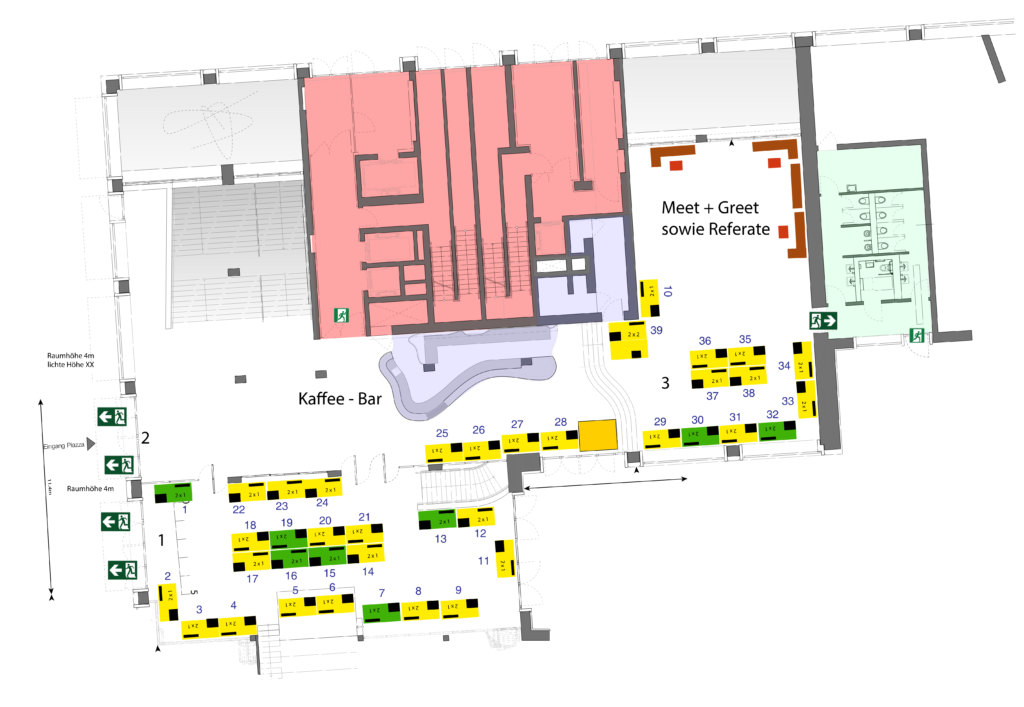
    Meet & Greet
    Also this year, providers, users and interested parties can exchange ideas at the symposium and seek direct contact with various software developers for the digital offerings. The latest software applications for the real estate industry will be presented by around 40 exhibitors. In addition, the “SVIT Digital” commission is launching a “Meet and Greet” for all visitors on this day. Specific digital concerns and questions can be discussed intensively directly with proven professionals on site and other users in order to develop efficient solutions. The practice-oriented specialist presentations are an additional highlight on the “SVIT Digital Day”. And the best part: access to the symposium and the presentations is free for everyone.

    Date: Friday, September 17, 2021
    Time: 11 a.m. to 5 p.m.
    Announcement Flyer Location: KOSMOS, Lagerstrasse 104, 8004 Zurich Arrival plan KOSMOS

    Admission is free for visitors.

    Subject presentations 2021
    1 2.00 a.m.
    Global Real Estate Run
    Mario Facchinetti, initiator

    12.00 p.m.
    Global Real Estate Run
    Mario Facchinetti, initiator

    1 p.m.
    Electronic signature in real estate practice
    Dr. Boris Grell, LL.M., lawyer; LAW FIRM GRELL

    Hall plan

    List of exhibitors 2021

    Stand Exhibitors
    number 1
    No. 2 Conreal Swiss AG
    No. 3 Schwyter Digital AG
    No. 4 FLOWFACT Schweiz AG
    No. 5 casavi GmbH
    No. 6 casavi GmbH
    No. 7
    No. 8 onOffice Swiss AG
    No. 9 Flatfox AG
    No. 10 GARAIO REM AG
    No. 11 Huperty AG
    No. 12 SVIT Digital
    No. 13
    No. 14 QualiCasa AG
    No. 15
    No. 16
    No. 17 immo! nvest
    No. 18 CreditTrust
    No. 19
    No. 20 Ormera AG
    No. 21 W&W Immo Informatik AG
    No. 22 WOONIG
    No. 23 WOONIG
    No. 24 goCaution AG
    No. 25 READY DATA
    No. 26 CreditTrust
    No. 27 NeoVac ATA AG
    No. 28 NeoVac ATA AG
    No. 29 Processfux AG
    No. 30
    No. 31 DesignRaum GmbH
    No. 32
    No. 33 Aandarta AG
    No. 34 Aandarta AG
    No. 35 ImmoScout24
    No. 36 eMonitor AG
    No. 37 eMonitor AG
    No. 38 ImmoScout24
    No. 39 immotrailer.ch – immotraffic.ch
  • Ina Invest has made millions in profit

    Ina Invest has made millions in profit

    Ina Invest closed the first half of 2021 with an operating result (EBIT) of CHF 3.1 million, the Implenia spin-off set up in spring 2020 informs in a message . The real estate company shows a net profit of 2.9 million francs.

    In the previous semester, a loss of just under 2 million francs was incurred. For 2020 as a whole, Ina Invest had already achieved a net profit of 3.9 million francs. With the result “again above expectations”, the company is building on “the successful previous year”, according to the announcement.

    The revaluation of investment properties achieved a profit of 3.8 million francs in the half-year under review. The total value of the real estate portfolio increased by CHF 19 million to CHF 385 million. Ina Invest explains that all of the properties currently being realized are on schedule. In the announcement, the real estate company highlights the tender high-rise in Winterthur. Here, 31 of the 39 apartments have already been sold or reserved.

    Ina Invest also acquired another property with a market value of more than 60 million francs in the six months under review. This means that the company has already exceeded its acquisition target for the year as a whole, the press release explains. Since the transfer of ownership will not take place until the current semester, the purchase will not yet affect the result in the half-year under review.

  • Swiss Life Asset Managers purchases in Oslo

    Swiss Life Asset Managers purchases in Oslo

    Swiss Life Asset Managers has taken over the real estate business of the Oslo-based investment company Ness, Risan & Partners ( NRP ). The acquired business area for commercial real estate and real estate funds with its 39 employees will in future operate under the Swiss Life Asset Managers brand.

    "With one of the leading providers of logistics real estate in the Nordic countries, we can strengthen our geographical presence in line with our strategy and further expand our position as a leading real estate manager in Europe", Stefan Mächler, CIO of the Swiss Life Group, is quoted in a press release. Nothing was known about the financial details of this transaction. It is expected to be completed in the fourth quarter.

    NRP has a strong network and knowledge of the Nordic commercial real estate market. Founded in 2000, the company manages a diverse portfolio of office, retail and industrial properties. At the end of 2020, NRP managed and managed assets worth the equivalent of 1.2 billion Swiss francs. In addition to the real estate industry, NRP is also active in the shipping and offshore sectors.

    Christian Ness, founder and managing partner of NRP, is certain to have found “the perfect partner for NRP”, “who has a strategic approach, financial strength, know-how and a network that makes this relationship more valuable than the sum total of the individual parts. "