Tag: immoNews

  • How researchers are turning concrete into a climate saver

    How researchers are turning concrete into a climate saver

    The EU project CARBCOMN, launched in 2024 and funded by Horizon Europe with around six million euros, is taking a radical approach. Instead of using more material, the researchers are optimizing the shape. The principle is called “compression dominant structures”: concrete components are designed in such a way that they are almost exclusively subjected to compression, similar to the arches of historic stone bridges. Concrete can withstand compression well, but hardly any tensile forces. If you make consistent use of this, you need less material and less reinforcement.

    Printed, not poured
    Digital production makes shapes possible that would be unthinkable with traditional formwork. The robot prints the concrete layer by layer and leaves cavities where no reinforcement is required, directly controlled by the digital model. This not only saves material, but also reduces the seismic load in proportion to the weight loss. This is a decisive advantage in earthquake-prone regions.

    No cement, no problem
    The concrete used in the CARBCOMN project contains no cement. Steel slag, a by-product of the steel industry, is used as a binding agent. After printing, the components are placed in a chamber in which CO₂ is injected. The reaction with the slag mixture hardens the concrete and permanently binds the greenhouse gas. The result is a building material with a negative CO₂ balance that is made exclusively from industrial waste.

    Metal with memory
    This concrete does not manage entirely without reinforcement, but with a specialty that Empa has been using for around 20 years: iron-based shape memory alloys (Fe-SMA). These pre-stretched metal rods contract during heating instead of expanding, thus subsequently pre-stressing the component. They are only inserted after printing, do not interfere with the automated process and can be separated from the concrete later. The Empa spin-off re-fer contributes this technology directly to the consortium.

    Built for dismantling
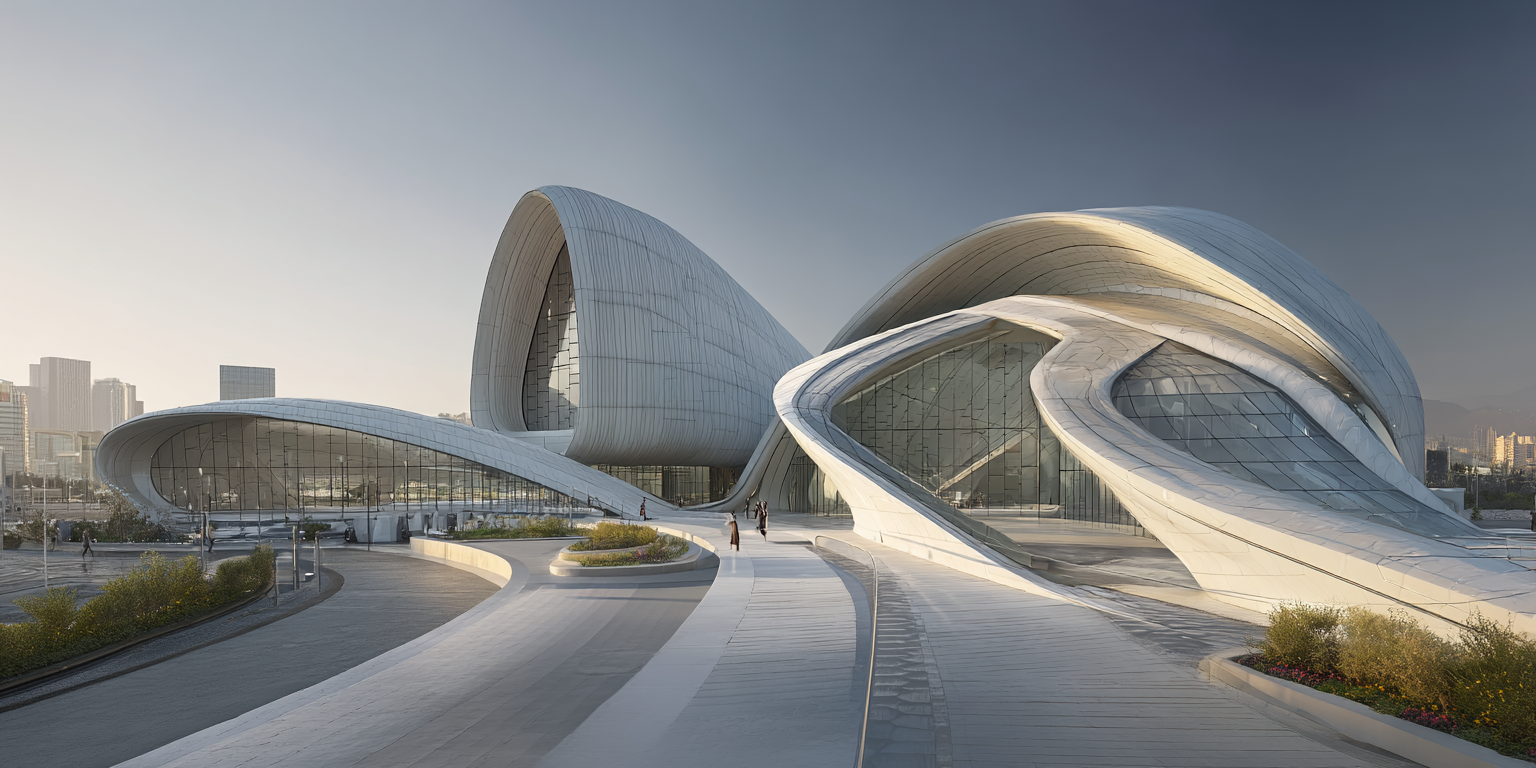
    What is built should also be able to be dismantled again. The individual concrete modules are designed as discrete blocks that can be detached, transported and reassembled elsewhere. Zaha Hadid Architects and Mario Cucinella Architects are working with the engineering teams to develop free-form structures that express this circular principle architecturally. By 2028, a real prototype will prove that concrete construction can also look like this.
  • Land belongs to everyone – except SBB owns it itself

    Land belongs to everyone – except SBB owns it itself

    At the end of the 1990s, Parliament separated SBB from the federal government. This gave it the freedom to manage its most valuable asset. Huge plots of land in prime locations throughout Switzerland. There were no clear specifications as to how many apartments should be built and at what prices. The Federal Council merely demanded that the proceeds flow into the pension fund and the railroad infrastructure. This was the birth of a system that is still a source of controversy today.

    3.5 billion for whom?
    Since 2003, CHF 3.5 billion has flowed from the SBB real estate portfolio into the railroad infrastructure. SBB sees this as a contribution to society. Carlo Sommaruga, SP member of the Council of States and President of the Swiss Tenants’ Association, takes a different view. SBB has “almost fully exploited” the financial value of its properties at the expense of the social component. It is particularly offensive that parts of these properties were once expropriated in favor of the former state-owned company.

    Europaallee as a mirror
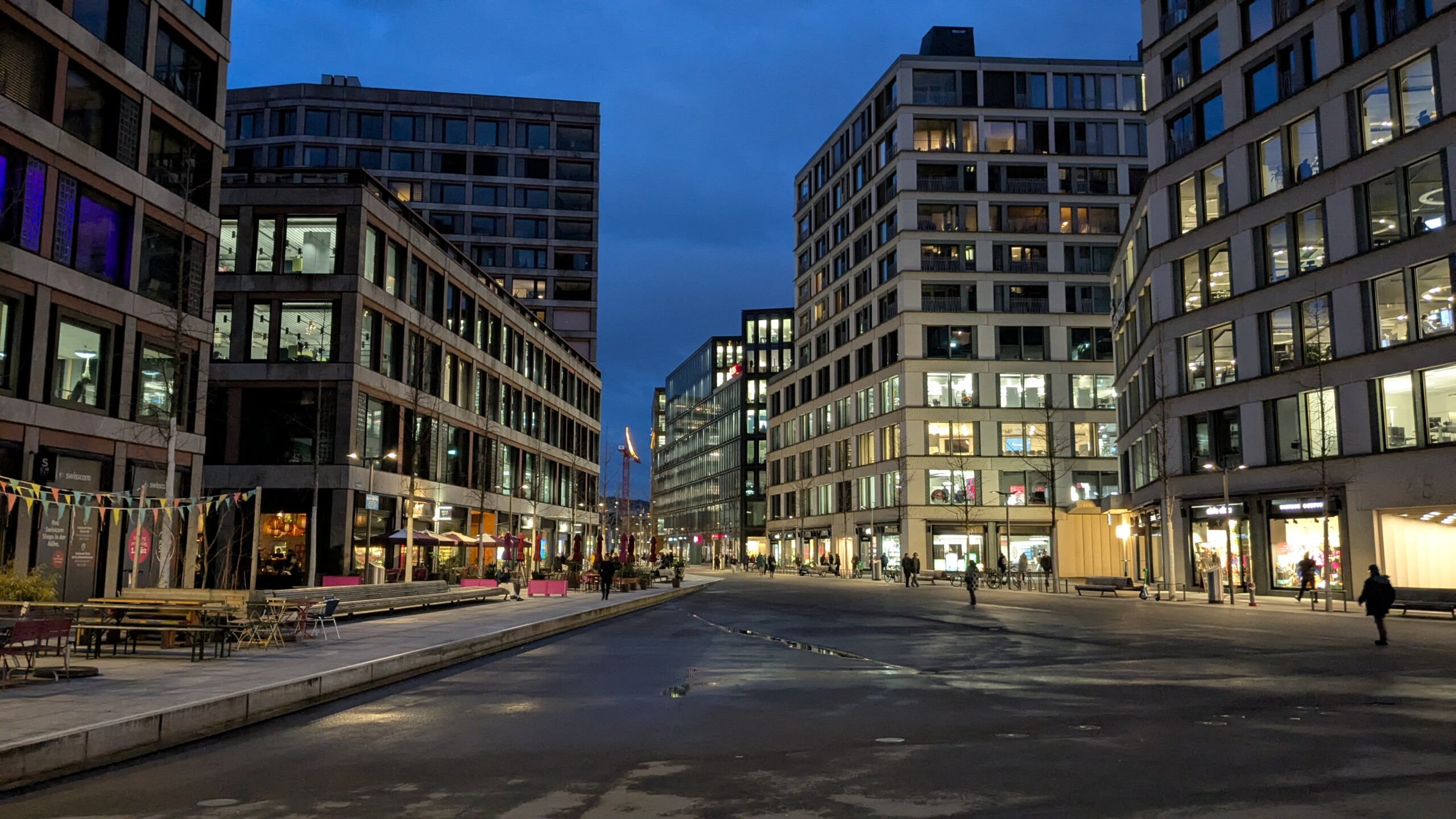
    The prime example is in the middle of Zurich. A 4-room apartment on Europaallee costs around CHF 5,000 per month. For the tenants’ association, the project has become a symbol of real estate speculation with public land. SBB counters that it is a fair landlord and that its apartments are on average below the market price. But the impression of maximum densification for maximum profits persists.

    Lausanne escalates
    In Lausanne, the conflict is coming to a head. The “La Rasude” project right next to the train station is set to accommodate around 500 residents and 1,200 jobs. However, only 20 percent of the living space is earmarked for moderate rents, even though SBB officially promises to rent out more than half of its apartments at low prices. The result is now almost 1000 objections. Construction work could start in 2029 at the earliest.

    The framework is lacking
    Salomé Mall, Head of Development at SBB Real Estate, emphasizes that the profits are used for rail operations and relieve the burden on the public purse. The argument is understandable, but falls short. As long as there are no legal requirements for housing shares and rents, the orientation towards the common good remains voluntary.

  • Ein Quartier ohne Einsprache

    Ein Quartier ohne Einsprache

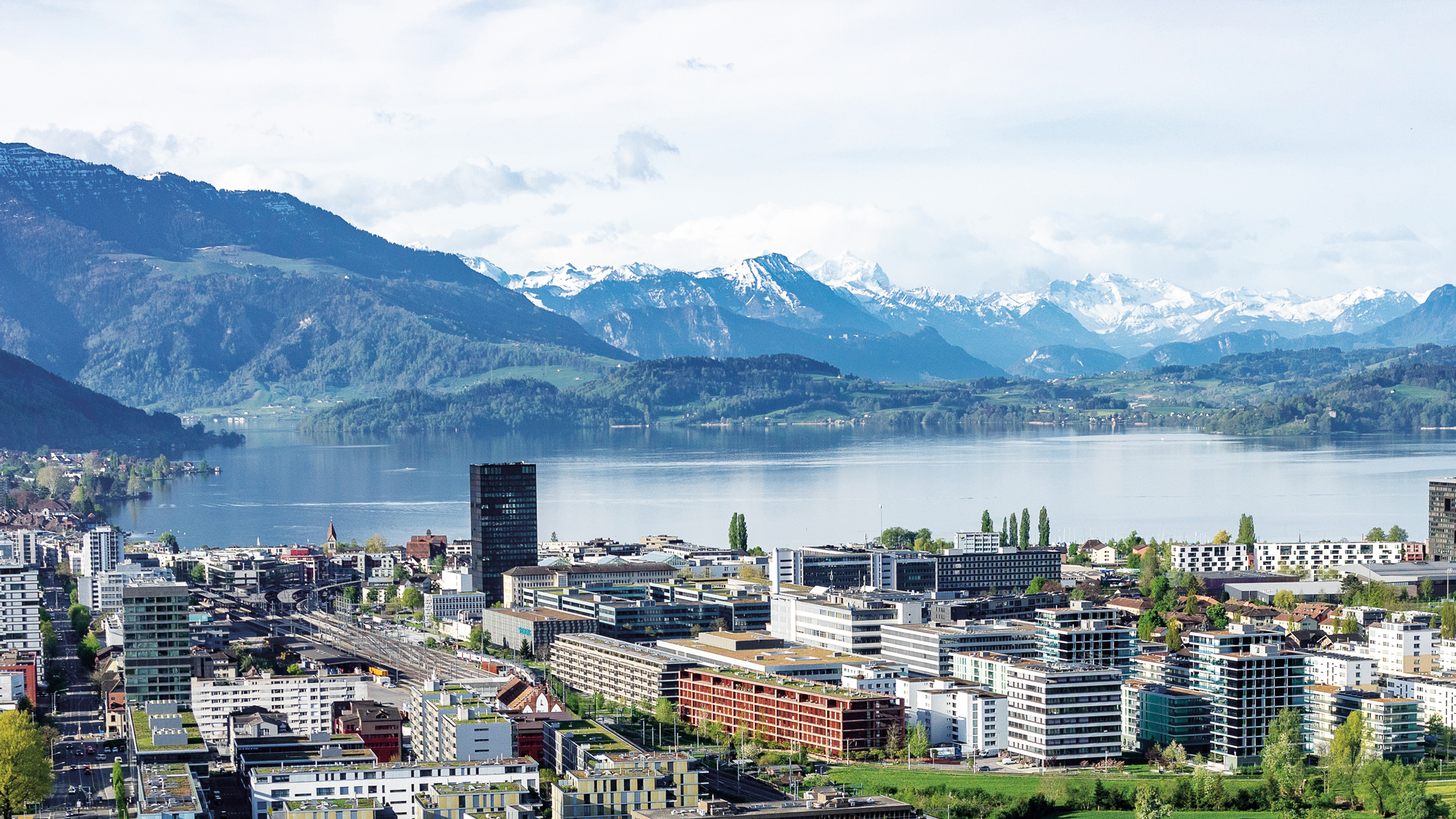
    Der Luzerner Regierungsrat genehmigte den Bebauungsplan Schützenmatt im Januar 2026. Der Emmer Einwohnerrat hatte ihn bereits am 1. Juli 2025 in zweiter Lesung einstimmig verabschiedet. Nach Ablauf der Beschwerdefrist liegt nun Rechtskraft vor, kein einziger Rekurs wurde eingereicht. Das ist bei einem Projekt dieser Grössenordnung keine Selbstverständlichkeit, sondern ein Zeichen breiter Akzeptanz.

    250 Wohnungen, 4000 Quadratmeter Leben
    Auf dem Areal entstehen rund 250 Wohnungen in verschiedenen Grössen sowie Gewerbe-, Gastronomie- und Dienstleistungsflächen von insgesamt rund 4000 Quadratmetern. Der Wohnungsmix reicht von kleineren Einheiten über Familienwohnungen bis zu Alterswohnungen . Bewusst konzipiert für alle Lebensphasen und verschiedene Einkommensstufen. Ein Teil der Wohnungen muss als preisgünstiger Wohnraum realisiert werden.

    Weniger Auto, mehr Velo
    Das Mobilitätskonzept setzt klare Prioritäten sodass Fuss, Velo und öffentlicher Verkehr Vorrang haben. Geplant sind über 970 Veloabstellplätze, darunter eine gedeckte, öffentlich zugängliche Velostation mit mindestens 300 Plätzen direkt an der Bahnhofunterführung. Für Autos stehen maximal 120 Parkplätze in der Tiefgarage bereit. Die Velohauptroute entlang der Gleise wird kreuzungsfrei geführt. Somit entfallen Konflikte mit dem Fussgängerverkehr.

    Die Stadt als Schwamm
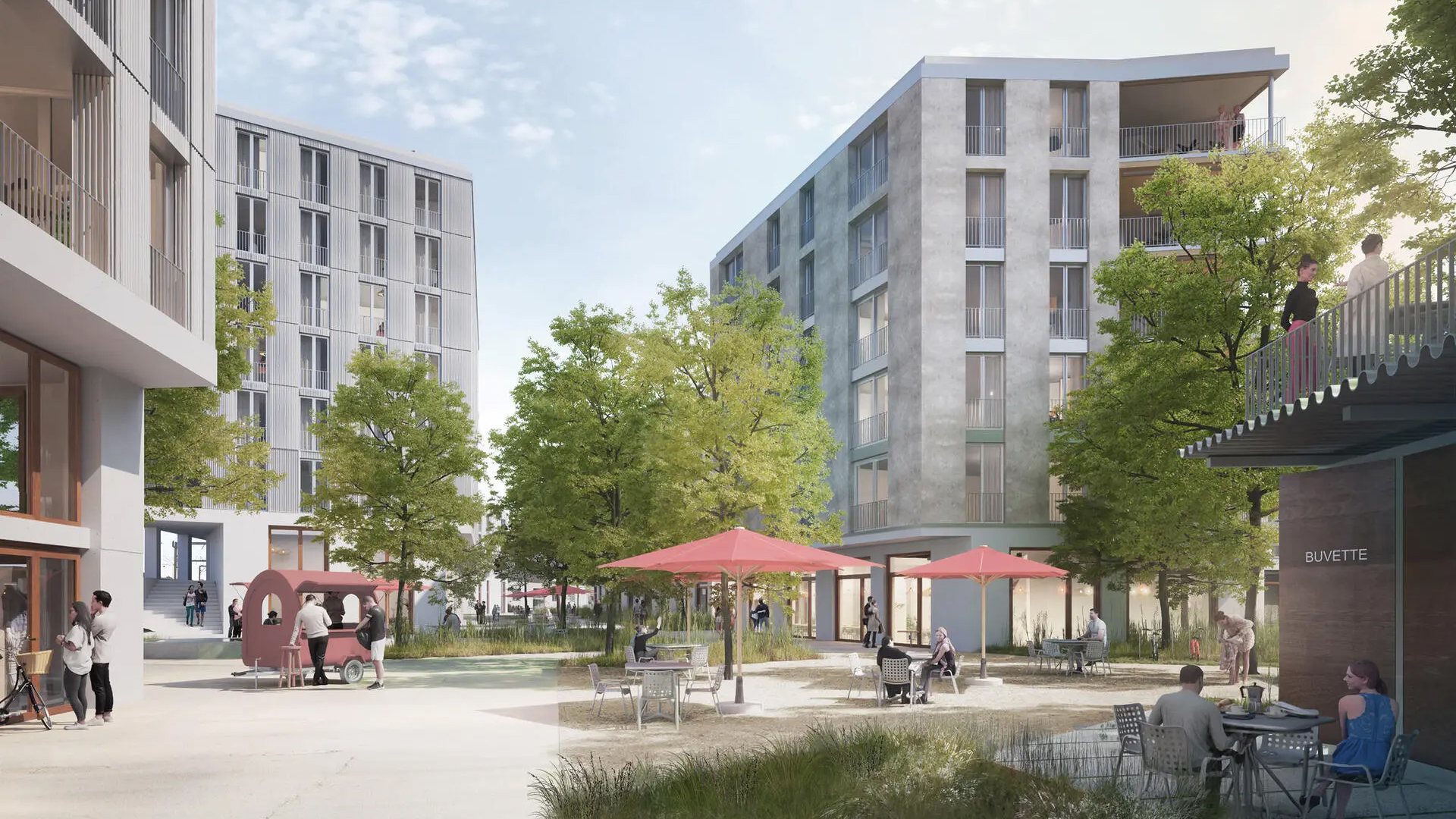
    Das städtebauliche Konzept stammt von Fischer Architekten, deren Wettbewerbsbeitrag mit dem ersten Preis ausgezeichnet wurde. Im Zentrum steht das Schwammstadtprinzip. Sickerfähige Beläge, Bäume auf natürlichem Boden und begrünte Dachflächen speichern Regenwasser und geben es kontrolliert wieder ab. Mindestens 60 Prozent der Dachflächen werden intensiv begrünt. Das verbessert das Mikroklima und macht das Quartier klimaresilient.

    Ab 2027 wird gebaut
    Mit der Rechtskraft liegt die Umsetzung nun bei den Grundeigentümerschaften. Die Realisierung ist in vier Etappen geplant, ein Bezug der ersten Wohnungen ist ab rund 2030 realistisch. Christine Bopp, Leiterin Planung der Gemeinde Emmen, spricht von einem abgeschlossenen langen Planungsprozess, der nun Planungssicherheit für alle Beteiligten schafft. Emmenbrücke bekommt sein neues Herz und baut es mit Bedacht.

  • Artificial intelligence: Absolutely, but..

    Artificial intelligence: Absolutely, but..

    Whether the English “AI” or the German “KI” – artificial intelligence is currently omnipresent. How its impact is assessed depends heavily on the perspective of the individual: For some, the opportunities outweigh the risks, while others primarily see risks. However, one thing is undisputed: the technology is here to stay.

    For us as a digital real estate platform, an open approach to technological innovation has always been part of our DNA. With ImmoScout24 and Homegate, we have been actively shaping the real estate market for over two decades. Our principle also applies here: AI must not be an end in itself, but should act as an unprecedented “enabler”. After all, the true potential of these two letters lies in the accelerated development, smart expansion and enhancement of innovative products that can create real added value and achieve daily efficiency gains.

    In the professional real estate sector in particular, the benefits of AI can be seen in its productive integration into existing, established processes. While this enables us as platforms to develop market-oriented products in a more agile way, it creates new efficiency gains for brokers and property managers in their day-to-day operations. The decisive factor is not the technology itself, but its real contribution.

    Two examples from the SMG Real Estate ecosystem illustrate this:

    • Our AI-based listing text creation saves an average of 14 minutes per listing. Extrapolated to an entire portfolio or a marketing campaign, this results in a substantial gain in productivity. The time saved can be invested specifically where it makes the biggest difference – in consulting, negotiation and customer relations. Anyone who instead advertises on ImmoScout24 or Homegate as a private individual can use this new intelligent function to partially compensate for a lack of marketing experience.
    • The new “Insight Hub” for real estate professionals provides AI-driven answers to questions about the potential and performance of listings that were previously difficult to narrow down. Every week, real estate agents and managers receive an overview of the listings with the greatest potential for improvement, including specific recommendations for action and the expected increase in visibility.

    This is just a small excerpt, plus numerous current developments at SMG Real Estate, including “Agentic AI”, a digital companion for real estate professionals in their day-to-day work – from the transcription of meeting notes to seamless CRM integration. But more on that in the near future. At the same time, technological innovation requires continuous investment – especially in cybersecurity. After all, it’s not just the right players who benefit from AI. State-of-the-art protection mechanisms, two-factor authentication, integrated access controls, etc. are essential to secure data and effectively prevent attempted fraud. Trust remains the central currency in the real estate market – especially in the digital one.

    But thanks to these targeted, ongoing investments in AI applications, we at SMG Real Estate are actively continuing to shape our role as the “digital shaper” of the Swiss real estate industry. Our goal is and remains first and foremost to make real estate professionals not only more efficient, but also more successful in the long term. This is also what our vision stands for: “Next-Gen Swiss Real Estate – digital and simple.”

  • The turnaround is real USZ turns positive

    The turnaround is real USZ turns positive

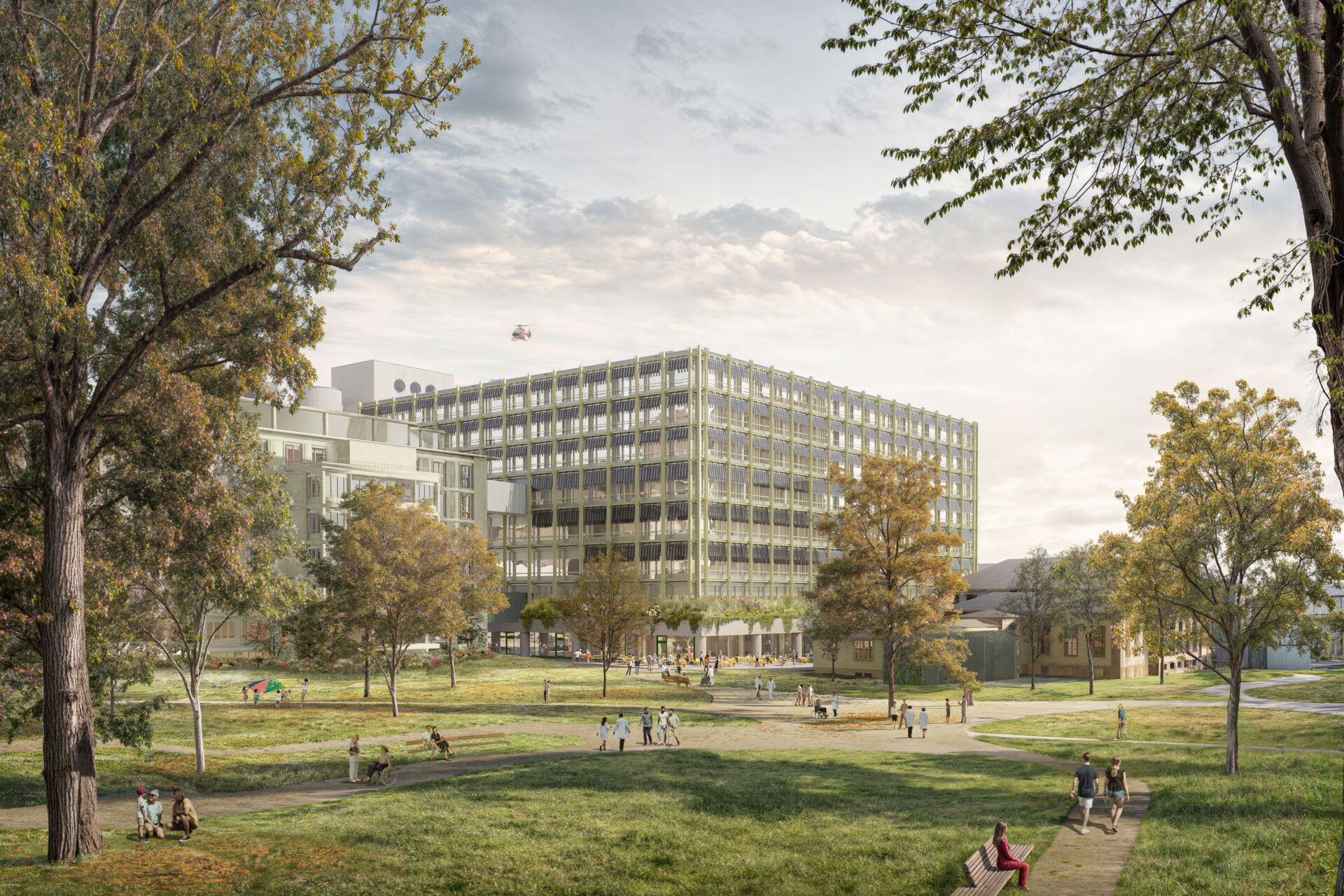
    Anyone driving through the Hochschulquartier will see it immediately. Cranes. Building pits. Large construction site. Campus Mitte is being built and with it the ambition to redefine cutting-edge medicine in the long term. The investments are underway. The question has long been, how will the balance sheet support this? Now there is an answer.

    The turnaround is real
    36 million francs profit. For the first time since 2019. A year earlier, a loss of 31 million francs. The contrast is clear and the direction is right.
    Inpatient cases rose by just under 3 percent, outpatient visits by 5 percent to around 882,000. More patients, better capacity utilization, more consistent processes. The result is no coincidence. The turnaround is real. The work has only just begun.

    Digitalization is paying off
    Since CEO Monika Jänicke took the helm in 2023, the clear strategy “USZ 2030” has been in place. More efficient processes, greater digitalization, focused medicine. The EBITDA margin rose from 2.9 to 6.6 percent. Strong, but not yet at the finish line. As the owner, the canton is demanding 10 percent. At the same pace, this can be achieved in 2026. The target for the equity ratio, just under 40%, has already been met.

    The canton is moving with
    Investments are running in parallel with the increase in earnings. Around CHF 100 million was invested in real estate in both 2023 and 2024. The canton is supporting the project and is borrowing CHF 690 million on the capital market. This at better conditions than the hospital itself would ever receive and passes the money on.
    The retained earnings, which fell to under 200 million francs in 2024, have now risen again to around 230 million francs. The cushion is growing.

    Not just the USZ
    The positive trend is not an isolated case. Winterthur Integrated Psychiatry closed 2025 with a profit of CHF 1.8 million. After red figures in the previous year. Patient numbers up 5 percent. This shows that cantonal healthcare institutions are responding to cost pressure with structure, efficiency and clarity.

  • Regensberg fights for survival

    Regensberg fights for survival

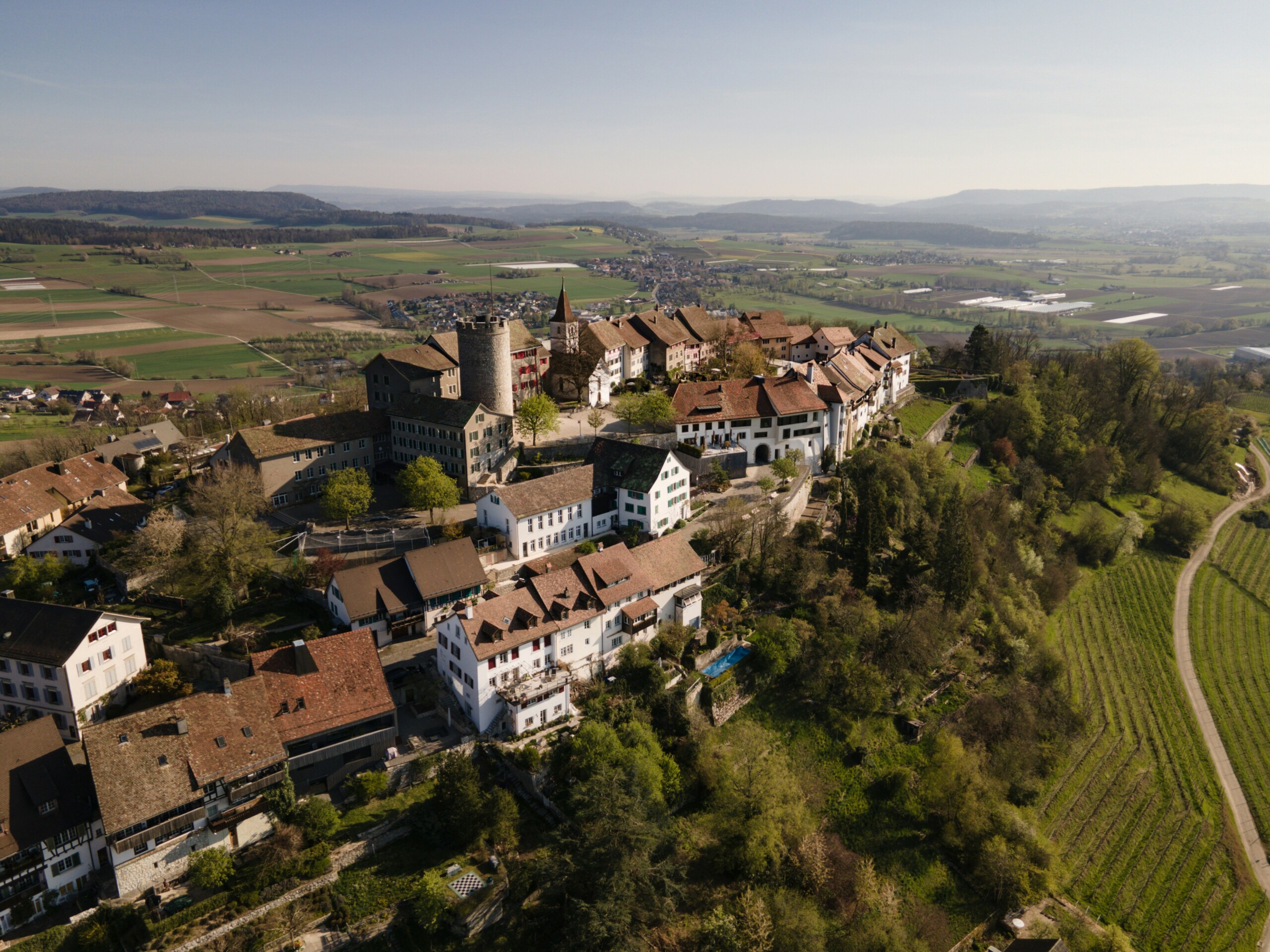
    Regensberg has exactly 477 inhabitants at the end of 2024. Despite two tax increases in recent years, there is not enough revenue to finance the municipality’s tasks. The structural deficit threatens the independence of the medieval country town on the rocky spur above Dielsdorf. A merger with a neighboring municipality is on the cards, a scenario that many Regensberg residents want to avoid.

    A meadow as a turning point
    The impetus came in April 2024 at a Future Day, where the population openly discussed the fate of their municipality for the first time. On the agenda was the Pünt meadow, the last major building site in the village. This discussion gave rise to the idea of a cooperative. In July 2025, the Pünt Regensberg building cooperative was officially entered in the commercial register.

    40 apartments, 80 new people
    The project, a four-storey building with 41 apartments, is to be built on the Pünt, around three quarters of which will be large family apartments with 4.5 to 5.5 rooms, the rest smaller units with 2.5 to 3.5 rooms. The cooperative anticipates 60 to 80 new residents. For a community the size of Regensberg, this corresponds to a population increase of around 15 percent. A competition to find the project team was held back in 2025.

    More than taxes
    The goal is not just fiscal. Regensberg has the fourth-highest average age of all Zurich municipalities. Younger families should come and thus also secure the elementary school, because without a school there are no families and without families there is no village life. The flexible usage concept also allows older people to move from their single-family home to a suitable smaller apartment without having to leave the village.

    non-profit instead of speculative
    If the project had ended up in private hands, the apartments in the attractive location would have primarily been investment properties. In contrast, the cooperative lets on a cost-rent basis, i.e. without the intention of making a profit. The project is being financed via share certificates, member loans, state subsidies and bank mortgages, with a target equity ratio of 35 to 40 percent.

    the cranes will rise in 2028
    Because Regensberg is listed in the federal inventory of sites worthy of protection, particularly strict conditions apply to construction. The building permit is due to be issued in 2027, with construction scheduled to start in 2028. The first apartments could be occupied one or two years later. Whether the cooperative can solve the structural deficit on its own remains to be seen. But it proves that sometimes a village saves itself.

  • When the state becomes an accomplice

    When the state becomes an accomplice

    Two houses, around 5000 square meters, directly on the shores of Lake Aegeri in the canton of Zug. Wüest Partner estimated the value at CHF 27 million. The property was sold in 2017 for CHF 16 million, around CHF 3300 per square meter. At the same time, comparable properties changed hands for between 6,000 and 13,500 francs.

    A bargain or a crooked deal
    The owner had made provisions. Her property was part of a holding structure. 45 percent to each child, 10 percent to the granddaughter. But the brother acted behind his sister’s back. The sale was sealed in less than 100 days, without a public tender, without a bidding process, without the sister’s consent. She found out about it a month after the contract was signed and immediately filed a criminal complaint.

    When 9 million finds no explanation
    The buyer paid 16 million and received an unsecured loan of up to 25 million from Zuger Kantonalbank, a difference of 9 million. Internally, the bank valued the property significantly higher than the purchase price would suggest.
    Today, the buyer is in the dock for money laundering. He is said to have known that the sale was based on serious injustice.

    When a commission remains silent
    The case grew beyond the courtroom. In the summer of 2025, the Zug Cantonal Council set up a PUK to investigate the role of the cantonal government. The focus was on faulty land register inspections. The notary responsible pushed the matter forward without any legal grounds for recusal and evaded the crucial questions during questioning.

    When justice takes time
    Nine days of hearings until the end of March. Presided over by Judge Svea Anlauf. A verdict in June at the earliest. The presumption of innocence applies to all defendants.

    Lake Aegeri glistens. What comes to light in the courtroom during these weeks could keep the canton of Zug busy for a long time to come.

  • AI as a competitive factor in the real estate industry

    AI as a competitive factor in the real estate industry

    Why the breakthrough is possible right now
    Current market analyses show a clear picture: AI has arrived in the industry. As part of an industry-wide market analysis, 55 AI solutions were examined and 24 specific use cases for the construction and real estate industry were derived. The study showed that most solutions can be found in the utilization and operation phase.

    The reason is obvious: large amounts of data are generated during operation, processes are recurring, efficiency pressure is high and sustainability targets are ambitious. This is where AI is already delivering measurable added value.

    In the planning phase, however, AI solutions have so far only been available in isolated cases. This is surprising in that there is a lot of potential for the use of AI in this phase in particular, for example in areas such as energy consumption and operating costs.

    Three areas of benefit that can make all the difference
    PLANNING & DEVELOPMENT
    Still little used, but strategically highly relevant. AI can optimize construction and resource plans or support operational processes on the construction site. In times when operational efficiency is becoming increasingly important, such tools could make all the difference.

    OPERATIONS & MANAGEMENT
    The current playing field of AI. From automated control of technical systems to optimized cleaning and waste processes and digital customer communication. Contract reviews and data management are also increasingly being supported by AI. This is already achieving a measurable boost in productivity.

    PORTFOLIO, INVESTMENT & STRATEGIC MANAGEMENT
    For owners, investors and portfolio managers, the added value lies more at the management and analysis level: data-based valuation models, portfolio analyses or the identification of CO2 savings potential enable well-founded decisions and thus strategically optimized management of real estate portfolios.

    What successful AI projects really need
    Artificial intelligence is not a sure-fire success. Three factors determine success or failure:

    • Data basis & governance: without clean, structured data, AI tools remain ineffective. Companies need to analyse their data quality, processes and IT infrastructure and optimize them if necessary.
    • Strategic anchoring: It is not the technology that should drive the use of AI, but a clear, strategic goal such as increasing efficiency, reducing costs, sustainability or portfolio optimization.
    • Realistic expectations & suitable implementation strategy: Many of the solutions identified are still at the pilot stage. A step-by-step approach, for example using low-code platforms or proven tools, can help to gain initial experience and then scale up.

    Conclusion: Shaping the future instead of waiting
    Artificial intelligence opens up many opportunities for the real estate industry: it can make processes more efficient and decisions more informed, reduce operating costs, promote sustainability and strategically manage portfolios. For organizations that consciously and strategically invest in AI today, it will become a differentiating factor across all phases of the real estate life cycle. However, the key lies not in the technology, but in a clear vision, a solid data foundation and appropriate implementation.

  • Digital Agenda connects events in the Limmat Valley

    Digital Agenda connects events in the Limmat Valley

    Limmatstadt AG has launched a joint digital events calendar in collaboration with municipalities and business associations in the Limmat Valley. Events relating to business, culture, sport, clubs and municipalities are recorded centrally and then automatically published on various channels and displayed collectively on the Limmatstadt website. According to a press release, the initiative aims to raise the profile of the region, exploit synergies, reduce administrative costs and strengthen and further develop the Limmattal region as a place to live and do business.

    “With the digital event calendar, we are highlighting everything the Limmat Valley has to offer – and at the same time strengthening cooperation in the region,” said Stephanie Kiener, Managing Director of Limmatstadt, in the press release.

    The technical basis for the calendar is the guidle platform. Event organisers enter their events once in a central location. These then appear on the regional calendar and, depending on the connection, on the websites of the respective municipalities and partner and media platforms. The solution thus creates transparency and visibility and enables simpler processes and efficient use of resources without overlaps.

    The digital event agenda was supported and financed by the municipalities of Aesch, Dietikon, Geroldswil, Oetwil an der Limmat, Oberengstringen, Schlieren, Spreitenbach, Uitikon, Unterengstringen, Urdorf and Weiningen, as well as the Dietikon Industry and Trade Association and the Schlieren Chamber of Commerce.

    “The new digital event calendar brings the Limmattal region even closer together – visible, connected and strong together,” the press release states.

  • New Head of Market and Policy at the Solar Association

    New Head of Market and Policy at the Solar Association

    According to a statement, Wieland Hintz has been head of market and policy at Swissolar since 1 March and is also its deputy managing director. The 45-year-old was previously responsible for solar energy at the Federal Office of Energy.

    Hintz studied physics at the Swiss Federal Institute of Technology in Zurich and earned his doctorate at the CERN nuclear research centre in Geneva. He has worked for Alpiq and the Association of Swiss Electricity Companies, among others. Together with his family, he operates six wind turbines and a solar park with a capacity of 1.2 megawatts in Germany.

    Hintz replaces David Stickelberger. Now 65, Stickelberger was the first managing director of swissolar from 1998 to 2023. Since 2023, he has been deputy to his successor Matthias Egli. In future, he will support the association as senior policy advisor.

    “Over the past ten years, photovoltaics has become a mainstay of Switzerland’s electricity supply, now covering over 15 per cent of electricity consumption,” Hintz is quoted as saying in the press release. “In my new role at Swissolar, I will devote all my energy to ensuring that photovoltaics is optimally integrated into the Swiss energy system and to driving forward the decarbonisation of buildings and transport.”

    Swissolar has created a new position of Director for French-speaking Switzerland. This will be filled by Anne Plancherel. She has been working since 2024, both as a strategic project manager and in setting up vocational training in western Switzerland. Plancherel will represent Swissolar in western Switzerland and further expand the regional network.

    The 44-year-old environmental engineer studied at the Swiss Federal Institute of Technology in Lausanne and continued her education in project management at the University of Geneva. “I am very much looking forward to working with our members, partners and authorities to further expand the potential of solar energy in French-speaking Switzerland and to strengthen the industry in the long term,” she is quoted as saying in the press release.

  • Digital tool assesses sustainability of events

    Digital tool assesses sustainability of events

    The Swiss Association for Sustainable Events (SVNE), based in Basel, has further developed its Clean Event platform. Under the new name Eventkit, it offers a uniform tool for planning and evaluating the sustainability of events. This tool can be used by both organisers and the approving authorities. According to a press release, the bilingual Eventkit platform also integrates the KITmanif platform, which was developed by the city of Lausanne and the canton of Vaud.

    Eventkit uses criteria formulated by experts in cities, cantons, federal offices and partner associations to evaluate events. These are grouped into clear categories ranging from management and communication, catering, traffic and transport, materials and waste, nature and landscape, health and prevention, inclusion and equal opportunities to the economy.

    A maximum of 340 points are awarded in total. 31 of the 58 criteria are scored with four points, while 27 criteria count double.

    The circular economy plays a central role. For example, catering is also assessed on the basis of whether there is a concept in place to avoid food waste. This includes avoiding disposable products and distributing free samples or flyers, as well as ensuring the return of reusable and recyclable disposable containers. Any damage to natural areas is repaired. Preference is given to the regional economy.

    Thanks to broad support, Eventkit is available free of charge to all interested event organisers. “With Eventkit, we are creating the first Switzerland-wide standard with target values that motivate events to gradually strengthen their sustainability,” SVNE President Marianne Gehring is quoted as saying in the press release.

  • AI and sensor technology are transforming concrete production

    AI and sensor technology are transforming concrete production

    Sika AG has entered into a distribution partnership with Canadian company Giatec Scientific Inc. Giatec’s range of digital technologies for the construction sector is to be integrated into Sika’s global product portfolio, according to a statement issued by the Zug-based specialty chemicals company. The aim of the business agreement is to drive forward digitalisation in the concrete industry worldwide.

    Giatec Scientific Inc., headquartered in Ottawa, Ontario, is a global provider of sensors, software solutions and artificial intelligence (AI)-powered data analysis systems. The use of digital technologies in construction is on the rise. According to the press release, this is demonstrated by figures from the global market research and consulting firm Fortune Business Insights. According to these figures, the global market for AI in the construction industry is expected to grow from CHF 4.7 billion in 2026 to CHF 27.5 billion by 2034. This corresponds to an average growth rate of 24.8 per cent per year.

    Sika and Giatec want to combine their strengths to provide customers with high-quality concrete data in real time, according to the announcement. “By combining the most advanced technologies, we are opening up new opportunities for our customers worldwide in terms of efficiency, quality and sustainability. At the same time, we are strengthening our ability to create additional value through digital innovation,” said Ivo Schädler, Head of Construction and member of the Group Executive Committee.

    AI-supported quality control and optimisation of concrete mix designs would offer the construction industry the opportunity to precisely optimise the amount of cement and aggregates used. This would enable efficiency gains, cost savings and CO2 reductions while simultaneously increasing performance on the construction site.

  • New factory site combines energy and network expertise

    New factory site combines energy and network expertise

    CKW AG plans to relocate business divisions from the Reussbühl district of Lucerne to Reussinsel in Emmen, where it will also establish the company’s new headquarters, according to a press release. The Axpo subsidiary intends to use this move to consolidate its activities.

    At the heart of the project, known as EnergiePark Emmen, is the construction of a new building for the Networks and Building Technology divisions. CKW’s network base, which will be built there, will be responsible for the construction, operation and maintenance of the electricity grid in the greater Lucerne area. The new building will provide modern workplaces for employees. After several years of planning, the Compact project by Penzel Valier AG from Zurich and Maurus Schifferli Landscape Architects from Bern was awarded the contract to build the new company headquarters.

    Reuss Island is the historical birthplace of CKW, where the first power plant supplied electricity to the region in 1894. “With the planned relocation of our headquarters to Emmen, we are building on these roots and committing ourselves to Emmen as a location in the long term,” said Martin Schwab, CEO of CKW, in the press release. The relocation of the business divisions and headquarters to Emmen will mean that 1,000 employees will work on Reuss Island in future, instead of the previous 600.

    In the coming years, a development plan based on the draft project will be drawn up by the municipality of Emmen. “Together with the municipalities of Emmen and Ebikon, we want to further develop the Reuss island in the interests of all parties involved,” Schwab continued. According to the current status, construction projects could be approved and implemented from 2030, according to the press release.

  • New logistics centre to be built in Hunzenschwil

    New logistics centre to be built in Hunzenschwil

    ERNE AG Bauunternehmung from Laufenburg is constructing a modern logistics centre for Lagerhäuser Aarau AG in Hunzenschwil, according to a press release. The new industrial building comprises a high-bay warehouse and office space. The 130-metre-long and 100-metre-wide building has a total volume of 364,043 cubic metres.

    The schedule for the shell construction is clearly defined: completion is scheduled for 9 December 2026. Halfway through the construction period, the building must already have reached its full height in the high-bay warehouse area. In order to meet these requirements, ERNE is relying on digital construction processes and a virtual overall model (Virtual Design and Construction), which maps all construction stages in detail. This enables construction processes to be planned precisely, trades to be optimally coordinated and interfaces and potential conflicts to be identified at an early stage.

    Around 50 employees and four Wolff WK 7534 cranes are in operation every day on the large construction site. For the concreting work, around 31,000 cubic metres of concrete are produced and processed on site with the aid of a mobile concrete plant, including water drainage. Once the foundation work has been completed, the walls and ceilings of the centre will follow. Once the floor slab has been completed, one of the 120 ceiling stages, each covering an area of 300 to 350 square metres, will be concreted every other day on average. The structural connection between the new building and the existing building will complete the shell construction work.

    Once completed, the extension will not only meet the growing demand for flexible storage and logistics solutions, but will also set new standards in automation, energy efficiency and sustainable construction, according to the announcement.

  • Temporary construction specialist expands into the Western Balkans

    Temporary construction specialist expands into the Western Balkans

    Hüttwilen-based Nüssli has opened its own office in the Serbian capital Belgrade. With this initiative, the company, which specialises in temporary structures, aims to expand its presence in the Western Balkans. According to a press release, the office opening also serves to prepare for Expo 2027, which will take place in Belgrade from 15 May to 15 August 2027.

    The theme of Expo 2027 will be: Play for Humanity – Sport and Music for All. With its experienced teams, Nüssli offers to support countries and organisations as a comprehensive partner from the conception to the realisation of pavilions and projects. The Thurgau-based company offers pavilion architecture, exhibition design and special solutions such as façade designs, sculptures and exhibits that can showcase countries’ presentations visually and spatially.

    Nüssli was responsible for five country pavilions at Expo 2025 in Osaka. Four of them received the Official Participant Awards from the Bureau International des Expositions (BIE) at the end of the Expo.

  • Telecommunications provider strengthens regional digital infrastructure

    Telecommunications provider strengthens regional digital infrastructure

    Datapark AG, based in Wil, has been part of EKT Holding AG, based in Arbon, since 23 February. The Thurgau-based energy supplier is also considering a merger with EKT and the integration of Datapark into its Digital Services division. The eleven jobs in Wil will be retained.

    As an internet service provider, Datapark has its own backbone as part of the internet in eastern Switzerland. It offers services for cable network operators, including network planning, internet connectivity, site networking and customer management systems.

    Datapark was founded in 1997 by André Otto and taken over by Martin Kaiser in 2020. With the takeover of the company by EKT Holding, Kaiser is now arranging his own succession. “The integration into the EKT Group offers several positive factors,” he is quoted as saying in the announcement. “On the one hand, we can further expand our strengths in operations, network technology and specialised solutions, and on the other hand, we benefit from the strong market position of the EKT Group. Together, we are creating an even more powerful, regionally anchored digital offering for our customers.”

    Andreas Plüer welcomes Datapark to the EKT Group. “With this long-established company, we are gaining a partner that has been setting standards in network technology, operations and customer service in eastern Switzerland for years,” the head of EKT’s Digital Services business unit is quoted as saying in the press release. Following the takeover, the EKT Group now employs 200 people.

  • Power generator continues to invest in flexible energy production

    Power generator continues to invest in flexible energy production

    According to a statement,Alpiq achieved net sales of CHF 5,920 million in 2025. In the previous year, this figure was CHF 6,366 million. Adjusted earnings before interest, taxes and depreciation amounted to CHF 572 million, CHF 310 million less than in the previous year.

    The Lausanne-based electricity producer attributes the significant decline primarily to the unplanned outage of the Gösgen nuclear power plant, in which it holds a 40 per cent stake. The nuclear power plant has been off the grid since May 2025 due to the modernisation of its water supply system. Energy trading generated a negative result of CHF 35 million in 2025. In the previous year, it had achieved a positive result of CHF 30.1 million.

    Alpiq’s financial position is strong, with an equity ratio of 61 per cent. The company is therefore focusing on further investments in its growth areas and is paying a dividend of CHF 230 million.

    “We are positioning Alpiq for the future: our strategy is focused on flexibility, modernising power plants and customer-oriented energy solutions,” CEO Antje Kanngiesser is quoted as saying in the press release. “This will consolidate our contribution to the future of energy in Europe.”

  • Building materials industry records profitable growth

    Building materials industry records profitable growth

    According to a statement, the Zug-based building materials group Holcim achieved annual sales of CHF 15.7 billion in 2025, representing growth of 3.0 per cent in local currency. Recurring EBIT (earnings before interest and taxes) rose to CHF 2.88 billion (10.3 per cent). The recurring EBIT margin improved by 80 basis points to an “industry-leading” 18.3 per cent. Earnings per share before impairment and disposals increased by 5.0 per cent to CHF 3.22. There were sharp declines in consolidated profit (-73.4 per cent to CHF 387 million) and earnings per share (-73.1 per cent to CHF 0.70). This was “characterised by a non-cash effect caused by exchange rate changes on the divestment of Holcim’s business in Nigeria”.

    Profitable growth accelerated particularly in the fourth quarter. Recurring EBIT increased by 12.2 per cent to CHF 601 million in local currency. Quarterly sales amounted to CHF 3.82 billion, representing growth of 3.4 per cent in local currency.

    By product line, Building Materials recorded organic sales growth of 5.1 per cent to CHF 11.56 billion. Building Solutions, on the other hand, posted an organic sales decline of 1.6 per cent to CHF 5.85 billion.  Regionally, Europe saw a decline in sales (organic -2.4 per cent), while recurring EBIT rose by 7.4 per cent to CHF 1.47 billion. The margin was 17.0 per cent. In Latin America, sales grew organically by 4.9 per cent to CHF 3.09 billion, while recurring EBIT declined slightly by 0.5 per cent organically. In Asia, the Middle East and Africa, sales grew organically by 10.0 per cent to CHF 3.62 billion. Recurring EBIT rose organically by 20.5 per cent, with the margin reaching 24.6 per cent.

    An important growth driver for Holcim in 2025 was the 21 transactions completed, 18 of which had a value-enhancing effect. In the announcement, CEO Miljan Gutovic thanked the 45,000 employees: “Together, we have achieved all our goals for 2025.” For 2026, the Group expects organic revenue growth of 3 to 5 per cent and an organic increase in recurring EBIT of 8 to 10 per cent. The company also expects a further improvement in the recurring EBIT margin.

  • Federal government conducts consultation on location promotion

    Federal government conducts consultation on location promotion

    The Federal Council has opened a consultation process on the message on location promotion for the first time. According to a statement, it is set to run until 1 June 2026. The Federal Council is submitting five financing decisions to Parliament for the years 2028 to 2031, with a total volume of CHF 392.21 million. Location promotion is to be carried out through SME policy, tourism policy, regional policy, export promotion and location promotion.

    The focus is on three key areas of location promotion: reducing the administrative burden on SMEs through digitalisation, facilitating SMEs’ access to international markets and, finally, strengthening the regions economically. Among other things, the expansion of the EasyGov.swiss platform will create a marketplace for digital services provided by the federal government and the cantons. With regard to international markets, the federal government supports export-oriented companies with information, advice and the use of export risk insurance. In the area of regional location promotion, the federal government supports tourist destinations and economic projects in rural areas, mountain regions and border regions.

    Despite the high budget, planning shows a decline of 5.2 per cent compared with the previous period, taking into account the special Covid and recovery payments and the 2027 relief package.

  • Building services engineering group expands in Engadin

    Building services engineering group expands in Engadin

    The Burkhalter Group has acquired Caotec SA, based in Brusio, which specialises in heating, ventilation, air conditioning and sanitation technology (HVAC). The acquisition of Caotec SA will enable the Burkhalter Group to provide HVAC services in the Upper and Lower Engadine and Valposchiavo regions in future.

    According to a statement, the acquisition is also part of the Burkhalter Group’s targeted acquisition strategy, which already saw it acquire Gattiker Elektro GmbH in Uster, Canton of Zurich, and Mathieu Ingenieure AG in Visp, Canton of Valais, in 2025.

    The newly acquired Caotec AG employs 17 people and most recently generated annual sales of around CHF 4.9 million. The company will continue to operate as an independent group company of Burkhalter Holding AG under the current management of Dario Cao. The name Caotec SA will be retained and all employees will be taken on.

    The Burkhalter Group is a full-service provider of cross-trade building technology, particularly in the areas of heating and cooling, ventilation and air conditioning, sanitation and electrical engineering. The group is headquartered in Zurich.

  • Architect takes over operational management of the company

    Architect takes over operational management of the company

    fsp Architekten AG has appointed Raman Misinovic as its new Chief Operating Officer. Together with CEO and owner Christoph Kaech and Selim Manjusak, Chief Digital Officer and Chief People Officer, he will be responsible for the strategic and operational development of the company, according to a press release. Misinovic previously spent several years as a project and team leader at fsp and later worked as an independent architect.

    “Raman has known us for many years,” the press release states. “His architectural experience, entrepreneurial vision and understanding of integrated processes shape his work. In recent years, he has further honed these perspectives and is now bringing them to bear in his new role at fsp.”

    Raman Misinovic completed his bachelor’s degree in architecture at the Zurich University of Applied Sciences (ZHAW) in 2012. He then continued his education at the University of Applied Sciences and Arts Northwestern Switzerland (FHNW) and Stanford University, receiving his master’s degree in virtual design and construction and digital building from the FHNW in 2016.

    Misinovic worked as a project and team leader at fsp between 2013 and 2021. He later worked as an owner and independent architect at RAUMKO GmbH and IMMOMIS GmbH. He now wants to contribute his in-depth knowledge of architecture, organisation and processes to the management of fsp Architects. “Together with Christoph Kaech and Selim Manjusak, we are shaping the further development of fsp – networked, entrepreneurial and with a clear commitment to quality and cooperation,” he explains in a statement.

  • Decarbonisation will rely on heat pumps in the future

    Decarbonisation will rely on heat pumps in the future

    The National Sports Centre in Magglingen will not be heated with heat from deep underground in future. According to a statement, the Federal Office for Buildings and Logistics (BBL) is discontinuing the project. The subsoil proved to be too complex. Deep drilling would therefore incur higher costs than forecast.

    The FBL launched the geothermal project in 2018. Studies had identified potential for hot water at a depth of 1,500 to 2,000 metres in 2023. The intention was to exploit this potential as early as 2029.

    However, the BBL is sticking to its intention to decarbonise the sports centre’s heat supply. To this end, it plans to use geothermal energy closer to the surface and heat pumps. These are to replace natural gas and wood pellets as the main heat suppliers. However, this is not likely to be possible until 2031 at the earliest, according to the press release.

  • Spatial planning is taught in a practical manner in the classroom.

    Spatial planning is taught in a practical manner in the classroom.

    Planning officials from Baden Regio initiated a spatial planning project with students from the Wettingen Cantonal School in autumn 2025. According to a recent announcement, the planners designed three lesson blocks in the specialised subject of humanities and social sciences. Working methods and planning tools were presented, and opportunities for public participation were explained.

    In practical projects, students analysed their immediate school environment and then developed proposals for the design of the western part of the monastery peninsula. In further lessons, the young people worked with their teachers to explore different housing concepts, housing needs and their influence on urban development. The focus was on social components.

    “The practical perspective and in-depth expertise of the speakers from Baden Regio opened up valuable new perspectives for both the pupils and the teachers,” said Oliver Schneider, a teacher at the Kantonsschule Wettingen, in the press release. “The lively interplay between theoretical principles and their direct application to a concrete example made the topic of spatial planning tangible and easy to understand. This aroused curiosity, promoted networked thinking and encouraged the students to look beyond their usual boundaries.”

    Those involved from Baden Regio and the teaching staff noted that it was striking how important the coexistence of people was to the pupils.

  • Transformation into an indoor climate specialist is proving effective

    Transformation into an indoor climate specialist is proving effective

    According to a statement, the Zehnder Group increased its turnover by 8 per cent to €760.7 million in the 2025 financial year. The ventilation segment in particular recorded strong demand, while turnover in the radiator segment continued to decline. The Group’s EBIT (earnings before interest and taxes) grew by 348 per cent to €63.4 million. In the previous year, one-off effects amounting to €35.9 million as a result of targeted portfolio adjustments and production relocations had weighed on earnings. Net profit in 2025 was €47.8 million, following a net loss of €2.4 million in the previous year. Operating cash flow also improved significantly to €80.0 million.

    The ventilation segment was a particular growth driver. Its sales rose by 18 per cent to €501.7 million in 2025. The acquisition of Siber in 2024 contributed around 5 per cent to growth in the segment. The ventilation segment’s share of total sales thus increased to 66 per cent, up from 60 per cent in the previous year. In regional terms, sales in the EMEA region (Europe, Middle East, Africa) rose by 23 per cent to €403.3 million, and in North America by 7 per cent to €76.1 million. In Asia-Pacific, however, sales fell by 10 per cent to €22.3 million.

    The radiator segment, on the other hand, recorded an 8 per cent decline in sales to €259.0 million. Its share of total sales fell from 40 to 34 per cent. The main reasons for this were weaker renovation activity in Europe and a trend towards cheaper radiator models.

    Zehnder expects demand for energy-efficient indoor climate solutions to continue to grow in the current financial year. Following its accelerated transformation from a radiator manufacturer to a leading provider of indoor climate solutions, the company intends to consistently exploit opportunities in the ventilation market, according to the announcement. In the medium term, Zehnder expects average annual sales growth of around 5 per cent and an EBIT margin before one-off effects of 9 to 11 per cent.

  • Digitalization in the real estate industry: progress with headwinds

    Digitalization in the real estate industry: progress with headwinds

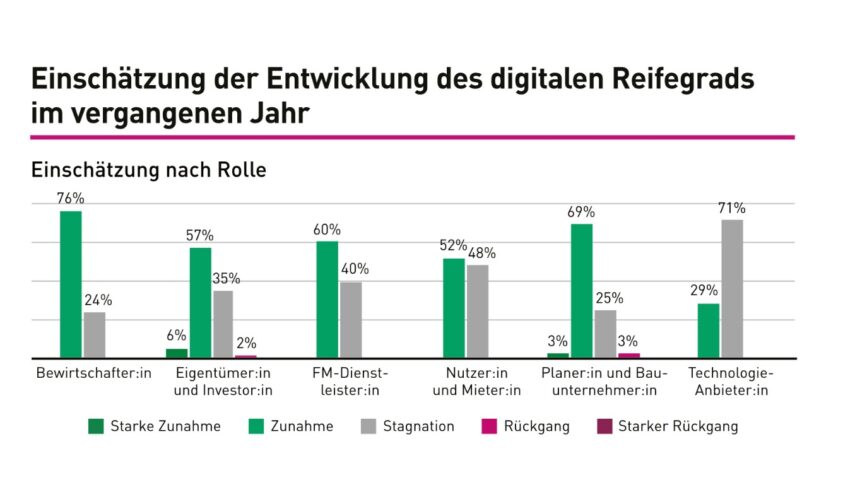
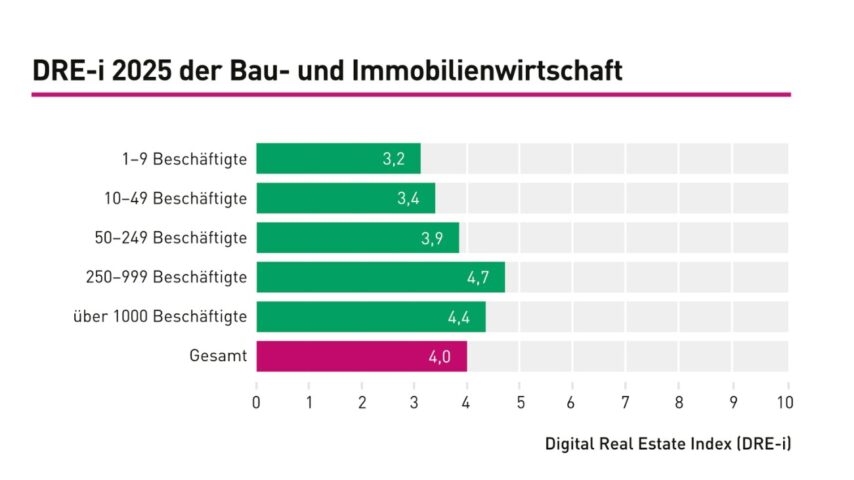
    The industry’s digital maturity level has fallen slightly in 2025. This is shown by the Digital Real Estate Index 2025: on a scale of 1 to 10, the level of digitalization in the real estate industry currently stands at 4.0 points, a decline compared to the previous year (2024: 4.6 points). There are many reasons for this. Increasing complexity, insufficient data quality, cost pressure. This development affects almost all company sizes and roles, but to varying degrees.

    The digital divide is deepening
    The digital divide is particularly evident when it comes to company size. Although the decline affects all categories, small companies in particular are struggling the most with the cost and financing of digitalization. Medium-sized and large companies are able to maintain their lead to some extent.

    Changing roles
    There are major differences between the various roles. Facility management service providers and property managers were even able to slightly increase their digital maturity. The situation is different for planners, construction companies, owners and investors: Here, disillusionment is spreading with regard to digital maturity. In particular, the consistent use of Building Information Modeling (BIM) across the entire life cycle remains a major challenge. In turn, users and tenants are more critical of their digital maturity than in the previous year.

    Perceived stagnation instead of a spirit of optimism
    The industry’s perception is increasingly in line with the measured values. An increase in critical assessments could already be observed in the previous year. This trend is even more pronounced this year. The majority of respondents speak of stagnation rather than major progress.

    Technologies: Benefits recognized, limited use
    Artificial intelligence has found its place in the industry’s consciousness. In the ranking of the most useful digital technologies, Artificial Intelligence & Machine Learning occupies third place. Given the rapid development and increasing presence of AI in the form of Large Language Models (LLM), this is hardly surprising. However, actual use is lagging behind: not even a fifth of respondents are already using the technology. The situation is similar for data analytics. The industry also sees great benefits in this area and is making efforts to increase its use, but the potential has still not been exhausted. Platforms and portals remain the frontrunners among the technologies.

    Conclusion: Maturity also means reflection
    The current decline in digital maturity does not mark a step backwards, but rather a phase of classification. This is because the real estate industry has recognized that digital maturity does not come from buying tools, but from their measurable benefits. An initial digitalization push is followed by disillusionment, triggered by high integration costs, a lack of standards and inadequate data strategies. At the same time, companies’ understanding of their own level of maturity has grown.

    As a result, the view has become more critical, but also clearer. There is a growing realization that many digital initiatives fail because they are implemented as pure IT projects and too little attention is paid to organizational and human factors. Without clear governance, appropriate competencies and the consistent involvement of employees, the added value remains limited.

    A more realistic attitude opens up the opportunity to make future steps more targeted, more effective and more successful in the long term. Real progress is made when digital transformation is no longer seen as a project with an end date, but is recognized as a permanent management task.

  • “Insieme” education centers in Sursee

    “Insieme” education centers in Sursee

    The project competition was announced as an open, single-stage and anonymous procedure for general planning teams, with eight teams submitting proposals on time. The jury assessed them according to functionality, cost-effectiveness, sustainability, urban planning and architecture and awarded the contract to the “Insieme” project by Bob Gysin Partner from Zurich. The centerpiece is a new seven-storey building along the railroad line, which makes a clear contribution to urban densification and orients the campus more towards the station.

    Bright learning landscape
    In future, the new main entrances will be oriented more towards the railroad station, thus relieving the existing access through the adjacent residential area. All gymnasiums will be accessible via the newly defined entrance area, which will simplify routing and orientation. The arrangement of classrooms, group rooms, atriums and meeting zones creates a bright, flexible learning landscape that supports different forms of teaching and informal encounters in equal measure.

    Building sustainably, upgrading open spaces
    In terms of construction, “Insieme” relies on a combination of existing buildings and timber construction. With the exception of the basement, the existing building in Wing B is being dismantled and extended with a timber ribbed ceiling to create a six-storey building. The design of the open space responds to the climate heating by shading the existing staircase and enhancing it with additional planting and seating. The edge of the forest will have new recreational areas and loose tree planting, which will significantly increase the quality of the outdoor space.

    Next steps until commissioning
    In the first quarter of 2026, the jury’s comments will be reviewed and the competition project optimized if necessary. The extended facility is currently scheduled to open in 2035. Around CHF 97.4 million has been set aside in the cantonal financial planning for the expansion and partial renovation of the BBZG W in Sursee. An investment in future-proof vocational training and a strong educational location in the region.

  • The way is clear for Wil West

    The way is clear for Wil West

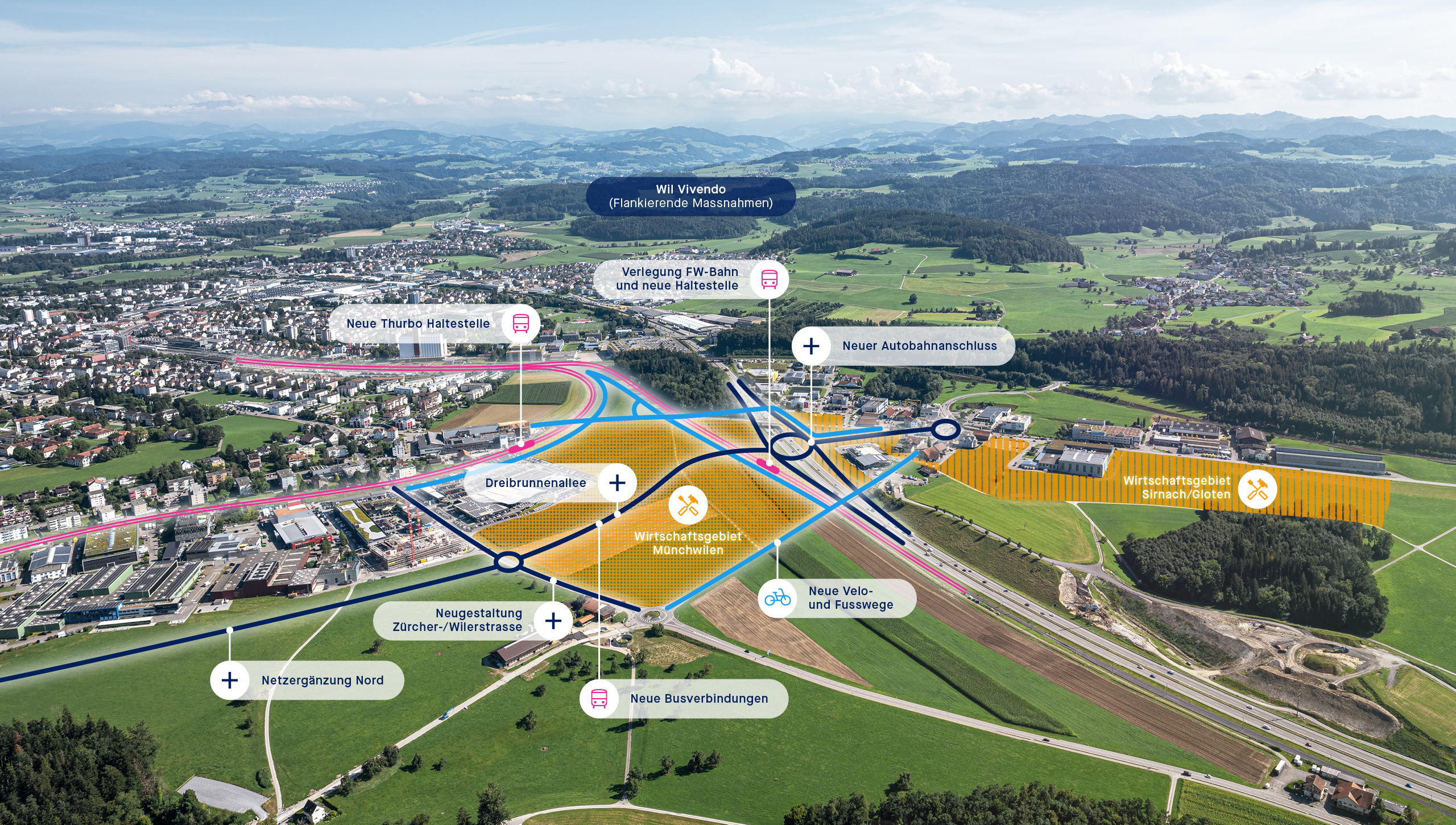
    At the second attempt, the voters of St. Gallen say yes to Wil West. The decision is close, but clear enough to create planning security. The vote shows that the region wants to grow. Bundled, plannable and coordinated across cantonal borders.

    With the sale of the land, St. Gallen is handing over a former estate of the Wil psychiatric clinic to the canton of Thurgau. In future, the economic area will be located entirely on Thurgau soil, but will remain within the immediate sphere of influence of the Will region. This creates a clearer starting position for investments, infrastructure and long-term settlement strategies.

    Concentration instead of urban sprawl
    Wil West stands for a model that keeps many regions busy, enabling economic growth without further urban sprawl. Instead of constantly scattering new commercial zones on the outskirts of towns, the location will in future concentrate companies, services and productive jobs in a location with good transport links.

    The plan is not just any old industrial area, but a modern work location. The aim is to create high-quality businesses that generate added value and skilled jobs without taking up an excessive amount of space. The development potential of the region will thus be utilized. For spatial planning, the project is therefore also an instrument for channeling growth instead of leaving it to chance.

    Infrastructure as a driver of development
    Wil West has a particularly strong impact through its infrastructure. With the project, the federal government, cantons and region are linking the expansion of the highway, public transport and pedestrian and bicycle connections. The planned freeway link to the A1 and better rail and bus connections will make the area attractive for companies and at the same time relieve pressure on the existing town centers.

    Sustainability as a location factor
    The first version of Wil West failed due to concerns such as loss of cultural land, traffic and ecological impact. In the revised version, sustainability plays a much more visible role. More compact construction methods, more careful land use and more green and open spaces are intended to reduce the ecological footprint.
    This is precisely what is becoming a location factor for companies looking to relocate. When choosing a location, more and more companies are looking at energy and land consumption, accessibility without a car and an attractive environment for employees.
    Wil West has the opportunity to set a new standard for work zones if quality assurance, phasing and criteria for settlements are consistently implemented.

    Seize opportunities, manage expectations
    With the yes vote for the proposal, expectations are now also rising. Politics and administration must pick up the pace without falling into a hectic pace. The region needs clear guidelines: which sectors should come? What density is desired? How can development be managed over decades without having to change strategy every time the economy changes?

  • Four axes that are reorganizing the real estate industry

    Four axes that are reorganizing the real estate industry

    Data & AI
    Industry reports see data-driven decisions and AI-based analytics as one of the strongest drivers. From predictive analytics for rents, vacancy rates and capex to automated valuations and AI-supported due diligence and document processing.

    Along the life cycle, this starts with land acquisition and project development (location scoring, risk and scenario models) and extends to operations and portfolio management (predictive maintenance, portfolio optimization, dynamic price and space management).

    Decarbonization and ESG
    Net-zero targets, taxonomy rules and ESG investing make green proptech a cluster in its own right. Smart building systems, IoT sensor technology and ESG data platforms measure emissions, energy and resources, automate reporting obligations and support refurbishment and investment decisions.

    This has a social impact through stricter regulation and investor pressure, and an economic impact through the growing difference in value between stranded assets and climate-friendly stocks. From carbon screening when purchasing land to decarbonization roadmaps for ongoing operations.

    User experience and flexibility
    Digital tenant experience, hybrid working models and flexible residential and commercial spaces are considered a core trend. Mobile access, self-service portals, real-time communication and dynamically bookable, usage-based spaces are required.

    Throughout the life cycle, this shifts the focus to user-centric concepts and mixed use right from the planning stage and requires platforms for booking, community building and personalized services during operation, which directly changes the value creation logic of properties.

    Platform ecosystems
    Many sources see a move away from isolated stand-alone solutions towards networked platforms in which data, processes and services from different players converge. Open interfaces and integrations are seen as the most important requirement on the part of developers and operators.

    Economically, this creates new platform operators, while socially, transparency, power and role models are shifting. From land purchase CRM and development tools to operating and ESG platforms that digitally connect the entire lifecycle.

  • First consultation on location promotion

    First consultation on location promotion

    For the first time, the dispatch on location promotion will be submitted to a consultation procedure, which will run until 1 June 2026. For the years 2028-2031, the Federal Council is requesting five financing decisions amounting to CHF 392.21 million, compared to CHF 428.83 million in the period 2024-2027. The instruments remain the same: SME policy, tourism policy, regional policy, export promotion and location promotion. The bottom line is that the budget, adjusted for special Covid payments and the 2027 relief package, will fall by around 5.2 percent.

    Easing the digital burden on SMEs
    One focus is on easing the administrative burden on SMEs by expanding digital government services. The core component is Easy-Gov.swiss, which is to be further developed into a marketplace for digital services from the federal government and cantons and positioned as a standard infrastructure for a “digital government” for companies. The aim is to simplify procedures, reduce duplication and ensure more efficient cooperation between the administration and business.

    Access to international markets
    Export promotion should provide SMEs with targeted support when entering new foreign markets and expanding existing ones. In an environment with increasing export hurdles and volatile framework conditions, there is a greater focus on information, advice, risk diversification and export risk insurance. At the same time, SMEs should be able to make better use of the opportunities offered by new and existing trade agreements.

    Strengthening regions as economic and living spaces
    The federal government wants to support economic development in all parts of the country with its location promotion. It promotes tourism destinations and economically oriented projects in rural and border regions. This enables them to remain attractive places to live and work. In this way, the Federal Council combines growth impulses for SMEs with balanced regional development.

  • Tour Invictus new face for Fribourg

    Tour Invictus new face for Fribourg

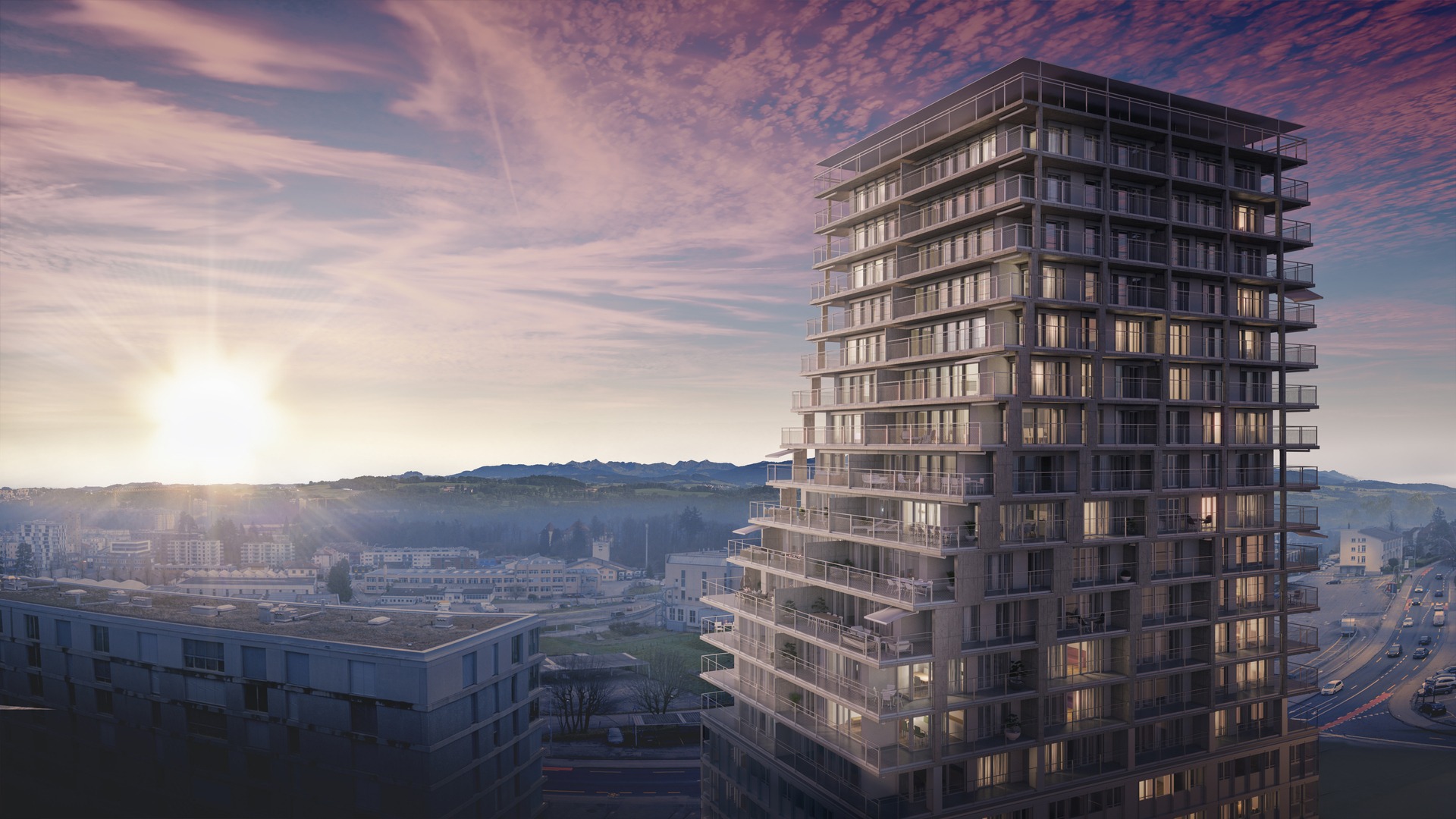
    The Tour Invictus marks a turning point in Fribourg’s urban development. It increases the density of living space upwards instead of continuing to grow outwards. The project is a response to scarce land, changing household structures and an ageing population.

    At the same time, the tower raises the question of identity. How much “high-rise” can a medium-sized Swiss city tolerate? The building will be visible from the city and from afar. It will thus become a symbol of a new phase of urban development that rebalances density, mobility and quality of life.

    New forms of housing instead of classic perimeter blocks
    The mix of uses is clearly geared towards housing, but is finely graduated internally. On the lower floors, there will be apartments suitable for the elderly with assisted living facilities. On the upper floors are privately financed condominiums with expansive views and a high quality of living.

    This vertical mix replaces the classic perimeter block with separate buildings for different target groups. It brings people with different lifestyles together in the same building. For operators, owners and urban planners, this opens up new options for services, neighborhood connections and community building.

    Creating quality of stay
    A tower of this height always provokes the same question. Will density become a burden or a quality? The decisive factor is the design of the transitions. The street level, first floor and surroundings must maintain the scale for pedestrians. Green outdoor spaces, a clear address and legible entrances determine whether the tower is perceived as a foreign body or as a natural part of the neighborhood.

    What counts inside is the sense of spaciousness. Daylight, room heights, private outdoor spaces and views are the counterbalance to the large number of units. Where open spaces are deliberately moved indoors, for example with communal rooms, roof terraces or usable arcades, identification is created instead of anonymity.

    Opportunities for the city
    For the city of Fribourg, the Tour Invictus is both an opportunity and a test case. It shows how investors, planners and authorities deal with densification targets. The handling of traffic, development, shading and the neighborhood will be closely monitored. If the project is successful, it will strengthen the acceptance of further vertical densification.

    At the same time, the area of tension remains visible. A high-rise triggers discussions about the skyline, character and social mix. Managers in administration and the real estate industry are called upon to actively moderate this debate. Clear narratives are needed as to why density does not mean sacrifice, but rather enables new forms of urbanity.