Tag: Neubau

  • Schlieren votes for construction of retirement centre

    Schlieren votes for construction of retirement centre

    After the vote on Sunday, 12 March, the retirement centre Wohnen am Stadtpark can be built in Schlieren. The new building in the middle of the city will replace the Sandbühl Centre for the Elderly. According to a media release, Schlieren’s voters approved the loan of CHF 44,317,000 for the project with a vote of 76.59 per cent.

    “The electorate already clearly approved the sale of the Sandbühl retirement centre in 2019,” Manuela Stiefel, head of the finance and real estate department, was quoted as saying. “With this second yes, we can now tackle the implementation-“

    The new building is described in the city’s statement as “an attractive facility in the centre of Schlieren”. It is to offer contemporary and affordable flats for older people. Occupation of the new premises is planned for 2027.

    Residents at the Zentrum Wohnen am Stadtpark will be able to live in their own flats in a mobile and self-determined manner and, depending on their needs, take advantage of services such as nursing and care, meals, cleaning or laundry services, according to the statement. They also do not have to move to another care facility if more intensive care is needed. An important goal of the city of Schlieren’s age strategy has thus been achieved.

    The turnout in the referendum on 12 March was only 22.12 per cent, according to the minutes of the electoral office. Of 9033 voters, 1998 cast a vote. Of the 1991 valid votes, 1525 were in favour and 466 against.

  • Papillon: Vielfältiger Wohnraum

    Papillon: Vielfältiger Wohnraum

    Wie ein Schmetterling entfaltet sich das neue Quartier «Papillon» bei Köniz. Der «letzte Flügelschlag» ist auf 2028 geplant. Bis dann finden hier rund 2000 Menschen einen neuen Lebensraum – inmitten von Wäldern und Wiesen. Die insgesamt acht Baufelder werden auf einer Gesamtfläche von
    324’000 m2 schrittweise entwickelt.

    Bereits bewohnt sind die rund 250 Wohnungen von «Aurora» und «Eisvogel». Die sechs hofartig angelegten Gebäude des «Monarch» umfassen 218 1,5- bis 4,5-Zimmer-Wohnungen. Diese sind im Herbst 2022 bezugsbereit. Den Auftakt zum östlichen Teil bildet ab 2025 der «Feuerfalter» mit 240 Wohnungen. Dieser erfüllt unter anderem mit Wärmedämmungen und Holzfassaden die Anforderungen an ein «Plusenergie-Quartier» und «2000-Watt-Areal». In den sechs Gebäuden von «Cleopatra» entstehen ab 2023 120 Miet- und STWE-Wohnungen mit nachhaltiger Bauweise. In den letzten drei Baufeldern «Apollo», «Heliconius» und «Pallidana» werden rund 300 weitere Wohneinheiten realisiert. Im ganzen Quartier wird nachhaltig und klimaneutral gebaut. Das Ziel: Mindestens 50 Prozent des Jahresenergiebedarfs vor Ort selbst zu produzieren. So werden beispielsweise Photovoltaik- und Wärmepumpen-Anlagen errichtet.

    Die insgesamt rund 1000 Miet- und Eigentumswohnungen eignen sich mit ihren Grössen von 40 bis 130 Quadratmetern für Singles, Paare und Familien. Dreimal pro Stunde hält ein Bus in der Papillonallee. Direkt vor der Haustür finden die Bewohnerinnen und Bewohner Einkaufsmöglichkeiten, eine Kita, Schule, Sportplatz sowie soziale und gemeinschaftliche Angebote. Eine Sozialplanerin ist eigens dafür da, den Gemeinschaftsgeist zu fördern. Von der Interessengemeinschaft «Eisvogel»
    werden regelmässig Quartierfeste, Bastelnachmittage, Schachturniere und
    andere gemeinschaftsfördernde Akti-vitäten veranstaltet. «Ruedü» bietet frische Bio-Lebensmittel von lokalen Produzenten im 18 Quadratmeter grossen Holzcontainer rund um die Uhr zur Selbstbedienung an. Der nahe Wald und die «Tubetränki» sowie die «Allmend» mit Grillplätzen und Fernsicht in den Jura sind zudem beliebte Destinationen für Erholungssuchende, Ausflügler, Sport- und Naturfreunde.

    Dieser Pavillon beherbergt die «IG Eisvogel».

    In absehbarer Zeit bildet der Weiler Ried als Quartierzentrum das Herzstück der Siedlung: Ein aus Leichtholz erbautes PRISMA-Gebäude wird neben einem Lebensmittelladen, Gewerbeflächen sowie Gastronomie auch Loftwohnungen beherbergen. Zusätzlich werden drei neue Mehrfamilienhäuser gebaut. Und in einem der ehemaligen Bauernhäuser ist ein Gemeinschaftsraum für die Quartierbewohner vorgesehen.

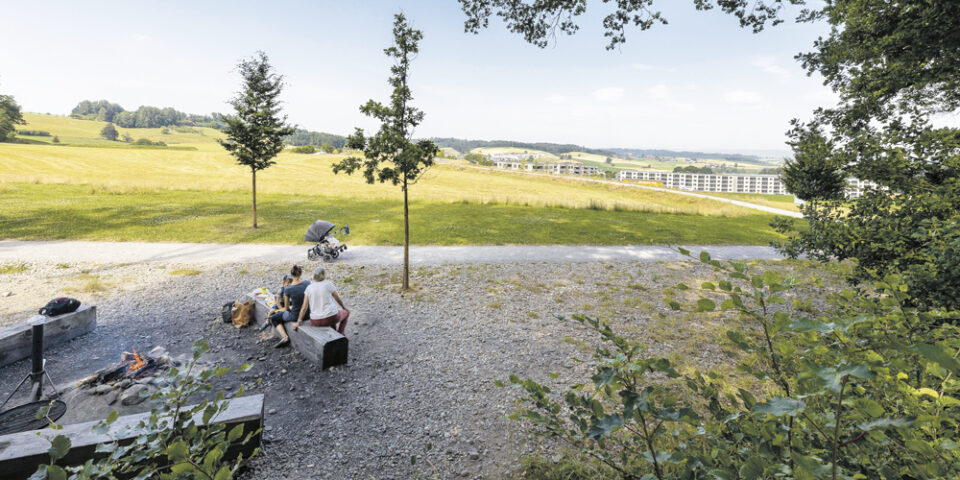
    Blick vom nahegelegenen Waldrand auf das Quartier.

  • Swiss Prime Site lays the foundation stone for the JED site

    Swiss Prime Site lays the foundation stone for the JED site

    The JED (Join.Explore.Dare) in Schlieren will receive a “sustainable keystone”, as stated in a press release from Swiss Prime Site . On September 22, the real estate company from Zug laid the foundation stone for a new building with office and laboratory space, which should be ready for the first tenants to move into from mid-2024. In addition to representatives from Swiss Prime Site and other project participants, Stefano Kunz, Head of the Construction and Planning Department of the City of Schlieren , also took part in the ceremony.

    JED is the site of the former NZZ printing works. Swiss Prime Site has already converted existing buildings there and thus “turned the area into a think and work tank for business, industry and trade”, as CIO Urs Baumann said on the occasion of the laying of the foundation stone. The existing buildings are used by the anchor tenants Halter and Zühlke . The new building will now add office and laboratory space to the area on five floors with a rentable area of 14,000 square meters. Anchor tenants could also be won with Superlab Suisse and FlexOffice .

    The new building will be built according to the principles of the circular economy, and certification according to SNBS Gold (Swiss Sustainable Building Standard) is being sought. “Swiss Prime Site has successfully managed to give the former self-contained NZZ area new life and flair through new paths and the open and spacious architecture,” City Councilor Stefano Kunz is quoted as saying.

  • Foundation stone laid on the JED campus

    Foundation stone laid on the JED campus

    Since 2018, the former location of a large industrial printing plant has been transformed into a modern place of work and living space with diverse and flexible types of use

    transformed. Urs Baumann, CIO Swiss Prime Site Immobilien: “The revitalization and the change of use initiated with the conversion of the existing buildings have turned the area into a think and work tank for business, industry and trade. The gratifyingly high level of first-time lettings proves that large spaces that interact with one another are very much in demand. The new building perfectly complements the existing ensemble with laboratory and office space.» Stefano Kunz, City Councilor of Schlieren adds: "Swiss Prime Site has successfully managed to give the former self-contained NZZ area new life and flair through new paths and the open and spacious architecture." The new building, which is being built on a land reserve of the site, with five floors, a rentable area of over 14,000 m2 and its unique external appearance, is particularly aimed at tenants who need large, connected and adaptable areas. According to the project plan, the first tenants will move into the building from mid-2024 .

    "Space as a Service" in the attractive Life Science Hub Schlieren
    The JED campus forms a center for know-how transfer, innovation and entrepreneurship and brings together companies from a wide range of industries and sizes. In addition to the already established anchor tenants Zühlke and Halter in the existing buildings, two more will be added in the new building with Superlab Suisse and FlexOffice and will ensure an additional strengthening of the ecosystem. According to their business models, they will offer space as a service to various start-ups and companies as "Space as a Service". Superlab Suisse focuses on young companies in the life sciences sector and offers them fully equipped laboratories with flexibly scalable services. After Lausanne and Basel in 2023, the third location operated by Superlab Suisse will be opened in Schlieren from 2024. FlexOffice already successfully offers fully equipped office space for SMEs in several Swiss cities and is now planning another location on the JED campus. «With Superlab Suisse and FlexOffice, we already had two successful anchor tenants at the time the foundation stone was laid, which fit perfectly into the existing structure of the area and the adjacent cluster. Together with the neighboring Wagi area, we will continue to strengthen the economic cluster and the infrastructure for companies in the life sciences sector and beyond,” concludes Urs Baumann.

  • Building program paid out record sum

    Building program paid out record sum

    According to a press release from the Swiss Federal Office of Energy ( SFOE ), around 361 million francs in subsidies for energy-efficient building refurbishment were approved by the federal government and the cantons in 2021. This is the highest amount that has been invested in renovation and new construction projects since the program was launched. Compared to 2020, the funding amount has increased by CHF 62 million.

    Thermal insulation projects, which were funded with CHF 126 million, received the largest amount. The highest increase of 70 percent compared to 2020 was achieved by building services projects, which received CHF 106 million in grants. The commitments for energy-related measures that will be implemented over the next five years have reached a new high of CHF 490 million.

    The high demand for subsidies can be attributed to the broad approval of owners for energy-efficient renovation of their properties or new builds. According to calculations, the measures approved in the year under review will lead to a reduction in energy consumption in buildings throughout Switzerland by 6.5 billion kilowatt hours and lower CO2 emissions by around 1.8 million tonnes over their lifetime.

    According to the statement, the building program has proven to be an effective instrument of Swiss energy and climate policy. A total of around CHF 2.7 billion has been paid out under the funding program since its introduction in 2010. The building program also has a positive effect on the economy. In 2021, 2,300 full-time jobs and around CHF 97 million in additional domestic value were created.

  • Swiss Life invests in development of JFK Airport

    Swiss Life invests in development of JFK Airport

    The Zurich-based life insurer Swiss Life is investing in a development project at JFK Airport in New York through its Swiss Life Asset Managers division. According to a media release , Swiss Life Asset Managers has committed itself to a minority stake in the new construction of Terminal One. Together with JLC Infrastructure and other consortium partners, a sum of 9.5 billion dollars will be provided.

    An approximately 223,000 square meter "ultramodern" terminal is to be built. It represents an "infrastructure investment with attractive long-term growth potential and fits very well with our fund's investment strategy," said Sinisha Ponzio, Head of Value Add Infrastructure at Swiss Life Asset Managers.

    The new investment represents the third investment in the aviation sector for Swiss Life Asset Managers. The insurer sees this as "a vote of confidence in the future of modern aviation". Swiss Life Asset Managers does not expect the aviation industry to slow down. In this context, the airlines' improved capacity utilization, new aircraft orders, technological progress and the construction of modern airport facilities are highlighted.

  • Implenia wins two large and complex real estate projects in western Switzerland

    Implenia wins two large and complex real estate projects in western Switzerland

    New Kyoto office building in the Green Village in Geneva

    The Swiss Life Investment Foundation has commissioned Implenia as general contractor to construct the Kyoto office building in the new Green Village district on the grounds of the World Council of Churches in Geneva. The project has a total volume of more than CHF 60 million and will be around
    take two years. Implenia's Real Estate Division has been commissioned to develop the Green Village district, and Implenia's Buildings Division has already realized the Montreal residential building. The Kyoto office building has ten floors, including the ground floor, which will be partially converted at the request of the future tenant. Sustainability plays into the development of the Green
    Village plays a central role, so the new building is aiming for SNBS certification. The project was planned with BIM and executed with Lean Construction.

    New residential and commercial building on Alleestrasse in Biel

    As the general contractor, Implenia is constructing two new replacement buildings with five full floors in the Brühlstrasse Süd area in Biel for the client Meili Unternehmungen AG. A total of 105 rental apartments and service areas on the ground floor facing the street are planned to a high architectural standard. The project resulted from a study commissioned by Meili Unternehmungen AG and won by the architects Bart & Buchhofer AG. The solid construction with a rear-ventilated wooden facade is created with geothermal probes, a heat pump and a large-scale photovoltaic system. The project has a total volume of CHF 42 million and will last around two and a half years.

  • The foundation stone for the Gupfengarten housing estate is laid

    The foundation stone for the Gupfengarten housing estate is laid

    According to a press release , real estate service provider Steiner celebrated the laying of the foundation stone for the Gupfengarten residential area. With the official starting signal, the construction project for a “family-friendly development in the Zurich Unterland” will be initiated. Steiner took over development, consulting and sales. The general contractor Eiffage Suisse AG , headquartered in Glattbrugg ZH, the architects Graf Biscioni based in Winterthur and the client Evostate Immobilien AG from Zurich are involved in the implementation.

    By the end of 2023, 36 terraced single-family houses and three multi-family houses with 21 condominiums are to be built on the Gupfengarten site south of the center of Niederweningen. The housing estate meets a contemporary living and development standard and covers the strong demand for high-quality living space.

    The planning meets the criteria for sustainable construction. The heat is generated almost entirely by means of a heat pump, geothermal probes and photovoltaic system. An energy management system enables “efficient and intelligent” use of energy. According to the announcement, the wooden building envelope has optimal thermal insulation.

  • Werkarena Basel: NOMEN EST OMEN

    Werkarena Basel: NOMEN EST OMEN

    [smartslider3 slider=”10″]

    In spring 2022, the commercial area on Neudorfstrasse in Basel’s St. Johann district came to life with the first companies moving in. Before that, in November 2021, a public kick-off event took place in the premises, which were still in the basic construction at the time: around 60 representatives from politics and business took part in the event and were enthusiastic. However, it took a while for that to happen. After the government council granted the building permit in 2013, the architecture team led by Markus Kägi and Thomas Schnabel won the 2014 competition put out by the municipality. The municipal trade association was involved as a partner in the processes right from the start, and the relevant companies were supposed to appear together as investors. But this plan didn’t work out. Invited project developers were able to present their ideas. Steiner AG prevailed against well-known competitors. Construction work on the factory arena began in 2019, and the shell was completed in March 2021.

    An appeal to the future
    The triangular, 4316 square meter lot of the business park is located in the north of Basel and directly on the French-Swiss border with St. Louis. The Rhine flows further to the east. The port of St. Johann existed there until 2009, which was then transformed into a waterfront promenade. It showed that industry has a long tradition in the district of the same name. Today, however, ship traffic no longer dominates and the newly settled sectors are more colourful: in the immediate vicinity of Neudorfstrasse there is sometimes the gambling industry or a hotel, but also the premises of a meat and poultry producer or the customs office. The location is ideal for high-emission traders. They have increasingly left the city in recent years because their noisy productions were no longer tolerated in many places. Now they are benefiting again, also in other areas: In addition to the connections to Basel-Mulhouse-Freiburg Airport and the St. Johann through station, the motorway makes trinational long-distance traffic possible. Finally, a fast connection to Basel city center is guaranteed from the Werkarena by car, bus and soon also by tram. The building has a total of 244 parking spaces for employees and visitors.

    Architecture with silent references
    The architectural appearance of the Werkarena is reminiscent of Erich Mendelsohn’s (1887–1953) department store Schocken in Chemnitz, which was completed in 1930. This example of new building caused a sensation at the time as a kind of horizontally layered composition with careful materialization. The structure of the façade of the Werkarena is only broken up towards Neudorfstrasse on the first three floors. The ground floor and first floor have 10 meter wide galleries that can be driven on. These floors are particularly suitable for commercial companies with a large logistics or production share. The connection to the outside space, i.e. to the street, is provided here intelligently and across floors by the element of the ramp. With a room height of 3.47 to 4.37 meters, they stand out visually from the other four floors, which are 2.95 and 3 meters high. At the same time, they give the building volume a visually refreshing depth. There, the pillars, which are arranged at regular intervals, also set a vertical counterpoint to the horizontal rows of windows from the third floor upwards.

    No marketplace of vanities
    With a usable area of 19,300 square meters, the business park is intended to appeal to small and medium-sized companies. Various tenants are already on board and will move into the complex with their offices after completion. They should benefit from each other through the direct proximity and thus also from the vision of the Werkarena – the focus is on a so-called ecosystem, i.e. close (technical) cooperation between the various companies, the use of synergies and a transfer of know-how. Nathalia Szydlowski, Managing Director of Tandemworks GmbH, was enthusiastic at the kick-off event in November 2021: Her company started as a start-up and has now established itself in the construction industry. This rise also has something to do with co-working spaces, because the existing infrastructure and all the accompanying programs have always allowed her to concentrate on her core business. Now Nathalia Szydlowski wants to continue her success story in the Werkarena – this also offers services such as telephone and postal services and various shared facilities, such as office, meeting and conference rooms or catering areas that can be used collectively. Stefan Gabriel, who heads the development team at Steiner AG in Basel, adds: “Right from the start, our concept was aimed at developing a flexible and site-specific product for the highly competitive Basel commercial and office market.”

  • The winning project for the Reussbühl West district has been chosen

    The winning project for the Reussbühl West district has been chosen

    Office of Living Things and Büro Dudler for space and traffic planning.

    The 27’000 square meters

    The assessment committee for the study contract for the redesign of the CKW site in Reussbühl, which is now used for commercial and industrial purposes, unanimously decided in favor of the “Habitat – Quartier im Hain” project. It was developed by the Zurich architects Salewski Nater Kretz in collaboration with the Office of Living Things and the Dudler office for space and traffic planning.

    According to a CKW press release , the 27,000 square meter area is to be “transformed into an attractive, lively and distinctive city quarter”. The energy service provider will give up its location there “in a few years”. In the call for tenders, requirements were made with regard to heat generation and rainwater management. In addition, at least half of the CKW shed hall, a former silk mill, was to be retained. Residential buildings will primarily be built on the remaining area.

    The winning project “convinces in the reinterpretation and further development of the historical landscape”, which was once characterized by floodplains and water-using industry. The design based on the so-called sponge city principle “cleverly” incorporates these historical references. This project will be further developed in the coming months and will then form the basis for the Reussbühl West development plan. The designs of all planning teams are on display at CKW in Rathausen from June 21st to July 4th.

  • iCITY is intended to strengthen the Allschwil life sciences location

    iCITY is intended to strengthen the Allschwil life sciences location

    The life sciences location around Basel is to be further strengthened with a new office concept. Behind it is iCITY , an initiative and an ecosystem that wants to network start-ups, investors and researchers. This is to take place in the Alba House , which will be completed by the architects Herzog & de Meuron by 2023.

    The Alba House is being built on the BaseLink campus in Allschwil. The Swiss Innovation Park Basel Area , the Swiss Tropical and Public Health Institute and the Innovation Office of the University of Basel are also located on the site. The house will offer flexible workplaces on a total area of almost 15,000 square meters. According to a press release, it is based on a compact design, circular economy, geothermal energy and photovoltaics.

    iCITY also operates a location for companies from the life sciences and biotech sectors in Reinach BL. There it offers, among other things, special laboratory and workspaces on an area of 10,000 square meters.

    iCITY has its roots in the Dutch family company Vebego . This has also implemented a similar concept for high-tech players in Eindhoven.

  • The LIMMIviva construction project ends with savings

    The LIMMIviva construction project ends with savings

    The Limmattal Hospital Association completes the LIMMIviva new construction project for the acute hospital. The construction was realized between 2014 and September 2018. This was followed by relocation and commissioning. The project can now be considered completed. According to the media release, less was spent on the costs than estimated. The approved commitment credit of 275.7 million francs, including two supplementary credits, was undershot by around 0.8 million francs.

    In a construction project lasting several years, adjustments to the original project are quite common, according to the hospital association. This also applied to the new building project for the Limmattal hospital. The high dynamics of the healthcare system meant that the project was continuously adapted to changing requirements in over 100 supplements. Such supplements usually lead to significant additional costs. During the construction of the Limmattal hospital, together with the Bern-based construction company Losinger Marazzi AG , which was commissioned as general contractor, additional costs that caused additional costs were compensated for by optimizations in other areas.

    With the hospital financing introduced in 2012 and an amendment to the municipal law, the Limmattal Hospital Association was able to finance the investments of around 270 million francs itself, without the help of the municipalities and thus without burdening the taxpayer. 220 million francs of outside capital was raised through the issue of two bonds.

  • New GLC research building, ETH Zurich: Today's facade technology for tomorrow's health sciences

    New GLC research building, ETH Zurich: Today's facade technology for tomorrow's health sciences

    With the new building in Gloriarank (GLC), ETH Zurich is creating a modern development and laboratory building at the interface between health sciences and technology in the university district of Zurich Zentrum. Together with partners, ETH Zurich would like to set a milestone in medical technology research and application. Research groups will meet in the new building and work more closely together on research projects with industry, the University of Zurich, the University Hospital Zurich and other university hospitals. ETH Zurich is also making an architectural statement with the new building. The attractive connection of the structure to the existing ETZ building creates a central courtyard, the heart of which is the listed Scherrer lecture hall. The inner courtyard created in this way becomes the center around which the main entrances and public facilities are grouped.

    When it comes to architecture, “Everything is Roger” here.
    He speaks of "Maison de Verre", but in this case he does not mean the famous 1930s glass house in Paris – the Zurich architect Roger Boltshauser. Rather, with the GLC research building, he created a sensational building that, with its glass facade made of glass block elements assembled in a cassette-like manner and the ventilation wings staggered in depth, creates a sublime heaviness that does justice to its representative character. Since the use of glass blocks as a façade material in contemporary industrial and university buildings has a long tradition, the architect redesigned the material for this project in terms of design, technology and energy. It not only meets today's enormously high demands on energy and sustainability. Rather, through the combination of reduction and robustness of the elements used, the design corresponds to the basic urban planning attitude of the quarter.

    Thinking together means thinking ahead.
    3,866 m² of steel facade, 22,550 m² of floor space, 1,875 mm high casement windows with a projection of 2,800 mm, the strictest environmental and fire protection standards and much more: the new GLC building was a challenge in every respect, which was mastered thanks to the open and constructive exchange of ideas between the companies involved was mastered. A good example of this are the particularly heavy cleaning blades. Due to its complex geometry, Aepli Metallbau – in cooperation with Jansen AG – subjected it to an endurance test beforehand. A prototype was specially built for this purpose. Exactly 1250 problem-free openings and closings later, it was clear: everything works perfectly!

    Contact:
    Matthew Elmer
    Aepli Metallbau AG
    Direct phone +41 71 388 82 38
    matthias.elmer@aepli.ch
    www.aepli.ch

  • Forum develops scenarios for the Papierwerd area

    Forum develops scenarios for the Papierwerd area

    The Paperwerd Forum was launched on April 11 under the direction of the Office for Urban Development. Here, 55 experts from various disciplines, representatives of politics, clubs, organizations and associations as well as the residents are to work out “the basics for the future of the Papierwerd area”, writes the building department of the city of Zurich in a statement . “We would like to have a broad debate with the interest groups and the population about the possible scenarios for the Papierwerd area,” Corine Mauch, Mayor of Zurich, is quoted there as saying. The scenarios range from preservation to partial preservation and demolition to new construction.

    The results of the dialogue process should form the basis for the city council’s strategy for the development of the area. The handling of the provisional globe will also be discussed, according to the statement. “Even if the Globus provisional is not listed as a historic monument, the building is definitely relevant in terms of architecture, urban planning and social history,” André Odermatt, head of the building department, is quoted as saying.

    The Papierwerd area is part of the area around the main station and the Central. For this, the civil engineering office creates a master plan as a superordinate consideration. Richard Wolff, Head of the Civil Engineering and Waste Management Department, explains that it will be “incorporated into the strategic process for the Papierwerd site”, but will not anticipate it.

  • Baumer is building in Frauenfeld for 20 million francs

    Baumer is building in Frauenfeld for 20 million francs

    Baumer will add a development center to its Frauenfeld site. The company is investing 20 million francs in its new Innovation Center. It will offer space for around 120 employees on 5,000 square meters. According to a press release , the teams should move in in late summer 2023.

    Baumer is investing in its innovative strength for the second time in just a few years, following the opening of the new high-tech center in Stockach in southern Germany in 2018. The central location between the Swiss Federal Institute of Technology in Zurich , the University of Excellence in Konstanz and the OST – Ostschweizer Fachhochschule is “optimal”. “The new building enables us to expand the development capacities at the headquarters in order to expand our position as a driver of innovation,” says Dr. Oliver Vietze quoted, CEO of the company from the St.GallenBodenseeArea.

    When it comes to sustainability and energy efficiency, the Innovation Center is set to become a showcase project. A complete solar building envelope is planned for power generation. Geothermal probes and a heat pump are to temper the building. Baumer will obtain further CO2-neutral electricity from Swiss hydropower.

  • Atelier M Architekten will realize a commercial development in Aarau

    Atelier M Architekten will realize a commercial development in Aarau

    The health organization Swica from Winterthur and Steiner AG from Zurich want to realize a mixed-use development in the Aarau district of Scheibenschachen. In a study order procedure carried out for this purpose, the project contribution Wohnen am Weinbergplatz by Atelier M Architekten was unanimously accepted, Steiner informed in a press release . The project approach envisages four new buildings with around 70 rental and owner-occupied apartments.

    In addition, there is a commercial section at street level, which will offer the quarter an improved range of shops in the future, explains the Zurich-based project development, total and general contractor. The proposal by the winning Zurich architects' office also integrates the historic Kreuz building on the site "in an appropriately respectful manner".

    The orientation of four buildings to an "urban figure" provided in the concept can cope well with the high urban density, is quoted in the communication from the appraisal committee. It certifies the approach of Atelier M Architekten as a "successful balance between urban elegance and good marketability". In the communication, Steiner also emphasizes the varied open spaces "with a neighborly character" envisaged by the draft.

  • PSP Swiss Property grows profitably

    PSP Swiss Property grows profitably

    According to a statement by PSP Swiss Property , the Zug-based real estate company generated property income totaling CHF 309.64 million in the 2021 financial year. Compared to the previous year, this corresponds to growth of 4.5 percent. The operating result (EBITDA) excluding property gains such as valuation differences amounted to CHF 278.76 million in 2021, which is 2.8 percent more than in 2020. PSP Swiss Property attributes the growth primarily to increased rental income year-on-year and higher profits on the sale of development projects and condominium back.

    A net profit of CHF 595.02 million was reported in the year under review, compared to CHF 292.09 million in the previous year. In addition to the factors relevant to the operating result, the appreciation of the portfolio by CHF 464.9 million played a decisive role here. As of the end of 2021, the real estate portfolio of PSP Swiss Property was valued at CHF 9.13 billion.

    In the course of the financial year, the real estate company completed a number of projects and added them to the investment portfolio. The announcement mentions, among other things, the new ATMOS building in Zurich-West with an area of 24,000 square meters. Four investment properties have been reclassified as development projects and a number of properties have been successfully sold, explains PSP Swiss Property. No new investment properties, areas or projects were acquired in 2021.

    For the current financial year, the company anticipates an EBITDA excluding real estate gains of CHF 285 million. The focus will remain unchanged on the modernization of selected properties, our own development projects and leasing. PSP Swiss Property intends to resell non-strategic real estate, while purchases are made dependent on the added value that is expected in the long term.

  • Eberli is building a new Lucerne city hotel

    Eberli is building a new Lucerne city hotel

    The new city hotel Tribschen is to be built in the Tribschen quarter of Lucerne by 2025. The office building of the owners HG Commerciale ( HGC ) and the Central Swiss Builders Association ( ZBV ) that has existed since 1975 will be replaced by a new building.

    Eberli AG from Sarnen will be responsible for the overall project management, construction supervision and construction management, according to a message on LinkedIn. The Lucerne architects Lütolf und Scheuner Architekten GmbH had already won the architectural competition last year.

    A business and holiday hotel with around 140 rooms in the three-star superior class is to be built. The hotel will be operated by Luzerner Tavolago AG . The subsidiary of the shipping company SGV already runs numerous restaurants in the region.

    Eberli AG recently completed another hotel project. She worked as a total contractor at the Kempinski Palace Engelberg. The Obwaldner Hotel started operations last summer.

  • HSG inaugurates the Square learning center

    HSG inaugurates the Square learning center

    On Sunday, February 13, the HSG inaugurates its new learning center. Square represents a “prototype of the university of the future” and should serve as a “place for surprising encounters and mutual inspiration”, writes the HSG in a statement . “The new learning and teaching formats that are being developed in Square are intended to inspire the entire university and prepare our students as best as possible for practice,” HSG Rector Bernhard Ehrenzeller is quoted as saying.

    Square’s work is based on three pillars that faculty, alumni and students have developed together. On the one hand, the learning center is intended to serve as an experimental field for new formats which, if successful, can be implemented at the HSG and other universities. For the spring semester beginning on February 21, 80 existing courses were selected to be carried out and evaluated in the square.

    On the other hand, Square will take on the role of a base camp for an exchange between students, alumni and researchers. The HSG has planned to include personalities from various professions and social groups. Paul Achleitner, Chairman of the Supervisory Board at Deutsche Bank, Gabriele Fischer, Editor-in-Chief and publisher of the German business magazine “Brand eins”, and Federal Chancellor Walter Thurnherr, among others, have confirmed for the spring semester.

    Last but not least, Square should also serve as a public space for a critical discourse by and with those who are not directly connected to the HSG. In order to attract residents of St.Gallen and guests from near and far, Square wants to present itself as a marketplace with an open atmosphere. Music, barista coffee and beer brewed especially for Square are also offered.

  • Kantonsspital Winterthur moves into a new building

    Kantonsspital Winterthur moves into a new building

    After ten years of planning and five years of construction, the new building of the Cantonal Hospital Winterthur (KSW) has been officially opened. According to a press release from the engineering and consulting company HKG , operations should definitely start in the coming week after the moving day on Thursday.

    According to the KSW, the new bed and operation wing will replace the existing high-rise building. After 55 years of operation it will be demolished. According to the KSW , the new building has 61,000 square meters of floor space, 13 floors, 213 rooms, seven operating theaters, 95 treatment rooms and 240 parking spaces. The RA-B architects working group (Rapp Architekten AG and Butscher Architekten AG) created the new KSW building under the direction of the cantonal building authority.

    The new building has a simple design with a lightweight travertine facade. Fully automatic building shading enables a pleasant climate in the rooms despite the large window areas. Like the facade, the KSW also designed the public park in front of the new building together with the Winterthur urban design specialist group.

    According to the announcement, the cantonal hospital invested CHF 350 million in the approximately ten years of planning and construction. CFO Hansjörg Lehmann, who will replace the current CEO Rolf Zehnder as Chairman of the Management Board in May, refers to the special features of the financing. “The KSW was the first hospital in Switzerland to place a green bond on the capital market and at the lowest conditions ever seen,” he is quoted as saying. The successful realization of the new building is “a milestone in the history of KSW”.

    Because a public celebration of the commissioning was not possible due to the pandemic, the KSW has provided videos with a virtual insight into the new building on a special website .

  • University of Applied Sciences on the way to the future

    University of Applied Sciences on the way to the future

    Die Fachhochschule Graubünden (FHGR) – die achte öffentlich-rechtliche Fachhochschule der Schweiz – ist heute auf fünf Standorte in neun Gebäuden innerhalb der Stadt Chur verteilt. Die Anzahl Studierender sowie das Forschungsvolumen der FHGR nehmen weiterhin zu. Die bestehenden Standorte bieten zu wenig Räumlichkeiten und Ausbaumöglichkeiten, um die Hochschule in Zukunft optimal aufzustellen. Bislang fehlt beispielsweise der Raum für den Austausch zwischen den Disziplinen sowie für die informelle Kommunikation zwischen den Studierenden und den Dozierenden. Darüber hinaus sind derzeit zu wenige studentische Arbeitsplätze vorhanden, die den heutigen Anforderungen genügen. Durch die Verteilung der Gebäude über die Stadt fehlt der Hochschule zudem die architektonische Visibilität.

    Aus diesen Gründen hat der Kanton Graubünden entschieden, das Fachholschulzentrum am Standort Pulvermühle neu zu erstellen. Hier befindet sich seit 1993 der Hauptsitz der FHGR. Der Neubau soll ein zusammenhängendes Bildungs- und Forschungszentrum ermöglichen, das von der Diversität und interdisziplinären Zusammenarbeit aller Organisationseinheiten lebt. Die Projektleitung wurde dem Hochbauamt Graubünden übertragen. In einem Wettbewerbsverfahren wurde aus den 57 eingegangenen Bewerbungen ein Generalplanerteam selektioniert, welches die Vorgaben und Ziele der Regierung bezüglich Funktionalität, Ortsbau und Architektur überzeugend umsetzt und die Realisierung in der geforderten Qualität und Wirtschaftlichkeit sowie unter Einhaltung der Kosten- und Terminvorgaben garantieren kann.

    Das Siegerprojekt überzeugt mit Nachhaltigkeit und Funktionalität
    Die Entscheidung fiel auf das Team rund um das Projekt «Partenaris». Den Lead übernimmt dabei das Zürcher Architekturbüro Giuliani Hönger Architekten. Überzeugt hat das Projekt die Jury durch die gleichmässige Berücksichtigung der Kriterien Architektur, Tragwerk, Nachhaltigkeit und Funktionalität. «Partenaris» sieht eine städtebauliche Positionierung des Neubaus vor – unter Einbezug der bestehenden Gebäude und durch die sorgfältige Gestaltung eines parkähnlichen Aussenraums. So wird ein attraktives Hochschulareal geschaffen. Die Planung berücksichtigt ausserdem die gewünschte Nutzungsflexibilität.

    Die erste Etappe sieht einen viergeschossigen U-förmigen Baukörper mit einer zentralen, rund 1200 Quadratmeter umfassenden Eingangshalle vor. Dabei öffnen sich die drei Gebäudeflügel nach Süden zur Pulvermühlestrasse hin und interagieren mit den bestehenden Gebäuden. Der Neubau wird als Hybrid-Skelettbau ausgeführt.

    Mittels Passerelle wird es mit dem Neubau verbunden. Die Obergeschosse sind für Nutzungen der Institute und Departemente vorgesehen, wobei der Öffentlichkeitsgrad und damit die Publikumsintensität mit jedem Stockwerk abnimmt. Das Raumprogramm wird mit vergleichsweise wenig Geschossfläche flächeneffizient umgesetzt. Dank der strukturierten Bauweise und ressourcenschonenden Materialisierung können die Werte bei der Grauen Energie auf einem guten Niveau gehalten werden. Im Westen entsteht zudem eine neue Terrasse. In der zweiten Etappe wird das bestehende Gebäude P57 in Richtung Westen erweitert.

    Aus Sicht des Kantons Graubünden ist die Realisierung des Fachhochschulzentrums hinsichtlich Bildung, Forschung und auch innovationspolitisch von grosser Wichtigkeit. Denn der Mangel an Fachkräften, insbesondere in den technisch-naturwissenschaftlichen Disziplinen, hat Auswirkungen auf die Bündner Unternehmen: Diesen fehlen das nötige Wachstum und die gewünschte Entwicklung. Die neue Fachhochschule soll junge Leute ausbilden, fördern und damit die Wettbewerbsfähigkeit der Bündner Volkswirtschaft stärken.

    Das Siegerprojekt wird in einem nächsten Schritt planerisch weiterbearbeitet. Danach muss es vom Grossen Rat genehmigt werden. Erhält «Partenaris» grünes Licht, soll Ende 2024 mit den Bauarbeiten begonnen werden. Im Jahr 2028 soll der Neubau bezugsbereit sein. Der Studienbetrieb läuft während den Umbauarbeiten weiter wie gewohnt.

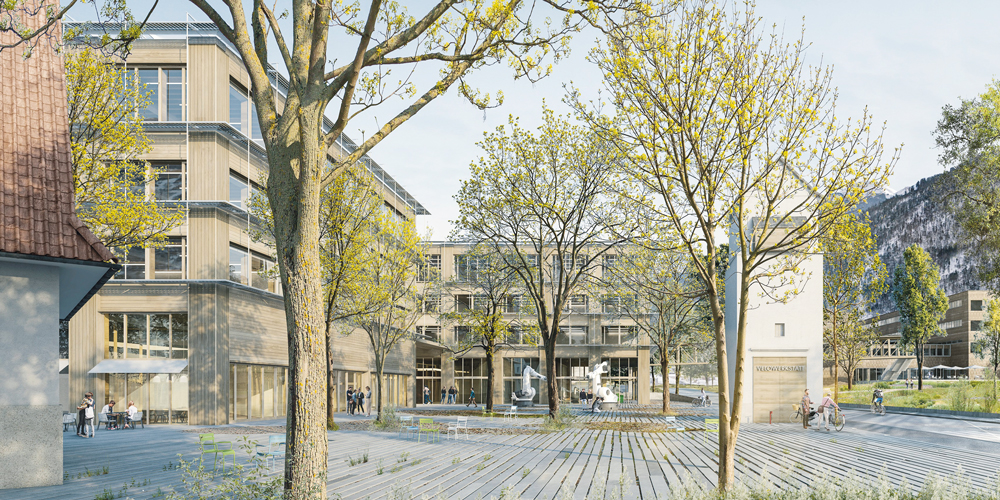
    Die Visualisierung zeigt den zukünftigen Campusplatz.
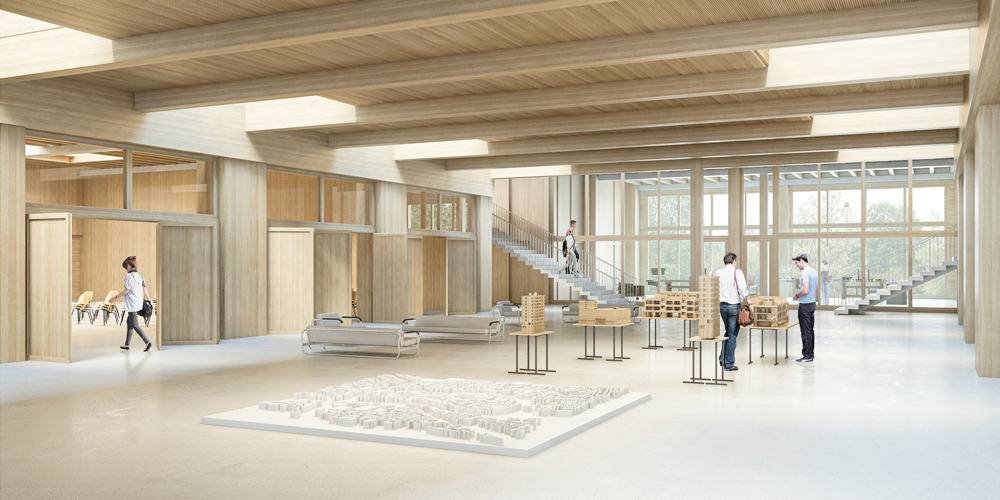
    So soll das Foyer des Neubaus dereinst aussehen.
  • A lighthouse at the gateway to Bern

    A lighthouse at the gateway to Bern

    Das neue Gewerbe- und Dienstleistungsgebäude am östlichen Tor zur Stadt Bern soll durch verschiedenste Nutzungen an Lebendigkeit gewinnen. Neben konventionellen Büroräumlichkeiten, flexibel buchbaren Büroräumen für Kleinmietende und Start-ups sowie einem zukunftsorientierten Gastronomie- und Eventbereich sind auch Gewerbeflächen für die Nutzung im Gesundheitsbereich möglich.

    BERN 131 wurde als Multispace konzipiert, wodurch grösstmögliche Flexibilität in der Innenraumgestaltung besteht. Multispace ist ein modulares Raumkonzept mit offenen Bürostrukturen und verschiedenen Sonderflächen – etwa für den Austausch, Pausen oder Rückzugsmöglichkeiten. Diese Raumvielfalt macht Multispace attraktiv und eignet sich gut für die neue, individualisierte Arbeitswelt. Gespräche mit verschiedenen Mietinteressierten sind im Gange.
    Die Architektur und die geschickte Planung von BERN 131 garantieren eine hohe Qualität des Arbeitsumfelds trotz der exponierten Lage. Der geplante Neubau profitiert von einer hohen Sichtbarkeit und der unmittelbaren Nachbarschaft zur Wankdorf City. In diesem jungen und aufstrebenden Stadtquartier sind zwei von drei Bauetappen abgeschlossen. Die SBB, die Schweizerische Post und andere Grossfirmen haben hier neue Hauptsitze bezogen. Rund um BERN 131 gibt es ausserdem verschiedene Gastronomie-Angebote, Supermärkte und Business-Unterkünfte. Der Bahnhof Wankdorf ist in rund fünf Gehminuten, diverse Autobahnanschlüsse sind in zwei Fahrminuten erreichbar.

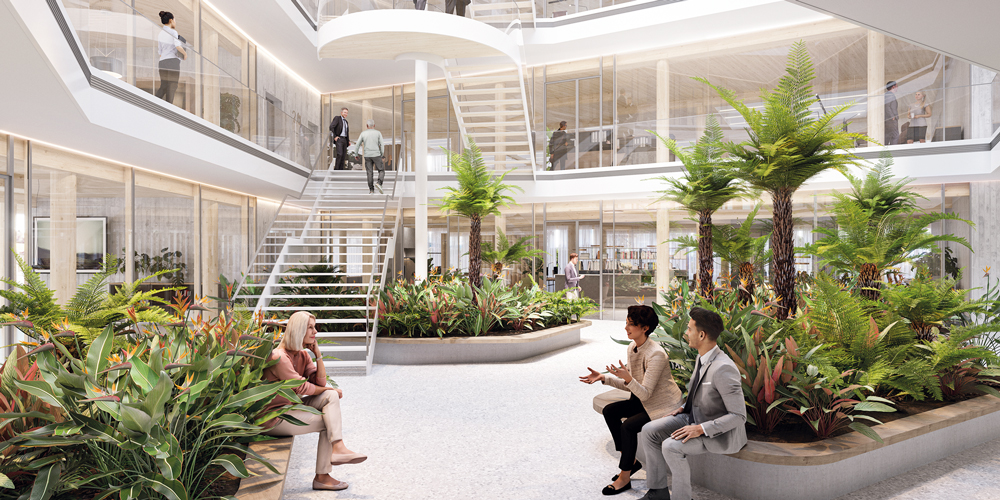
    Das Gebäude in der Form eines Kreisbogendreiecks wird sechs Etagen haben. Die einzelnen Etagen können durch die drei Erschliessungskerne und einen Ring, der sich um das begrünte Atrium legt, erschlossen werden. Die Geschossflächen können flexibel auf verschiedenste Flächenbedürfnisse aufgeteilt werden. Das Gebäude wird grösstenteils in Skelettbauweise mit Holzstützen, Holzunterzügen und Holzhybridecken errichtet. Bei der horizontalen Aussteifung des Gebäudes setzt man auf Erschliessungskerne in Massivbauweise.

    Photovoltaik-Anlagen an der Fassade und auf dem Dach, Energieerzeugung über Erdwärmesonden, ein innovatives Lüftungskonzept mit Wärmerückgewinnung sowie die Nutzung von Regenwasser tragen zur Nachhaltigkeit und Energieeffizienz bei. Die Verwendung von Holz und Holzwerkstoffen schafft zudem eine schöne Raumqualität und ein angenehmes Raumklima.

    Mit seiner Architektur, seiner ausgewogenen Betriebsenergiebilanz sowie zahlreichen gebäudetechnischen Innovationen soll das Gebäude ein Vorzeige- und Leuchtturmprojekt in Sachen Nachhaltigkeit und Ingenieurskunst werden.

    Die Baueingabe erfolgte Mitte Mai 2021; die rechtskräftige Baubewilligung wird zeitnah erwartet. Der Baustart ist auf das zweite Quartal 2022 geplant. Im dritten Quartal 2024 soll BERN 131 bezugsbereit sein.

  • Climate-friendly concrete

    Climate-friendly concrete

    The construction project in the Tech Cluster Zug is the largest construction project to date in which CO2-enriched concrete is used. For this purpose, CO2 from Switzerland is used for the first time, which the ETH spin-off neustark obtains from the wastewater treatment plant of ara region bern AG. In addition to binding CO2, the client also required the use of high-quality recycled concrete. In this way, V-Zug relies on the efficient use of concrete. "For example, the ceiling systems were optimized in terms of material consumption, and hollow core ceilings are planned in places with low static stress," says Christoph Graf, "Zephyr Ost" project manager at Tech Cluster Zug AG.

    The recycled concrete EvopactRecarb is manufactured and supplied by Holcim. Using state-of-the-art technologies, the company processes regional mineral demolition material into high-quality secondary raw materials, which flow back into the building material cycle in cement and concrete production. "We are delighted to be taking a step closer to our vision of climate-neutral and circular concrete production with the help of the innovative neustark process," adds Giovanni Barbarani, Head of Concrete Performance at Holcim Switzerland. "This project is a milestone on the way to sustainable construction in Switzerland, also thanks to its regionality and short transport routes."

  • New federal building receives certificate for sustainability

    New federal building receives certificate for sustainability

    The new government administration building in Zollikofen has been awarded the platinum certificate of the Swiss Sustainable Building Standard. According to a press release , this is the federal government's third award for sustainable building since 2019.

    In 2020, the new administration building on Pulverstrasse in Ittigen received the gold certificate, and in 2019 the administration center on Guisanplatz in Bern was awarded. "With the third award within a short period of time, the Federal Office for Buildings and Logistics is being rewarded for its consistent focus on sustainable building," says a press release.

    With its certificates, the Swiss Sustainable Building Network honors "high-quality and forward-looking objects" that make an ecological, social and economic contribution. In the assessment, the Zurich-based association takes into account a total of 45 indicators from the areas of business, society and the environment, including the energy consumption of a building, the flora and fauna of the surrounding area and the regional added value. The selection of the architect's office by means of a competition procedure and communication also play a role.

    According to the press release, the certified new building at Eichenweg 3 houses parts of the Federal Office for IT and Telecommunications as well as the IT Service Center of the Federal Department of Justice and Police.

  • Optisol inaugurates new company headquarters

    Optisol inaugurates new company headquarters

    Optisol has created the largest wooden structure in Valais and recently inaugurated it. The new building of the company headquarters for the company of the Migros subsidiary Micarna had become necessary because the manufacturer of high-quality organic and organic-mineral fertilizers had to relocate from the floodplain of the Rhone correction. According to a media release , the building at the new location in Vétroz reflects Migros’ strong commitment to sustainability.

    Its facade is made of Valais larch wood. The latest technologies are designed to clean the air from dust, odors and ammonia, among other things, before it is released into the atmosphere. In this way, the standards of the Clean Air Act would be met. The dryer for the litter from the poultry farming is supplied by the wood-fired thermal power station installed on the neighboring property. This district heating system also reduces CO2 emissions.

    In addition, Micarna leases the roof area to the Oiken Group. She will operate a photovoltaic system there. Nests for swifts and falcons have been built under the roof.

  • Halter AG realizes the VIVO Aesch project

    Halter AG realizes the VIVO Aesch project

    The Halter AG construction group is teaming up with the UBS Sima real estate fund as an investor and future builder to implement the VIVO Aesch project. According to the press release , the legally binding building permit for a new development with residential, commercial and commercial use at the northern entrance to the municipality of Aesch is available. The 15,188 square meter area was used by the previous landowner Victus Real Estate AG as a material storage and transshipment point.

    The new mixed-use development is to be built by 2024, with around 85 percent of the main area being intended for residential use. According to a press release, after the development phase was completed in July, Halter AG was able to win an investor in Balintra for VIVO Aesch. Balintra AG in Basel is a real estate company owned by the UBS Sima real estate fund.

    The new property owner will transfer the project with an investment volume of around 150 million Swiss francs as builder together with Halter as developer and overall provider into the first construction phase from this autumn.

    According to Halter, the project comprises four building units. The 40 meter high VIVOTower at the motorway turn marks the entrance to the municipality of Aesch. On the lower floors, the tower offers space for commercial use and the TowerCafe. In addition, 36 apartments and 80 rental apartments are planned.

    The VIVOHof is another building with mixed use, with areas for small businesses and 36 rental apartments on the upper floors. The VIVOKamm comprises 57 rental apartments with south-facing terraces as well as a common room with access to the neighborhood square. VIVOQube offers a further 55 rental apartments on six floors, mostly maisonette apartments.

    According to Halter AG, the start of marketing for the commercial space is in spring 2022, and for the apartments in spring 2023. Completion is planned for the third quarter of 2024.

  • Inventx can expand its headquarters in Chur

    Inventx can expand its headquarters in Chur

    Inventx has received the green light to expand its headquarters in Chur, according to a press release . The IT service provider wants to build a new building on the area of the old forestry workshop in the city center. This should offer space for more than 200 employees. In addition, there will be space in the new building for apartments, restaurants, a daycare center and the Chur city archive.

    Inventx has been planning to expand its headquarters for four years. However, the project was delayed due to “objections from the neighborhood”. Ultimately, the complaints landed before the federal court. But she rejected this.

    “We are pleased that the project can now finally be realized and that the fallow area in the city center is revitalized,” says Mayor Urs Marti (FDP) in the press release. “In addition, the project strengthens Chur as a business location in the long term and thus also strengthens the city’s position as an attractive ICT location,” he adds.

  • Two new buildings turn the arsenal area in Uster into a cultural center

    Two new buildings turn the arsenal area in Uster into a cultural center

    The city of Uster wants to create a culture and meeting center on the arsenal area. An architecture competition was announced for this in autumn 2018. The jury awarded the “KUZU” project by EM2N Architects, Zurich, with first place and recommended the project to the city council for further processing.

    The “KUZU” project complements the existing armory with two simple buildings that differ in size and structure: the “Culture Shelf” and the “Culture Hall”. The old building will remain, the historical substance will only be minimally rebuilt and renovated.

    The eastern new building, the culture shelf, forms the new face of the city. It is planned as an open structure with redensification potential. A cladding made of corrugated polycarbonate sheets and wood should make the building appear light and permeable. A small hall with a stage and 120 seats, a restaurant, two small cinema halls with a bar and an exhibition room are planned for the culture shelf. The small hall and the cinema halls are to replace the Ustermer Kulturhaus Central, which will be demolished in the next few years.

    A large event hall with 700 seats is to be built in the new western building, the Kultursaal. A parking garage is planned underneath. The culture hall is to serve as a replacement for the outdated city courtyard hall. The structure of the culture hall is filled with prefabricated concrete elements and thus appears more massive and closed than the culture shelf.

    The buildings should be in an open courtyard figure, the “culture courtyard”, to each other. This should help with orientation and create a common center, where synergies of the different uses should also arise.

    In the next two years or so, the project is to be concretized to such an extent that the population of Uster can definitely decide on the redesign and the building loan. The opening of the new culture and meeting center is planned for 2028.

  • Tax deductions for eco-investments in new buildings should take effect more quickly

    Tax deductions for eco-investments in new buildings should take effect more quickly

    There is currently a waiting period for environmentally friendly investments in real estate. Such investments are only tax-deductible five years after the property has been built. Last December, Councilor of States Roberto Zanetti (SP / SO) submitted a motion calling for this waiting period to be shortened.

    In view of the high construction costs, the financial limits of especially younger builders for ecological measures in new buildings are understandable, writes Zanetti in his motion. If, after completion of the building, it turns out “that the corresponding ecologically desirable additional investments would be financially viable”, the owners will, however, in view of the five-year waiting period “be careful not to take these investments by hand immediately”. This is “regrettable from an ecological point of view,” says Zanetti.

    The shortening of the waiting period called for by the SP Council of States can now be implemented. After support from the Federal Council and the adoption of the motion by the Council of States, the National Council has now “accepted the proposal without discussion”, the parliamentary services inform in a message . Now it is the Federal Council’s turn. He must create the legal basis for shortening the waiting period. In addition, different procedures between the cantons are to be harmonized so far.

  • Federal government uses geothermal energy for buildings

    Federal government uses geothermal energy for buildings

    Most of the buildings in the National Sports Center in Magglingen are currently heated with gas, according to a press release from the Federal Office for Buildings and Logistics (BBL). The BBL is currently realizing a number of new construction and renovation projects for the Federal Office for Sport at the sports center. For the first time, the federal government is using geothermal energy to supply heat to buildings. A new district heating network will supply both the existing and the new buildings.

    Geothermal energy from a depth of 1,300 meters is used for the heat supply. It is expected that the extracted water has a temperature of 30 to 50 degrees Celsius. For this purpose, two wells are being built. The warm water is pumped up via one, the cooled water is let down again via the other. In between, a heat exchanger on the surface takes the heat from the water and uses it to supply the building.

    While the gas supply currently emits 1,300 tonnes of CO2 annually, this should only be 70 tonnes in the future.