Tag: Projekt

  • Garden city – city and lots of nature

    Garden city – city and lots of nature

    It all started with a concept competition: Think Architecture AG and Koch Kommunikation AG won the race from three participating architecture firms: “It was a successful attempt to integrate marketing into the project from the very beginning and not later in the process,” remembers Corinne Ruoss , Team Leader Development at Mobimo. The outside space of the condominiums was given a very high weight. The floor plans are modern, functional and flexible. The apartments attract with a generous outside space of at least 14 square meters and a fireplace. The living space climate in the building (Eco) as well as the energy balance (Minergie) play a central role: “The building is planned in accordance with the Minergie Eco standard. A spacious staircase is naturally illuminated with daylight. And the vertically structured wooden facade with wooden slats is a particular eye-catcher. The balconies are integrated into the facade, so that when viewed from the outside, there is a unity, ”adds Ruoss.

    In-house electricity and e-mobility
    A photovoltaic system on the roof generates in-house electricity, and the parking spaces in the underground car park are intended for e-mobility. Based on the “garden city”, the use of natural materials is planned. Native plants are provided for good biodiversity, there is a butterfly meadow on the balcony roofs (intensive greening), and only a few sealed areas are planned. There is a flowing transition to the surroundings with soft shapes, trees and bushes. Seen in this way, the estate fits perfectly with Mobimo’s selection of project locations, with an urban or suburban location and good access to public transport: “In the implementation, convincing architecture and a high standard of construction are important to us, and we also pay close attention to sustainability … and yes: A good price-performance ratio is ultimately decisive for the response on the market. “

  • Tax deductions for eco-investments in new buildings should take effect more quickly

    Tax deductions for eco-investments in new buildings should take effect more quickly

    There is currently a waiting period for environmentally friendly investments in real estate. Such investments are only tax-deductible five years after the property has been built. Last December, Councilor of States Roberto Zanetti (SP / SO) submitted a motion calling for this waiting period to be shortened.

    In view of the high construction costs, the financial limits of especially younger builders for ecological measures in new buildings are understandable, writes Zanetti in his motion. If, after completion of the building, it turns out “that the corresponding ecologically desirable additional investments would be financially viable”, the owners will, however, in view of the five-year waiting period “be careful not to take these investments by hand immediately”. This is “regrettable from an ecological point of view,” says Zanetti.

    The shortening of the waiting period called for by the SP Council of States can now be implemented. After support from the Federal Council and the adoption of the motion by the Council of States, the National Council has now “accepted the proposal without discussion”, the parliamentary services inform in a message . Now it is the Federal Council’s turn. He must create the legal basis for shortening the waiting period. In addition, different procedures between the cantons are to be harmonized so far.

  • Timber construction project for the Rockwell area

    Timber construction project for the Rockwell area

    The Aarau Aeschbachquartier with 167 rental apartments, 92 condominiums, the Aeschbachhalle and the Oehlerpark as well as 4600 square meters of commercial space is being expanded. A large part of the Rockwell area, which belongs to the western part of Torfeld Süd, will be linked to the existing quarter. This is made possible because Rockwell Automation GmbH is largely giving up operations there. Only research and development will remain at the site.

    The owner of the area, Mobimo Management AG, invited five architecture firms to participate in a study. The specifications were defined as follows: The project is to be carried out in wood and meet the SNBS Gold standard. The client also wanted a clear contrast to the existing and planned properties in Torfeld Süd.
    Baumberger & Stegmeier Architects from Zurich emerged victorious from the process. In collaboration with Hoffmann Müller Landschaftsarchitekten and Pirmin Jung Holzbauingenieur, your project provides for an extension of the historic Hall 5. This is supplemented by a courtyard-like new building in the desired timber construction and a spacious square. This creates 110 barrier-free rental apartments of various sizes. In addition, alternative forms of living such as cluster apartments and five commercial units are planned. The timber construction is also consistently implemented inside the property. Several green areas and trees are distributed over the site and take up the vision of the Aeschbach district – that of an «Urban Village».

    The first groundbreaking should take place in mid-2023. Completion is scheduled for mid-2025.

  • Hotel Rotbuche: energy efficiency, ecology and comfort

    Hotel Rotbuche: energy efficiency, ecology and comfort

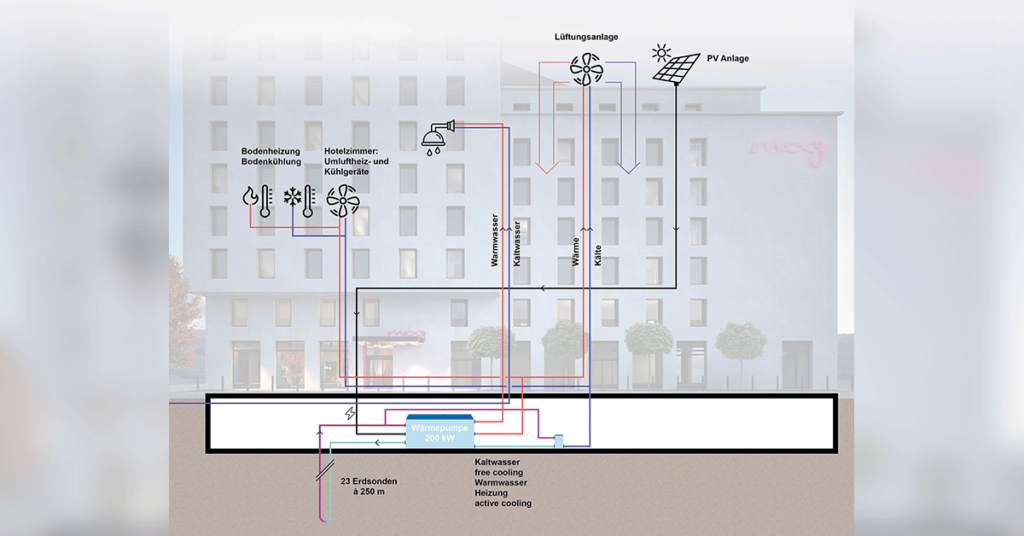
    The groundbreaking ceremony for the Hotel Rotbuche in Rapperswil-Jona took place in mid-February of last year. The three requirements and specifications for the energy supply and the energy system for the new hotel were clear: energy efficiency, ecology and comfort. In order to implement these requirements, geothermal probes were drilled as an energy source for the heat pump and a sustainable energy concept was developed in cooperation with Energie Zürichsee Linth (EZL). EZL will also operate and maintain the building technology as a contractor.

    Heat recovery measures
    "The reversible heat pump can be used to provide heat for heating purposes and for domestic hot water," explains Roman Fausch, project manager for energy services at EZL. In summer there is the possibility of cooling the building in an energy-efficient way using geothermal probes, according to the expert. If there is a high need for cooling, there is also the option of using cold from the reversible heat pump. Various heat recovery measures are also installed and, thanks to an intelligent control system, also regulated as required. "In connection with energy and sustainability, it is one of the most sustainable hotel projects that we have been able to plan and implement," says Stefano Ghisleni, general planner at Ghisleni Partner AG, based in Rapperswil, Zurich, St. Gallen and Zug.

    At the Moxy Hotel Rotbuche, the natural heat comes from a depth of around 200 to 250 meters. The 23 probes, distributed over the entire construction area, withdraw 10 to 15 degrees from the ground. The heat is fed into the heat pump in the building using a carrier fluid and converted. This is how it gets into the hotel's heating and air conditioning system. The entire length of the geothermal probe control system is more than five kilometers.

    Reduction of the room temperature by up to four degrees
    Those responsible for the project emphasize that the basic need for room cooling in the warmer seasons in the Hotel Rotbuche can be covered with the environmentally friendly free cooling system. This means that the room temperature can be reduced by up to four degrees. This has a positive side effect: the dissipated heat is in turn temporarily stored in the geothermal probes and can be used for hot water preparation or in winter for heat supply. A photovoltaic system is installed on the roof to operate the heat pump. With around thirty percent, it should provide sufficient coverage to cover part of the electricity demand. "The moderately controlled balancing of heat and cold makes a continuous room climate possible without massive temperature fluctuations," says project manager Roman Fausch. The first guests will be able to feel this for themselves from the coming autumn. At this point in time, the new “Rotbuche” hotel with its 86 rooms is due to open. ■

  • Battery project aims to make sea transport more sustainable

    Battery project aims to make sea transport more sustainable

    The Current Direct project aims to reduce greenhouse gas emissions in maritime transport by up to 482,000 tons of CO2 equivalents annually, explains Blackstone Resources in a press release . The Zug-based battery expert is one of a total of 13 partners who launched the Energy as a Service project. The European Union supports Current Direct through its Horizon 2020 research program.

    Blackstone Resources is contributing lithium-ion battery cells produced using 3D printing to the project. According to the announcement, state-of-the-art materials are used in their production, which reduce the costs of production. In addition, the materials used can be recycled.

    Overall, Current Direct aims to halve the cost of battery-powered ship propulsion systems. The Energy as a Service model also relieves ship owners of their capital costs. Current Direct thus offers “energy companies, institutional investors and state actors a mechanism to participate in the green transformation of the European merchant and passenger fleet,” writes the Zug-based battery expert.

  • Investors from Glarus develop the Kartoni district

    Investors from Glarus develop the Kartoni district

    As early as 2013, the municipality of Glarus declared the Kartoni-Areal and Untere Allmeind areas in Glarus to be key development areas as part of their structure planning, the project company Kartoni Quartier AG informed in a message. A mixed living and working area with private, semi-private and public open spaces is to be created here. A footbridge for pedestrians and bicycles across the Linth will connect the quarter directly to the train station and the center of Glarus.

    The project management team at Sutter Projects, in cooperation with the municipality of Glarus, has now been able to win two local investors for the implementation of the project. One of these is the Glarus Pension Fund . It is described in the communication as a guarantor for “a sustainable and far-sighted project that does not allow real estate speculation”.

    On the other hand, Sutter and the community were able to get Trümpi Immobilien AG enthusiastic about the project. The Glarus real estate company is "a local partner who understands project development and construction from the ground up," the press release said.

    Together with Robert Sutter's Immolmpuls AG, the investors have now founded the Kartoni Quartier AG project company. She will take over the implementation of the construction plans on the Kartoni site. According to the announcement, Kartoni Quartier AG has already acquired all the properties in the area from the previous owners.

  • GOFAST and fast food go together

    GOFAST and fast food go together

    The Swiss fast charging provider GOFAST is launching a project together with McDonald's Switzerland to expand the charging infrastructure for e-cars. According to a press release , a total of 90 new charging stations for electric vehicles are to be built at numerous locations in the fast-food chain. The fact that GOFAST was able to win a new partner in McDonald's Switzerland is a real stroke of luck for the steeply growing number of e-car drivers, says Domenic Lanz, Managing Director of the e-mobility company GOFAST, which was founded in 2016. GOFAST is an abbreviation for GOtthard FASTcharge AG based in Zurich.

    The usual charging time of 20 to 30 minutes for a range of – depending on the model and the charging capacity of the batteries – around 300 kilometers can be used while eating in the restaurant. With GOFAST HPC chargers (high-power charging), e-car drivers can recharge their vehicle with outputs of up to 150 kilowatts, the message explains. Ideally, a range of up to 150 kilometers could be achieved in ten minutes. Only Swiss electricity from renewable energies is used for charging.

    The expansion begins at the McDonald's restaurants at the Martigny motorway exit with six loading spaces. The next stops are the McDrives in Hinwil, Kölliken, La Tour-de-Trême and Lugano. Aglaë Strachwitz, Managing Director of McDonald's Switzerland, is quoted in the press release: “We at McDonald's have been committed to the environment together for years. Our logistics partner drives with biodiesel and biogas, made from our kitchen waste. We rely on the train as a means of transport, for electricity on hydropower and now increasingly on fast charging stations for our guests. "

  • Replacement modules from several solar technicians form a new system

    Replacement modules from several solar technicians form a new system

    In St.Gallen, several solar technicians have collected the remaining modules from photovoltaic systems that have already been implemented. Now they are jointly producing solar power on the roof of the building called Lattich at the St.Gallen freight yard. The unusual project, about which the city of St.Gallen reported in a media release , provides solar energy for ten four-person households.

    This photovoltaic system is a joint project of the St.Galler Stadtwerke (sgsw) and five solar energy companies that have the Swisssolar quality label Solarprofi: Helion , Etavis Grossenbacher AG , Grob AG Gebäudehüllen, Huber + Monsch AG and solarmotion GmbH . They all delivered the solar modules that were no longer needed. They planned and created the system together with SGSW.

    In return for their contribution to the project, the partners involved receive solar power units on the Lattich roof and thus benefit from a credit on their electricity bills. Solar power units from the St.Gallen Solar Community are still available to the public on the roof of the Lerchenfeld ice rink.

  • Leclanché is building the largest solar system in the Caribbean

    Leclanché is building the largest solar system in the Caribbean

    The energy storage company Leclanché , together with the government of the Caribbean island state of St. Kitts and Nevis and the state-owned Electric Company ( SKELEC ), broke ground “for a groundbreaking project”. As stated in a press release by the energy storage company, the largest solar power generation and storage system in the Caribbean is to be built on 102 hectares of land owned by the government over the next 18 months. In the first year of operation, it will generate around 61,300 megawatt hours of electricity.

    The $ 70 million microgrid project is being built by Leclanché. It should also represent a model project for other island states. Together with the most important subcontractor, the Spanish Grupotec , the Valais company will provide a turnkey solar plus storage solution. Leclanché will operate the facility through its subsidiary SOLEC Power Ltd. as part of its strategic build, ownership and operation model. with partner Solrid Ltd. own and operate.

    Up until now, tankers have been delivering diesel fuel on a weekly basis. According to the announcement, Prime Minister Timothy Harris described the project as a milestone for his country, tourism, the economy and the entire Caribbean region: "This visionary project will help ensure our energy independence." Tons of “save carbon dioxide emissions.

    Together they designed a system on site that saves SKELEC costly upfront investments, says Leclanché managing director Anil Srivastava: As part of a 20-year power purchase agreement, Leclanché will sell clean, renewable energy to SKELEC at a flat rate over this entire period.

  • deltaVERDE

    deltaVERDE

    premise
    deltaZERO is “a group of designers from the fields of architecture and urban planning who want to build buildings and cities for the man of the 21st century”. The group is a leader in the planning of zero-emission buildings in Switzerland and has developed a number of self-advertised prototype buildings to directly test the systems proposed in the studio's projects.

    In 2008 the deltaZERO building in Paradiso proposed a new standard for low-energy buildings of the future, which is characterized by flexibility and transparency. This was followed by deltaROSSO, a prototype building, a rental building for mixed residential and administrative purposes, which was awarded the special prize of the Swiss Solar Agency in 2019 for the best multi-family house with positive energy

    Now the "test bench" is represented by the DeltaVERDE complex, in which the properties already proposed in the previous prototypes are further developed.

    properties
    The complex with 5,000 m2 and 86 parking spaces is characterized by two habitable volumes that stand on a base that serves as a garage, storage and technical room.

    The property, which belongs to the shareholders of deltaZERO, benefits from a building permit that has grown in the judgment.

    In accordance with the DeltaZERO philosophy, the building was developed in such a way that it has the following features:
    – Respect for the environment, therefore no higher emissions into the atmosphere and energy production than consumption
    – higher than consumption
    – Maximum flexibility thanks to a modular design concept with the resulting possibility of changing the destination and partitions according to market requirements; Thanks to the removable radiant floor with deltaZERO concepts, transformation is easy at any time
    -high living comfort with ventilation
    continuous, large hot and cold radiation surfaces with consequently reduced temperature delta in the distribution
    ne, filtered and ionized air, home automation

    location
    Chiasso is a town a few kilometers from the Lugano and Como lakes and close to its numerous tourist attractions. It is the ideal place for those who want to live in peace and at the same time want to be connected to local and international transport and service networks.

    deltaVERDE is located in Via Sottopenz, only a few steps away from the historic center and in the middle of the green of the Penz hill park with its shady and relaxing paths that offer opportunities for relaxation in nature.

    The location is strategic from a logistical point of view: in a few minutes on foot you can reach the train station, the central square of the municipality and all services. The location therefore meets the requirements of a young clientele who want a life without constant use of the car, even when the motorway is nearby.

    innovation
    Integration of energy saving and energy generation technologies.

    Implementation of new concepts aimed at ensuring the flexibility of the destination and the use of the spaces according to the constantly changing needs of the contemporary user.

    The most modern technological systems contain no emissions and no consumption, maximum flexibility and high comfort and consequently guarantee the stability of the commercial value of the property in the long term.

    Positive energy
    deltaVERDE produces more energy than it consumes thanks to:
    -A construction that pays attention to mass and optimal thermal insulation
    – energy generation with two reversible heat pumps
    – Solar collectors and photovoltaic modules integrated into the building envelope

    Comfort
    – optimal lighting guaranteed by large windows
    – clean air thanks to ventilation
    Continuation with air filtration and ionization
    – Summer cooling and dehumidification
    – thermal activation of the roof mass
    – Home automation and the ability to quickly adapt the electrical system to the needs of the user thanks to the removable raised floor

    flexibility
    Choosing a construction system that makes it possible to divide the spaces according to the needs of the user and adapt them to the needs of residence and work in constant transformation throughout the life cycle of the building.

    The rooms can therefore accommodate apartments, offices or mixed solutions and can easily be modified; Each floor can be divided into a flexible number of units as required.

    Low costs
    Despite the exceptional properties of the building in terms of technology, comfort and materials used, we intend to bring to the market, through a linear and modular project, residential and / or administrative spaces of the highest quality in a building with positive energy, the cost of which is the average local market correspond . This design philosophy leads to a long-term preservation of the value of the building, despite the climate change and the changes in user needs, which are characteristic of our society in a rapid and constant transformation. ■

  • A lifestyle brand is stirring up the hotel industry in Zurich

    A lifestyle brand is stirring up the hotel industry in Zurich

    The German hotel company Althoff Hotels will take over the traditional hotel “Bellerive au Lac” in Zurich towards the end of the year. The historic building at Utoquai 47 has been completely rebuilt since January of this year and then opened as the third AMERON hotel in Switzerland – two hotels are located in Davos and Lucerne – and the first AMERON boutique hotel in Switzerland. "The size and the spatial plan are perfect for the conversion into an AMERON boutique hotel", Thomas H. Althoff, founder and owner of Althoff Hotels, is quoted in various media.

    High quality hotel design
    As an interior concept, Monoplan – an architecture firm based in Zurich specializing in the hotel industry – has developed a modern interpretation of the existing hotel design, which can be read on their website. This mainly includes interior design, implementation planning and creative management. “A World of Many Worlds” – that is the hotel group's credo. All hotels are characterized by a cosmopolitan interior design, which at the same time has an individual character in each house. The house will have 61 rooms and suites, an event restaurant and various conference rooms. If everything goes according to plan, the four-star hotel is due to open this winter. ■

  • From commercial building to design hotel

    From commercial building to design hotel

    On Beatenplatz, not far from Zurich's main train station, a budget design hotel of the Munich hotel group Ruby with 208 rooms and a restaurant operated by Candrian Catering is being built in the listed former “Haus Du Pont” commercial building. For more than 100 years, the building housed the ABC cinema from 1913. Historically, the “Haus Du Pont” by Zurich architects Jakob Haller and Karl Schindler has been referred to as a palace-like building. Indeed: the comparison is appropriate.

    Simple and representative appearance
    Now a look into the future: In the course of the conversion, the largely listed building will be completely renovated. This includes its supporting structure, stairwells, facade and roof structures. In order to achieve an elegant, simple and at the same time representative appearance, classic means are used, emphasize the project managers. These include, for example, a surrounding wall frieze. That means a linear, horizontal style element. This narrow strip, delimits, divides and decorates parts of the building. There are also structured wall surfaces, a terrazzo floor and seating niches in the lobby. The philosophy of the hotel group is "Lean Luxury – luxury in a small area".

    The Zurich architects Monoplan are responsible for the architecture, the interior design, the overall planning and the construction management. The owner and builder of the historic building is PSP Swiss Property, which is investing 45 million francs in the total renovation. If everything goes according to plan, the two-year construction work will be completed by the end of 2021. ■

  • From the former rectory to the gently renovated holiday apartment

    From the former rectory to the gently renovated holiday apartment

    Bringing building culture to life is the maxim of the Foundation for Monument Holidays. From 2021, for example, the renovation work on a former rectory in Valais, which is being converted into a holiday apartment, is to begin. The former rectory – called "Kaplanei" – is located in the Valais village of 400 people, Ernen. It was built in 1776 and used as a rectory until 1952. Since then, the property has been largely empty and is becoming increasingly dilapidated. That will now change because the Foundation Holidays in Monument was able to take over the building under construction law at the end of 2018.

    The chaplaincy suffered from the long vacancy, says Nancy Wolf, who is responsible for marketing and communication at the foundation. Although the owners, in cooperation with the preservation of monuments, restored the outer facade, including the windows and the roof, there are neither modern kitchen facilities nor up-to-date sanitary and heating installations.

    Building with its own house chapel
    The plan is to concentrate on the maintenance of the existing substance during the extensive renovation work – this mainly includes the repair of the interior. Only the fixtures in the kitchen and bathroom should be implemented cautiously in a contemporary design language. The well-proportioned pre-protection house is particularly impressive due to the alternation of wood and stone on its eaves and the doors and windows framed with red tuff stone. Those responsible for the project emphasize that they radiate wealth and dignity. Characteristic of this type of building, the rear part of the house with the kitchen was made of stone. Inside there is also its own house chapel. When entering the reception room, the benefice's parlor, one notices the neatly worked, strongly curved paneling with the deep bevelled edges, of which there are not many today, can be read in the project description. The cube-shaped stove shows Saint George on a horse, the patron saint of the church and the parish, as well as Saint Catherine with the wheel.

    H out with a manorial character
    On the first and second floors you can find religious inscriptions in Latin, with which the residents probably wanted to give practical instructions on how to live, the preservationists suspect. One room on the upper floor has a vaulted plaster ceiling. In the middle is a painting. Painted, tulip-shaped flowers on the consoles and the arched portals to the cellar give the house its stately character. Future vacation home owners will soon be able to marvel at these treasures. ■

  • Ein neues Kleid für das Grand Hôtel & Centre Thermal Yverdon-les-Bains

    Ein neues Kleid für das Grand Hôtel & Centre Thermal Yverdon-les-Bains

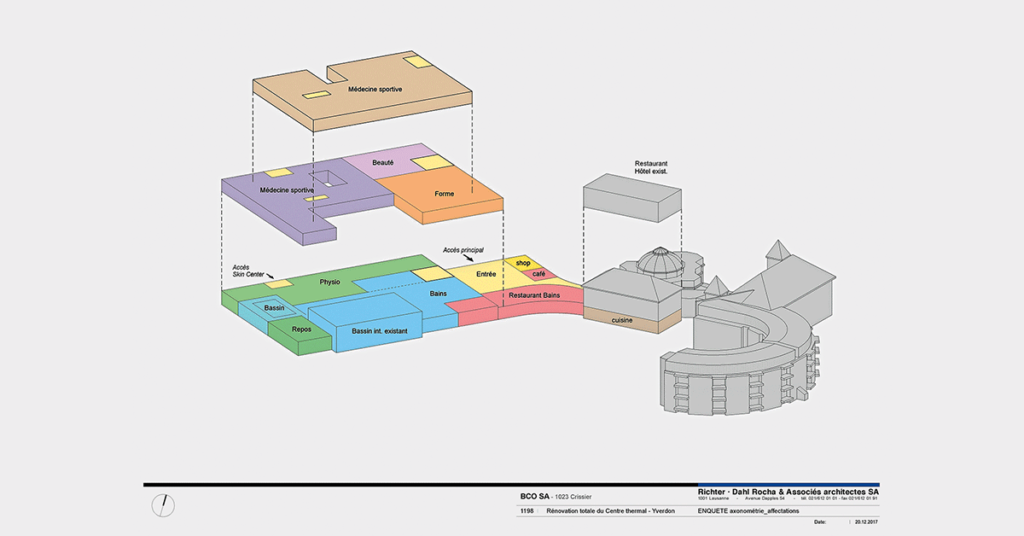
    Seit Herbst 2019 wird das historische Hotel mit 116 Zimmern und Suiten während drei Jahren umgebaut. Das Gesamtbudget von rund 32 Millionen Franken enthält die Kosten für die vollständige Renovierung der Innenräume und des Aussenbereiches sowie des Thermalbades und des Grand Hôtels. Im Grand Hôtel werden die Zimmer und Bäder, die Küche und der Aussenbereich inklusive Schwimmbad renoviert. Der Eingang zu den Thermalbädern wird neu ausgestaltet und mit Geschäftsflächen und Restaurants erweitert. Die Umkleidekabinen werden renoviert.

    Ein neues Café wird nur von den Bädern aus zugänglich sein. Die Zone um die Aussenschwimmbecken wird mit einem 350 m2 grossen Wellnessbereich mit Hamam und Sauna ergänzt. Der Fitnessbereich umfasst neu 700 m2. Während der gesamten Bauzeit wird das Thermalbad den normalen Betrieb aufrechterhalten. BCO SA, eine Tochter der BOAS-Gruppe, leitet die Bauarbeiten; das Architekturbüro Richter Dahl Rocha mit Sitz in Lausanne hat das Projekt ausgearbeitet.

    Das Thermalbad von Yverdon-les-Bains besteht aktuell aus verschiedenen, zum Teil dreistöckigen Gebäuden, die untereinander verbunden sind. Im Aussenbereich stehen zwei grosse Schwimmbecken zur Verfügung. Das 4-Sterne-Superior-Hotel liegt inmitten eines prächtigen Parks mit altem Baumbestand. Aufgrund seiner langjährigen Geschichte strahlen die verschiedenen Räumlichkeiten des Grand Hôtels jeweils ihren eigenen, ganz besonderen Charme aus. So zum Beispiel die sogenannte Rotunde (kreisförmiger Bauteil), in der sich das Restaurant und die Lounge-Bar befinden oder der vor kurzem renovierte «Belle Epoque»-Saal und insbesondere auch das zum Hotel gehörende Schloss. Über einen Glastunnel ist das Hotel mit den Thermalbädern verbunden.

    Neues Seedorf und neue Einrichtungen
    Der erste Schritt des gross angelegten Renovationsprojektes ist der Bau des Seedorfes im Park vor dem Hotel – am Ufer eines neu angelegten Weihers. Drei Holzbrücken führen die Besucher übers Wasser zu den Häusern, die verschiedene Wellnessbereiche wie Hamam, Sauna und Ruheräume beherbergen. Ein Barfussweg wird ebenfalls entstehen. Die bereits heute für die Physiotherapie und Arztpraxen genutzten Räumlichkeiten werden durch zwei Einheiten ergänzt: Entstehen soll ein Zentrum für Sportmedizin mit einem separaten Eingang. Weiter ist vorgesehen, die medizinischen Infrastrukturen räumlich zu konzentrieren, sodass die Patienten über eine grössere Privatsphäre verfügen.
    Durch die Verlegung des Thermalbadeingangs entsteht ein attraktiver, lebendiger Raum, durch den der Gast vom Hotel direkt zur Bäderzone gelangt.

    Dieser Bereich umfasst 900 m2 und umfasst eine Empfangshalle, eine Boutique, ein Restaurant und ein Café. Der bislang für den Übergang genutzte, wenig ansprechende Glastunnel wird abgebaut. Renoviert werden zudem Küche und Restaurationsbereich. Die Fassaden und Dächer der Thermalbad-Gebäude werden abgerissen. Stattdessen wird einer äusseren Einfassung Platz gemacht, die den ganzen Komplex umfasst und vereinheitlicht. Die gesamte Fläche wird um eine Etage aufgestockt. Damit entsteht Raum für moderne, besser durchdachte, architektonisch homogen und stilvoll integrierte Inf-
    rastrukturen. Auch die Infrastruktur des Thermalzentrums wird optimiert: Das Hallenbad wird komplett renoviert und um ein neues Schwimmbad mit Spielbereich erweitert.

    Infrastruktur des Neubaus in der Übersicht:
    Erdgeschoss
    Neuer Eingang, 600 m2
    Boutiquen, Café / Restaurant, 360 m2
    Bäder-Restaurant
    Bereich Physiotherapie (960 m2) mit unabhängigem Rehabilitationsbecken
    Neue Umkleideräume und Duschen
    Neues Innen-Schwimmbecken
    (Unterricht und Erholung)
    Inneres Becken vollständig renoviert
    Zwei Aussen-Schwimmbecken

    Erste Etage
    Fitness-Raum, 700 m2
    Schönheitspflege, 340 m2
    Sportmedizinisches Zentrum (1160 m2) mit Anbindung an den Physiotherapiebereich und neuem separatem Eingang

    Über BOAS Swiss Hotels
    Boas Swiss Hotels ist eine private Hotelgruppe mit Sitz in Crissier / Lausanne. Zur Gruppe gehören zehn Beherbergungsbetriebe in den Kantonen Wallis, Waadt und Genf. Die Hotels gehören mehrheitlich zur Kategorie der 3- und 4-Sterne-Superior-Betriebe. ■

  • Jean Nouvel is renovating the Grand Hotel Geneva

    Jean Nouvel is renovating the Grand Hotel Geneva

    At the beginning of the year, the Grand Hotel Geneva changed operators: Fairmont Hotels & Resorts, one of the luxury brands from the Accor Group, is taking over from the Kempinski Group. At the same time, the owner, Le Palace Genève SA, announced the extensive renovation of the hotel.

    The Geneva 5-star hotel directly on the lake with a view of Mont Blanc is being remodeled by the French star architect Jean Nouvel. With his architecture office, he secured the contract in the context of an international architecture competition. Brigitte Jucker-Diserens' Geneva partner office is coordinating the project. The KKL Luzern, the Lyon Opera, the Galerie Lafayette in Berlin and the national museum in Doha all came from Nouvel's hands. He was awarded the Pritzker Prize in 2008 and has so far created over 200 structures.

    Targeting the highest energy efficiency standards
    The renovation work should begin at the end of 2020 / beginning of 2021, once all permits have been received. One focus of the renovation is on the facade. It should be perfectly integrated into the environment and should be based on the design and materials of the other houses in the bay. The inner courtyard, the public areas and the restaurants are also being renovated. In addition, the hotel should meet the highest energy efficiency standards after the renovation. It is currently being clarified whether a thermal heating solution can be implemented. Then the hotel would be heated and cooled with water from Lake Geneva. This focus on sustainability is in line with the philosophy of the Fairmont brand.

    The hotel has 412 rooms, including 33 suites and 14 apartments; three restaurants, a lounge and bar with a view of the lake, a heated indoor pool and a spa and fitness center. The number of rooms will be unchanged after the renovation, as the press officer at Fairmont Hotels & Resort, Philippe Eberhard, announced. The centrally located hotel will remain open during the renovation. According to Eberhard, the costs are likely to amount to tens of millions of francs.

    Fairmont's portfolio currently includes 77 hotels in 29 countries, including the GrandHotel Geneva. The Fairmont Le Montreux Palace is also located on Lake Geneva. ■

  • La Margna becomes the Grace Hotel St. Moritz

    La Margna becomes the Grace Hotel St. Moritz

    The renovation work has been underway since September 2016: In St. Moritz, the former Hotel La Margna on Via Serlas is becoming the Grace Hotel. The owner is the internationally active Grace Hotel Group. She has the building carefully renovated and expanded with an annex. The opening was originally planned for 2017, was then postponed to autumn 2019 and is now to take place in 2022. The reason for the delay: the project was modified and expanded again after construction began. The number of hotel rooms was increased by a third to 56, as a correspondingly high demand is expected.

    Upon completion, the hotel will include the historic “La Margna Wing” and the modern, newly built “Grace Wing”. In the "Grace Wing" an underground car park, a spa area as well as hotel rooms and suites are being built. In the “La Margna Wing”, the rooms on the upper floors are being completely renovated. The rooms on the lower floors are being restored so that the historical building fabric is preserved. Here guests will discover vaults, arches and other architectural features of Art Nouveau.

    Art Nouveau meets modernity
    The former Hotel Margna was built in 1906 and 1907 according to plans by the architect Nicolaus Hartmann in the Engadin style. In 1911 the east wing was increased by three storeys. After that, renovations and renovations took place again and again, but the external appearance was never significantly changed. The striking facade is to be retained even after the current renovation.

    The drafts for the project come from the pen of the architect Nikolas Travasaros from Divercity Architects. For him, the main challenge was to freshen up the original architecture and at the same time create a modern extension for additional rooms and a spa. In addition to taking into account the strict building regulations and the given restrictions due to the sloping terrain, Travasaros had to plan hotel rooms that can also be converted into long-term apartments.

    His plans combine old and new by expanding the base of the existing building. The extension follows the natural gradient and fits seamlessly into the landscape. The new wing is deliberately kept discreet and does not overshadow the traditional architecture and the breathtaking alpine surroundings. Panoramic windows and adaptable, open interiors create a feeling of light and space.

    Blarer & Reber Architects in Samedan are responsible for the planning and implementation on site. The preservation of monuments in Graubünden was included in the project development so that the greatest possible preservation of the historically valuable building fabric is guaranteed. The STW AG for spatial planning based in Chur was also included in the project team.

    All rooms and suites of the boutique hotel Grace St. Moritz will offer lake or panoramic views. Three restaurants and a spacious spa area with swimming pool as well as a fitness center on over 800 square meters are planned. The hotel has a private car park and is just a 2-minute walk from the train station and the bus stop. A ski shop and ski room are also planned. Serviced apartments are also to be offered for sale in both wings. ■

  • Coop verwandelt den Basler Märthof in ein Boutique-Hotel

    Coop verwandelt den Basler Märthof in ein Boutique-Hotel

    Im ersten Halbjahr 2021 soll im historischen Gebäude des Märthofs in Basel das Boutique-Hotel Märthof eröffnen. Die Eigentümerin, die Coop Immobilien AG, hat das Architekturbüro Burckhardt + Partner mit der umfassenden Renovation beauftragt. Geführt wird das Hotel nach der Eröffnung von der zu Coop gehörenden Bâle Hotelgruppe. Sie betreibt bereits die Hotels Pullman Basel Europa an der Clarastrasse sowie das Victoria am Centralbahnplatz und das Hotel Baslertor in Basel-Muttenz.

    Das Gebäude des Märthofs entstammt dem 19. Jahrhundert und bestand ursprünglich aus fünf einzelnen Häusern, die 1981 zu einem Gebäudekomplex zusammengeführt wurden. Die freiwillige Denkmalpflege Basel wehrte sich Anfang der 70er-Jahre gegen den geplanten Warenhaus-Neubau, der anstelle des alten Gebäudes vorgesehen war. Der Abbruch wurde 1976 in einer Volksabstimmung abgelehnt. Nun soll ein Hotel der oberen 4-Sterne-Kategorie entstehen, wobei die Fassade mit einem neuen Anstrich in ihrer jetzigen Form erhalten bleibt. Das Mauerwerk selber bleibt unverändert – auch die Natursteinpartien werden nur gereinigt.

    Laut Coop-Mediensprecherin Rebecca Veiga sollen im neuen Boutique-Hotel die Stilepochen der ehemals fünf bestehenden Gebäude unverkrampft und spielerisch vermischt werden. «Verspielte Motive des Neubarocks und die funktionale Gestaltung der Geschäftsfassade aus dem Jahre 1927 treffen im Inneren des Gebäudes auf die lineare 80er-Jahre-Struktur», sagt Veiga.

    Offene Übergänge und eine freundliche Atmosphäre
    Auf die insgesamt 68 geplanten Zimmer, davon acht Suiten und acht Juniorsuiten, werden Stehleuchten, Wandleuchten, Sessel und weiteres Mobiliar individuell verteilt – kein Zimmer wird exakt wie das andere aussehen. Die Zimmer erhalten unterschiedliche Farbschemen und widerspiegeln die Geschichte vom jeweiligen Gebäudeteil, in dem sie sich befinden. Die Farben sind abwechslungsreich und sollen nicht polarisieren – sodass sie das ganze Jahr hindurch auf die Gäste angenehm wirken.

    Des Weiteren sind ein Fitnessraum, eine Bibliothek, ein Res-
    taurant sowie eine Bar auf der Dachterrasse im 6. Stock mit 55 Sitzplätzen vorgesehen – und eine weitere im Erdgeschoss. Alle funktionalen Räumlichkeiten sind analog einer starken Wirbelsäule um den Erschliessungskern des Hauses angeordnet und stossen von innen nach allen drei Aussenseiten. Die Übergänge der unterschiedlichen Nutzungsflächen im Erdgeschoss sind offen gestaltet, sodass es als Fläche ohne Unterbrüche wahrgenommen wird.

    Eine helle und freundliche Atmosphäre empfängt den Gast im Standardzimmer. Der Raum wird mit Ausnahme der abgeschlossenen Dusche und einem separaten WC grosszügig offen gestaltet. Nebst der eingebauten Schrankzeile im Eingang sind alle Möbelstücke freistehend. Sanfte Rundungen gemäss dem Gesamtkonzept des Hauses werden auch im Zimmer durchdekliniert.
    Die Aussenbestuhlung und die grossen Fenster verbinden das Gebäude mit dem Marktplatz. «Die einmalige Lage und das lebendige Geschehen am Marktplatz soll nach innen spielen und umgekehrt», sagt Veiga. Das Boutique-Hotel will internationale wie auch lokale Gäste ansprechen und durch Restaurant und Bar entlang der Eisengasse als Treffpunkt für die lokale Bevölkerung und die Hotelgäste dienen. ■