Tag: wirtschaft

  • Bern is to get the greenest alley in Switzerland

    Bern is to get the greenest alley in Switzerland

    The Institute of Plant Sciences at the University of Bern wants to contribute to coping with climate change and biodiversity loss. To this end, the institute is tackling a project in Bern’s old town together with business partners and residents. Here, the Postgasse, a listed building, is to be transformed into the greenest alley in Switzerland, the University of Bern informs in a statement.

    “We are supporting residents in greening their own windowsills and outdoor areas with suitable plants,” project initiator Matthias Erb is quoted as saying in the statement. Afterwards, the researchers from the University of Bern want to study the effects of greening on the ambient temperature, biodiversity, water balance and quality of life in the Postgasse. “The collected data and experience from this pilot project should help Bern and other cities in the future to increase their sustainability and attractiveness even more quickly and easily,” explains Armin Komposch from the Institute of Plant Sciences.

    The companies Baumschule Gartenpflanzen Daepp, Ricoterand Zollinger Bio are contributing plants, seedlings and soil to the project. Plant containers with automatic irrigation are contributed by Boum AG. The young Bernese company was founded in 2021 as a spin-off of the University of Bern.

    The official start of the project is a planting day on 6 May. Here, interested residents can pick up plants, soil and pots to green the Postgasse as they see fit. The residents themselves are to take over the subsequent maintenance.

  • Urban Manufacturing!

    Urban Manufacturing!

    More than ten years ago, we prepared an internal study on user-centred location development for an economic region. The core focus was on high-tech companies whose needs were to be taken into account in settlement processes. By high-tech companies we did not just mean the “Googles” and “Facebooks” of today’s economy, but companies in general that operate with the most modern means, i.e. also manufacturing industry. Larger companies looking for a new location were interested in having a university close to them geographically. This was in order to ensure an exchange with science and teaching and to be able to attract graduates with attractive offers in relative proximity. Google leads the way: in 2004, the American company started in Zurich with two employees. Today, the high-tech company offers around 5,000 jobs in Zurich. This is not only because Zurich is a beautiful city, but above all because the renowned “Eidgenössische Technische Hochschule” (ETH) is at home in Zurich. The study also showed that employees of such companies look for a wide range of local leisure and cultural activities, i.e. short distances. Even if land prices are higher in the city than in the countryside: many companies attach importance to “exciting” buildings for their corporate base (see exemplary article picture). The city often offers interesting brownfield sites where industrial companies used to be located. As a PR effect and from the perspective of good employer branding, this should not be underestimated.

    So why should urban locations consider creating more offers for manufacturing industry again in the future? The answer: underused areas are functionally mixed and thus upgraded. The municipality contributes to shorter distances, relieves the sometimes overburdened local transport system, the commuter volume is reduced, which leads to an increased sustainability of a location. By creating jobs in the municipality, purchasing power is increased, which in turn increases business tax revenues. Urban manufacturing is a megatrend that distinguishes between “urban industry”, “urban manufactures” (handicrafts) and “urban agriculture” (urban farming). A future topic that is very interesting for every city and urban region and should be kept in mind as a topic in location development. Why not create a picture of the future that shows what a sustainable location could look like in the future with a healthy mix of manufacturing, leisure and housing?


    Swiss Association for Location Management SVSM – the umbrella organisation for location and business development
    The SVSM is a practice-oriented and independent contact point for questions on the topic of location management and business development. As an umbrella association, it has around 80 members from the fields of location management, regional marketing, business development and real estate. The association promotes the interdisciplinary exchange of experience and networking and is committed to professionalism in location management. With the event series “SVSM Dialog”, the SVSM organises a semi-annual hybrid specialist conference with a changing focus on location management or economic development. Since 2007, the organisation has presented the SVSM Awards for innovative projects in location and business development and elected a deserving personality as location manager of the year.

    www.svsm-standortmanagement.ch
    info@svsm-standortmanagement.ch

  • Winterthur Economic Region – From Industry to Service and Education Stronghold

    Winterthur Economic Region – From Industry to Service and Education Stronghold

    At the 97th immoTable Winterthur, we show what moves the region in cooperation with the City Development and House of Winterthur.

    We shed light on this innovative economic area with speakers from business and politics.

    Take advantage of the opportunity for networking afterwards. Present your company and services to influential guests.

    The 97th immoTable will take place on 1 June 2023, starting at 1.30 pm. Be there and secure your ticket now. We look forward to seeing you.

  • Innovations and challenges – windays 2023

    Innovations and challenges – windays 2023

    After the pandemic-related online event two years ago, it was possible to shake hands again at the Bieler Kongresshaus. Well over 300 professionals took advantage of the opportunity to cultivate their network. The focus of the windays was on the trade exhibition and, above all, the exciting presentations.

    Energy, ventilation, comfort
    In the first presentation, National Councillor Priska Wismer discussed how politicians want to make the Swiss building stock more sustainable. By 2050, it should consume only half as much energy as it does today. This will only be possible with a significant increase in energy efficiency, as the centrist politician explained.

    Kristina Orehounig from Empa presented the great importance of windows for energy-efficient renovation. Her research clearly shows that building envelopes are not only important for energy efficiency in winter. Due to climate change, heat protection in summer plays an increasingly important role. This topic was also taken up by Julia Bachinger from Holzforschung Austria. She presented 10 golden rules that make “cool rooms through cool windows” possible. A central point here is correct ventilation, which is also important for many other areas, as Julian Wenzel (Maco) and Beat Frei from the engineering firm Frei Wüst Expert pointed out in their presentations. According to SIA 180, a ventilation concept is mandatory today. When asked who is responsible for this in renovations, Beat Frei replied: “The window installer, but he often doesn’t know.”

    Window installation
    In the installation section, Michael Lerch from 4B showed that windows are getting bigger, heavier and more complex. Often, even the insertion of the elements on the construction sites is an elaborate challenge. Most of those involved are aware that installation does not work without perfect planning. But at least as important is the implementation, which depends heavily on the personnel deployed. Dominik Sieber (SFS) emphasised in his presentation that two thirds of complaints are directly or indirectly related to the installation.

    One idea to simplify window installation is elastic bonding to the wall. Peter Schober reported on the investigations of Holzforschung Austria on this topic. With bonding, one can combine fastening, insulating and the connections on the outside and inside in one work step. However, specially modified adhesive systems and the corresponding application aids are needed. Peter Schober estimates that such systems could be on the market in two to five years.

    Thechallenge of a lack of skilled workers
    Since the pandemic, the shortage of skilled workers in the construction industry has become even more acute. Tom Sahli, an expert in personnel recruitment, showed in his presentation that for many employees the values of a company are clearly more important than the technical issues of the job. The younger generation’s ideas have also changed significantly in various other areas. Basically, companies today apply to potential employees, not the other way around.

    A panel discussion on the same topic produced some exciting approaches. Nicole Wenger, for example, described how her company, Wenger Fenster AG, now allows part-time work in all areas, including assembly. The company also employs people with disabilities.

    Markus Stebler explained that at his company, Stebler Glashaus AG, peers from the future team conduct the job interviews. The HR managers join them later.

    In his small company in Reitnau AG, Heinrich Hochuli relies on continuing to employ his own apprentice carpenters after they have completed their apprenticeship. As a representative of the Association of Master Carpenters, he also pointed out the projects that the VSSM is launching to counteract the shortage of skilled workers.

    Human resources expert Tom Sahli recommended that companies continue to develop their existing employees. Due to the full order books and the lack of resources, this is difficult, but worthwhile in any case.

    Sustainability
    Hansueli Schmid from Lignum spoke about the life cycle assessment of windows. Up to now, there has been little demand for precise values in window construction. However, this could change in the foreseeable future if ecological criteria become relevant when awarding contracts. BIM could act as a solution provider here.

    The presentation by Gerald Feigenbutz, from the Quality Association for Plastic Window Profile Systems, also dealt with ways to more sustainability. His organisation is striving to further increase the proportion of recycled material in plastic windows. At the moment it is 25%. The decisive factor for the recyclability of the products is that they can be easily separated into the materials used at the end of their service life. This process must already be taken into account during development.

    Digitalisation
    Two examples showed how much potential the use of simulations offers. Karim Ghazi Wakili from the Bern University of Applied Sciences BFH presented hygrothermal simulations of terrace connections. And the female duo Vasiliki Gkesouli/Julia Hauth presented the project “Glass rebate bonding for plastic windows”. They used FEM models and DIC technology for their development. This not only saved them a lot of time and money, they were also able to benefit from the high reliability of modern technology.

    Nikita Aigner came up with an exciting practical example. Together with a team from BFH, he digitised and automated the renovation of windows in architecturally valuable buildings. The process begins with taking measurements at the construction site. Based on the data collected there, a robot can take over the tedious manual work of glazing and milling.

    Outlook
    The windays are held every two years. The next windays will take place on Thursday, 3 April and Friday, 4 April 2025.

  • Sustainability Days 2023 show it’s time to act

    Sustainability Days 2023 show it’s time to act

    Under the motto “Get things done”, the Sustainability Days presented trends, concrete solutions in the form of innovative products and services as well as strategies and outlooks in the four congress and exhibition formats SmartSuisse, Re’ Summit, Future-Proof Infrastructure and MUT – Environmental Technology Exhibition during 28 and 29 March 2023. “We are delighted that the Sustainability Days, with their 15 thematic focal points around sustainability, have been so well received. In the future, our goal is to establish ourselves as the central platform for a sustainable future in the areas of smart city, corporate sustainability,
    environmental technology and infrastructure,” says Julien Rousseau, Brand Director of the Sustainability Days, with satisfaction.


    Food for thought from national and international voices
    On 28 March, Marco Lambertini, Special Representative and former Director General of WWF International, was among those who kicked off the congress series with a total of over 170 speakers. He pleads for the initiation of a profound change of our economic model in order to become a nature-friendly society and to decouple development from environmental destruction. Keynote speaker and architect Thomas Rau also emphasises the need for change as quickly as possible. For him, one important way to do this is the circular economy. In his opinion, we have to rethink the value chain, towards a value preservation chain. In a finite world, material must be seen as something that is only used temporarily and then returned to the cycle of things.


    The political perspective on the topic of sustainability also played a major role. For example, the Swiss city presidents Stefanie Ingold (Solothurn), Beat Jans (Basel), Michael Künzle (Winterthur), Barbara Thalmann (Uster) and Beat Züsli (Lucerne) discussed the goal of climate-neutral cities. There was agreement that climate protection in this context was not an alibi exercise. This shows, among other things, what measures and considerations are already underway or being considered. Cities certainly have a role model function, as they often have more resources at their disposal. Regula Rytz, former member of the National Council
    and President of the Green Party of Switzerland, took a look at the topic “Sustainable Technology: between real transformation and progress myths” as a historian. According to her, new challenges in environmental policy need new forms of sustainable
    technology – and it needs pioneering spirit for real transformation. In his keynote speech, Pekka Timonen, Mayor of Lahti, presented the success story of the traditional industrial city. This is how Lahti has become Finland’s leading green city and a pioneer among Europe’s sustainable cities.


    Other keynotes and sessions focused on climate change as such. The Secretary General of the UN organisation WMO, Petteri Taalas, gave an impressive presentation on climate change and the associated climate catastrophes and future scenarios with a global impact. He said that action must be taken now if the worst effects of climate change are to be prevented in this century. And Prof. Dr. Reto Knutti, Professor of Climate Physics at the ETH Zurich and speaker at the Re’ Summit, organised jointly with sun21, shares this view. According to him, only a complete shift away from fossil fuels and net zero emissions before 2050 can limit climate change. The obstacles are not primarily of a technical and economic nature, but a collision of identities and the question of how to respond to the challenges. A new feature of SmartSuisse was the expansion of the main topics to include health, which met with lively interest. At the Health Podium, for example, experts from the field discussed whether health data is the new gold under the aspect of data security vs. data use.


    Cross-sectoral meetings
    Another highlight was the networking dinner party on Tuesday evening. Over a three-course meal in a relaxed atmosphere, participants of all formats came together to talk to each other across sectors, to exchange ideas and to discuss. They were guided through the evening in an entertaining way by stand-up comedian and magician Michel Gammenthaler and by “The Blackouts”, who showed with their LED show how art and technology can be used to convey a message and inspire people. Also a guest was the Swiss adventurer and visionary
    Bertrand Piccard, who told of his round-the-world flight in a solar plane without fuel during his appearance. A pioneer in viewing ecology through the lens of profitability, he is now an advocate for renewable energies and clean technologies.


    Concrete solutions to touch and try out
    The accompanying exhibition offered ample opportunity for professional exchange as well as networking. 72 suppliers presented their solutions and innovations and were able to make important contacts with visitors as well as other participants. “SmartSuisse is an important meeting place for SBB to exchange ideas with other experts, to further develop our projects and to generate new ideas. This is entirely in keeping with the Smart City Lab Basel motto ‘network, develop, test, experience’”,
    says Smart City Lab Basel, SBB AG.


    There were also exciting things to experience at the exhibition: The exhibitor SAAM (Swiss Association for Autonomous Mobility) presented the teleoperated driving project initiated by SwissMoves as part of SmartSuisse and offered visitors the opportunity to ride in a vehicle controlled from Fribourg on a test track. Also part of the exhibition was the MUT – Environmental Technology Exhibition, which catered to the professional audience of the Swiss environmental technology sector. “The meeting of the cleantech industry at the MUT shows the need to promote ecological and pragmatic solutions,” says Andreas Knecht of Mokesa AG, which was an exhibitor at the Environmental Technology Fair.

    Virtual discussion: sustainable infrastructure projects
    On 28 March, the Future-Proof Infrastructure virtually discussed the challenges that infrastructure projects have to face in order to achieve sustainability, such as financial and political resilience. For this, the virtual congress brought together key international stakeholders, investors and infrastructure experts. The discussions made clear that there is a huge inancing deficit in infrastructure investments in all sectors and that there is an urgent need to tackle climate change by improving sustainable infrastructure outcomes. Solutions for financing infrastructure were addressed by the FAST-Infra panel, among others, which aims to unlock private investment in valuable infrastructure. Also discussed was how project preparation institutions can bring to light important infrastructure projects in countries with limited access to financial and technical resources. The partner of the format is the Global Infrastructure Basel Foundation (GIB). The second edition of the Sustainability Days is scheduled to take place in Basel from 9 to 11 April 2024.

  • Green light for digitally manufactured concrete staircase

    Green light for digitally manufactured concrete staircase

    It is one of the big challenges in the upcoming NEST unit “STEP2”: a concrete staircase whose shape is reminiscent of a human spine. Although the unit is still in the planning stage, parts of the stairs have already been produced as prototypes. Because the unit pursues a great goal: only what has a future in the construction industry will be built. Together, the partners work consistently towards market readiness – and this is also the case with the staircase.

    “Over the past two years, the project team has jointly developed a completely new concept for the production of customised concrete components. This was only possible because the experts along the entire value chain worked together at eye level,” says Enrico Marchesi, innovation manager at NEST and project manager of “STEP2”, with conviction. The interdisciplinary project team was put together together together with the scouting and incubation experts of the main partner BASF. It is made up of the architectural firm ROK, which is responsible for the project management, the ETH Chair of Digital Building Technologies, 3D printing experts from the BASF subsidiary BASF Forward AM and the 3D printing company New Digital Craft, experts from the precast concrete manufacturer SW Umwelttechnik, engineers from the engineering firm WaltGalmarini and the experts from the Empa spin-off “re-fer”.

    Customised solutions
    The “STEP2” staircase impressively demonstrates how concrete structures can be realised with the help of computer-aided design and the latest 3D printing technologies. By using 3D-printed formwork, it is possible to create more complex shapes than with previous special formwork. At the same time, the amount of material required can be significantly reduced.

    The process enables customised concrete solutions that can be optimally adapted to the respective application and have a high level of detail. In addition, it also holds great potential in restoration, for example in the renovation of historical buildings.

    High complexity
    The design of the staircase comes from the ETH Chair of Digital Building Technologies. Based on this, the project team developed a complex, parameter-based formwork system for the individual steps, which is produced using 3D printing. “It was important for us to use digital fabrication in such a way that we can produce extremely filigree concrete elements. A key criterion for the system was the reusability of the formwork for the production of multiple steps. At the same time, we had to take into account the requirements of 3D printing and the material, as well as the conditions when filling the formwork,” explains Benjamin Dillenburger, head of the “Digital Building Technologies” team. In order to meet all these requirements, the exchange within the entire project team was of central importance.

    “In order for the 3D-printed formwork to be used for several stages, we used a suitable coating. In terms of sustainability, we opted for a material that can be detached from the formwork again. This is the only way we can ensure that the material is separated by type,” says Jörg Petri from “New Digital Craft”. He and the “Virtual Engineering” team from “BASF Forward AM” brought their years of know-how in the 3D printing field to the project.

    “For BASF Forward AM, the project is an important milestone in demonstrating that the materials used can withstand the high demands. It pays into our strategy to realise formwork using 3D printing as an alternative to conventional mould making,” says Anke Johannes, Director Sales Europe at BASF Forward AM. For the formwork material, the team chose Ultrafuse® PET CF15 filament because of its excellent properties for concrete formwork applications. In the end, the concept for manufacturing and assembling the formwork elements was ready.

    The endurance test
    Now the time had come to turn the stairs into reality. SW Umwelttechnik produced the steps in its own factory with the help of the formwork. Ultra-high-strength fibre-reinforced concrete was used as the material. “Our concrete allows for very thin, complex shapes that could not be realised with normal reinforced concrete. It’s great that we can demonstrate this so impressively with the staircase in the “STEP2″ unit,” says a pleased Klaus Einfalt, CEO of SW Umwelttechnik.

    The WaltGalmarini engineering office is responsible for calculating and assessing the statics. To check whether the calculated values correspond to reality, the steps were sent to Empa. There they were subjected to various load tests by Empa experts under the supervision of the engineering office. The first prototype consisting of three stages, which were all tested individually, largely fulfilled expectations and at the same time provided new findings for optimising the system.

    In the subsequent prototype, not only the statics but also the construction of the staircase system was put to the test. Three steps were threaded on top of each other and clamped together using “memory-steel”, an innovative prestressing technique developed by Empa spin-off “re-fer”. In the process, bars of the type “re-bar R18” were placed in predefined cavities and mechanically anchored. The pre-stressing was done by heating with electricity. Afterwards, further tests were carried out to analyse how loadable the steps are individually and the system as a whole. The result: the engineers deemed the overall system reliable.

    “I am very pleased that the staircase could not only convince on paper, but now also in practice. This represents an extremely important milestone in the project for us,” says Michael Knauss from ROK. With this “proof of concept”, the production of the final staircase can now take place – another important step towards the realisation of the NEST unit “STEP2”.

  • Confederation introduces new guide for location promotion

    Confederation introduces new guide for location promotion

    The Federal Department of Economic Affairs, Education and Research(EAER) has launched a new advisory platform for companies and other forms of organisation. According to a press release, the platform, which will be available from 16 February, is intended to support users in their search for business locations and funding. In doing so, the advisory tool currently being introduced expands the existing portals on the website of the State Secretariat for Economic Affairs(SECO).

    The multilingual location promotion guide that has now been announced brings together various promotion projects and is intended to be easily accessible via the internet for interested parties and applicants. The current range comprises 16 promotion instruments with around 50 different offers. The primary target groups are entrepreneurs, authorities at all federal levels and individuals. According to the EAER, the new guide should make Switzerland even more attractive and transparent as a business location. It can be accessed at promotion.guide.

  • First SNBS certification level platinum for timber construction in St. Gallen

    First SNBS certification level platinum for timber construction in St. Gallen

    On April 21, Stefanie Steiner from the certification organization SNBS presented the certificate at a certification ceremony in the Tröckneturm St. Gallen and thanked the builder Previs Vorsorge for the good work and handling of the certification.

    The Waldacker development is made up of two long, kinked rows of buildings that hug the natural terrain lengthways. Together they form an interior space that serves as a meeting and communication space for the residents. From the upper edge of the basement, the buildings were almost entirely built using timber system construction with closed, rear-ventilated spruce wood formwork, including the lift shafts. The timber construction was inspired by the historic Tröckneturm, which is located directly next to the superstructure.

    The living room has external areas on both sides in the form of a veranda and an integrated winter garden. The apartments are accessed via a continuous arcade; Access is via external, covered stairwells. Photovoltaic systems were installed on the roofs and the heat supply is ensured by the district heating network of the city of St. Gallen. Between the two rows of buildings, a continuously green inner space with a playground and seating areas invites you to linger. The neighborhood should be kept car-free as much as possible. There is a large number of bicycle parking spaces and charging stations for e-bikes and e-cars. There are also Mobility vehicles that can be used by tenants.

  • Schlieren becomes a start-up hotspot

    Schlieren becomes a start-up hotspot

    Das Licht ist orange, Luft strömt rauschend durch Schläuche, manchmal faucht es, als ob ein Ventil Überdruck ablasse. Was in diesem Labor des Start-ups Spectroplast hergestellt wird, gibt es auf der ganzen Welt sonst nirgendwo: 3-D-Druck mit zu 100 Prozent echtem Silikon.

    In einem Fach liegen künstliche Herzklappen, im anderen Stents für Luftröhren. Das Licht ist orange gedimmt, weil Silikon lichtempfindlich ist. Spectroplast ist eines von zwölf Unternehmen, die sich zu einem Hub für Medizinaltechnik zusammengeschlossen haben – zum Healthtechpark Zürich-Schlieren. Er ist gestern eröffnet worden.

    Die Chancen stehen gut, dass er schnell abhebt. Wie der Initiator Albert Schweizer am Rande der Veranstaltung sagte, sind in den vergangenen Monaten bereits rund 150 Arbeitsplätze in diesem Bereich entstanden. Er geht davon aus, dass es schon bald dreibis viermal mehr sein werden.

    Auch Regierungsrätin Carmen Walker Späh, die den neuen Hub aus der Taufe hob, ist optimistisch: «Das wird ein Booster für die Zürcher Volkswirtschaft.» Der Kanton Zürich ist bereits heute der grösste Healthtech- Standort in der Schweiz, doch ein eigentlicher Hub fehlte bisher. Walker Späh betont: «Innovationen entstehen immer seltener isoliert. Mit diesem Healthtechpark ermöglichen wir einen besseren Austausch.»

    Healthtech entwickelt Produkte und Geräte für Spitäler oder Ärzte, braucht also einen direkten Draht zu diesen, um deren Bedürfnisse zu kennen. Dies ist in Schlieren institutionalisiert, denn das Universitätsspital und das Spital Limmattal sind mit an Bord.

    Gabriela Senti, Direktorin Forschung und Lehre am USZ, ist vom Potenzial eines solchen Healthtechparks überzeugt. Sie erzählt von einer ungeheuren Dynamik im Bereich der Medizinaltechnik und im Diagnosebereich. «Die neuen Ideen vieler Jungunternehmen blasen uns fast weg.»

    «Wenn es um Laborräume geht, fallen in der Schweiz drei Namen: Basel, Lausanne und Schlieren.»

    Albert Schweizer, Initiator Healthpark

    Sie meint das durch und durch positiv. Allerdings mangle es manchen Jungunternehmen ein bisschen «am Gespür für die Anwendung». Umgekehrt könnten viele etablierte Unternehmen vom «Start-up- Groove» profitieren, ist sie überzeugt. Genau dieser Austausch werde nun erleichtert.

    Einige Stockwerke über Spectroplast ist vor kurzem das Startup Avelo eingezogen. Fünf Mitarbeitende, ein Projekt: ein Atemkollektor, um Erreger in der Atemluft nachzuweisen. Ein Prototyp ist schon gebaut. Damit könnte der allseits bekannte, unangenehme Nase-Rachen-Abstrich abgelöst werden.

    Kein Geld, aber viele Ideen
    Avelo-CEO ist Melanie Aregger. Sie ist zugleich Präsidentin des Healthtechparks, der als Verein organisiert ist. Aregger erzählt, wie sie zusammen mit ihrem Geschäftspartner Tobias Broger vor zwei Jahren beschlossen hat, alles auf eine Karte zu setzen. Sie kündigten ihre Stellen, plünderten ihr Bankkonto – und fanden kein bezahlbares Labor. Bis Aregger – eher zufällig – Albert Schweizer traf und ihm ihr Leid klagte. Schweizer wusste Rat, denn er trug schon länger die Idee mit sich herum, neben dem bestehenden Biotechpark einen weiteren Hub in einem verwandten Gebiet ins Leben zu rufen.

    Die beiden Cluster, Bio- und Healthtech, stehen an einem Ort, der Industriegeschichte geschrieben hat: auf dem Areal der Wagons- und Aufzügefabrik. Die «Wagi» trug einst den Namen Schlieren an Zügen und Lifts in alle Städte Europas, wurde aber 1985 geschlossen. Das Areal jedoch entwickelte bald eine Sogwirkung für Unternehmen, die in der Stadt Zürich keine bezahlbare Bleibe mehr fanden. Und allen voran für die ETH.

    Die ETH platzte in den 1990er- Jahren aus allen Nähten, doch verzögerte sich die dritte Etappe des Campus auf dem Hönggerberg aufgrund eines Rechtsstreits. So zogen verschiedene Institute nach Schlieren. Als diese dann nach und nach auf den Hönggerberg übersiedelten, überliess die Hochschule ihre Labors dem Kanton Zürich und der Stadt Schlieren, die beide aktiv anfingen, Spin-offs und Startups aus der Biotechbranche anzuwerben.

    Wichtig sei gewesen, dass auch ganz kleine Einheiten – 30-Quadratmeter-Labors – angeboten worden seien, sagt Albert Schweizer, der schon damals zusammen mit dem kantonalen Wirtschaftsförderer Stephan Kux treibende Kraft war. «Denn wer ein Start-up aufzieht, hat in der Regel gute Ideen, aber kein Geld.»

    So erging es auch den Gründern von Heiq, einem Spin-off der ETH. Auch sie suchten bezahlbare Laborräume und fanden sie in Schlieren. Heiq produziert Medizintextilien, also beispielsweise spezielle Masken für Spitäler, die natürlich in den letzten zwei Jahren reissenden Absatz fanden.

    Dazu kommt ein Reinigungsmittel, das Desinfektionsmittel mehr als ersetzt, weil es nicht nur Keime tötet, sondern eben mittels «guter Bakterien» verhindert, dass sich neue bilden. Eben hat sich dieses bei einem Versuch an der Charité in Berlin als äusserst wirksam bewährt.

    Erfolge ziehen Grossinvestoren an
    Heiq zeigt, wie ein Start-up abheben kann, wenn es zur richtigen Zeit am richtigen Ort die richtigen Ideen hat und diese sich umsetzen lassen. Unterdessen ist das Unternehmen in vierzehn Ländern aktiv und arbeitet weltweit mit über dreissig Universitäten zusammen. Die zwei Räume, die es einst in Schlieren mietete, haben sich mittlerweile zu zwei Stockwerken ausgeweitet.

    Die Anfänge von Heiq liegen schon einige Jahre zurück, die Nachfrage nach Laborräumen hat aber nicht mehr nachgelassen. Auch ist die Strahlkraft solcher Hubs auf etablierte Firmen beachtlich, wie der Erfolg des Biotechparks zeigt: 2018 und 2021 wurden in Schlieren zwei weitere Hochhäuser bezogen, in einem mietete sich Roche ein. Und 2016 zog die Kantonsapotheke in einen Neubau nach Schlieren. Albert Schweizer sagt: «Wenn es um Laborräume geht, fallen heute in der Schweiz drei Namen: Basel, Lausanne und Schlieren.»

    Solche Erfolge ziehen Grossinvestoren an. So sicherte sich mit Swiss Prime Site die grösste kotierte Schweizer Immobiliengesellschaft 2015 die Liegenschaft der ehemaligen NZZDruckerei mit rund 20’000 Kubikmeter Nutzfläche. Zusätzlich realisiert sie bis Herbst 2024 einen Neubau mit rund 15’000 Quadratmeter Nutzfläche auf dem Gelände.

    Schweizer hat keine Bange, dass diese leer stehen werden: «Wir haben im Moment eine Warteliste für 10’000 bis 15’000 Quadratmeter Laborräume.» Und die 2019 gegründete Firma Superlab Suisse hat sich dort bereits eine Fläche von 6000 Quadratmetern reserviert, auf der sie «Ready-to-go-Labs» einrichten und vermieten wird. Also kleine, variable Labors zu günstigen Preisen.

  • MoneyPark forecasts falling mortgage interest rates

    MoneyPark forecasts falling mortgage interest rates

    The war in Ukraine will bring the economic recovery to a standstill, predicts MoneyPark in the latest economic and interest rate update from the fintech from Pfäffikon, which specializes in mortgages and real estate. According to him, capital market rates have already fallen significantly as a result of the outbreak of war. This development has also reached mortgage interest rates with a slight delay, writes MoneyPark.

    Specifically, between Feb. 24 and March 8, the company observed a 6 to 8 basis point cut in fixed-rate mortgage rates. By contrast, mortgages based on the SARON reference interest rate (Swiss Average Rate Overnight) remained unchanged. MoneyPark expects further slight reductions in mortgage interest rates over the next few weeks.

    “It is currently particularly important to follow the development of the capital and mortgage markets promptly,” says the update. In particular, MoneyPark anticipates that mortgage providers will launch temporary special offers “due to the intense competitive environment”.

  • Strengthen Switzerland as a location for innovation and expand the lead

    Strengthen Switzerland as a location for innovation and expand the lead

    The Swiss economy is characterized by an enormously high level of innovation and has been able to secure its leading position worldwide in recent years despite the strong Swiss franc. The vocational training system, the close interaction between research and business, start-ups and corporations as well as the high willingness to found new companies are the cornerstones of the recipe for success. The pandemic and the associated restrictions have put great pressure on the economy in all European countries.
    This is a valuable opportunity for Switzerland to further expand its lead in key areas through targeted funding with existing or new instruments.

  • University of Applied Sciences on the way to the future

    University of Applied Sciences on the way to the future

    Die Fachhochschule Graubünden (FHGR) – die achte öffentlich-rechtliche Fachhochschule der Schweiz – ist heute auf fünf Standorte in neun Gebäuden innerhalb der Stadt Chur verteilt. Die Anzahl Studierender sowie das Forschungsvolumen der FHGR nehmen weiterhin zu. Die bestehenden Standorte bieten zu wenig Räumlichkeiten und Ausbaumöglichkeiten, um die Hochschule in Zukunft optimal aufzustellen. Bislang fehlt beispielsweise der Raum für den Austausch zwischen den Disziplinen sowie für die informelle Kommunikation zwischen den Studierenden und den Dozierenden. Darüber hinaus sind derzeit zu wenige studentische Arbeitsplätze vorhanden, die den heutigen Anforderungen genügen. Durch die Verteilung der Gebäude über die Stadt fehlt der Hochschule zudem die architektonische Visibilität.

    Aus diesen Gründen hat der Kanton Graubünden entschieden, das Fachholschulzentrum am Standort Pulvermühle neu zu erstellen. Hier befindet sich seit 1993 der Hauptsitz der FHGR. Der Neubau soll ein zusammenhängendes Bildungs- und Forschungszentrum ermöglichen, das von der Diversität und interdisziplinären Zusammenarbeit aller Organisationseinheiten lebt. Die Projektleitung wurde dem Hochbauamt Graubünden übertragen. In einem Wettbewerbsverfahren wurde aus den 57 eingegangenen Bewerbungen ein Generalplanerteam selektioniert, welches die Vorgaben und Ziele der Regierung bezüglich Funktionalität, Ortsbau und Architektur überzeugend umsetzt und die Realisierung in der geforderten Qualität und Wirtschaftlichkeit sowie unter Einhaltung der Kosten- und Terminvorgaben garantieren kann.

    Das Siegerprojekt überzeugt mit Nachhaltigkeit und Funktionalität
    Die Entscheidung fiel auf das Team rund um das Projekt «Partenaris». Den Lead übernimmt dabei das Zürcher Architekturbüro Giuliani Hönger Architekten. Überzeugt hat das Projekt die Jury durch die gleichmässige Berücksichtigung der Kriterien Architektur, Tragwerk, Nachhaltigkeit und Funktionalität. «Partenaris» sieht eine städtebauliche Positionierung des Neubaus vor – unter Einbezug der bestehenden Gebäude und durch die sorgfältige Gestaltung eines parkähnlichen Aussenraums. So wird ein attraktives Hochschulareal geschaffen. Die Planung berücksichtigt ausserdem die gewünschte Nutzungsflexibilität.

    Die erste Etappe sieht einen viergeschossigen U-förmigen Baukörper mit einer zentralen, rund 1200 Quadratmeter umfassenden Eingangshalle vor. Dabei öffnen sich die drei Gebäudeflügel nach Süden zur Pulvermühlestrasse hin und interagieren mit den bestehenden Gebäuden. Der Neubau wird als Hybrid-Skelettbau ausgeführt.

    Mittels Passerelle wird es mit dem Neubau verbunden. Die Obergeschosse sind für Nutzungen der Institute und Departemente vorgesehen, wobei der Öffentlichkeitsgrad und damit die Publikumsintensität mit jedem Stockwerk abnimmt. Das Raumprogramm wird mit vergleichsweise wenig Geschossfläche flächeneffizient umgesetzt. Dank der strukturierten Bauweise und ressourcenschonenden Materialisierung können die Werte bei der Grauen Energie auf einem guten Niveau gehalten werden. Im Westen entsteht zudem eine neue Terrasse. In der zweiten Etappe wird das bestehende Gebäude P57 in Richtung Westen erweitert.

    Aus Sicht des Kantons Graubünden ist die Realisierung des Fachhochschulzentrums hinsichtlich Bildung, Forschung und auch innovationspolitisch von grosser Wichtigkeit. Denn der Mangel an Fachkräften, insbesondere in den technisch-naturwissenschaftlichen Disziplinen, hat Auswirkungen auf die Bündner Unternehmen: Diesen fehlen das nötige Wachstum und die gewünschte Entwicklung. Die neue Fachhochschule soll junge Leute ausbilden, fördern und damit die Wettbewerbsfähigkeit der Bündner Volkswirtschaft stärken.

    Das Siegerprojekt wird in einem nächsten Schritt planerisch weiterbearbeitet. Danach muss es vom Grossen Rat genehmigt werden. Erhält «Partenaris» grünes Licht, soll Ende 2024 mit den Bauarbeiten begonnen werden. Im Jahr 2028 soll der Neubau bezugsbereit sein. Der Studienbetrieb läuft während den Umbauarbeiten weiter wie gewohnt.

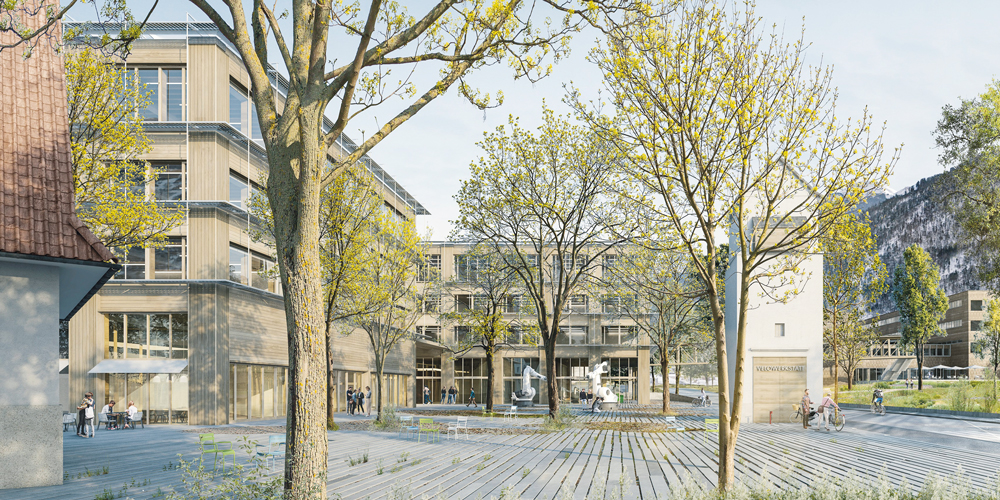
    Die Visualisierung zeigt den zukünftigen Campusplatz.
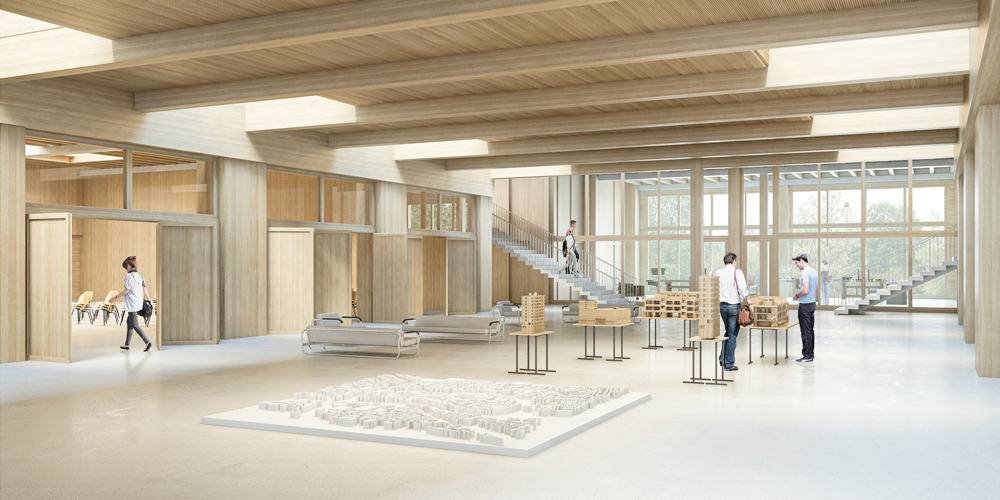
    So soll das Foyer des Neubaus dereinst aussehen.
  • Daiwa House Modular Europe names four trends that will be essential for the real estate industry in 2022

    Daiwa House Modular Europe names four trends that will be essential for the real estate industry in 2022

    Global scarcity of resources
    The prices of many building materials are currently skyrocketing. This will not change this year either – insulating materials, steel, everything will become more expensive and scarce. Construction prices are rising accordingly and threaten to make many projects unprofitable. In addition, the emerging countries in particular are currently asking for a lot of material and are buying the market empty. So the situation will continue to worsen. In the long term, only improved project planning with a greater focus on reusability can help, because circular economy and resource protection already begin in the planning phase. If entire buildings, parts of buildings and building materials can be recycled or found a subsequent use, this not only reduces the material requirement, but also contributes to greater sustainability at the same time. It is important to think big about Cradle to Cradle in the future.

    Sustainability not only through energy savings in the usage phase
    The German construction industry in particular has an urgent need to catch up when it comes to sustainability. In the Netherlands there is already a CO 2 cap per square meter of new construction. With the new government with green participation, it is quite conceivable that such a cap will also become the new guideline in Germany. In addition, disposal costs will remain a major issue and will increase proportionately. Due to the still immature framework conditions for recycling processes and the low landfill capacities, waste is becoming a further driver of construction costs. This shows how important it will be in the future to use building materials and building parts for a long time and to reuse them later – as is already possible in modular construction by refurbishing reused modules. The circular economy should therefore be the focus of the project early on in the planning.

    Digitization and AI also in construction
    In order to increase sustainability across the entire industry and to counteract the scarcity of resources, both planning and production must be optimized. Both must become more intelligent overall and network. The use of “artificial intelligence” is ideal for this. It supports construction projects, for example, through generative design, proactive problem detection and the avoidance of delays and cost overruns. But it also has to be used in production. An example: Digitizing the cut leads to less offcuts and waste. Thanks to good advance planning and the use of an AI, the remaining material from a cut can be used for further use in other future projects. This not only saves material, but also additional work steps and thus increases the efficiency of the entire production process. After all, residual materials are also resources.

    Industrialized manufacturing as in the automotive industry
    The advance of digitization within the construction industry also enables the use of semi- or fully automated processes. They reduce sources of error and make production more efficient. Affordable living space can be optimally realized with robot-supported construction processes in connection with the necessary digital management of the construction data – from planning to construction site. In view of the acute shortage of skilled workers, which will not be solved in the next few years, this development is the logical consequence. Daiwa House Modular Europe will also rely on automated processes in the already planned German gigafactory.

    These four trends should encourage the construction industry to rethink. In addition, there are a number of other changes such as a generational change in the ranks of managers as well as political and social change. Builders are now open to standardized building solutions. Modularly planned and built buildings offer a short construction time and high quality thanks to around 90 percent prefabrication in the factory. In the residential, care, hotel and education segments in particular, there are similar needs despite the different locations – so not every building has to be a prototype.

  • World economy after COVID-19. This is what investors expect.

    World economy after COVID-19. This is what investors expect.

    Economic growth continues
    The pandemic isn’t over yet, but vaccinations have at least brought some normalcy back. The upswing is likely to continue in 2022. Strong economic growth of 4.3 percent is expected. The reasons for this are as follows: solid demand, a supportive fiscal and monetary policy environment and further easing measures.

    Inflation likely to peak
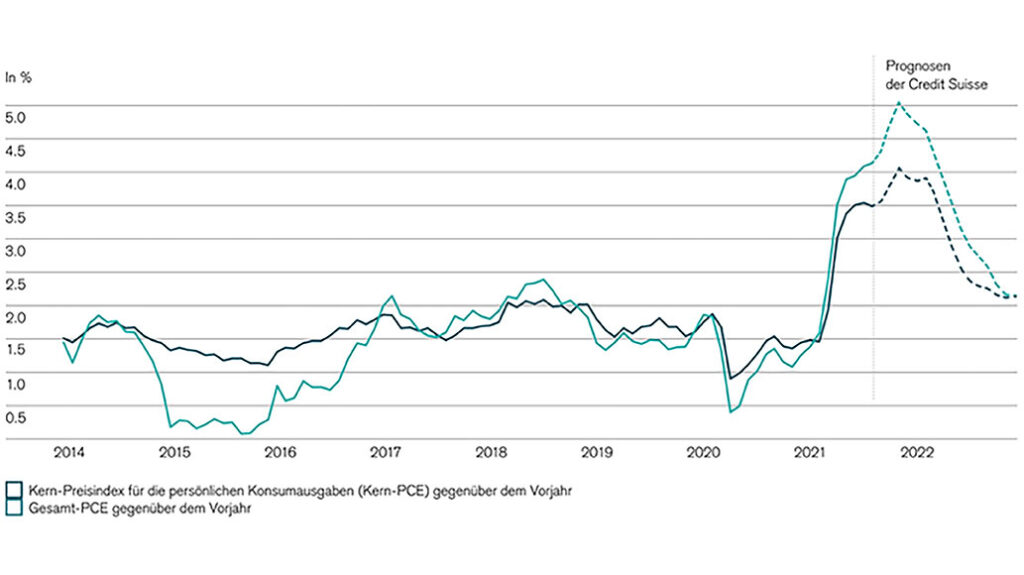
    The rise in inflation was one of the central themes of 2021 and will continue to occupy us in the future. For 2022, the global inflation rate is expected to remain at an elevated level of 3.7 percent. The key question is how central banks will respond. Credit Suisse experts assume that many will initially reduce their purchases of securities. Interest rates, on the other hand, are likely to remain unchanged as long as inflation falls from 2021 levels.

    Inflation rate in the US is likely to fall after 2022
    Most of the recovery in prices lags behind the US. The base effects wear off.

    Last data point: 09/2021

  • "Zurich should become even stronger as an innovation location"

    "Zurich should become even stronger as an innovation location"

    At the beginning of this year you took over the management of location promotion. What measures have you taken to settle in well and quickly?
    Fabian Streiff: An important point for me was networking with cantonal actors, representatives from business and science. Due to the circumstances, this first had to be done virtually. But even more relevant for me was the question of how we can support companies – especially during the pandemic. The companies’ need for information was enormous. Especially in times when instruments such as short-time work and hardship aid were used.

    What exactly have you done to support the companies?
    The Office for Economy and Labor sought an intensive exchange with entrepreneurs early on in order to find out which issues we need to address at national level and which we can solve within the canton. We have also set up a hotline for companies and continuously updated various websites. Now we are looking to the future and addressing the question of how we can positively influence the attractiveness of Zurich as a business location.

    What is this plan like?
    Discussions with Zurich-based companies confirmed that we should focus even more on an attractive innovation location. Innovations are increasingly emerging in networks, which is why strong innovation ecosystems make a significant contribution to the future success of Zurich’s economy. This needs to be strengthened. A central theme are new hybrid forms of work such as home offices or working from co-working spaces. We have to ask ourselves what this means for the location and its development. It is also exciting to see how Zurich can remain an attractive business location for companies. Are there opportunities to improve access to talent and specialists, especially in the context of mobile working? What role can the state play in making a contribution here? These are all open questions – we are already seeing trends, but of course also the consequences of them, such as the discussion about making labor law more flexible.

    Is Zurich really losing its attractiveness as a business location?
    Many companies answer this question with a resounding no. But shifts are becoming apparent. Large companies are forecasting a concentration on individual locations within the next two years. This means that certain properties could become vacant. On the other hand, these could quickly be used again for new forms of work such as co-working spaces. Rural centers are likely to be revitalized thanks to home office options. The business location Zurich is also strengthened by the universities, which do a great job with their successful spin-offs and research work and are right at the top of the rankings. The companies in the canton of Zurich were also able to attract risk capital on a large scale last year, which is very gratifying.

    How did this positive development come about despite the pandemic?
    Zurich has positioned itself well in recent years, especially with a view to digital transformation. Top talent is needed here and can be found at the Zurich location. This is thanks to the universities and the talent pool, which has been able to develop significantly in recent years. At first the banks had a magnetic effect, now it is the large companies from the information and communication technology sector. The interaction of the various industries is very promising for the future. We are also registering positive developments in the area of research. The points mentioned are becoming more and more relevant in the location competition. But other locations don’t sleep and have positioned themselves very well nationally and internationally, which is why the leading position of the Canton of Zurich cannot be taken for granted. It must continue to be strengthened in the area of innovation.

    The canton of Zurich is Switzerland’s leading business location. Why?
    The attractiveness of Zurich is based on various factors. Starting with education, through a highly qualified workforce, to strong sectors from the financial sector and increasingly from the areas of life science technology, cleantech and information and communication technology. This diversity of competencies enables strong ecosystems, which strengthen cross-industry learning and innovation. The quality of life per se also speaks in favor of Zurich as a location.

    What are you doing to secure this status in the future?
    Our new strategy has three focal points: The first is the strong focus on innovation topics in the areas of financial technology, digital health, biotech, cleantech and new mobility. Here we want to create more networking and opportunities for cooperation. The second focus is on cooperation with regional location subsidies in order to strengthen the diversity of the industry. The size of the Canton of Zurich requires networked work in order to do justice to the diversity of the individual regions. In this way, we can also support exciting regional projects, such as was the case with the Bio-Technopark in Schlieren. We are currently also seeing this at the Digital Health Center in Bülach. The third focus is on creating attractive framework conditions, especially in the area of innovation. Here we can work to ensure that the regulations at federal level are adapted for specific innovation topics.

    Which regulations are in urgent need of adjustment?
    With Zurich as a strong innovation location, the focus is currently on the consequences and solutions following the failed framework agreement with the EU. The exclusion from Horizon Europe weighs heavily. Adjustments to labor law due to changed needs must also be checked – such as when working on the move.

    Which areas are companies currently looking for the most?
    From the customer side, we see a need for space in well-developed locations that are integrated into an ecosystem. Connections to universities are being sought more and more. Biotech laboratories are also becoming increasingly important. Schlieren was able to develop enormously in this area. Nevertheless, we are registering a demand here that cannot yet be satisfied nationwide.

    What is the problem?
    In the biotech sector, the space that comes onto the market is occupied again very quickly. More and more investors are needed who are willing to invest in laboratories. Such a project usually takes two years or more to develop. Appropriate foresighted planning is imperative.

    How do you see the future for the office buildings in the canton of Zurich in light of the changing work models?
    We are currently grappling with this question. In general, employers want to become even more attractive. The demands on an office workplace will therefore increase. But whether that means that more space is required for each employee, or whether there will be mergers, we will only see in one or two years. But we believe that co-working will become even more important. However, in a more comprehensive form than today – in the sense of a meeting place where an in-depth exchange with science, the authorities and other actors in the ecosystem can take place. Quasi a co-working plus.

    Which locations are most desirable?
    The city of Zurich and the airport region remain very attractive. At the airport, we are seeing high demand for the newly built The Circle. And the Limmattal has become even more attractive with the Limmattalbahn and the Bio-Technopark. The city of Winterthur and the Zimmerberg region are also popular locations thanks to the ZHAW.

    Which companies are interested in The Circle?
    The Circle not only attracts companies from the information and communication technology sector such as Microsoft or Oracle, but also from the life sciences sector. Digital health is an important topic here. After a difficult start-up phase caused by Corona, the business on the Circle is now picking up, and 85 percent of the space is already rented.

    What are the most important source markets for the Canton of Zurich?
    The USA is still by far the strongest market. Europe, especially Germany, as well as China and Japan are also important. We are now concentrating on Korea and Israel. Companies are increasingly thinking in terms of research and development hubs. For many companies, Zurich is not only an international business location, but also such a hub. Marketing abroad is handled by the Greater Zurich Area location marketing organization for us.

    How should Zurich as a business location develop over the next 10 years?
    It should become even stronger as an innovation location. Zurich has a long history and is well known as a financial center. That is important – also with a view to future settlements in the area of financial technology. Zurich should also distinguish itself in the areas of artificial intelligence and new mobility, such as the development of autonomous systems. We believe in a move away from the traditional Zurich financial center towards a business location that will be very strong in the new topics mentioned and in digitization. The Zurich economy is already well positioned and is resistant to crises – but in the future Zurich should become even more innovative, attractive and thus even stronger.

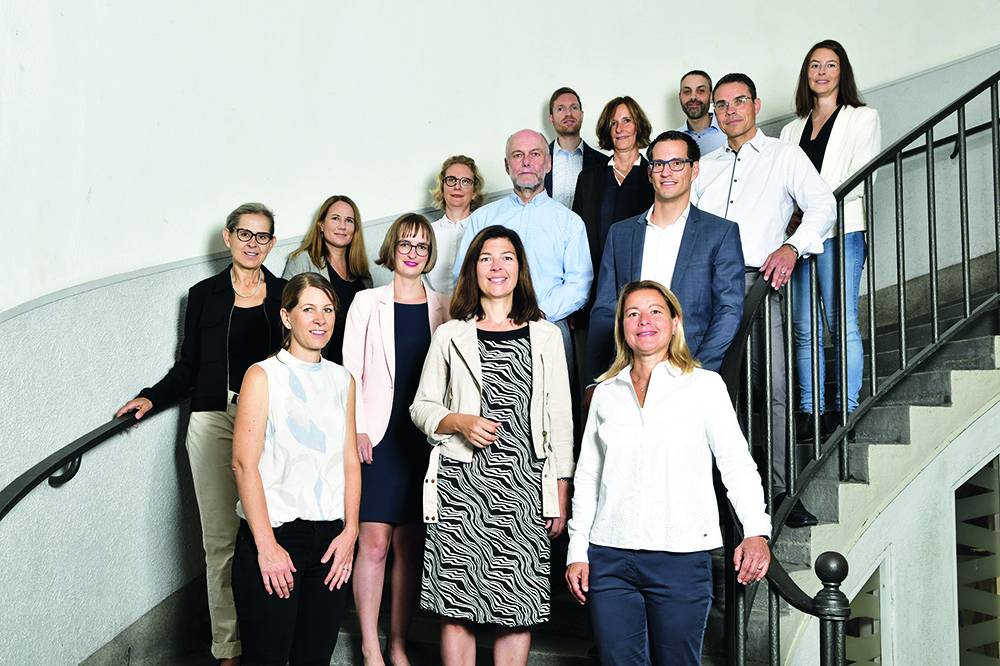
    Fabian Streiff with his team.
  • Canton of Zurich – on the pulse of the action

    Canton of Zurich – on the pulse of the action

    The canton of Zurich is an important growth driver in the Swiss economy. Its gross domestic product (GDP) was more than CHF 143 billion in 2017. That corresponds to more than 20 percent of Swiss GDP. This means that the canton of Zurich has the greatest economic output and added value within Switzerland. The added value can be increased by companies, research and educational institutions and specialist organizations cooperating along the value chain in clusters such as financial services, life sciences, creative industries, cleantech, aerospace, information and communication technology. According to the Statistical Office, the canton of Zurich generates more than 20 percent of the Swiss gross domestic product (GDP) with an annual GDP volume of over CHF 120 billion. This is the greatest cantonal economic added value in Switzerland.

    Maintaining international relationships is also an opportunity to directly follow and actively influence international developments in both the economic and political spheres. The business contacts acquired in this way are of direct benefit to the representatives from business, science and administration based in the canton.

    In terms of quality of life and standard of living, Zurich has held top positions in international rankings for many years. The city of Zurich emerged as the winner of the well-known Mercer study on quality of life seven times in a row. It has been in second place since 2009. The study compares 230 cities based on 39 criteria such as health care, entertainment, shopping, schools, housing, environmental issues, and the political and economic situation.

    A new index also measures the economic and social distribution of prosperity for the first time, and the metropolis on the Limmat ranks first among 113 cities, as zh.ch writes: The “Prosperity and Inclusion in Cities Seal and Awards Index” not only measures economic growth, but above all its quality and what proportion the different population groups have in it. Zurich scored particularly well in terms of work, living, leisure, security and education. Vienna follows in second place, ahead of Copenhagen, Luxembourg and Helsinki. In the inner Swiss city ranking, Zurich ranks first and Winterthur third.

    Testimonials

    Carmen Walker Spah
    Government Councilor,
    Director of Economics

    Thanks to the first-class universities, the availability of specialists, the excellent infrastructure and the high innovative strength of our economy, the canton of Zurich is a highly attractive location for companies.

    David Allemann
    Co-founder On

    Zurich is cosmopolitan, cool and rethinks. It is important that many creative minds live and work in Zurich who drive the location forward in terms of creativity and innovation. So Zurich remains unique.

    René Kalt
    Managing Director
    Innovation Park Zurich

    Universities and numerous innovative companies make Zurich a perfect location for networking science and business. The Innovation Park Zurich contributes to this knowledge and technology transfer, making Zurich even more innovative.

    Mario Jenni
    Co-Founder &
    CEO Bio-Technopark Schlieren-Zurich

    Zurich is an excellent life sciences location due to numerous health and technology companies as well as excellent universities. The “Paradeplatz” of the biotech scene is located in Schlieren and is becoming more and more important nationally and internationally.

  • Schaffhausen extends contract with Generis AG

    Schaffhausen extends contract with Generis AG

    Generis AG will continue to run the economic development agency for the canton of Schaffhausen until 2024. The same applies to the office for the promotion of regional and location development. The government council decided this at its meeting on Tuesday.

    The service contract currently runs until the end of 2022. After that, it can be extended for a further two years for the last time. At the beginning of 2015, Generis AG was awarded the contract to manage both facilities.

    As stated in a communication from the government council, Generis AG has “so far fulfilled its mandate very well. The results achieved to date in the field of business development represent a real success story. ”That is why the service contract is now being extended.

  • Aargau wants to attract more companies

    Aargau wants to attract more companies

    The Aargau government council has presented the task and financial plan for the years 2022 to 2025. It also provides for measures to increase the attractiveness of the business location, including the settlement of new companies. According to the government's embassy, Aargau and its advantages should be made better known to companies abroad. "That is why additional measures should be examined and implemented in this area in order to increase the density of companies in Aargau in the long term."

    When it comes to settling in, the canton wants to concentrate primarily on the sectors in which it is already strong today, namely the life sciences and the energy industry. The focus is on industrial companies and industry-related service providers who rely on a highly qualified workforce. The aim is to locate between twelve and 14 companies each year, including six to eight in the two focus industries. In the past year five companies were relocated, three of them in the focus industries. The acquisition strategy is to be developed next year and applied in a selected market from 2023.

    According to the embassy, it will be checked as early as 2022 whether the canton should join an existing cross-cantonal organization of location marketing. The canton was one of the founders of the Greater Zurich Area (GZA) in 1999, but later left it. Today, GZA is the largest location marketing organization with nine German and Italian-speaking member cantons, including the three neighboring cantons of Aargau: Solothurn, Zug and Zurich. Aargau also borders the Basel Area Business & Innovation , to which the two Basel cantons and the Jura belong.

    With Lucerne, Nidwalden and Obwalden, the Aargau is only one of four cantons that do not belong to any cross-cantonal organization of location marketing. Western Switzerland is organized in the Greater Geneva Bern area , the four cantons of Eastern Switzerland in the St.GallenBodenseeArea .

  • Solothurn economic barometer

    Solothurn economic barometer

    The evaluation of the first-time survey among the members of the Solothurn Chamber of Commerce and the Cantonal Solothurn Trade Association on the Solothurn Economic Barometer shows that the economy is returning to the growth zone. There are big differences in the industries. The sectors affected by the lockdowns are suffering, but since the beginning of the year large parts of industry and economic services have returned to a steep growth path.

  • City of Schlieren adopts economic strategy

    City of Schlieren adopts economic strategy

    Schlieren has developed into a strong business location just outside the gates over the past two decades. There are now 1162 companies based in the city. There are 18,500 jobs for every 19,500 inhabitants. Schlieren now ranks 20th out of 132 municipalities in the city ranking of “Bilanz”.

    The city wants to expand this strong position. This emerges from the economic strategy 2021-2025 , which was drawn up with over 80 business representatives and has now been presented .

    Schlieren starts with its existing strengths. In the field of biotech around the Bio-Technopark Schlieren , the city is to further expand its international position. On a national level, Schlieren wants to position itself even more strongly as a location for start-ups. In Schlieren, clusters in the field of medtech and health care and in ICT are also to be added to match these two topics. Schlieren wants to establish itself as a node in networks that extend far beyond the city.

    This also requires increased communication. In the future, the city also wants to communicate in English and French on selected topics.

    But the city also wants to maintain its other clusters. For example, a service agreement with Shopping Schlieren is planned in the purchasing area. Important actors are to be retained and niche providers to settle in Schlieren. The automobile cluster should also be looked after and preserved.

    A good location needs space: Areas such as the Gasi, Geistlich-Areal, Wagi, Rüti and others should receive tailor-made development strategies. A good location also needs people: the leisure and service offers should be expanded.

    The city wants to further develop the location with partners such as Limmatstadt AG and the Greater Zurich Area. An economic council made up of representatives of the companies in Schlieren is also planned to support the city in the further development of the location. There will also be a change at the top of location promotion: Albert Schweizer built it up in over two decades. He will retire in around five years; the successor should be prepared in the next few years.

  • "Best overall package thanks to the Spirit of Zug"

    "Best overall package thanks to the Spirit of Zug"

    To person
    Beat Bachmann is lic.oec. HSG and has management experience in the areas of business development, sales, finance and project management in domestic and foreign markets. His industry experience includes life sciences / medical technology, wholesale / sales of consumer goods, real estate, information and communication technology.

    You are the head of the Business Contact Point in the Canton of Zug. How can you imagine a normal working day?
    Beat Bachmann: Every day is different. As a "one-stop-shop", we primarily support and advise local companies on a wide variety of issues. This also includes support in finding office space. With over 100 company visits per year and by networking the companies with one another in the industry clusters, we help ensure that the companies can operate successfully in a business-friendly location. In addition, we support many companies each year in setting up in the canton of Zug.

    How are the companies based in the canton with regard to the pandemic?
    The Zug economy with its strong international ties is also affected and cannot escape the structural changes. The effects are to be mitigated thanks to the measures taken by the federal government and the canton. Due to the strong constitution of Zug's economy before the Corona crisis and the broad diversification, I estimate that the negative effects will be slightly lower compared to the rest of Switzerland. Nonetheless, our team was able to look after the same number of relocations in 2020 as in previous years.

    In the Credit Suisse location ranking, Zug almost always ranks first – not least because of the low corporate income tax rate of 12 percent. What else do you offer more than other cantons?
    We primarily offer the best overall package of excellent location conditions: These include long-term financial and political stability, tax and finance policy, great innovative ability, high availability of skilled workers in important industry clusters and efficient infrastructure. The fascinating living space and thus the quality of life are also very important. Last but not least, we often hear that economic friendliness – our “Spirit of Zug” – is very much valued.

    What tasks does the Business Contact Point take on in site development?
    In particular, we help ensure that the needs and requirements of the economy and companies are incorporated into the site developments. And when the properties are completed, we offer support in arranging the space for new tenants or buyers.

    Does the site development show that the potential is being exhausted?
    We are very happy that the landowners and site developers have made a significant contribution to the sustainable and qualitative development of the canton for decades. It is in line with the long-term strategy of the government council that Zug should remain an attractive place to live and live. There is still enough arable land. I therefore think that the canton of Zug can continue to develop in this way over many generations.

    «Zug, Baar and Rotkreuz score points with the
    Companies"

    Several commercial buildings are under construction in the canton of Zug. In the wake of the pandemic, however, the trend is towards home offices. Still, are you confident that all of these projects can be brought to life?
    Yes, I am confident that these surfaces will be absorbed. Switzerland and the canton of Zug are and will remain a leading international economic area. In the case of new settlements, the availability of ready-to-move-in space is an important location factor. It is difficult to estimate the long-term impact of Covid-19 on office space demand. The trend towards more home offices is countered by a trend towards more space per capita, as well as co-working spaces / business centers.

    Besides Zug, which city in the canton is the most popular location for companies?
    On the one hand, the Lorzen plain (valley communities) has had the most companies and jobs for decades. Since the canton records around 40% train commuters on working days, the proximity to train stations with IC and express train connections is playing an increasingly important role. Accordingly, along with Zug, Baar and Rotkreuz have been the most popular locations in recent years; Cham follows behind.

    What makes the canton of Zug attractive as a place to live?
    Zug offers a good international infrastructure, excellent schools and political stability. The standard of living is high and the living spaces are intact. There are lakes, mountains and diverse landscapes in the smallest of spaces. Zug therefore offers an outstanding quality of life and the proximity to central Switzerland and Zurich.

    How do you assess the current demand on the housing market?
    It is consistently high in the canton of Zug. At the same time, the vacancy rate in the canton of Zug is only increasing minimally.

    How do you rate the building potential in the housing market?
    Since we at the Business Contact Point primarily deal with companies and, accordingly, with office and commercial space, I am not an expert on the housing market. However, I observe that many apartments have been built unchanged for decades and that they are constantly finding residents. As the smallest full canton in Switzerland in terms of area and due to our sustainable growth strategy mentioned above, we will continue to see a high proportion of commuters in the future.

  • "The city of Zug should become greener"

    "The city of Zug should become greener"

    To person
    Eliane Birchmeier (FDP) has been city councilor and head of the building department of the city of Zug since January 2019. The 58-year-old studied business administration and is federally certified. dipl. PR consultant and founded Birchmeier Communications AG based in Zug in 2005. She was a member of the Board of Directors of Kursaal-Casino AG from 2004 to 2017 and co-owner of C-Matrix Communications AG from 1992 to 2004.

    You are the head of the building department of the city of Zug. Where do you see your core tasks?
    Eliane Birchmeier: My core tasks include the classic areas of responsibility in construction: On the one hand, there are building permits and building projects for city-owned civil engineering and structural engineering projects. On the other hand, we deal with planning, design and legal aspects in town planning and urban planning. This is about the future development of the city of Zug in terms of urban development and spatial planning with settlement, landscape and traffic.

    The city of Zug is forecast to have around 10,000 population growth by 2040. What structural measures are planned to do justice to this development?
    The forecast growth depends on the development of the project by private owners and investors. We have already done our homework in many areas. For example, when it comes to infrastructure projects in the areas of drainage, energy and disposal. In education, we – like other communities in Switzerland – have a certain amount of catching up to do. Various plans are currently underway for expanded and new school facilities. But we also want to upgrade the green and open spaces and improve the network of footpaths and bike paths in the coming years.

    The economy should also continue to grow. Where do you see the greatest potential for new commercial buildings?
    There is still great potential for expansion for trade and services in various former industrial and urban areas. These include the technology cluster with the V-Zug area, urban areas east and west of the station such as Metalli, Baarerstrasse West and the LG area. Then there is the area on the Aa II, which is being developed by the Zuger Verkehrsbetriebe, the Hertizentrum and the outer Lorzenallmend. In the future, these areas will offer mixed, urban uses of living, leisure and work.

    Where in the canton can you find larger land reserves?
    As elsewhere in the canton, growth in the city of Zug will mainly take place in the interior through densification. In addition, there are a few construction areas that have not yet been built up, such as the outer Lorzenallmend, areas in the Herti and Unterfeld, in the Lüssi / Göbli and in a southerly direction in the Salesianum and in Oberwil. Actual zoning is not the focus of ongoing local planning.

    "We expect planning applications for the Lüssi / Göbli area and the area of the Salesianum country house soon"

    Which projects are planned there?
    In the outer Lorzenallmend, a development plan is being drawn up for a residential and work area and in Herti Süd one for a residential development. There are currently no plans in the Herti Nord, Unterfeld or Spielhof. In the Lüssi / Göbli and the Salesianum there are legally binding development plans for residential developments. We expect planning applications for this in the near future.

    What are currently the most important construction projects that you are involved in?
    City-owned projects are the construction of the recycling center and the Ökihof in the north of the city. School complexes are being planned and projected throughout the city. The project competition for the extension of the lido starts this year, and in summer the Zug population will be able to use the new emergency rooms in the Göbli district.

    The city of Zug is in the middle of the local plan revision process. Is there already an initial strategy for mobility and open space?
    The city's spatial development strategy will be drawn up in several stages and steps up to autumn 2021. The first thrusts based on the technical basis, the population survey and the first participation phase are clearly emerging: the city should become greener. In addition, a diverse and high-quality range of different open spaces should be available to the population.

    What does the population want?
    She would like the growth in mobility to be absorbed by expanding and promoting pedestrian and bicycle traffic as well as public transport. Traffic routing in the center is to be simplified and designed in a way that is compatible with settlement. Particular attention is paid to optimizing commuter traffic. In cooperation with the canton and neighboring communities, but also with employers, we are focusing on an increased shift towards public transport, which is already excellently developed, and non-motorized private transport.

  • Lidl is planning branches for the future

    Lidl is planning branches for the future

    Lidl Switzerland had already committed itself in 2014 to make the operation of its branches more sustainable, informs the retail company in a message . After all, the energy consumption of 150 Swiss Lidl branches corresponds to that of a medium-sized city in the country. The savings potential is correspondingly large.

    New branches are to be implemented as early as this year with the help of an innovative energy concept, the communication further explains. "It is very important to us that our future locations are future-proof and sustainable with regard to building materials, energy consumption and technology", Reto Ruch, Chief Real Estate Officer of Lidl Switzerland, is quoted there. Lidl Switzerland is working with Empa to develop this energy concept.

    In a first step, the two partners will analyze the energy consumption of the existing branches. As a result, optimization measures should then be derived from this. At the same time, Empa and Lidl want to test alternative energy systems with the help of computer simulations. "Our goal is to help Lidl Switzerland with our research work to further improve sustainability, continue to reduce emissions in the future and optimize energy management," explains Empa researcher Curdin Derungs in the press release.

  • Poenina takes over Kälte 3000 AG

    Poenina takes over Kälte 3000 AG

    Bündner Kälte 3000 AG will belong to Poenina Holding as of March 31, 2021, the building services group from the Zurich economic area informed in a message . According to her, the relevant contract was signed on January 15th. The notification does not provide any information about the purchase price.

    "With the acquisition of Kälte 3000 AG, we are continuing our growth strategy in the core competence areas of heating and cooling," said Jean Claude Bregy, CEO of the Poenina Group, in the press release. The new acquisition, which specializes in services for refrigeration technology, has, in addition to its headquarters in Landquart, branches in Samedan GR, Untereggen SG and Regensdorf ZH. The company's annual turnover is estimated at around 15 million francs.

    The previous directors Ronny Berry, Robert Gadient and Pius Gruber will also manage Kälte 3000 AG under the Poenina umbrella. The company will also continue to operate under its old name, informs Poenina in the announcement.

  • Smart cities work together

    Smart cities work together

    Basel, Bern, Lugano, Lucerne, St.Gallen, Winterthur and Zurich are already working together on the next national exhibition, " NEXPO – the new Expo ". Now, within this framework, they also want to jointly develop models for future cooperation between intelligent cities, according to a media release from the canton of Basel-Stadt. Its cantonal and urban development in the presidential department is taking the lead in a first pilot project of the initiative.

    With “Smart Inter-City – our common path into the future”, the participants not only want to develop models of cooperation between so-called Smart Cities, but also to implement them. By networking the seven cities, existing synergies are to be used. The project is also open to partners from business, science and the general public.

    The pilot project is to be promoted at the respective innovation locations of the participating cities. In Basel, for example, this includes the Smart City Lab Basel , which was launched by the canton and the SBB.

  • Empa presents three innovation awards

    Empa presents three innovation awards

    The Eidgenössische Materialprüfungs- und Forschungsanstalt ( Empa ) has honored three of its groundbreaking projects and achievements with the Empa Innovation Award. The prize, endowed with CHF 5,000, has been awarded every two years since 2006. In doing so, Empa honors the efforts of its researchers to build further bridges between science and business with applied, market-oriented research.

    According to a press release by Empa, the first prize goes to the novel tissue adhesive technology Nanoglue. It was developed by researchers at the Particles-Biology Interactions Laboratory at Empa in St.Gallen in collaboration with the Nanoparticle Systems Engineering Lab at the Swiss Federal Institute of Technology in Zurich . Their radically new approach uses the wound-healing properties of inorganic nanoparticles. The inexpensive materials could be manufactured on a large scale. The “unique technology” is now being brought to market maturity by the Zurich start-up anavo medical , which has yet to be founded.

    The transparent face mask from the Hello Mask project by Empa and the Swiss Federal Institute of Technology in Lausanne ( EPFL ) also received an award. It consists of a fine membrane with a pore size of around 100 nanometers. This membrane allows air to pass through, but holds back viruses and bacteria. “The fully see-through mask was developed primarily with the aim of improving the relationship between caregivers and patients,” says researcher Joshua Avossa. The Geneva start-up HMCare has been working on the market launch of the Hello Mask from Empa and EPFL since 2020. It should be available in mid-2021.

    The software platform Urban Sympheny for planning sustainable energy systems is the third winner. The Empa spin-off of the same name, based in Dübendorf, helps planners to identify optimal solutions for their location and their customers. The goal is energy and cost efficiency. The innovative platform was developed in Empa’s Urban Energy Systems department. Last year Venture Kick awarded Urban Sympheny 50,000 francs.

  • Zug is the most attractive canton for companies

    Zug is the most attractive canton for companies

    The major bank Credit Suisse has published its location quality indicator for this year. This measures the attractiveness of the cantons from the point of view of companies. The canton of Zug moved up to first place this year and was able to overtake the canton of Basel-Stadt. Credit Suisse explains this with the reduction in corporate income taxes that came into effect at the beginning of 2020. The effective maximum corporate income tax rate in Zug is now 11.91 percent – in the previous year it was 14.35 percent.

    Behind Zug and Basel-Stadt, the canton of Zurich follows in the ranking, followed by the canton of Geneva, which has moved up ten places. The fifth place is occupied by the canton of Aargau, the sixth by the canton of Schwyz.

    In addition to the tax policy of the cantons, Credit Suisse also includes the availability of highly qualified and skilled workers in its analysis. According to the economists of the big bank, the level of education of the Swiss workforce has risen sharply in recent decades. However, there is a gap between urban and rural areas when it comes to the availability of highly qualified workers. In urban regions as well as in the closer agglomeration areas, over 40 percent of potential employees have a higher education. In the city of Zurich this proportion is even 57 percent.

    Credit Suisse not only scrutinized the cantons, but also economic regions. This is because she is of the opinion that consideration at the canton level falls short of the mark, especially in larger, heterogeneous cantons. According to the results, metropolitan areas such as Zurich, Zug, Basel, Baden and Geneva and their agglomerations are among the most attractive regions for companies.

  • Fischermätteli Burgdorf: Future-oriented area in the Minergie-A-Eco standard

    Fischermätteli Burgdorf: Future-oriented area in the Minergie-A-Eco standard

    In December 2019, the excavators drove into the former industrial site in Burgdorf and the new Fischermätteli district should soon come to life: the first apartments will be ready for occupancy in summer 2021. By 2024, ten apartment buildings with 169 inexpensive 2.5 to 5.5 room apartments and living spaces between 52 and 140 square meters are to be built in a total of three construction phases. Located in an idyllic location in the immediate vicinity of the forest, the buildings are grouped around a central meeting zone with five differently designed outdoor spaces.

    Largest Minergie-A-Eco quarter made with Swiss wood

    The Fischermätteli settlement will one day be the largest development in Switzerland that will not only be built with Swiss wood, but also meet the Minergie-A-Eco standard. This requires a positive energy balance and the expenditure for space and water heating, air renewal as well as for all electrical devices and lighting must be covered by renewable energies. The addition Eco focuses on the issues of health and building ecology and ensures a high level of living comfort. "Based on the positive experiences we have made so far, it was the only right decision for us in terms of ecology and sustainability to build the Fischermätteli in the Minergie-A-Eco standard," explains Bruno Kälin. He is Head of Marketing and a member of the management team at Strüby Konzept AG. The Strüby companies act both as builders and as full service providers (project development, architecture, engineering, production, implementation, customer service, customer service) and are also responsible for sales.

    For the Fischermätteli, the client relies on spruce and silver fir from Swiss forests: “There is no better building material than wood. It is available locally, is growing steadily, is CO 2 -neutral, creates jobs in the region and ensures a good and healthy indoor climate, ”explains Kälin. The wood required for construction is bought directly from the forest owners, sawn, glued and processed in the region. Long transport routes are eliminated, which means that the embodied energy is very low.

    Sophisticated energy concept

    The client had put out a tender for the energy concept, which ewz won. The energy service company is responsible for planning, financing, realizing and operating the energy supply. The contracts run until December 2044 and begin in stages according to construction stages. The ewz Energy Solutions division has developed an integral concept for the Fischermätteli district, which, in addition to a sophisticated heat and power supply, also includes ancillary costs accounting that covers all media.

    All buildings on the site are connected to an area heating network. The heart of the heat supply is the heating center with an output of 550 kW. Wood pellets from the region are used as energy sources. The quality management system of the working group QM wood heating plants ensures efficient heat production. The energy service provider finances and implements the heating center and the lines for heat distribution to the house. The client, on the other hand, builds the installations for the domestic hot water and for the fine distribution of heat in the houses. A heat pump instead of wood heating could not be considered due to the geological conditions at the site.

    100 percent renewable solar power

    In addition to the heat supply contracts, ewz agrees electricity supply contracts with the owners. These regulate the supply of electricity to a total of seven floor and site owners. Since the Minergie-A building standard requires 100 percent coverage with renewable electricity, a photovoltaic system is installed on every house roof. The ten plants in the final stage will have an output of 722 kWp. According to project manager Christian Rolli from ewz Energielösungen, the challenge was to achieve the required solar power yield and still have enough space on the roofs for maintenance and servicing of the photovoltaic modules. The solution was to choose monocrystalline high-performance modules with a higher degree of efficiency, which produce more yield in less space, but this is reflected in a higher price. Around 3200 m 2 of photovoltaic modules are installed on the site. If, for example, there is such a high overproduction during the summer holidays that not all of the electricity can be fed into the grid, production can be reduced.

    The overall concept worked out by ewz Energielösungen convinced the client: "Our specifications for an ecological and economical solution that can be implemented and maintained holistically by one partner were implemented very well by ewz," says Bruno Kälin.

  • Fabian Streiff becomes the top Zurich location promoter

    Fabian Streiff becomes the top Zurich location promoter

    There is a change at the top of the business location promotion department at the Zurich Office for Economics and Labor. Markus Assfalg is retiring after eleven years as head of location promotion, as announced by the office. He will be replaced by Fabian Streiff . The 35-year-old has been with the Basel Area Business & Innovation since the beginning of 2019 and heads the DayOne healthcare initiative. Prior to that, he was co-head of Basel-Stadt's economic development department.

    Streiff holds a doctorate in economic geography from the University of Bern and a Master of Science from the University of Zurich .

    One of the first to congratulate the cantonal location promotion and to Fabian Streiff is the location promoter of the city of Schlieren , Albert Schweizer. "We are very pleased with the choice of Fabian Streiff," he says. "We have known Fabian Streiff for a long time and have followed his work in the canton of Basel-Stadt very carefully."

  • BaselArea cantons submit a joint economic report

    BaselArea cantons submit a joint economic report

    Successful business needs good framework conditions. This is not only the case at the moment in the three cantons of the BaselArea. “They will continue to develop their strength in the future,” says the media release on the joint report by Basel-Stadt, Basel-Landschaft and the Jura. The report gives an optimistic view of the future of the changes that have also been triggered by the effects of the Corona crisis and lockdown, failure and future redesign of the international division of labor and delivery routes. The regional economy has repeatedly shown in the past that it is able to react to change and develop positively.

    The three cantons have been working closely together on economic policy for years. It was therefore only natural for the governments to prepare a joint economic report. This is now happening for the first time. Basel-Stadt and Basel-Landschaft published the last economic report in 2016.

    On the basis of this analysis, future opportunities and challenges were developed and named. Above all, they want to work together on state innovation funding and location promotion. This means that more can be achieved than with the previous individual activities of each canton.

    The Basel Area Business & Innovation association is at the center of the future coordinated approach. It is already financially supported jointly by the three cantons. With the range of services offered by Basel Area and the Switzerland Innovation Park Basel Area (SIP), the region wants to create an attractive environment for companies, research and innovation in which research and development, service providers and investors find the prerequisites for international communication and marketing.

    The second additional report analyzes the effects of COVID-19 on the business location Basel-Stadt.