Category: New construction

  • Gartenstadt Bergacker living with a future

    Gartenstadt Bergacker living with a future

    The approximately 70-year-old buildings on the Bergacker estate are no longer up to date and are in need of renovation. It is not feasible to renovate them while they are occupied, which is why the owners, Swiss Life for the western part of the site and Habitat 8000 for the eastern area, have decided in favour of a comprehensive replacement building.

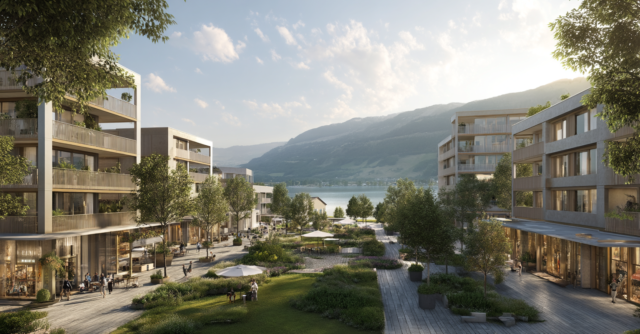
    Test planning was carried out back in 2019 to develop a sustainable urban planning solution. The result is a concept based on four-storey terraced buildings that are arranged along the slope and create generous, green open spaces. These “garden courtyards”, developed by EMI Architekten and Maurus Schifferli Landschaftsarchitekt, tie in with the original garden city idea and promote the quality of life.

    Sustainability as a guiding principle
    The entire construction project is designed in accordance with the highest sustainability standards and aims to achieve the “Gold” certificate of the Swiss Sustainable Building Standard. Energy is supplied by geothermal probe heat pumps and photovoltaic systems, making the neighbourhood largely self-sufficient in renewable energy. Green roofs and climate-resistant outdoor spaces with wildflower meadows and shady trees promote biodiversity. At the same time, a large proportion of the garden courtyards remain unsealed in order to improve natural water management.
    In addition to ecological sustainability, the social component also plays a central role. The new building will create a total of 270 flats with 1.5 to 5.5 rooms, which are aimed at a broad public, from singles and families to older people. The focus is on affordable living space that is suitable for all stages of life.

    Living quality through intelligent architecture
    The new buildings make optimum use of the hillside location to offer maximum living comfort. A noise-reduced mezzanine floor has been created on the street side, while the rooms on the garden side have generous ceiling heights and offer direct access to the green open spaces. The floor plans are designed in such a way that morning sun in the kitchens and evening sun in the living rooms ensure a pleasant indoor climate. Each flat has two outdoor areas in the form of a loggia, a balcony or a terrace with a private garden.

    Particular emphasis is placed on communal areas. In a participatory process, tenants expressed a desire for seating, playgrounds, barbecue areas and urban gardens, which are now being integrated into the planning.

    Staggered implementation for a smooth transition
    To ensure an orderly transition for residents, the new building will be realised in several stages. The construction project planning should be completed by the end of 2025 before the first construction phase starts in 2026. The first new buildings are expected to be occupied in 2028, while the other construction phases should be completed by 2030.

    Swiss Life tenants will be actively supported throughout the entire process. They will receive help in finding accommodation, have priority when re-letting within the neighbourhood and benefit from flexible notice periods.

    A showcase project for sustainable living
    Gartenstadt Bergacker is becoming a forward-looking neighbourhood that combines sustainable construction with a high quality of living and a social mix. Conscious planning and the involvement of the tenants will create an environment worth living in that fulfils ecological, economic and social requirements in equal measure. The project sends out a strong signal for the future of sustainable living in the city of Zurich.

  • Expansion of the headquarters to start this year

    Expansion of the headquarters to start this year

    CSS is planning to start construction work on the extension of its headquarters on Tribschenstrasse in Lucerne in the fourth quarter of this year. The building application will be submitted at the beginning of April, the Lucerne-based health, accident and property insurer is quoted as saying in a report in the Luzerner Zeitung newspaper. The new building and renovation of the commercial building acquired by CSS in 2015 should be completed by the end of 2027.

    CSS intends to use almost all of the space in the new building and the commercial building for its own needs. A bistro is only planned on the ground floor of the commercial building. The amount of the construction costs is not being communicated by CSS, at least not at the moment.

    The concept for the extension of the CSS headquarters is based on a design by Diener und Diener Architekten. The Basel-based architectural firm won a competition organised by CSS against nine competitors. The winning Lambris design envisages that the commercial building, which is classified as worthy of protection, will be enclosed by the extension.

  • New building combines warehouse, office space and solar system

    New building combines warehouse, office space and solar system

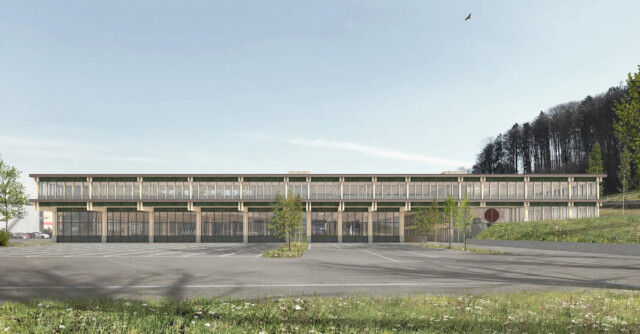
    Schenker Schweiz AG broke ground for the expansion of the national transport terminal in Eiken on 1 April 2025. According to a press release, the terminal is to be expanded by 9800 square metres to 15,400 square metres. The new transshipment warehouse is planned with an underground car park on two levels of 4900 square metres each. An office wing with social facilities is also to be created on the upper floor.

    A photovoltaic system will be installed on the roof of the new building, which is to be constructed in accordance with modern guidelines and will also supply charging stations for electric lorries. The main contractor for the building is Tierstein AG, which is responsible for the entire planning and execution.

    “With the modern extension, Schenker has additional capacity to further expand its land transport network,” said Basaran Yildirim, Head of Land Transport at Schenker Schweiz AG, in the press release. “We would like to thank the municipality of Eiken for its trust and the cooperation with all those involved in the project.”

    The Eiken site plays a central role for Schenker logistics for imports and exports by land due to its good transport connections on the north-west border of Switzerland.

  • New school buildings create space for growing pupil numbers

    New school buildings create space for growing pupil numbers

    The Limmattal cantonal school in Urdorf now has more space for teaching. On Tuesday, 1 April, two extension buildings were officially inaugurated, according to a press release from the Canton of Zurich Building Department. They offer modern rooms for science lessons, two double sports halls, an assembly hall and an outdoor area, according to the press release. According to population forecasts, the number of pupils at the cantonal school is set to increase significantly in the coming years. The new buildings will create the necessary space for the increasing number of pupils.

    The new premises were inaugurated in the presence of the Director of Construction, Martin Neukom, the Director of Education, Silvia Steiner, and the Principal of the Limmattal Cantonal School, Andreas Messmer. The inauguration was accompanied by musical performances by around 90 pupils from the cantonal school, according to the press release.

    One of the new buildings contains two double sports halls, classrooms for music and an auditorium with 500 seats. The second building houses four floors of rooms for physics, chemistry, computer science and biology as well as several classrooms. The new buildings were designed by PenzisBettini Architekten from Zurich.

    Thermal energy for the new buildings is generated by geothermal probes. Photovoltaic systems have been installed on the roofs of the two extension wings to supply the cantonal school buildings with electricity.

    On Saturday, 5 April, there will be an open day for school tours.

  • SBB continues to develop Basel

    SBB continues to develop Basel

    With the “Wolf Basel” project, SBB is transforming a 160,000 square metre site in the east of the city into a lively, sustainable urban quarter. The transformation is exemplary for the intelligent densification of urban spaces. Living, working, leisure and logistics are to coexist here in a new form that conserves resources, is sustainable and integrated into the existing urban structure.

    Construction work on the western part of the site will start in 2027. SBB has sought and found top architectural and functional solutions in two competitions. The jury, consisting of independent experts and representatives of the client and the Canton of Basel-Stadt, has now recommended the projects “Janus” by ARGE Experience from Paris with M-AP Architects from Lausanne and “Binaria” by ARGE Parabase GmbH and Confirm AG from Basel for realisation. The two new ten-storey buildings will offer around 300 flats and set standards in terms of sustainability, quality of living and architectural integration.

    Sustainability meets urban innovation
    The planned residential buildings reflect the changes in urban development. The flats are designed for different lifestyles, and communal areas in the ground floor zones promote social interaction. The roofs not only serve as a source of energy through photovoltaics, but also as water reservoirs and in some cases as accessible recreational areas. Photovoltaic elements on the façades, greenery, renewable heating systems and sophisticated systems for cooling in summer are all part of a comprehensive energy concept.

    The project also sets new standards in terms of construction. Screw connections replace adhesive joints, modular structures allow for later conversion or dismantling, making design for disassembly a reality. Wolf Basel thus presents itself not only as an urban development model, but also as a technical model for the future.

    Identity is created through dialogue
    Even before construction begins, the site will be opened up for interim uses, experiments and participation. A historic railway hall has recently been used as a temporary pickleball court, bringing movement to the centre of the development area. In addition, various spaces are available for longer-term uses in the areas of culture, leisure and catering. SBB is calling on people to submit creative ideas and play an active role in shaping the future neighbourhood.

    The opening is more than just a gesture, it is part of a strategy in which urban development is understood as a participatory process. This creates an emotional bond with the neighbourhood and its future identity at an early stage.

    Staged construction with vision
    Construction of Wolf Basel is scheduled to start in 2027. In the first phase, the residential buildings will be built in the western part of the site, including a third in the affordable segment by non-profit property developers. At the same time, the Urban Hub, a public space offering catering, sport, culture and services, will be developed in the middle section. In a second phase, expected from 2031, commercial and service buildings with around 1,000 workplaces will follow in the eastern section.

    The entire project is based on the legally binding development plan dated 2 May 2023 and is an example of the high-quality development of inner-city potential areas in Switzerland.

  • House of the Future secures further tenants in Winterthur

    House of the Future secures further tenants in Winterthur

    The Green Spin project aims to change the world of work in a sustainable way. To this end, the House of the Future is being built in Winterthur with 100 per cent sustainability and 100 per cent work quality, according to the Green Spin website. The project has now found its second anchor tenant in the form of the Foundation for Speech Therapy Schools in the Canton of Zurich, Green Spin explains in a press release.

    “Green Spin offers the perfect setting for innovative educational approaches,” Peter Felix from Felix Partner Architektur Design, which initiated and developed the project, is quoted as saying. “With the Stiftung Sprachheilschulen im Kanton Zürich, we have gained another tenant that ideally complements our concept of openness, networking and forward-looking development.” The foundation currently operates at four locations in Zurich, Winterthur, Fahrweid in the Limmat Valley and Stäfa.

    Green Spin received its building permit last year and construction is due to start this year. The centre is expected to be ready for occupation in 2027. In addition to the foundation, the leisure sports provider Padelta has already reserved premises in Green Spin.

    Green Spin is intended to offer young and established companies an ideal environment. The building is designed as a modular timber construction and will have a photovoltaic façade and wind power for its own energy supply. In addition to bright working environments, the project envisages meeting places such as a roof garden, a courtyard forest and market alleyways.

  • Gold-coloured façade modules in Schlieren set new solar standards

    Gold-coloured façade modules in Schlieren set new solar standards

    Megasol Energie AG, based in Deitingen, has launched a new coloured solar module on the market. According to a press release, the modules with their new colour design achieve around 94 percent of the efficiency of conventional black photovoltaic modules.

    The panels under the name SOLARCOLOR Morpho are manufactured for installation as façade elements. For example, they have been installed on two new buildings in the Lacheren area of Schlieren. Depending on the incidence of light, the gold-coloured modules create a lively play of colours, according to the press release.

    The two buildings in Lacheren comprise 36 flats. The roof is also covered with photovoltaic modules and generates peak values of 68 kilowatts with an annual yield of 59,900 kilowatt hours. The façade elements generate peaks of 17 kilowatts and an annual yield of around 16,200 kilowatt hours.

    Megasol Energie AG is one of the five nominated finalists for the Prix SVC Espace Mittelland 2025 sponsored by the Swiss Venture Club (SVC), which will be awarded in Bern on 12 March 2025.

  • Westspitz neighbourhood in Dietikon enters the planning phase

    Westspitz neighbourhood in Dietikon enters the planning phase

    The Basel-based insurer Baloise has completed the study contract for the urban development of the Dreispitz site in Dietikon, according to a statement from the city of Dietikon. The Westspitz neighbourhood is to be built there. The design plan process will begin in summer 2025 and run until the end of 2027, with the building permit procedure and project planning scheduled for 2028/2029. The construction phase is set to last from 2030 to 2032, with completion and occupation scheduled for 2032/2033.

    According to the press release, the consortium Penzel Valier in Zurich and ROBERTNEUN, based in Berlin, was unanimously recommended by an independent jury as the winning project for further development. The jury was appointed by Baloise as the owner and leaseholder of the site. The project, known as Westspitz Dietikon, meets the urban planning requirements of the city of Dietikon, supports its development strategy and provides new impetus for an urban, sustainable neighbourhood, it added.

    Westspitz Dietikon is located at the intersection of Badenerstrasse and Überlandstrasse. In the coming years, Westspitz is set to grow into a lively, mixed and well-connected neighbourhood. The neighbourhood consists of 80 to 90 percent residential space. Compact residential units for smaller households and larger flats for families are planned, as well as communal areas and noise-protected outdoor spaces. The ground floor zones along Badenerstrasse are to be enlivened by small-scale commercial spaces that meet the needs of residents and the surrounding neighbourhoods, the report continues.

  • Canton Aargau approves Vinea project in Spreitenbach

    Canton Aargau approves Vinea project in Spreitenbach

    The municipality of Spreitenbach can realise the Vinea design plan for the construction of flats at the entrance to the village. The Department of Construction, Transport and Environment(BVU) of the Canton of Aargau has approved the design plan, according to a press release. It forms the planning basis for the realisation of a development with around 37 flats on the previously commercially used site south of the Landstrasse and Wigartestrasse junction.

    According to the municipality, the planned development comprises three buildings. A four-storey building is to be constructed along Landstrasse, a three-storey building on Wigartestrasse and a two-storey building directly facing the village stream.

    A traffic-free inner courtyard is to be created between the buildings, which will be available to residents. The underground car park is intended to increase the quality of living and contribute to sustainable development.

    Vinea is based on the indicative project by Hunziker Architekten AG in Baden-Dättwil and SKK Landschaftsarchitekten AG in Wettingen AG. Metron AG in Brugg AG drew up the design plan together with the client and the municipality of Spreitenbach. The Vinea site is currently built on with a commercial development. A development study was prepared by Hunziker Architekten back in 2018. After weighing up various options, the municipality decided in favour of a longitudinally oriented development along the road in order to “create optimal urban planning conditions”.

  • Foundation stone laid for new company building in Grabs

    Foundation stone laid for new company building in Grabs

    Frauenfeld-based HRS will be the total contractor for the construction of the new Körber Business Area Pharma building in Grabs. According to a press release, the foundation stone was laid on 13 February.

    In addition to the existing building at the site, a basement, two production floors and two office floors will be built on a vacant site. A total of 7500 square metres of production space and 5000 square metres of office space will then be created in the new building. The building itself will fulfil current sustainability and energy efficiency requirements. In addition to its own photovoltaic system on the roof, extensive charging facilities for electric cars will also be provided, according to the press release.

    The new building, which is scheduled for completion in 2027, will bring together all the resources of Körber’s Business Area Pharma.

    “The new building plays a central role in our planned growth, which is centred around our customers and, of course, our employees,” said Christoph Hammer, CEO Packaging of the Körber Business Area Pharma in Grabs, in the press release. “In addition to our spatial capacities, we are also growing our team. More than 360 colleagues are already working on the development and production of our technologies at the site. By the end of this year, this figure is set to rise to more than 390. We are creating a state-of-the-art working environment for them.”

  • Work begins on extension to Baden cantonal school

    Work begins on extension to Baden cantonal school

    Preparations for the extension of the Baden cantonal school have begun with clearing work on the construction site. According to a press release from the Canton of Aargau, this preparatory work will be carried out during the sports holidays from 3 to 14 February. This involves removing shrubbery and felling trees in the Schönaustrasse area in Baden. This work must be carried out before construction work on the extension begins in July 2025.

    The early start is necessary because the tree felling must be carried out outside the bird breeding season from the beginning of March to the end of September. New trees will be planted across the entire site once the extension has been completed. According to the press release, this will once again take greater account of biodiversity on the grounds of Baden Cantonal School.

    The building permit for the extension to the cantonal school has been valid since the end of October 2024. The extension will include an additional wing for maths, IT, natural sciences and technology (STEM subjects) and a sports wing including a double sports hall.

    In addition, the outdoor facilities and sports pitches will be redesigned. The planned extension represents the final expansion of the site based on the current school planning, according to the canton’s press release.

  • Potential and challenges of new living concepts

    Potential and challenges of new living concepts

    The focus is on self-built residential units, which are often built in large halls and are shared by groups or individuals. Residents attach importance to sustainable and individualised living, foregoing excessive private space and sharing communal areas instead.

    The projects analysed in Zurich and Bern show that these types of housing use significantly less living space per person than the Swiss average. The high degree of flexibility in the interior design allows for individual customisation, but also entails high time and financial costs.

    Legal framework and challenges
    Clear but flexible framework conditions and supportive guidance from property developers and authorities are crucial for the successful implementation of these concepts. Building law hurdles and financing issues in particular require customised solutions to make such projects economically viable.

    Innovative niche solutions with potential
    Although these forms of communal living currently represent a niche, they offer exciting approaches for a more sustainable and diversified use of living space. However, their long-term potential for the affordable housing market remains to be seen.

    The study was conducted by the OST and FHNW universities of applied sciences in collaboration with the BWO, the Solidarity Fund Foundation, the Migros Culture Percentage and other partners. It is part of the research focus areas “Affordable housing” and “Adapting the housing stock to changing needs”.

  • Campus Platztor architectural competition launched

    Campus Platztor architectural competition launched

    In the first round of the competition, 73 applications were received, a surprisingly high number with high-quality reference projects. Decisive factors in the selection of the 16 offices were sustainability aspects, experience with similarly complex projects as well as urban planning and architectural quality. The selected teams come from St. Gallen, Zurich, Thurgau, Basel-Stadt and Geneva.

    Next steps and timetable
    Following the selection of the winning project in summer 2025, the canton and the university will further develop the project. Construction is scheduled to start in 2028 and the new campus is expected to open in 2031. The new campus will serve as a place of reflection and a meeting place and will blend harmoniously into the cityscape. The aim is to strengthen the university’s links with the city and its population.

    Realignment after project restart
    The current competition became necessary because the project selected in 2021 could not be satisfactorily developed further. The new process is now intended to create a viable concept that fulfils the high standards of architecture, sustainability and urban integration.

  • Baden Cantonal Hospital celebrates handover of keys for new hospital building

    Baden Cantonal Hospital celebrates handover of keys for new hospital building

    With the handover of the keys on 22 January, the KSB is now officially responsible for the new hospital building. The keys were handed over by actress Salomé Jantz in the role of Queen Agnes of Hungary, the KSB announced in a press release. The Habsburg queen donated a hospital to the town of Baden in 1349 and is the namesake of the current construction project.

    The new building was realised by a team from Ghisleni Partner AG under the leadership of owners Stefano and Maurizio Ghisleni. “By using a general planner, we were able to continuously optimise the project and incorporate the latest findings,” KSB CEO Adrian Schmitter is quoted as saying in the press release. “This means that our hospital will not be ten years old when it opens, but will be at the cutting edge of medical and technical development.”

    KSB has invested a total of 600 million Swiss francs in the eight-storey building. The new building, equipped with state-of-the-art medical and building technology, is due to open on 25 February. KSB will then move from the old to the new building.

  • First construction phase in Unterfeld Süd in Baar starts in 2025

    First construction phase in Unterfeld Süd in Baar starts in 2025

    The owners Ina Invest and Estella Invest and the developer Implenia decided in favour of a digital project competition in which a digital 3D model was submitted instead of physical models. This made the jury process much easier, as different levels and elements could be flexibly combined and analysed. The winning design for the first construction phase, a combination of the proposals from Enzmann Fischer Partner AG and ORT AG, impressed with its innovative floor plans and a well thought-out design of the open space that harmoniously combines living and working.

    Open space design as the key to the attractiveness of the neighbourhood
    The Unterfeld Süd neighbourhood will be enhanced by generous open spaces, which
    extend along the Stampfibach stream. An ecologically valuable green space is being created here that offers a wide range of uses. The central arrival square at the S-Bahn station will be transformed into an inviting place to meet and linger thanks to tall trees and green islands.

    High-rise building with a view to the future
    The 60-metre residential tower block in the first phase is impressive not only for its height, but above all for its well-thought-out floor plans and flexible room layouts. The generous windows offer impressive views from every flat, while the bay windows on the façade allow residents to enjoy both the outside and the inside of their own flat.

    Commercial building as a centre for dynamic companies
    The adjoining commercial building also focuses on flexibility. Two glazed inner courtyards create islands of light that can be used as break areas. With its flexible room structure, the building offers space for a wide range of uses – from small offices to larger rental spaces for anchor tenants.

    The second phase will provide affordable housing and flexible commercial space
    The second construction phase, the planning of which is already at an advanced stage, will focus on affordable rental flats and owner-occupied flats. The inner courtyard of the planned perimeter block development in the second phase will create opportunities for retreat and public meeting spaces in equal measure. The buildings along Nordstrasse are deliberately designed to minimise noise pollution. A referendum on the second stage will also be held in Baar in 2025.

    Sustainable architecture and flexible usage concepts
    The architecture of the buildings reflects the vision of a future-oriented neighbourhood. The combination of flexible living, versatile commercial space and well thought-out open spaces creates a lively and attractive cityscape. Particularly noteworthy is the combination of living and working, which is supported by well thought-out spatial concepts and attractive outdoor areas.

  • New school infrastructure in Zofingen takes shape

    New school infrastructure in Zofingen takes shape

    The building construction for the new secondary school centre in Zofingen has been underway since June 2024. As the construction company responsible, STRABAG, has now announced, the basement and the first floor with classrooms are already in place. In the excavation pit next to the gymnasium, the specialised civil engineering team has completed the groundwork by installing the bored piles and constructing the retaining walls.

    At the same time, employees from Verkehrswegebau Obergösgen are laying the service lines. The structural engineering work should be completed by the end of June 2025. The finishing work will then begin, according to the information provided. The building will be put into operation at the start of the 2027/2028 school year.

    STRABAG describes the ten concrete beams for the gymnasium ceiling, which were lifted into place in mid-November, as a “spectacular highlight”. Each of them was 29 metres long and weighed 60 tonnes. Other prefabricated elements were also installed. They were reportedly planned immediately after the contract was awarded in order to be ready for use on time.

    Now that the beams for the new triple gymnasium have been moved into place, the structural engineering staff, led by site manager Daniela Huonder and foreman Vincenzo Tafaro, are currently busy shuttering, reinforcing and masonry work on the other floors.

  • Start of construction of the forest town Im Pantli

    Start of construction of the forest town Im Pantli

    Halter AG has begun construction of the Waldstadt in Pantli. The ground-breaking ceremony for the residential project in the Pantli forest clearing in Schaffhausen took place on 10 January, the Schlieren-based property developer announced in a press release. The 214 condominiums planned in Waldstadt are being realised by Halter in collaboration with DOST Architektur GmbH from Schaffhausen.

    “The Waldstadt project in Pantli is making a valuable contribution to urban development,” says Mayor Peter Neukomm in the press release, quoting from his speech at the ground-breaking ceremony. “The development should serve as a model for future construction projects and strengthen Schaffhausen as a location for sustainable and innovative living.” Waldstadt is designed as living space for different living models.

    Specifically, the residential project aims to appeal to families and couples as well as singles and commuters. A kindergarten and daycare centre are also planned. Open spaces and communal facilities are intended to create “ideal conditions for harmonious coexistence”, according to the press release.

    Planning and realisation are based on the requirements of the Swiss sustainability standard. Around two and a half years have been estimated as the construction period for the first stage. The first of the 2.5- to 5.5-room flats should be ready for occupancy as early as next year.

  • Life cycle assessment calculator supports sustainable building

    Life cycle assessment calculator supports sustainable building

    The environmental product declarations (EPD) in accordance with SN EN 15804 make it possible to transparently present the ecological impact of a building material over its entire life cycle. This provides building owners with a sound basis for making decisions on sustainable construction that goes beyond individual environmental parameters and allows a comprehensive assessment.

    Baustoff Kreislauf Schweiz provides its members with independently verified average EPDs for various types of concrete and aggregates. This data forms a reliable basis for sustainable construction projects.

    Life cycle assessment calculator as a digital tool
    An industry-specific life cycle assessment calculator has been developed to calculate CO₂ emissions, energy consumption and other environmental indicators. This verified calculation tool offers the construction industry a practical way to determine and optimise environmental product declarations.

    The online tool at oekobilanz-rechner.ch enables an orientating analysis, but does not replace a complete EPD preparation. On request, the data entered can be further processed to create an officially verified environmental product declaration.

    Transparency and optimisation for the construction industry
    The life cycle assessment calculator provides the construction industry with a valuable tool for making sustainable material decisions based on data. By optimising the recording and evaluation of environmental impacts, the tool contributes to reducing the ecological footprint in the construction industry and supports a resource-conserving circular economy.

  • Final construction phase for sustainable development in Rotkreuz

    Final construction phase for sustainable development in Rotkreuz

    Zug Estates is tackling the final construction project in the development of the Suurstoffi site in Rotkreuz, which began in 2010. The Zug real estate company announced in a press release that the ground-breaking ceremony for the two new buildings Suurstoffi 43 and 45 was held at the beginning of December together with representatives from the authorities and project partners. Together with a central park, they are due to be completed by mid-2027.

    Zug Estates is creating around 14,400 square metres of office and training space in the two new properties. A further 1,100 square metres have been designed as living space for student accommodation. Once completed, the Suurstoffi 45 property will be home to the Central Switzerland Health Education Centre(XUND). The training centre is relocating from Alpnach OW to Rotkreuz in order to meet the growing demand for practical healthcare training and changing training models. XUND and Zug Estates signed a long-term rental agreement for Suurstoffi 45 in September.

    The final development project for the site “fits seamlessly into the Suurstoffi site, both architecturally and in terms of sustainability”, writes Zug Estates. “The existing, almost emission-free energy system” will have another geothermal probe field. The proportion of grey energy will be lower than in comparable properties thanks to a reduced basement level and the optimisation of façades, building services and statics.

  • Sustainable construction projects launched in Germany and abroad

    Sustainable construction projects launched in Germany and abroad

    Implenia, the construction and property company based in the Glattpark district of Opfikon, has won several tenders for building construction contracts. According to a press release, the contracts have a total volume of 160 million Swiss francs.

    The company will construct the new office building of the Swiss National Science Foundation(SNSF) in Bern. The sustainable building will be constructed using local timber and recycled concrete in accordance with the Swiss Sustainable Building Standard (SNBS). Implenia has also been awarded several contracts in Germany.

    In Mainz, Implenia, together with its partners Gemünden and Apleona, was awarded the contract to construct a new 10,000 square metre research building for TRON. The research institute develops new diagnostics and active ingredients for immunotherapeutic treatments.

    In Leipzig, Implenia and its partner GP Günter Papenburg AG are building a seven- to eight-storey residential development on nine connected properties. In addition to 202 residential units, many commercial and ancillary premises are to be built. The buildings will be constructed as low-energy buildings in accordance with the Efficiency House 55 standard and the entire complex will be handed over on a turnkey basis.

    Three residential buildings with 101 units are being built in Munich, which should be ready for handover by 2026. Implenia will also realise a further stage of an ongoing project in Heilbronn and has been commissioned with a pre-construction phase in Siegburg.

  • New indoor swimming pool for theKSS approved

    New indoor swimming pool for theKSS approved

    The decision of the Schaffhausen electorate paves the way for the construction of a new, modern indoor swimming pool on the KSS site. With an investment volume of CHF 80 million, this project represents an important milestone in the further development of the city’s infrastructure. The new building is not only a response to the ageing existing facility, but also a commitment to sustainable and future-oriented urban development.

    The new building will replace the existing indoor swimming pool from 1972, which is no longer up to modern-day standards due to its poor condition and outdated technology. The last refurbishment measures were carried out more than 30 years ago and the facility suffers from serious deficiencies such as water and heat losses, a lack of accessibility and outdated safety equipment. In addition, the current indoor pool can no longer cope with the increasing number of visitors, which leads to considerable conflicts of use.

    An indoor pool for all generations
    The planned new building will not only exceed the previous standard, but will also set new benchmarks. With a swimming pool comprising eight lanes of 25 metres each, as well as a teaching pool, a course pool with a lifting floor, a separate diving pool and a children’s paddling area, the range of facilities will be significantly expanded. There will also be an outdoor warm water pool and a state-of-the-art wellness centre with various saunas, a steam bath and a sauna garden. This facility will not only meet the sporting needs, but also the increasing demands of the population for wellness and relaxation.

    A central element of the new concept is the separation of the pools according to their main uses in order to avoid the current conflicts of use. The new structure makes it possible to use the various facilities simultaneously and without restrictions. The central entrance to the new building will ensure efficient access to all facilities and optimise operations.

    Sustainability as a guiding principle
    The new indoor swimming pool will be built to the “Minergie-P-ECO Standard”, one of the highest standards for energy-efficient and sustainable construction in Switzerland. The project’s energy concept provides for the extensive use of waste heat, in particular from the neighbouring ice rink, as well as a connection to a local heating network. These measures will help to significantly reduce the ecological footprint of the new building and position Schaffhausen as a pioneer in sustainable construction.

    New synergies and sources of income
    The new indoor pool will not only offer sports and health facilities, but will also be of economic importance. A publicly accessible restaurant with 130 indoor and 150 outdoor seats will generate additional income and establish the KSS facility as a meeting place for the entire population. In addition, an underground car park with 150 parking spaces will improve accessibility.
    Additional rental space for health and fitness facilities will round off the concept and contribute to the attractiveness and profitability of the overall project. These synergies between the various uses will strengthen the KSS site as a central focal point for sport, leisure and recreation in Schaffhausen.

    Competition and project management
    Following the approval of the population, the project competition will now begin with the aim of finding an innovative design for the new building that fulfils the high standards of architecture, functionality and sustainability. Twelve qualified teams will develop their proposals by summer 2025 and the winning project will be presented to the public. Construction is scheduled to start in 2027, with the new indoor pool opening in 2029/2030.

    The construction of the new indoor pool in Schaffhausen is more than just a building project – it is a strong signal of the city’s future viability and innovative strength. With state-of-the-art infrastructure, sustainable construction and an expanded range of facilities, the new indoor pool will make the KSS complex an even more attractive and contemporary leisure centre.

  • The Steig school complex is extended and modernised

    The Steig school complex is extended and modernised

    The Steig school complex, the oldest primary school in Schaffhausen, is located in the north-western part of the city, not far from the old town, and comprises several buildings of different ages. The need for renovation is considerable, as the existing infrastructure no longer meets modern requirements. The gymnasium from 1892 and the room capacities for the growing number of pupils no longer meet today’s requirements.

    In order to meet future needs, the city is planning a new building on the existing site. This will include a new single sports hall, additional classrooms and facilities for after-school care. The extension is part of a comprehensive development concept for Schaffhausen’s primary schools.

    The winning project and its elements
    A project competition crowned the “cinque pi” project by Soppelsa Architekten GmbH and Rosenmayr Landschaftsarchitektur GmbH as the winner. This cleverly divides the required programme into five building blocks, which create a harmonious overall impression as an ensemble. A new three-storey building with a gymnasium and classrooms forms the core of the project. The old observatory will be retained as a free-standing building.

    The existing gymnasium will be restored to its historical structure to create space for a new pavilion for the day centre and library. This will become the central hub of the entire complex. Conversions are also planned. The Trotte will now house storage rooms and a public toilet on the ground floor and therapy rooms on the upper floor.

    Redesign of the outdoor facilities
    Not only the buildings, but also the outdoor facilities will be redesigned. Existing qualities are to be further developed with moderate interventions. The observatory and the group of trees by the playground will be retained. The play and sports areas will be rearranged to create space for an all-weather playing field and a hard court.

    Financing and political approval
    The total cost of the project is estimated at CHF 21.7 million. This sum already includes the planning costs approved by the city council. Following the deliberations in the city council, the electorate will make the final decision on the extension of the Steig school complex.

    The “cinque pi” project is a forward-looking response to the growing demands and challenges of the education sector in Schaffhausen. It combines modernity and tradition in a progressive and resource-conserving construction method and the creation of lively learning and living spaces.

  • “Smetterling”: a co-operative project by HGW for the Alpenblick site

    “Smetterling”: a co-operative project by HGW for the Alpenblick site

    The Alpenblick site in Schaffhausen, adjacent to the historic Niklausen neighbourhood, will be redesigned by the end of 2027 with the winning project “Smetterling”. The jury, consisting of representatives from the city of Schaffhausen, HGW, the neighbourhood and neighbourhood meeting place nik. as well as independent experts, praised the project in particular for its precise urban design and the clear zoning of the open spaces. The compact design of the building and its harmonious appearance fit in perfectly with the surroundings and create a link between the listed Niklausen single-family house estate and the neighbouring high-rise building.

    A concept that promotes community
    The “Smetterling” project envisages a tall point building that takes up very little of the surrounding area and marks the transition to the taller houses on the opposite side of the street. The positioning creates two different open spaces. A garden space to the west and an urban space to the east. This arrangement encourages social interaction while at the same time preserving the residents’ privacy.

    The project reflects HGW’s co-operative values by creating communal spaces in addition to living space, thus promoting a lively community life.

    The ground floor of the building will house communal areas such as a laundry room, a co-working space and a commercial space. The upper floors offer 20 flats of different sizes, while the top floor comprises five one-bedroom flats with direct access to the roof garden. The spacious communal areas and the roof garden offer many places of retreat, but also opportunities for neighbourly interaction and the creation of social interaction.

    Wood and recycled concrete
    The winning project favours an ecologically sustainable construction method. The clear, simple geometry of the building also contributes to energy efficiency and makes the project a role model for ecological construction.

    HGW Heimstätten-Genossenschaft Winterthur has been creating affordable living space since 1923 and promotes lively community life and innovative solutions. With over 2,250 flats and more than 5,000 residents, it is the largest independent housing co-operative in the region.

  • Life Sciences Campus Allschwil continues to grow

    Life Sciences Campus Allschwil continues to grow

    With the official laying of the foundation stone for the ALL laboratory building in Allschwil, the Switzerland Innovation Park Basel Area marks a new stage in the development of a world-leading life sciences location. Domenico Scala, President of the Innovation Park, Stephen Wilson, CEO of BIIE, and Johannes Eisenhut, Managing Director of Senn Development AG, celebrated the start of construction with a time capsule in which representatives of the regional economy, politics and schoolchildren from the Swiss International School recorded their wishes for the future.

    Research building with a focus on sustainability
    The new ALL building is scheduled for completion in 2027 and will offer around 21,500 square metres of state-of-the-art laboratory and office space in accordance with the SNBS Platinum sustainability standard. This third collaboration between Senn and the architecture firm Herzog & de Meuron on the Innovation Park’s Main Campus strengthens the long-term orientation of the site. The investor Senn is aiming to intensively promote collaboration across the entire campus in order to maximise the innovative strength of researchers and companies.

    Research for tomorrow’s health
    With the BIIE, the ALL building will be home to one of the most significant investments in the life sciences sector. The BIIE, supported by 15 years of funding totalling USD 1 billion from the Basel Botnar Foundation, is dedicated to researching the immune system in order to develop new solutions for the diagnosis, treatment and prevention of diseases in children and adolescents worldwide. “The choice of location was crucial for our institute. The Main Campus offers exactly the right environment to meet our high standards,” explains Stephen Wilson.

    A strong life sciences cluster in Europe
    As part of the national innovation park Switzerland Innovation, the Switzerland Innovation Park Basel Area is an important hub for research and development in Switzerland. With sites in Allschwil, Jura and the Novartis Campus in Basel, the park focuses on the key areas of biotechnology, medical technology, digital health and industrial transformation. Around 1,200 specialists from 92 companies and 12 research groups work at the Basel site, making it the largest area for life sciences in a Swiss innovation park.

    Future prospects for Allschwil and Switzerland
    The construction of the laboratory building symbolises the sustainable development of Basel as a life sciences location and the innovative strength of the region. “We are using the knowledge gained from previous projects such as the HQ main building and HORTUS and are continuing to focus on sustainable infrastructure and the promotion of synergies,” emphasises Johannes Eisenhut. The development of the Switzerland Innovation Park Basel Area shows how Basel is becoming an international centre for life science research and technology – a win-win situation for science, business and society.

  • “Vision 2040 “AROVA HALLEN in Flurlingen

    “Vision 2040 “AROVA HALLEN in Flurlingen

    One step on a long journey has been taken: all those involved in the consultation process have signed the utilisation and development concept (NEK) for the AROVA HALLEN site. The Cantonal Office for Spatial Development ARE accompanied the upstream informal process in an advisory capacity without a signature. This means that the planning realisation can be addressed and discussed.

    Culturally unique and economically viable
    The AROVA HALLEN site is currently registered in the regional structure plan as a workplace area and is clearly differentiated from others by its historic building fabric. This represents both an obligation and an opportunity. The aim of the NEK is to put the site on a sustainable and economically viable footing and thus provide a forward-looking response to the challenges of spatial development in the Weinland region.

    Goals and visions for a mixed neighbourhood
    The main objective of the NEK is to maintain and strengthen the location as a place to work and to value the architectural heritage. The plan is for high-quality internal development that brings living and working closer together. “Vision 2040” envisages the creation of around 250 new flats by 2040 without reducing the existing 400 jobs. The focus is on modern forms of living and working as well as a lively neighbourhood with moderate traffic, complementary specialist shops and restaurants.

    Working and living in harmony
    The NEK thus follows the idea of mixed utilisation – living and working are moving closer together. Due to the historic building fabric, the site is particularly suitable for moderately disruptive businesses and services. The “Vision 2040” target image shows how the site can be developed into a modern business park that reduces mutual emissions and creates a lively neighbourhood.

    Current developments and plans
    In addition to the long-term goals, there are numerous current measures to strengthen the image and identity of the site. By focussing on the preferences of potential tenants, additional space has already been let. Interim uses and temporary events are also planned for the future. Following the fire in the beautiful WERKHALLE, the damage was repaired and a meeting point for tenants and their customers is to be created on the ground floor.

    Coordination and information
    The AROVA HALLEN utilisation and development concept is closely coordinated with the settlement development strategy of the municipality of Flurlingen. Further information and the final report can be downloaded at www.arovahallen.ch.

  • A new landmark at the Rhine Falls with great potential

    A new landmark at the Rhine Falls with great potential

    The goal was clearly defined. A third of the 900,000 annual Rhine Falls tourists were to be lured to the other side of the river and attracted to the “Rhyfall Village” area. “Rhyfall Village”, or “RIVI” for short, is the name of the new neighbourhood. With a mix of gastronomy, art and shopping, the area will become a centre of attraction – not only for tourists, but also for the local population.

    The site and its future
    The “RIVI”, once the site of industrial production, is undergoing a reorganisation. The neighbourhood is characterised by two striking high-rise buildings, one of which was acquired by Helvetia. These offer living space with impressive views and space for catering, office and retail areas.

    Potential and challenges
    The visionary project met with broad approval in the region. Beat Hedinger, Managing Director of Schaffhauserland Tourismus, saw the village at the time as a “colourful mosaic piece” in the overall tourism picture. The rooftop restaurant with a view of the Alps in particular promised to be a special highlight. Hedinger also recognised the challenge of skilfully bridging the distance between the Rhine Falls basin and the site.

    Felix Tenger, Mayor of Neuhausen, is optimistic that the “RIVI” will revitalise the centre of Neuhausen and also strengthen the retail trade. Building director Martin Kessler also saw great potential to turn the site into a meeting place that creates synergies with existing facilities and increases the attractiveness of the entire region.

    Good connections and creative solutions
    The site’s location scored highly thanks to its proximity to the Rhine Falls and good public transport connections. The Badische Bahnhof Neuhausen railway station is located directly next to the site and numerous bus connections and over 200 parking spaces are available to visitors. Visitors can travel in comfort between the Rhine Falls basin and the Rhyfall Village on the Rhyfall Express tourist train.

    A project with vision
    Rhyfall Village is more than just another residential neighbourhood in Neuhausen. Whether rooftop restaurant, promenade or art gallery – the RhyTech site stands for a modern, versatile and vibrant future in the immediate vicinity of one of Switzerland’s most impressive natural wonders.

  • Foundation stone laid for new research institute in Allschwil

    Foundation stone laid for new research institute in Allschwil

    The foundation stone has been laid for the construction of the ALL laboratory building on the Main Campus of the Switzerland Innovation Park Basel Area in Allschwil, which is operated by Basel Area Business & Innovation. According to a press release, the building should be ready for occupancy in 2027. The anchor tenant is the independent and non-profit international Botnar Institute for Immune Engineering(BIIE), which opened in June 2024. It is dedicated to research into the immune system of young people and will be endowed with 1 billion dollars over 15 years by the Basel-based Botnar Foundation. This is one of the highest amounts ever donated by a Swiss charitable foundation.

    “We were looking for a location for our institute that fully meets the high standards of the world’s best researchers in immune engineering,” says BIIE CEO Stephen Wilson. “The Main Campus of the Switzerland Innovation Park Basel Area is located in one of the best life sciences ecosystems in Europe and has proven to be the best global location for us.”

    Following the Main Campus HQ and Hortus buildings, the new ALL building is the third collaboration between investor and real estate developer Senn and Basel architects Herzog & de Meuron on the Main Campus. It will offer 20,500 square meters of space and comply with the Platinum Standard for Sustainable Building Switzerland(SNBS).

    The BIIE on the Main Campus will further strengthen Basel as a research location, emphasizes the President of the Switzerland Innovation Park Basel Area, Domenico Scala. “The exchange of knowledge on the Main Campus is the focus of our work, and having the BIIE on board is a great benefit.”

  • Foundation stone laid for new Tösstal campus in Winterthur

    Foundation stone laid for new Tösstal campus in Winterthur

    The ground-breaking ceremony for the new building of the Winterthur Vocational College marks the beginning of a new era in educational infrastructure. The modern campus will provide space for a growing number of students and enable modern training in the specialist areas of retail and care. Thanks to well thought-out planning, construction work has been progressing rapidly since the start in February 2024.

    The new school infrastructure, right next to the Wiesental and Mühletal sites, allows previously separate school locations to be brought together. The “Campus Tösstal” will provide space for up to 1000 students in the future. In addition to traditional classrooms, open learning niches will provide space for individual and collaborative work. The flexible building structure makes it possible to easily integrate future spatial requirements.

    Sustainable architecture sets standards
    The building meets the Minergie-P-Eco standard and the Gold Standard for Sustainable Building Switzerland. A green roof and photovoltaic system contribute to an ecological balance and a better urban climate. The building will also be connected to the city’s district heating network, combining energy efficiency and sustainability. Completion is scheduled for spring 2027.

  • New building for diagnostics solutions in Rotkreuz

    New building for diagnostics solutions in Rotkreuz

    Roche laid the foundation stone for a new diagnostics production building in Rotkreuz on October 29. According to a press release, the pharmaceutical company will invest 215 million Swiss francs in one of the most important sites of its Diagnostics Division. Sustainability and energy efficiency have top priority.

    The new building will replace an old production building, cover around 29,000 square meters and is scheduled for completion by 2027. The development and introduction of new tests and systems for the rapid and reliable diagnosis of diseases reportedly requires additional space that can no longer be provided by the existing infrastructure. “Roche is thus sending a clear signal of the importance of the Rotkreuz production site and underlining its clear commitment to Switzerland,” the company said.

    Roche Diagnostics International AG develops, produces and markets diagnostic systems for clinics, laboratories and doctors’ surgeries in Rotkreuz with around 2,700 employees. It is the largest private employer in the canton of Zug.

    “We are proud that here in Rotkreuz we will be making another important contribution to the healthcare sector in Switzerland and worldwide by providing answers to patients’ health issues with our diagnostic solutions,” said site manager Andreas Klopp. “This innovative and sustainable production facility will play a key role in this.”

  • Suissetec opens new building on the education campus in Lostorf

    Suissetec opens new building on the education campus in Lostorf

    The Swiss-Liechtenstein Building Technology Association suissetec is expanding and modernising its training and further education centre in Lostorf, according to a press release. By the beginning of 2025, a building with workshops, laboratories, training rooms and meeting areas is to be built on around 1,800 square metres. The new building will be presented to the public at an open day on 16 November 2024.

    The infrastructure offers new opportunities for the quality of training and further education in construction professions, according to the statement. Students can learn in a concrete shell at an outdoor workstation just like on a real construction site. Interdisciplinary workshops for plumbers and heating engineers as well as the integration of construction data modelling into the didactic concept would serve as a role model. Müller Wüst AG, which belongs to Debrunner Acifer, has created a digital fabrication model for construction, which is also intended for use in teaching.

    Digital tools allow for flexible, hybrid forms of learning. “Learners will work with real materials, but also practise digitally with virtual reality glasses,” says suissetec Director Christoph Schaer.

    The new two-storey building is the first part of an expansion comprising several buildings. From 2026, the other existing buildings will be renovated in three stages. Suissetec operates the campus as one of three training centres as a “meeting place as well as a place for training and further education” for the construction industry.

    The campus was certified as the country’s first Minergie site in 2023. This means that it fulfils strict energy criteria. The aim is to maximise self-sufficiency with renewable energy, which is generated on the site itself all year round.