Category: New construction

  • Municipality of Hochdorf buys and develops Südi site

    Municipality of Hochdorf buys and develops Südi site

    At the end of August 2021, the management of the Hochdorf Group, known in the region as “Südi”, informed that it wanted to sell its 86,000 square metre site in Hochdorf. Shortly afterwards, the Hochdorf municipal council decided to participate in the bidding process.

    The acquisition of the site by the municipality for over 60 million Swiss francs required, among other things, the approval of the Hochdorf electorate. With 87.6 percent of the votes in favour, the project met with great support.

    Since the beginning of 2022, the municipality of Hochdorf has owned the land, which previously belonged to the Hochdorf Group and its pension fund. The Hochdorf Group has leased the site back until the end of 2025, with the option to extend it by one year. The municipality would like to use this time to plan the development of the site.

    Since the beginning of 2022, the municipality of Hochdorf has been the owner of the land, which previously belonged to the Hochdorf Group (red) and its pension fund (green).
    .

    The people of Hochdorf are to play a decisive role in this. The project began with a three-stage participation process. In a first step, qualitative focus discussions were held with interested parties until mid-September 2022. In a second step, the input from these discussions was discussed at a public participation event at the end of September 2022. In a third step, at the end of October 2022, the population was given the opportunity to evaluate and weight the inputs from the first two steps in an online survey and to further sharpen the emerging idea.

    Thanks to the many responses, those responsible gained a clear picture of the ideas of the people of Hochdorf. A large majority wants a central meeting place with inviting squares and paths. A broad housing mix and attractive office and commercial space are important to them. Ecological measures should also be a central factor in further planning.

    The findings and the vision derived from them were summarised in a report and presented to the population at the end of February 2023. They form the basis for the test planning due in summer 2023, where topics such as urban development, traffic planning or building density will be examined for the first time.

    The municipality would like to complete the utilisation planning, including the revision of the zoning plan, for part of the site by the end of the leaseback contract at the end of 2025 or 2026.

  • Reussperle Buchrain: New prestigious commercial buildings under construction

    Reussperle Buchrain: New prestigious commercial buildings under construction

    Directly on the Reuss canal in Buchrain, a lively new quarter with eight apartment buildings has been created in several stages over the past few years. A car-free inner courtyard, various green zones and shopping facilities in the vicinity create recreational and meeting spaces in the Reuss pearl Buchrain.

    Now Alfred Müller AG is also building two modern commercial buildings there. They will be built directly on the main access road to Buchrain and will create an arrival zone for visitors to the Reussperle Buchrain.

    The two buildings of the Reussperle comprise a total of around 6600 square metres of commercial and office space on three and four floors respectively. The special thing about it is that these spaces are offered in condominium ownership. “Buy instead of rent” is the motto here.

    The Reussperle commercial buildings have a striking, contemporary architecture with a high identification character. The flexible space on offer is suitable for owner-managed or owner-operated companies from a wide range of sectors and of different sizes. The four walls can be divided up and developed according to individual wishes. On the outside, the buildings have a striking, space-creating architecture with a high identification character. This includes the noble, sustainable façade in black glass, framed with anodised aluminium strips, as well as the high-quality wood-aluminium windows. The photovoltaic system on the roof supplies renewable electricity from the building’s own production.

    The commercial buildings are optimally accessible by both private and public transport. The A14 motorway junction is only a few minutes’ drive away. The Reussbrücke bus stop, with connections to Ebikon and Lucerne railway stations every half hour, is right on the doorstep. Various shopping and catering facilities in the vicinity as well as the nearby Reuss canal as a recreational area contribute to the high attractiveness of the location. Construction of the two Reussperle commercial buildings will start in September 2022, and occupation of the fully developed area is planned from August 2024.

  • New hub for the energy industry at the Museum of Transport Lucerne

    New hub for the energy industry at the Museum of Transport Lucerne

    The “House of Energy” at the Museum of Transport Lucerne is a new, long-term platform on the subject of energy. Not only transport and mobility are connected with energy – energy is needed for every form of locomotion. But it also plays a key role in the burning issue of climate change: transport alone accounts for more than a third of CO2 emissions in Switzerland.

    Many people still do not understand the complex interrelationships. The Swiss Museum of Transport wants to change this with its new exhibition. On an area of 600 square metres, the interrelationships and their effects on society are to be shown: How do housing and mobility interact? What might innovative solutions and Switzerland’s energy future look like in 2050? Visitors will be able to view exhibits and interactive attractions that illustrate and bring to life the past, present and future of energy. In addition, various conferences and events on the topic of energy are planned from 2023.

    The purpose-built building by Gigon Guyer Architekten from Zurich, which replaces the former “Schienenverkehr 1” hall, was designed with the latest generation of energy technology equipment: Minergie P is the standard, the energy centre runs on water, and photovoltaic systems have been installed on the roof and the façade. Thanks to this energy centre, the entire Swiss Museum of Transport will be able to run largely on renewable energy in the future. In realising the project, the Swiss Museum of Transport worked together with partners from politics, administration, science and business. The “House of Energy” is intended to serve as an educational venue for schools and universities as well as an experimental laboratory and innovation location for initiating and accompanying activities and projects in the context of sustainable mobility.

    The Swiss Museum of Transport in Lucerne, with its strong visitor numbers of 500,000 to 600,000 people per year at the museum, sees itself as a partner in the transformation process towards the targeted net-zero climate neutrality in 2050. The new energy platform is intended to promote interest in and discussion of the topics of energy and mobility with a focus on Switzerland. The goals include imparting knowledge, creating a strong connection to the everyday lives of visitors, and transparently presenting the challenges along with possible solutions and communication in relation to schools and the professional world. The interactive exhibition will open in April 2023. The new building, which does not include the energy centre and tenant improvements, cost around 37.8 million Swiss francs.

  • Total renovation and new construction in record time

    Total renovation and new construction in record time

    The Hagenmatt housing estate in Root, with around 160 flats, is a good example of successful total renovation and redensification: the estate, built in the 1970s, offered ideal conditions for this project. For the implementation, Die Liegenschaftsverwalter AG, representing the owner Schürch Immobilien AG, engaged PP Baumanagement AG from Kriens for the overall project management, cost planning and construction management. In addition, six new buildings with a total of fourteen terraced detached houses and fourteen 2.5-room flats in timber construction were realised by Strüby Konzept AG from Seewen SZ on behalf of the owner.

    In addition to a more attractive design of the flats, the renovation also aimed at optimising the building’s appearance, redesigning the outdoor spaces and optimising energy efficiency. The latter was achieved thanks to technical measures such as triple-glazed windows and a connection to the EWL district heating system, as well as switching off the oil-fired heating system. For more living comfort, underfloor heating was installed in the existing property, the balconies were extended, the kitchens were equipped with new appliances and the wet rooms were renovated.

    The newly built single-family and multi-family houses are all two-storey and blend in harmoniously with the previously underutilised areas. They feature Minergie-compliant building envelopes, green flat roofs, generously designed roof terraces, and large windows that ensure that the houses are flooded with light. The total renovation of the Hagenmatt development and the construction of the six new buildings was completed in stages within eight months.

    The fast construction time – especially for the new buildings – is due to the chosen timber construction: The components are delivered to the construction site prefabricated, so that assembly can begin directly on site. The Strüby companies purchase around 20,000 cubic metres of wood per year directly from Swiss forest owners. The wood is sawn and glued in the respective region before it is processed further. Thanks to these short distances, grey energy is significantly reduced.

    In addition to the short construction time, the owner of Die Liegenschaftsverwalter AG, Andreas Gasser, is proud that the project’s total cost budget of 42 million Swiss francs could even be undercut. Moreover, the quality of living for the tenants, who were not yet affected by the conversion in the first stage, was not restricted at any time. Gasser emphasises that by cleverly increasing the density by adding storeys, extensions or supplementary buildings, it was possible to create more living space on existing areas and at the same time curb land wastage.

  • The transformation of the Papieri site

    The transformation of the Papieri site

    The Papieri site in Biberist, Solothurn, can look back on a long industrial history: Its existence began in 1862 as the site of the “Papieri” paper mill. After almost 150 years, the factory ceased operations in 2011, most recently owned by the international paper group SAPPI. Subsequently, HIAG from Zurich acquired the 60,000 square metre site – with the aim of creating a lively and diverse quarter.

    However, the industrial spirit that is strongly anchored here is not to be lost: The “Papieri” is to continue to be used for commercial and industrial purposes. The location and general conditions of the area are still ideally suited for this. The site can be reached in a few steps from Biberist Ost railway station. In addition, it is served by the bus stops Biberist Emmenbrücke and Biberist Derendingenstrasse (BSU). Attractive pedestrian and bicycle connections are also planned for the medium term.
    HIAG has worked out a sustainable development strategy in close consultation with the canton, municipalities and other stakeholders. As early as 2013, an urban planning study was carried out in collaboration with five architectural firms. The findings of this study commission formed the basis for the master plan, which was completed in 2015 in consultation with the municipality of Biberist. The partial zone plan revision is currently underway. This is currently undergoing a cantonal preliminary examination.

    The long-term planning envisages a division of the site into two parts: The “West” area near the Biberist East railway station comprises about one third of the total area and is to become an area open to the public with quiet commerce, services, leisure, culture and housing. No concrete residential projects are planned yet. But: “The future usage regulations allow for a residential share in the western area,” says Dominik Ulrich, project developer of HIAG Immobilien Schweiz AG. The eastern area towards Derendingen, on the other hand, will be transformed into a workplace area for the manufacturing industry.

    nightnurse.ch

    Access to the publicly accessible western area of the site is already from the southwest. In future, the triangular Papier-Platz will mark the beginning of the site. The square is enclosed by the striking existing building at Fabrikstrasse 1, which will be made fit for the planned transitional uses by mid-2023: On the ground floor, spaces between 160 and 1000 square metres will be rented to commercial and service providers. The rooms on the upper floors are ideally suited for commercial and storage space as well as studios. Offices are also available in the neighbouring building. “The transitional use of Building 1 is planned for up to ten years. The goal is to establish uses that will last in the long term,” explains Ulrich. The dismantling of the machinery was a prerequisite for opening up the area. The machines were successfully sold in recent years and transferred to new owners.

    The centre of the area, and thus the centre, is the square by the canal: Demolition work is currently underway here to create open spaces and breakthroughs in the hall structures. So far, 17,000 tonnes of material have already been removed. HIAG attaches great importance to sustainability: 14,000 tonnes of it will be processed into granulate on site and reused. The deconstruction work is scheduled to be completed by the end of this year. From mid-2023, the construction of a new modern building is planned, which will offer around 15,000 square metres of usable space for trade, production and offices. The first tenants are expected to move in by the end of 2024. According to Ulrich, concrete negotiations are currently underway with prospective tenants.

    Demolition work is currently underway in the middle of the site.
  • Basel: Visionary building planning on the Dreispitz North site

    Basel: Visionary building planning on the Dreispitz North site

    The planning of Basel’s new Dreispitz Nord district in the “Gundeli” neighbourhood was penned by Basel architects Herzog & de Meuron. It fills the area with new life, the parking area disappears. On an area of about eight football pitches, space is created for a diverse further development of the neighbourhood.

    The direct access from Gundeldingen to Dreispitz Nord is an eye-catcher: via a wide, green ramp, a footpath leads to the roof of the new MParc shopping centre, where there is a unique view over the roofs of Basel.

    The new secondary school for about 600 pupils is also located on the roof of the shopping centre. There are sports fields, a triple gymnasium, green and open spaces and a youth club.

    The new public parks, the size of two football pitches, offer space for play and recreation with their large, shady trees. Pedestrians and cyclists have priority here, and the public space is to be car-free.

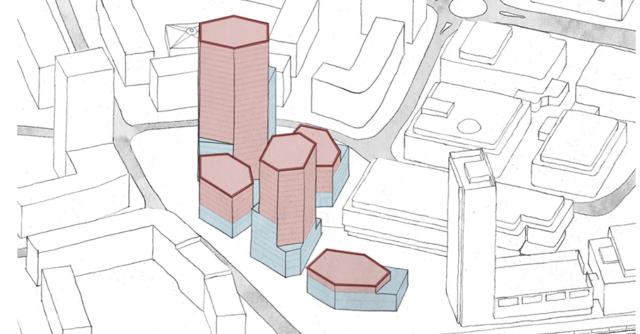
    800 flats are being built in Dreispitz Nord. In the far north, seven townhouses are planned with affordable or non-profit housing. In addition to attractive flats, the three round high-rises will also offer space for offices and other uses such as a library or a fitness centre.

    A secondary school for 600 pupils will be built on the roof of the MParc shopping centre.

    The area is already well served by public transport and is only three tram stops away from the SBB railway station. The new footpaths and cycle paths, car-sharing facilities and around 4000 bicycle parking spaces are intended to promote low-car living. Those who still need a car will have a parking space in separate parking facilities and will not have to search for parking spaces in the adjacent neighbourhood streets. A maximum of 662 parking spaces are planned for the new living and working areas. Access to the parking facilities on the northern edge will help keep the new district and the Gundeldingen neighbourhood car-free.

    The district development wants to lead the way as a model example of sustainable spatial development: Instead of sealed car parks, new green and open spaces will be created. Due to the high level of use, the use of land is economical. Existing jobs are preserved and new ones are to be created. A balanced range of housing for all incomes allows for a mix of residents. As part of the construction work, the existing MParc building will be integrated into the new complex. The spacing in the development on the northern edge and the spaces between the high-rise buildings allow air to circulate and ensure good ventilation. The green and open spaces provide cooling through shade and evaporation, and water can seep back into the ground, thus improving the urban climate.
    In September 2020, those responsible for the project presented the Dreispitz North guideline project to the general public. This serves as the basis for the development plan, the environmental impact assessment and the urban development contract. In order to include the neighbourhood interests in the best possible way, the planning partners have maintained a dialogue with neighbourhood organisations since the start of the project.

    In the first quarter of 2023, the public plan submission of the development plan and the environmental impact report should be ready. The parliamentary decision is expected in 2024. As soon as the decision is legally binding, construction project planning for the first stage can begin. Concrete construction measures can be expected from 2027.

  • Lymhof: Versatile, lively district planned in Schlieren

    Lymhof: Versatile, lively district planned in Schlieren

    The Lymhof district at the Rietpark will be built near Schlieren railway station, where the Vitis sports centre stands today. The name recalls the past of the former factory site, where Geistlich glue and fertiliser were produced in the 20th century in the so-called “Lymi”. The area of the Lymhof itself was then used for farming.

    With its location near the Schlieren West railway station subway, which is extended under Wiesenstrasse, one can get from the railway station or from the centre of Schlieren beyond the tracks through Lymhof-Gasse directly into the neighbourhood at Rietpark. The Lymhof is to become a colourful, lively part of the neighbourhood, where commuters can grab a quick coffee and croissant on their way to the train in the morning and meet for an aperitif on the terrace in the evening.

    To ensure that this vision also works in reality, Geistlich Immobilia is developing the uses for the special buildings of the guesthouse and hall, as well as the ground floors, in collaboration with experts and in a participatory process – through discussions and exchanges with interested residents and potential future users.

    The project comprises around 350 flats for a diverse range of residents from students to senior citizens, a guesthouse with hotel rooms and a bistro, a hall building, small commercial spaces and studios where people can both live and work.

    The world’s first vertical farm is planned in the hall building, which will be integrated into a residential quarter. Site owner Geistlich Immobilia signed an agreement to this effect with the start-up company Yasai in October 2022. From 2026, herbs, lettuces and much more will be grown in the eight-metre-high hall in a resource-friendly and pesticide-free way and sold directly on site. The urban farming company already operates a pilot farm in Niederhasli.

    Sustainability characterises the project in its planning, construction and operation. Around 900 bicycle parking spaces, a car and e-bike sharing service and charging stations for electric vehicles are planned for the Lymhof. The buildings will be heated with geothermal energy, solar panels will produce electricity and green roofs and outdoor spaces will promote biodiversity. A large part of the buildings will be made of wood and environmentally friendly materials will be used for the interior fittings.

    A study commission was organised for the project planning. In summer 2020, the interdisciplinary jury, in which the city of Schlieren was also represented, decided in favour of the project by the Zurich firm Clou Architekten and the landscape architects from Atelier Oriri. “We were convinced by the diversity and playfulness of the project with its different building sections, which are connected to each other but still allow for independent characters in terms of design and uses,” explains Martin Geistlich, managing director of the landowner Geistlich Immobilia.

    The building sections of different heights are grouped around two large green inner courtyards. Their façades are clad with ceramic tiles in different colours and concrete elements. The exterior design creates diverse meeting places and landscaped areas with large trees and native plant species, which are intended to cool the courtyards and create habitats for small animals.

    The Lymhof is scheduled to be built from 2024 and ready for occupation from 2026.

    The building sections of different heights are grouped around two large green inner courtyards.
  • ETH Campus Hönggerberg continues to develop

    ETH Campus Hönggerberg continues to develop

    The core mission of ETH Zurich is teaching and research as well as the transfer of knowledge to the economy and society. A modern infrastructure is a key factor in this. In order to cope with the increasing number of students and researchers and to create the necessary space for new research areas and innovative teaching methods, ETH Zurich is working on the further development of its main locations Zurich Centre and Zurich Hönggerberg. With regard to future space requirements, the Hönggerberg campus plays a central role. As a basis for its further development, ETH Zurich, together with the City and Canton of Zurich, has drawn up the master plan “Campus Hönggerberg 2040”. It describes the long-term spatial development goal. The structural densification and further development of the campus should preserve the current conditions of the site, such as the sensitive embedding in the local recreation area as well as listed buildings and gardens, and only take place in accordance with the emerging demand. In the next few years, a new building for quantum physics, a computer centre and a centre for student and entrepreneurial initiatives will be built, among other things. The central Wolfgang-Pauli-Strasse will also be renovated and upgraded as an important master plan element. Until the campus is fully developed, a conversion, new construction, extension or renovation of around a dozen buildings is planned, including four new high points. Various green areas are to be expanded. With the new master plan, ETH is building on the previous “Science City” master plan from 2005. ETH Zurich wants to develop its campus sustainably on various levels: ecologically, economically and socially. Among other things, it wants to take a big step towards climate neutrality and is focusing on energy supply without fossil fuels. A central element of this is the expansion of the current energy grid. Projects are also planned with regard to sustainable building, local climate, biodiversity as well as retention and drainage. For the further development of the campus, ETH Zurich is in dialogue with internal and external interest groups and involves selected people in a participatory manner on a selective basis.

    Attractive open spaces should ensure a high quality of stay and support biodiversity on the campus.

    In order to protect the surrounding landscape, the campus will be developed inwards and densified within the existing area. A green ring road around the campus symbolises this development and serves as a transition from the campus to the landscape. Attractive open spaces will ensure a high quality of stay and further promote biodiversity on the campus. The campus should be easily accessible by environmentally friendly means of transport such as public transport or bicycle. To relieve the local public transport system, a direct electrically powered bus, the so-called eLink, already runs between the Hönggerberg Campus and the Campus Zentrum for ETH members. Other local services such as bike sharing are available and are being continuously expanded. The current urban district character of the Campus is to be further strengthened. The central Wolfgang-Pauli-Strasse will become a lively and green promenade with versatile ground floor uses for the public. The central “piazza” will also gain in importance in the future and will invite people to meet and exchange ideas.

  • Maaglive makes Zurich West even more attractive

    Maaglive makes Zurich West even more attractive

    Up to now, the Maag site has been characterised mainly by office use. The large-scale Maaglive project will give Zurich West a versatile and green centre with various uses by 2027. An ensemble of three buildings is planned: a residential tower with a roof garden and loggias, a four-storey cultural centre and the existing Building K, which will be renovated and converted.

    Building K will be protected as a historic monument – after all extensions have been removed. In the future, it will offer operational synergies with the neighbouring Kulturpavillon with a foyer, restaurant and bar as well as a market hall and book café. Wooden constructions provide for an attractive interior of the culture pavilion.
    The residential tower is characterised by flexible usage possibilities, with the residential area predominating. Office space and rooms for events complete the offer. A co-working space with café and wine bar will be incorporated into the two-storey base.

    The visualisation shows the town square near the tower.

    At the highest point of the tower – next to the green roof garden – residents will have access to a library and a communal kitchen. Public-oriented uses are planned for the ground floors. An area of around 6000 m2 is planned for the flats, 3000 m2 for the cultural and event area, and a further 3000 m2 for studios, co-working and gastronomy.

    The centre of the area is formed by the neighbourhood square, which is planted with up to 80 high-stemmed native trees and extends over 4000 m2 . The canopy of foliage thus created is intended to provide the square with the quality of stay that has been lacking up to now. Open spaces and additional green areas with seating as well as various play and rest areas will also provide more life on the site during the day. At the same time, this will optimise the microclimate and reduce the heat that accumulates in summer. The latter is a particular problem in the city centre. Maaglive also counters this with pavement structures that offer a certain degree of retention as well as heat reduction. The entire construction project focuses on circular building and the use of resource-efficient building materials.

    The historic Lichtstrasse and the Maschinenstrasse will be opened up to the public. In addition, new pedestrian and bicycle paths will be created. The project is the brainchild of the Berlin architectural firm Sauerbruch Hutton. Hager Landschaftsarchitekten is responsible for the landscape architecture. The owner of the site, Swiss Prime Site, has already submitted the building application. Realisation will begin in the 3rd quarter of 2024 at the earliest. If everything goes according to plan, Maaglive should be ready for occupation in the 3rd quarter of 2027.

    The cultural pavilion is intended to become a lively meeting place for art, the creative industries and the population.
  • A new administration and security centre in hybrid design

    A new administration and security centre in hybrid design

    The Canton of Schwyz is planning to build its new administration and security centre on the Kaltbach site, which covers an area of about 40,000 square metres. This is located at the north-western end of the village between the roads to Sattel and Seewen.

    430 workplaces are planned. This means there is enough space for the cantonal administration, the operations centre of the Schwyz and Zug cantonal police, the main police station of the Schwyz cantonal police, fire brigade bases and rescue services. In addition, a production kitchen is planned from which all cantonal properties will be supplied in the future. The new building will make it possible to do away with expensive and unsuitable rental solutions and thus save costs of around CHF 1 million per year in the long term. In addition, external locations of the cantonal administration in the Schwyz valley can be bundled here, which will increase the efficiency of the individual work processes and realise a modern and high-quality working environment for the employees.

    In a single-stage open project competition, the structural engineering office of the canton of Schwyz looked for the best possible implementation for the new building, which will primarily serve as a replacement for the AHV building on Bahnhofstrasse in Schwyz, which has reached the end of its service life. The new administration and security centre should integrate well into the attractive landscape location and enter into dialogue with the existing buildings. The requirements were to meet the Minergie-A standard as well as optimal user-friendliness with fixed and flexible workplaces, the creation of meeting and retreat spaces as well as rooms for teamwork and concentrated work. Proposals in the sustainable timber construction method were expressly encouraged.

    The winning team was Sollberger Bögli Architekten AG from Biel and Klötzli Friedli Landschaftsarchitekten AG from Bern. Their project “Propeller” convinced the jury with a conceptually very clear and efficient organisation of the different units, an excellent urban integration. The building figure with four wings radiates into the landscape and comprises four outdoor areas: In the north-east is the entrance area for the administration and visitors, in the south-east the entrance area for the police, in the south-west the forecourt of the fire brigade and in the north-west that of the ambulance.

    The cross-shaped building is to be constructed using the hybrid construction method: A lightweight construction in wood is combined with steel, concrete as well as reinforced concrete composite structures. The ground floor and upper floor are designed as a skeleton structure in timber construction. The façade is to be greened and the roof equipped with a photovoltaic system. An atrium is planned for the interior of the building. Thanks to the large skylight, a five-storey atrium will be created.

    The compact building has good economic efficiency and is also convincing in terms of sustainability thanks to its differentiated construction. In the next step, the project will be revised with the planners in collaboration with the users and specialist planners. Subsequently, the cantonal council will be asked to approve the expenditure for realisation at the beginning of 2024. If everything goes according to plan, the new building could be ready for occupation at the end of 2027.

  • Ziegler-Areal auf dem Weg zum Wohnquartier

    Ziegler-Areal auf dem Weg zum Wohnquartier

    Das Ziegler-Areal soll gemäss heutiger Planung zu einem vielfältigen Quartier mit Schwerpunkt Wohnen entwickelt werden. Seit der Spitalbetrieb auf dem Areal im Jahr 2015 eingestellt wurde, sorgt die Stadt Bern als Grundeigentümerin mit verschiedenen Zwischennutzverträgen für Leben und Vielfalt auf dem Gelände. Insgesamt steht heute eine Nutzfläche von rund 23’000 Quadratmeter zur Verfügung.

    So betreibt die Firma ORS Service AG im Auftrag des Staatssekretariats für Migration (SEM) das einstige Bettenhochhaus als Empfangs- und Verfahrenszentrum. Der Kanton Bern zeichnet als Mieter der Räumlichkeiten des Renferhauses verantwortlich und stellt diese der Medizinischen Fakultät der Universität Bern zur Verfügung. Büroräumlichkeiten und eine Wohnung sind im Haus Bellevue untergebracht. Zur Wohnnutzung dient auch das Personalhaus 2 sowie das Wohnhaus Kirchbühl.

    Der Verein Boulissima betreibt im Personalhaus Ost/West eine IndoorBoule-Anlage, während der Verein Ziegler-Freiwillige im Personalrestaurant ein Begegnungszentrum für Quartierbewohnende und Asylsuchende geschaffen hat. Ansonsten wird das Gebäude vom Hostel77, der Geschäftsstelle des Vereins «Helvetiarockt», als Studentenwohnheim und von der Quartierküche Ziegler genutzt. Hierbei handelt es sich um die erste Quartierküche der Stadt Bern, die seit dem Beginn des Schuljahres 2019/20 insgesamt 19 Tagesschulen und Kitas mit Mahlzeiten versorgt.

    Das Leitbild für die Entwicklung des Ziegler-Areals wurde in Partizipation mit den verschiedenen Anspruchsgruppen erarbeitet. Auf Grundlage dieses Leitbilds wird eine Areal- und Nutzungsstrategie entwickelt. Diese soll den zuständigen politischen Gremien Anfang 2023 zur Beschlussfassung vorgelegt werden. Die Volksabstimmung zur Planungsvorlage dürfte frühestens 2028 stattfinden.

    Das Areal grenzt direkt an die Gemeinde Köniz an. In unmittelbarer Umgebung liegen der Naherholungsraum Gurten und dessen Talstation. Das Gelände ist durch die Buslinien 19, 22 und 29 bereits heute gut erschlossen. Ein mögliches zukünftiges Wohnareal soll sich sorgfältig in sein Umfeld einfügen und dank vielfältigen Nutzungen – die sich mitunter aus den der-zeitigen Zwischennutzungen ergeben können – zu einem belebten Ort werden.

  • Papillon: Vielfältiger Wohnraum

    Papillon: Vielfältiger Wohnraum

    Wie ein Schmetterling entfaltet sich das neue Quartier «Papillon» bei Köniz. Der «letzte Flügelschlag» ist auf 2028 geplant. Bis dann finden hier rund 2000 Menschen einen neuen Lebensraum – inmitten von Wäldern und Wiesen. Die insgesamt acht Baufelder werden auf einer Gesamtfläche von
    324’000 m2 schrittweise entwickelt.

    Bereits bewohnt sind die rund 250 Wohnungen von «Aurora» und «Eisvogel». Die sechs hofartig angelegten Gebäude des «Monarch» umfassen 218 1,5- bis 4,5-Zimmer-Wohnungen. Diese sind im Herbst 2022 bezugsbereit. Den Auftakt zum östlichen Teil bildet ab 2025 der «Feuerfalter» mit 240 Wohnungen. Dieser erfüllt unter anderem mit Wärmedämmungen und Holzfassaden die Anforderungen an ein «Plusenergie-Quartier» und «2000-Watt-Areal». In den sechs Gebäuden von «Cleopatra» entstehen ab 2023 120 Miet- und STWE-Wohnungen mit nachhaltiger Bauweise. In den letzten drei Baufeldern «Apollo», «Heliconius» und «Pallidana» werden rund 300 weitere Wohneinheiten realisiert. Im ganzen Quartier wird nachhaltig und klimaneutral gebaut. Das Ziel: Mindestens 50 Prozent des Jahresenergiebedarfs vor Ort selbst zu produzieren. So werden beispielsweise Photovoltaik- und Wärmepumpen-Anlagen errichtet.

    Die insgesamt rund 1000 Miet- und Eigentumswohnungen eignen sich mit ihren Grössen von 40 bis 130 Quadratmetern für Singles, Paare und Familien. Dreimal pro Stunde hält ein Bus in der Papillonallee. Direkt vor der Haustür finden die Bewohnerinnen und Bewohner Einkaufsmöglichkeiten, eine Kita, Schule, Sportplatz sowie soziale und gemeinschaftliche Angebote. Eine Sozialplanerin ist eigens dafür da, den Gemeinschaftsgeist zu fördern. Von der Interessengemeinschaft «Eisvogel»
    werden regelmässig Quartierfeste, Bastelnachmittage, Schachturniere und
    andere gemeinschaftsfördernde Akti-vitäten veranstaltet. «Ruedü» bietet frische Bio-Lebensmittel von lokalen Produzenten im 18 Quadratmeter grossen Holzcontainer rund um die Uhr zur Selbstbedienung an. Der nahe Wald und die «Tubetränki» sowie die «Allmend» mit Grillplätzen und Fernsicht in den Jura sind zudem beliebte Destinationen für Erholungssuchende, Ausflügler, Sport- und Naturfreunde.

    Dieser Pavillon beherbergt die «IG Eisvogel».

    In absehbarer Zeit bildet der Weiler Ried als Quartierzentrum das Herzstück der Siedlung: Ein aus Leichtholz erbautes PRISMA-Gebäude wird neben einem Lebensmittelladen, Gewerbeflächen sowie Gastronomie auch Loftwohnungen beherbergen. Zusätzlich werden drei neue Mehrfamilienhäuser gebaut. Und in einem der ehemaligen Bauernhäuser ist ein Gemeinschaftsraum für die Quartierbewohner vorgesehen.

    Blick vom nahegelegenen Waldrand auf das Quartier.

  • Swiss Prime Site lays the foundation stone for the JED site

    Swiss Prime Site lays the foundation stone for the JED site

    The JED (Join.Explore.Dare) in Schlieren will receive a “sustainable keystone”, as stated in a press release from Swiss Prime Site . On September 22, the real estate company from Zug laid the foundation stone for a new building with office and laboratory space, which should be ready for the first tenants to move into from mid-2024. In addition to representatives from Swiss Prime Site and other project participants, Stefano Kunz, Head of the Construction and Planning Department of the City of Schlieren , also took part in the ceremony.

    JED is the site of the former NZZ printing works. Swiss Prime Site has already converted existing buildings there and thus “turned the area into a think and work tank for business, industry and trade”, as CIO Urs Baumann said on the occasion of the laying of the foundation stone. The existing buildings are used by the anchor tenants Halter and Zühlke . The new building will now add office and laboratory space to the area on five floors with a rentable area of 14,000 square meters. Anchor tenants could also be won with Superlab Suisse and FlexOffice .

    The new building will be built according to the principles of the circular economy, and certification according to SNBS Gold (Swiss Sustainable Building Standard) is being sought. “Swiss Prime Site has successfully managed to give the former self-contained NZZ area new life and flair through new paths and the open and spacious architecture,” City Councilor Stefano Kunz is quoted as saying.

  • Foundation stone laid on the JED campus

    Foundation stone laid on the JED campus

    Since 2018, the former location of a large industrial printing plant has been transformed into a modern place of work and living space with diverse and flexible types of use

    transformed. Urs Baumann, CIO Swiss Prime Site Immobilien: “The revitalization and the change of use initiated with the conversion of the existing buildings have turned the area into a think and work tank for business, industry and trade. The gratifyingly high level of first-time lettings proves that large spaces that interact with one another are very much in demand. The new building perfectly complements the existing ensemble with laboratory and office space.» Stefano Kunz, City Councilor of Schlieren adds: "Swiss Prime Site has successfully managed to give the former self-contained NZZ area new life and flair through new paths and the open and spacious architecture." The new building, which is being built on a land reserve of the site, with five floors, a rentable area of over 14,000 m2 and its unique external appearance, is particularly aimed at tenants who need large, connected and adaptable areas. According to the project plan, the first tenants will move into the building from mid-2024 .

    "Space as a Service" in the attractive Life Science Hub Schlieren
    The JED campus forms a center for know-how transfer, innovation and entrepreneurship and brings together companies from a wide range of industries and sizes. In addition to the already established anchor tenants Zühlke and Halter in the existing buildings, two more will be added in the new building with Superlab Suisse and FlexOffice and will ensure an additional strengthening of the ecosystem. According to their business models, they will offer space as a service to various start-ups and companies as "Space as a Service". Superlab Suisse focuses on young companies in the life sciences sector and offers them fully equipped laboratories with flexibly scalable services. After Lausanne and Basel in 2023, the third location operated by Superlab Suisse will be opened in Schlieren from 2024. FlexOffice already successfully offers fully equipped office space for SMEs in several Swiss cities and is now planning another location on the JED campus. «With Superlab Suisse and FlexOffice, we already had two successful anchor tenants at the time the foundation stone was laid, which fit perfectly into the existing structure of the area and the adjacent cluster. Together with the neighboring Wagi area, we will continue to strengthen the economic cluster and the infrastructure for companies in the life sciences sector and beyond,” concludes Urs Baumann.

  • Schindler & Scheibling wants to grow in Saland

    Schindler & Scheibling wants to grow in Saland

    The floor, facade and roof of Schindler & Scheibling’s new production hall in Saland are all made of wood, the Zürcher Kantonalbank informs in a statement . She supported the timber construction company based in Uster in setting up the new location. With the new building, Schindler & Scheibling wants to compensate for the lack of expansion options at the two locations in Uster and Hittnau ZH.

    The 86 meter long, 46 meter wide and 17 meter high timber construction is also designed as a lighthouse project for timber construction. “We want to use this to arouse enthusiasm for timber construction among builders, carpenters, architects and also spontaneous visitors,” Nathanael Weiss, Head of Architecture at Schindler & Scheibling, is quoted as saying in the press release. The high-performance combination of solid wood and modern, curved glued laminated timber and the fact that the hall and roof are supported by “only five tree supports from different forest areas in the canton of Zurich” are described as particularly impressive.

    At the new location, Schindler & Scheibling has set up a production line for solid wood element construction systems. Tailor-made constructions for ceilings, floors and walls are produced here, which can be installed on the construction site in record time using dowel technology. “Thanks to prefabricated timber construction, the individual home can be built within one to two days,” explains Fabian Scheibling, Head of Sales and Project Development at Schindler & Scheibling.

  • New building in Rotmonten: A green oasis for St. Gallen

    New building in Rotmonten: A green oasis for St. Gallen

    The construction work for the replacement building in the area of Ludwigstrasse and Seeblickstrasse in the Rotmonten district in St. Gallen is in full swing. Compared to the old superstructure, the living space will be doubled: A total of 50 rental apartments – from 1.5 to 6.5 rooms – will be built in three buildings and three terraced single-family houses. The settlement thus offers diverse living space for mixed-age living in a natural environment.

    The garden city in a modern way
    At the beginning of the 20th century, the St. Gallen architect Adolf Gaudy created a green and yet urban structure in Rotmonten with his development plan. With the new development with extensive green areas, the AXA Investment Foundation is realizing a project that follows Adolf Gaudy’s idea of the garden city and is developing it further: “The mixture of contemporary residential and living space as well as extensive green areas are just 2.3 kilometers from the city center Central to the concept of Staufer & Hasler Architects and convinced us in the competition. Shapes and elements typical of the quarter were also incorporated and implemented in a contemporary way,” says Jan Biedermann, Development Project Manager at AXA Investment Managers.

    Cross-generational meeting places
    The heart of the new residential complex is a 70-year-old linden tree, embedded in the native and naturally planted garden courtyard. Together with the adjacent playground for children, this forms a meeting place for all ages. On these social areas, residents should have the opportunity to meet and exchange ideas. The apartments are all aligned with a view of the meeting places or green areas.

    Ecological construction
    The attic is designed in an element timber construction for an efficient and ecological construction method. This offers good sound insulation and ensures a comfortable room climate. The buildings are heated with geothermal heat pumps. In addition, the exhaust air from the apartments is collected and fed into an exhaust air heat pump for each house, which supplies energy for hot water. The entire building complex is Minergie-Eco certified.

  • SQUARE, the future-oriented HSG Learning Center

    SQUARE, the future-oriented HSG Learning Center

    Architect? Dreamer? Or both? In any case, Sou Fujimoto is not an architect like any other. And therefore exactly the right thing to build the new experimental field of the University of St.Gallen for future-oriented forms of learning and teaching up on the Rosenberg: SQUARE. With his buildings, Fujimoto constantly explores what is possible. Many then rub their eyes and wonder whether his radically drawn creations are really buildings or spatial illusions. In any case, the SQUARE is real. Delicately encased in a light, almost ethereal glass facade, so complex that only three bidders applied for the project. In the end, Aepli Metallbau prevailed with its innovative AAC element façade. A lighthouse project for the whole of Eastern Switzerland that we can all be proud of.

    Success through precision and precision through teamwork
    In order to realize a “zero-tolerance facade” like this, everyone involved must work at the highest level of quality and strictly adhere to their tolerance framework. Teamwork and mutual trust are the key to success, which is why Aepli Metallbau worked particularly closely with the master builder, the scaffolder, the roofer, the building services and the crane operators. Each step was carefully planned and coordinated in advance. For example, the immensely large elements of the facade were lowered by the crane between the scaffolding and the building. And then precisely placed on the pre-assembled anchor points and the underlying module by four members of the Aepli assembly team. Laser measuring devices were used to precisely set the anchor points on the shell beforehand. Clever solutions were also required in logistics. The oversized elements were pre-produced in the Aepli production hall. However, they could not be transported through the narrow streets of the district on trucks standing up – as is usually the case – but lying down. A second crane was used to erect them on the construction site and hang them on the assembly crane.

    The Aepli AAC façade: in a class of its own in terms of energy and looks
    The outer shell of the SQUARE building impressively shows how well exceptional aesthetics and forward-looking sustainability can complement each other. To match the room-high glazing, it was designed as a prefabricated glass façade consisting of an AAC element façade (AAC = AEPLI-AIR-Control®). This technically superior, compact double-skin facade with venetian blinds in the space between the glass covers the highest energy requirements, protects against extreme solar radiation and allows an exceptional amount of daylight to enter the building. A high standard of sustainability was achieved through the consistent separation of building structure, facade skin and technical building installations. When the building is in operation, a large part of the energy required is generated in an environmentally friendly manner by means of geothermal probes and a photovoltaic system. The complete drainage of the building also shows ingenuity: It takes place in the facade. The rainwater runs down all floors – according to the same principle as a Chinese fountain.

    The transparent facade: light in effect, complex in implementation
    Buildings like the HSG Learning Center shape the image that people have of Japanese architecture in this country: transparent, open, dematerialized, almost ethereal. However, this visible lightness can only be achieved with complex technical and planning solutions. It starts with the architecture and goes through the logistics to the extremely demanding installation. For example, in order to create the optical lightness desired by the architect, Aepli Metallbau worked with room-high glass facade elements that have no balustrades. This was just one of many challenges, considering the consistent separation of building structure and facade skin and the size of the facade elements as well as the missing parapet bands. In total, the team built and installed 448 façade elements in 304 different designs. However, these are not directly connected to each other in this project – so there is neither a beginning nor an end. The usual gaps in a balustrade, which allow readjustment, simply do not exist. Which means that even minimal deviations are enough for the whole thing not to fit.

    The new quality of learning
    SQUARE aims to be an innovative place of thought and work that enables new ways of learning and interaction between students, teachers and practitioners. Based on a didactic concept, the HSG is striving for a new quality of learning in order to prepare students in the digital age as best as possible for their later professional tasks. SQUARE is to be understood as an ecosystem for the further development of the learning and teaching culture at the University of St. Gallen.

  • The foundation stone for the Gupfengarten housing estate is laid

    The foundation stone for the Gupfengarten housing estate is laid

    According to a press release , real estate service provider Steiner celebrated the laying of the foundation stone for the Gupfengarten residential area. With the official starting signal, the construction project for a “family-friendly development in the Zurich Unterland” will be initiated. Steiner took over development, consulting and sales. The general contractor Eiffage Suisse AG , headquartered in Glattbrugg ZH, the architects Graf Biscioni based in Winterthur and the client Evostate Immobilien AG from Zurich are involved in the implementation.

    By the end of 2023, 36 terraced single-family houses and three multi-family houses with 21 condominiums are to be built on the Gupfengarten site south of the center of Niederweningen. The housing estate meets a contemporary living and development standard and covers the strong demand for high-quality living space.

    The planning meets the criteria for sustainable construction. The heat is generated almost entirely by means of a heat pump, geothermal probes and photovoltaic system. An energy management system enables “efficient and intelligent” use of energy. According to the announcement, the wooden building envelope has optimal thermal insulation.

  • Groupe E begins construction work for the Neuchâtel site

    Groupe E begins construction work for the Neuchâtel site

    Groupe E has started construction work on a new operations center on the Sécherons II business park in Boudevilliers, in the municipality of Val-de-Ruz, the Friborg energy supplier informs in a press release . An administration building, a warehouse, a car wash, a yard for recycling and an underground car park are to be built here. The company put the investment volume at around CHF 22 million in October 2020.

    Groupe E wants to design the new building as a “prime example of sustainability and environmental protection,” according to the statement. Around 950 square meters of solar modules on the roof and south facade, charging stations for electric vehicles and a bicycle rental system are planned for this purpose. A heat pump will heat the rooms, and Groupe E will use a free-cooling system for cooling. Rainwater is also to be collected and used in the car wash. In addition, a 10-meter-wide green border strip will be laid out around the building as a retreat for animals.

    Immediately after completion, Groupe E plans to relocate the company’s employees, who are currently based in Neuchâtel Corcelles-Cormondrèche and responsible for the operation and expansion of the electricity network in the canton of Neuchâtel, to Boudevilliers. According to the announcement, Groupe E supplies around 33,000 customers with a total of 458 gigawatt hours of electricity annually. Via the subsidiary Vuilliomenet Électricité AG based in Boudry NE, Groupe E also offers services in the canton of Neuchâtel in the field of building technology or electrical systems and home automation.

  • Phenomena presents the design of the main building

    Phenomena presents the design of the main building

    The design for the iconic buildings in the Phenomena exhibition was presented on July 6th in the new Limmattalbahn facility in Dietikon . According to a press release, the winning design for the main building, which is made entirely of wood, came from Professor Yves Weinand of the Swiss Federal Institute of Technology in Lausanne ( EPFL ).

    After a word of welcome from the mayor of Dietic, Roger Bachmann, overall project manager Urs J. Müller presented the winning project of the architectural competition. “Phenomena provides the basis for a better understanding of central themes of the present and future. Therefore, it demands an architecture that corresponds to its objectives and promotes the improvement of our planet through the understanding and use of modern science,” Müller is quoted as saying.

    The main building on the Dietiker Niderfeld will be a structure made of regional logs. Intelligent robots process the natural trunks on site. You create a reusable plug-in system. After the phenomena, the wood can be used in other projects with almost no waste.

    “With the buildings of the phenomena I want to show how one of the oldest building materials – wood – in connection with modern digital tools promotes local use and circularity,” Weinand is quoted as saying. The architect and head of the IBOIS laboratory for wooden structures at EPFL and founder of the Bureau d’Études Weinand has designed and built numerous emblematic wooden buildings. For example, the Saint Loup chapel, the new Vaud Parliament or, more recently, the Vidy Theater pavilion in Lausanne.

  • New Clinic 3: Government Council approves changes

    New Clinic 3: Government Council approves changes

    The University Hospital Basel (USB) is facing a long-term renewal of its structural infrastructure. With this generational project, the USB is laying the foundation for people in the Basel region to have access to a wide range of outpatient and inpatient medicine at university level in the coming decades. The changes to the existing development plan create the conditions for the construction of Klinikum 3. With a view to long-term use for the benefit of patients, the new Klinikum 3 offers a high degree of flexibility in use and enables sensible hospital processes. According to the current planning status, the new clinic will offer space for complex outpatient treatments, for example for a tumor center, and it will also accommodate functional and laboratory areas. Research facilities will also be added later. In addition, the new building offers the necessary space during the realization of Klinikum 2 without having to build costly and unsustainable provisional solutions in the hospital garden.

    According to the current planning status, a first phase of the new building of Klinikum 2 is to be realized in the years 2022 to 2028, for which the development plan is already available and has been approved by the Great Council. The construction of Klinikum 3 is planned for 2024 to 2030. Some of the uses of Clinic 2 will then be shifted to Clinic 3 in order to be able to complete the base building of the new Clinic 2 between 2031 and 2038.

    An objection from Homeland Security was received within the deadline against the public plan requirement regarding changes to the existing development plan. The University Hospital Basel and the Department of Construction and Transport have exchanged views with the Heimatschutz Basel and presented the hospital operational and planning law standpoints. The Government Council proposes that the Great Council dismiss the objection.

  • The City Council approves the Josef-Areal development concept

    The City Council approves the Josef-Areal development concept

    Operation of the waste-to-energy plant in Josefstrasse was discontinued in spring 2021. A development concept was drawn up under the leadership of the Office for Urban Development in order to define what the area should look like in the future. The plan is to expand the work yard, a health center for the elderly in combination with apartments for the elderly, an indoor swimming pool and a neighborhood park. Additional rooms for the public and the quarter are also planned on the ground floor. The city council has now approved the development concept.

    development and participation
    As a basis for the development concept, the city carried out test planning. Various stakeholder groups took part in this test planning and the residents of the neighborhood were able to get involved in dialogue events. Due to this close involvement, the different needs could be picked up and taken into account.

    The main points of the development concept
    The development concept makes specifications for the location of buildings and the district park and defines overriding principles for the desired urban planning and urban spatial qualities. This includes, for example, the integration and networking in the quarter, the provision of open spaces and possible uses.

    After the city council has approved the development concept, the planning phase begins with an architectural competition, construction project and referendum.
    The construction work should be completed by 2032 and the new uses on the Josef site should be ready for occupancy.

  • New construction of the sports center in Witikon

    New construction of the sports center in Witikon

    The multi-sports sports facility Witikon from the 1970s has developed into a frequently used training ground and venue for competitions. In order to meet the strong demand from sports clubs, a new building with a triple sports hall, cloakroom, audience and care infrastructure for the neighboring Looren school complex is to be built in the south-western part of the site by 2027. The project competition for general planners in the open process has ended. The team from Bur Architekten AG and Kuhn Landschaftsarchitekten GmbH from Zurich won with their “Diego” project. According to the competition program, construction costs of CHF 52.5 million are expected for the new replacement building of the sports center (BKP 1-9, excl. reserves). The cost accuracy in the competition phase is +/- 25 percent.

    New sports infrastructure for Witikon
    The winning project convinced the jury with its stringent ecological attitude, which reduces the excavation and thus the balance of greenhouse gas emissions of the new building to an exemplary minimum. To this end, the majority of the spatial program is accommodated above ground in a high timber construction with a small footprint, including the triple sports hall on the 2nd floor. As a result, the sports facility benefits from daylight on all sides and is accessible and visible. On the ground floor are the public sports cloakrooms for the runners, the public sports bar, which can also be used as a canteen, and the separate care facilities for the students of the Looren school complex. The two existing bridges over the Stöckentobelbach ensure short and clear connections between the school area and the new day care in the sports center. The cloakrooms for those using the outdoor sports fields are located on the first floor and can be reached directly via four outside stairs and a surrounding arcade. The space in the basement, which is kept to a minimum, is used for the building services and for a water cistern, which is used to irrigate the playing fields in a circular manner.

    Attractive outdoor spaces for athletes and local residents
    On the south side of the new sports center, an entrance square with shady trees forms an attractive prelude to the new facility. The outdoor sports fields, which are slightly shifted and twisted in relation to one another, divide the area in such a way that a network-like system of paths is created that fits harmoniously into the landscape. The paved areas are limited to the absolute minimum. Furthermore, this sustainable project is characterized by large photovoltaic surfaces on the facade and on the roof and a clever summer heat protection through clever night-time cooling as well as a concept for the implementation of the sponge city principle.

    competition exhibition
    Saturday, July 9th to Monday, July 18th, 2022 in the Werd exhibition space, Morgartenstrasse 40, 8004 Zurich. Opening times: Mon to Fri 4 to 8 p.m.; Sat and Sun 2 p.m. to 6 p.m.

  • Werkarena Basel: NOMEN EST OMEN

    Werkarena Basel: NOMEN EST OMEN

    [smartslider3 slider=”10″]

    In spring 2022, the commercial area on Neudorfstrasse in Basel’s St. Johann district came to life with the first companies moving in. Before that, in November 2021, a public kick-off event took place in the premises, which were still in the basic construction at the time: around 60 representatives from politics and business took part in the event and were enthusiastic. However, it took a while for that to happen. After the government council granted the building permit in 2013, the architecture team led by Markus Kägi and Thomas Schnabel won the 2014 competition put out by the municipality. The municipal trade association was involved as a partner in the processes right from the start, and the relevant companies were supposed to appear together as investors. But this plan didn’t work out. Invited project developers were able to present their ideas. Steiner AG prevailed against well-known competitors. Construction work on the factory arena began in 2019, and the shell was completed in March 2021.

    An appeal to the future
    The triangular, 4316 square meter lot of the business park is located in the north of Basel and directly on the French-Swiss border with St. Louis. The Rhine flows further to the east. The port of St. Johann existed there until 2009, which was then transformed into a waterfront promenade. It showed that industry has a long tradition in the district of the same name. Today, however, ship traffic no longer dominates and the newly settled sectors are more colourful: in the immediate vicinity of Neudorfstrasse there is sometimes the gambling industry or a hotel, but also the premises of a meat and poultry producer or the customs office. The location is ideal for high-emission traders. They have increasingly left the city in recent years because their noisy productions were no longer tolerated in many places. Now they are benefiting again, also in other areas: In addition to the connections to Basel-Mulhouse-Freiburg Airport and the St. Johann through station, the motorway makes trinational long-distance traffic possible. Finally, a fast connection to Basel city center is guaranteed from the Werkarena by car, bus and soon also by tram. The building has a total of 244 parking spaces for employees and visitors.

    Architecture with silent references
    The architectural appearance of the Werkarena is reminiscent of Erich Mendelsohn’s (1887–1953) department store Schocken in Chemnitz, which was completed in 1930. This example of new building caused a sensation at the time as a kind of horizontally layered composition with careful materialization. The structure of the façade of the Werkarena is only broken up towards Neudorfstrasse on the first three floors. The ground floor and first floor have 10 meter wide galleries that can be driven on. These floors are particularly suitable for commercial companies with a large logistics or production share. The connection to the outside space, i.e. to the street, is provided here intelligently and across floors by the element of the ramp. With a room height of 3.47 to 4.37 meters, they stand out visually from the other four floors, which are 2.95 and 3 meters high. At the same time, they give the building volume a visually refreshing depth. There, the pillars, which are arranged at regular intervals, also set a vertical counterpoint to the horizontal rows of windows from the third floor upwards.

    No marketplace of vanities
    With a usable area of 19,300 square meters, the business park is intended to appeal to small and medium-sized companies. Various tenants are already on board and will move into the complex with their offices after completion. They should benefit from each other through the direct proximity and thus also from the vision of the Werkarena – the focus is on a so-called ecosystem, i.e. close (technical) cooperation between the various companies, the use of synergies and a transfer of know-how. Nathalia Szydlowski, Managing Director of Tandemworks GmbH, was enthusiastic at the kick-off event in November 2021: Her company started as a start-up and has now established itself in the construction industry. This rise also has something to do with co-working spaces, because the existing infrastructure and all the accompanying programs have always allowed her to concentrate on her core business. Now Nathalia Szydlowski wants to continue her success story in the Werkarena – this also offers services such as telephone and postal services and various shared facilities, such as office, meeting and conference rooms or catering areas that can be used collectively. Stefan Gabriel, who heads the development team at Steiner AG in Basel, adds: “Right from the start, our concept was aimed at developing a flexible and site-specific product for the highly competitive Basel commercial and office market.”

  • Bühler builds technology center for milling in Uzwil

    Bühler builds technology center for milling in Uzwil

    Bühler is replacing its old application center at the Uzwil site, which dates back to the 1950s, with a new one. From 2024, Bühler intends to work with its customers and partners to develop, test and scale sustainable and efficient solutions for grain and animal feed processing in the new Grain Innovation Center. The technology company from the St.GallenBodenseeArea is investing a double-digit million amount for this.

    Among other things, the new building will offer an integrated cleaning and grinding process for all types of grain, a feed grinding process for all types of compound feed and a research and development department. According to the information, the old building no longer meets the requirements for a future-oriented and safe environment for customer-specific tests and developments.

    In addition, the machines, processes and a modern teaching infrastructure for digital and on-site customer training are to be housed there. The training center will be attached to the existing Application & Training Center, the Cubic Innovation Campus inaugurated in 2018, the Bühler Energy Center and the recently announced Protein Application Center, which is still to be built.

    “All new developments will come from the new Grain Innovation Center. Bühler will continue to keep this important part of its research in Uzwil,” Peter Striegl, Head of Innovation Milling Solutions, is quoted as saying.

  • The Circle: Switzerland's largest Minergie building certified

    The Circle: Switzerland's largest Minergie building certified

    Minergie and LEED certification has been an integral part of planning and construction at the Circle for 12 years. In the presence of Christian Appert, CEO Amstein + Walthert AG, Martin Kull, CEO and owner HRS Real Estate AG, Daniel Scheifele, Chief Real Estate Officer, Flughafen Zürich AG, Giorgio Engeli, Head Real Estate Portfolio Management Switzerland, Swiss Life Asset Managers, and Stefan Feldmann, Head The Circle, Flughafen Zürich AG, the team around The Circle celebrated on Monday, June 27, 2022, the goal they have now achieved.

    Beautiful, functional, climate-optimized
    With a good 200,000 m 2 energy reference area, the circle accounted for 6% of the certified Minergie area in the year of provisional certification, but was only one of around 1,900 buildings. This shows the size and importance of this extraordinary building in the Swiss context. The Circle is the largest Minergie-certified building in Switzerland. According to government councilor Marc Mächler, the Minergie certificate means that – in addition to all other requirements and uses – the building is also climate-optimized. Climate-optimized means «that this building does not accelerate climate change and that it uses resources carefully. It is efficient and works almost entirely with renewable energy instead of fossil energy.”

    Thanks to intensive cooperation between the Minergie certification body and those responsible for the circle, the high requirements of the Minergie quality label for the building envelope and ventilation could also be met. Andreas Meyer Primavesi, Managing Director of Minergie, is pleased that the result ultimately benefits everyone: “Especially with today’s energy prices, every kilowatt hour of energy saved is worth it – not only for the climate, but also financially”.

    Into the net-zero energy future
    With the leading Swiss building label Minergie, more than 12 million tons of CO 2 and 67 million megawatt hours of energy have been saved since 1998 thanks to over 53,000 Minergie buildings compared to the minimum legal requirements. Minergie certifies around 3 million m 2 of energy reference area per year. In close coordination with the cantons, Minergie always leads the way and is therefore a pioneer in cantonal energy laws. This interaction has worked since the beginning and continues successfully. Minergie is currently looking very closely at the energy used and the greenhouse gas emissions in the construction of a building. And secondly, Minergie is striving to improve the operating phase: Extensive, digitized building data is used to measure the energy flows during operation in order to then carry out operational optimization where necessary on the basis of the monitoring. For years, fossil-free operation – even with modernization – Minergie is moving more and more towards net zero. The Minergie-A-ECO standard comes closest to the Swiss net-zero building.

  • Swisspor is building in Reiden

    Swisspor is building in Reiden

    Swisspor wants to set up a production plant for mineral insulating materials and a service center in Reiden Mehlsecken. The internationally active company based in Stans has secured the area of 200,000 square meters designated by the canton of Lucerne as a strategic work area, according to the Lucerne State Chancellery in a press release . The establishment of a building and environmental technology cluster planned by swisspor is supported by the canton of Lucerne and the municipality of Reiden .

    swisspor will use 145,000 square meters of the total area of the site for its own facilities. The remaining area is reserved for research institutions and other companies active in the field of building and environmental technology. The Lucerne University of Applied Sciences and Arts wants to expand its existing cooperation with swisspor in Reiden Mehlsecken.

    In addition, other industry-related companies and research partners are to be recruited. The coordination for this was taken over by the Switzerland Innovation Park Central , according to the statement. The Federal Materials Testing and Research Institute ( Empa ) was also addressed.

    “We support the creation of a building and environmental technology cluster with swisspor and the Lucerne University of Applied Sciences and Arts,” government councilor Fabian Peter is quoted as saying in the statement. The head of the construction, environment and economic department sees a double opportunity for the region and canton: “On the one hand, jobs, innovation and value creation are created and on the other hand, the cluster makes a contribution to achieving our climate goals”.

  • At home close to nature

    At home close to nature

    Attention: In Niederweningen, 36 child-friendly terraced single-family houses with 4.5 and 5.5 rooms are being built on a plot of around 11,000 m². You have your own private garden, and the 21 spacious apartments in condominium ownership with 1.5, 3.5 and 4.5 rooms have a covered outdoor area or garden. The settlement is traffic-free and may only be entered in exceptional cases. An underground car park with direct access to the corresponding residential units and above-ground visitor parking spaces complete the unique living experience: “The sweet life moves into the Gupfengarten and a relaxing and carefree retreat is offered,” says Alexandra Schlegel, who is responsible for marketing this project at Steiner AG responsible for. “In terms of size and price, the project is perfectly tailored to young families and couples who want to fulfill their dream of owning their own home and prefer the charming village life to the big city.”

    The Gupfengarten is located in a quiet residential area on a slight slope in the southern part of Niederweningen. The colorful and local architecture characterizes the likeable character of this project and radiates a relaxed homeliness: “The project impresses with its individuality and personality, because here you can help determine the expansion and interior with the online configurator. From our carefully coordinated and harmonious range of materials and colors you can put together your very own combination according to your individual wishes. We have already selected four well-balanced and characterful designs for you as a suggestion – let yourself be inspired and simply use the configurator on our website www.gupfengarten.ch.»

    Sustainability is a top priority in the Gupfengarten: the heat generation is almost entirely covered by renewable energy using a heat pump and geothermal probes as well as a photovoltaic system. In addition, an integral energy management system ensures an efficient and intelligent energy solution. The building shell is made of wood and achieves optimal thermal insulation values. The idea of sustainability is further implemented through the use of wood as a CO2-neutral and naturally renewable raw material. Living with a feel-good factor of 100, so to speak.

  • Metro Campus: New data center in Dielsdorf

    Metro Campus: New data center in Dielsdorf

    Three high-performance data centers and modern office buildings are being built on an area of 46,000 m2 on the Zurich Metro campus. The campus is embedded in a natural green area and should offer all the services that characterize a leading data hub: A modern, certified data location, comprehensive networking and access to a complete cloud ecosystem. The Metro Campus wants to network IT infrastructures in the shortest possible way and ensure that companies, cloud providers and IT companies come together with their solutions. The data centers are designed for national and international companies from all sectors as well as for cloud providers and technology companies.

    All buildings are planned with four floors. The building shell of the data center is to be implemented as a sandwich panel system with expanded metal cladding as the outermost layer. The material of the buildings should reflect their technical content and enable an optimal interaction with the building technology. Glass facades are planned for the office buildings in the area. The roofs and parts of the glass facade are equipped with photovoltaic systems.

    Architecture, room design, technologies and systems are precisely coordinated and designed for maximum energy efficiency. Free cooling with cold ambient air minimizes the need for cooling and the use of waste heat via the initiated thermal network and contributes to sustainability. In the future, apartments and industrial companies in the region, as well as the office buildings on campus, can be heated with the waste heat from the data center.

    The Zurich Metro Campus is being built in several stages. The first of three data centers is currently being fitted out. The first major customers are expected to move in in the third quarter of 2022. Further buildings are to be completed in the fourth quarter of 2022 and from 2024 onwards.

  • The Hönggerberg campus of ETH Zurich is being further developed

    The Hönggerberg campus of ETH Zurich is being further developed

    ETH Zurich comprises two main locations. One of them is the “Campus Hönggerberg”, which was originally created as an outdoor location in the local recreation area of the Käferberg. Today, almost half of all ETH members study and work here. ETH Zurich expects further growth in student numbers over the next few years. The main location “Campus Zentrum” in the city of Zurich can only be expanded to a limited extent due to the historical district and city structures. For this reason, ETH Zurich is concentrating on the “Hoenggerberg campus” when planning the space it will need in the future. In the coming decades, this is to be further developed extensively.

    Together with the city and canton of Zurich, ETH Zurich developed the master plan Campus Hönggerberg 2040. This builds on the master plan of 2005 called Science City. The idea of a ring road around the campus as well as the development into a city district with offers for ETH members and visitors is being pursued further. An urban appearance with varying heights as well as gardens and squares is planned. In order to protect the environment, the campus will not be expanded in the direction of the surrounding quarters or the recreation zone, but will be compressed inwards and upwards.

    ETH Zurich attaches great importance to sustainability: In the future, the energy supply should be without fossil fuels. The energy network is being expanded for this purpose. On the side of the adjoining quarters Affoltern and Höngg, a portal building with public-oriented offers is to be built at both campus entrances. Along the central Wolfgang-Pauli-Strasse, two more high-rise buildings are planned, which will offer space for teaching and research. In addition, this street is to be developed into a lively, green promenade with a range of ground floor uses. According to the study contract, this redesign allows the needs such as urban planning, traffic, open space, lighting as well as retention and drainage to be taken into account.

    The existing open and green spaces will be upgraded and expanded. A new garden is planned for the central square. The development of sustainable means of transport and the expansion of bicycle connections are also planned. The credo is: We only build if there is a need for it on the part of teaching and research.