Category: Projects

  • New logistics hall increases efficiency in the national distribution network

    New logistics hall increases efficiency in the national distribution network

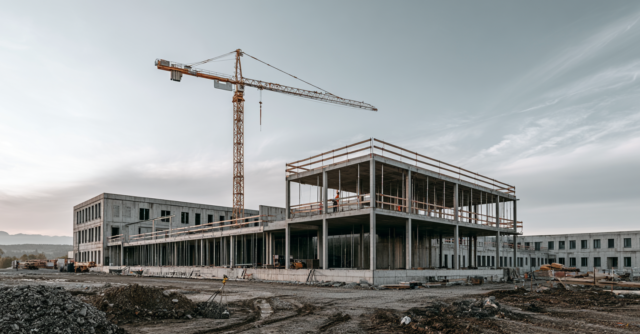
    Senn AG from Oftringen, which specializes in extensions, new buildings and special constructions, is building a new steel warehouse for the Migros distribution company(MVB) in Suhr. According to a press release, the new building covers an area of 7500 square meters, is more than 100 meters long and 15.5 meters high. At the heart of the modernization is a fully automated storage system, which will increase capacity and make logistics more efficient.

    A total of 1100 different components were required, which was logistically demanding and a challenge for assembly due to limited space for temporary storage. According to Senn AG, most of the assembly work was carried out using the company’s own mobile crane and two construction site cranes.

    According to the press release, the supporting structure is made of white-coated steel. a total of 530 tons of steel were used. According to the company, Senn AG processes 7,000 tons of steel and aluminium annually at its headquarters and is active in steel and metal construction, sheet metal and stainless steel centers, emergency power systems, mobile crane operations and other transport solutions.

    Construction work has been underway since the end of June. Around three quarters of the hall has been assembled and the final parts of the hall are currently being coated in the workshop and prepared for transportation. The project should be completed before the end of December.

    The realization of the warehouse is important for Migros’ supply network. As MVB writes, the retail group operates one of two national distribution centers in Suhr. The first was built more than 50 years ago in Neuendorf SO, and another site was built in Suhr more than 25 years ago.

  • Polysportive lighthouse project takes shape

    Polysportive lighthouse project takes shape

    After many years of planning, construction has now begun. A large polysport complex is being built on the Dürrbach site for around CHF 65 million, realized by HRS Real Estate AG as total contractor. The new building is set to open in fall 2026 and will mark a new sporting focal point in the Glattal.

    Over 30 sports under one roof
    The project is being supported by Zurich Tennis and the Zurich Gymnastics Association, which together unite almost 100,000 sports enthusiasts in the region. The plans include modern halls for tennis and gymnastics, specialized training areas and space for numerous other indoor sports. The offer will be complemented by sports infrastructure, overnight accommodation and facilities for sports medicine and regeneration. The sports center is designed for year-round operation of popular and elite sports.

    Campus for sport and training
    The new sports center will also be home to the Zürcher Oberland Art and Sports School. This will create a campus that combines training, school and talent development in terms of space and content. Young athletes will find ideal conditions on site to combine sporting ambitions and training.

    Beny Ruhstaller strengthens strategic management
    Beny Ruhstaller recently joined the Board of Directors of Sportzentrum Dürrbach AG. He is not joining primarily as a construction specialist, but as an expert in the world of gymnastics. Thanks to his previous activities for the Zurich and Swiss Gymnastics Associations, he brings many years of association experience, a broad network in gymnastics and tennis and a keen sense of the needs of athletes. This strengthens his ambition to develop the Zurich Sports Center into a forward-looking platform for sport, training and exercise in the region.

  • Strategic acquisition focuses on specialized commercial areas

    Strategic acquisition focuses on specialized commercial areas

    Swiss Life Asset Managers aims to strengthen its position in the life sciences sector with the acquisition of Schlieremer Gewerbe- und Handelszentrum AG(GHZ), as detailed in a press release. GHZ has developed the Wagi site that belongs to it. A total of around 250 companies and organizations from the life sciences sector are now based there on a rental area of 143,000 square meters, providing more than 2,400 jobs. The Bio-Technopark Schlieren is also located on the site.

    The GHZ site will be retained, the employees will be kept on and GHZ Managing Director Walter Krummenacher will continue to act as a contact person for the tenants and develop the site with his employees. “We are very happy to have found a reliable partner in Swiss Life Asset Managers that shares our values and our long-term commitment to real estate and life science as a contribution to society. In this way, the vision of our founder Leo Krummenacher will be carried into the future”, Walter Krummenacher is quoted as saying in the press release.

    With the acquisition of the “dynamic and fast-growing center with long-term value creation potential”, Swiss Life Asset Managers wants to underline its focus on investments in the Living, Logistics, Light Industrial and Life Science and Tech (“4L”) sectors. “We are delighted to continue the impressive development of the site with the experienced team at GHZ. Swiss Life Asset Managers is convinced of the attractiveness and future strength of life science real estate, as it is of great importance for our economy as well as for our society,” says Paolo Di Stefano, Head of Real Estate Switzerland at Swiss Life Asset Managers.

  • Modernized shopping center boosts usage and energy efficiency

    Modernized shopping center boosts usage and energy efficiency

    Schlieren-based Halter AG has completed the modernization and redesign of the Signy Centre in Signy-Avenex. The renovation included two buildings with administrative and commercial space, three floors with around 50 stores and five parking decks with a total of around 1,100 parking spaces. According to Halter, the project started in 2023 and has now been completed with the official handover to customers.

    As part of the renovation, the technical systems and security facilities in the Signy Centre were modernized. Halter also redesigned the shopping center and its outdoor facilities. According to the company, the completed renovations increase the comfort and safety of employees and customers in the shopping center. The site’s energy and environmental footprint has also been improved.

    The project also involved the companies Burckhardt and ARFOLIA, which were responsible for the architecture and landscape architecture respectively. While sd ingénierie was involved as the civil engineer, Caeli Ingénierie took on the role of technical engineer. The last fire protection engineer was srg engineering.

  • New heating network combines climate protection and regional value creation

    New heating network combines climate protection and regional value creation

    The Maisprach heating network in the canton of Basel-Landschaft and the Basel-based energy supplier IWB have launched a new project to supply heat from regional raw materials. Since the beginning of December, energy has been generated from a wood-fired boiler and a biochar plant and fed into the heating network, according to a press release.

    The municipality of Maisprach laid the foundations for this step in January 2025 with the construction of a new depot. IWB initially set up new wood heating systems there. This was followed in November by the construction of the biochar plant. Every year, 250 tonnes of biochar are to be produced here from landscape conservation wood and biomass through pyrolysis. The waste heat from the charcoal production will be fed into the district heating network. The operators anticipate 900 megawatt hours of heat energy for network customers, with a further expansion of the network on the horizon. The wood-fired boiler is also fuelled by regional biomass. The biochar produced is used in the region as an additive for composting, in soil substrates and in agriculture. IWB invested CHF 3.5 million in the project.

    “IWB has experience in the construction and operation of heating plants. As part of a pilot project in Basel, IWB tested the innovative approach of utilising waste heat from a biochar plant in a heating network. We can now benefit from this,” said Dorian Wernli, Mayor of Maisprach, in the press release.

  • Timber construction sets new standard for cantonal buildings

    Timber construction sets new standard for cantonal buildings

    Architect Markus Schietsch has received a silver Hase Architecture Prize from “Hochparterre” for his new construction of the cantonal AVS building in Unterentfelden. The prize was awarded on December 2 at the Zurich Museum of Design. It recognizes the architectural quality of the building and the consistent implementation of sustainable construction methods.

    The new building with its laboratory and office workstations for currently 80 employees was officially opened on October 25, 2024 after two and a half years of construction. The construction work was planned and carried out by Immobilien Aargau.

    “The award confirms the path we have taken,” said Cantonal Councillor Dr. Markus Dieth in a press release. “The canton of Aargau invests in sustainable, economical and high-quality buildings that also take cost-efficient construction into account. I would like to congratulate Markus Schietsch and the Aargau Real Estate Department on this success.”

    According to Schietsch, this award shows “that careful planning, a clear architectural approach and the courage to use sustainable materials such as wood are more in demand today than ever before”. Head of office and cantonal chemist Dr. Alda Breitenmoser emphasizes that the new building offers “optimal working conditions” for consumer protection: “The architecture supports our work processes, creates a pleasant indoor climate and shows that modern administration can be ecological and functional at the same time.”

    At the beginning of November 2025, the new AVS headquarters received an award from the Pro Holz Aargau wood network for its timber construction.

  • Expansion of Basel SBB West station

    Expansion of Basel SBB West station

    Basel SBB station has long since reached its limits. Over 140,900 people use it every day, and the trend is rising. With the Basel SBB West project, the partners are preparing the station for this development. A comprehensive extension is planned in the west of the site, where the train stop will be moved further west in future and additional access to urban traffic will be created. Two closely linked sub-projects form the core, the Margarethen platform access and the new construction of the Margarethen Bridge.

    The new passenger bridge for the Margarethen platform access is to run parallel to the existing Margarethen Bridge. It will be around 16.5 meters wide, have stairs, escalators and lifts and provide access to all platforms. To make this possible, SBB is extending several platforms to the west and adapting the track layout. The project thus responds to the expected growth in rail traffic and at the same time relieves the existing passerelle at the main station.

    Linking rail and city
    In addition to rail planning, urban integration plays a central role. The canton of Basel-Stadt is planning a new multimodal transportation hub to the west of the station, at the Markthalle site. Here, the transfer between train, streetcar, bus and bicycle is to become even more efficient in future. This reorganization will relieve the overcrowded Centralbahnplatz and enable a more balanced traffic regime in the city center.

    The Margarethen platform access is more than just a bridge. It will become a link between the new urban traffic axes and the rail network. It offers space, light and orientation. Features that are particularly important in highly frequented traffic zones.

    A new Margarethen Bridge with a signal effect
    The second sub-project is dedicated to the renewal of the Margarethen Bridge. The existing bridge is owned by SBB and only meets current safety requirements for heavy goods traffic with restrictions. In addition, it does not meet the future requirements of SBB and the canton on both the rail and road sides. The new bridge will therefore not only be structurally more efficient, but also significantly wider – 27 meters compared to 16.3 meters today. This will create space for a barrier-free streetcar stop in the middle of the bridge as well as wider footpaths and cycle paths.

    A temporary auxiliary bridge is planned during the construction period. The possibility of integrating this temporary structure into the new building at a later date is being examined. This solution should minimize construction interruptions and ensure urban mobility during the entire implementation phase.

    The winning project by Penzel Valier
    In the spring of 2025, an assessment panel of independent experts and representatives from SBB and the canton evaluated the proposals of six interdisciplinary planning teams as part of a study commission. The contract was awarded to Penzel Valier. Their design impresses with a generous, flexibly expandable roof that spans both the new streetcar stop on Margarethenbrücke and the platforms. This creates a hall-like space that characterizes the western part of the station.

    The roof fulfills several functions at the same time. It brings daylight onto the platforms, protects against the weather and allows the installation of photovoltaic systems and greenery. In terms of urban planning, this creates a harmonious link between the SBB station, the listed SNCF hall and the adjacent Gundeldingen and St. Johann districts.

    The SNCF hall itself will be retained in the context of the French part of the station and in its function as a platform canopy. This was a key concern of the conservation authorities. The hall will be moved to the west to create space for the new track layout.

    Planning, financing and time horizon
    The Margarethen platform access is part of the 2035 national rail expansion phase. The federal government has already approved the planning and preliminary project planning. While the Margarethen platform access is financially secured, the funds for the implementation of the new Margarethen Bridge are still being decided. Both projects can be built technically independently of each other, but should be realized at the same time if possible.

    The planning requirements are high. They take into account ongoing rail operations, the protection of historic buildings and integration into the dense city traffic. Construction is currently scheduled to start in 2034 at the earliest. The project volume for both project elements (platform access and bridge) is estimated to be in the low to mid three-digit million range.

    More than infrastructure – a new entrance for Basel
    Basel SBB West will not only provide the city with a strategically important transportation hub, but also a new entrance to the city. The relocation of train traffic to the west will create space for clearer traffic routing, a better quality of stay and greater safety for cyclists and pedestrians. In future, travelers will experience shorter routes, generous spaces and intuitive orientation.

    The interaction between trains, streetcars, buses and bicycles will become more efficient, more sustainable and more pleasant. At the same time, the project forms the structural foundation for future expansions such as the possible Basel SBB underground station. In its entirety, Basel SBB West thus stands for a new generation of railroad stations – open, networked and future-proof.

  • How much of the past can densification tolerate?

    How much of the past can densification tolerate?

    The Brunnergut estate was built in two stages in the mid-1950s and early 1960s and marked the transition to the functionalist, automotive city. As one of Winterthur’s first residential ensembles with underground parking, it replaced the Villa Malabar and reshaped an entire inner block between Lindstrasse, Kreuzstrasse, Sulzbergstrasse and St. Georgenstrasse. The 1954 planning application itself sparked a fierce controversy. Early debates about density, traffic and cityscape, as they occupy the entire agglomeration today

    in 2016, the city of Winterthur added Brunnergut to the inventory of buildings worthy of protection, followed by its entry in the cantonal inventory of listed buildings of supra-municipal importance in 2018. This made it clear that the estate was not only considered everyday architecture, but also an ensemble with architectural and socio-historical significance that should be taken into account in any further planning

    Legal ping-pong over protection
    With the cantonal dismissal in 2024, the building department wanted to relax the protection status again. Based on an expert opinion from the cantonal monument preservation commission and subsequent additions. The Zurich Heritage Society challenged this, and the Building Appeal Court demanded a supplementary or top-level expert opinion during the proceedings and criticized gaps in the expert assessment

    At the same time, the Winterthur city council planned to remove Brunnergut from the municipal inventory. The Zurich Heritage Society lodged another appeal against this. In its decision of November 6, 2025, the Building Appeals Court has now ruled that the city is unlawfully relying unilaterally on the KDK report and that the facts of the case have not been sufficiently clarified for the property to be removed from the inventory. The judges demanded an expert opinion from an independent expert who had not previously been involved. A clear signal for higher requirements for the justification of de-protection decisions

    More than just a technical issue of monument preservation
    The criticism focuses not only on formal deficiencies, but also on gaps in content. Imprecise plans, insufficient discussion of the qualities identified in the inventory sheet and an insufficient appreciation of the social and economic-historical significance. Specifically, the court criticized the fact that the role of the estate as an early example of dense, car-oriented post-war modernism and as part of Winterthur’s settlement history was not seriously included in the comparison with other estates

    For urban planning and the real estate industry, Brunnergut is therefore far more than an isolated case. The procedure shows how strongly inventory decisions must be legally and professionally underpinned today if they are to survive in an environment of housing shortages, pressure to densify and politically heated debates about objections and heritage protection

    What the case means for future projects
    The Zürcher Heimatschutz sees the decision as a strengthening of the inventory concept. Inventories are not mere lists, but planning instruments that must meet high standards before they can be dismantled. For cities like Winterthur, this means that anyone wishing to subsequently remove protection must transparently explain why arguments relating to building culture, urban development and social history outweigh the interests of densification, renewal or returns

    For investors, owners and planners, this increases the importance of well-documented surveys and early involvement of heritage conservation. Especially in the case of post-war housing estates, which were long regarded as “ordinary” existing buildings. Brunnergut shows that the second half of the 20th century is increasingly understood as part of the architectural heritage and that the path to conversion or replacement construction will in future often lead via independent expert reports and carefully balanced conservation concepts

  • Railroad modernization in the sensitive Alpine region

    Railroad modernization in the sensitive Alpine region

    STRABAG AG is carrying out the outstanding renovation work on the Zentralbahn line between Meiringen and Brienzwiler in the Bernese Oberland. The narrow-gauge line runs on a single track along the Hasliaare, which is part of the Aare flood plain. Out of consideration for several nature conservation areas, “maximum precision for logistics and coordination” is required for the new construction, according to a press release. Preparatory work began in March 2025 and the ten-week intensive phase has been underway since October 2025.

    Heavy rainfall events had repeatedly occurred in the area, causing the railroad embankment and superstructure to flood, resulting in damage to the railroad infrastructure and adjacent cultivated land. STRABAG already carried out track construction work there in 2022 and 2023 (lots 1 and 3). The modernization project will now be completed with a total reconstruction of the challenging middle section of lot 2 over a length of 2600 meters and in the middle of the Sytenwald nature reserve. This involves raising the railroad embankment. To allow surface and slope water to drain away, a continuous planned drainage system will be installed along the route. The area along the Hasliaare will receive a new flood protection wall.

    According to the press release, the “tight space conditions and local lack of redundant construction slopes in certain sections between the Hasliaare, the railroad line and several nature conservation areas” are a special construction feature, which requires special precautions for ecology and landscape protection. On the one hand, STRABAG is building 30 new foundations for the catenary masts on the side facing away from the river, and on the other, 37 crossings are to ensure the ecological continuity of the terrain. This means protection for wildlife and small animals when crossing the section.

    A particularly challenging component is the new construction of the Hüsenbach bridge made of ultra-high-strength and durable fiber-reinforced concrete (UHPC). During bridge construction, special consideration was given to the trout population present there at spawning time.

  • Modern site project in Sittertobel focusses on renewable energies

    Modern site project in Sittertobel focusses on renewable energies

    Sitter Projekt AG and Mettler Entwickler AG are realising the Sitter Valley in St.Gallen’s Sittertobel. The two St.Gallen companies want to develop an area of 50,000 square metres here for offices, commerce and industry with up to 600 workplaces.

    St.Gallen’s public utility company will supply the site with energy for heating and cooling. According to a press release, they are relying on a combined energy supply with a wood pellet boiler and a reversible air/water heat pump. The pellet heating system will primarily be used in the winter months. The first heat supply is scheduled for winter 2026/2027.

    The Sitter Valley is also to be equipped with photovoltaic systems. These will contribute to the site’s electricity supply.

  • Selection of future-oriented start-ups strengthens digital property development

    Selection of future-oriented start-ups strengthens digital property development

    A total of 95 young companies applied for Swiss Prime Site ‘s 27th Accelerator Programme. of these, 21 were allowed to present themselves and eight reached the final. Four of them have now been selected to work with the property company, according to a press release from Venturelab. The Schlieren-based start-up promoter is working with Swiss Prime Site on the programme and is conducting the associated workshops.

    The winning companies are Jurata AG, Legartis Technology AG, Optiverse AG and Epic Fusion AG. All four are active in the field of artificial intelligence (AI), the focus of the current Accelerator programme. Jurata develops solutions for law, accounting and taxes, Legartis for contract review and analysis. Optiverse is working on using AI to make meetings more efficient, while Epic Fusion is optimising workplaces.

    “I was really impressed with the quality of the presentations. Each project was well prepared and professionally presented, with a clear business case for Swiss Prime Site,” said Victor Wolff Casado, Digital Project Manager at Swiss Prime Site. “Venturelab’s unique start-up network and expertise help us to drive innovation in a systematic and fast process.”

  • Electrochemical breakthrough in the fight against contaminated sites

    Electrochemical breakthrough in the fight against contaminated sites

    According to a press release, researchers at the Swiss Federal Institute of Technology in Zurich(ETH) have achieved a breakthrough in the remediation of contaminants such as DDT and lindane. These are persistent organic pollutants, or POPs. These are toxic chemicals that were widely used in the 1940s to 1980s. They degrade very slowly and can now be found in the food chain of humans and animals. The university team led by Bill Morandi, Professor of Synthetic Organic Chemistry, has now developed a novel electrochemical process that completely dehalogenates these environmental toxins and binds them in harmless salt. The remaining organic hydrocarbons can be fed into the circular economy and thus serve as valuable raw materials for the chemical industry.

    “We wanted to solve one of the biggest environmental problems of the last century. It is unacceptable to leave the dirt to future generations,” Alberto Garrido-Castro, electrochemistry specialist and former postdoc in the group, is quoted as saying in the press release. The ETH team sees the remediation of such contaminated sites in soil, water and landfills as one of the major unresolved issues in environmental protection. The degradation of these chemicals using electrochemical processes has been investigated for some time. According to the press release, the ETH researchers have now achieved the decisive breakthrough with the use of alternating current in electrolysis. “It splits the halogen atoms into harmless salts such as NaCl (common salt) and produces valuable hydrocarbons at the same time,” explains Morandi. The hydrocarbons are benzene, diphenylethane or cyclododecatriene. Chemicals that are used in the production of plastics, paints or coatings and therefore contribute to a sustainable circular economy.

    An important prerequisite for implementation is that the new process can be applied not only to pure substances, but also to mixtures of contaminated soil, earth or sludge. The researchers are considering mobile systems that can be used on site, which would eliminate the need to transport these hazardous substances. A prototype has already been successfully tested.

  • Future area in the north of Basel creates living and working space

    Future area in the north of Basel creates living and working space

    The Klybeck site in the border triangle of Basel is to become a modern neighbourhood on the banks of the Rhine. According to a press release, the planning partners Canton Basel-Stadt, Swiss Life and Rhystadt have initiated the klybeckplus indicative project, which forms the basis for the utilisation planning.

    The approximately 30-hectare site is to become a mixed neighbourhood with residential complexes, commercial buildings and parks. The aim is to create living space for 8,500 people. According to the plans, a third of the flats will be made available to the public for rent at cost. In addition, 7500 jobs are to be created. The two owners, Swiss Life and Rhystadt, will invest 3 billion Swiss francs in the renovations, according to the press release.

    “The finalised indicative project, as it is now available, offers a good basis for realising the enormous potential of the site and creating significant and, above all, long-term added value for the population and the entire region,” Christian Mutschler from Rhystadt is quoted as saying in the press release. Jürgen Friedrichs from Swiss Life adds: “The indicative project shows how the diverse objectives from residential to open space can be combined while at the same time ensuring structural, spatial planning and economic feasibility.” District President Conradin Cramer is convinced that the project will create an “attractive new part of the city for the well-being of the population”.

  • Strategisches Wachstumsprogramm setzt auf Digitalisierung und Effizienz

    Strategisches Wachstumsprogramm setzt auf Digitalisierung und Effizienz

    Sika hat ein strategisches Wachstumsprogramm vorgestellt. Das weltweit operierende Unternehmen für Spezialchemie mit Sitz in Baar will mit dem Fast-Forward-Programm sowohl Investitionen als auch an anderer Stelle Einsparungen im dreistelligen Millionenbereich vornehmen, heisst es in einer Mitteilung.

    So will Sika im Bereich digitaler Transformation 120 bis 150 Millionen Franken investieren. Für effiziente Strukturanpassungen in China und anderen Märkten wird für das laufende Jahr mit einem Umfang von 80 bis 100 Millionen Franken gerechnet. Parallel zu den Investitionen will das Unternehmen in verschiedenen Bereichen jährlich 150 bis 200 Millionen Franken einsparen, mit „voller Wirkung ab 2028″. Zudem bestätigt Sika seine Strategie 2028 und damit ein angestrebtes Umsatzwachstum zwischen 3 und 6 Prozent.

    „Sika lanciert das Fast Forward-Programm aus einer Position der Stärke. Wir verzeichnen die höchste Gewinnmarge unserer Unternehmensgeschichte und machen Sika mit Fast Forward fit für die Zukunft“, wird Thomas Hasler, CEO von Sika, in der Mitteilung zitiert. „Wir investieren gezielt in Digitalisierung und Effizienz, um weltweit noch näher an unseren Kunden zu sein. Unser Ziel ist es, digitaler Spitzenreiter in unseren Märkten zu werden – als Grundlage für weiteres Wachstum und zur langfristigen Stärkung unserer hohen Profitabilität.“

  • Renovation creates modern space for research and teaching in Zurich

    Renovation creates modern space for research and teaching in Zurich

    The Careum Tower was officially inaugurated in mid-November after around two and a half years of renovation work. According to a statement from the Careum Foundation, which is in charge of the project, the former nurses’ tower block of the University Hospital Zurich(USZ) has now become a modern working and meeting place for education and healthcare. According to the statement, this will create more space on 17 floors in Zurich for the planned expansion in the field of medicine. This was celebrated at the inauguration with the Director of Education of the Canton of Zurich, Silvia Steiner, and the Director of University Medicine Zurich, Beatrice Beck Schimmer, among others.

    The Careum Foundation has concluded a 40-year lease agreement with the USZ with an option to extend. There are now 6000 square metres of floor space available with the possibility of 350 workstations. The foundation itself, which offers training and further education in the healthcare sector, intends to use three of the 17 floors itself. The Careum Publishing House and the Careum Centre for Health Literacy, for example, will move into rooms. The remaining space has been let to institutes of the University of Zurich Medical School.

    “We are thus expanding our campus and creating additional space for networking and inspiration between disciplines and institutions. In keeping with the purpose of our foundation, we are utilising the potential in Zurich’s university district to further promote education and research in the healthcare sector and make a contribution to healthcare provision,” Careum Foundation President Hans Werner is quoted as saying.

    According to documentation, the historical character played a central role in the renovation. For example, two floors were left in their original state. According to the press release, the responsible experts from Bhend & Schlauri Architects worked closely with the City of Zurich’s monument preservation authorities.

  • Lift technology strengthens the development of the destination Andermatt

    Lift technology strengthens the development of the destination Andermatt

    As a partner of Andermatt Swiss Alps, the Finnish lift and escalator manufacturer KONE has realised one hundred installations since 2011, according to a press release. As part of Samih Sawiri’s development project for the destination, 1.7 billion Swiss francs are being invested, with a focus on long-term partnerships. KONE passenger and goods lifts are now in operation in luxury hotels, villas and flat blocks in the area. The company, which has its Swiss headquarters in Brüttisellen, is also responsible for new escalators and a moving walkway at Andermatt railway station.

    According to the press release, most of the passenger lifts installed are the KONE MonoSpace 500 DX and KONE MonoSpace 700 DX models, while the goods lifts are TranSys DX models. In addition, customised lifts have been manufactured for the five-star Chedi Andermatt hotel, for example.

    Sustainability in terms of energy efficiency, energy recovery and service life played an important role in all projects, according to the company. This is not only in line with the Andermatt Responsible initiative, but also with KONE’s principles. It is noted that KONE was voted one of the 20 most sustainable companies in Europe by the trade magazine “Corporate Knights” in 2025.

    According to Jan-Eric Mahnkopf from Andermatt Swiss Alps, a project of this size and duration can only be successfully realised with strong, long-term partnerships. “With KONE, we have a technologically leading and flexible partner at our side who has reliably fulfilled our high demands on quality, design and efficiency for years,” Mahnkopf is quoted as saying as the construction project manager.

    According to KONE, this long-term approach has the advantage of optimising planning and logistics and always having sufficient materials and personnel on site. “The collaborating teams are perfectly attuned, they know the needs and requirements of the partner,” says Lukas Lehmann, the responsible KONE sales manager.

  • Circular building with reeds

    Circular building with reeds

    The residential building by Marina Rosa and Jacobus van Hoorne, designed by Gilbert Berthold, architect and research assistant at BFH, deliberately stands out in a single-family housing estate on Lake Neusiedl. It combines a consistent timber construction with a striking thatched roof and thus relies on local, renewable raw materials with a low ecological footprint. The numerous awards, from the client prize of the Central Association of Austrian Architects to the architecture prize of the province of Burgenland and the newcomer prize “House of the Year”, underline the exemplary character of the project.

    Reeds as a high-performance building material
    Jacobus van Hoorne, originally a particle physicist at CERN, took over his father’s reed cutting and thatching business and developed it into an innovation laboratory. Together with Berthold, he developed a roof structure that met strict fire protection requirements and was officially approved through real fire tests. A milestone for reed in new buildings, even in densely populated areas. The gently curved roof surfaces follow the material logic. Each additional degree of inclination extends the service life of the roof, the construction makes the qualities of the natural material visible and legible.

    Geometry, material and space as a unit
    The floor plan of the house follows an S-shape resulting from the rotation of the central living space. At its heart is a two-storey, light-flooded atrium that opens onto the garden and is closely linked to the outside space via terraces. Compactly organized functional spaces create scope for spacious recreation areas. The interplay between the thatched roof and the natural oak façade connects the building and the landscape. The roof becomes a design-defining element and a contemporary interpretation of traditional craftsmanship.

    Real-life laboratory for bio-based materials
    For Gilbert Berthold, the project marked the start of his self-employment and at the same time a real testing ground for sustainable construction. Today, the house serves as a home, study object and exhibition space all in one. It provides data on energy efficiency, indoor climate and the long-term behavior of bio-based building materials. In the context of the BFH, it fits in with research into plant-based materials such as straw, flax, hemp and mycelium and shows that reeds can be used not only as an insulating material, but also in a leading architectural role.

    Symbol of a regenerative building culture
    The project illustrates how circular building with regional resources can already be implemented today. It shows students and professionals that regenerative architecture is not a vision of the future, but a built reality. With reeds as a strong symbol for a building culture that rethinks nature, technology and society.

  • Bassersdorf plans the next growth step

    Bassersdorf plans the next growth step

    Today, around 90 people work at the Pöschen, Gmeindwisen site on over 90,000 square meters. Over the next 20 years, 600 to 800 new jobs are to be created there and living space for around 1,200 people.
    With the further conversion of all plots, additional space for 100 to 200 more jobs and around 300 more residents is planned. The basis for this is the rezoning to a five-storey residential and commercial zone with a design plan obligation, which has been legally binding since February 2024. The development will take place in stages over several decades, with existing businesses retaining their place.

    Traffic, public transport and “low-car” concept
    The focus of the dialog with the population was on traffic. Questions were asked about parking, access and the future of the bus station. The planning team emphasized the clear focus on public transport. The district is not intended to accommodate through traffic, residents’ cars will be parked in underground garages and no new park-and-ride areas are planned. Despite the development of the area, the planned bypass will remain possible. Those responsible expect to attract a younger, more public transport-oriented population.

    Green spaces, neighborhood life and phasing
    The approximately 50 attendees were particularly positive about the generous green and open spaces, squares and connecting paths. The winning project structures the area into clearly recognizable neighbourhoods, with a noise-shielding block along Zürichstrasse, workplace-oriented uses towards the tracks and diverse residential areas in between. This structure facilitates implementation in stages. Complete realization is expected in ten to fifteen years.

    Political backing and participation
    Mayor Christian Pfaller and the landowners reaffirmed their support for the winning project and the long-term development of a diverse, sustainable district. As the municipality does not own any land itself, it is reliant on a cooperative approach with the owners. A school building is not required. Kindergarten and daycare facilities are planned, which the municipality intends to buy into. With the 2022 building and zoning regulations, the electorate approved the transformation to a mixed zone in principle, but at the same time anchored a design plan obligation. The current consultation event is part of this communication process. The feedback will now be incorporated into the indicative project, which will form the basis for the public design plan, which is expected to be discussed again next year.

  • The real estate sector is a support for the canton and the citizens

    The real estate sector is a support for the canton and the citizens

    Innovative’ housing projects that are economically, environmentally and socially sustainable could help stimulate the economy in Ticino.

    The conditions for becoming a landlord are becoming increasingly restrictive, and proportionally fewer families can afford to buy property. In Ticino, it is not only families belonging to the economically weaker segment of the population that have to cope with too many expenses to pay rent and ancillary costs. Inevitably, many families ask the State for financial support. By activating an active policy in favour of moderately rented housing we could create the conditions to reduce the demands on the state.

    Private actors in the real estate sector could play an active and decisive role in this direction, as is already the case in other parts of Switzerland, bringing a public benefit while reducing the vacancy rate in the medium term.

    By planning the renovation, refurbishment and conversion of existing buildings in a coordinated and careful manner, we could reduce land consumption by improving the housing stock and, at the same time, have a better social impact in respect of the environment.

    More attention and a sense of individual responsibility towards the community could lead to savings on the part of the state, which is currently under pressure to find solutions and meet citizens’ needs.

    More awareness of the advantages of sharing spaces and services would lead to an increase in quality of life and savings. By optimising expenditure on housing, families could better cope with increases in the cost of living, including healthcare costs.

    Among the many possibilities is the development of public utility housing (which can be non-profit corporations, foundations, housing cooperatives) with rents based on actual costs, taking advantage of funding from the
    Federal funding and sureties. These projects should mainly focus on renovations of existing buildings, realising quality projects, optimising space so that, if possible, there is less consumption of floor space per inhabitant.

    In order for the costs of realising housing projects, as mentioned above, also starting from existing buildings, to be low, it is important that the land cost is not excessive. To be reasonable, the cost of land should be around 20 per cent, or if in central areas 25 per cent, of the total cost. Often in urban areas this is the biggest obstacle.

    The housing stock in Ticino is old. Many owners have not invested in renovations, even with low mortgage rates, and when they decide to sell, the economic demands are too high to create income housing with rents affordable to a large segment of the population. It should not be forgotten that the effort rate for housing should not exceed 33% of the income of a family belonging to the upper-middle class of the population. This rate should not exceed 25% if it is in the lower social stratum. Properties for sale, therefore, are often purchased by developers with specific targets who do not always realise projects that correspond to the needs or economic possibilities of families taking into account that wages are low compared to the rest of Switzerland and that the population is ageing faster.

    The instrument of surface rights, mainly used for commercial real estate projects, is little used in Ticino for housing projects. Yet it could help to find alternative solutions to develop ‘innovative’ projects. It could be very interesting both for the owner of the land, who would regularly receive a rent (ground lease fee) and at the end of the contract would come back to decide how to use the property, and for the landowner, who would develop his project with his own capital according to his needs without having to find funds to buy the property, which is perhaps located in a well-serviced area. Not needing capital to buy the land, many more families would have the means to invest in housing to live in.

    North of the Alps, municipalities or other public authority actors lease out their property by putting bonds on it for private individuals, including Anonymous Societies, to invest capital in specific projects including adequate and affordable housing.

    There are also other avenues that could be pursued. The Soliterra Foundation could be of help if it were a project developed by a non-profit housing project developer, in fact, its aim is to promote the construction of affordable housing throughout Switzerland. This is done in particular through the purchase of land and the granting of surface rights to it. The Soliterra Foundation gives financial support to small or young residential housing cooperatives, in particular for the purchase of properties with existing buildings or for approved new construction projects. But what makes the Soliterra Foundation special? The land can be bought back as soon as the financial situation is stable and the loan capital has been sufficiently repaid. The costs for the land right are low because they correspond to the reference interest rate plus a surcharge for administrative costs and a 50% inflation adjustment.
    The formula is similar to that of the federal government’s revolving fund, which thanks to loan repayments, which are not a cost to the state because they are remunerated, over time funds are again available to buy more property and thus promote new housing projects of public benefit.

    Restructuring the housing stock in Ticino to meet the needs of all generations could bring new opportunities whose benefits would extend to the community. The whole of society would benefit.

  • Walensee: Steep face solar project to be cancelled

    Walensee: Steep face solar project to be cancelled

    The rock face on the north side of Lake Walen will not receive a solar installation in the foreseeable future. As the project partners EKZ and SAK write in a press release, they are no longer pursuing the Felsenstrom solar project.

    The electricity suppliers of the cantons of Zurich, St.Gallen and Appenzell justify their decision on the one hand with delays in the authorisation process. Adjustments to the project as a result of objections would require a new public enquiry. Secondly, the installation of free-hanging modules on the steep face would be challenging, complex and time-consuming.

    The project partners therefore no longer expect to be able to complete the project by the end of 2030. However, this would be a prerequisite for it to be able to benefit from the facilitations and subsidies under the Solar Express programme.

    The plant would be built at the former Schnür quarry. The solar modules with an area of 44,000 square metres should generate around 12 gigawatt hours of electricity per year, according to the public building notification from September 2024.

  • New building to replace outdated shopping center

    New building to replace outdated shopping center

    A feasibility and potential study has shown that the Migros shopping center in the “Im Funken” area in Zofingen is outdated in terms of use and operation. According to a statement from the town of Zofingen, partial preservation is not an option, so a new replacement building is now to be planned. This new building is at the heart of the plans for a “mixed quarter for shopping, living and working”, which is being planned by Migros Aare, the city of Zofingen and the real estate company Zofimmo AG.

    Now that a “first milestone” has been reached with the study, “viable and concrete projects” are to be developed by several teams through a study contract. In a subsequent step, these are then to be legally secured through corresponding municipal planning instruments or a design plan.

    The results of the study commission should be available by the end of 2026, with construction starting in 2029 at the earliest. During the possible construction phase, a temporary facility would allow shopping to continue. On completion of the work, residential space is to be created on the existing parking lot by the railroad tracks. In addition to commercial space, residential space is also planned for the green part of the site opposite the old town – but the green character is to be retained.

  • Restoration brings Eaumorte Bridge back into the townscape

    Restoration brings Eaumorte Bridge back into the townscape

    The construction company MAULINI SA, based in Satigny, informs in a LinkedIn post about the completion of the restoration of the Eaumorte Bridge. The bridge between Avully and Cartigny was built in the mid-19th century and is considered one of the oldest in the canton of Geneva. Work began on June 2, 2025 and was completed at the end of October. The municipality of Avully described the bridge as being in an “advanced state of deterioration” before the restoration began.

    MAULINI carried out all the work, including the restoration, the removal of vegetation, the reconstruction of the stones according to the original and the design of the access to the bridge. According to the company, “the work consisted of repointing the stones with historic mortar, creating a new superstructure and installing a parapet made of local wood to give the bridge back its original stability and charm”. The aim of the restoration was to make the bridge accessible again for pedestrians, bicycles and horses. MAULINI worked together with the engineering firm EDMS from Petit-Lancy GE on this project.

    Founded in 1910, MAULINI SA specializes in building construction and civil engineering. This includes in particular projects for the construction of apartment buildings, industrial and administrative buildings as well as restoration projects such as the Conservatoire de Musique de Genève. The company is one of the five finalists for the Prix SVC Genève 2025, which will be awarded on November 27, 2025 at the Bâtiment des Forces Motrices in Geneva.

  • New pipe bridge strengthens regional district heating network

    New pipe bridge strengthens regional district heating network

    BRUGG Pipes from Kleindöttingen, part of the Brugg-based BRUGG Group AG, has supplied pre-insulated district heating pipes for a crossing of the A4 highway. The bridge element between Holzhäusern and Rotkreuz was lifted into place at the end of October, according to a press release. During assembly, two 48-metre-long pipes suitable for bridge structures were installed. They weigh 4.9 tons without water.

    The pipe bridge connects existing and new sections of the Ennetsee heating network. Further districts and commercial locations in Rotkreuz ZG, Cham ZG and neighboring areas are to be connected to the district heating network. The client for the project is WWZ. The company B S AG was responsible for the planning and construction management of the bridge, supported by Hodel SHLK AG as the pipe constructor. “I am delighted with how WWZ, B S, Hodel SHLK and the other partners implemented this project in a spirit of partnership and with the utmost precision. Laying our pipes like this with our own bridge is definitely not an everyday occurrence. I am all the more pleased that the installation was successful and that our pre-insulated pipe systems are now supporting the expansion of the Ennetsee heating network and decarbonization,” said Martin Rigaud, CEO of BRUGG Pipes, in the press release.

    WWZ uses the waste heat from the Renergia waste incineration plant in Perlen LU as a heat source. Cham is also to be supplied with district heating from the project by fall 2026. Overall, the expansion of the network is expected to save around 12,000 tons of carbon dioxide per year.

  • Renewable gas strengthens local supply

    Renewable gas strengthens local supply

    Since October, some of the sewage gas from the wastewater treatment plant (WWTP) of the Aargau and Surroundings Wastewater Association(AVAU) in Telli in Aarau has also been used to supply heat locally. According to a press release, Green Power Aarau AG processes the gas, which is then fed into the natural gas network of Eniwa AG.

    This replaces fossil natural gas with renewable gas. According to the press release, the quantities are currently still manageable. However, they should be significantly increased with the ARA expansion.

    “With this project, we are demonstrating how the by-product sewage gas can be turned into a valuable energy source,” said Hans-Kaspar Scherrer, CEO of Eniwa and Chairman of the Board of Directors of Green Power Aarau AG, in the press release. “The collaboration between AVAU, Green Power Aarau and Eniwa is a strong example of how the circular economy works in practice in the region.” According to Scherrer, the three companies are jointly contributing to a sustainable energy supply and the reduction of CO2 emissions, as well as strengthening local value creation.

  • Central Switzerland’s first alpine solar plant goes online

    Central Switzerland’s first alpine solar plant goes online

    energieUri has connected the first alpine solar plant in Central Switzerland to the grid on the Sidenplangg in the municipality of Spiringen, according to a press release. The plant at an altitude of 1,800 to 2,000 meters is set to generate 12.5 gigawatt hours of electricity per year with a total output of 8 megawatts when fully expanded. Almost half of this will be produced in winter.

    The plant currently supplies 13 percent of the planned electricity. This qualifies it for funding under the Solarexpress program. Work is due to resume in spring and be completed by the end of 2028.

    APV Sidenplangg AG is owned by the Uri-based energy supplier energieUri AG as the initiator and aventron AG, based in Münchenstein BL. “Such power plant projects create and secure highly qualified jobs in the region – be it in the planning, realization or future operation and energy management by energieUri,” says Werner Jauch. CEO of energieUri and Chairman of the Board of Directors of APV Sidenplangg AG, is quoted in the press release.

  • Award for sustainable hospital construction

    Award for sustainable hospital construction

    Baden Cantonal Hospital(KSB) has been honored at the World Architecture Festival in Miami, Florida. The architecture of the new KSB building won a prize in the Health category, according to a press release. The World Architecture Festival was held from November 12 to 14.

    At the event at the Miami Beach Convention Center, 160 international jurors voted on 460 projects. The hospital building realized by Nickl & Partner Architekten Schweiz and other planning partners was recognized for its clear design language, sustainable construction and consistent focus on a healing environment for patients, according to the press release. “This award is an impressive confirmation of our vision: to build a hospital that combines medical excellence and efficient operation with state-of-the-art architecture,” said Pascal Cotrotzo, CEO of KSB. “We are proud that our new building in Miami has received international recognition. Our thanks go to everyone who made this major project possible.”

    KSB already received the European Healthcare Design Award in London in June 2025. In order to show off the entire new building to its full advantage, a green space will be built on the site of the old hospital to connect it to the city. The KSB refers to a complaint by the Aargau Heritage Society against the demolition of the old building and a petition with 7,000 signatures against this complaint.

  • Double use of space increases solar power production

    Double use of space increases solar power production

    According to a press release, ARA Thunersee has inaugurated HORIZON, the largest movable solar folding roof in the world. It was realized by the cleantech company dhp Technology from Zizers. With an installed capacity of 3.6 megawatts peak and around 3 gigawatt hours of electricity, the system will supply 700 households.

    According to ARA Thunersee, the more than 20,000 square meter plant is based on technology from dhp Technology. dhp CEO Gian Andri Diem sees great potential in generating energy on existing areas. “This is how we create progress without taking up additional space,” he is quoted as saying.

    According to dhp’s project description, efficient use of space is relevant in order to make progress with the energy transition through photovoltaics. Wastewater treatment plants, logistics areas, waterworks and parking areas are particularly suitable for solar power production due to their previously unused areas. According to Ingo Schoppe, Managing Director of ARA Thunersee, “intelligent land use makes an active contribution to security of supply, economic efficiency and climate protection”.

    The solar folding roof spans several clarifiers and makes double use of existing infrastructure areas – for wastewater treatment on the ground and for solar power generation above. The electricity generated there is intended for wastewater treatment and local supply.

    Based on Swiss cable car technology, the roof is able to react to extreme weather conditions. It folds up automatically in the event of storms, snow or hail. This allows operational safety and energy production to be achieved without having to intervene in ongoing processes.

  • Frauenfeld integrates old town car park into Smart Parking

    Frauenfeld integrates old town car park into Smart Parking

    The city of Frauenfeld is expanding its Smart Parking system to include the Altstadt multi-storey car park. The city has now announced this. To this end, it has been equipped with sensors that display free parking spaces in the Regio Frauenfeld app. The pilot project was launched in 2023 and continued in 2024 following a comprehensive evaluation. It now comprises a total of six car parks and 24 cameras.

    Occupancy is recorded there every two minutes and visualised on the app. This should enable road users to find a free parking space more quickly and benefit from smoother traffic flow.

    The Altstadt multi-storey car park is the only one not equipped with cameras. It is owned by Wohnpark Promenade AG and managed by Tobler Immobilien AG. A one-year trial operation was agreed with the managers of both companies. The underground car park offers 66 parking spaces in a central location.

    Following the renovation of the Passage shopping centre, its multi-storey car park with around 260 parking spaces will also be connected. The construction work should be completed by the end of 2027.

    Frauenfeld’s smart parking concept is based on a project by the Innovation Sandbox for Artificial Intelligence in the canton of Zurich. Parquery AG from Zurich, a spin-off from the Swiss Federal Institute of Technology in Zurich(ETH), used image recognition to efficiently record and analyse car park occupancy in real time.

  • Education cluster Polyfeld Muttenz

    Education cluster Polyfeld Muttenz

    The canton of Basel-Landschaft is combining the BBZ BL, the Muttenz grammar school and the Zentrum für Brückenangebote into a joint secondary II campus at Polyfeld. Stage 1 focuses on the dismantling and conversion of the existing tower, which has been gutted from top to bottom, decontaminated and completely dismantled in the core area. The core walls, staircases, floor slab and foundations were removed in a controlled manner over an area of around 20 by 20 meters.

    To ensure that the slender tower remained stable during the conversion and new construction, temporary bracing with heavy steel frames was installed on each floor. At the same time, the new construction of the building core and the construction of the new main staircase, which is to become a design center of the BBZ as a freely suspended prefabricated construction in exposed concrete, began.

    Exposed concrete, workshop building and triple sports hall
    All new buildings in stage 1 will be constructed in high-quality exposed concrete, with a project-specific formwork and concreting concept for uniform surfaces. The workshop building, which is around 55 meters long and 26 meters wide, is being built in three stages so that walls, columns, earthquake walls and ceilings can be constructed in parallel on each floor.

    The new triple sports hall will have a complex supporting structure made of pre-stressed prestressed concrete beams, which will be assembled in stages, provisionally supported and pre-stressed after the ceiling has been concreted. This allows the hall to be flexibly divided into three smaller units at a later date. An external spiral staircase with specially developed formwork provides an architectural accent. The adjoining assembly hall and canteen is a prefabricated construction, combining exposed concrete with a composite timber ceiling and functionally linking the different parts of the building.

    Life science training building in the Polyfeld
    Parallel to the cantonal campus project, the Polyfeld is being given an additional focus with a new life science training center. The Basel district council has approved a contribution of around two million francs for this. Around CHF 1.7 million for the construction of the new training location at Birsfelderstrasse 46 and around CHF 390,000 for special laboratory equipment. The new building will have a net floor area of around 19,500 square meters. Cantonal funding will be provided for an eligible floor space of around 1,400 square meters.

    The project is sponsored by the Aprentas training association, which intends to combine its existing locations on Lachmattstrasse and in Schweizerhalle in the new building. Aprentas, which originally emerged from the Novartis environment, offers inter-company courses for EFZ training in chemistry, biology and chemical and pharmaceutical technology. The cantonal funding strengthens Muttenz as a life science training location and complements the Polyfeld secondary school campus with a clearly profiled, practice-oriented training infrastructure for regional industry.

  • La Rasude Lausanne

    La Rasude Lausanne

    La Rasude is one of Lausanne’s six urban transformation poles and is located directly next to the train station and one of the most important public transport hubs in French-speaking Switzerland. From the city’s point of view, this is the ideal location for densification that combines short distances, high density of use and a better quality of life. The plan d’affectation defines the permitted uses, building volumes and requirements for the environment, mobility and monument protection

    Building on existing buildings instead of tabula rasa
    Around 70 percent of the existing buildings will be preserved, including the striking building on Avenue de la Gare designed by Alphonse Laverrière, whose protection was explicitly secured in a revised project following criticism from the federal government and experts. Individual buildings such as “Gare 45” and “Horizon” may be raised by two storeys, and two new structures will be added. One along the tracks and one in the district center, the heights of which are defined in such a way that the existing skyline and visual references are respected and the Edipresse tower is not towered over

    Living, working and social mix
    Around 30 percent of the floor space is earmarked for housing, at least 20 percent of which will be logements d’utilité publique, i.e. non-profit apartments. In total, almost 500 people will be able to live in a district that is currently uninhabited. At the same time, a diverse mix of uses will be created, including offices, a hotel, stores, early childhood care, cultural and leisure spaces and neighborhood services. Around 500 square meters will be reserved for cultural professionals and public uses at controlled, affordable rents

    Public space, greenery and mobility
    The currently closed, heavily sealed complex will be transformed into an open, pedestrian-oriented quarter. Around half of the site will be available as public space in future, much of it with trees and green areas, supplemented by green roofs, photovoltaic systems and a connection to renewable heat sources to significantly improve the carbon footprint. Access on the surface is primarily on foot and by bicycle, while an underground garage with around 275 car parking spaces and around 1,200 bicycle parking spaces bundles the necessary mobility options underground

    Political process and outlook
    The plan is available for public inspection until December 18. Objections and objections will be incorporated into the further revision before the decision is taken by the municipal council to the canton. In parallel, competitions for architecture and public spaces with participatory formats are planned to ensure the quality of implementation. Construction is currently scheduled to begin around 2029, with the new district coming into operation in stages between 2031 and 2033, provided that any political referendums do not change the timetable.