Tag: Energie

  • Energie 360° wants to store summer electricity underground with methane

    Energie 360° wants to store summer electricity underground with methane

    In a new study, the energy service provider Energie 360° has highlighted geo-methanisation as a way to store surplus electricity in summer for use when there is a shortage of electricity in winter. According to a media release, the study, conducted together with the energy storage company RAG Austria AG in Vienna, focuses on the economic use of this method.

    In geo-methanisation, surplus renewable energy, such as solar power, is converted into hydrogen (H2) in summer. This is injected into a natural underground reservoir together with CO2, which comes from biogas plants, for example. At a depth of more than 1000 metres, microorganisms combine hydrogen and carbon to form methane gas (CH4). In winter, when the demand for electricity and heat is high, the renewable gas can be stored and used in a variety of ways, according to the technical explanation in the press release.

    The University of Bern, the Swiss Federal Laboratories for Materials Testing and Research (Empa) and the OST – Ostschweizer Fachhochschule (University of Applied Sciences of Eastern Switzerland) collaborated on the Underground Sun Conversion – Flexible Storage (USC-FlexStore) research project by Energie 360° and RAG Austria. The joint study shows that implementation is possible and economically interesting if existing gas storage facilities are used. These exist in Switzerland’s neighbouring countries, such as Pilsbach in Austria.

    “The potential is enormous: annually, renewable energy of several terawatt hours can be stored seasonally with this method. This will substantially alleviate the winter electricity shortfall in Switzerland,” Jörg Wild, CEO of Energie 360°, is quoted as saying. The prerequisite is that Switzerland concludes binding regulations with its neighbouring countries for the purchase of renewable gases.

  • Zurich Wind – Zurich cooperation for the use of Zurich wind energy

    Zurich Wind – Zurich cooperation for the use of Zurich wind energy

    With its Energy Strategy and Energy Planning 2022, the Zurich cantonal government has defined the direction of travel in the canton of Zurich: away from imported, fossil fuels towards renewable, domestic energy. EKZ, ewz and Stadtwerk Winterthur therefore intend to jointly implement wind projects at the sites defined by the Canton of Zurich and specified in the Cantonal Structure Plan. The governments of the cities of Zurich and Winterthur have approved a corresponding cooperation agreement. Michael Baumer, Zurich City Councillor: “With EKZ, ewz and Stadtwerk Winterthur, three strong partners have joined forces to further expand local energy production and supply the population in the city and canton of Zurich with even more renewable energy.” Winterthur city councillor Stefan Fritschi adds: “With wind projects in the canton of Zurich, we are jointly making a valuable contribution to renewable electricity production and to our climate and energy policy goals.” Zurich Wind, the Zurich cooperation for the use of Zurich wind energy, is intended to ensure the development, but also the financing, construction and operation of wind power plants in the canton of Zurich. Wind projects are not welcomed everywhere by the population. According to Urs Rengel, CEO EKZ, the partners are aware of this: “Zürich Wind relies on dialogue and will only realise wind projects with the support of the local population.” With Zürich Wind, the three partners want to send a clear signal for a renewable power supply in the canton of Zurich.

    On 7 October 2022, the canton of Zurich presented its plans for the evaluation of wind energy areas in the cantonal structure plan. Wind power plants are also to contribute to the future supply of electricity with renewable energies in the canton of Zurich. Security of supply is becoming increasingly important and solutions must be found in particular to meet the demand for electricity in winter. Wind turbines are particularly suitable for contributing to security of supply, as electricity production is mainly in winter due to wind conditions, when production from photovoltaic plants is low due to a lack of optimal solar radiation in the midlands.

    Wind potential in the Canton of Zurich
    On behalf of the federal government, the Canton of Zurich’s Department of Construction prepared a basic report on wind energy regarding the situation in the Canton of Zurich and published it last autumn. The report shows that it is also possible to use wind energy in the canton of Zurich. Around 50 areas are defined as potential areas. Whether the realisation of wind power plants is feasible in these areas and whether the wind yield is economical has to be clarified in specific projects. The canton’s goal is to complete the guideline planning with the determination of locations by the end of 2025.

    Source www.ewz.ch

  • “Charter for Circular Building” twelve big ones make headway

    “Charter for Circular Building” twelve big ones make headway

    Despite great progress in recent years: Too many valuable, non-renewable raw materials are still irretrievably lost during construction. And the net zero target is still a long way off. The construction and operation of buildings and infrastructures are responsible for about 50 percent of the raw material demand, one third of the CO2 emissions and over 80 percent of the waste produced in Switzerland. If the construction industry is to become more sustainable and fit for the future, the consumption of non-renewable raw materials in construction must decrease and grey greenhouse gas emissions must fall.

    Against this background, twelve of the largest public and private construction clients in Switzerland are setting out on the path towards a circular economy. Together, they are responsible for around CHF 4 billion of building construction investments per year. By signing the “Charter for Circular Construction”, they have committed themselves to a joint ambition to reduce the use of non-renewable primary raw materials to 50 percent of the total mass by 2030, to record and greatly reduce grey greenhouse gas emissions, and to measure and greatly improve the circularity of renovations and new buildings.

    In the construction and maintenance of their properties, innovative solutions are to be developed to achieve these goals: refurbish instead of building new, build for the long term, reduce material use, reuse. The participating companies confirmed this today by signing the charter in NEST, Empa/Eawag’s modular research and innovation building in Dübendorf. They are determined to take decisive steps forward in the circular economy in the Swiss construction industry. They want to learn together and invite other building owners to join the charter.

    With the Charter, a number of the most important Swiss construction clients have committed themselves to the circular economy. The Charter is open to other partners. The charter partners want to pool their knowledge and experience in order to promote the development of the circular economy in the Swiss construction industry, in the awareness of their great responsibility for sustainable, climate-friendly construction in Switzerland.

    The focus is on voluntary cooperation and networking driven by a pioneering spirit, and on joint learning with the aim of triggering concrete steps towards circular construction.

    The common ambition is to reduce the use of non-renewable primary raw materials to 50 percent of the total mass by 2030, to record and strongly reduce the emission of indirect greenhouse gas emissions, and to record and strongly improve the circularity of renovations and new buildings. The first signatories of the charter are: Allreal; AXA Investment Managers Schweiz AG, Baudirektion Kanton Zürich, Bundesamt für Bauten und Logistik BBL, Empa, Hochbaudepartement Stadt Zürich, Post Immobilien Management und Services AG, Swiss Prime Site, Swiss Life Asset Management AG, UBS Fund Management (Switzerland) AG, Zug Estates and Zurich Invest AG.

  • Mineral oil importers promote electric mobility

    Mineral oil importers promote electric mobility

    Member companies of the Swiss AVIA Association of Independent Swiss Importers and Suppliers of Energy are committed to sustainable electromobility. To this end, they founded AVIA VOLT Suisse AG, headquartered in Lucerne, on 29 June, the newly founded company informs in a press release. The aim of AVIA VOLT Suisse is to promote electromobility, electricity production and energy optimisation in buildings.

    “By founding AVIA VOLT Suisse AG, we are doing the only right thing for the development of electromobility: we are joining forces and investing jointly in the future,” Martin Osterwalder, Chairman of the Board of Directors of AVIA VOLT Suisse AG, is quoted as saying in the press release. In a first step, AVIA shop filling stations will be equipped with fast-charging stations for electric vehicles. At a later stage, charging stations are planned at other AVIA filling stations as well as at partner companies and customers.

    “With AVIA VOLT Suisse AG, we are providing a broad and reliable range of services for e-mobility throughout Switzerland,” explains Alexander Streitzig, Managing Director of AVIA VOLT Suisse AG. “This is an important step towards CO2-reduced mobility of the future.” In addition to promoting electromobility, the new foundation also wants to get involved in the expansion of solar and wind power plants. Member companies of the AVIA association are also active in the production and distribution of green hydrogen.

  • Baden’s landmarks get new lighting

    Baden’s landmarks get new lighting

    Regionalwerke AG Baden (RWB) operates the floodlights of the historic buildings for the city of Baden. In the past two years, the lighting of the city tower, the Catholic church, the town hall and the bailiff’s castle have been renewed, according to a press release. The last project to be completed is the renewal of the illumination of the city landmark Ruin Stein. This began on Monday, 26 June and is expected to last three to four weeks. During this time, the floodlighting will be completely out of operation.

    As with the other lighting, that of the Stein Ruin will be renewed in an environmentally friendly and economical manner, according to the statement. The previous 46 luminaires at 25 locations will be replaced. Newly, 36 modern LED spotlights and projectors will be used at 18 different locations.

    This type of illumination is intended to illuminate the Stein ruins with as little light pollution as possible. The term light pollution refers to the artificial illumination of the night sky, the press release explains. It is caused by direct, artificial light emissions or by artificial light that is scattered by air and dust particles in the atmosphere and thus brightens the sky. This is referred to as a light bell.

    With the new concept, seven previous light locations can be eliminated. And 90 per cent electricity can be saved per year. According to the press release, this corresponds to a saving of about 4,000 Swiss francs in energy costs.

    The project planning and the lighting calculations are being carried out by the specialist company Priska Meier Lichtkonzepte from Turgi AG. The client is the infrastructure department of the city of Baden. The project is being managed by Regionalwerke.

  • ebw operates with new leadership

    ebw operates with new leadership

    The association Energie bewegt Winterthur said goodbye to its president Thomas Schumann, who has been in office since 2019, at its 2023 general meeting. Stève Mérillat was unanimously elected as successor to Schumann, who is stepping down for age reasons, ebw informs in a statement. Mérillat has also headed Technopark Winterthur, which specialises in intelligent energy technologies, since the beginning of June.

    “It is very important to me that we tackle the challenges in the field of energy here and now,” the new president of ebw is quoted as saying in the statement. “As the head of Technopark and the new president of this regional network, I am convinced that together we will form a positive force to move the region forward in a sustainable way.”

    With Stadtwerk Director Marco Gabathuler and Roger Graber, Head of Economic Development House of Winterthur, two other board members gave up their posts. Stefan Brägger, the new representative of Stadtwerk Winterthur, and Sven Corus, who has been Head of Economic Development at House of Winterthur since 1 February, succeeded them on the ebw board. Both were also unanimously elected to their new posts.

    The management of ebw was also placed in new hands at the general meeting. Since the founding of the association, Andreas Mächler of Taktform AG had managed the operational business of the association, first as part of a team and then alone. As of 1 July, David Peran and his team from the Winterthur-based start-up company Lumexus GmbH will take over the management of the ebw office.

  • FRZ Airport Region Zurich invites to the 9th Real Estate Summit

    FRZ Airport Region Zurich invites to the 9th Real Estate Summit

    The Economic and Location Promotion FRZ Airport Region Zurich, based in Glattbrugg, invites you to the 9th Real Estate Summit in Dübendorf. On 4 July, speakers from the construction and real estate industry will deal with new forms of cooperation, sustainability, energy and mobility, according to a media release.

    Accordingly, Ursina Kubli, head of real estate analytics at the Zürcher Kantonalbank, will speak from 1.30 p.m. about the development from abundance to scarcity on the real estate market and how the demand for office space is shaping up in times of home office. Afterwards, Marco Faiss, co-founder at em2, will show new ways of cooperation in construction projects.

    Bernd Hofer, CEO of Freo Switzerland, and Sophie Stigliano, Director at Urban Standards, will address sustainable building and the question of climate-friendly mobility as an integral part in their presentation “Green Only Development and the Leverage of Neighbourhood Mobility”.

    After a coffee break and opportunities for networking, the second part of the programme continues at 4.30 pm. Here Hannes Pichler, Director of Real Estate at the Swiss Federal Institute of Technology Zurich(ETH), will speak about integrated project management against the background of the circular economy and digitalisation.

    Jens-Uwe Meyer, management mastermind, book author and digital entrepreneur, will address the audience with the last paper of the day, “Reset! Strategies for the Decade of Radical Change”, he looks to the future. The evening will conclude with an aperitif and the opportunity to network.

    Admission to The Hall is from 11 am. Registration for participation is possible online.

  • “NEST provides the ideal environment to further develop our innovation”

    “NEST provides the ideal environment to further develop our innovation”

    Buildings are responsible for more than 40 per cent of global energy consumption. A large part of this is used to ensure user comfort – i.e. for heating and cooling. Especially in view of the current developments in the energy market, the big question is how we can cover our energy consumption in the future. Ways must be found to tap new energy sources and at the same time reduce the energy consumption of buildings. One of these could be the better use of façade surfaces.

    This certainly holds potential, since the majority of the building façade is still unused and at the same time the central factor for either letting energy into the building or keeping it inside. Researchers at ETH Zurich have therefore developed an innovation as part of the NEST HiLo unit that can exploit this potential: an adaptive solar façade that not only optimises electricity production, but also reduces energy loss at the same time. Attached to the actual façade, this forms a kind of second skin for the building. The innovation thus also bears the appropriate name “Solskin”.

    Simple architectural embedding
    “We wanted to develop a façade that could be very easily installed on a building and optimally integrated into the architecture,” Bratislav Svetozarevic explains the idea behind the innovation. He was significantly involved in the development of “Solskin” from the beginning, first in 2014 as a PhD student in Arno Schlüter’s “Architecture and Building Systems” group at ETH Zurich and from 2018 as a Post Doc at ETH and Empa, where he researched related topics.

    “Solskin” consists of a lightweight substructure that is attached to the façade. Mounted on it are small square thin-film solar panels that can be colour-matched to the existing building envelope. In this way, the solar façade blends in perfectly with the overall appearance of the building. At the same time, the panels can be turned individually in all directions. This is because behind each module there is a control unit that Svetozarevic and his colleagues have developed over the years. The special thing about it is that the panels are aligned using air pressure. The materials used are both robust and flexible so that the system can withstand strong gusts of wind and precipitation.

    Reality check
    The idea behind the flexible alignment is that the solar façade can follow the position of the sun, thereby optimising electricity production. At the same time, “Solskin” also serves to actively shade the building in summer, thus reducing the need for cooling, or to open the panels and let the sun’s rays into the interior, thus saving heating energy in winter.

    The first prototype tests at ETH Zurich have convinced the researchers of the innovation’s applicability. But would the innovative façade also work on a real building? To find the answer to this question, “Solskin” was attached to the façade of the HiLo unit. “HiLo offered us the opportunity to install and test our system on a busy building for the first time. This enabled us to record the usage and acceptance of the users,” explains Svetozarevic. An important factor, because in addition to the actual system, the researchers also developed an algorithm that records the needs of the people working in the HiLo unit and can thus improve user comfort in addition to optimising production. This is now being further developed with the help of data from operation at NEST.

    A bright future
    The results of the prototypes and the pilot project at NEST point in a clear direction: energy can be saved with “Solskin” – and saved enormously. While solar production can be increased by up to 40 per cent compared to conventional solutions, savings of up to 80 per cent are possible in heating and cooling energy compared to a conventional, non-adaptable shading system. “We are pleased that we were able to show at NEST that our system works and what potential it has,” says Svetozarevic, beaming. Various expert juries were also convinced of this potential and awarded “Solksin”. Among the awards is the renowned Watt d’Or, which is awarded annually by the Federal Office of Energy.

    The next step is now commercialisation. To this end, Bratislav Svetozarevic and his team founded the spin-off “Zurich Soft Robotics” in 2022 and have already landed a major contract. The company KELLER Druckmesstechnik AG in Winterthur wants to attach “Solskin” to its new production building – on a total area of 1,300m2.

    In addition to its use on new buildings, however, the innovation is also ideal for upgrading older buildings. Solskin” thus has great potential to optimise the energy efficiency of the entire building stock and thus provide an answer to the question of how we can continue to generate enough energy to operate our buildings in the future.

  • Basel harbour area wants to save energy

    Basel harbour area wants to save energy

    The players on the Basel port site could reduce their energy costs by 20 to 25 per cent, Industrielle Werke Basel(IWB) explains in a statement. The energy supplier is basing this on an analysis carried out by IWB together with the companies based on the port site, Schweizerische Rheinhäfen, Rhenus Alpina AG and Ultra-Brag AG, as well as the young company Sympheny from Technopark Winterthur. As a result, the analysis shows a far-reaching energy concept that relies on an interconnection for self-consumption.

    “The planning for the harbour area was complex, as the numerous electrical consumers, such as cranes and buildings, had to be taken into account,” Bernd Weinmann, senior strategy developer at IWB, is quoted in the statement. This is where the solutions of Empa spin-off Sympheny came into play, with which resilient models were created and viable scenarios developed. “This enables the consortium to make objectified strategic decisions for the future development of the port area,” Weinmann says.

    Two photovoltaic systems already in use are to be supplemented by a third on the roof of Terminal 4, explains Rhenus Alpina CEO Andreas Stöckli. Ultimately, the partners want to produce more electricity in the port than they need themselves. “It was clear to us that we therefore needed an overall concept for the port area,” says Stöckli. “IWB and Sympheny provided us with very good support in this complex process

  • Mettmenstetten receives the Energy City Gold Award

    Mettmenstetten receives the Energy City Gold Award

    Mettmenstetten is the first municipality in the Affoltern district to be awarded the title of Energy City Gold. According to a report in the “Anzeiger aus dem Berzirk Affoltern”, the Zurich government councillor and Green Party building director Martin Neukom presented the certification at the Energy Day in Mettmenstetten to Céline Lingua, president of the Knonau-Maschwanden-Mettmenstetten secondary school, Melanie Vollenweider, president of the Mettmenstetten primary school, and Marcel Eicher, municipal councillor in Mettmenstetten.

    According to the report, the village municipality only started with energy policy measures at a late stage. The first certification by the Energy City Association was in 2014, but since then Mettmenstetten has “sprinted in terms of energy policy”, Bruno Bébié, member of the board and former energy commissioner of the city of Zurich, is quoted in the media report.

    In the meantime, the municipality is ranked eleventh in the cantonal energy city ranking. “This testifies to energy policy commitment,” Bébié continued.

    The primary and secondary schools played a major role in the certification. The Knonau-Maschwanden-Mettmenstetten secondary school, for example, is now energy self-sufficient. The Mättmi secondary school, which includes an indoor swimming pool, has been generating heat and electricity in an integrated combined heat and power plant for a few years. This is operated with bio-gas. This hybrid box solution reduces CO2 emissions by 100 per cent compared to the previous oil-fired heating system, according to the blog of the FDP Kanton Zürich.

    The Energiestadt Gold certification of the supporting association Energiestadt is the highest award for cities and municipalities that “are continuously committed to the efficient use of energy, renewable energies and climate protection and meet particularly high requirements”, it says on the website of the supporting association. For the gold label, they must use at least 75 per cent of their respective scope for action.

  • Alliances to supply 45 per cent of the heat in Winterthur

    Alliances to supply 45 per cent of the heat in Winterthur

    The city of Winterthur can cover 45 per cent of the city’s heating needs with public heating networks. Energy from the municipal utility’s waste incineration plant could cover 33 per cent of the city’s heating needs, the city writes in a statement. Wood, biogas and waste heat utilisation could provide another 10 per cent. The new Schützenwiese energy centre could cover another 2 per cent by using groundwater heat.

    About two-thirds of the necessary municipal heating networks have already been realised. Further investments are needed for the remaining third. For example, the electorate must approve the building loan for the replacement of incineration line 2 of the waste incineration plant. From 2028, this line will generate waste heat energy from the flue gas purification plant. In addition, around 300 million Swiss francs must be invested in the expansion of the city’s heating networks. For this purpose, a credit bill is to be prepared by the end of 2024, which will also be voted on by the electorate. These heating networks are to supply areas with high energy density with heat.

    The city council estimates that around 55 per cent of the city’s heating needs will have to be covered by private solutions. Another study will examine how areas with lower energy density can be developed economically and ecologically.

  • Regio Energie Solothurn awards two prizes in 2023

    Regio Energie Solothurn awards two prizes in 2023

    Regio Energie Solothurn did not just award a prize for energy efficiency, climate protection and sustainability at its annual energy forum, as is usually the case. This year, according to a statement, two organisations were awarded instead: the Restessbar Sol othurn association and the Discherheim Solothurn foundation.

    The Restessbar association saves food. Since 2017, its members have been collecting fruit, vegetables, pastries and drinks from partner companies on a voluntary basis, which would otherwise end up in the waste. They are then sorted and distributed to around 300 people on twelve tours per week. In this way, around 26 tonnes of food that can still be consumed are saved from disposal every year. In addition, the association conducts educational work against food waste and supports pupils in the preparation of a cookbook.

    At the Discherheim, “care is taken to ensure that everything you do has as long an effect as possible”, says Regio Energie Solothurn. At the three locations of the foundation, which offers housing and jobs to people with disabilities, this also applies to energy efficiency and resource conservation, both in the conversion of the heating source and the fleet of six vehicles to electric drives. The electricity for this comes from the building’s own photovoltaic system. In addition, the biotope, hedges, natural meadow, insect hotels and birdhouses contribute to biodiversity.

  • AMAG launches charging option for short-stay parkers

    AMAG launches charging option for short-stay parkers

    The AMAG Group is expanding the range of its multi-storey car parks to include charging facilities for short-term parkers. Last summer, the Cham-based car dealer group partially converted the Utoquai, Kongress and Messe car parks in Zurich into charging stations. Initially, the parking spaces with charging facilities were rented out exclusively on a monthly basis. The focus of the first phase was on charging solutions for tenants and condominium owners, AMAG stated in a press release.

    Now the offer is being expanded to include hourly or daily use. The new type of use is already possible at the Utoquai loading bay, and the Messe loading bay will follow suit on 16 May. Short-term parkers have to take out a parking ticket when entering the loading bay. The charging process itself is activated with a charging card or by scanning the QR code on the charging station in a charging app. Alternatively, it is also possible to leave credit card details. The price depends on the corresponding charging card provider or operator.

  • Magog distributes Meyer Burger solar modules

    Magog distributes Meyer Burger solar modules

    Meyer Burger Technology AG and Schiefergruben Magog GmbH & Co. KG have concluded a cooperation agreement on the distribution of the new Meyer Burger Slate product. This is a product variant that is suitable for listed buildings and is intended for slate-covered houses. Meyer Burger will supply Magog with it from August.

    This small-format, uniformly slate-grey solar roof tile “fits harmoniously into slate roofs and thus makes the energy turnaround possible for listed houses as well”, the responsible division manager Frank Hötzsch is quoted as saying in a media release. “We are very pleased about the cooperation with Magog, a proven expert in the field of slate applications.”

    “The new Meyer Burger Slate – Magog Slate Edition is characterised by a high energy yield,” said Georg Guntermann, managing partner of Magog. In addition, he said, it is easy for roofers to install and maintain. Thanks to the use of glare-free, structured solar glass, it can be integrated inconspicuously into the building. According to the information, the first pilot projects will be finalised soon.

  • Buildings become energy hubs

    Buildings become energy hubs

    Buildings should contribute to the implementation of the Confederation’s Energy Strategy 2025. The cantons support this through regulations and the promotion of climate-friendly technologies. The goal is to transform buildings into energy hubs, explains the EnDK in a press release. To illustrate this development, the EnDK has launched the new platform energiehub-gebäude.ch. Here, the legal foundations and the status of the implementation of the cantonal building policy are presented and practical examples are given.

    The Conference of Cantonal Energy Offices has also had the effects of the cantonal requirements for heating system replacement analysed on the basis of five selected cantons. EBP Schweiz AG was entrusted with the preparation of a corresponding study, the EnDK informs in a press release on energiehub-gebäude.ch. The results showed that CO2 emissions from buildings have steadily decreased since 1990. The requirements defined in the cantons’ 2014 model energy regulations in the area of heating system replacement were the decisive factor. There, a share of between 10 and 100 per cent of renewable energies is prescribed for residential buildings when replacing heating systems.

    “On average, the regulations in the five cantons led to 90 percent of new heating systems in residential buildings being operated with renewable energy or waste heat,” the statement says. The availability of gas and dense development in urban areas are cited as complicating factors. Despite strong subsidies, financial reasons continue to play a role in the retention of fossil-fuel heating systems.

  • Emost AG erhält den Innovationspreis Zurzibiet

    Emost AG erhält den Innovationspreis Zurzibiet

    Das Wirtschaftsforum Zurzibiet (WFZ) mit Sitz in Klingnau hat die Dietiker emost AG mit dem diesjährigen Innovationspreis Zurzibiet ausgezeichnet. Laut einer Medienmitteilung wurde der Preis für den mobilen Batteriespeicher Butler s zugesprochen. Der umweltfreundliche Stromgenerator ohne CO2-Ausstoss ist als Ersatz für die herkömmlichen Dieselgeneratoren an Baustellen entwickelt worden. Die Technologie namens emost (electric mobile storage/Deutsch: elektrischer mobiler Speicher) kann aber auch bei Veranstaltungen oder in Notfällen eingesetzt werden.

    Entwickelt wurde das fahrbare Gerät, für dessen Einsatz es keiner besonderen Genehmigung bedarf, gemeinsam mit einem Team des Energieversorgers Axpo in Baden AG. Entwicklungsort war Döttingen AG im Zurzibiet. Der Preis wurde am 25. April im Kulturhaus Rain in Kleindöttingen AG dem Siegerprojekt übergeben. Der Preis wird alle zwei Jahre vergeben.

    Zu dem prämierten Gerät heisst es auf der Internetseite des Herstellers, der emost Butler s sei für Einsatz bei Bauunternehmen im Tief- und Strassenbau sowie Gartenbau konzipiert. Ebenso für die Verwendung bei Blaulichtorganisationen, im Transportsektor, bei Ladestationen für E-Autos, bei Festivals, Messen, Food-Trucks und zur unterbrechungsfreien Notstromversorgung. Das Gerät sei wirtschaftlicher als Dieselgeneratoren. Da es keine Abgase gebe, sei es auch für geschlossene Räume geeignet. Und der Butler s sei leise und ermögliche so den Einsatz auf Nachtbaustellen.

  • Warmer Winter senkt Stromverbrauch

    Warmer Winter senkt Stromverbrauch

    Die Schweiz hat 2022 insgesamt 61,3 Terawattstunden Strom benötigt, informiert das Bundesamt für Energie in einer Mitteilung. Nach Abzug von Übertragungs- und Wärmeverlusten ergibt sich ein Stromendverbrauch von 57,0 Terawattstunden. Im Jahresvergleich fiel der Stromendverbrauch damit um 1,9 Prozent oder 1,1 Terawattstunden geringer als 2021 aus.

    Zur Senkung des Stromverbrauchs hat vor allem der warme Winter 2022/23 beigetragen. Darüber hinaus wirkten auch Effizienzsteigerungen und Stromsparappelle verbrauchssenkend. Die positive Wirtschaftsentwicklung und eine leichte Steigerung der Bevölkerung wirkten hingegen verbrauchssteigernd.

    Die inländische Elektrizitätserzeugung belief sich 2022 auf 63,5 Terawattstunden gegenüber 64,2 Terawattstunden im Jahr zuvor. Nach Abzug des Verbrauchs der Speicherpumpen ergibt sich 2022 eine Nettoerzeugung von 57,9 Terawattstunden. Der Löwenanteil von 52,8 Prozent wurde dabei von den Wasserkraftanlagen geleistet. Kernkraftwerke trugen 36,4 Prozent, die konventionell-thermischen Kraftwerke und die Anlagen für Erneuerbare zusammen 10,8 Prozent bei.

    Den Importen von Strom im Umfang von 33,1 Terawattstunden standen im Berichtsjahr Exporte von 29,7 Terawattstunden gegenüber. Trotz des Importüberschusses von 3,4 Terawattstunden konnte im Stromhandel jedoch ein kleiner positiver Aussenhandelssaldo von 71 Millionen Franken verbucht werden.

  • Households demand affordable climate protection

    Households demand affordable climate protection

    Switzerland wants to become climate neutral by 2050. This goal is supported by 77 percent of the population, explains Stiebel Eltron Switzerland in a press release. The Aargau-based manufacturer of domestic and system technology is basing this on the results of its current energy trend monitor. For this, Stiebel Eltron Switzerland had a representative survey carried out among 1000 Swiss people.

    However, 75 percent of the respondents do not want to be asked to pay more for climate neutrality. In particular, support for weak households with the costs of the energy transition (85 percent of respondents) and cheaper electricity for heat pumps (86 percent) are demanded. “Consumers must not be left alone with the costs of the private energy turnaround,” Patrick Drack, Managing Director of Stiebel Eltron Switzerland, is quoted as saying in the statement.

    At the centre of the measures for climate neutrality is the replacement of oil, gas and electric heating systems with “clean and efficient technology”, according to the statement. For this purpose, subsidies totalling 200 million Swiss francs per year are to flow over the next ten years. “With renewable technology such as heat pumps, we are making an important contribution towards climate neutrality,” says Drack. On its website, the company provides information about current subsidy programmes for heat pumps.

  • New heating plant in Emmen goes into operation

    New heating plant in Emmen goes into operation

    Energie Wasser Luzern(ewl) opened its new heating centre in Emmen on Tuesday, 4 April. It is located at the site of the RUAG armaments factory. According to a press release, the utility ewl expects to sell about 22 gigawatt hours of heat per year when it is completed. This corresponds to the heating needs of about 2200 four-person households. This will save a total of about 4,600 tonnes of CO2 per year in the region, according to the ewl statement.

    The opening of the Emmen Dorf heating plant was carried out by Fernwärme Luzern AG, a subsidiary of ewl Luzern, together with the building lease provider RUAG Real Estate and representatives of the municipality of Emmen. It is described as an important milestone in the regional district heating expansion. In total, Fernwärme Luzern AG invested around 31 million Swiss francs in the expansion of the district heating network in Emmen Dorf, with around 8 million Swiss francs going into the new control centre, including buildings and facilities.

    “The building lease to Fernwärme Luzern AG and the completion of this heating centre are the prerequisites for RUAG’s big ecological step – namely connection to the district heating network from the 2023/24 heating period. For RUAG, this will result in a reduction of around 2,000 tonnes of CO2 per year,” Matthias Hauswirth, RUAG’s Chief Real Estate Officer, is quoted as saying.

    After the start of construction in February 2022, delivery problems in the wake of the Ukraine war led to delays and uncertainties, according to a statement by Patrik Rust, Chairman of the Board of Directors of ewl. The fact that the project was completed on time is thanks to the great commitment, good cooperation and constructive exchange between the planning team, the construction companies and RUAG Real Estate as the lender of the building rights.

  • Greenpower: Unique energy ecosystem in Dagmersellen

    Greenpower: Unique energy ecosystem in Dagmersellen

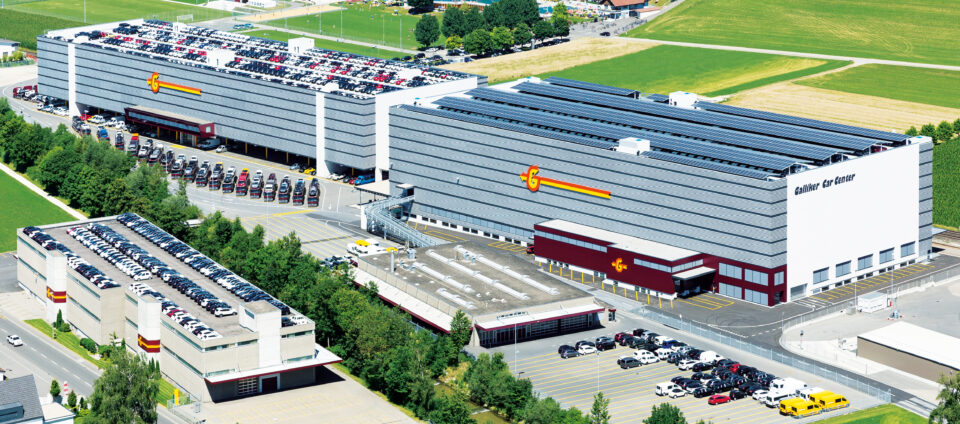
    An energy ecosystem unique in Switzerland is to be created in Dagmersellen over the next few years. The transport company Galliker, the milk processor Emmi, the producer of biogas PanGas and the energy supplier CKW have signed a joint declaration of intent at the end of 2022.

    For the partners, the project is an important step towards achieving the energy strategy goals of the companies involved and of Switzerland. “Together we want to drive forward the energy transition and make a significant contribution to the decarbonisation and diversification of the energy supply with the planned energy ecosystem,” explains Martin Schwab, CEO of CKW.

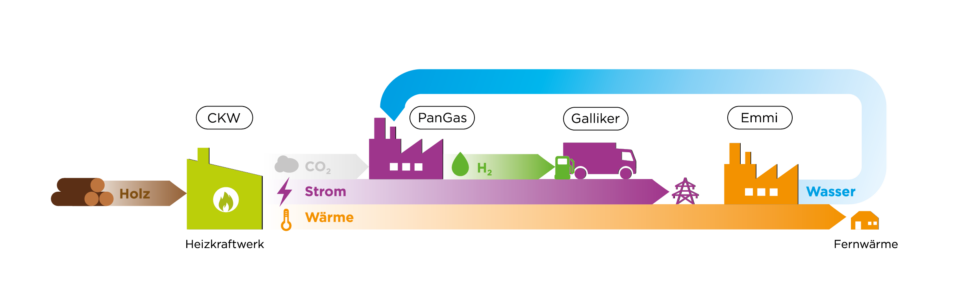
    The energy ecosystem will start with a wood-fired power plant operated by CKW to produce heat and electricity. PanGas will use part of the electricity to produce hydrogen to supply Galliker’s fleet of trucks. In addition, PanGas will extract green CO2 from the combustion process; for use in the food industry, for example.

    “At PanGas, we have always been involved with hydrogen. We are very pleased that we can make a significant contribution to CO2 reduction with this project and come a big step closer to the Swiss decarbonisation target”, says Roger Britschgi, Managing Director PanGas.

    With the renewable energy from the wood-fired power plant, Emmi covers part of the thermal energy required at the Dagmersellen production site for the production of fresh cheese specialities such as mozzarella or ricotta as well as milk powder. With a view to closing the loop, Emmi also supplies demineralised water from the production of dairy products for hydrogen production.

    The energy ecosystem is intended to function as a closed loop.

    “This unique energy ecosystem, designed in conjunction with three regionally based national partners, enables more sustainable production of our dairy products and reduces our dependence on fossil fuels,” says Marc Heim, Head of Emmi Switzerland.

    The wood-fired power plant will produce electricity and heat when fully operational. Emmi will use a good third of the heat. Other possible heat consumers are local industry and heating networks in the surrounding villages. As far as possible, the wood-fired power plant will be operated with regional forest chips and waste wood. This will require up to 200,000 tonnes of wood per year.

    The four companies plan to invest a total of about 200 million Swiss francs in the production, distribution and use of renewable energy. Before the energy ecosystem can be built, further planning and approval steps are needed. In the detailed planning, the entire value chain is to be organised. Before building applications can be submitted, the zoning plan of the municipality of Dagmersellen must also be adapted.

    The population will be regularly informed about the project status. The current planning anticipates commissioning in 2027 at the earliest.

  • Cantonal Council committee approves extension of airport runways

    Cantonal Council committee approves extension of airport runways

    The Zurich Cantonal Council ‘s Commission for Energy, Transport and the Environment is in favour of the planned extension of Runways 28 and 32 at Zurich Airport by eight votes to seven, the Zurich Cantonal Council informs in a statement. According to the eight commission members from SVP, FDP, Mitte and EVP, an extension of the two runways will only lead to the consolidation of flight operations during peak times and bad weather conditions. Among other things, the communication cites greater reliability and punctuality.

    The minority of SP, GLP and Greens, on the other hand, fears that an extension of the runways will also be used to expand capacities at Zurich Airport. However, they reject any growth at the airport “due to the pressing climate problems”, the statement says.

    The airport is “pleased to note” the decision, it writes in a statement. The extension of the runways was an important measure to increase the safety margin and stabilise operations. They do not lead to an increase in capacity. There is no correlation between the length of the runways and the number of aircraft landing and taking off.

    The Zurich Chamber of Commerce(ZHK) also welcomes the Commission’s decision. The existing system has proven to be “not stable enough”. Increased delays endanger “the function of Zurich Airport as Switzerland’s only intercontinental air traffic hub”, the ZHK writes in a commentary. “The runway extensions already demanded by the federal government enable the airport to function reliably and stably in all weather conditions.”

    The next step is for the cantonal council to decide. The project is subject to an optional referendum.

  • Energie 360° increases share of renewable energy to 23.4 percent

    Energie 360° increases share of renewable energy to 23.4 percent

    Despite significantly higher net revenues in 2022 of plus 56.8 per cent, the energy supplier Energie 360° generated less net profit than in the previous year. The company, which is majority-owned by the City of Zurich, only achieved a net profit of CHF 54.1 million in the financial year ending 30 September 2022, compared to CHF 61.9 million in the previous year, according to a media release. The reason was a sharp rise in energy procurement costs.

    However, Energie 360° significantly increased the share of renewable energy in direct sales to 23.4 percent. The share is thus above target and is approaching the interim goal of 30 percent by 2025. A total of 1223 gigawatt hours of gas were generated from renewable sources, an increase of 2.9 percent. Total gas sales, on the other hand, fell from a total of 5468 to 5219 gigawatt hours, a decrease of 4.5 percent.

    Total biogas sales, including resales, even amounted to 1288 gigawatt hours. This corresponds to an increase of 11 percent. Energie 360° intends to further increase the share of this climate-friendly energy source in its standard product. This is to be achieved through the construction of new plants and new technologies.

    By 2040, the Swiss-wide energy provider aims to supply 100 percent renewable energy. The focus is on locally available solutions. Therefore, the company plans to build seven new energy networks in the city of Zurich alone.

    The annual general meeting approved a reduced dividend payment of CHF 11.7 million. It reportedly takes into account a higher investment requirement for the transformation of the company. The equity ratio is 85.1 per cent.

  • Summertime has a positive effect on the energy balance of office buildings

    Summertime has a positive effect on the energy balance of office buildings

    Researchers from the Urban Energy Systems-Lab of the Swiss Federal Laboratories for Materials Testing and Research(Empa), based in Dübendorf, have studied the influence of the changeover from winter to summer time on the heating and cooling energy required by office buildings. They came to the conclusion that setting the clocks forward by one hour has a positive effect on the energy balance, according to a media release.

    Accordingly, the scientists simulated the heating and cooling energy expended with and without daylight saving time for different climatic regions based on data from various office buildings in 15 American cities. In order to include the influence of climate change, they took into account not only the current climate, but also future climate scenarios up to 2050.

    They were able to determine energy savings across all climate scenarios and zones. The highest possible saving was 3 per cent. “Since much more cooling than heating energy is consumed in summer, the time change has an overall positive impact on the energy balance of a building,” Massimo Fiorentini, one of the four study authors, is quoted as saying.

    Therefore, in the debate about abolishing the time change, political decision-makers should not only consider the electricity savings, as has been the case up to now, but also the potential for energy savings in office buildings during summer time.

    Nevertheless, the researchers see the clock change as only one of many possibilities for reducing energy consumption. Improving the building stock, behavioural changes and a general adjustment of working hours are also important building blocks in climate protection.

  • Save energy and CO2 when showering

    Save energy and CO2 when showering

    Hot water needs about as much energy as heating. Up to 80 percent of all hot water is needed for showering alone. But while developments to make heating more efficient and energy-saving have been in focus for years, a lot of hot water still simply flows unused down the drain. But this does not have to be the case! The new Kaldewi shower channel uses the heat of the outflowing shower water to preheat the cold fresh water on its way to the shower fitting. A heat exchanger integrated into the drain thus ensures efficient heat recovery. In the spirit of sustainability, significantly less hot water needs to be added to achieve a pleasantly warm shower temperature. This saves a lot of energy, noticeably lowers costs and reduces the CO2 footprint.

    The new shower channels were designed by the internationally renowned Studio Aisslinger and meet the highest design standards. Patented handling for easy opening and closing of the cover, great flexibility in channel positioning and the wide range of dimensions are further convincing arguments. And with exclusive colours and surfaces, the branded channel becomes a true jewel in the bathroom.

  • Schaffhausen seeks operators for heating networks

    Schaffhausen seeks operators for heating networks

    Stack Infrastructure Switzerland SA is building a large data centre in Beringen by 2025. The Swiss subsidiary of the globally active specialist for large data centres wants to achieve the highest possible energy efficiency. The engineering company Amstein + Walthert has now prepared a feasibility study for the use of waste heat for heat networks on behalf of the Schaffhausen building department.

    According to the study, the energy requirement of the data centre in its final configuration is 30 megawatts, the thermal waste heat capacity 9 to 15 megawatts, and the waste heat quantity at least 79 gigawatt hours per year. Of this, a maximum of 26 gigawatt hours can be used for thermal grids.

    The feasibility study concludes that the thermal energy of the data centre can be used for the expansion of an existing thermal network in Beringen and for three new networks. The canton, the city of Schaffhausen, the municipality of Beringen and Stack now hope that companies will show interest in setting up and operating such heating networks. According to a statement by the cantonal energy office, the cantonal economic development agency is acting as a contact for interested parties.

  • AEW installs district heating at Mutschellen

    AEW installs district heating at Mutschellen

    The Aargau energy supplier AEW Energie has plans to build a heating centre for the Mutschellen area on the Sika factory site in Widen, according to a media release. Private and municipal consumers in the heating network around the Mutschellen Pass are to be supplied with sustainable energy via a district heating network. The communities of Widen, Berikon AG and Rudolfstetten-Friedlisberg AG are connected.

    The local heating concept envisages predominantly regionally grown wood to generate the heat. The installation of modern, low-emission plant technology is intended to prevent the formation of a steam plume.

    Letters of intent have been signed with Sika Schweiz AG, the Turidomus investment foundation and other owners. The interest of the population in a district heating solution is being ascertained by means of a survey.

  • Axpo spins off battery innovation

    Axpo spins off battery innovation

    A team from Axpo has been working on an environmentally friendly generator for four years in collaboration with regional construction companies. The result is a battery storage solution that can replace diesel generators at construction sites. The technology called emost (electric mobile storage) can also be used at events or in emergencies. It has already been awarded the IDEE SUISSE Innovation Prize in spring 2021.

    Now Axpo has decided to sell the technology to a consortium of the project’s existing management and several Swiss entrepreneurs. This will ensure optimal management continuity and knowledge transfer, Axpo writes in a media release. All relevant rights and contracts have been transferred to the newly founded emost AG, headquartered in Dietikon, as of the end of October 2022.

    The founding team reportedly consists of the entire management team that has developed the technology over the past several years. Benedikt Domke becomes CEO of emost AG. Christoph Sutter, who previously headed Axpo’s Renewables Division, will become Chairman of the Board of Directors. He intends to focus in particular on international expansion.

  • WWZ geht Fernwärmenetz in Rotkreuz an

    WWZ geht Fernwärmenetz in Rotkreuz an

    WWZ leitet die Bauarbeiten für ein Fernwärmenetz im Zentrum von Rotkreuz ein, informiert der Zuger Energie-, Telekom- und Wasserversorger in einer Mitteilung. Dabei werden ab der bestehenden Fernwärmeleitung in der Waldetenstrasse weitere Quartiere im Gebiet Waldetenstrasse, Meierskappelerstrasse, Waldeggstrasse und Buonaserstrasse an den Wärmeverbund Ennetsee angeschlossen. Die Bauarbeiten sollen bis Sommer 2024 abgeschlossen sein.

    Im Wärmeverbund Ennetsee soll die gleichnamige Region im Kanton Zug mit Abwärme aus der Kehrichtverbrennungsanlage in Perlen versorgt werden. Damit könnten in den Gebieten Rotkreuz, Bösch, Hünenberg-See, Cham, Städtler Allmend und Äussere Lorzenallmend, Zug und Steinhausen jährlich rund 12’000 Tonnen CO2-Emissionen vermieden werden, erläutert WWZ in der Mitteilung. Das Unternehmen hat sich zum Ziel gesetzt, „möglichst schnell viele Haushaltungen, Büros und Geschäfte des Gebietes Ennetsee mit CO2-freier Fernwärme zu versorgen, um die Abhängigkeit von fossiler Primärenergie in der Region zu reduzieren“.

    Während der Bauarbeiten wird es im Zentrum von Rotkreuz zu Änderungen in der Verkehrsführung und punktuellen Behinderungen für Verkehrsteilnehmende kommen. In der Mitteilung werden die geplanten Massnahmen detailliert beschrieben.

  • Papillon: Vielfältiger Wohnraum

    Papillon: Vielfältiger Wohnraum

    Wie ein Schmetterling entfaltet sich das neue Quartier «Papillon» bei Köniz. Der «letzte Flügelschlag» ist auf 2028 geplant. Bis dann finden hier rund 2000 Menschen einen neuen Lebensraum – inmitten von Wäldern und Wiesen. Die insgesamt acht Baufelder werden auf einer Gesamtfläche von
    324’000 m2 schrittweise entwickelt.

    Bereits bewohnt sind die rund 250 Wohnungen von «Aurora» und «Eisvogel». Die sechs hofartig angelegten Gebäude des «Monarch» umfassen 218 1,5- bis 4,5-Zimmer-Wohnungen. Diese sind im Herbst 2022 bezugsbereit. Den Auftakt zum östlichen Teil bildet ab 2025 der «Feuerfalter» mit 240 Wohnungen. Dieser erfüllt unter anderem mit Wärmedämmungen und Holzfassaden die Anforderungen an ein «Plusenergie-Quartier» und «2000-Watt-Areal». In den sechs Gebäuden von «Cleopatra» entstehen ab 2023 120 Miet- und STWE-Wohnungen mit nachhaltiger Bauweise. In den letzten drei Baufeldern «Apollo», «Heliconius» und «Pallidana» werden rund 300 weitere Wohneinheiten realisiert. Im ganzen Quartier wird nachhaltig und klimaneutral gebaut. Das Ziel: Mindestens 50 Prozent des Jahresenergiebedarfs vor Ort selbst zu produzieren. So werden beispielsweise Photovoltaik- und Wärmepumpen-Anlagen errichtet.

    Die insgesamt rund 1000 Miet- und Eigentumswohnungen eignen sich mit ihren Grössen von 40 bis 130 Quadratmetern für Singles, Paare und Familien. Dreimal pro Stunde hält ein Bus in der Papillonallee. Direkt vor der Haustür finden die Bewohnerinnen und Bewohner Einkaufsmöglichkeiten, eine Kita, Schule, Sportplatz sowie soziale und gemeinschaftliche Angebote. Eine Sozialplanerin ist eigens dafür da, den Gemeinschaftsgeist zu fördern. Von der Interessengemeinschaft «Eisvogel»
    werden regelmässig Quartierfeste, Bastelnachmittage, Schachturniere und
    andere gemeinschaftsfördernde Akti-vitäten veranstaltet. «Ruedü» bietet frische Bio-Lebensmittel von lokalen Produzenten im 18 Quadratmeter grossen Holzcontainer rund um die Uhr zur Selbstbedienung an. Der nahe Wald und die «Tubetränki» sowie die «Allmend» mit Grillplätzen und Fernsicht in den Jura sind zudem beliebte Destinationen für Erholungssuchende, Ausflügler, Sport- und Naturfreunde.

    Dieser Pavillon beherbergt die «IG Eisvogel».

    In absehbarer Zeit bildet der Weiler Ried als Quartierzentrum das Herzstück der Siedlung: Ein aus Leichtholz erbautes PRISMA-Gebäude wird neben einem Lebensmittelladen, Gewerbeflächen sowie Gastronomie auch Loftwohnungen beherbergen. Zusätzlich werden drei neue Mehrfamilienhäuser gebaut. Und in einem der ehemaligen Bauernhäuser ist ein Gemeinschaftsraum für die Quartierbewohner vorgesehen.

    Blick vom nahegelegenen Waldrand auf das Quartier.

  • 58 percent of Swiss buildings are heated with oil and gas

    58 percent of Swiss buildings are heated with oil and gas

    According to a press release , most heating systems in Swiss buildings were operated with oil or gas in 2021. This is the result of the building and housing statistics now published by the Federal Statistical Office ( BFS ) based in Neuchâtel. According to this, in 2021 there were 1.77 million residential buildings and 4.69 million apartments in Switzerland. 58 percent of the buildings were heated with fossil fuels – heating oil and gas are mentioned. Every fourth person heated with gas. 17 percent of the apartments were equipped with a heat pump. Their share of Swiss heating has quadrupled since 2000.

    Almost 40 percent of the population used heating oil in 2021. 25 percent heated with gas and 16 percent with a heat pump. The proportion of people who use heating oil was highest in the cantons of Ticino with 54 percent and Glarus (50 percent). Gas was used most frequently in the cantons of Geneva and Vaud, at 38 percent and 37 percent respectively.

    There are big differences in the share of gas between urban and rural areas. In urban communities, 30 percent of buildings were heated with gas, compared to just 4 percent in rural communities.

    More than 1 million of all buildings are single-family homes, of which more than half of the inhabited single-family homes were only occupied by one or two people, according to the BFS statement. An inhabited apartment in Switzerland was 102.4 square meters on average. Three and four room apartments make up 55 percent of all apartments in Switzerland.