Tag: Energie

  • Viboo wins Empa Innovation Award

    Viboo wins Empa Innovation Award

    Every two years since 2006, Empa has honored in-house innovations or successful technology transfers from science to industry with the Empa Innovation Award. This year, the CHF 5,000 prize went to the Empa spin-off viboo , the research institute said in a statement . The young company based in Dübendorf has developed a self-learning algorithm that uses weather and building data to calculate the optimum energy use of a building several hours in advance.

    The algorithm developed by Felix Bünning and Benjamin Huber together with Empa Senior Researcher Matthias Sulzer in Empa's Urban Energy System Lab has already been tested in pilot tests in the NEST innovation building and in an Empa administration building. It has been shown that the approach can save around a quarter of the heating energy, according to the statement.

    For the application, only the analogue thermostats have to be replaced by intelligent thermostats. Here, viboo is already working with Danfoss and wants to get other manufacturers of such thermostats, such as ABB and Schneider Electric , on board for further pilot projects. Huber wants to reciprocate the award with a contribution that “empa will get through the coming heating period well”, the viboo co-founder is quoted as saying in the press release.

  • Hilcona installs new solar power plant

    Hilcona installs new solar power plant

    The Hilcona Group has installed a photovoltaic system at its Landquart site. The international food producer invested CHF 920,000 in this. The almost 4,000 square meter solar power plant produces up to 830 megawatt hours of electricity per year, which according to a press release is sufficient for around 165 households.

    The head of quality management and sustainability, Oliver Bindel, is quoted as saying that the Hilcona catchment area already uses 100 percent hydropower. "Our electricity is already 100 percent renewable today." Hilcona wants to further expand its own electricity production and gradually reduce the proportion of purchased electricity.

    "Lighthouse projects such as the current one at the Hilcona site in Landquart show that Hilcona is not too big a project to have net zero CO2 emissions in the long term. It is important to us to make a positive contribution to achieving global climate goals.”

  • Ostermundigen installs smart thermostats in school

    Ostermundigen installs smart thermostats in school

    The council of the municipality of Ostermundigen recently voted in favor of the installation of 237 smart thermostats from the cleantech start-up Cleveron , based in Stettlen. According to a media release , they are intended to convert the radiators in the Dennigkofen school and reduce their heating energy consumption by up to 30 percent. The investment costs amount to 40,000 Swiss francs.

    These costs should have amortized after two to three years through the optimized energy consumption. Should the measure reduce the current energy consumption for heating by at least 8 percent, the municipality of Ostermundigen will consider equipping other school complexes and administration buildings with new thermostats.

    “With the pilot operation in the Dennigkofen school, we are testing how we can reduce energy consumption in our community-owned properties in the future. At the same time, the procurement is a contribution to minimizing the risk of energy shortages in the coming winter,” Maya Weber Hadorn, municipal councilor in Ostermundigen, is quoted as saying in the media release.

    Cleveron heating thermostats measure the temperature and humidity in rooms. They also take into account the current weather data and the outside temperature. A self-learning algorithm is designed to ensure optimal temperature regulation. All data can be displayed and evaluated via an app, and the thermostats can be controlled via it. Last fall, the municipality installed 220 Cleveron sensors in school buildings to improve air quality.

  • IWB and Kiwigrid cooperate for decentralized energy supply

    IWB and Kiwigrid cooperate for decentralized energy supply

    The Basel Industrial Works ( IWB ) and the German IT company Kiwigrid , which specializes in decentralized energy and e-mobility, are working together to set up energy communities. Both companies have jointly developed software for energy management and asset management, IWB and Kiwigrid inform in a joint statement . It is to be used for the first time on the Westfeld site in Basel. There, the housing cooperative is realizing a new quarter with around 500 cooperative apartments.

    IWB will equip the district with an integrated heating, cooling and power supply. The Basel energy supplier obtains the necessary energy management from Kiwigrid. Using the Energy-IoT platform of the Dresden-based company, the district’s electricity meters, photovoltaic systems, charging stations and heat pumps can be integrated into a network for self-consumption, intelligently controlled and managed.

    “Our goal is a completely renewable, climate-friendly energy supply,” says Markus Balmer, Head of Sales and member of the management board at IWB. The company wants to contribute to the development of sustainable living and working spaces. “As an expert in energy management systems and IoT for renewable energies, Kiwigrid has proven to be the ideal partner in the implementation of our ambitious goals,” explains Balmer.

    The energy community in Westfeld should not remain the only joint project between IWB and Kiwigrid. According to the announcement, the partners have already found interested parties for further mergers. hs

  • Bern has the most climate-friendly building stock

    Bern has the most climate-friendly building stock

    Navitas Consilium has developed an interactive tool to show the share of renewable or imported energy in the building stocks of each municipality in Switzerland, the Martigny-based energy and climate consultancy informs in a press release . The amount of greenhouse gases generated by the building stocks can also be called up using the tool. With its development, Navitas Consilium wants to help determine the need for decarbonization of building stocks for the implementation of the Swiss climate strategy.

    An interactive map can be used to show that the most densely populated areas of the country use a low proportion of renewable energy compared to rural areas. With a share of 28 percent, Lausanne is still the best of the ten major cities. For Switzerland as a whole, the values vary between 2 and 84 percent.

    At almost 40 percent, heating and hot water in buildings account for a very high proportion of total energy consumption. For the implementation of the climate strategy, Navitas Consilium therefore considers a reduction in energy consumption in combination with the use of low-emission renewable energies to be essential.

    The city of Bern is currently one step ahead when it comes to the climate-friendliness of its building stock. With 23 kilograms of CO2 equivalents per square meter per year, Bern has the lowest emissions of the ten largest cities in Switzerland. Zurich and Basel follow, each with 24 kilograms of CO2 equivalent per square meter. In general, cities with less than 10 percent energy from renewable sources have comparatively high emissions of greenhouse gases.

  • Home2050.ch now advises on solar, heating and e-charging stations

    Home2050.ch now advises on solar, heating and e-charging stations

    The Basel-based energy supplier Primeo Energie , the Elektra Baselland cooperative ( EBL ) and the Basellandschaftliche Kantonalbank ( BLKB ) have transformed their joint solar advice platform sun2050.ch into home2050.ch . According to apress release , they are reacting to the fact that their customers' requests for advice are increasingly going beyond the optimal photovoltaic solution for their property.

    That's why the range of advice on home2050.ch now also includes questions about heating replacements and your own e-charging stations. As before, homeowners receive free reference offers for photovoltaic systems on the newly designed website and can then register for a fee-based individual consultation. BLKB continues to support interested parties with a specially created energy mortgage.

    According to EBL CEO Tobias Andrist, the energy transition can only succeed in cooperation with the population. The three partners therefore want to "generate real added value" for their customers by "with the cooperation home 2050.ch we offer a simple and effective solution for the procurement of your solar system, your new heating system or your new e-charging station".

  • Artificial intelligence to achieve gas reduction by 15%

    Artificial intelligence to achieve gas reduction by 15%

    Die meisten Energie-Sparmaßnahmen verursachen einen erheblichen Kapitalaufwand – die KI von Arloid kann dagegen kostenlos implementiert werden, bis notwendige Einsparungen erzielt werden. Dies macht die KI-Lösung zu einer der günstigsten und einfachsten Möglichkeiten für EU-Staaten, den Energieverbrauch ohne Vorabkosten erheblich zu senken. Sobald Einsparungen festgestellt werden – dies ist üblicherweise nach 30 Tagen der Fall – kann eine prozentuale Gebühr berechnet werden.

    Eine Reduzierung des Energieverbrauchs lässt sich durch eine Reihe einfacher Schritte erreichen: Zunächst wird ein virtuelles Gebäude erstellt, das zu dem identisch ist, in dem Einsparungen erzielt werden sollen. Der digitale Gebäude-Zwilling verfügt dabei über gleiche Baumaterialien, Lage, Klima und Personal-Eigenschaften. Die KI erstellt daraufhin eine Reihe von Simulationen auf Grundlage der Live-Daten des realen Gebäudes. Der komplette Vorgang benötigt rund einen Monat.

    Die KI reguliert daraufhin selbstständig und kontinuierlich die Heiz-, Lüftungs- sowie Kühleinstellungen und führt so zu direkten, realen Einsparungen. Bisher wurden dafür notwendige Einstellungen von Gebäudetechnikern oder Hausverwaltern vorgenommen, was im Vergleich deutlich mehr Zeitaufwand erfordert. Die Automatisierung durch KI spart damit nicht nur Energie und Geld ein, sondern verbessert zugleich auch die Steuerung und den Bedienkomfort.

    Die KI von Arloid nutzt Deep Reinforcement Learning, um den Betrieb von HLK-Systemen in einer Vielzahl von Gebäuden über ein sicheres Virtual Private Network (VPN) automatisch zu verwalten. Die von der KI ausgeführten Regulierungen basieren dabei auf der Grundlage von Verstärkungsverhalten und Echtzeitdaten, um eine schnellere Optimierung und bessere HLK-Leistung zu erreichen. Durch die Steuerung jedes HLK-Geräts im System und die Aufteilung des Gebäudes in Heiz- und Kühlmikrozonen stellt arloid.ai mehr Kontrolle über die Umgebung und besseren Benutzerkomfort bereit.

    Die Technologie gewinnt nicht nur in Europa, sondern weltweit an Bedeutung, mithilfe der sich direkte Einsparungen auf schätzungsweise über 56 Mio. qm2 Fläche erzielt lassen. Dazu zählen Immobilien und Geschäftsgebäude wie u.a. Einzelhandel, Hotels, medizinische Zentren bis hin zu Lagerhäusern. Durch die Reduzierung des Gebäude-Energieverbrauchs kann so unmittelbar den Auswirkungen von Energieversorgungsproblemen, höheren Preisen und Inflation entgegengewirkt werden.

    KI sollte deshalb EU-weit weit oben auf der politischen Agenda stehen, um die Mitgliedsstaaten dabei zu unterstützen, ihre freiwilligen Gasreduktionsziele von 15 % zu erreichen. Es ist nicht so schwer zu erreichen, wie es zunächst erscheint, weil neue Technologien mit sehr wenig Aufwand eine wichtige Rolle dabei übernehmen können. In jeden Fall ist es ein offensichtlicher und erreichbarer erster Schritt in Richtung EU-Ziele und bietet jenen Ländern eine bessere Option an, die gedimmtes Licht und kürzeres Duschen empfehlen.

    Weitere Information unter: arloid.com

  • Building program paid out record sum

    Building program paid out record sum

    According to a press release from the Swiss Federal Office of Energy ( SFOE ), around 361 million francs in subsidies for energy-efficient building refurbishment were approved by the federal government and the cantons in 2021. This is the highest amount that has been invested in renovation and new construction projects since the program was launched. Compared to 2020, the funding amount has increased by CHF 62 million.

    Thermal insulation projects, which were funded with CHF 126 million, received the largest amount. The highest increase of 70 percent compared to 2020 was achieved by building services projects, which received CHF 106 million in grants. The commitments for energy-related measures that will be implemented over the next five years have reached a new high of CHF 490 million.

    The high demand for subsidies can be attributed to the broad approval of owners for energy-efficient renovation of their properties or new builds. According to calculations, the measures approved in the year under review will lead to a reduction in energy consumption in buildings throughout Switzerland by 6.5 billion kilowatt hours and lower CO2 emissions by around 1.8 million tonnes over their lifetime.

    According to the statement, the building program has proven to be an effective instrument of Swiss energy and climate policy. A total of around CHF 2.7 billion has been paid out under the funding program since its introduction in 2010. The building program also has a positive effect on the economy. In 2021, 2,300 full-time jobs and around CHF 97 million in additional domestic value were created.

  • Energie 360° renovates its headquarters in Altstetten

    Energie 360° renovates its headquarters in Altstetten

    Energie 360° wants to convert and repair its headquarters at Aargauerstrasse 182 in Altstetten, which was built in 2003. The energy supplier, which is majority owned by the city of Zurich , is investing almost 28 million francs in this. In its capacity as client representative, the Office for Buildings of the City of Zurich has now submitted the corresponding building application, the city administration and energy company inform in a joint statement . They expect construction to begin next spring.

    The conversion work is intended to adapt the headquarters to the requirements of a modern working environment "with flexible and hybrid working concepts", according to the statement. For this purpose, the existing premises are to be redesigned “into an open office landscape” with correspondingly modernized building services. A large-scale photovoltaic system is planned for the facades and roof.

    After a "strategic review", the management of Energie 360° has given up on initial considerations of adding a new building to the existing building, the statement explains further. Instead, the existing building should be optimized "for an efficient and result-oriented working environment". Jessenvollweider Architektur from Basel is responsible for the architectural concept.

    By 2040, Energie 360° wants to switch its offer exclusively to energy from renewable sources. According to the announcement, the conversion of the headquarters is driving this “transformation of the company and enables targeted energy saving measures in our own operations”.

  • MARNA Beteiligungen wants to buy solar company Flisom

    MARNA Beteiligungen wants to buy solar company Flisom

    According to a press release , MARNA Beteiligungen AG from Heidelberg plans to take over the majority of the Flisom Group based in Niederhasli. MARNA Beteiligungen AG wants to cooperate with FL1 Holding GmbH, which belongs to it, and is also planning a capital increase.

    Flisom, a spin-off from the Swiss Federal Institute of Technology in Zurich ( ETH ), has developed particularly flexible and lightweight thin-film solar cells. They are produced on plastic films using so-called roll-to-roll manufacturing techniques and can be attached to roofs or facades, for example. However, they are also suitable for use in mobility applications, such as in aviation. In 2020, Flisom commissioned a 40-megawatt production plant in Hungary to manufacture the modules.

    "Flisom is ideally positioned to benefit from the megatrends behind the increasing demand for electricity (…)," writes MARNA Beteiligungen AG in the press release. She counts population growth, increasing prosperity, digitization and electromobility among these megatrends.

    According to the information, various requirements still have to be met for the planned transaction.

  • ewz builds second solar system on dam wall

    ewz builds second solar system on dam wall

    ewz is building its second large-scale solar system on the Valle di Lei dam at over 1,900 meters above sea level. The Graubünden municipality of Ferrera issued the building permit for this in November 2021. According to a press release , more than 1,000 modules will be installed on the Valle di Lei dam wall of the Hinterrhein power plant ( KHR ) over a length of 550 meters. Most of the construction and installation work is carried out by KHR employees.

    The system was developed and planned by Reech GmbH from Landquart GR. It will have an output of 343.2 kilowatt peak. Annual production will be around 380 megawatt hours. According to ewz, this corresponds to the annual electricity requirements of around 160 households in Zurich.

    High alpine photovoltaic systems are particularly efficient. According to the information, they deliver 25 percent more electricity on average over the year than systems in the Mittelland. They also produce around half of the annual electricity in winter. As a result, according to ewz, they contribute to security of supply in the winter months.

    Similar to the first photovoltaic system from ewz on the Albigna dam, ewz customers can also participate in Lago di Lei – Solar. 73 percent of the available space has already been sold.

  • Asking rents continue to rise

    Asking rents continue to rise

    The Homegate rental index now stands at 117.9 points. This means that asking rents increased again by 0.3 percent in June, and by 1.3 percent since the beginning of the year. According to a media release from the real estate marketplace, this is “in stark contrast to the rental price development before the COVID 19 pandemic, when rising vacancies in the Swiss rental apartment market caused nervousness among investors”.

    Because the net rents have also become more expensive, the increased energy costs alone cannot be held responsible. In fact, building applications have been declining for the last two years. At the same time, there is brisk demand for rental apartments. “So just a few years ago there was concern about an oversupply of rental apartments, but these are again extremely scarce in sought-after locations.”

    Homegate describes the half-year increases in the cantons of Zug (5.4 percent) and Graubünden as well as in Appenzell (4.3 percent each) as remarkable. The increases were lowest in the cantons of Basel-Landschaft (0.6 percent) and Ticino (0.5 percent).

    In the cities, demand has increased again since the infrastructure started up again after the first phases of the pandemic, particularly in Zurich (4.8 percent). Lausanne (2.5 percent) and Lugano (1.8 percent) were also above the national average. Only in St.Gallen were rents slightly down (minus 0.2 percent).

  • Cowa receives 1 million francs from investors

    Cowa receives 1 million francs from investors

    In a first round of financing, Cowa Thermal Solutions AG has received over CHF 1 million from private investors and its own founders Remo Waser and Simon Maranda. According to an article on the startupticker.ch portal, the young company based in Lucerne’s Technopark wants to use the fresh capital to market its heating storage system for heat pumps on a larger scale.

    The cleantech start-up is developing a heating storage system with capsules that contain environmentally friendly salts as a phase change material. A tank filled with the capsules can absorb three times more energy than a conventional water tank for heat pumps. According to the information, this makes a heating system less dependent on mains electricity. In addition, unlike batteries or rechargeable batteries, it does not use lithium.

    The storage tank filled with Cowa capsules has been available from the building technology company Meier Tobler since April of this year. According to startupticker.ch, the additional costs for the Cowa product compared to conventional storage systems are quickly balanced out due to the energy density and longevity of 20 years.

    In addition to further scaling on the domestic market, the company would like to expand to Germany soon. Initial talks with potential sales partners have already taken place.

  • Jaisli-Xamax completes work on Confiserie Speck

    Jaisli-Xamax completes work on Confiserie Speck

    Jaisli-Xamax has completed the work on the electrical installation at the new production site of the traditional company Confiserie Speck . The confectionery remains in Zug, but moves to the Göbli area. There will be over 3,000 new jobs there in the future, which makes the area very attractive, confectionery owner Peter Speck is quoted as saying in a media release by Jaisli-Xamax. In a short interview published there, Speck emphasizes the special features of the electrical installation brought in by the Dietiker company. “We wanted to optimize the production process and make it as sustainable as possible. We are able to do this thanks to the cooperation with the Multi-Energy-Hub, which combines local energy sources into a CO2-neutral overall energy system with a maximum degree of self-sufficiency,” Peter Speck is quoted as saying.

    In addition, one wants to bring visitors closer to the craft in the confectionery. This is achieved by looking into the well-lit production hall, which is also called the “aquarium”.

    The new Confiserie Speck location is more than just a production hall. In addition to the bakery, there are also offices, apartments, a café and a shop at the new location.

    The electrical manufacturer Jaisli-Xamax from Dietikon only opened a new branch in Zug in 2021. The company, which has been active in the entire electrical sector for over 50 years and specializes in innovative solutions, now has offices in Basel, Bern and Zug in addition to its headquarters in Dietikon. Jaisli-Xamax AG employs a total of around 400 people.

  • Miromico manufactures 26,000 climate sensors for Ecco2

    Miromico manufactures 26,000 climate sensors for Ecco2

    Ecco2 is increasing its production volume from over 11,000 in the past two years to 26,000 climate sensors. As a provider of intelligent solutions for buildings, the company based in Givisiez wants to reduce the consumption of heating energy. These sensors are manufactured by the Zurich high-tech company Miromico , which focuses on development services for integrated circuits, electronic systems and the Internet of Things. As stated in amedia release , Miromico has been Ecco2’s “trustworthy hardware manufacturer” for years.

    With the increased production volume, Ecco2 wants to tackle energy savings of up to 4,000,000 square meters of heated space from 2023, according to its Head of Operations, Alain Wagnières. With this production capacity, Ecco2 can fulfill its vision of saving 50,000,000 kilowatt hours of energy annually by next winter.”

    In Switzerland this year, Ecco2 won the Prix d’Innovation in the digital category at the annual event for real estate professionals, Rent Switzerland . The company was also awarded the Swisscom IoT Climate Award 2022 in silver.

  • Photovoltaics: Economic and ecological benefits for real estate owners

    Photovoltaics: Economic and ecological benefits for real estate owners

    Enormous solar potential
    After a steady increase over the years, photovoltaics recorded a record increase in 2020. According to the “Solar energy statistics” of the Federal Office of Energy (SFOE), around 118,000 photovoltaic systems with an output of almost 3 gigawatts were installed at the end of 2020. The strong market growth continued in 2021, so that according to Swissolar, photovoltaics (PV) today covers more than 6 percent of Switzerland’s electricity requirements. Experts assume that this trend will continue, not least in view of the efforts towards much more energy independence.

    Ecological and economic advantages
    Photovoltaic systems bring a whole range of advantages for owners of real estate portfolios. On the one hand, they can protect themselves against rising electricity prices. On the other hand, they already meet possible future self-production specifications today. Also with regard to subsidies, new rules will make the production of solar power more attractive in the future. In addition, portfolio owners with their own solar systems benefit from a clear reputation advantage.

    In most cases, PV power from your own roof is cheaper than power from the grid. The fact that power consumption due to heat pumps and electromobility will continue to rise in the future contributes to the financial attractiveness of PV systems. Improving the ecological balance sheet is also becoming increasingly important, because sustainability aspects are part of the strategy of more and more companies. Furthermore, PV systems are also interesting because they increase the value of real estate. If the photovoltaic systems produce more electricity than can be consumed on site, it is possible to use the solar power in other properties.

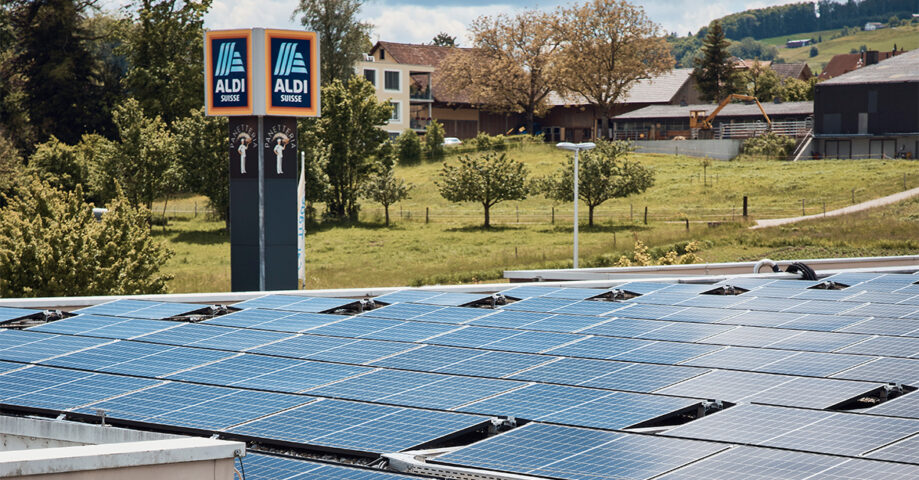
    In the ALDI SUISSE solar project , for example, sustainability and cost-effectiveness play a key role. In just over a year, ewz equipped 68 store roofs between Romanshorn and Geneva with photovoltaic systems. ALDI SUISSE uses most of the solar power itself for its own branch operations. Thanks to the large PV systems, the implemented solution enables a high solar yield with an average self-consumption of 55 to 60 percent.

    High self-consumption increases profitability
    There is already a heat pump in around 90 percent of new buildings, and new registrations of electric cars are continuing to rise sharply. However, heat pumps and electric vehicles are only really low in CO 2 if they use renewable electricity. The combination with a photovoltaic system therefore makes sense: Solar power reduces CO 2 emissions and high self-consumption increases the profitability of the PV system. This is because the production costs for solar power are lower than the electricity tariff for households and because the energy suppliers pay a low tariff for the solar power fed into the grid.

    A good way of using a large part of the solar power yourself is to organize several end users in a group for self-consumption (ZEV) . These are possible both in rental properties and among property owners. The degree of self-consumption of photovoltaic systems is on average 30 to 40 percent. This value can be significantly increased with self-consumption solutions.

    A large part of the electricity is used on site through the targeted control of consumers such as heat pumps or electric vehicles. The advantage for property owners and their tenants: the cost of solar power, at 8 to 16 centimes per kilowatt hour, is lower than the electricity tariff for households, which costs 15 to 25 centimes per kilowatt hour.

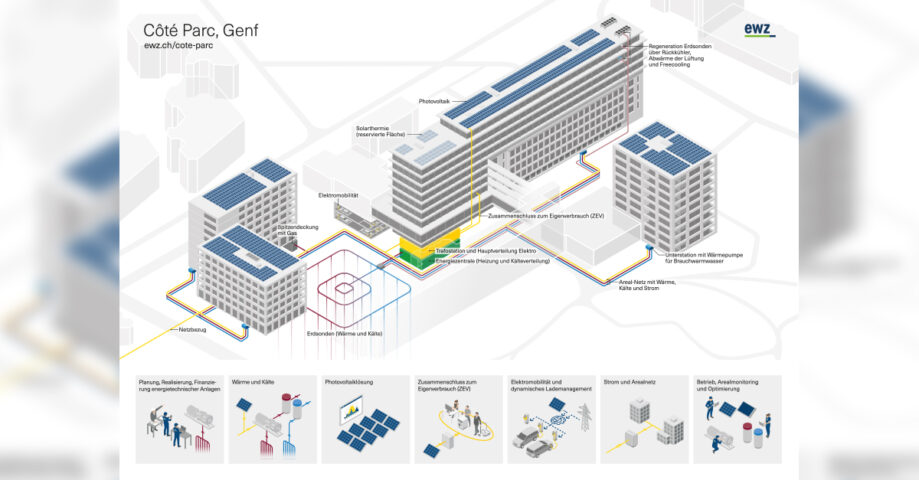
    An interesting practical example of this is the “ Côté Parc ” project in Geneva. 776 photovoltaic panels on the roofs of the area form the basis for an integrated solar solution with heat pumps, charging stations for electric cars and the area’s own power grid, including self-consumption for the users.

    For real estate owners with large roof areas (from approx. 700 m2), a contracting model is an option worth considering. The provider takes over all services – from planning to financing, implementation to operation over several decades. Including the integration of photovoltaic systems in a holistic energy solution with heat and cold supply, electromobility and self-consumption models.

    Business customers of ewz can rely on efficient and tailor-made solutions from competent teams with many years of experience. Investment, maintenance and repair costs are not incurred during the contract period. After the end of the contract period – usually 20 to 30 years – the photovoltaic system becomes the property of the customer.

    Further interesting information on the subject of photovoltaics and the white paper “Photovoltaics & ZEV” can be found here .

    ewz energy solutions
    Locations in Zurich, Sils (GR) and Rolle (VD)
    ewz.ch/energy-solutions


  • Holistic solar solution for ALDI SUISSE

    Holistic solar solution for ALDI SUISSE

    The project is about sustainability and profitability: Photovoltaic systems with a total output of around 15,000 kWp were installed on around 70 store roofs. If you add up the systems, you get one of the largest solar energy projects in Switzerland. It will produce around 14 million kilowatt hours of electricity per year, which corresponds to the consumption of around 5,300 households. In this way, the retailer makes a valuable contribution to the sustainable energy supply in Switzerland – and at the same time can significantly reduce its operating costs.

    The electricity from the systems is used by the shops themselves, which – like all retailers – consume a relatively large amount of energy because of the many refrigerated shelves, the oven, the heating and the lighting. In addition, where available, the solar power is used in the e-charging stations next to the branches and, if there is excess, fed into the grid.

    Time pressure as a challenge and opportunity
    At the end of 2019, ewz Energy Solutions was awarded the contract to build the systems. In close cooperation, ewz developed a pilot system with its subsidiary SunTechnics Fabrisolar and another partner. This procedure made it possible to use the know-how of all those involved and to clarify technical questions in advance. ALDI SUISSE’s extensive requirements for the construction process, safety requirements and functionality were also taken into account. ewz prepared the rollout during the pilot phase and continuously incorporated the findings from the construction of the first systems. The time pressure thus proved not only to be a major challenge, but also an opportunity. Because of the almost simultaneous construction of the 70 or so plants, many synergies could be used, which enabled efficient implementation.

    Elaborate static test
    Before the modules were installed, each roof had to be statically tested. This is particularly important for existing buildings, as the additional loads from modules, fastening systems and cast concrete blocks are high. For each store roof, the specialists used calculation software to create a ballast plan that specifies the number and positioning of the modules. The modules are usually set up in an east-west direction. A southern orientation would also be possible in principle due to the high direct solar radiation at midday, but over the course of the day the east-west orientation proves to be more profitable.

    Maximum solar yield
    “When planning, we didn’t look at the size of the house connection, but at the available roof area and the maximum number of modules we could place there,” says Roland Jucker, overall project manager at ewz. The goal of ewz was clearly to generate as much solar yield as possible. However, this fundamental decision presented the planners with a number of challenges. The biggest was to integrate the PV system into the existing power supply of the branches.

    The electricity produced by the PV system is primarily used directly in the ALDI branch to cover its own consumption. If the branch is using less electricity than the PV system is producing, the excess electricity is fed into the grid. The electrical house connection must therefore be matched to the maximum output of the PV system (e.g. sunny Sunday with maximum production and low self-consumption). However, because this situation occurs extremely rarely and only for a short time, strengthening the house connection would be disproportionately expensive.

    The solution is dynamic power control. It is constantly measured how much electricity the PV system is currently producing, what the consumers are drawing and how much electricity is being fed back into the grid. If the feedback current is above a certain limit, the control unit gives the command to the inverter to throttle the power. The house connection fuse cannot be overloaded and self-consumption is not restricted.

    Thanks to the large PV systems, the solution implemented for ALDI SUISSE enables a very high solar yield with an average self-consumption of around 60 percent.

    ALDI SUISSE has concluded a contracting agreement with ewz
    To put it simply: ALDI SUISSE provides the roofs and, as far as possible, obtains the solar power to cover the electricity consumption directly in the branch. The PV systems belong to ewz, which is also responsible for maintenance, billing and renewal. The “carefree package” also includes the overall coordination of the project, obtaining building permits, remote monitoring and the use of residual electricity.

    Roland Jucker, overall project manager at ewz says: “The idea of equipping as many roofs as possible with a standardized PV solution is visionary”. “In the end, around 45,000 modules were installed.” Jucker is particularly proud of the fact that the installation was able to take place during ongoing operations. “We had to be off the network for 30 minutes after closing time – that was the only interruption.”

    Christoph Deiss, Head of the Energy Solutions division at ewz, says: “I am not aware of a similar project in Switzerland. In this way, ALDI SUISSE is making a valuable contribution to climate protection together with us.» Christoph Deiss emphasizes the great experience: “We have been using photovoltaic technology for over 30 years – we have been a solar pioneer from the very beginning.” Thanks to its great know-how and many years of experience, ewz prevailed against around a dozen competitors in the tender. “ewz is a Swiss company with locations in Zurich, Graubünden and Vaud,” emphasizes Christoph Deiss. “Thanks to the regional operating teams, we guarantee the highest security of supply and short response times.”

    Further information at: ewz.ch/aldisuisse

  • Coop builds new solar system on shopping center

    Coop builds new solar system on shopping center

    The retail cooperative Coop has installed a photovoltaic system on the roof of the Friborg Süd shopping center. According to a press release , Coop has installed a total of 60 solar systems on the roofs of its supermarkets, shopping centres, production facilities and distribution centers since 2016. The commitment is part of a new sustainability strategy for the Basel-based company.

    At 4,300 square meters, the new facility in Villars-sur-Glâne is one of the largest at Coop to date. All systems together result in an area of 115,000 square meters of solar cells. They produce 19 million kilowatt hours of electricity a year. According to the information, this corresponds to the annual electricity consumption of 5800 households.

    Coop uses the electricity to supply its own infrastructure in the sales outlets, including refrigerated shelves and lighting. The Friborg South location uses 90 percent of its solar power.

    In the future, Coop wants to switch to 100 percent electricity from renewable energy sources. As part of its sustainability strategy, the cooperative also wants to reduce its direct CO2 emissions by 20 percent by 2026. Furthermore, Coop wants to expand the transport of goods by rail and implement projects to reduce carbon dioxide along the supply chain.

  • Tägi invites you to the Bauen+Wohnen trade fair

    Tägi invites you to the Bauen+Wohnen trade fair

    The leisure, sports and event center Tägi in Wettingen invites you to the Bauen+Wohnen Aargau trade fair again this spring after a two-year break. According to the press release , it will take place from Thursday, April 7th to Sunday, April 10th and will present offers for everything to do with building, living, gardening and energy. More than 180 exhibitors present products and services in four halls as well as on Tägerhardstrasse, the Tägi forecourt and in the event arena. There are also several specialist lectures in the Limmatraum on topics such as light, heat pumps, kitchen planning or solar power.

    The fair is open on Thursday and Friday from 1 p.m. to 8 p.m. and on Saturday and Sunday from 10 a.m. to 6 p.m. There is paid parking on the circus meadow.

    This weekend the Tägi also opens the mini golf season. The 18-hole mini golf course is open daily from 1 p.m. to 8 p.m. Provided the weather is nice and allows the game to play.

  • Climate neutral by 2050

    Climate neutral by 2050

    Many homeowners cannot afford a renovation. Long-term loans are now intended to support builders who want to make their property climate-friendly but do not have sufficient financial resources or prefer to invest their money in their core business. At least that's what the state wants. Whether and how this can be done remains questionable. Because the financial institutions intended for this, such as banks and insurance companies, are hardly interested in loans with terms of more than 30 years. The federal government therefore wants to act as a security guarantor. A pilot project in Berne is now to examine whether this financing idea is realistic.

    The Zuger Energeek Group AG proposes another way. "With Energeek®, the solar panel with rental for you", she gets people to invest in solar energy, whether they own real estate or not. Energeek provides the solar panels and the real estate projects. Anyone who wants to invest can buy one or more panels online and then rent them out to a project company. Upon purchase, the buyer also benefits immediately from the one-time payment (EIV), the federal subsidy for solar systems. The panels acquired will be integrated into a larger panel network that generates electricity sustainably; the buyer of these panels thus becomes a producer of electricity through renewable energy with the right to rental income. A minimum rental price is guaranteed when the contract is signed. However, upward rent adjustments are possible at any time. For example, when the price of electricity rises with inflation. The purchased solar panels can also be resold, inherited or given away at any time together with the rental agreement and the associated rental income.

    Another big advantage: so that solar panels and the projects work very efficiently, solar trackers are used whenever possible and in addition to the permanently installed PV area. With these, the panels are not permanently installed, but rotate according to the sun. This means that, for example, the morning and evening sun is also optimally used. Or discover the smallest gap in the cloud on a cloudy day and use it to generate electricity. This achieves an increase in production of an additional + 63% kWh on average. This in comparison to permanently installed solar panels.

    Energeek Group AG presents the projects for which solar panels can be purchased on its website. The buyer can decide for himself which project the acquired panels should be rented to. For example, a project on a horse farm and hotel in the Freiberge is currently on offer. There, the group, together with its certified partners, will set up photovoltaic systems on a planned area of 1,590 square meters and thus supply the hotel building infrastructure, neighbors, heat pumps and e-charging station(s) with electricity. A panel in this project currently costs a little more than CHF 900, the annual rental income is CHF 82.50. A respectable return.
    More information at www.energeek.biz

  • Refurbishment of the large Webermühle development

    Refurbishment of the large Webermühle development

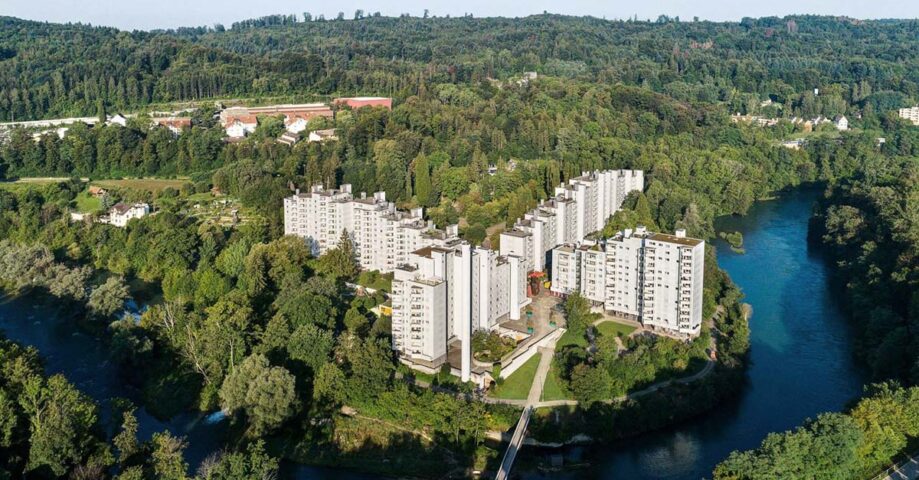
    The Webermühle development in Neuenhof houses 368 rental apartments. The settlement on a peninsula in a loop of the Limmat was built on the industrial site of a former weaving mill and was ready to move into in 1984 after ten years of construction. Planned by the architectural office Steiger Partner AG and built by Ernst Göhner AG, the Webermühle with its different volumes offers living space for up to 1,500 residents. Despite the very high density, the apartments with the four rows of high-rise buildings arranged in a cross shape are characterized by a surprising foresight. Since 2008, the buildings realized in the “Göhner 3” modular construction system have been owned by a real estate fund from Credit Suisse Asset Management.

    Ecologically and economically sustainable renovation
    A good 40 years after moving in, the apartments no longer met today’s standards – neither in terms of appearance nor in terms of comfort. With an analysis of the building structure, the client started planning an extensive partial renovation in 2009, which was implemented in stages between 2012 and 2014. The portfolio strategy of Credit Suisse Asset Management attaches great importance to ecologically and economically sustainable solutions. With the modernization of the Webermühle, one wanted to make the living and green space more attractive for the tenants and to maintain the value of the property. On the other hand, the building technology should be brought up to date and thus the energy consumption should be significantly reduced. Better connections to public transport were also an important goal: Since the construction of a new inclined lift in 2015, Wettingen train station can be reached within a few minutes on foot.

    Heat supply: switch to flow heat
    The core of the energetic renovation is the reorientation of the heat supply. To this end, the client defined a clear goal right from the start: in future, the heat supply in the Webermühle should be at least 70 % CO 2 -free. Due to the size of the facility, Credit Suisse Asset Management wanted to have the heating system replaced by a contractor instead of producing heat itself. The sustainability of the solution proposed by ewz with a river water heat pump convinced the client even after a detailed examination by specialists.

    More about the project

    White paper on the topic of energy-efficient refurbishment
    In addition to the practical example “Webermühle”, the white paper “Energy-related renovations as an opportunity for the real estate industry”, which was created in close cooperation between ewz and the research and consulting company intep, offers insights into the relevance of energy-related renovations.

    Knowing that the building sector is responsible for about a quarter of emissions, there is an urgent need to renovate the building stock. Because the few climate-friendly and energy-efficient new buildings will not have a major effect on the entire sector. At the moment we are in a renovation backlog. The current renovation rate of one percent must be doubled in order to achieve the climate targets.

    Practical experience shows that during renewal processes, too little attention is paid to energy-related refurbishment compared to replacement new buildings. The landowners often lack basic information that shows them the economic, ecological and social potential of energy-related renovations. The whitepaper is intended to make a contribution to precisely this. There is a basic overview of the urgency, legal framework, benefits, opportunities and possible strategies of energy-related renovations.

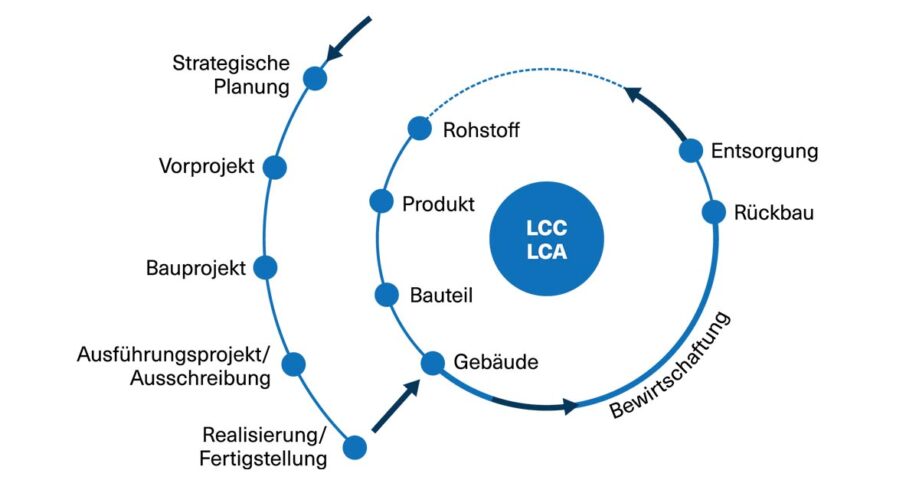
    The results of an ecological balance sheet (life cycle analysis, LCA) and an analysis of the life cycle costs (LCC), for example, form an excellent basis for decision-making. These quantitative assessment methods take into account the entire building life cycle.

    The life cycle analysis (LCA) to determine the environmental impact and the analysis of the life cycle costs (LCC) offer quantitative decision bases for energy renovation. (Source: Kellenberger (intep), 2021)

    To the white paper

  • Energie 360° wants to supply only renewables from 2040 onwards

    Energie 360° wants to supply only renewables from 2040 onwards

    The Zurich energy supplier Energie 360° wants to supply only renewable energy from 2040 onwards. This is ten years earlier than previously aimed for. The reason for the faster phase-out of fossil fuels such as gas and oil is the Russian crisis, the company announced in a media release on the annual balance sheet.

    According to this, the energy supplier delivered 15.9 percent more energy to end customers in the 2021 financial year than in the previous year. Of the 4978 gigawatt hours, 18.2 percent were of renewable origin. The company sees itself “on course”. By 2025, the share of renewables should increase to 30 percent.

    With sales of CHF 537.1 million, Energie 360° generated a net profit of CHF 61.9 million. In the previous year, sales were CHF 466.2 million and net profit was CHF 71 million. The reason for the decline is lower investment income after the sale of two subsidiaries.

    In view of the Russian crisis, Energie 360° recommends “customers who want to move away from Russian gas to replace their gas heating and switch to renewable energy sources”. As an alternative, the company promotes the energy networks in the city of Zurich, which make locally available renewable energy such as heat from Lake Zurich available. It names wood pellets as a further option and recommends increasing the proportion of biogas.

    Energie 360° sees great potential in biogas and has increased its share in its standard gas product to 25 percent as of April 1, 2021. This saved around 200,000 tons of CO2 in the direct supply area. Energie 360° wants to build more biogas plants and invest in innovative research projects.

  • Energeek makes investing in solar energy accessible to everyone

    Energeek makes investing in solar energy accessible to everyone

    The cleantech-project.org of Energeek Group AG and CES Cleantech Energy Systems GmbH wants to enable everyone to participate in the energy transition. CES Cleantech Energy Systems explains in a press release that those who do not have the financial means to renovate their own roof or do not own any property at all cannot usually contribute to climate neutrality through solar energy. To remedy this, Energeek Group AG offers investments in solar panels for specific real estate projects.

    Interested parties can purchase one or more panels and then rent them out to the project company, as explained in the press release. A project on a horse farm and hotel in the Freiberge mountains is given as an example. Here Energeek offers panels at a price of just over 900 francs per piece. In addition to the annual rental income of 82.50 francs, the buyers benefit from federal subsidies for solar systems, the one-off payment.

    As an advantage of Energeek’s projects, the company emphasizes the use of so-called solar trackers. In addition to permanently installed panels, panels are installed that turn towards the sun via the solar trackers. In this way, morning and evening sun and gaps in the clouds can also be used to produce solar power.

    Energeek provides online information on the current range of real estate projects, the prices and the rental income of the corresponding solar panels. According to the statement, purchased panels and the associated rental agreement with the project company can be resold, inherited or given away at any time.

  • Minergie and SNBS adopt labels for 2000-watt areas

    Minergie and SNBS adopt labels for 2000-watt areas

    The label for 2000-watt areas will disappear at the end of 2023. According to a statement from the Federal Office of Energy (SFOE), the suppliers of labels for sustainable buildings in Switzerland have agreed on this. The label was previously offered by the SFOE Swiss Energy program.

    In return, the Minergie association will in future also offer a Minergie area label for areas that comply with climate protection. The Swiss Sustainable Building Network , as the sponsor of the Swiss Sustainable Building Standard (SNBS), will create the SNBS-Areal label for the sustainability of sites in all their dimensions.

    At the building label level, there will also be the cantonal building energy certificate (GEAK), the various Minergie categories and the SNBS.

    The bearers of the various labels want to achieve a greater impact by pooling resources. “Sustainable real estate makes a major contribution to climate protection. The trend is positive, but the potential is far from being exhausted,” Marc Mächler, District President of the Canton of St.Gallen and President of the Minergie Association, is quoted as saying in the statement. “The labels complement each other, are better coordinated with each other and builders and planners can find out more easily which label meets their needs.”

  • Whitepaper: Energetic renovations as an opportunity

    Whitepaper: Energetic renovations as an opportunity

    Knowing that the building sector is responsible for around a quarter of emissions, there is an urgent need to renovate the building stock. Because the few climate-friendly and energy-efficient new buildings will not have a major effect on the entire sector. At the moment we are in a renovation backlog. The current renovation rate of one percent must be doubled in order to achieve the climate targets.

    Practical experience shows that during renewal processes, too little attention is paid to energy-related refurbishment compared to replacement new buildings. The landowners often lack basic information that shows them the economic, ecological and social potential of energy-related renovations. The whitepaper is intended to make a contribution to precisely this. There is a basic overview of the urgency, legal framework, benefits, opportunities and possible strategies of energy-related renovations.

    The results of an ecological balance sheet (life cycle analysis, LCA) and an analysis of the life cycle costs (LCC), for example, form an excellent basis for decision-making. These quantitative assessment methods take into account the entire building life cycle.

    To the white paper

    Comprehensive redevelopment of the Webermühle housing estate
    One example of a successful renovation is the large Webermühle development in Neuenhof. The former Göhner settlement, which was occupied in 1984 and has been owned by a real estate fund from Credit Suisse Asset Management since 2008, houses 368 rental apartments with around 1,500 residents.

    The core of the energetic renovation of the Webermühle is the reorientation of the heat supply. To this end, the client defined a clear goal right from the start: in the future, the heat supply should be at least 70% CO₂-free. Due to the size of the facility, Credit Suisse Asset Management wanted to have the heating system replaced by a contractor instead of producing heat itself. The sustainability of the solution proposed by ewz with a river water heat pump convinced the client.

    Find out more

  • Solar powered RV charges towing vehicle

    Solar powered RV charges towing vehicle

    The Lucerne University of Applied Sciences and Arts ( HSLU ) has designed a practical example of sustainable living without CO2 emissions: a mobile home. The electricity that the Solar Butterfly needs inside is produced by fold-out solar wings. This also charges the electric towing vehicle. According to a press release , students led by Stephen Wittkopf are significantly involved in the implementation of the project. He heads the knowledge and innovation transfer at the Department of Technology & Architecture at the HSLU.

    The Solar Butterfly is currently being built near Lucerne in central Switzerland. Its construction material consists largely of plastic waste that is collected from the sea and then transformed. The motorhome is 10 meters long and 13 meters wide with the sun panel wings up. They offer a total of 80 square meters of space for generating solar power.

    The project was initiated by Swiss environmental pioneer Louis Palmer. 15 years ago he was the first person to circumnavigate the world in a solar-powered car. From May 2022, the Solar Butterfly will travel around the world together with its passengers. On this trip around the world they want to identify 1000 inspiring projects against global warming, record them and then publish them.

  • TBW realize the first solar system in roof rental

    TBW realize the first solar system in roof rental

    The TBW have implemented their first project in the roof rental model on the roof of the riding hall in Wil, the city-owned energy service company informs in a press release . Specifically, a solar system with a peak output of 178 kilowatts was implemented. It will produce around 170 megawatt hours of electricity annually.

    TBW will make the electricity produced on the roof of the riding hall available to its own customers, the company explains in the press release. In return, the Wil Riding Club receives rent for the roof it has provided and for other ancillary rooms used by the project. The corresponding contract has a term of 25 years.

    The TBW assume that the demand for electricity from renewable energies will increase as a result of the abandonment of fossil fuels. In order to cover this, “innovative solutions such as those on the roof of the Wiler Reithalle are required,” writes the company.

  • Primeo Energie and Technic 360 join forces for renewables

    Primeo Energie and Technic 360 join forces for renewables

    Primeo Energie and Technic 360 are launching an offensive for decentralized renewable energy supply in the canton of Fribourg, the Basel-based energy supplier said in a statement . The two partners have developed a portal on which interested parties can calculate the potential and benefits of their own combination of photovoltaic system and heat pump. In addition, maison-intelligente.ch offers detailed advice and financing solutions.

    “From a global perspective, climate-friendly energy and mobility solutions are among the most important drivers of a successful energy transition,” Conrad Ammann is quoted as saying in the press release. For the CEO of Primeo Energie, “intelligent solutions for the optimal implementation, use and financing” of solar systems and heat pumps “make an important contribution”.

    With maison-intelligente.ch, the two partners have created the first offer of this type in French-speaking Switzerland, the press release explains further. You are planning information events in the canton of Friborg in the near future to make the platform better known. The project is supported by the Freiburger Kantonalbank . It offers preferential financing conditions for solutions implemented via maison-intelligente.ch.

    “The energy transition can only succeed in cooperation with the population and thus our customers,” explains Alexandre Fragnière, Director Technic 360, in the communication. Maison-intelligente.ch should offer them “a simple and effective solution for the procurement of their solar system and heat pumps”.

  • Buildings should become power plants

    Buildings should become power plants

    The Swiss Federal Office of Energy ( SFOE ) has published its vision for the Swiss building stock by 2050 in a document . By then, the majority of buildings should be able to meet their own electricity needs from sustainable energy sources. The excess electricity is to be used for electric mobility.

    At the same time, the electricity requirements of buildings are to be reduced. Overall, the final energy consumption of the Swiss building stock by 2050 should be around 65 instead of 90 terawatt hours.

    With a few exceptions, there should no longer be any heating oil, natural gas or electricity for direct consumption for heating. Oil and natural gas heaters and stationary electrical resistance heaters are to be replaced by renewable energy sources. Energetic operational optimization should be mandatory for all buildings by 2030.

  • NEST data center helps with heating

    NEST data center helps with heating

    The ECO-Qube project examines how the electrical and thermal worlds can be brought together with IT infrastructure. For this purpose, the waste heat potential of micro data centers for building heating is to be examined. The field tests are taking place in the newly installed data center in Empa ‘s NEST research building and at two other locations in Turkey and the Netherlands.

    ECO-Qube is designed for three years. After that, the team wants to provide guidelines for planners and operators of buildings. The project is supported by the EU funding program Horizon 2020. It brings together research and industry partners from Switzerland, Turkey, Spain, Germany, Sweden and the Netherlands. “Our goal is to reduce both the energy requirements and the CO2 emissions of small data centers by a fifth,” says Çağatay Yılmaz, Innovation Manager at the Turkish IT solution provider Lande and project manager of ECO-Qube, in an Empa press release quoted.

    With the help of big data structures and artificial intelligence, sensor data from the individual IT components is accumulated and combined with air flow simulations for precise cooling. At the same time, the computing loads would be distributed in such a way that the systems work as energy-efficiently as possible.

    The three data centers will also be integrated into the energy systems of the surrounding districts. If possible, they should be powered by renewable energy. “It is interesting for us to consider the micro data center not just as an electrical consumer, but as a dynamic component in the overall system,” explains Philipp Heer, head of the Energy Hub energy research platform at Empa.