Tag: Entwicklung

  • Venture Kick supports Solaxer with CHF 150,000

    Venture Kick supports Solaxer with CHF 150,000

    According to a press release , the start-up Solaxer based in Écublens has developed a new generation of receivers for the efficient use of solar heat. The Schlieren-based start-up promoter Venture Kick is supporting Solaxer with CHF 150,000 to accelerate the upscaling and complete the first pilot systems with Solaxer receivers.

    According to the announcement, Solaxer receivers are equipped with an innovative selective absorber coating that has better durability and optical performance compared to existing absorbers. In industry worldwide, more energy is used for process heat than for electricity. Today, industrial heating requirements are almost entirely covered by fossil fuels and are responsible for 20 percent of global CO2 emissions per year, it is said.

    Solaxer aims to accelerate the use of solar process heat by developing a new generation of receivers for the efficient use of solar heat. Such concentrating collectors deliver solar steam and process heat with high efficiencies and are among the most cost-effective and mature technologies for decarbonizing industrial processes. Annual growth rates of 90 percent are forecast for this special sector. The worldwide addressable receiver market amounts to 4 billion dollars. Based on the declarations of intent alone, Solaxer can supply receivers for more than 800,000 square meters of installed collector area over the next five years.

    The Venture Kick program helped Solaxer "develop from an idea to a company," Anna Krammer, co-founder of Solaxer, is quoted as saying.

  • AMAG honors Griesser AG

    AMAG honors Griesser AG

    Griesser AG is the winner of this year's AMAG Family Business Awards , the Zug-based automotive company informs in a press release . The family company based in the St.GallenBodenseeArea was able to prevail against the two other finalists CTA from Münsingen BE and Nachbur from Holderbank SO. As the winner of the Family Business Award, the company is allowed to keep an all-electric Skoda ENYAQ SportLine iV made available to all three finalists for a year after the end of the year.

    Griesser AG was founded in 1882 as a roller shutter factory by Anton Griesser. The company, which is now in the fourth generation of the Strässle family, specializes in the development and manufacture of innovative shading solutions. Sustainability is mentioned in the communication as one of the cornerstones of the company. On a social level, this is expressed “in respectful and responsible interaction across all hierarchical levels”. On an ecological level, Griesser has set itself the goal of making all production sites climate-neutral by 2035. In addition, the company's fleet of 400 vehicles is to be converted to alternative drives such as electric by 2030.

    "The Family Business Award stands for AMAG's exemplary values in terms of sustainability and social responsibility," Griesser COO Pascal Strässle is quoted as saying in a Griesser statement on the award ceremony. "We are proud that Griesser carries on these values with the award".

  • Graubünden gets a new tourist center in Sedrun

    Graubünden gets a new tourist center in Sedrun

    Andermatt Swiss Alps AG intends to invest on the Graubünden side of the Oberalp Pass for the first time: in a unique location at the end of the valley in Sedrun/Dieni, 13 buildings with 410 hotel rooms are to be built on the site of today’s car park opposite the Dieni valley station of the Andermatt-Sedrun SkiArena by 2027 develop. Of these, 204 hostel and 206 double and triple rooms are planned. 119 additional residential units are for sale and are managed for tourism. The units vary in size from the studio to the 5.5 room apartment. Resort Dieni Development AG, which is owned by Andermatt Swiss Alps AG (ASA), has submitted a planning application for this.

    "The Dieni resort is a pioneering project that sets new standards in the region and in the canton of Graubünden," says Raphael Krucker, CEO of Andermatt Swiss Alps AG. A total of 1,800 beds are planned – as well as 478 parking spaces, 150 of which are available for guests of the SkiArena Andermatt-Sedrun. The resort also includes three restaurants, two bars, various retail areas and leisure facilities such as spa, bowling, bouldering, cinema, fitness and gaming. "Andermatt Swiss Alps AG is investing CHF 170 million in this," continues Raphael Krucker. The number of hotel beds in Surselva has increased by over 20 percent.

    With the Resort Dieni, the tourist offer in Sedrun is supplemented in the direction of inexpensive apartments and hotel rooms geared towards families/groups. The resort is designed for young families and groups. With ski-in/ski-out and the alpine experience on the mountain in Dieni/Sedrun, a new tourist center is being created in the canton of Graubünden. Mayor Martin Cavegn: “This major project is a milestone for the community of Tujetsch and the whole of Surselva. In order to be able to keep up with the competition, new hotels and managed holiday apartments are needed.»

    The new part of the village will be embedded in a spacious landscape with a view down the valley and into the mountains. The location directly on the year-round train connection Chur-Andermatt and the most modern and largest ski area in the Gotthard area as well as the year-round accessibility by road make the location unique. In addition, the municipality is creating a bus connection between Sedrun and Dieni.

    For the Dieni resort, the aim is to build and operate as sustainably as possible. This includes the choice of sustainable materials, but also state-of-the-art operation. The resort is CO 2 neutrally heated by a wood pellet heater; 50 percent of the roof area will be equipped with 1,500 m2 of photovoltaics. The developer is Resort Dieni Development AG (RDD) owned by Andermatt Swiss Alps AG (ASA), and the operator is also ASA or its partner company from the Orascom Group, Orascom Hotel Management. A third party as a joint venture partner is conceivable.

    Andermatt Swiss Alps AG will invest around CHF 350 million in its core business of real estate and tourism infrastructure over the next few years in order to implement the vision of "The Prime Alpine Destination". In addition, 149 million Swiss francs will be spent from the partnership with Vail Resorts, Inc. With their many years of experience in developing ski areas, the guest experience on the mountain is improved with new lifts, additional snowmaking and new restaurants.

  • Siemens launches AI-based suite for carbon-neutral buildings

    Siemens launches AI-based suite for carbon-neutral buildings

    Siemens Smart Infrastructure is launching an open, interoperable and fully cloud-based smart building suite, the Zug-based Siemens subsidiary announced in a press release. The various interest groups such as building users, real estate investors, real estate companies and facility managers can digitally combine their building data from different sources on Building X. The smart building suite can integrate third-party software, has a range of applications based on artificial intelligence and has built-in cyber security.

    “We can now bring together all the data generated by systems in intelligent buildings in a single data pool,” Matthias Rebellius is quoted as saying in the statement. According to the board member of Siemens AG and CEO of Smart Infrastructure, this would allow “intelligent buildings to be implemented more quickly”, bringing the “vision of autonomous, climate-neutral buildings” closer. “Building X creates measurable data-based results in terms of efficiency, performance and user experience.”

    An energy manager, an operations manager, a security manager and a 360° viewer are currently available on Building X. The suite can be obtained in the form of software as a service on a subscription basis. In addition, Siemens offers the Xcelerator Building Services, a program based on Building X, in which Siemens assumes responsibility for achieving customer goals. The report mentions the reduction of energy costs and the optimization of systems as examples.

  • Negative effects of the Ukraine war on the real estate industry in Switzerland

    Negative effects of the Ukraine war on the real estate industry in Switzerland

    The Ukraine war has global economic ramifications. How do you feel it in the local real estate market? PriceHubble investigated this question with a survey of real estate professionals from all areas of the real estate industry.

    55 percent of the real estate professionals who took part in the current study "Effects of the Ukraine War on the Real Estate Industry in Switzerland" believe that the Ukraine crisis could have a negative impact on their company over the next twelve months. 31 percent think there will be no impact. In contrast, 14 percent of respondents see a positive development for their business.

    According to those surveyed, the reasons for a change are the increase in construction costs, rising mortgage interest rates and a stagnating or declining buyer's market. As one real estate manager comments: «The increase in material costs and delivery times affects both the construction sites and the purchase prices. As a result, buyers will resort to existing goods and abandon construction projects.”

    In general, more real estate professionals (28 percent) see a decrease in the number of mandates over the next twelve months than an increase (17 percent). More than 55 percent of those surveyed do not expect any change in the number of mandates.

    50 percent of the respondents are of the opinion that projects will not be postponed because of the Ukraine war. 9 percent expect a postponement of up to 6 months, 12 percent a delay of 6 to 12 months, 26 percent of 12 to 18 months, 2 percent a postponement of the projects by 18 to 24 months and another 2 percent even by up to to 24 to 30 months.

    Development of luxury properties difficult to predict
    In the case of luxury real estate, 34 percent of those surveyed stated that they expected prices to rise. In contrast, 31 percent believe that a decline is to be expected. 35 percent are of the opinion that the prices in this segment will not change.

    In the comments column to this question, many of the respondents indicated that they expected a decrease in general interest in objects in this segment. Others are of the opinion that luxury real estate is crisis-resistant and that the strong demand will remain. Many are also convinced that the supply will remain stable.

    "Luxury real estate in Switzerland, especially in exclusive locations, will always tend to find buyers (both domestically and abroad) and it is therefore possible that the prices for them remain the same or may even rise," comments one broker.

    Price development of energy-efficient objects remains exciting
    When it comes to the question of whether a greater price change is to be expected when buying properties with a high energy efficiency class (A or A+), there is a tie: 50 percent say "yes" and 50 percent say "no".

    With regard to the demand for real estate with a high energy efficiency class since the beginning of the Ukraine crisis, 68 percent of the real estate experts surveyed stated that they had not noticed any change. "But it will come, people are slowly becoming sensitive to it," a real estate manager commented on this question. 32 percent of those surveyed believe that demand has already increased.

    Regarding rental prices for properties with a high energy efficiency class (A or A+): 69 percent of the participants stated that there will be no changes. In contrast, 31 percent expect a change.

    Further results, for example on the impact of rising mortgage interest rates, the development of rents or sales prices of residential properties can be found in the complete study.

  • The Swiss proptech company Immowise offers its solution in German-speaking Switzerland

    The Swiss proptech company Immowise offers its solution in German-speaking Switzerland

    Condominiums in Switzerland: An industry that only gains from digitization
    Swiss real estate is feeling the direct effects of the turn to digitization, as the most important players in the industry have accelerated the pace of increasing efficiency every year. Switzerland, with its 1.4 million owners* (including more than 445,000** condominiums), ultimately represents an important market for Immowise.

    Immowise's digital solution is easy to implement and adapts to any type of condominium. By connecting to the most important ERPs used in the industry, the platform is fully integrated into the digitization strategy initiated by the agencies. The lean cost management is also suitable for small structures and self-governing condominium associations.

    An office in Zurich serving condominium owners' associations in German-speaking Switzerland
    With the office opening in Zurich, Immowise wants to offer administrations, self-managed condominium associations or independent local administrators a solution to simplify and reduce the workload with a platform that has already proven itself in western Switzerland. By 2022, around 20 general meetings for over 500 condominium owners had already been held. Immowise wants to cover all Swiss regions by 2023. In addition, the platform will be expanded with additional modules such as the internal news service for condominium owners, the comparison of cost estimates and budget management.

    Immowise's development in German-speaking Switzerland is rounded off with the appointment of Teresa Astorina as Director, based in the Zurich region. As a recognized expert in the real estate sector, in which she has been active for over 25 years, she takes over the proptech leadership with the declared goal of converting the management of condominium associations throughout Switzerland using digital technology.

    Sebastian Chiappero, Managing Director of Wise.swiss, Immowise's parent company, adds: "20 months after the founding of Immowise, the appointment of a director marks a further step towards ensuring the nationwide rollout of Immowise. I am very pleased that Teresa will be part of this Position has joined us. Her many years of experience in the real estate industry and her skills in the area of strategy development are all plus points for Immowise". Among other things, she was also active in the management or in leading positions in companies such as Credit Suisse, m3 Real Estate, Privera or EPM.

    Teresa Astorina emphasizes: "The future of the real estate industry lies in digitization. I am very proud to be able to accompany the development of a "Swiss made" solution that offers a real service in the management of condominiums in Switzerland."

    Portrait of Teresa Astorina here for download

    About Immowise
    Immowise was founded in 2021 and is the first Swiss solution for the digitization of condominium meetings. Developed and hosted in Switzerland, this application helps administrators and condominium owners prepare, manage and follow up on meetings. It complements the wise.swiss software from EPwise AG, which was launched in 2020 and offers public administrations and companies a range of digital communication and event organization tools (eventwise, partnerwise and fundwise). https://wise.swiss/de/immowise/
    Immowise headquarters: Neuchâtel
    Offices: Geneva, Zurich

  • Zurich airport region – digitization and development

    Zurich airport region – digitization and development

    [smartslider3 slider=”9″]

    The event was moderated by Monika Schärer, who confidently guided the guests through the afternoon. After a brief welcome, Arun Banovi, owner of immo!nvest/immoTable, and Christoph Lang, managing director of FRZ Flughafenregion Zürich, were briefly asked about the economic region and the connection with immo!nvest.

    In addition, Fabian Streiff from the Zurich Business Development Agency gave the first presentation and presented the region in more detail. From this it emerged that the canton of Zurich is a globally significant hub for artificial intelligence (AI). He also introduced us to the innovation hubs in the Zurich airport region, including the Digital Health Center (Bülach), The Circle (Kloten) and the Zurich Innovation Park (Dübenorf).

    As the second speaker, Hans Egloff, President of HEV Switzerland, brought us closer to the topic of digitization in the real estate industry. Using various examples, he explained the opportunities and risks of digitization. For example, the AHV number serves as a personal identifier in the electronic land register and this entails a large group of authorized users and thus a large potential for misuse.

    Before the break, Tindaro Milone, Head of Large Plants, presented the EKZ and explained what is currently happening in the energy sector. For example, the scarcity of resources, climate change, politics and customer needs. He then presented the future of energy, it is mainly about decarbonization, digitization and decentralization. Of course, sustainability is also a topic that is very topical and will continue to occupy you in the future. He completed his presentation on the subject of electricity storage.

    After the first part of the program there was a break that was used for the first talks. There were also cool drinks, refreshing fruits and delicious cakes.

    This was followed by Dadvan Yousuf, who introduced us to his platform “Dohrnii”, where everyone can easily learn about cryptocurrencies in a playful way. The presentation also included the Dohrnii Markplace, the DHN Token and the Dohrnii DAO. Finally, he made the connection and opportunities between cryptocurrencies and the real estate industry.

    Then Christoph Axmann, Chartered Surveyor MRICS at Wüest Partner, came on stage. With overviews of the population and employment development, he showed the demand in the Glattal-Furttal region. Then he showed which offer can be used to cover inquiries. Below that are investments, quantities, supply in relation to inventory and prices. Finally, he showed the development potential in the airport region.

    The last speaker was René Götz from the business development department of the city of Bülach. He introduced the business location Bülach, showed the positioning, spoke about the goals and available development areas. The key sectors of the region, the space requirements of companies and the Digital Health Center Bülach were also included in the presentation.

    The crowning glory was the exciting panel discussion with Doris Meier (Mayor of Bassersdorf), Christoph Lang (Managing Director of the FRZ Zurich Airport Region), Fabian Streiff (Local Promotion Canton of Zurich) and Heinz Eberhard (Eberhard companies).

    During the aperitif with delicious appetizers and ice cream, there was a lot of networking. The atmosphere was very good and relaxed. Especially when the draw for the competition was due. You could win a trip to the Top of Europe – Jungfrau Joch with overnight stay and dinner for 2 people. This great prize was sponsored by eSMart, which celebrated its 10th anniversary last year. Monika Schärer made it exciting and presented the award to the delighted winner Markus Nussbaum.

    We would like to take this opportunity to thank all guests and speakers for the exciting afternoon. A big thank you also goes to the Eventalm for the great and flexible organization, the friendly service and the delicious treats. But we don’t want to forget our partners either, without you such an event would not have been possible! Thanks to EKZ, eternit, eSMART, Seitzmeir, Sunrise, SVIT Zurich, Rigips, PropTechMarket, Woonig and FRZ.

    We hope to see some of you in Lausanne on October 6th and in Basel on November 24th. Until then, we wish you a nice summer!

  • New GLC research building, ETH Zurich: Today's facade technology for tomorrow's health sciences

    New GLC research building, ETH Zurich: Today's facade technology for tomorrow's health sciences

    With the new building in Gloriarank (GLC), ETH Zurich is creating a modern development and laboratory building at the interface between health sciences and technology in the university district of Zurich Zentrum. Together with partners, ETH Zurich would like to set a milestone in medical technology research and application. Research groups will meet in the new building and work more closely together on research projects with industry, the University of Zurich, the University Hospital Zurich and other university hospitals. ETH Zurich is also making an architectural statement with the new building. The attractive connection of the structure to the existing ETZ building creates a central courtyard, the heart of which is the listed Scherrer lecture hall. The inner courtyard created in this way becomes the center around which the main entrances and public facilities are grouped.

    When it comes to architecture, “Everything is Roger” here.
    He speaks of "Maison de Verre", but in this case he does not mean the famous 1930s glass house in Paris – the Zurich architect Roger Boltshauser. Rather, with the GLC research building, he created a sensational building that, with its glass facade made of glass block elements assembled in a cassette-like manner and the ventilation wings staggered in depth, creates a sublime heaviness that does justice to its representative character. Since the use of glass blocks as a façade material in contemporary industrial and university buildings has a long tradition, the architect redesigned the material for this project in terms of design, technology and energy. It not only meets today's enormously high demands on energy and sustainability. Rather, through the combination of reduction and robustness of the elements used, the design corresponds to the basic urban planning attitude of the quarter.

    Thinking together means thinking ahead.
    3,866 m² of steel facade, 22,550 m² of floor space, 1,875 mm high casement windows with a projection of 2,800 mm, the strictest environmental and fire protection standards and much more: the new GLC building was a challenge in every respect, which was mastered thanks to the open and constructive exchange of ideas between the companies involved was mastered. A good example of this are the particularly heavy cleaning blades. Due to its complex geometry, Aepli Metallbau – in cooperation with Jansen AG – subjected it to an endurance test beforehand. A prototype was specially built for this purpose. Exactly 1250 problem-free openings and closings later, it was clear: everything works perfectly!

    Contact:
    Matthew Elmer
    Aepli Metallbau AG
    Direct phone +41 71 388 82 38
    matthias.elmer@aepli.ch
    www.aepli.ch

  • Subordinated real estate loans

    Subordinated real estate loans

    Subordinated loans as a complement to traditional financing
    In Switzerland, private real estate debt is increasingly establishing itself as an alternative form of real estate financing. This is mainly because structural changes in the traditional credit market and stricter regulations have led to traditional mortgage institutions becoming increasingly reluctant to lend capital. Private Real Estate Debt supplements the classic mortgage and is aimed at small and medium-sized real estate developers, among others, who are finding it increasingly difficult to obtain financing from traditional sources. Real estate companies and private property owners use this financing solution for reasons of yield optimization, freeing up capital and as a source of liquidity for asset reallocation. In any case, the financing is secured with subordinated promissory notes from Swiss real estate.

    The advantages for investors
    A regulated way is opening up for investors to invest in mortgage-backed loans. Credit checks and project security are of the utmost importance. Thanks to regular interest payments, the asset class has a fixed-income character related to the Swiss real estate market and only a low correlation to the stock markets.

    About Property One
    Property One is an independent, owner-managed group of companies owned by private shareholders, consisting of the public limited companies Property One Partners AG, Property One Investors AG and Property One Ticino SA. It provides services along the entire real estate value chain. The group combines the four business areas of investment management, development and planning, marketing and real estate family office under one roof. Property One combines real estate expertise with knowledge of financial investments. To date, credit requests exceeding an annual volume of CHF 1 billion have been processed. And so far, several hundred million francs in subordinated loans have been granted. The company employs over 40 real estate and finance specialists at the locations in Zurich, Zug and Ascona.

    CTA: Learn more about Private Real Estate Debt.

    The information in this document has been prepared with the greatest care and to the best of our knowledge, is intended solely for informational purposes and does not constitute investment advice. Opinions and assessments contained in this document are subject to change and reflect the point of view of Property One Investors AG (POI). No liability is assumed for the correctness and completeness of the information. Past performance is not an indicator of current or future development. This document is marketing material.


  • «When it comes to energy, the construction and real estate industry must reinvent itself»

    «When it comes to energy, the construction and real estate industry must reinvent itself»

    Zur Person
    Pascal Bärtschi,
    Bauingenieur ETH, ist
    Vize-Präsident von
    Entwicklung Schweiz und seit 2015 CEO der Losinger Marazzi AG. Der 52-Jährige leitete zuvor bei Losinger
    Marazzi die Region Mitte (Bern-Freiburg-Basel).

    Wo sieht der Branchenverband Entwicklung Schweiz seine Kernaufgaben?
    Wir vertreten Unternehmen, die in der Lage sind, Gesamtleistungen zu übernehmen. Also solche, die von der Projektentwicklung bis und mit Realisierung alles abdecken können. Unsere Hauptaufgabe sehen wir darin, mit unseren Kunden, Investoren, den zuständigen Behörden wie auch mit politischen Verantwortlichen übergeordnete Themen wie etwa Verdichtung und Raumplanung auf einer entsprechenden Flughöhe zu besprechen. Unsere Mitglieder erhalten so die Möglichkeit, via Entwicklung Schweiz mit den zuständigen Personen in Dialog zu treten. Darüber hinaus haben wir als Verband verschiedene Positionspapiere verfasst – derzeit entsteht zum Beispiel gerade ein Positionspapier zur Frage, was man unter Qualität eines Bauprojekts versteht.

    Von welchen Vorteilen profitieren Ihre Mitglieder?
    Wir organisieren für unsere Mitglieder und assoziierte Partner regelmässig Anlässe, bei denen sie sich mit Stakeholdern wie Politikern oder Investoren austauschen können. Darüber hinaus ist es deutlich einfacher als Verband, Gespräche zu übergeordneten Themen mit Kantonen oder auch Instanzen wie zum Beispiel dem Bundesamt für Bauten und Logistik (BBL) zu führen, als wenn dies jedes Mitglied für sich tun müsste. Gerade bei regulatorischen Themen profitieren unsere Mitglieder von der direkten Schnittstelle zur Politik, die wir dank unserem Präsidenten, Ständerat Martin Schmid (FDP), haben. Er ist Rechtsanwalt und somit nicht in der Branche tätig, was wir als weiteren Vorteil sehen.

    Welchen Einfluss hat der Verband in der Schweiz und insbesondere auch in Bundes-Bern?
    Wir bieten den Ämtern, Investoren und unseren Kunden eine bewährte Schnittstelle. Ich bewerte unseren Einfluss als gut. Wir haben uns als Gesprächspartner der grossen Instanzen sehr gut etablieren können. Die Immobilienbranche ist dezentralisiert aufgestellt. Für uns ist es deshalb wichtig, dass wir nicht nur in Bern Gehör finden, sondern auch bei den Kantonen und Gemeinden. Denn ein Projekt wird von einer Gemeinde oder einem Kanton bewilligt. Dank unserem Präsidenten und den Kontakten der Geschäftsstelle haben wir einen guten Draht zu Bundes-Bern, was natürlich hilft, wenn es um Themen wie etwa das Raumplanungsgesetz geht.

    Braucht es so einen Verband zwingend für eine erfolgreiche Zukunft der Baubranche?
    Ich würde sagen, es ist wichtig und notwendig, dass ein solcher Verband existiert. Die Zahl der Schweizer Gesamtdienstleister in der Immobilienbranche ist überschaubar. Unser Verband kann diese Unternehmen optimal auf den verschiedenen Ebenen vertreten.

    Welche Verantwortung nimmt Entwicklung Schweiz in Bezug auf die Wohn- und Lebensqualität bei Bauprojekten wahr?
    Wir setzen unseren Mitgliedern keine Rahmenbedingungen. Die Wahrnehmung der Wohnqualität ist jedoch auf jeden Fall gegeben, da wir uns als Entwicklung Schweiz mit damit zusammenhängenden Themen wie Lärmschutz, Verdichtung nach innen und Raumplanung intensiv auseinandersetzen. Aber bei uns ist jedes Mitglied selbst dafür verantwortlich, die Projekte entsprechend zu entwickeln und die nötige Qualität zu liefern. Man darf nicht vergessen, dass sich die Mitglieder in einer Wettbewerbssituation befinden.

    «
    CO2-arme
    Baumaterialien, flexiblere
    Umnutzungen
    »

    Welche Bedeutung hat die Energiestrategie 2050 für den Verband?
    Die Energiestrategie hat eine grosse Bedeutung für uns. Wir versuchen, Partner und Kunden dafür zu sensibilisieren. Der CO2-Verbrauch in der Immobilien- und Baubranche ist immer noch relativ hoch. Der eine Teil fällt beim Bau an, der andere während des Lebenszyklus einer Immobilie. Geht man von einem Lebenszyklus einer Liegenschaft von 60 Jahren aus, haben Entscheidungen, die heute für einen Neubau getroffen werden, langfristige Auswirkungen. In diesem Zusammenhang wird sich die Immobilien- und Baubranche neu erfinden müssen.

    Wie meinen Sie das?
    Vor zehn Jahren fielen etwa 50 Prozent der CO2-Emmissionen bei der Herstellung der Baumaterialien sowie in der Bauphase selbst an. Die anderen 50 Prozent fielen auf den Unterhalt einer Liegenschaft. Heute sind wir, was Unterhalt und Betrieb eines Gebäudes betrifft, bei etwa einem Drittel des CO2-Ausstosses; bei der Herstellung der Baumaterialien sowie dem Bau selber bei zwei Dritteln. Wir müssen uns Gedanken machen, wie wir den CO2-Fussbadruck einer Immobilie reduzieren können. Eine Lösung besteht darin, dass man wirklich nur die für ein Gebäude notwendige Fläche bebaut. Ein anderer Ansatz ist die Wahl der Materialien – heute gibt es bereits CO2-armen Beton oder die Möglichkeit des umweltfreundlichen Holzbaus. Ausserdem müssen bestehende Strukturen später umgenutzt werden können. Schauen wir uns die Investitionen in der Immobilienbranche an, fallen 99 Prozent auf Neubauten und nur 1 Prozent geht in Sanierungen. Hier sehen wir Handlungsbedarf.

    Wie hat die Bau- und Immobilienbranche die Pandemie bis jetzt bewältigt?
    Die Baubranche ist relativ gut durchgekommen – es gab wenig Umsatzeinbussen, da die Baustellen mit Ausnahme des Kantons Genf auch während des Lockdowns offengeblieben sind. Etwas schwieriger gestaltete sich die Immobilienentwicklung. Die Entwicklung eines Projekts startet in der Regel mit einem Quartierplan und einer Baubewilligung. Die Pandemie hat vieles ausgebremst. So mussten Gemeindeversammlungen, bei denen beispielsweise über ein Vorhaben abgestimmt werden sollte, häufig verschoben werden. Damit verschiebt sich automatisch auch das Projekt. Bei der Bearbeitung der Baugesuchdossiers hat man die Verlagerung zur Arbeit im Home-Office gespürt: Der Austausch wurde erschwert; es hat alles etwas mehr Zeit in Anspruch genommen, was wiederum zu Verzögerungen geführt hat.

    Zeichnet sich beim Arbeitsleben durch die Pandemie eine Veränderung ab?
    Die Pandemie hat Tendenzen, die sich schon vorher abgezeichnet haben, beschleunigt. Ein Beispiel hierfür ist die pro Person weniger benötigte Bürofläche. Bei der Konzeption von Wohnungen dürfte die Berücksichtigung des immer öfter benötigten Home-Office langfristig Einfluss haben. Wobei dies nicht zwingend in einem zusätzlichen Arbeitszimmer in der Wohnung selber resultieren muss. Ich kann mir gut vorstellen, dass man innerhalb eines Quartiers verschiedene kleine Co-Working-Spaces entwickelt. Diese könnten auch Mischnutzungen aufweisen, also beispielsweise über Mittag als Restaurant fungieren.

    Wohnen die Menschen in der Romandie anders als in der Deutschschweiz?
    Die Nachhaltigkeitsaspekte werden zurzeit in der Romandie noch weniger wahrgenommen als in der Deutschschweiz. Ich vermute, das kommt daher, dass die grünen Tendenzen zunächst aus Deutschland kamen und somit zuerst die Deutschschweiz erreicht haben. Auch im Bereich des Öffentlichen Verkehrs hat die Deutschschweiz einen gewissen Vorsprung – wobei die Romandie hier am Aufholen ist.

    Welche Meilensteine hat Entwicklung Schweiz in den letzten Jahren erreicht?
    Der wichtigste Punkt ist sicher, dass wir heute etablierte Ansprechpartner für übergeordnete Themen auf Stufe Kantone und Bund sind.

  • «The conversion and renovation market will show the strongest growth»

    «The conversion and renovation market will show the strongest growth»

    To person
    dr Jens Vollmar is Head Division Buildings/Country President Switzerland and a member of the Executive Committee at Implenia AG. He is also Vice-President of Swiss Development and a member of the board of the umbrella organization «Bauen Schweiz». The 37-year-old studied at the University of St. Gallen (HSG) and the University of California in Berkeley and has a doctorate in Accounting and Finance. He is also a lecturer in the areas of construction & real estate management and mergers & acquisitions (mergers and takeovers) at the HSG.

    Which factors are important for the further successful development of the real estate market in our country from the point of view of Swiss Development?
    From our point of view, the market parameters, i.e. the so-called fundamental data, continue to support the positive development of the Swiss real estate market in the short and medium term. We see important drivers such as population growth, low interest rates or the unemployment rate at a stable and good level. However, the real estate itself is also important for healthy development. In addition to the location of a property, the focus is on the quality of the investments. In doing so, we understand quality not only as the materialization, but rather the optimal balancing of the needs of all stakeholder groups. A property today must have the desired flexibility and adaptability for users and owners. But the deadline within which a property can be put on the market is also important. As an association, we are committed to greater planning security, faster approval processes and streamlining and standardization of planning legislation. In this context, we strive to sensitize the actors involved to these issues.

    What influence does climate change and the associated overheating of cities have on construction projects?
    The frequency and intensity of heat waves are increasing and are already a reality. In addition, spatial planning calls for more dense building towards the inside, which contributes to the additional warming of the cities. As a direct result, temperatures in the unair-conditioned or uncooled interior spaces of properties will rise in the summer. We have to face this challenge. Our members work accordingly on technical and structural solutions. This includes, for example, thermal simulations in the early development phase or the option of activating floor heating for cooling. We are also seeing increased demand for greening buildings.

    Online trade is booming, which is likely to have an impact on commercial ground floor uses. How do you assess the future of these uses?
    The uses of the ground floor actually pose major social and urban planning challenges for the municipality, urban planners, investors and project developers. Different uses are increasingly converging: Today, working, living and leisure time can no longer be separated from each other. The separation of uses provided for in zoning plans and in the building and zoning regulations is difficult to reconcile with this trend. From our point of view, new, flexible zoning based on alternative criteria is worth examining – this could make ground floor uses more attractive again.

    Are there already changes?
    Yes, we are registering the advancement of innovative ground floor formats such as showrooms or parcel pick-up points. In the future, the restrictions on motorized private transport that are being asked for more and more, the creation of pedestrian zones and the discussion about wider sidewalks are likely to change the outdoor spaces of properties and quarters in the long term and thus also influence the use of ground floors. However, in our opinion, the latter should be defined in a needs-based manner, taking into account use and the environment, and not have to follow rigid legal requirements. In the long term, flexibility should also be a decisive point for ground floor uses.

    What factors influence the decision to convert/refurbish or build a new building?
    In the past, replacement buildings were a big topic. However, we believe that the conversion and renovation market will show the strongest growth in the future. Especially with regard to the increasing sustainability considerations. Energy and space efficiency as well as regulatory requirements play an important role here. Various factors are relevant for a decision about new construction or conversions or a change of use: recording the condition of the building and where a property is in the life cycle, analyzes of location and local market development, financial/economic parameters or also the consideration of the property utilization reserves.

    «
    inflexible
    complicate regulations
    the building at
    Duration
    »

    What efforts is Swiss Development making in digitization?
    The planning and realization of buildings and infrastructure still have a strong unique character today. Topics such as industrialization, productivity and digitization are essential for Switzerland's competitiveness in the field of development. Thanks to the use of BIM and 3D printers, digital construction progress control or the use of drone or robotic technology, planning security in terms of costs, quality and deadlines can be greatly optimized. In our opinion, unification and standardization as well as simplification in application are very important here. Development Switzerland, together with the member companies, examines possible contributions to the promotion and improvement of standards and their application. We anticipate a decade that will transform our industry in terms of digitization and productivity like never before.

    Today, new buildings must be energy-efficient and preferably completely recyclable. How are these aspects taken into account in Development Switzerland?
    Sustainability and ESG strategies are more relevant than ever in the real estate industry. Our members have long recognized these market needs and implemented them in their organization and range of services. For example, many companies already have sustainability departments. The greatest leverage is not in new buildings, but in spatial and energy-related renovations of existing properties. Development Switzerland always takes a holistic view of issues relating to energy sustainability, resource efficiency and the circular economy. This means that we try to take economic, social and ecological aspects into account in a balanced way. Our members work with start-ups, developers and research institutions to support and drive rapid market launch of innovative ideas.

    Agricultural land is still being built over in Switzerland. Do you think this is necessary?
    No, the focus is clearly on inward settlement development. Various legal advances, such as the revision of the Spatial Planning Act of 2013, restrict the development of cultivated land in favor of densification. In addition, the conversion of agricultural areas into building zones is usually only possible by means of area compensation or exchange. In general, it can be said that the utilization reserves in the cities and agglomerations are still very high. For the creation of living and working space, these usage reserves should be realized in advance.

    What's the problem with this?
    Less restrictive legal requirements would be desirable. The value-added tax, for example, makes it difficult or sometimes impossible to realize utilization reserves. But there are many other inflexible regulations that make building in existing buildings almost insurmountable challenges. Development Switzerland is working with the industry to sensitize decision-makers, authorities and politicians to this topic. We advocate more discretion so that good solutions can be developed taking into account the situation and user needs.

    Do you think the repeatedly forecast real estate bubble in Switzerland is a serious scenario?
    The ongoing low-interest policy of the central banks and the market development make investing in real estate attractive. There are few investment alternatives that have a similar risk/return profile. Switzerland has also learned from the mistakes of the past and is in a much better position today than it was at the beginning of the 2000s – for example against the background of more restrictive mortgage lending. However, the noticeably louder calls for a return to a normalized monetary policy show that this situation can also change in Switzerland. Rising interest rates too quickly and the associated refinancing hurdles could lead to a fall in market values, which in turn would have an impact on capital requirements. Accordingly, Switzerland would do well to continue its stable monetary and interest rate policy and to think in scenarios. The more robust the business models and financing, the less our economy is exposed to risks. As an association, we are very confident about the short and medium-term future.

  • Sika posts record sales

    Sika posts record sales

    Sika generated record sales of 9.24 billion Swiss francs in the 2021 financial year, the Zug-based group specializing in specialty chemicals in the construction and automotive industries, which is active around the world, reports in a press release. Compared to the previous year, this corresponds to growth of 17.1 percent in local currencies. Organic growth is put at 15.1 percent year-on-year in the announcement. A number of acquisitions made during the reporting period contributed 2.0 percentage points to sales growth.

    "As expected, the challenging year 2021 ended very successfully for Sika", CEO Thomas Hasler is quoted in the announcement. "We benefit from various growth platforms and are excellently positioned to achieve long-term success." Hasler expects government investment programs to further boost sales growth in the future. In addition, the CEO sees an enormous need for sustainable solutions in the construction industry.

    In the year under review, Sika sales in the construction industry grew faster than the market, the press release further explains. Sika shows double-digit growth year-on-year in all regions of the world. The strongest growth in sales, at 21.0 percent, was in the Americas region. In the separately reported business with the automotive industry (Global Business segment), Sika returned to the growth zone in the reporting year after a decline in 2020. Specifically, growth of 4.3 percent was achieved in local currencies.

    The group plans to communicate its detailed annual report for 2021 on February 18. In doing so, Sika expects to be able to report a disproportionately high increase in the operating result at EBIT level and an EBIT margin of 15 percent.

  • Lucerne University of Applied Sciences offers training in digital construction

    Lucerne University of Applied Sciences offers training in digital construction

    From March 2022, the Techik & Architektur department at HSLU will be offering modular advanced training courses in digital construction. According to a media release , she wants to close the skills gap of numerous specialists in whose training digitization has not yet played a role.

    The HSLU starts with two Certificate of Advanced Studies (CAS): Digital Construction – Ordering & Development and Digital Construction – Design & Planning. In the following semesters, the modules Management & Collaboration, Fabrication & Creation and Operation & Maintenance are to be added. The expansion to Diploma of Advanced Studies (DAS) and Master of Advanced Studies (MAS) is in preparation. Those who take part in the further training will become "a professional in digital ordering, planning, building and operation and will receive an in-depth overall view of the digital value chain and the lifecycle data management of tomorrow".

    As the HSLU notes, there is a lot of catching up to do in the construction industry when it comes to the application of digitally based processes, methods and technologies. Hundreds of corresponding advertisements can already be found on job portals. The curriculum is based on specific practical tasks and international requirements. "In this way, the participants create the best conditions for positions at home and abroad," says co-program director Markus Weber.

  • "The Energy Act takes us a decisive step further in terms of climate protection"

    "The Energy Act takes us a decisive step further in terms of climate protection"

    What topics do you deal with as the head of the building department of the canton of Zurich?
    Martin Neukom: As a member of the government, I have many different tasks. On the one hand, I lead the construction department with around 1,800 employees. On the other hand, I am a member of the seven-member government, which deals with the important political business from all directorates. As the construction director, I deal with very different topics, from noise protection to agriculture and waste management. Among other things, it is this variety of topics that makes my work exciting.

    How many construction projects are you currently working on?
    There are around 700 construction projects – from the roof renovation of a school building to the PJZ police and justice center, which is currently one of the largest construction sites in Switzerland. We do nature conservation and water protection projects as well as the maintenance of the 1500 kilometers of state roads in the canton. Through spatial planning, we influence development, protect the cultivated land and shape the appearance of the canton.

    To what extent do you benefit from your engineering degree and your master’s degree in solar energy systems for your work as head of the canton’s building management?
    The exchange with the experts in the building department is exciting and enriching. My scientific background helps me understand numerous topics and projects, for example in the energy or environmental protection sector, but also in the construction sector.

    What are the most important construction projects that are currently running in the cantons or that will start in the near future?
    These include the police and justice center as well as the Zurich Center university area with its new buildings for the university and the upgrading of public spaces. The laying of the foundation stone for the Winterthur district facility is planned for this November.

    Several construction projects are underway at the Zurich University of Applied Sciences (ZHAW). Where do you see the greatest challenges and progress here?
    Building in existing structures is a major challenge here. In addition, the space in the densely built-up Winterthur must be used optimally. Various projects have already been successfully completed, for example the university library.

    According to a survey, less than half of homeowners have looked at alternatives to oil and gas when it comes to replacing heating
    The subject of energy is very important to you. The CO2 law failed in the last vote at the ballot box. The canton of Zurich will vote on the energy law in autumn. What goals do you want to achieve with this new law? What are the key issues for residential and commercial property owners?
    With the amendment to the Energy Act, the Canton of Zurich is creating an important basis for effective climate protection in the building sector. In the future, oil and gas heating systems will have to be replaced by climate-neutral heating systems at the end of their service life. In order to avoid high costs and hardship cases, there are exceptions. The canton’s financial contributions to climate-neutral heating will be increased to make the switch easier.

    The homeowners association of the Canton of Zurich has called the referendum. The HEV advocates voluntariness and personal responsibility instead of coercion and regulations. In addition, the HEV says that homeowners have long been assuming their responsibility. How do you react to these arguments?
    Today more than every second oil or gas heater is replaced by a new oil or gas heater at the end of its service life. This means that the canton is not achieving its climate targets. According to a survey in the city of Zurich, less than half of homeowners have looked at alternatives to oil and gas when it comes to replacing heating. In order to achieve the climate targets, binding rules are needed for the replacement of heating systems. The Energy Act takes us a decisive step further in terms of climate protection.

    How confident are you that there will be a YES this time?
    The population in the canton of Glarus has just approved an even more ambitious energy law than we are putting it to the vote in the canton of Zurich. In addition, the canton of Zurich has approved the CO2 law with over 55 percent. I am confident. But it is definitely not going to be a walk, on the contrary.

    The city of Zurich seems to be on track in terms of climate technology. The picture is different in the canton. How do you sensitize the rest of the canton of Zurich to the energy issue?
    It is now more about acting than about raising awareness. The Energy Act would bring us a lot further here.

    When it comes to financial support for solar systems, the canton of Zurich does poorly in a Swiss comparison. When and how do you intend to change that?
    There is indeed a need for action here, and we are working intensively on it. In addition, the Cantonal Council has instructed the Government Council to work out a corresponding template by 2022.

    What does your solution in the mobility sector look like?
    Here, too, net zero must be the goal. This means that there must be no environmentally harmful emissions. The era of fossil internal combustion engines has passed. The sooner they are replaced, the better for the climate and thus for us and future generations. Good cooperation with the Department of Economics, which is in the lead in mobility, is also important to me here.

    Most cantons rely on architects for their master builders. You have appointed Beat Pahud as the new cantonal master builder on August 1, 2021. Critics complain that he did not complete a degree in architecture. What do you reply to them?
    The management of the structural engineering department with its 150 employees does not require a degree in architecture. What it takes: a strong leader with a lot of know-how in the construction sector. Beat Pahud is the ideal cast for this.

  • Pestalozzi sees construction as a modern and digital industry

    Pestalozzi sees construction as a modern and digital industry

    A corporate mission statement has been developed for the Pestalozzi Group. In an interview with “ KMU Magazin ”, Matthias Pestalozzi names the main areas: corporate culture of continuity, development of digitization and networking, and cross-generational corporate management. The delegate of the board of directors to the company's management is quoted as saying that the most interesting and most important aspect of the formulation of the mission statement was the broad discussion with the employees who worked on it in workshop teams. Pestalozzi: "In the end there weren't many differences to the old model, but it is formulated in more detail, especially the topic: How do we work together?" One consequence is that the company has introduced the you culture.

    Pestalozzi, who runs the family business founded in 1763 in the ninth generation, emphasizes in the interview the importance of digitization for the company that specializes in trading in everything related to construction. Digitization and networking are a "huge topic, we are constantly working on it". Digitization is important in customer contact. The group has invested a lot in the e-shop in recent years to enable digital orders. Around 40 percent of orders for finished products already go through electronic trading. Digital marketing has also been expanded, with the use of platforms such as LinkedIn or the distribution of a newsletter. According to Pestalozzi, security problems in the digital sector are often underestimated, especially by SMEs. At Pestalozzi, employees are therefore trained on an ongoing basis.

    The Pestalozzi Group wanted to motivate young people to train in the building and construction industry with the 39th prize awarded this year for good apprenticeship qualifications. It is often difficult to find apprentices there. The pen prize is awarded in the building envelope, building services, metal construction and metal processing sectors.

  • Implenia wants to make construction sites CO2-free

    Implenia wants to make construction sites CO2-free

    The Norwegian subsidiary of the Implenia construction group, Implenia Norge AS, has signed a contract with Oslo-based TECO 2030 ASA for the development and testing of hydrogen-powered construction solutions. In doing so, Implenia is responding to the Norwegian government's goal of ensuring that all construction sites in the transport sector should be free of fossil fuels by 2025.

    “Our fuel cells can be used for large ships and other heavy-duty applications,” explains TECO 2030 CEO Tore Enger in a press release from his company, “why not also drive devices on construction sites? We are very pleased that an industry leader like Implenia has decided to work with TECO 2030 to develop and test the fuel cells that are necessary to achieve the climate targets. "

    “Our collaboration with TECO 2030 is an important part of our strategic plan and our corporate sustainability goal,” says Audun Aaland, CEO of Implenia Norge AS.

    The agreement between the two companies extends for a period of five years. It comprises the three steps of project financing, product development, and commercialization and use. The first fuel cells are to be delivered in January 2023.

  • Focus on qualitative development

    Focus on qualitative development

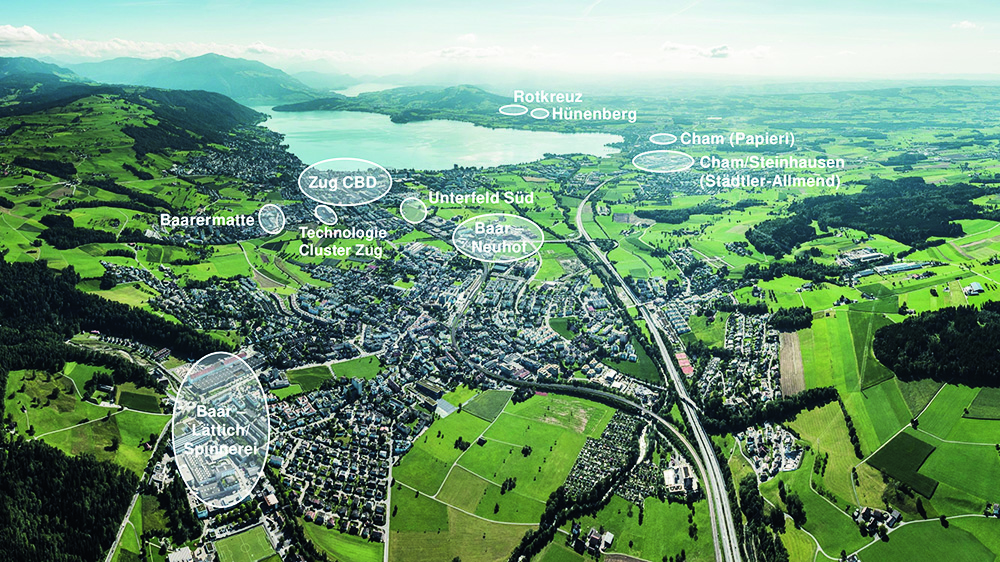
    Zug is one of the most popular economic and living areas. This is proven by numerous studies and rankings. The success is based on a long-term development strategy and attractive framework conditions. Zug offers a unique combination of excellent location factors such as the availability of skilled workers, stability, attractive taxation, central location, quality of life, level of education and economic friendliness.

    The Zug business center is dynamic, as evidenced by developments on the real estate market and in the transport infrastructure. The strong presence of value-added industries and service providers as well as a high concentration of high-growth sectors are important for the quality of economic development. The broadly diversified industry structure and the unique mix of small, large, local and international companies are an important driver for the innovative development of the canton. The focus of economic management by the Department of Economics is on the existing and established companies. Their growth makes the greatest contribution to the canton's economic development.

    Testimonials

    Silvia Thalmann-Gut, member of the government, economics director and governor of the canton of Zug

    The canton of Zug offers excellent location conditions for everyone. This includes the "Spirit of Zug" that is lived. The distances are short, the authorities work quickly and efficiently. Zug's success is based on a long-term strategy.

    Heini Schmid, lawyer, former Cantonal Councilor and long-time President of Zug Tourism

    Zug is in Switzerland what Switzerland is in Europe: small, surrounded by large neighbors and therefore open and adaptable. For us, changes are always an opportunity to do things differently and better. Zug is Switzerland to the power of two; it is the total package that counts.

    Matthias Rebellius, CEO Siemens Smart Infrastructure, Chairman of the Board of Directors Siemens Schweiz AG

    From Zug, we are driving digitalization at Siemens Smart Infrastructure. For us, Zug is an ideal location for our global headquarters, as we can attract and promote the best local and international talent here.

    Johanna Friedl-Naderer, President Europe, Canada & Partner Markets, Biogen

    Zug is the hub of our international headquarters. From here we coordinate our operational and administrative activities worldwide. The central location and high quality of life make Zug an attractive location for top talent.

    Contact point for the economy of the Canton of Zug
    Welcome to the canton of Zug. Our services are aimed directly at you as an entrepreneur. We are your partner and promote Zug as a business location.

    Business contact point, Aabachstrasse 5, 6300 Zug, T +41 41 728 55 04, economy@zg.ch

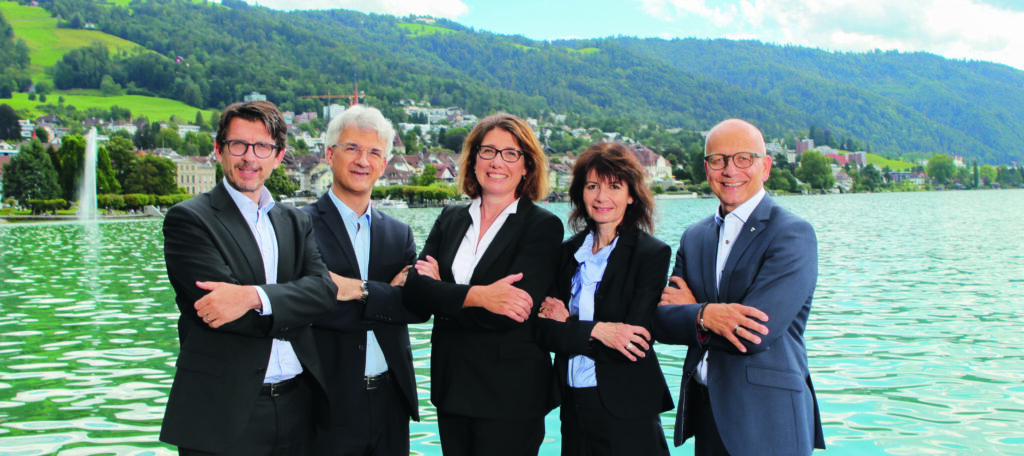
    Alberto Diaz, Deputy Ladder; Peter Müllhaupt, jur. Employee; Yvonne Valentino, assistant / back office manager; Ursula Kottmann Müller, Marketing / Communication; Beat Bachmann, Head (from left to right). Photographer: Peter Hofstetter
  • Plazza defies the pandemic

    Plazza defies the pandemic

    Plazza AG achieved a very positive result in 2020 and exceeded its own expectations, writes the Zurich real estate company in a press release . Specifically, the company, which has been listed on the SIX since 2015, was able to increase its property income from CHF 24.3 million in the previous year to CHF 24.6 million in the year under review. At the same time, the operating result before depreciation and revaluation increased from 18.9 million to 20.0 million francs.

    The profit was 63.3 million francs, compared to 36.7 million francs in the previous year. The increase is primarily due to success in revaluations, explains Plazza in the press release. Without taking them into account, the profit remained unchanged from 2019 at 17.0 million francs.

    Plazza cites the high proportion of residential properties in its own portfolio as the background for the good developments. It was unchanged at 73 percent in the year under review and will continue to rise this year through the purchase of 80 apartments in the Tiergarten estate in Zurich's Friesenberg district, the statement said. According to her, none of the apartments managed by Plazza had been vacant by the end of 2020. Overall, the real estate company was able to reduce its vacancy rate year-on-year from 4.0 to 3.7 percent. The company writes that it mainly affects free commercial space.

    For the current year, Plazza is aiming for an operating result before depreciation and revaluation "at least in the order of 2020". Subject to the building permit expected in the first half of the year, the first stage of the development project in Crissier VD is to be tackled. The construction of a nursing home for a foundation and a primary school for the community of Crissier were agreed in the reporting year.

  • Commercial real estate is likely to become cheaper

    Commercial real estate is likely to become cheaper

    KPMG 's Swiss Real Estate Sentiment Index is an indicator of expected developments in the real estate investment market. Last year the index reached an all-time high. This year it has fallen to its lowest level since measurements began in 2012. According to a statement from the consulting company, it is -13.1 points.

    Market participants' assessment of economic development contributes 20 percent to the overall index. The corresponding value fell by 60.9 points to -73.8 points. The second component is the expectation of price developments. After 43.5 points in the previous year, the value here is just above the stability axis at 2.1 points.

    In the case of residential real estate, price expectations remain positive and are close to the 2015 high. Contrary to expectations, actors in the real estate investment market are also not assuming falling prices for real estate in peripheral locations.   However, the prices of commercial real estate are likely to fall. A total of 76 percent of those surveyed assume that the demand for office space in the extended business belt will decrease as a result of the Corona crisis. Sales areas are also likely to be used far less in the future. The respondents see less need for shopping centers in particular. However, experts see more demand for real estate in the healthcare sector and for logistics space.

    The results show that the Corona year has clouded the mood on the real estate investment market. "Because of the expected effects on future demand, the market participants also see opportunities that new user segments will move into the investment focus," Beat Seger, partner and real estate expert at KPMG, is quoted as saying. In addition, residential real estate would contribute to the stability of the asset class.

  • Regional 2025 – projects for diversity

    Regional 2025 – projects for diversity

    The Limmattal – a diverse, coherent mosaic
    Despite urban thrusts, the development and the initial situation are not the same everywhere. For example, Spreitenbach and Neuenhof are changing from the formative 1970s modernism to more urban locations, but the dynamic cannot be compared to Schlieren, for example, until now. Wettingen is also discussing densification, and the concept of the garden city, which has been so formative up to now, is being questioned.

    It looks completely different on the right bank of the Limmat. The communities with their large single-family house areas look in amazement at the other side of the valley and watch the development from a distance. They are still villages and want to stay that way. This heterogeneity of the Limmat Valley, which can be interpreted as a difficulty, is above all its strength. In addition, with the formative landscape there is a kit that holds these pieces of the puzzle together. Above all the Limmat as namesake and identity bearer, as a unifying force of nature that meanders through the valley. But “spaces in between”, such as the Sulperg-Rüsler or Hüttikerberg-Sandbühl landscape corridors, are becoming increasingly important and are developing into a park landscape.

    "City" is only of limited use as a guiding term for this diverse fabric and does not do justice to the differences in places and the role of the landscape as a framework for the whole. Experts therefore speak more of “urban landscapes” in order to do justice to this phenomenon. That is why the edge of the block, the square and the boulevard, as tried and tested city elements, are not always the cure-all. In doing so, it is often not considered that this does not correspond to the complex social, economic and spatial structures of the Limmat Valley. The implementation of this idea can be seen, for example, in the Limmatfeld, where the new structures have so far represented an island in the context of the surroundings and have not yet been able to form the desired lively center beyond the railway.

    These new city modules are definitely a good contribution to the discussion about the future of the Limmat Valley, but they ignore many of the realities of the existing Limmat Valley and the sensitivities of the population. The starting point in the Limmat Valley is too complex to take just one approach. Industrial wastelands such as the Rietbach area in Schlieren or the Limmatfeld for consistent new urban building blocks are practically no longer available. Everything that is now added in the course of the consolidation must deal with the existing. The further construction of the Shoppi Tivoli in Spreitenbach requires different strategies than the densification of Wettingen or Neuenhof. And the strategies for the further development of the villages to the right of the Limmat require completely different recipes.

    Overcoming boundaries – spatially and thematically
    The whole thing becomes interesting in the combination of different strategies for the long-term further development of the Limmat Valley. In the longitudinal direction, the Limmattalbahn establishes the linear connection with high-density nodes along the stops. It is also exciting when the cross-connections are considered. So far, hardly trained, they have the potential to form completely new gravity lines: both in built-up space and in the landscape. The axes such as Schlieren-Unterengstringen or Dietikon-Fahrweid-Geroldswil, like the landscape corridors, offer an opportunity to connect the differences spatially and socially and to enable a new interaction across the longitudinal barriers.

    This is also of great importance within the towns and cities themselves. Examples of this are various plans and concepts that must be pursued further: Schlieren would like to link the rapidly emerging new districts on both sides of the railway with the existing districts and the village center. In Dietikon there is the idea of a connection between Silbern and Niederfeld. Spreitenbach would like to extend the central axis as far as the Limmat, and Neuenhof is developing transversely to the main axis into “Neuenhof am See”. This requires new connections and bridges over the railway, the Limmat or over roads. These are not only spatial connections, but also bring long-term residents and newcomers closer to one another.

    Growth and change therefore not only affect the areas of construction and mobility, but all areas of life of the population: The everyday life lived across borders is already reflected today in work, living and leisure behavior as well as in mobility and consumer behavior. What began with a visit to the Shoppi Tivoli in Spreitenbach in the 1970s will intensify with the construction of the Limmattalbahn and result in further investments. The cantons of Zurich and Aargau have therefore decided, together with 16 cities and municipalities in the Limmat Valley, to actively shape the development across borders using a new format. To this end, they founded an association in 2015, the “Regional Project Show Limmattal”.

    To cope with the challenges and also to alleviate the “growing pains” in the Limmattal, the Regionale 2025 is pursuing a thematically broad approach which, in addition to the classic spatial planning issues, also includes the areas of culture and society. ■

  • ABB supplies chargers to Chinese electric car factory

    ABB supplies chargers to Chinese electric car factory

    ABB chargers ensure the charging capacity for up to 120,000 vehicles in an e-car factory owned by the Chinese Dongfeng Motor Group and the Japanese Honda Motor Company . Dongfeng Honda will use it to equip the assembly and test lines in its more than 980,000 square meter plant in Wuhan.

    As the company writes in a press release , Dongfeng Honda has selected a range of different chargers “based on its previous positive experience with low and medium voltage products from ABB”.

    As part of its industrial development plan for energy-efficient and new-energy vehicles by 2035, China expects that one in four new vehicles sold in the country will be an electric car by 2025. More than 64 million are expected to be on Chinese roads by 2030.

    "The development of charging capacity must go hand in hand with the booming sales figures for electric cars," said Frank Mühlon, Head of E-Mobility Infrastructure Solutions at ABB. "We are excited to support Dongfeng Honda in implementing their electric vehicle strategy."