Tag: immobilien

  • When glacier sticks carry over a ton…

    When glacier sticks carry over a ton…

    A box of ice cream sticks, a tube of glue and creativity and intuition: that’s all it took to take part in Switzerland’s national bridge-building competition. The interest of the vocational schools from the three language regions was correspondingly great. The 64 participating trainees in the professions of draughtsmen and draughtswomen in the fields of civil engineering, geomatics, architecture, landscape architecture or spatial planning as well as carpenters constructed their bridge models in
    their free time and invested up to 100 hours in it. The competition is also increasingly popular with the FH students, who participated with eight teams and 21 participants. The bridge-building competition is organised by the VSS together with the engineering firm AJS.

    The presentation of the bridge models in the congress centre in Biel showed the whole range of creativity of the students: From elegant and light to massive and heavy, inspired by classical forms or simply springing from free imagination, meticulously worked out to the last detail or rather improvised. Jean-Marc Jeanneret, President of the organising Association of Swiss Road and Transport Professionals (VSS), was also pleased with the huge
    variety of the models presented. For him, this competition, which has been established in many countries for years, has another effect that should not be underestimated, especially in the digital age: “When you assemble the construction ‘by hand’, you understand it in the truest sense of the word. Weak points become more concretely apparent than with static calculations or 3D models on the computer. In this way, learners gain a lot of knowledge in a playful way, which they otherwise often have to painstakingly acquire
    . That’s why this competition is also a good introduction to professional life.”

    The highlight of the event was the resilience test, with which the most effective bridge was chosen. First crackling, then crashing and with much applause from the audience, the bridge models break on the test bench. The effectiveness of the bridge is rated according to the load-bearing capacity achieved in relation to its own weight. This evaluation formula rewards those who arrive at the most efficient solution with a minimum of material consumption – entirely in the spirit of a resource-efficient
    economy.

    As in the previous year, the team from the ZHAW Winterthur solved this task best among the students. Their bridge carried a load of an incredible 1060 kg! The three students Pascal Lämmler, Fabio Schäfer and Naatan Lohrer not only won a cheque for 1000 Swiss francs, they also won the “maximum load” category and set a new record. A team also dominated in the apprentice category: the Wetzikon Vocational School with Valentin Voll, Pascal Roffler and Denis Bilgin won both the “most effective bridge” and the “maximum load” category (773 kg).

  • Halter develops residential project in Bischofszell

    Halter develops residential project in Bischofszell

    After the transfer of ownership of the Schützengütli site in Bischofszell to Halter AG, a site development for the construction of 50 condominiums will begin there, according to a media release. In February 2022, Halter acquired the site with two areas of around 6500 and 1000 square metres. On 10 February 2023, the revised building and zoning plan of the town of Bischofszell came into force, allowing residential use with a design plan obligation on the site.

    For the planned owner-occupied flats, the existing building stock must give way, except for individual elements, according to the statement. Halter has commissioned a two-stage study for a high-quality site development in order to offer future residents a high quality of life and living. The new buildings should also blend in harmoniously with the surrounding neighbourhood.

    “With this site development in an intact neighbourhood, we will create attractive living space in a very well connected location right next to the railway station,” Rolf Zäch, project manager at Halter Entwicklungen, is quoted as saying. “The centre of our city continues to develop positively. The city council is pleased about this,” says Thomas Weingart, mayor of Bischofszell. With Halter AG, a renowned company is active in Bischofszell that brings great experience in urban development.

    The property had served the Schiffli embroidery factory from 1907 and later the glass rectifier construction. In 1946, it became the property of the malt factory and fruit pressing plant Laumann & Co. Until a few years ago, essences and syrups were still produced there, according to the notice.

  • Wallisellen switches to LED

    Wallisellen switches to LED

    Wallisellen is increasingly relying on LED luminaires for lighting in public spaces. As it says in a media release, the utility company die Werke operates the lighting of public streets and squares with energy-saving LED lamps on behalf of the city of Wallisellen. Already today, 65 percent of the city in the canton of Zurich is equipped with intelligent LED lamps. These can be switched on or off as required and can also be dimmed.

    “With LEDs, electricity can be saved and light pollution reduced,” says Philipp Maurer, Head of Civil Engineering + Landscape at the City of Wallisellen, explaining the conversion. The measures taken are part of the project “More Night for Wallisellen”, according to the press release.

    Compared to their predecessors, the sodium vapour lamps, the new LED lights only need about half the electrical energy. This large saving is also achieved by the fact that the LED luminaires are equipped with sensors. When vehicles or pedestrians approach, the light is raised via motion sensors. At times of low activity, it is reduced by 50 percent.

    By mid-2023, all street lighting should be equipped with the new system. The city buys the electricity required for operation from local solar power producers.

  • EVZ gets lead management for Bossard Arena expansion

    EVZ gets lead management for Bossard Arena expansion

    The city of Zug, the Kunsteisbahn Zug AG (KEB) and the EV Zug have agreed to implement the expansion of the Bossard Arena in a tenant model. “The city council recognises the necessity of further developing the Bossard Arena,” Urs Raschle, head of the finance department, is quoted as saying in a corresponding statement by the Zug city administration. “With the present Memorandum of Understanding, we have now created the necessary conditions together with the EVZ and KEB.”

    The memorandum of understanding stipulates that the Bossard Arena will remain the property of the city of Zug even after the expansion. KEB will become a tenant of the city and will operate the Bossard Arena on its behalf. KEB’s subtenant EVZ, as the main user of the arena, will realise and finance its expansion. A feasibility study estimates the necessary investments at around 36 million Swiss francs.

    The Keep Building project provides for the expansion of the arena capacity from 7,200 to 9,000 seats and the extension of the catering facilities. Among other things, the northern roof of the stadium is to be steepened and led over an extension module that will be built underneath. It is assumed that planning permission will be granted in 2024, with construction work to be completed in 2027.

    This year, the Zug Ice Sports Club is one of the finalists for the Prix SVC Central Switzerland, which will be awarded on 2 May. With this, the entrepreneurial network Swiss Venture Club honours companies for their innovative products and services, for their corporate culture and for their sustainable track record.

  • The shell of the QUBO think tank is complete

    The shell of the QUBO think tank is complete

    The shell of the two interconnected buildings of QUBO in Sarnen North is complete. Sixteen months have passed since the groundbreaking ceremony. According to a media release from Obwaldner Kantonalbank(OKB), this think tank will offer established companies, innovative start-ups and co-workers space for meetings and interactive inspiration.

    OKB is constructing a new building there that will provide a new home for innovative companies in Obwalden. The bank will make most of the premises in the new building available to the Startup Pilatus association for the promotion of start-ups as early as October 2023. OKB itself will set up an Innovation Lab there for itself and others. Eberli AG is modernising and expanding its existing headquarters there. Its two conversion and expansion partners, werkunion ag and Orfida Treuhand + Revisions AG, will each occupy one floor as future co-owners of the building.

    The QUBO will have the QULT bistro on the ground floor and the QLUB room for events with up to 100 people. The OKB describes the official opening, planned for March 2024, as an “important milestone for Sarnen as a business location and for entrepreneurs in the region”.

  • Building in Andermatt meets Minergie-P standard

    Building in Andermatt meets Minergie-P standard

    The Andermatt Reuss part of the village, realised by Andermatt Swiss Alps AG, can boast a new attraction, writes the building directorate of the Canton of Uri in a statement. With the Frame flat house, the village district has the first building with Minergie-P certification in the Ursertal valley. For the top category of the Minergie standard, high requirements must be met for the building envelope, energy balance and overall energy efficiency.

    “Only a few buildings have received this award in Uri so far,” building director Roger Nager is quoted as saying in the press release. In Frame’s case, the alpine location of the apartment building is an additional factor. “It is a great achievement that this low-energy house could be built at around 1500 metres,” says Nager.

    The building owner, Andermatt Swiss Alps AG, is having all the new apartment buildings and hotels in the Andermatt Reuss part of the village built to the Minergie standard. In the case of the Frame apartment building, the developer decided to implement the Minergie-P standard thanks to support and advice from the Uri Energy Promotion Programme, writes the building directorate. It expects that two more buildings in Andermatt Reus will soon receive Minergie-P certification.

    The Frame apartment building at Ritomgasse 7 in Andermatt Reuss was built by the total contractor S+B Baumanagement AG. Its 34 flats have already been handed over to their new owners in 2021.

  • WOHGA again offers inspiration for the home

    WOHGA again offers inspiration for the home

    After a three-year break, the WOHGA public fair will present trends and expertise for the home at the Eulachhallen Winterthur from 9 to 12 March 2023. Over the four days of the fair, a total of 150 exhibitors will offer visitors the opportunity to get to know a mix of productions for interiors and exteriors as well as core products on home, construction and renovation topics.

    Interested visitors will learn in direct dialogue with industry experts how interiors and exteriors can be designed to be atmospheric, practical and safe. The spring fair will be complemented by culinary offerings and live music in the evenings.

    Special areas will focus on walk-in garden worlds, safety and everything to do with barbecues. The Entrepreneur’s Piazza will once again be part of the fair world, as will grill master Grill-Ueli, who will advise and feed the guests.

    On 12 March, a garden house built by apprentices will be auctioned off. A crafts market with homemade products and a whisky show by the Winterthurer Whisky Mäss will have their premiere. Tickets are available online.

  • AEW installs district heating at Mutschellen

    AEW installs district heating at Mutschellen

    The Aargau energy supplier AEW Energie has plans to build a heating centre for the Mutschellen area on the Sika factory site in Widen, according to a media release. Private and municipal consumers in the heating network around the Mutschellen Pass are to be supplied with sustainable energy via a district heating network. The communities of Widen, Berikon AG and Rudolfstetten-Friedlisberg AG are connected.

    The local heating concept envisages predominantly regionally grown wood to generate the heat. The installation of modern, low-emission plant technology is intended to prevent the formation of a steam plume.

    Letters of intent have been signed with Sika Schweiz AG, the Turidomus investment foundation and other owners. The interest of the population in a district heating solution is being ascertained by means of a survey.

  • Prices drive revenue growth at dormakaba

    Prices drive revenue growth at dormakaba

    According to a statement from dormakaba, the globally active locking technology group from Glattal generated sales totalling CHF 1.42 billion in the first half of the 2022/23 financial year, which ended on 31 December 2022. This corresponds to year-on-year growth of 5.2 percent. Organic growth is put at 8.0 per cent in the press release. It was mainly generated by price increases, explains dormakaba.

    The adjusted operating result at EBITDA level was 4.6 percent below the previous year’s value at 184.6 million Swiss francs, and the corresponding margin fell from 14.3 to 13.0 percent. Similar losses were recorded in net profit. At 84.9 million francs, it was 15.7 million francs lower than in the same semester last year. The company attributes the decline in profitability to higher operating costs, a change in product mix and low volume growth in sales.

    “Dormakaba has consistently continued on its path of successive improvement,” CEO Jim-Heng Lee is quoted as saying in the statement. “Although this is a good result, there is still much to be done.” Here, dormakaba is putting the focus on improving profitability. “In the second half of the 2022/23 financial year, we will focus on measures to reduce the cost base across the company, increase efficiency and improve our operational performance,” Lee explains.

  • Innovationspark Dübendorf – Strengthening the shareholder base of IPZ Property AG

    Innovationspark Dübendorf – Strengthening the shareholder base of IPZ Property AG

    The Zurich-based Angst+Pfister Group, a leading developer, manufacturer and global supplier of high-performance components and engineering solutions, has acquired a significant stake in IPZ Property AG. This company is responsible for the planning, development and realisation of the Zurich Innovation Park on the former military airfield in Dübendorf on behalf of the Zurich Innovation Park Foundation (IPZ Foundation).

    “With the new shareholder, we have succeeded in taking a next, strategically very significant step towards strengthening the generation project. For the first time, a well-known industrial partner from Switzerland is participating in the Zurich Innovation Park as an investor,” says Peter Bodmer, President of the IPZ Foundation. A decisive role was played by the fact that over the last two years, thanks to the extremely good cooperation between the Canton of Zurich, the federal government as landowner, the neighbouring communities, the IPZ Foundation, the real estate service provider HRS and other partners, it was possible to set the right legal and political course.

    Switzerland’s most exciting development project
    “For us, the Zurich Innovation Park is by far the most exciting development project in Switzerland,” says Christof Domeisen, CEO and Delegate of the Board of Directors of Angst+Pfister, explaining the group’s investment decision. “As a globally active company with a history going back over 100 years, we are convinced that the close integration of research and development in one place creates an ideal platform to be successful in the future. The Zurich Innovation Park on the site of the Dübendorf airfield fulfils precisely these conditions. This design space makes it possible to successfully transfer knowledge from research into solutions and products. The location is ideally suited for a unique innovative environment and is extremely attractive by international standards.”

    Owner and CEO Martin Kull is confident that HRS, which has been the main investor in the planning and construction of the development, will succeed in bringing other major investors on board over the next few years. “Our goal has always been to make the development of the Innovation Park economically viable within the framework of the very constructive public-private partnership with the Canton of Zurich. The developments of the last two years prove us right that we are on track with this.”

    Political process successfully completed
    Now that the commitment credit approved by a large majority in the Zurich Cantonal Parliament at the end of November 2022 has become legally binding with the expiry of the referendum deadline on 7 February 2023, the political process has been successfully completed. For Andrea Claudio Thöny, as head of IPZ Property AG responsible for the overall development on the site, this paves the way for the prompt implementation of the next phase. “Now that the Cantonal Council’s decision has become legally binding, the Zurich Cantonal Government together with IPZ Property AG can conclude the corresponding building lease contracts. The plan is that ETH Zurich and the University of Zurich will soon be able to take over the existing aircraft hangars. In addition, an architectural competition is currently underway for the new buildings of the first major development phase, in which both internationally renowned architectural firms and young up-and-coming talents from Switzerland are participating. And it is very pleasing that more and more companies are interested in settling on the IPZ. Since the political decisions have been made, things are now moving ahead quickly.”

    Settlement of numerous companies and institutions in the next few years
    Already involved in the project as partners are ETH Zurich and the University of Zurich as well as the Cantonal Bank of Zurich. They have set up research and development laboratories and a start-up hub in the former aircraft hangars and buildings on the periphery of the site, and are thus playing a decisive role in the take-off and rapid development of the Generation Project.

    For industry, the proximity to world-leading universities is a key element in the IPZ’s attractiveness. This dovetailing of university research and industrial development at a location with excellent national and international transport connections and which, thanks to its dimensions, also allows space-intensive tests on the ground and in the air, is rare in a global comparison. Dozens of other companies and institutions are also rented in the IPZ, but not yet housed on the site itself, as the appropriate usable space must first be created for their settlement.

  • BFH researchers develop sustainable binder for wood-based materials

    BFH researchers develop sustainable binder for wood-based materials

    The sustainability of wood-based materials such as plywood or wood fibreboard is largely determined by the binder used. Formaldehyde-based binders, as they are mainly used today, are responsible for the majority of CO2 emissions from wood-based materials. Moreover, their formaldehyde emissions are often considered problematic. Research into the development of mineral binders has therefore been going on for several years, including at BFH. Compared to a formaldehyde adhesive, these binders have almost 80 percent lower CO2 emissions. A new mineral binder for the production of wood-based materials is being developed by researchers at the BFH’s Institute of Materials and Wood Technology IWH in a recently launched Innosuisse project. In the project, the researchers are working together with the Swiss company Omya International AG, a leading global supplier of calcium carbonate minerals.

    Less than 20 per cent binder
    The development by BFH and Omya International AG is initially intended for the production of mineral-bonded plywood. The finished boards are to contain less than 20 per cent binder and have the mechanical properties of conventionally produced plywood for interior use. The binder should be able to be cured with heat, which will enable a fast manufacturing process and thus make the product competitive.

  • Patrick Berger takes over management of DBU Facility Services

    Patrick Berger takes over management of DBU Facility Services

    Patrick Berger has been the new Managing Director of DBU Facility Services AG in Schlieren since 1 January. The 30-year-old is not only the new head of the family business, but also a partner in DBU, according to a media release from the company specialising in facility management. Patrick Berger takes over the company management from his father Daniel Berger.

    He joined DBU in 2020 to assist with the introduction of the Abacus ERP software. Enterprise Resource Planning (ERP) covers the areas of personnel, resources, capital, operating resources, materials and information and communication technology. For more than two years, Patrick Berger has been working to further digitalisation within the DBU.

    “It is a huge privilege and not at all self-evident that I can take on such a great responsibility at my young age,” Patrick Berger, who has a Master’s degree in business administration, is quoted as saying. “Thanks to this succession solution, the responsibility for DBU remains in the hands of the owners,” Daniel Berger is quoted as saying.

    In addition to the new managing director, DBU has also brought other young executives into the team. in 2021, Joanna Schneider took over as Head of Administration and Human Resources. She joined DBU as a commercial apprentice and has worked her way up to become a member of the management team.

    Sandro De Nardo, Head of Finance and responsible for Information and Communication Technology (ICT), is a new, young face who joined the DBU in 2021. In spring 2022, Reto Langenegger, an experienced facility management employee, joined the company as operational head of Facility Services. With the strong management team, the new managing director wants to concentrate on overarching topics and strengthen the DBU’s position in the market.

  • 5. Global Real Estate Run- act locally, act globally

    5. Global Real Estate Run- act locally, act globally

    On 30 and 31 March 2023, the 5th Global Real Estate Run will take place, an event dedicated to promoting innovation, sustainability and energy efficiency in the real estate and construction industry. Participants can jog or walk a freely selectable distance of 6 km within a 48-hour time window. The organiser will plant a tree for every kilometre completed.

    The event format is ideal as a fun team event and is aimed at tenants, owners and real estate professionals who want to get moving for a more generation-friendly real estate and construction industry.

    “We believe that every individual has a contribution to make towards a more generationally friendly future. The Global Real Estate Run is an opportunity for the real estate and construction industry to come together and make a mark together,” says Mario Facchinetti, initiator of the event.

    The participation fee for individuals is free, for teams it is CHF 37 per person. In return, the team receives a tree planting certificate for each tree that is walked in the team. The event now has over 4000 participants from around 57 countries and is supported by various companies that are committed to a more sustainable real estate and construction industry.

    The event is an example of how tenants, owners and real estate professionals can play a part in reducing environmental impact and creating a more generation-friendly future.

    Interested parties can register now at www.globalrealestaterun.com and look forward to a sporty and fun activity.

  • Home prices resilient despite sharpest interest rate rise in 30 years

    Home prices resilient despite sharpest interest rate rise in 30 years

    Prices for residential property increased again in nominal terms in 2022 despite the strongest rise in interest rates for 30 years, although much less strongly than in the previous year. In the case of single-family houses, prices increased by an average of 4 percent last year, which was significantly below the previous year’s value of 9 percent. In the same period, prices of condominiums increased slightly by 5.7 per cent – again, less markedly than in 2021, which equalled an increase of 8.3 per cent. However, a closer look at the four regions of Switzerland with the most transactions (purchases and sales of single-family houses and condominiums) – Zurich, Northwestern Switzerland, Bern, Lake Geneva – reveals a differentiated picture: Adjusted for inflation, only half of the regions still show a price increase for either single-family houses or condominiums.

    The analysis by Homegate and ImmoScout24 together with the Swiss Real Estate Institute is based on the effective sales prices of the Swiss Real Estate Data Pool. This includes the owner-occupied properties financed by Credit Suisse, UBS and Zürcher Kantonalbank and covers around 40 percent of all transactions in Switzerland. In 2022, around 7,200 sales of owner-occupied homes were registered in the regions surveyed. As in the previous year, this represents a decline of around 10 percent compared to 2021, although in contrast to the previous year, this was largely reflected in the number of condominiums sold.

    Martin Waeber, Managing Director Real Estate, SMG Swiss Marketplace Group, sees the reasons for the slowdown in price increases primarily in the sharp increases in key interest rates and the resulting rise in mortgage rates, as well as a declining effect of home offices compared to 2021: “The dampening effect of rising interest rates on the development of home prices predicted at the beginning of 2022 has been confirmed, albeit to a lesser extent than might have been expected. However, home prices seem to have slowly reached their zenith. Apart from the fact that many people simply can no longer afford to buy their own home at current prices, the declining use of home offices has also led to a decline in the valuation of the work situation within one’s own four walls. Both factors dampened the price increase in the course of the past year. However, in view of the scarcity of land and the continuing influx into Switzerland, a real estate bubble is not to be expected in this country, Waeber continues. This is especially true since properties for sale are still very popular, especially in places like Geneva and Zurich.

    Single-family homes in the Lake Geneva region more than 70 percent more expensive than in the Bern region
    With strong price growth of 9.3 percent, prices for single-family homes in the Zurich region increased the most in 2022 – and this was even the only region with a higher price increase than in 2021 with an increase of 7.7 percent. The average single-family home cost CHF 1.53 million. As a result, the Zurich region increasingly caught up with the Lake Geneva region, which remained the most expensive: the gap to the average single-family home price in the Lake Geneva region narrowed by CHF 80,000, or 28 percent, compared to the previous year. In the Lake Geneva region, an average property cost CHF 1.74 million in 2022, 3 per cent more than in 2021. In the Bern and Northwestern Switzerland regions, average property prices for single-family homes also converged somewhat, with prices in the Bern region recording an increase almost twice as high (6.3 per cent to CHF 1.02 million) as in the Northwestern Switzerland region (3.6 per cent to CHF 1.14 million). Taking into account last year’s inflation, this results in only a minimal price increase of 0.8 per cent for northwestern Switzerland. Nevertheless, Bern remains the cheapest region to buy a single-family home.

    Condominiums in the Lake Geneva region almost as expensive as in the Zurich region
    In the case of condominiums, growth in the Zurich region for 2022 was restrained at 3.7 per cent, especially compared to that of single-family homes. Nevertheless, properties in this region remain the most expensive of all four regions analysed, averaging CHF 1.12 million. Due to a considerable price increase in the Lake Geneva region of 12 percent compared to 2021, the difference to the front-runner narrowed significantly (from CHF 120,000 to CHF 40,000). The Bern region continues to be by far the cheapest for potential buyers of condominiums. Average prices here rose by only 2.9 per cent to CHF 0.7 million last year. Taking inflation into account, this region can even be said to have stagnated. In addition to the Lake Geneva region, the second cheapest region – northwestern Switzerland – was also unimpressed by rising interest rates and the declining trend towards home offices: prices rose by 7.9 per cent in 2022, even more than in the previous year (5.6 per cent). At CHF 820,000, an average condominium now costs CHF 60,000 more than in 2021.

    With a view to the property prices per square metre of net living space, an additional effect is particularly evident for the Lake Geneva and Zurich regions. In the Zurich region, prices per square metre rose significantly faster than property prices in the same period. This indicates falling residential areas of the traded properties. In the Lake Geneva region, on the other hand, the opposite was true, i.e. property prices rose five percentage points more than prices per square metre. Thus, larger properties tended to be sold on the market in the Lake Geneva region for 2022 than in 2021.

    The cheapest houses are in Aarburg, the most expensive in Uetikon am See*
    Not surprisingly, of the five municipalities with the highest median prices for single-family houses, three came from the Zurich region. The most expensive are in Uetikon am See (CHF 4.0 million), followed by Kilchberg (CHF 3.68 million) and Meilen (CHF 3.41 million). These are followed by two municipalities in the Lake Geneva region, Vésenaz (CHF 3.06 million) and Nyon (CHF 2.98 million). Two findings are worth noting: firstly, all five of the most expensive municipalities for single-family homes were not listed last year; secondly, prices in this highest segment have risen significantly once again. In the case of the highest median prices for condominiums, all five municipalities even came from the Zurich region: led by Küsnacht (CHF 2.52 million), Zumikon, Herrliberg and Meilen (CHF 2.3 million each) and Erlenbach (CHF 2.16 million).

    On the other side of the scale, the cheapest residential properties in the four regions surveyed – for both single-family houses and condominiums – all come from the canton of Aargau. Depending on the municipality, condominiums are priced from CHF 400,000 (Klingnau), while single-family homes could be purchased last year from CHF 610,000 (Aarburg). This shows impressively: for the price of a condominium in Küsnacht in Zurich, there are six to buy in Klingnau, less than 35 kilometres away. And almost seven single-family homes – or a complete apartment building – can be bought in Aarburg for the price of one in Uetikon am See. These two places are also just 60 kilometres apart as the crow flies.

    Summing up the results of the latest Home Market Price Analysis, Peter Ilg, head of the Swiss Real Estate Institute, is amazed at how robust price growth is in the owner-occupied home market: “After nine years of negative interest rates, the turnaround in interest rates came abruptly last year with several key rate hikes totalling 1.75 percentage points. For the first time in more than 30 years, the SNB has raised the key interest rate so significantly within one year.” Falling home prices in Switzerland would therefore not have surprised Ilg at this turn of events – combined with a trend towards a decline in the use of the home office. “Nevertheless, I am amazed at how robust the price growth in the owner-occupied home market is: In three of the eight segments examined, price growth was even significantly higher than the previous year despite this headwind,” Ilg said, summarising the findings of the Home Market Price Analysis for 2022.

  • Credit Suisse lowers distribution for real estate funds

    Credit Suisse lowers distribution for real estate funds

    Credit Suisse Funds AG expects a reduction in the net asset value of its Credit Suisse Real Estate Fund International (CS REF International). The background to this is developments in the global target markets on which the real estate fund is based, Credit Suisse informs in a statement. Here, rising interest rates in the key markets of the US, UK and Germany have impacted valuations.

    In concrete terms, the fund’s net asset value will fall to between CHF 960 and CHF 970 as of the reporting date at the end of 2022. As at year-end 2021, a net asset value of 1070.72 was recorded. By year-end 2022, Credit Suisse Funds AG has accepted redemption requests amounting to 13.3 percent of the units issued.

    As a result of the expected reduction in the net asset value of 9.5 to 10.5 percent, the major Zurich bank is adjusting the distribution on CS REF International. For 2022, the distribution is to be 35 to 38 francs per unit. In the previous year, 40 francs per unit were distributed.

  • Lucerne City Council applies for loans and credits for ewl site

    Lucerne City Council applies for loans and credits for ewl site

    The city council is requesting a municipal loan of CHF 50 million for the conversion of the ewl site in Lucerne. In addition, it requires special loans of almost 83 million francs for the so-called Rotpol project, according to a press release from the city of Lucerne.

    The plans include 90 non-profit flats and 60 flats suitable for the elderly, as well as the construction of a new fire station for the professional and militia fire brigade, including a location for the civil defence organisation ZSOpilatus and a base for the rescue service of the Lucerne Cantonal Hospital. In addition, there will be a new building for the ewl building and new office space for several municipal departments. The listed Red House is to become a meeting place for the public.

    Since the planned mix of uses is tailored to public needs, ewl Areal AG ‘s business plan shows a total return of only 2.6 per cent. “The low return is basically justifiable due to the extensive uses for public purposes,” says the media release. However, the equity ratio is also at a low level. Therefore, the city council is requesting a municipal loan of CHF 50 million.

    For a capital increase of ewl Areal AG from CHF 6 million by CHF 39 million to CHF 45 million, the city council is also requesting a special loan of CHF 7.8 million. Furthermore, 25.5 million francs for the tenant fit-out for the municipal uses as well as their rental and ancillary costs amounting to 49.5 million francs over the next ten years.

    The City Council will decide on the special loans on 30 March. Due to the amount, a referendum is also to be held on 18 June.

  • Innovation Park Zurich wins Angst+Pfister as investor

    Innovation Park Zurich wins Angst+Pfister as investor

    The Innovation Park Zurich(IPZ) has gained Angst+Pfister as an investor. The globally active Zurich-based manufacturer of high-performance components and engineering solutions has acquired a significant stake in IPZ Property AG, which is responsible for realising the project, the Zurich Innovation Park Foundation informs in a statement. “For the first time, a well-known industrial partner from Switzerland is participating as an investor in the Innovation Park Zurich,” foundation president Peter Bodmer is quoted there.

    For Christof Domeisen, CEO and Delegate of the Board of Directors of Angst+Pfister, the Zurich Innovation Park is “by far the most exciting development project in Switzerland”. His company is convinced “that the close interlocking of research and development in one place creates an ideal platform to be successful in the future”. Domeisen sees precisely these conditions fulfilled at the Zurich Innovation Park on the grounds of the Dübendorf airfield.

    The implementation of the project has successfully completed its political process with the now legally binding approval of the commitment credit by the Zurich Cantonal Council. Next, the Swiss Federal Institute of Technology Zurich and the University of Zurich are to take over the existing aircraft hangars on the site. An architectural competition is already underway for the new buildings in the first phase of development. In addition, “more and more companies are interested in locating on the IPZ,” explains Andrea Claudio Thöny, head of IPZ Property AG. “Since the political decisions have been made, things are now moving ahead quickly.”

  • SJA-Holding secures the long-term direction of the most important industry award

    SJA-Holding secures the long-term direction of the most important industry award

    The most important annual event for outstanding achievements in the Swiss construction and real estate industry, the Real Estate Award, has been secured for the long term. The company of the same name is being taken over by the owner-managed SJA-Holding based in Rapperswil. The investment company focuses primarily on financing, development, project management and services in the real estate sector, as well as IT services and digitalisation projects.

    “We are very proud that we can secure the independence and long-term development of this most important industry event in Switzerland with our commitment,” says SJA owner Serge Aerne. “The Real Estate Award is something like the Oscar for top performance in the construction and real estate industry. This motivated us to answer the call of the founders, who were willing to sell, to take over the event. Over the past ten years, they have made the award what it is today. They deserve respect and thanks for that!”

    The founders, Miran Mislovic and André Spathelf, are also satisfied. “We are very happy that we have found the right partners in SJA-Holding and in Serge Aerne. The solution found guarantees that the Real Estate Award will continue to be independent, innovative and pioneering.”

    Mara Schlumpf will take over the management as of 1 April 2023. She is currently still working as a journalist and head of print/online at “Südostschweiz” in Chur. Previously, she was Head of Events at the Aargauer “Landanzeiger”.

    This year, co-founder Miran Mislovic is still responsible for the organisation of the 11th edition, which is already in full swing. It will take place in the usual setting on 21 June 2023 at the Mövenpick Hotel in Zurich-Regensdorf. Innovative ideas and concepts can now be submitted in one of the five categories. An independent jury of experts and a public vote will judge the applications. “We want to stick to this system because it guarantees the highest degree of independence,” says Serge Aerne. However, with a view to the future, it is planned to include further categories such as sustainability or innovative forms of financing in order to better reflect the dynamic development of the industry.

    Applications for 2023 can be submitted at www.realestateaward.ch

  • Cancellation “SVIT Digital Day

    Cancellation “SVIT Digital Day

    In 2022, the “SVIT Digital Day” was held in parallel to the aforementioned real estate trade fair at the Zurich Congress Centre. With the discontinuation of this platform, the association has decided to return to the original location “Kosmos Zurich” with the “SVIT Digital Day” in 2023. Unfortunately, the news reached us in December 2022 – and you have certainly also read it in the press – that the operation of “Kosmos Zürich” was discontinued with immediate effect and the balance sheet was deposited with the bankruptcy court because the debt burden and costs were too high. It was no longer possible to put the operation on a sound footing.

    The message also has drastic consequences for the “SVIT Digital Day”, because the acquisition of an adequate infrastructure at the same cost and in the same time frame is very difficult and challenging. The time factor in particular has contributed to SVIT Zurich suspending the trade fair day for 2023. In parallel, ideas have emerged in the “SVIT Digital Commission” to create a new networking platform for 2024 in a clean and orderly manner. The event is to be launched in the first half of 2024 and include various topics relating to business. We are convinced that we will be able to create another forward-looking and attractive platform. We would be happy to inform you about the planned intentions and contents if you are interested.

  • New white paper on ‘Climate-conscious building’

    New white paper on ‘Climate-conscious building’

    Climate change is causing summer temperatures to rise in Switzerland. This is particularly apparent in densely built cities with extensive sealed surfaces. Buildings and their surroundings must be designed to offer a comfortable quality of life in the climate of the future. ewz’s new white paper on ‘Climate-conscious building’ offers an overview of this topic. The publication serves as a knowledge base and inspiration for construction in the context of climate change and is free to download here.

    Focus on cities
    Green spaces with shady trees and cold air corridors intended to bring cooling are often either entirely absent or inadequate, meaning heat islands form in urban areas – where temperatures can be up to ten degrees higher at night than in surrounding areas. A catalogue of measures tailored to each specific location is needed to counteract this heat island effect. Important principles for eco-friendly urban planning and building include building position and sizing, green areas, facades and roofs, and shading.

    Copyright Roland Bernath

    Moderate window proportions
    It’s not just exterior spaces that need to be planned and built in a climate-conscious way, but also the buildings themselves. To keep interiors as cool as possible when external temperatures rise, parameters such as building orientation, window surface areas and the building’s retention capacity are critical, starting at the design stage. Solid ceilings and floors, for example, store heat due to their mass and the room temperature rises more slowly. Windows also need special attention. Large-scale glazing is beneficial in that it lets abundant natural daylight into the interior and keeps solar heat input high in winter. In summer, however, this heat is undesirable. It is therefore recommended to avoid floor-to-ceiling windows as far as possible, and to strike a balance between aesthetics and comfortable temperatures. A window proportion of up to 30 per cent in residential buildings and up to 40 per cent in office buildings is a benchmark.

    Ventilation and cooling
    During long periods of hot weather, even a well-planned building heats up. It is extremely effective to dissipate the accumulated heat at night. This can be achieved by cross-ventilation, for example. Even better is to design a building that develops a chimney effect. Ventilation flaps in the façade – adjacent to the windows, for example – allow cool outside air to enter the interior and then discharge through an opening in the roof by way of the stairwell. Solutions like this entail no or minimal additional costs and work more efficiently than air conditioning units.

    Unlike residential buildings, today’s office buildings are often equipped with cooling systems. This is due to the high internal loads produced by users and IT infrastructure, not to mention the high proportion of glass in the façades. There are office buildings whose requirements for cooling and heating energy are now already identical. By 2100, office buildings could require up to ten times more energy for cooling than for heating, depending on climatic developments. This would presumably increase operating costs significantly and make it more difficult to operate buildings economically.

    An array of local energy sources
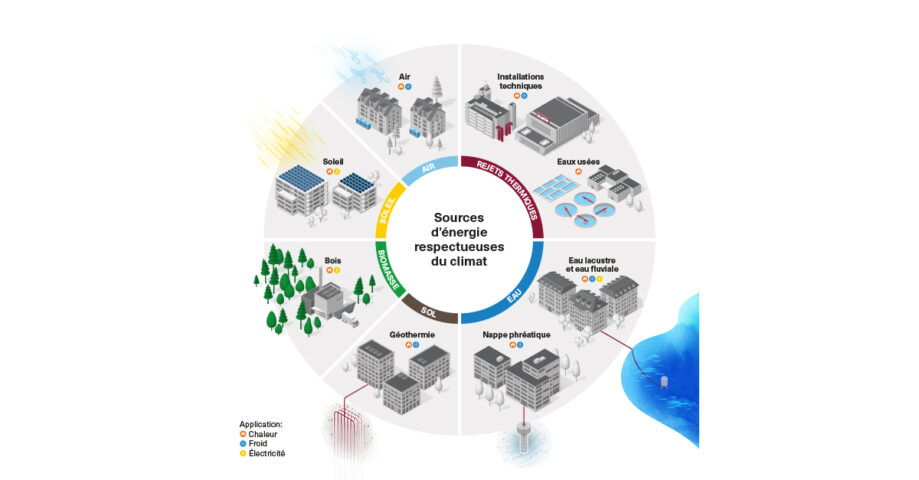
    Environmentally friendly passive cooling is ideal for meeting the basic cooling requirements of office and residential properties. Known as free cooling, there are various energy sources in Switzerland that are suitable for this.

    Geothermal heat accessed via probes is often used. In winter, thermal energy from the ground is used as a heat source, while in summer it serves also for cooling, because required temperatures are significantly below room temperatures. Lake water is another particularly suitable energy source, as the many Swiss lakes provide a valuable thermal storage mass. Because their shores are often densely populated, the lake water can be efficiently used to supply numerous buildings.

    Whether it comes from geothermal probes, lake water or other sources, it is crucial that cooling uses as little energy as possible. So it’s a good idea for building owners, investors and architectural specialists to discuss this issue with an energy service provider such as ewz as early as possible and see which options are feasible. This enables the construction of buildings that can offer high comfort levels even in the hot summers of the future, without placing an additional burden on the environment.

    Environmentally friendly heating remains important
    It is important to bear in mind that the cooling energy needed for residential buildings is relatively low compared to the heating required. Decarbonisation of heat supply must therefore remain a priority in order to achieve net zero. Sustainable heating is not a problem nowadays, with various technically mature and economically attractive renewable heating systems available.

    The ‘Climate-conscious building’ white paper provides in-depth information, detailed insights and a range of best-practice examples highlighting specific solutions for tackling this issue. The new white paper is free to download for all interested parties.

    https://www.ewz.ch/en/business-customers/real-estate.html

  • Milestone of transparency on greenhouse gas emissions of the real estate industry

    Milestone of transparency on greenhouse gas emissions of the real estate industry

    With a share of 23.9%, real estate is the third largest source of greenhouse gas emissions in Switzerland after transport and industry. There is therefore no way around sustainable real estate to achieve the net-zero climate targets. However, you can’t tell by looking at real estate whether it is environmentally friendly or not. Labels and ratings were therefore created early on to provide information about the sustainability of real estate.

    Comparability is central
    What initially contributed a lot to the promotion and better understanding of the sustainability of real estate has meanwhile become a problem itself. The variety of labels and initiatives in the sustainability field overwhelms many market participants. Moreover, the individual ratings can hardly be compared with each other. Some ratings include several dozen indicators, so that in the end it is no longer clear what they are trying to express at all. Moreover, many investment vehicles in the real estate sector are now labelled as sustainable and apply ESG criteria, but there is no clarity as to how sustainable the respective properties are.

    The trend is towards disclosure of environmental indicators
    However, investors are demanding increasingly precise information and want to be able to compare different investment products not only in terms of returns or risks, but also in terms of sustainability. The trend today is therefore towards direct disclosure of environmental indicators, such as energy consumption or greenhouse gas emissions. Last year, the AMAS and KGAST associations obliged or requested their members to publish the most important key figures in the annual reports of real estate funds and real estate investment foundations with a closing date from the end of 2023.

    Why do we need a standard?
    However, calculating these key figures is anything but simple. Different values can result for the same properties, depending on the calculation method. Standardisation is therefore necessary. REIDA has taken on this task and developed a standard for determining the most important environmentally relevant key figures in the real estate sector. According to this REIDA standard, a benchmarking was carried out in 2022 with 3984 existing properties or 36 property portfolios, which have a total of almost 23 million m2 of energy reference area.

    What was measured?
    Only consumption values measured in real terms were recorded and balanced. This is a big difference to other surveys, where in many cases no consumption data is available and which therefore mostly operate with calculated values (estimates based on benchmarks). For each of the real estate portfolios, the degree of coverage is also shown together with the results. This describes the proportion of properties in the portfolio for which measured energy consumption data are available. On average, the coverage rate for all 36 portfolios is 83.1%. The disclosure of the degree of coverage also serves transparency, but is still not widespread. An analysis of the annual reports of listed real estate funds by pom+Consulting in 2022, for example, showed that only 25% of them contained quantitative information on the degree of coverage.

    Benchmarking results and their classification
    The average energy consumption in the REIDA benchmarking portfolio is 97.4 kWh per m² of energy reference area. The range is between 59 and 146 kWh/m². Special situations are probably responsible for portfolios at the lower end of the values – e.g. that single tenants purchase a lot of energy themselves, which according to the current methodology is not yet taken into account in the energy indicator. In an online survey by the University of Lausanne, which analysed 66 portfolios of institutional investors with a good 31 million m² of building space, a somewhat higher value of 105.5 kWh/m² of energy reference area was reported for the reference year 2020 – but without using a uniform calculation methodology.

    The share of renewable energy in the REIDA CO2 benchmarking is 25.8% on average, with a range of 13% to 54%. On average, the greenhouse gas emissions of the portfolios that participated in the REIDA benchmarking amount to 13.1 kg CO2 equivalents per m² energy reference area. In addition to carbon dioxide, the benchmarking also takes into account all other greenhouse gases, such as methane or nitrous oxide, and calculates CO2 equivalents (CO2e) from them. The REIDA portfolio 2022 thus achieves a very good value – with a range between 4.1 and 22.4 kg CO2e/m². The sample surveyed by the University of Lausanne achieved an average value of 19.6 kg CO2e/m². Again, due to the lack of a uniform calculation method, a direct comparison is only possible with reservations.

    Specification of uncertainty ranges
    Another achievement of the REIDA benchmarking is the specification of uncertainty ranges. This is because the consumption and emission values used as well as the calculations are always subject to uncertainties (e.g. inaccurate measurement sensors, small conversion uncertainties from lettable area to energy reference area). These uncertainties are aggregated for each portfolio and shown at the level of the key figures in the form of an uncertainty range, which indicates how reliable the key figure is. The uncertainty range is given as twice the standard deviation, which means that the actual value lies within the specified uncertainty range with a probability of 95%. For the indicator of CO2e emission intensity, the individual portfolios show uncertainty ranges from 0.3 to 5.8 kg CO2e/m².

    New standard for ESG reporting in Switzerland
    With the CO2 benchmarking, REIDA sets a new standard and thereby achieves a milestone in the ESG reporting of real estate in Switzerland. The standard will not only be continuously improved in terms of methodology and data quality, but will also cover aspects of environmental sustainability that have so far been excluded. One of the most important tasks will be to cover not only the operating phase of real estate, but also its entire life cycle, and in particular to incorporate the issue of grey energy. The addition of ratings and certificates – which have limits in terms of transparency and comparability – as well as the transition to direct reporting of the actual key performance indicators are thus in full swing.

  • Milestone for the further development of CH energy policy

    Milestone for the further development of CH energy policy

    Particularly important decisions of the Commission meeting of 20-23.2.2023

    • A regulation for solar plants in the national interest: This will make it possible to build Alpine solar power plants even after the expiry of the urgent federal decree (“Solar Express”).
    • The obligation of operators of larger storage hydropower plants to participate in the energy reserve: Photovoltaics (PV) in combination with hydropower enables a secure power supply in winter, provided the reservoirs are not emptied prematurely for economic reasons.
    • The possibility of loans in case the resources of the grid surcharge fund are not sufficient for the intended promotion of renewable energy production: This can avoid a “stop-and-go”.
    • Data from smart metering systems are to be made available to end consumers in real time: This promotes the optimal coordination of electricity production (e.g. from PV systems) and consumption at the local level, which can reduce investments in electricity grids.
    • Storage facilities without end consumption are to be exempted from the grid fee for an unlimited period. And storage facilities with end consumption should also be able to benefit from a refund of the grid fee for the energy fed back into the grid from these storage facilities: This promotes the grid-serving use of stationary storage facilities as well as the bidirectional charging of electric vehicles.
    • The framework conditions for local electricity communities (LEG) have been significantly improved compared to the resolution of the Council of States: this is also a significant contribution to the intelligent use of the grids.
    • In rural areas, high costs for grid reinforcements often lead to PV projects being suspended. A cost pass-through is intended to provide relief here.
    • The parliamentary initiative by Swissolar President Jürg Grossen’s initiative to harmonise the taxation of the sale of solar electricity was unanimously approved. This is an essential contribution to clearing up the “patchwork” of framework conditions for solar plants.


    Detailed information at www.parlament.ch

  • Green light for digitally manufactured concrete staircase

    Green light for digitally manufactured concrete staircase

    It is one of the big challenges in the upcoming NEST unit “STEP2”: a concrete staircase whose shape is reminiscent of a human spine. Although the unit is still in the planning stage, parts of the stairs have already been produced as prototypes. Because the unit pursues a great goal: only what has a future in the construction industry will be built. Together, the partners work consistently towards market readiness – and this is also the case with the staircase.

    “Over the past two years, the project team has jointly developed a completely new concept for the production of customised concrete components. This was only possible because the experts along the entire value chain worked together at eye level,” says Enrico Marchesi, innovation manager at NEST and project manager of “STEP2”, with conviction. The interdisciplinary project team was put together together together with the scouting and incubation experts of the main partner BASF. It is made up of the architectural firm ROK, which is responsible for the project management, the ETH Chair of Digital Building Technologies, 3D printing experts from the BASF subsidiary BASF Forward AM and the 3D printing company New Digital Craft, experts from the precast concrete manufacturer SW Umwelttechnik, engineers from the engineering firm WaltGalmarini and the experts from the Empa spin-off “re-fer”.

    Customised solutions
    The “STEP2” staircase impressively demonstrates how concrete structures can be realised with the help of computer-aided design and the latest 3D printing technologies. By using 3D-printed formwork, it is possible to create more complex shapes than with previous special formwork. At the same time, the amount of material required can be significantly reduced.

    The process enables customised concrete solutions that can be optimally adapted to the respective application and have a high level of detail. In addition, it also holds great potential in restoration, for example in the renovation of historical buildings.

    High complexity
    The design of the staircase comes from the ETH Chair of Digital Building Technologies. Based on this, the project team developed a complex, parameter-based formwork system for the individual steps, which is produced using 3D printing. “It was important for us to use digital fabrication in such a way that we can produce extremely filigree concrete elements. A key criterion for the system was the reusability of the formwork for the production of multiple steps. At the same time, we had to take into account the requirements of 3D printing and the material, as well as the conditions when filling the formwork,” explains Benjamin Dillenburger, head of the “Digital Building Technologies” team. In order to meet all these requirements, the exchange within the entire project team was of central importance.

    “In order for the 3D-printed formwork to be used for several stages, we used a suitable coating. In terms of sustainability, we opted for a material that can be detached from the formwork again. This is the only way we can ensure that the material is separated by type,” says Jörg Petri from “New Digital Craft”. He and the “Virtual Engineering” team from “BASF Forward AM” brought their years of know-how in the 3D printing field to the project.

    “For BASF Forward AM, the project is an important milestone in demonstrating that the materials used can withstand the high demands. It pays into our strategy to realise formwork using 3D printing as an alternative to conventional mould making,” says Anke Johannes, Director Sales Europe at BASF Forward AM. For the formwork material, the team chose Ultrafuse® PET CF15 filament because of its excellent properties for concrete formwork applications. In the end, the concept for manufacturing and assembling the formwork elements was ready.

    The endurance test
    Now the time had come to turn the stairs into reality. SW Umwelttechnik produced the steps in its own factory with the help of the formwork. Ultra-high-strength fibre-reinforced concrete was used as the material. “Our concrete allows for very thin, complex shapes that could not be realised with normal reinforced concrete. It’s great that we can demonstrate this so impressively with the staircase in the “STEP2″ unit,” says a pleased Klaus Einfalt, CEO of SW Umwelttechnik.

    The WaltGalmarini engineering office is responsible for calculating and assessing the statics. To check whether the calculated values correspond to reality, the steps were sent to Empa. There they were subjected to various load tests by Empa experts under the supervision of the engineering office. The first prototype consisting of three stages, which were all tested individually, largely fulfilled expectations and at the same time provided new findings for optimising the system.

    In the subsequent prototype, not only the statics but also the construction of the staircase system was put to the test. Three steps were threaded on top of each other and clamped together using “memory-steel”, an innovative prestressing technique developed by Empa spin-off “re-fer”. In the process, bars of the type “re-bar R18” were placed in predefined cavities and mechanically anchored. The pre-stressing was done by heating with electricity. Afterwards, further tests were carried out to analyse how loadable the steps are individually and the system as a whole. The result: the engineers deemed the overall system reliable.

    “I am very pleased that the staircase could not only convince on paper, but now also in practice. This represents an extremely important milestone in the project for us,” says Michael Knauss from ROK. With this “proof of concept”, the production of the final staircase can now take place – another important step towards the realisation of the NEST unit “STEP2”.

  • “No facial recognition in the stations”

    “No facial recognition in the stations”

    Why does SBB want to know its customers’ routes in the station?
    SBB wants to offer its customers safe and clean stations and the best possible service. This is what SBB employees work for every day, with heart and soul. Knowing the flow of people better helps us to fulfil our mission of guiding customers safely and comfortably through the station.

    SBB already measures passenger movements in the station. Why does it want to know more and procure a new system?
    Today we measure the number of station users with sensors at the entrance and exit of the station. Now we are evaluating which systems are available that show us and our tenants how individual customer groups behave, i.e. where exactly people pass through, where they stop, where there are accumulations. This is also because the contract with the current provider is expiring. Of course, we are looking for a solution that is state of the art. And this technology has developed rapidly in recent years.

    How does this help to improve the service?
    We can use the findings to further improve the quality of service and the quality of stay: with safety precautions for critical densities of people, signage along the walkways that is appropriate for the situation, with the intensity of cleaning that is appropriate for the situation, with construction projects for the correct dimming of the facilities if necessary, or even with a service offer that is geared to the flow of people. For example, if we know that 100 customers walk from platform 5 to platform 2 and have 10 minutes to spare, then we can ideally place the regional coffee supplier with croissants there. If we know that there are a lot of prams on a certain route, we can install a lift in the right place. We recognise group formations immediately and the security service can intervene.

    Dowe need facial recognition for this additional information, as the media write?
    No, precisely not. Because we don’t want to identify the individual persons. That’s why we don’t need facial recognition (for more on facial recognition, see box). We want to know how the subgroups of our customers behave in the station, for example people with prams, passengers with skis or bicycles. To do this, we don’t need to know who the individual people are or what their names are. That is none of our business and is simply irrelevant.

    Themedia and experts are asking whether this does not violate fundamental rights.
    The discussion shows that this is a sensitive topic, and I understand the concerns. Of course, we strictly adhere to data protection regulations. As I said, it is not about identifying individuals. In the tender documents, we explicitly require that the providers must ensure that they comply with the Data Protection Act and describe how they do so. And that is why we have been in contact with the Federal Data Protection Commissioner (FDPIC) for a long time and will of course comply with all demands before the new system is introduced (for the FDPIC’s current opinion on the SBB’s plan, see box).

    And what about the storage of data?
    Here too, data protection must be guaranteed in any case. Since we don’t collect any personal data, we don’t store any personal data. The data is stored in a cloud. The cloud infrastructure used must be located in Switzerland or the EU, according to the tender. Which cloud infrastructure will be used will only become clear after the contract has been awarded.

    What do we expect in the end, additional revenue?
    SBB and all its employees have done a good job when passengers and all visitors feel safe and comfortable in the station and are satisfied with our services or, in the best case, even enthusiastic about them. If the services we offer at the stations meet the needs of the customers, then the turnover is also good.

    What you’re saying here sounds very different from what the media have reported so far. Why?
    That’s true and it worries me. We failed to explain what we really want after the K-Tipp article was published. The story has taken on a life of its own in the media, false statements are circulating. But we also have to be self-critical: The SIMAP tender was formulated in a very technical way and in some places was simply misleading. We must do better in future. The crucial thing for me is that data protection is simply a given for us as SBB, something we adhere to. Full stop.

    SBB does not use facial recognition
    Facial recognition refers to a technology that uses biometric data to precisely identify a face or a person. Biometric features are special characteristics of a person’s body that can be assigned unambiguously and with almost 100% certainty to a specific person. For the customer frequency measurement system that SBB wants to use, it does not use facial recognition. It is about recording statistical information, such as gender, age or height, but without allowing conclusions to be drawn about individual persons.

    This is what the Federal Data Protection and Information Commissioner (FDPIC) has to say about the tender for the new measurement system
    “The SBB informed the FDPIC about this project in October 2022. They assured the FDPIC that the data will not be used in a personal manner and that they will carry out a data protection impact assessment on the project. The FDPIC will continue to supervise the project.”

  • Centurion Tower: Tight as an officer

    Centurion Tower: Tight as an officer

    With its clear volume, the new high-rise integrates itself as a matter of course into the urban structure of the new “Vision Mitte” quarter. It takes up the lines of the surrounding buildings and forms, so to speak, the last piece of the puzzle in the large cluster of buildings of the university of applied sciences and office and industrial buildings on this site. The building was not named after the number of flats, of course, but after the famous Roman excavation site in Windisch (Vindonissa).

    The right type of wall for every use
    The 16 condominiums are located on the top four floors of the tower, the 116 rental flats on the 3rd to 10th floors. On the lowest three floors, the Centurion Towerhotel with 66 flats and rooms meets the needs of many regional businesses as well as the neighbouring technical college. These different uses are reflected not least in the materialisation and design within the building. The tower was raised as a skeleton structure and completely finished with non-load-bearing gypsum drywall systems.

    The (almost) all-rounder
    Hydrophobised Rigips® Habito board plays a central role in the kitchens and wet rooms of the condominiums. It is probably one of the most versatile gypsum boards available and is suitable for residential, office and commercial construction, but also for hotels, hospitals and schools. During development, the focus was on an optimal room climate and easy processing. The revolutionary product was uncompromisingly optimised for these properties and equipped with the best performance data and a wide range of applications. The board is very robust, fire-resistant, sound-insulating, ecologically sustainable and efficient to work with.

    A lot of planning and conversion freedom
    As soon as a brick wall is replaced with the Rigips® Habito system, the advantages multiply. There is no need to measure and install load-reinforcing wall inserts, because force loads such as furniture, pictures or TV screens can be screwed on directly without dowels. For the same reason, there is no need to determine the wall inserts at an early stage, which increases planning freedom. Habito is therefore as stable as a Roman legionnaire or as a conventional solid wall. With all these strengths in terms of building physics and con-
    struction, thanks to planning with gypsum drywall systems, there remains sufficient flexibility for later conversions if the utilisation requirements of individual rooms or even floors should change.

    Gypsum drywall construction has also long been able to keep up at this level.

    ABOUT RIGIPS
    Rigips is a pioneer of dry construction in Europe and part of the Saint-Gobain Group, one of the most traditional and innovative industrial groups in the world. In Switzerland, Rigips AG is the leading producer and supplier of gypsum drywall systems and a reliable supporter in the planning and execution of sophisticated interior design solutions. Plasterboard systems from Rigips AG are developed to successfully and sustainably realise the goals of customers and partners.

    www.rigips.ch


  • A new administration and security centre in hybrid design

    A new administration and security centre in hybrid design

    The Canton of Schwyz is planning to build its new administration and security centre on the Kaltbach site, which covers an area of about 40,000 square metres. This is located at the north-western end of the village between the roads to Sattel and Seewen.

    430 workplaces are planned. This means there is enough space for the cantonal administration, the operations centre of the Schwyz and Zug cantonal police, the main police station of the Schwyz cantonal police, fire brigade bases and rescue services. In addition, a production kitchen is planned from which all cantonal properties will be supplied in the future. The new building will make it possible to do away with expensive and unsuitable rental solutions and thus save costs of around CHF 1 million per year in the long term. In addition, external locations of the cantonal administration in the Schwyz valley can be bundled here, which will increase the efficiency of the individual work processes and realise a modern and high-quality working environment for the employees.

    In a single-stage open project competition, the structural engineering office of the canton of Schwyz looked for the best possible implementation for the new building, which will primarily serve as a replacement for the AHV building on Bahnhofstrasse in Schwyz, which has reached the end of its service life. The new administration and security centre should integrate well into the attractive landscape location and enter into dialogue with the existing buildings. The requirements were to meet the Minergie-A standard as well as optimal user-friendliness with fixed and flexible workplaces, the creation of meeting and retreat spaces as well as rooms for teamwork and concentrated work. Proposals in the sustainable timber construction method were expressly encouraged.

    The winning team was Sollberger Bögli Architekten AG from Biel and Klötzli Friedli Landschaftsarchitekten AG from Bern. Their project “Propeller” convinced the jury with a conceptually very clear and efficient organisation of the different units, an excellent urban integration. The building figure with four wings radiates into the landscape and comprises four outdoor areas: In the north-east is the entrance area for the administration and visitors, in the south-east the entrance area for the police, in the south-west the forecourt of the fire brigade and in the north-west that of the ambulance.

    The cross-shaped building is to be constructed using the hybrid construction method: A lightweight construction in wood is combined with steel, concrete as well as reinforced concrete composite structures. The ground floor and upper floor are designed as a skeleton structure in timber construction. The façade is to be greened and the roof equipped with a photovoltaic system. An atrium is planned for the interior of the building. Thanks to the large skylight, a five-storey atrium will be created.

    The compact building has good economic efficiency and is also convincing in terms of sustainability thanks to its differentiated construction. In the next step, the project will be revised with the planners in collaboration with the users and specialist planners. Subsequently, the cantonal council will be asked to approve the expenditure for realisation at the beginning of 2024. If everything goes according to plan, the new building could be ready for occupation at the end of 2027.

  • Confederation introduces new guide for location promotion

    Confederation introduces new guide for location promotion

    The Federal Department of Economic Affairs, Education and Research(EAER) has launched a new advisory platform for companies and other forms of organisation. According to a press release, the platform, which will be available from 16 February, is intended to support users in their search for business locations and funding. In doing so, the advisory tool currently being introduced expands the existing portals on the website of the State Secretariat for Economic Affairs(SECO).

    The multilingual location promotion guide that has now been announced brings together various promotion projects and is intended to be easily accessible via the internet for interested parties and applicants. The current range comprises 16 promotion instruments with around 50 different offers. The primary target groups are entrepreneurs, authorities at all federal levels and individuals. According to the EAER, the new guide should make Switzerland even more attractive and transparent as a business location. It can be accessed at promotion.guide.

  • EPFL develops concept for city-river balance on the Rhône

    EPFL develops concept for city-river balance on the Rhône

    The redevelopment of brownfield sites along the Rhône should balance the needs and constraints of a city and its river. Based on this guideline, a group of architects from the Laboratory for Architecture and Sustainable Technologies at the EPFL has developed a corresponding handbook for those with political responsibility.

    According to a press release, the group selected two locations in Switzerland, Sion VS and Geneva, and two in France, Givors and Avignon, for their study. For each district, they developed three customised and architecturally different visions. In total, the team identified more than 1400 neighbourhoods in transition along the Rhône. It sees enormous potential in this for the development of derelict areas that were abandoned by companies, for example, when they abandoned the waterways.

    The study did not look at urban areas as a whole, as is usually the case. “Our approach is different because we tackle urban development and planning issues on a smaller scale and focus on individual river neighbourhoods,” lab and study leader Emmanuel Rey is quoted as saying. “Our tool provides a more detailed, entirely local picture of what the river can do and how it interacts with the city,” Rey says. “In that sense, it’s an argument against traditional, generic planning.”

    This new assessment method with its 18 indicators was applied as an example to one of the case studies, the La Jonction neighbourhood in Geneva. For example, the indicator for the energy transition shows whether a particular vision is in line with the canton’s overall strategy. At the city level, it can be used to evaluate plans for shuttles, pedestrian bridges or other aspects of river transport. And at the neighbourhood level, for example, it provides information on whether river water could be used to heat or cool buildings.

  • Walo builds training rooms at Y-Parc

    Walo builds training rooms at Y-Parc

    Walo Bertschinger has built the training rooms for a new training centre for professions in the automotive industry in the technology park of Yverdon-les-Bains. The construction company from Dietikon has built premises for 1500 apprentices in the Y-Parc, according to a statement on Facebook. The training centre of the Swiss Automobile Trade Association(AGVS) will combine training rooms and workshops and will be spread over four floors. Operations are scheduled to begin in August.

    According to its own information, Y-Parc Swiss Technopole is the largest technology park in Switzerland with more than 200 companies on an area of 52 hectares. 1800 people are employed there. There is 130,000 square metres of space available for the companies.

    According to Walo , the new building has a rectangular shape with a recess in the middle and comprises two buildings on a plot of about 8000 square metres. There is an administrative area with a total area of 4000 square metres on five levels and a second, u-shaped industrial area. This will house the mechanical workshops and training rooms with an area of 6000 square metres on four floors. In the workshops, the ceiling height is raised to between 4 and 7 metres to allow for the installation of motorbike and car lifts. There is also an area for trucks.

    In the centre of the new training centre there is a landscaped terrace, above which there is a covered parking area of around 700 square metres.

  • Spherical spheres at Expo 2025 in the Swiss pavilion

    Spherical spheres at Expo 2025 in the Swiss pavilion

    From April 13 to October 13, 2025, the next World Expo will take place in Osaka, Japan. Under the motto “Designing Future Society for Our Lives”, Switzerland will present itself as an efficient and leading innovation hub and will show concrete examples from business, science and research. Nüssli, together with Manuel Herz Architekten and Bellprat Partner, won the tender for the design, construction and dismantling of the Swiss presence and is implementing the pavilion in lightweight construction and with a touch of magic. The team is completed by Robin Winogrond Landscape Architects, Studio AA-Morf, and Kyoto Design Lab.

    Swiss ideas, experience and know-how in Japan
    “We are very proud to continue our long tradition as implementation partner of the Swiss Pavilion at Expo 2025 in Osaka. Despite this long Expo experience, however, the Swiss Pavilion with its pneumatic, spherical construction will also provide us with some sticking points,” says Andy Böckli. Stefan Sekiguchi adds: “To successfully realize the architectural design together with Japanese service providers and according to the applicable guidelines in Japan requires getting to know the country and its people. That’s why we work with our local partner and can benefit from valuable knowledge.” Arnau Bellprat is looking forward to the challenges in the global environment. “In our Spheres, visitors should be able to immerse themselves in an immersive, narrative and fantastic world. They should have a sensory and emotional experience that they will remember for a long time – we call it a biographical note.” Architect Manuel Herz is particularly interested in pneumatic construction, which allows for a building of minimal weight and has a long tradition for pavilions at World’s Fairs. “We are taking an architecture that has been used before for iconic Expo buildings and reinterpreting it.”

    Pavilion embedded in nature
    The concept for the Swiss pavilion focuses on sustainability. Spheres and modular structures made of recycled recyclable materials, as well as plants that overgrow, enclose and sequesterCO2 from the building, make up the single-story barrier-free architecture and contribute to a minimal ecological footprint. The scenography takes up the light exterior appearance of the building and stages the contents in the exhibition with light and color. In the five spheres of the pavilion, visitors experience how Swiss innovation is created from the nutrients of nature as well as with Switzerland’s humanistic tradition and a little magic. They can help shape, explore and ultimately take Swiss innovation out into the world in the form of plant seeds. In the pavilion, they will also meet the mythical figure of Heidi, who acts as a link to the host country, Japan. The care and preservation of nature are also important common concerns that link Japan and Switzerland.

    Cooperation and local support
    The topic of sustainability is taken seriously in the Swiss Pavilion and carefully implemented with academic support. With researchers, lecturers and students from the Kyoto Institute of Technology – in particular with the KIT Design Lab of the Faculty of Architecture – the social, economic and ecological footprint of the appearance is to be analyzed and improved over its entire lifespan.