Tag: immobilien

  • AKB Green Mortgage finances climate buildings

    AKB Green Mortgage finances climate buildings

    The Aargauische Kantonalbank ( AKB ) is expanding its mortgage product to include all environmentally friendly properties. According to the press release , since May 2nd it has been financing not only owner-occupied residential properties but also all thermally regulated investment properties as well as business and commercial properties with the certified AKB Green Mortgage. From the perspective of the cantonal bank, this is particularly interesting for small and medium-sized enterprises (SMEs). “With the product expansion to business and commercial properties, we now also offer a sustainable, attractive financing solution for SMEs,” Patrick Küng, Head of Corporate Customers & Institutional Banking at AKB, is quoted as saying.

    With the AKB Green Mortgage, AKB promotes environmentally friendly construction activity and in this way supports the reduction of greenhouse gas emissions from buildings, according to the cantonal bank. With terms of two to ten years, the AKB Green mortgage offers a significant interest rate advantage over the standard interest rates of conventional fixed-rate mortgages. AKB is expected to launch another Green Bond to finance the AKB Green Mortgage over the course of the year.

    The report on the effect of the Green Bond states that in 2020 and 2021 a reduction of around 490 tons of CO2 was achieved with the sustainable mortgage offer for owner-occupied residential property. That corresponds to the annual CO2 emissions of around 393 new, commercially available passenger cars.

  • Eberli erhöht Lehrstellenplätze

    Eberli erhöht Lehrstellenplätze

    Eberli will sich stärker in der Ausbildung engagieren. Dazu will das Gesamtdienstleistungsunternehmen in der Bau- und Immobilienbranche der Zentralschweiz mit Sitz im Kanton Obwalden die Zahl seiner Lehrstellen erhöhen, informiert Eberli in einer entsprechenden Mitteilung. Konkret sollen in diesem und im nächsten Jahr jeweils ab Sommer zwei Auszubildende eine Lehre im kaufmännischen Bereich (KV EFZ Profil E) beginnen können.

    Interessierte können sich an Schnuppertagen einen Einblick in das Berufsbild und die Ausbildung bei Eberli beschaffen. Der nächste dieser Schnuppertage stehe am 4. Mai an, informiert Eberli.

    Hier erhalten die potenziellen Bewerber und Bewerberinnen eine Einführung in die Aufgaben eines KV-Lernenden und Antworten auf ihre entsprechenden Fragen. Gleichzeitig haben sie die Möglichkeit, sich vor Ort ein persönliches Bild zu machen und Lernende und Mitarbeitenden von Eberli kennenzulernen. Ein Formular für die Anmeldung zum Schnuppertag kann online ausgefüllt werden.

  • The LIMMIviva construction project ends with savings

    The LIMMIviva construction project ends with savings

    The Limmattal Hospital Association completes the LIMMIviva new construction project for the acute hospital. The construction was realized between 2014 and September 2018. This was followed by relocation and commissioning. The project can now be considered completed. According to the media release, less was spent on the costs than estimated. The approved commitment credit of 275.7 million francs, including two supplementary credits, was undershot by around 0.8 million francs.

    In a construction project lasting several years, adjustments to the original project are quite common, according to the hospital association. This also applied to the new building project for the Limmattal hospital. The high dynamics of the healthcare system meant that the project was continuously adapted to changing requirements in over 100 supplements. Such supplements usually lead to significant additional costs. During the construction of the Limmattal hospital, together with the Bern-based construction company Losinger Marazzi AG , which was commissioned as general contractor, additional costs that caused additional costs were compensated for by optimizations in other areas.

    With the hospital financing introduced in 2012 and an amendment to the municipal law, the Limmattal Hospital Association was able to finance the investments of around 270 million francs itself, without the help of the municipalities and thus without burdening the taxpayer. 220 million francs of outside capital was raised through the issue of two bonds.

  • Heating advice from EnergieSchweiz is now free of charge

    Heating advice from EnergieSchweiz is now free of charge

    The impulse advice on renewable heating has been free of charge for owners of residential properties since April 1, 2022, according to a press release . With this SwissEnergy program, the federal government is promoting the switch to a renewable heat generation system.

    The approximately one and a half hour on-site consultation can be used for any residential property whose heating system is more than ten years old and is used as the main heating system for room heating. The building category and the energy source of the old heat generator are irrelevant.

    Interested parties can use the postcode search to get a list of approved impulse counselors in their area and make an appointment. There are only two categories: a single-family house or a multi-family house with up to six residential units, as well as a multi-family house with more than six residential units or condominiums.

  • Consolidation in the Swiss label market

    Consolidation in the Swiss label market

    The handling of the Ecobau requirements, which sometimes formed the basis for the Minergie ECO label, has apparently not yet been finally clarified. As is well known, they have largely been included in the SNBS (Swiss Sustainable Building Standard), as they include topics that will become even more important in the future, namely the circular economy, gray energy, etc. – sustainable buildings are not just buildings that have been optimized in terms of operational energy .

    And yet, this consolidation creates clarity in the market and is also a clear commitment to the SNBS, as a key benchmark in the Swiss construction and real estate market and an important instrument for implementing the Energy Strategy 2050.

    Click here for the media release from the Swiss Federal Office of Energy

  • First SNBS certification level platinum for timber construction in St. Gallen

    First SNBS certification level platinum for timber construction in St. Gallen

    On April 21, Stefanie Steiner from the certification organization SNBS presented the certificate at a certification ceremony in the Tröckneturm St. Gallen and thanked the builder Previs Vorsorge for the good work and handling of the certification.

    The Waldacker development is made up of two long, kinked rows of buildings that hug the natural terrain lengthways. Together they form an interior space that serves as a meeting and communication space for the residents. From the upper edge of the basement, the buildings were almost entirely built using timber system construction with closed, rear-ventilated spruce wood formwork, including the lift shafts. The timber construction was inspired by the historic Tröckneturm, which is located directly next to the superstructure.

    The living room has external areas on both sides in the form of a veranda and an integrated winter garden. The apartments are accessed via a continuous arcade; Access is via external, covered stairwells. Photovoltaic systems were installed on the roofs and the heat supply is ensured by the district heating network of the city of St. Gallen. Between the two rows of buildings, a continuously green inner space with a playground and seating areas invites you to linger. The neighborhood should be kept car-free as much as possible. There is a large number of bicycle parking spaces and charging stations for e-bikes and e-cars. There are also Mobility vehicles that can be used by tenants.

  • Wincasa manages properties from real estate funds

    Wincasa manages properties from real estate funds

    As of July 1, Wincasa has the management mandate for more than 130 properties of Immofonds Asset Management AG . It was awarded as part of a tender. With this win, Wincasa is “further expanding its position as Switzerland’s leading real estate service provider,” according to a press release .

    According to the information, the value of the managed portfolio of real estate funds and real estate funds suburban increases to over 78 billion francs. Wincasa in Winterthur will manage two-thirds of these with a full mandate. The remaining third is looked after together with two other companies. The fact that this will happen in Wincasa’s own software environment means “efficient cooperation without media discontinuity” for all parties.

    “Wincasa won us over as part of the strategic realignment of the management mandate,” Gabriela Theus, Managing Director of Immofonds Asset Management AG, is quoted as saying. “In addition to security, an innovative spirit and a Swiss-wide branch network, Wincasa also has comprehensive know-how in many other areas beyond actual management,” for example with regard to sustainability. In addition, the selected mandate structure ensures “that the existing provider remains on board as the technical manager for a sub-portfolio”.

    As Andy Kürsteiner, Head of Business Development at Wincasa, emphasizes, the confidence shown by Immofonds encourages his company to “continue to pursue the path of customer-centric working methods”.

  • The world's tallest residential building made of wood is being built in Lokstadt

    The world's tallest residential building made of wood is being built in Lokstadt

    [smartslider3 slider=”7″]

    The study contract for the construction of the Rocket and Tigerli houses has been completed, as informed by Ina Invest in a press release . A jury made up of representatives from the city of Winterthur and architects selected the concept by the architecture offices of Cometti Truffer Hodel Architects from Lucerne and Schmidt Hammer Lassen Architects from Copenhagen from nine designs.

    The winning design shows an “outstanding architectural completion” of the former industrial site. As can be seen in the media release, the decision is based on a “non-anonymous study order in the form of a digital, one-step process with pre-qualification and interim discussion”. In addition to urban planning and architectural aspects, the focus was on sustainability and innovation. At the heart of Lokstadt, on Dialogplatz, the Rocket high-rise with a terracotta facade is to reach a height of 100 meters into the sky.

    Mixed use is planned for the entire residential area. In the Rocket high-rise, a diverse range of residential properties is to be created over 32 floors. According to the Lokstadt development team, the architectural concept is characterized by flexible planning.

    The base building Tigerli is intended for student apartments and non-profit housing. A Radisson Red Hotel is to be housed on part of the area, including the listed industrial halls.

  • Carmen Walker Späh speaks of a "moving moment"

    Carmen Walker Späh speaks of a "moving moment"

    Schlieren gets a new cluster. After the Bio-Technopark, the shopping and the start-up cluster, the new Healthtechpark was opened on Tuesday. The project is based on the work of the Health Tech Park Zurich-Schlieren association, which was founded last year and on whose board the city of Schlieren and the canton are also represented.

    The goal: Even more companies and start-ups from the health tech sector should move into the property of the city of Schlieren. It is hoped that if the companies work together from a central location, they can network better – and thus provide decisive impetus in the industry.

    The new park is located in the properties at Rütistrasse 12 to 18 at the Innovation and Young Entrepreneur Center (IJZ). 82 percent of the buildings belong to the city. According to location promoter Albert Schweizer, it is currently renting a quarter of its 17,000 square meters to health-tech companies. According to the canton, 12 companies have currently joined the Healthtechpark. The city of Schlieren has gradually renovated its property in recent years and made it suitable for laboratories.

    Zurich Economics Director Carmen Walker-Späh (FDP) officially inaugurated the park together with Schlierem City President Markus Bärtschiger (SP). For her, this is "a moving moment," said Walker Späh.

    The pandemic has shown society how important the healthtech sector is. For example by producing diagnostic devices or hygiene masks. Walker Späh is certain that further innovative diagnostic methods will be developed in the new park, for example for the treatment of cancer.

    Canton pays 200,000 francs over four years
    The Healthtechpark not only serves the well-being of the population, but is also important for Zurich as a business location. The canton is already the largest healthtech location in Switzerland. The sector is currently experiencing a boost. The industry is responsible for added value of CHF 5.3 million and 19,000 jobs throughout Switzerland. One in seven of these is in the canton of Zurich – and the trend is rising.

    In order for this trend to continue, the new park is needed. Because: “Innovation is increasingly being created in networks. » Finally, Walker Späh emphasized that important partners for the project had been found in the Zurich University Hospital and the Limmattal Hospital. On request, government councilor Walker Späh also said that the canton would support the Healthtechpark with an allocation of CHF 200,000 spread over the next four years. According to this, the park, which is currently financed by sponsors and patrons, should be self-supporting.

    The Mayor of Schlieren, Bärtschiger, explained why he didn't consider the Schlieren location to be coincidental. For example, because the Biotechnopark is already located here. The city therefore already knows what laboratories would require – and what permits are required for them. In addition, Schlieren is an important location for start-ups. And the healthcare system is represented on the one hand by the Spital Limmattal and the University Hospital Zurich, on the other hand by the Cantonal Pharmacy Zurich.

    Not only the place, but also the time was chosen correctly, as Bärtschiger emphasized. The healthcare system experienced a drive during the corona crisis. "Now people want to show what they can do." Bärtschiger therefore believes that this tailwind should be used.

    Location promoter Albert Schweizer receives a lot of praise
    The Schlierem location promoter Albert Schweizer was in the spotlight. He received praise from the speakers for initiating the project and working on it for eight years. Councilor Walker-Späh specifically mentioned Schweizer and Mayor Bärtschiger said about him: "He always finds pearls." The park's CEO, Stefan Leuthold, praised Schweizer's vision. And as a thank you for his work, he gave him a special box to remind him to drink enough every day. In line with the health promotion of the new park.

    But what good is this park for the Schlieremer population? Markus Bärtschiger replies: "One quickly forgets that Schlieren not only has 20,000 inhabitants, but also 19,000 jobs." And around 50 percent of the tax base comes from the companies based in Schlieren that are subsidized by such parks.

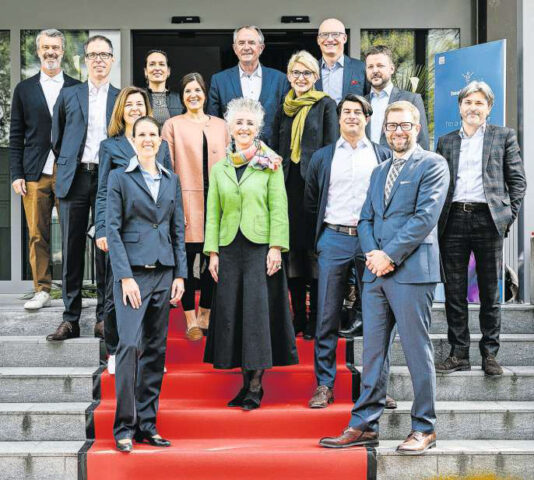
    Left: The board of the Healthtechpark association with the government councilor and mayor from left to right: Bruno Schefer, Stefan Leuthold, Danielle Spichiger (centre), Melanie Aregger (below), Karina Candrian (top, not on the board), Regina Grossmann, Carmen Walker Späh, Albert Schweizer, Gabriela Senti, Carlo Centonze, Matthias Herrmann, Michael Tschudin, Alain Rudiger, Markus Bärtschiger. Right: The Healthtechpark logo.
  • Schlieren becomes a start-up hotspot

    Schlieren becomes a start-up hotspot

    Das Licht ist orange, Luft strömt rauschend durch Schläuche, manchmal faucht es, als ob ein Ventil Überdruck ablasse. Was in diesem Labor des Start-ups Spectroplast hergestellt wird, gibt es auf der ganzen Welt sonst nirgendwo: 3-D-Druck mit zu 100 Prozent echtem Silikon.

    In einem Fach liegen künstliche Herzklappen, im anderen Stents für Luftröhren. Das Licht ist orange gedimmt, weil Silikon lichtempfindlich ist. Spectroplast ist eines von zwölf Unternehmen, die sich zu einem Hub für Medizinaltechnik zusammengeschlossen haben – zum Healthtechpark Zürich-Schlieren. Er ist gestern eröffnet worden.

    Die Chancen stehen gut, dass er schnell abhebt. Wie der Initiator Albert Schweizer am Rande der Veranstaltung sagte, sind in den vergangenen Monaten bereits rund 150 Arbeitsplätze in diesem Bereich entstanden. Er geht davon aus, dass es schon bald dreibis viermal mehr sein werden.

    Auch Regierungsrätin Carmen Walker Späh, die den neuen Hub aus der Taufe hob, ist optimistisch: «Das wird ein Booster für die Zürcher Volkswirtschaft.» Der Kanton Zürich ist bereits heute der grösste Healthtech- Standort in der Schweiz, doch ein eigentlicher Hub fehlte bisher. Walker Späh betont: «Innovationen entstehen immer seltener isoliert. Mit diesem Healthtechpark ermöglichen wir einen besseren Austausch.»

    Healthtech entwickelt Produkte und Geräte für Spitäler oder Ärzte, braucht also einen direkten Draht zu diesen, um deren Bedürfnisse zu kennen. Dies ist in Schlieren institutionalisiert, denn das Universitätsspital und das Spital Limmattal sind mit an Bord.

    Gabriela Senti, Direktorin Forschung und Lehre am USZ, ist vom Potenzial eines solchen Healthtechparks überzeugt. Sie erzählt von einer ungeheuren Dynamik im Bereich der Medizinaltechnik und im Diagnosebereich. «Die neuen Ideen vieler Jungunternehmen blasen uns fast weg.»

    «Wenn es um Laborräume geht, fallen in der Schweiz drei Namen: Basel, Lausanne und Schlieren.»

    Albert Schweizer, Initiator Healthpark

    Sie meint das durch und durch positiv. Allerdings mangle es manchen Jungunternehmen ein bisschen «am Gespür für die Anwendung». Umgekehrt könnten viele etablierte Unternehmen vom «Start-up- Groove» profitieren, ist sie überzeugt. Genau dieser Austausch werde nun erleichtert.

    Einige Stockwerke über Spectroplast ist vor kurzem das Startup Avelo eingezogen. Fünf Mitarbeitende, ein Projekt: ein Atemkollektor, um Erreger in der Atemluft nachzuweisen. Ein Prototyp ist schon gebaut. Damit könnte der allseits bekannte, unangenehme Nase-Rachen-Abstrich abgelöst werden.

    Kein Geld, aber viele Ideen
    Avelo-CEO ist Melanie Aregger. Sie ist zugleich Präsidentin des Healthtechparks, der als Verein organisiert ist. Aregger erzählt, wie sie zusammen mit ihrem Geschäftspartner Tobias Broger vor zwei Jahren beschlossen hat, alles auf eine Karte zu setzen. Sie kündigten ihre Stellen, plünderten ihr Bankkonto – und fanden kein bezahlbares Labor. Bis Aregger – eher zufällig – Albert Schweizer traf und ihm ihr Leid klagte. Schweizer wusste Rat, denn er trug schon länger die Idee mit sich herum, neben dem bestehenden Biotechpark einen weiteren Hub in einem verwandten Gebiet ins Leben zu rufen.

    Die beiden Cluster, Bio- und Healthtech, stehen an einem Ort, der Industriegeschichte geschrieben hat: auf dem Areal der Wagons- und Aufzügefabrik. Die «Wagi» trug einst den Namen Schlieren an Zügen und Lifts in alle Städte Europas, wurde aber 1985 geschlossen. Das Areal jedoch entwickelte bald eine Sogwirkung für Unternehmen, die in der Stadt Zürich keine bezahlbare Bleibe mehr fanden. Und allen voran für die ETH.

    Die ETH platzte in den 1990er- Jahren aus allen Nähten, doch verzögerte sich die dritte Etappe des Campus auf dem Hönggerberg aufgrund eines Rechtsstreits. So zogen verschiedene Institute nach Schlieren. Als diese dann nach und nach auf den Hönggerberg übersiedelten, überliess die Hochschule ihre Labors dem Kanton Zürich und der Stadt Schlieren, die beide aktiv anfingen, Spin-offs und Startups aus der Biotechbranche anzuwerben.

    Wichtig sei gewesen, dass auch ganz kleine Einheiten – 30-Quadratmeter-Labors – angeboten worden seien, sagt Albert Schweizer, der schon damals zusammen mit dem kantonalen Wirtschaftsförderer Stephan Kux treibende Kraft war. «Denn wer ein Start-up aufzieht, hat in der Regel gute Ideen, aber kein Geld.»

    So erging es auch den Gründern von Heiq, einem Spin-off der ETH. Auch sie suchten bezahlbare Laborräume und fanden sie in Schlieren. Heiq produziert Medizintextilien, also beispielsweise spezielle Masken für Spitäler, die natürlich in den letzten zwei Jahren reissenden Absatz fanden.

    Dazu kommt ein Reinigungsmittel, das Desinfektionsmittel mehr als ersetzt, weil es nicht nur Keime tötet, sondern eben mittels «guter Bakterien» verhindert, dass sich neue bilden. Eben hat sich dieses bei einem Versuch an der Charité in Berlin als äusserst wirksam bewährt.

    Erfolge ziehen Grossinvestoren an
    Heiq zeigt, wie ein Start-up abheben kann, wenn es zur richtigen Zeit am richtigen Ort die richtigen Ideen hat und diese sich umsetzen lassen. Unterdessen ist das Unternehmen in vierzehn Ländern aktiv und arbeitet weltweit mit über dreissig Universitäten zusammen. Die zwei Räume, die es einst in Schlieren mietete, haben sich mittlerweile zu zwei Stockwerken ausgeweitet.

    Die Anfänge von Heiq liegen schon einige Jahre zurück, die Nachfrage nach Laborräumen hat aber nicht mehr nachgelassen. Auch ist die Strahlkraft solcher Hubs auf etablierte Firmen beachtlich, wie der Erfolg des Biotechparks zeigt: 2018 und 2021 wurden in Schlieren zwei weitere Hochhäuser bezogen, in einem mietete sich Roche ein. Und 2016 zog die Kantonsapotheke in einen Neubau nach Schlieren. Albert Schweizer sagt: «Wenn es um Laborräume geht, fallen heute in der Schweiz drei Namen: Basel, Lausanne und Schlieren.»

    Solche Erfolge ziehen Grossinvestoren an. So sicherte sich mit Swiss Prime Site die grösste kotierte Schweizer Immobiliengesellschaft 2015 die Liegenschaft der ehemaligen NZZDruckerei mit rund 20’000 Kubikmeter Nutzfläche. Zusätzlich realisiert sie bis Herbst 2024 einen Neubau mit rund 15’000 Quadratmeter Nutzfläche auf dem Gelände.

    Schweizer hat keine Bange, dass diese leer stehen werden: «Wir haben im Moment eine Warteliste für 10’000 bis 15’000 Quadratmeter Laborräume.» Und die 2019 gegründete Firma Superlab Suisse hat sich dort bereits eine Fläche von 6000 Quadratmetern reserviert, auf der sie «Ready-to-go-Labs» einrichten und vermieten wird. Also kleine, variable Labors zu günstigen Preisen.

  • Halter realizes winning project in Emmen

    Halter realizes winning project in Emmen

    At the Seetalplatz in Emmen, a new development with a variety of uses for all sections of the population is to be built. There was a competition for this, in which six architects' offices took part. According to the press release , the study drawn up by Westpol Landschaftsarchitektur from Basel together with Dreier Frenzel architecture + communication from Lausanne emerged as the winner and is recommended for further processing.

    On behalf of the Rüüssegg housing cooperative, the planning and implementation of the superstructure will be carried out under the leadership of Halter AG . Completion of the entire development on the relevant construction sites is scheduled for the end of 2026.

    The Rüüssegg housing cooperative based in Lucerne is the holder of the building right. It was founded by Halter AG and the non-profit housing cooperative Wir sind Stadtgarten after they, as a bidding consortium, had been awarded the building lease by the Lucerne government council in June 2021.

    The winning concept "offers an opportunity for social interaction, communication and exchange between residents and users," says the managing director of the Rüüssegg housing cooperative, Thomas Häusler.

    "In addition to a well-balanced mix of apartments in terms of price and space, the project also provides age-appropriate housing, commercial, office and studio space, which allows for a mix and social diversity," says Peter Lötscher, Head of Portfolio Management at the Canton of Lucerne's Real Estate Office. This also fulfills the mandate of the cantonal parliament.

  • Bouygues ES builds digitally and with robots

    Bouygues ES builds digitally and with robots

    Bouygues Energies & Services uses work robots and a version of the digital planning method Building Information Modeling (BIM) on a construction site in Zuchwil, BIM-to-field. According to the press release , both will be used as part of the new RiverNest building in Zuchwil. The center of excellence for renewable energy, which will also be the headquarters of the Helion business unit of Bouygues ES, is currently being built as a timber structure on the site on the Aare.

    On the basis of the coordination and execution plans, the basics for the prefabrication of the pipeline construction and the fastening points were modeled. A logistics concept was also drawn up in order to order all materials for the construction of the systems in the desired quantity and in the required dimensions. According to the press release, planning risks can be minimized and sources of error avoided in this way.

    The Jaibot , a semi-autonomous drilling robot developed by Hilti , was also used for the first time in timber construction at the construction site in Zuchwil. Based on the digital planning data, the Jaibot worked its way through the premises and drilled all the holes required for mounting the suspensions. In doing so, he operated independently within a specified radius and also marked the drilled holes for the respective trade, according to the statement. The robot works much faster than a worker and avoids misinterpretation of the planning data.

    This "does not mean that we no longer need the fitter on the construction site," says Yves Kessler, HVAC Division Manager at Bouygues ES in the Jürasüdfuss region. But he no longer has to be used for "low-quality work" such as drilling holes on suitable construction sites.

  • Avobis takes over Kreditfabrik

    Avobis takes over Kreditfabrik

    Zurich -based Avobis has taken over the credit factory from Horgen ZH via Avobis Invest AG. The real estate and mortgage service provider, which specializes in independent, integrated and technology-based real estate and financing solutions, intends to use the integration to further expand its market position in mortgage servicing.

    As Avobis writes in a press release , both companies are leading providers of mortgage services. Avobis has been strongly positioned in servicing solutions in the mortgage market for 25 years. Kreditfabrik specializes in services for the processing, management and risk assessment of mortgages.

    Thanks to Kreditfabrik's customer relationships, Avobis will have a credit volume of over CHF 12 billion after the takeover and will be able to underline its "number 1 position in the market". "Avobis is the largest provider on the Swiss market that can support pension funds, investment foundations, insurance companies and all types of banks as mortgage servicing customers with the right solution for them," says Andreas Granella, Managing Director of Avobis Invest AG . As an asset manager for collective capital investments, Avobis Invest AG offers services for all customer segments.

    In order to complete the range of services "along the entire real estate value chain", Avobis Invest AG also wants to create additional investment opportunities for institutional investors in the coming year by introducing new products.

  • Forum develops scenarios for the Papierwerd area

    Forum develops scenarios for the Papierwerd area

    The Paperwerd Forum was launched on April 11 under the direction of the Office for Urban Development. Here, 55 experts from various disciplines, representatives of politics, clubs, organizations and associations as well as the residents are to work out “the basics for the future of the Papierwerd area”, writes the building department of the city of Zurich in a statement . “We would like to have a broad debate with the interest groups and the population about the possible scenarios for the Papierwerd area,” Corine Mauch, Mayor of Zurich, is quoted there as saying. The scenarios range from preservation to partial preservation and demolition to new construction.

    The results of the dialogue process should form the basis for the city council’s strategy for the development of the area. The handling of the provisional globe will also be discussed, according to the statement. “Even if the Globus provisional is not listed as a historic monument, the building is definitely relevant in terms of architecture, urban planning and social history,” André Odermatt, head of the building department, is quoted as saying.

    The Papierwerd area is part of the area around the main station and the Central. For this, the civil engineering office creates a master plan as a superordinate consideration. Richard Wolff, Head of the Civil Engineering and Waste Management Department, explains that it will be “incorporated into the strategic process for the Papierwerd site”, but will not anticipate it.

  • Implenia is renovating the Gubrist tunnel

    Implenia is renovating the Gubrist tunnel

    The Federal Roads Office has awarded the Gubri consortium (ARGE Gubri) the third lot for the renovation of the two existing tubes of the Gubrist tunnel, Implenia reports in a statement . The construction and real estate company from Opfikon has a 40 percent stake in the consortium and is in charge. The remaining 60 percent are held equally by the Dietiker construction company Walo Bertschinger and Anliker based in Emmen LU. The total order volume is estimated at CHF 184 million in the announcement. Implenia will account for CHF 74 million of this.

    As part of the contract, the partner companies will set up 22 new SOS niches in the second tube and refurbish the existing 24 SOS niches in the first tube. In addition, the roadway in both tubes will be lowered by 30 centimeters and a new, higher intermediate ceiling will be installed, explains Implenia. The aim is to adapt the driving space to today's requirements.

    The refurbishment of the two tubes is planned to follow the establishment of a third tube of the Zurich northern bypass, which is currently under construction. The start of the preparatory work for the renovation of the two existing tubes is dated autumn. The takeover of the project is in line with Implenia's strategy of "focusing on large, complex infrastructure projects with the Civil Engineering Division," the statement said.

  • Sika presents a strong start to the year

    Sika presents a strong start to the year

    Sika closed the first quarter of 2021 with record sales of almost CHF 2.40 billion, the Zug-based building materials group, which operates worldwide, announced in a press release. In a year-on-year comparison, this corresponds to growth of 20.0 percent. In local currencies, growth of 21.9 percent was realized, writes Sika.

    All of the Group’s market regions contributed to the good development with double-digit growth rates in local currencies. The strongest growth was realized in the Americas region at 36.2 percent. In the region with the highest sales, EMEA (Europe, Middle East, Africa), sales increased by 18.1 percent to CHF 1.04 billion.

    For the year as a whole, Sika is aiming for sales growth of well over 10 percent in local currencies to total sales of more than CHF 10 billion for the first time. The operating result is to be increased disproportionately by at least 15 percent.

    Sika sees the construction sector being shaped “by the megatrend of climate change” and the associated shift to sustainable construction. According to its own statements, the group is well positioned here. “With our environmentally friendly and innovative solutions, we are positioning ourselves as a sustainability champion and, together with our customers, are making an important contribution to climate neutrality in the construction and vehicle industries,” said Group CEO Thomas Hasler in the statement. According to the announcement, the takeover of the former construction chemicals business of the BASF Group (MBCC Group), which was launched in November 2021, should also make Sika a “key player for more sustainability”.

  • Nüssli expo pavilions have received numerous awards

    Nüssli expo pavilions have received numerous awards

    Despite the pandemic, the Nüssli project teams built ten country pavilions for the Expo in Dubai on time. As the company has now announced , they have received numerous nominations and a total of 23 awards.

    Five pavilions have been nominated for one of the Expo’s governing body’s prestigious BIE (Bureau International des Expositions) awards . The German and Kazakh received gold and silver in the Theme Interpretation category. The Japanese Expo building also won gold in the Exhibition Design category. Silver and bronze in the architecture category went to Austria and China. The pavilions of Belarus, Germany, Kazakhstan and Luxembourg received one, and the Japanese pavilion even two Honorable Mentions in the various categories.

    With its unusual and sustainable architecture, the Austrian Pavilion attracted a lot of attention. It also won the renowned Global Architecture & Design Award 2021 , the BLT Built Design Award 2021 , the Austrian Green Planet Building Award and the German Design Award 2022 .

    According to the information provided, the Austrian pavilion consumed 70 percent less energy than comparable buildings. The structure and facade of the Kazakh building can be largely recycled. And when the Baden-Württemberg house was built from wood, 200 tons of CO2 could be saved compared to conventional steel structures. According to Nüssli, these three examples are “exemplary for the innovation and sustainability of Nüssli’s pavilion range.

  • Super core residential real estate for return and sustainability

    Super core residential real estate for return and sustainability

    In order to limit global warming to 1.5 degrees, the world must become climate-neutral by 2050 according to the Paris climate agreement. Real estate investors play an important role in reducing CO 2 emissions. According to the World Green Building Council, buildings cause around 40 percent of global CO 2 emissions during operation and construction.

    The 2050 climate goal represents a major challenge because it requires far-reaching measures in the building sector. At the same time, however, it also offers opportunities, especially when it comes to sustainable living space in popular cities. Based on particularly low-risk real estate in a prime location (core assets), in combination with the sustainability factor, one can speak of an up-and-coming “super core” asset class.

    Investment decisions are increasingly being made not only on the basis of expected returns, but also on the basis of environmental, social and corporate governance aspects (ESG criteria). Therefore, fund managers go to great lengths to meet sustainability criteria and to communicate transparently. A lot of money goes into optimizing the ESG profiles of potential investments, for example in the form of green building certifications or the climate neutralization of entire funds.

    But it is also clear that the industry as a whole needs clear rules if it is to fully exploit its potential to deal with the climate crisis. A corresponding legal framework offers a solid basis to support professional investors on their way to more sustainable decision-making processes.

    Financial and social returns

    This development also creates new investment opportunities, not least with the new asset class Super-Core. Residential properties in established urban regions with a strong ESG profile are sustainable per se – ecologically, socially and economically. They are also inherently low-risk, as sought-after residential areas in attractive cities have historically proven to be extremely crisis-proof.

    Super-Core also offers the opportunity to generate a social return. Large investors are able to manage large housing stocks efficiently and professionally with digital support. This increases the residents' quality of life. They like to live in the neighborhood and move less often. This is all the more true when social infrastructure such as day-care centers, green spaces and local amenities are already firmly integrated during the construction phase. Investors, in turn, benefit from lower tenant fluctuation, a higher occupancy rate and a more sustainable environment overall.

    Super-Core also means constructing buildings according to modern sustainability criteria. New near-natural materials and increasingly popular methods such as modular construction can massively reduce both CO 2 emissions and construction time and costs. The components are manufactured in factories and then assembled on site.

    It's not just about ESG

    It would, however, be wrong to restrict the view to new buildings. Most of the houses that we will live in in the next 50 years have already been built. The sustainable renovation of existing buildings is therefore becoming increasingly important. While every building is different, there are many ways to achieve significant results at relatively low cost. The simple measures include changing the lighting, ventilation and insulation, modern heat and water supply and photovoltaic systems. Greenwashing and redevelopment just for the sake of rent increases must be avoided at all costs. Investors and tenants would rightly rebel.

    As important as sustainability is, the appeal of super-core residential real estate lies just as much in its financial security. Aside from logistics, no other real estate market segment has proven as resilient in terms of cash flow and valuations as residential real estate over the past several years. The new Super-Core asset class is a real asset for real estate investors.

  • Switzerland attracts more foreign companies

    Switzerland attracts more foreign companies

    The location promotion of the Confederation, regions and cantons can look back on another positive year, explains the Conference of Cantonal Economics Directors ( VDK ) in a statement . Once a year, it compiles statistics on the number of new foreign companies settling in Switzerland. According to the latest VDK survey, a total of 282 foreign companies settled in Switzerland in 2021. This exceeded the previous year's figure by 62 settlements.

    The jobs created by the settled companies in the first year of operation increased year-on-year by 20 percent to 1396 jobs. With 3566 jobs forecast for the third year of operation, the high level of 2020 could be maintained, writes the VDK.

    Most of the companies that came to Switzerland in the year under review are active in the life sciences and ICT sectors. In terms of origin, around half of the new settlements come from the USA, Germany and France.

    The focus on future technologies set in the current strategy 2020-2023 of the national location promotion has proven itself so far, the VDK explains further in the communication. She also emphasizes the "successful cooperation" between the official Swiss organization for export promotion and location promotion, Switzerland Global Enterprise , and its representations abroad, which are run as Swiss Business Hubs, with the regions and cantons. According to the VDK, this cooperation is organized in such a way "that the Swiss location can be optimally marketed abroad as 'Team Switzerland'".

  • Steiner AG sells commercial building in the Glasi district

    Steiner AG sells commercial building in the Glasi district

    The investment company Edmond de Rothschild Real Estate SICAV from Geneva has bought the Angelo house in the new Glasi district in Bülach from the Zurich general contractor Steiner , who is developing the quarter. Nothing was known about the purchase price. According to a press release , the first expansion work began in November 2021.

    The Wisli Foundation will move in as a long-term tenant. The non-profit social institution wants to run a cafeteria and a bakery on the ground floor. Furthermore, the digital health center , a center for digital innovation in healthcare, occupies rooms. Overall, more than 80 percent of the 6,576 square meter commercial space is rented.

    From the summer, the new district with its 21 new buildings on a 42,000 square meter site of the former Bülach glassworks should gradually come to life. After completion of all work, the quarter will offer 1,500 people 560 apartments and more than 20,000 square meters of commercial space to live and work.

  • TSC Real Estate closes 2021 as the best year in the company's history

    TSC Real Estate closes 2021 as the best year in the company's history

    Assets under management increased from approximately EUR 1.5 billion at the end of 2020 to approximately EUR 1.6 billion as of December 31, 2021, with the number of employees increasing to 27 in the same period. In addition, TSC Real Estate has accompanied sales worth around EUR 530 million.

    Berthold Becker, Managing Director of TSC Real Estate, comments: “The asset class 'health care properties' is becoming more and more differentiated and complex. We actively accompany this ongoing process for our customers and support them with our expertise and industry know-how in strategic investment decisions and management. In addition, we formulated ESG as a value-added service early on, including the development and implementation of a rating structure, our own ESG reporting and property-specific catalogs of measures. Even if we are constantly developing in this regard, we are already positioned for the future. This puts us in a position to create and transparently implement an individual manage-to-ESG strategy for our properties and those of our customers.”

    In 2022, TSC Real Estate has both the initiation and launch of its own investment vehicles for institutional investors in the area of residential and healthcare real estate and the participation in or the establishment of operating companies in the respective real estate segments on the agenda.

    In addition to organic growth options, acquisitions will also be examined and, if necessary, implemented in the coming months. In addition, not only the purchase of real estate with a volume of approx. EUR 300 million is planned, but also the further development of the vertical service structure. This includes the expansion of the areas of property management and, last but not least, project development.

  • Andermatt Swiss Alps is growing at double-digit rates

    Andermatt Swiss Alps is growing at double-digit rates

    In the 2021 financial year, the Andermatt Swiss Alps Group generated sales totaling CHF 201.1 million, according to the company responsible for the development, realization and operation of the holiday destination . In a year-on-year comparison, this corresponds to growth of 30 percent. The operating result at the EBITDA level increased by around CHF 20 million to CHF 25.3 million in the same period. A loss of CHF 8.0 million was reported as a net result. The Andermatt Swiss Alps Group writes that the result from the previous year was improved by CHF 24.4 million.

    “It is very gratifying that we were able to massively increase our sales and profitability in 2021,” said Group CEO Raphael Krucker in the statement. On the one hand, real estate sales worth CHF 122 million, up 58 percent year-on-year, contributed to the positive developments. On the other hand, the two hotels in the group, The Chedi Andermatt and Radisson Blu Reussen, reported a positive operating result for the first time due to the increase in sales and occupancy as well as the reduction in costs.

    The SkiArena Andermatt-Sedrun, on the other hand, continued to suffer from the consequences of the pandemic in the winter season and from the bad weather in the summer, the statement explains further. Specifically, Andermatt-Sedrun Sport AG’s sales of CHF 21.6 million were around 10 percent lower than in the previous year.

  • Leading security technology manufacturer Telenot enters the market for access control technology

    Leading security technology manufacturer Telenot enters the market for access control technology

    "For companies of all kinds as well as for public buildings, it is of obvious importance to control the safe access to the building as well as the flow of people and access authorizations inside in a structured and precise manner. Because security begins at the company door,” says Hendrik Spering. Telenot's product manager is one of the developers of the innovative access control system, the latest addition to the company's portfolio. The specialists for electronic security technology have now presented a comprehensive expansion stage for the system.

    Optimum processes for every requirement
    As usual from Telenot, the hilock 5000 ZK impresses with maximum performance and efficiency for every type of building. "During the development, we had in mind a system that was flexible in every respect, which enables optimal business processes and visitor flows, regardless of whether it is a small shop, an administration building or a large industrial plant," explains Spering. Particularly practical: thanks to the VdS approval of the control device as a switching device for an intruder alarm system, access control and intruder alarm technology can be linked in an economical and VdS-compliant manner, as required by building property insurance companies.

    Basic license enables extensive solutions
    The basic principle of the access control system is simple: everyone who wants to enter the building is checked before they enter. If someone is not authorized, they are not allowed in. The complexity is hidden in the details: For companies, for example, it is important that all employees can enter the company premises without delay. However, if there are areas that should only be accessible to certain groups of people, the same access control system must also regulate such authorization solutions. And this, if necessary, with a time limit or under other predefined conditions. The new access control system enables the flexible configuration and control of such authorization solutions in buildings of all kinds. This makes it easier for users to implement optimal business processes or visitor flows.

    “In combination with the compasZ 5500 management software and the hilock 5500 evaluation control unit with integrated Ethernet interface, we offer an economical solution for every size and type of property,” says Spering. Function time models can be set up very easily, for example to regulate the opening of shops. Even special routines for public holidays do not pose a problem for the system. Both significantly reduce the time required for administration and serve the security of the company. In addition, all access rights can be coordinated across locations – whether from one or more locations. The new system also offers countless other applications such as area change control, counting functions, elevator control, toggle authorizations, admin administration, formation of organizational units and groups. The highest encryption standards ensure maximum security – from the administration software to the evaluation and control device, the RFID reader to the transponder.

    Even with the basic license, the access control system enables the construction of a solution that is sufficient for many applications. Should an extension of functions or licenses become necessary, for example due to the opening of a new location, this can easily be done by the specialist company via the Telenot online shop, which is available around the clock.

    Access control with chip, code or smartphone access
    For on-site use, users can access a wide range of peripheral products. In addition to the well-known cryplock RFID readers, Telenot has a brand new selection of mechatronic locking elements in its range – door handles, door fittings, locking cylinders, furniture locks or locker locks. They connect centrally wired online access control systems with mechanical locking systems. This new type of access control has many advantages, as Spering explains: "The costs that arise in a company because of lost keys are considerable. Depending on the system and the key, they can easily reach a four-digit amount. With our mechatronic locking system, only the lost transponder has to be blocked.” This is done quickly and easily in the software.

    Flexible authorization management
    The innovative character of the access control system is also evident in the management of authorizations. With Credential Data Management (CDM), the user has a flexible choice of two online versions (classically wired or as a wireless system) and one offline system. With the latter, the access authorizations are written directly to the transponder. Since the component has no direct access to the evaluation and control unit (i.e. it is offline), the transponder is also used for data transfer between the online and offline system. A Smartphone Access CDM can also be integrated into the system. In this case, an app on the smartphone serves as a transponder.

  • Tägi invites you to the Bauen+Wohnen trade fair

    Tägi invites you to the Bauen+Wohnen trade fair

    The leisure, sports and event center Tägi in Wettingen invites you to the Bauen+Wohnen Aargau trade fair again this spring after a two-year break. According to the press release , it will take place from Thursday, April 7th to Sunday, April 10th and will present offers for everything to do with building, living, gardening and energy. More than 180 exhibitors present products and services in four halls as well as on Tägerhardstrasse, the Tägi forecourt and in the event arena. There are also several specialist lectures in the Limmatraum on topics such as light, heat pumps, kitchen planning or solar power.

    The fair is open on Thursday and Friday from 1 p.m. to 8 p.m. and on Saturday and Sunday from 10 a.m. to 6 p.m. There is paid parking on the circus meadow.

    This weekend the Tägi also opens the mini golf season. The 18-hole mini golf course is open daily from 1 p.m. to 8 p.m. Provided the weather is nice and allows the game to play.

  • Climate neutral by 2050

    Climate neutral by 2050

    Many homeowners cannot afford a renovation. Long-term loans are now intended to support builders who want to make their property climate-friendly but do not have sufficient financial resources or prefer to invest their money in their core business. At least that's what the state wants. Whether and how this can be done remains questionable. Because the financial institutions intended for this, such as banks and insurance companies, are hardly interested in loans with terms of more than 30 years. The federal government therefore wants to act as a security guarantor. A pilot project in Berne is now to examine whether this financing idea is realistic.

    The Zuger Energeek Group AG proposes another way. "With Energeek®, the solar panel with rental for you", she gets people to invest in solar energy, whether they own real estate or not. Energeek provides the solar panels and the real estate projects. Anyone who wants to invest can buy one or more panels online and then rent them out to a project company. Upon purchase, the buyer also benefits immediately from the one-time payment (EIV), the federal subsidy for solar systems. The panels acquired will be integrated into a larger panel network that generates electricity sustainably; the buyer of these panels thus becomes a producer of electricity through renewable energy with the right to rental income. A minimum rental price is guaranteed when the contract is signed. However, upward rent adjustments are possible at any time. For example, when the price of electricity rises with inflation. The purchased solar panels can also be resold, inherited or given away at any time together with the rental agreement and the associated rental income.

    Another big advantage: so that solar panels and the projects work very efficiently, solar trackers are used whenever possible and in addition to the permanently installed PV area. With these, the panels are not permanently installed, but rotate according to the sun. This means that, for example, the morning and evening sun is also optimally used. Or discover the smallest gap in the cloud on a cloudy day and use it to generate electricity. This achieves an increase in production of an additional + 63% kWh on average. This in comparison to permanently installed solar panels.

    Energeek Group AG presents the projects for which solar panels can be purchased on its website. The buyer can decide for himself which project the acquired panels should be rented to. For example, a project on a horse farm and hotel in the Freiberge is currently on offer. There, the group, together with its certified partners, will set up photovoltaic systems on a planned area of 1,590 square meters and thus supply the hotel building infrastructure, neighbors, heat pumps and e-charging station(s) with electricity. A panel in this project currently costs a little more than CHF 900, the annual rental income is CHF 82.50. A respectable return.
    More information at www.energeek.biz

  • Investis grows profitably

    Investis grows profitably

    Investis generated total sales of 216 million francs in the 2021 financial year, the Zurich-based real estate group, which specializes in apartments in the mid-price segment in the Lake Geneva region, announced in a press release. In a year-on-year comparison, this corresponds to growth of 21 percent.

    The operating result at EBITDA level before revaluations increased by 18 percent to CHF 54 million in the same period. Operating profit at EBIT level increased by 73 percent to CHF 235 million. This includes a gain from revaluation effects of CHF 184 million.

    At CHF 235 million, net profit was CHF 99 million higher than in 2020. The real estate portfolio was valued at CHF 1.735 billion at the end of 2021. At the end of 2020, 1.490 billion Swiss francs were reported.

    Stéphane Bonvin, CEO of Investis Group, said he was “very proud of everything that has been achieved since our IPO in 2016”. “All of the targets we set for the IPO were exceeded.” According to Bonvin, both the real estate business and the real estate services business contributed to the good developments.

    For the near future, Investis assumes that demand for apartments in the Lake Geneva region will increase and prices will rise as a result. Here the group intends to further optimize its real estate portfolio in the current year. Digitization is to be promoted in the Real Estate Services division.

  • The SVIT real estate fair and Digital Day 2022

    The SVIT real estate fair and Digital Day 2022

    The Zurich Real Estate Days took place from March 18th to 20th. Under the roof of the newly renovated congress center, the “SVIT Immobilien-Messe”, the “SVIT Digital Day” and the “Digital Kompass Schweiz” were held there for the first time. Over the three days, there were a total of more than 2,500 visitors and more than 50 exhibitors at the fair.

    The “SVIT Immobilien-Messe” was held for the twelfth time and was a complete success. Due to the intensive construction activities in the economic area of Zurich, the fair has found its place in the agenda of visitors. Those interested in home ownership or first-time rentals found what they were looking for at the “SVIT Immobilien-Messe”, because existing properties and properties that are only in the planning stage are also presented.

    For the third time, but for the first time combined with the SVIT real estate trade fair, the “SVIT Digital Day” took place on Friday, March 18, 2022. The latest digital trends for the real estate industry were shown by around 40 exhibitors. The practice-oriented specialist presentations by Joel Hadwiger (Sales Manager casavi), Luc Zehnder (Account Executive Intrum AG) and Erich Birchler (CEO BMT AG) were also very exciting.

    The “Digital Compass Switzerland” is an innovation of the SVIT Zurich. The tool accompanies real estate players on the way to digital transformation, because the efficiency of a real estate company depends heavily on its software and its interfaces. The SVIT platform shows specific applicable solutions that are specifically tailored to the Swiss real estate industry.

    We look forward to all upcoming SVIT events.

  • Refurbishment of the large Webermühle development

    Refurbishment of the large Webermühle development

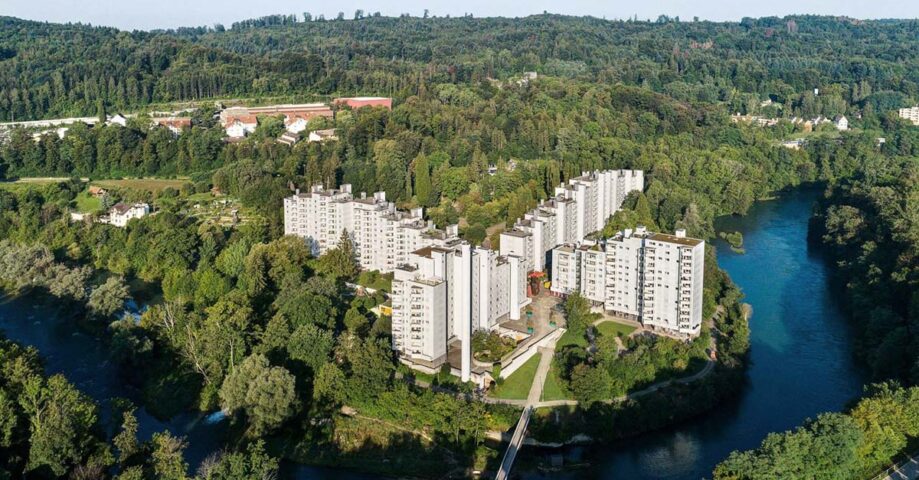
    The Webermühle development in Neuenhof houses 368 rental apartments. The settlement on a peninsula in a loop of the Limmat was built on the industrial site of a former weaving mill and was ready to move into in 1984 after ten years of construction. Planned by the architectural office Steiger Partner AG and built by Ernst Göhner AG, the Webermühle with its different volumes offers living space for up to 1,500 residents. Despite the very high density, the apartments with the four rows of high-rise buildings arranged in a cross shape are characterized by a surprising foresight. Since 2008, the buildings realized in the “Göhner 3” modular construction system have been owned by a real estate fund from Credit Suisse Asset Management.

    Ecologically and economically sustainable renovation
    A good 40 years after moving in, the apartments no longer met today’s standards – neither in terms of appearance nor in terms of comfort. With an analysis of the building structure, the client started planning an extensive partial renovation in 2009, which was implemented in stages between 2012 and 2014. The portfolio strategy of Credit Suisse Asset Management attaches great importance to ecologically and economically sustainable solutions. With the modernization of the Webermühle, one wanted to make the living and green space more attractive for the tenants and to maintain the value of the property. On the other hand, the building technology should be brought up to date and thus the energy consumption should be significantly reduced. Better connections to public transport were also an important goal: Since the construction of a new inclined lift in 2015, Wettingen train station can be reached within a few minutes on foot.

    Heat supply: switch to flow heat
    The core of the energetic renovation is the reorientation of the heat supply. To this end, the client defined a clear goal right from the start: in future, the heat supply in the Webermühle should be at least 70 % CO 2 -free. Due to the size of the facility, Credit Suisse Asset Management wanted to have the heating system replaced by a contractor instead of producing heat itself. The sustainability of the solution proposed by ewz with a river water heat pump convinced the client even after a detailed examination by specialists.

    More about the project

    White paper on the topic of energy-efficient refurbishment
    In addition to the practical example “Webermühle”, the white paper “Energy-related renovations as an opportunity for the real estate industry”, which was created in close cooperation between ewz and the research and consulting company intep, offers insights into the relevance of energy-related renovations.

    Knowing that the building sector is responsible for about a quarter of emissions, there is an urgent need to renovate the building stock. Because the few climate-friendly and energy-efficient new buildings will not have a major effect on the entire sector. At the moment we are in a renovation backlog. The current renovation rate of one percent must be doubled in order to achieve the climate targets.

    Practical experience shows that during renewal processes, too little attention is paid to energy-related refurbishment compared to replacement new buildings. The landowners often lack basic information that shows them the economic, ecological and social potential of energy-related renovations. The whitepaper is intended to make a contribution to precisely this. There is a basic overview of the urgency, legal framework, benefits, opportunities and possible strategies of energy-related renovations.

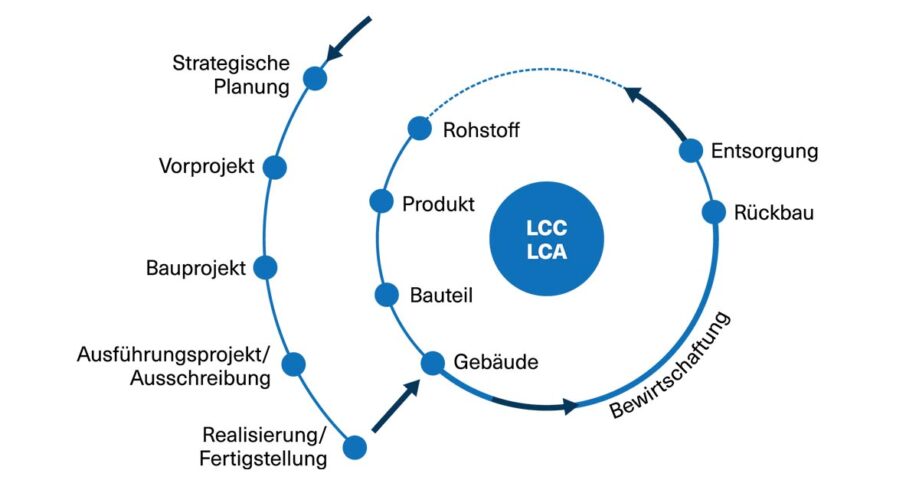
    The results of an ecological balance sheet (life cycle analysis, LCA) and an analysis of the life cycle costs (LCC), for example, form an excellent basis for decision-making. These quantitative assessment methods take into account the entire building life cycle.

    The life cycle analysis (LCA) to determine the environmental impact and the analysis of the life cycle costs (LCC) offer quantitative decision bases for energy renovation. (Source: Kellenberger (intep), 2021)

    To the white paper

  • MIPIM 2022: Between desire and reality

    MIPIM 2022: Between desire and reality

    [smartslider3 slider=”4″]

    MIPIM 2022 took place from March 15th to 18th – and it was far from the industry euphoria of three years ago under the impression of a conflict almost 2,000 kilometers away. While the Ukraine was at least visually represented with a mostly deserted stand, there was hardly a trace of Russia or Russian cities. Only a few obvious gaps in the trade fair room allocation indicated that there had also been cancellations at short notice.

    Interest rates are rising again…
    The industry buzzwords ESG, impact investing and interest rates were also part of the discussions in many places. From the Federal Reserve Bank in the USA alone, further interest rate hikes are expected this year, which would result in key interest rates of just under two percent at the end of the year. The market assumes that other central banks (UK, EU, CH) will follow suit, albeit with a time lag. For Switzerland, this means that negative interest rates will soon be a thing of the past. In the case of ten-year federal bonds, a value of 0.425 percent was already reached on the Wednesday of the fair (March 16, 2022) – a level that was last recorded at the end of 2014.

    … and what next for decarbonization?
    The topic of sustainable or green investments was also represented in many MIPIM panels and discussions. But even if there are now many options for measuring sustainability as well as certificates and labels: the coming years will challenge the construction and real estate industry on many levels. On the side of the energy sources alone, the change away from fossil fuels to renewable ones has added another dimension with the Ukraine-Russia conflict. It is now time to reassess the oil and gas factors in the real estate industry’s decarbonization efforts. It remains to be seen whether this will ultimately lead to oil and gas heating systems being discarded sooner in this country.

    Farewell to old braids
    Other significant changes are also becoming apparent in the traditional asset classes. The traditional real estate classifications such as residential, office and retail are becoming more diverse. This has already been shown in recent years thanks to online shopping, coworking and coliving. The hospitality forum on the Thursday of the trade fair, for example, showed that there is also something new happening in the hotel industry. Swiss Life Asset Managers announced the new camping investment class there and is even considering launching its own fund product in this area. In general, it can be said that the star classifications are becoming less important for hotel users, with the focus increasingly being on the extraordinary experience, special locations and trips close to nature and the local people.

    Propel Awards for newcomers
    The four winners of the PropTech competition Propel were also chosen this year at the real estate fair in Cannes: From the 20 finalists, centralF (optimization tool for workplaces) in the data category, Apricot (leasing for homebuyers) in the investment category, OakTree Power ( Demand optimization for building energies) in the sustainability category and Parametric Solutions (software solution for project developments) in the user experience category. A Swiss proptech startup was not represented in the global competition.

    Swiss project wins MIPIM competition
    On the evening of the Thursday of the fair, however, there was an award for an outstanding Swiss construction project: the Musée Atelier Audemars Piguet in Le Brassus received an award in the “Best Cultural and Sports Infrastructure” category. The museum extension designed by the Danish Bjarke Ingels Group (BIG) includes a new glass structure that integrates into the landscape by means of two spiral structures. Inside, the museum offers a glimpse into the history of watchmaking in the Vallée de Joux.

    25th anniversary of Swiss exhibition stands
    The two Swiss networks Swiss Circle for German-speaking Switzerland and Horizon Léman for western Switzerland also had something to celebrate this year. The exhibition stand organizers and initiators Roman H. Bolliger and Yves de Coulon were delighted to receive congratulations and two “birthday cakes” from the MIPIM organizer RX on their 25th anniversary. The handover took place after the MIPIM event “Forum Suisse”, where Swiss industry players from Swiss Prime Site, Mobimo, M3 and Wüest Partner discussed the topic of “mobility and its consequences for the real estate industry”. In 2022, more than 50 companies from Switzerland used the two trade fair platforms Swiss Circle and Horizon Léman for international exchange on the Côte d’Azur.

  • Thomas Hinderling becomes the new division manager

    Thomas Hinderling becomes the new division manager

    Thomas Hinderling has been with Wincasa since 2017. He played a key role in setting up the Mixed-Use Site Management (MUSM) department, which has been in existence for five years, and initially managed the projects in the Zurich area. From 2019, he was assigned to head the MUSM German-speaking part of Switzerland. In this role, he was responsible for the sub-area within Center & Mixed-Use Site Management (CMSM) and was the deputy head of CMSM. The 47-year-old has an Executive MBA Marketing FH, a CAS in Urban Management FH and was CEO and partner of various marketing and distribution companies before joining Wincasa. From May 1, 2022, he will be the new Head of CMSM at Wincasa and thus a member of the Executive Board. Thomas Hinderling will be succeeded by Philipp Arnold as the new head of MUSM German-speaking Switzerland.

    Internal succession regulations
    Thomas Hinderling is looking forward to his new role: “It fills me with joy and pride to take over the management of CMSM from Felix Kubat. We both have worked very well together in the past and have successfully launched many projects. Now it is important to push this work further together with my new team, because there is still a lot of potential.»

    The CMSM department has been headed by Felix Kubat since the end of 2019. During his tenure, he successfully developed and implemented a new strategy for the area. This included, among other things, the establishment of two CMSM locations, thanks to which great added value could be achieved through a targeted bundling of strengths and expertise on the part of center and mixed-use site management. He also confidently led the business through the Corona crisis. He is leaving the company of his own volition and will in future devote himself to management and teaching activities at a commercial vocational school. «In the past 2.5 years at Wincasa, I have been able to shape and continuously develop the Center and Mixed-Use Site area. It was a very exciting and intensive time, which I look back on with great pleasure. Now I’m looking forward to a new chapter. For several years I have been sporadically working as a lecturer at HF level in the field of management training. I will now continue to pursue this passion with a position as a manager and lecturer at a commercial vocational school,” says Kubat about his move.

    Thomas Hinderling’s successor is also an internal change. Philipp Arnold is now taking on the role of Head of MUSM German-speaking Switzerland. He has been with Wincasa since 2014, started out as Center Manager Zentrum Regensdorf & HUB and then took over management of the MUSM Hub Zurich in January 2020. Among other things, Philipp Arnold has a degree in business administration, an MAS in real estate management, an MAS in brand and marketing management and is a RICS member. He is therefore well prepared to succeed Thomas Hinderling.

    Oliver Hofmann, CEO of Wincasa, is very positive about the two internal career steps: “I would like to thank Felix Kubat for his valuable commitment and the good cooperation. It is very gratifying that we were able to nominate Thomas Hinderling as the new head of CMSM and Philipp Arnold as the new head of MUSM German-speaking Switzerland and to organize the successor internally. We are convinced that with this personnel solution we can further strengthen our already leading position in the market.»