Tag: immobilien

  • What is the ideal building age for an investment?

    What is the ideal building age for an investment?

    In order to answer the question of the ideal age of a real estate investment, PriceHubble first examined the development of market prices and rents for buildings of different ages for its analysis. “Buildings, like cars, tend to depreciate faster in the early part of their life cycle than in later years. However, since a property usually also includes a plot of land that does not wear out, the value of the property then approaches the value of the land,” says Dr. Nima Mehrafshan, Head of Research at PriceHubble.

    The analysis was carried out based on the PriceHubble valuation model. For each of these, a location in a major Swiss city was selected and a typical apartment in this location was evaluated. The year of construction was varied for each apartment assessed, while all other influencing factors were kept constant – including the time of the assessment. “In this way, we can determine how the market value and market rent of a typical apartment decrease with age, ignoring market-wide price changes over time,” adds Dr. Mehrafshan.

    Biggest loss in value in Bern and sharpest drop in rent in Basel – real estate in Geneva with the smallest loss in value
    The majority of the price loss occurs across all the cities examined in the first 40 years after construction and then levels off between 17 and almost 26 percent. Real estate in the city of Bern experienced the greatest loss in value at around 26 percent. In contrast, real estate in Geneva only lost around 17 percentage points.

    A similar picture emerges when it comes to rents, with the decline in market rents already having largely taken place after 20 to 30 years. After this time, rents are between -12 and -25 percent compared to a new building. Rents in the city of Basel are falling the most at around 25 percent, while rents in Geneva are only falling by just under 12 percent.

    Lowest rental yield after 10 to 20 years
    Basically, rental yields are only slightly influenced by the age of the building. The rental yields for new buildings are only slightly lower than for older buildings. The rents fall slightly in the first few years, since the market rents fall a little faster than the market prices with the age of the building. In general, rental yields are lowest for buildings that are 10 to 20 years old and range between 2.3 percent and just under 3.0 percent. After almost 60 years, returns reach their zenith and remain between 2.6 percent and 3.4 percent.

    The city of Bern is the leader in terms of rental returns with a rental return of around 3.4 percentage points after 60 years. The city of Zurich has the lowest average rents and shows a return of 2.6 percent after 60 years.

    10-year return: Bern is the leader
    A similar picture emerges when looking at 10-year returns (combination of rental returns and market value loss through wear and tear). Here, too, the yields level off from an age of just under 60 years. The city of Bern is also the front runner with a total return of around 33 percent. Real estate in the city of Zurich meanwhile has the lowest average return of around 26 percent.

    In principle, the return on buildings under 20 years of age also falls to 16 percent to 23 percent over a 10-year period. «In order to answer the question of the best building age for an investment, investors must also consider the maintenance costs in addition to our analysis. Here, of course, the faster depreciation early in the property’s life is offset by the higher maintenance costs for most older buildings. Nevertheless, investors can use the results of the study to review their investment strategy,” says Dr. Mehrafshan.

    Detailed information at: https://bit.ly/3tzmpt6

  • Subordinated real estate loans

    Subordinated real estate loans

    Subordinated loans as a complement to traditional financing
    In Switzerland, private real estate debt is increasingly establishing itself as an alternative form of real estate financing. This is mainly because structural changes in the traditional credit market and stricter regulations have led to traditional mortgage institutions becoming increasingly reluctant to lend capital. Private Real Estate Debt supplements the classic mortgage and is aimed at small and medium-sized real estate developers, among others, who are finding it increasingly difficult to obtain financing from traditional sources. Real estate companies and private property owners use this financing solution for reasons of yield optimization, freeing up capital and as a source of liquidity for asset reallocation. In any case, the financing is secured with subordinated promissory notes from Swiss real estate.

    The advantages for investors
    A regulated way is opening up for investors to invest in mortgage-backed loans. Credit checks and project security are of the utmost importance. Thanks to regular interest payments, the asset class has a fixed-income character related to the Swiss real estate market and only a low correlation to the stock markets.

    About Property One
    Property One is an independent, owner-managed group of companies owned by private shareholders, consisting of the public limited companies Property One Partners AG, Property One Investors AG and Property One Ticino SA. It provides services along the entire real estate value chain. The group combines the four business areas of investment management, development and planning, marketing and real estate family office under one roof. Property One combines real estate expertise with knowledge of financial investments. To date, credit requests exceeding an annual volume of CHF 1 billion have been processed. And so far, several hundred million francs in subordinated loans have been granted. The company employs over 40 real estate and finance specialists at the locations in Zurich, Zug and Ascona.

    CTA: Learn more about Private Real Estate Debt.

    The information in this document has been prepared with the greatest care and to the best of our knowledge, is intended solely for informational purposes and does not constitute investment advice. Opinions and assessments contained in this document are subject to change and reflect the point of view of Property One Investors AG (POI). No liability is assumed for the correctness and completeness of the information. Past performance is not an indicator of current or future development. This document is marketing material.


  • Warteck Invest grows profitably

    Warteck Invest grows profitably

    Despite the ongoing pandemic, 2021 was a successful financial year, Warteck Invest wrote in a statement . Specifically, the Basel real estate company increased its net profit by 2.4 percent to CHF 27.4 million. Excluding the gain from the revaluation of properties, growth of 5.6 percent to CHF 17.4 million was realised.

    At CHF 36.9 million, rental income was 0.4 percent up on the previous year. Financial expenses fell year-on-year by 2.6 percent to CHF 5.5 million. The vacancy rate was reduced by 0.6 percentage points to 2.4 percent compared to 2020.

    The market value of Warteck Invest’s real estate portfolio increased by CHF 35.8 million to CHF 874.4 million in the course of the year under review. The increase was not achieved through acquisitions, but through investments in new construction and renovation projects and the resulting revaluations. In the past financial year, the real estate company invested a total of CHF 22.8 million in ongoing projects. A project pipeline with a total volume of over 270 million Swiss francs should generate further growth over the next five to seven years.

  • Atelier M Architekten will realize a commercial development in Aarau

    Atelier M Architekten will realize a commercial development in Aarau

    The health organization Swica from Winterthur and Steiner AG from Zurich want to realize a mixed-use development in the Aarau district of Scheibenschachen. In a study order procedure carried out for this purpose, the project contribution Wohnen am Weinbergplatz by Atelier M Architekten was unanimously accepted, Steiner informed in a press release . The project approach envisages four new buildings with around 70 rental and owner-occupied apartments.

    In addition, there is a commercial section at street level, which will offer the quarter an improved range of shops in the future, explains the Zurich-based project development, total and general contractor. The proposal by the winning Zurich architects' office also integrates the historic Kreuz building on the site "in an appropriately respectful manner".

    The orientation of four buildings to an "urban figure" provided in the concept can cope well with the high urban density, is quoted in the communication from the appraisal committee. It certifies the approach of Atelier M Architekten as a "successful balance between urban elegance and good marketability". In the communication, Steiner also emphasizes the varied open spaces "with a neighborly character" envisaged by the draft.

  • Energie 360° wants to supply only renewables from 2040 onwards

    Energie 360° wants to supply only renewables from 2040 onwards

    The Zurich energy supplier Energie 360° wants to supply only renewable energy from 2040 onwards. This is ten years earlier than previously aimed for. The reason for the faster phase-out of fossil fuels such as gas and oil is the Russian crisis, the company announced in a media release on the annual balance sheet.

    According to this, the energy supplier delivered 15.9 percent more energy to end customers in the 2021 financial year than in the previous year. Of the 4978 gigawatt hours, 18.2 percent were of renewable origin. The company sees itself “on course”. By 2025, the share of renewables should increase to 30 percent.

    With sales of CHF 537.1 million, Energie 360° generated a net profit of CHF 61.9 million. In the previous year, sales were CHF 466.2 million and net profit was CHF 71 million. The reason for the decline is lower investment income after the sale of two subsidiaries.

    In view of the Russian crisis, Energie 360° recommends “customers who want to move away from Russian gas to replace their gas heating and switch to renewable energy sources”. As an alternative, the company promotes the energy networks in the city of Zurich, which make locally available renewable energy such as heat from Lake Zurich available. It names wood pellets as a further option and recommends increasing the proportion of biogas.

    Energie 360° sees great potential in biogas and has increased its share in its standard gas product to 25 percent as of April 1, 2021. This saved around 200,000 tons of CO2 in the direct supply area. Energie 360° wants to build more biogas plants and invest in innovative research projects.

  • Energeek makes investing in solar energy accessible to everyone

    Energeek makes investing in solar energy accessible to everyone

    The cleantech-project.org of Energeek Group AG and CES Cleantech Energy Systems GmbH wants to enable everyone to participate in the energy transition. CES Cleantech Energy Systems explains in a press release that those who do not have the financial means to renovate their own roof or do not own any property at all cannot usually contribute to climate neutrality through solar energy. To remedy this, Energeek Group AG offers investments in solar panels for specific real estate projects.

    Interested parties can purchase one or more panels and then rent them out to the project company, as explained in the press release. A project on a horse farm and hotel in the Freiberge mountains is given as an example. Here Energeek offers panels at a price of just over 900 francs per piece. In addition to the annual rental income of 82.50 francs, the buyers benefit from federal subsidies for solar systems, the one-off payment.

    As an advantage of Energeek’s projects, the company emphasizes the use of so-called solar trackers. In addition to permanently installed panels, panels are installed that turn towards the sun via the solar trackers. In this way, morning and evening sun and gaps in the clouds can also be used to produce solar power.

    Energeek provides online information on the current range of real estate projects, the prices and the rental income of the corresponding solar panels. According to the statement, purchased panels and the associated rental agreement with the project company can be resold, inherited or given away at any time.

  • Switzerland and UAE discuss city of the future

    Switzerland and UAE discuss city of the future

    On March 21 at the Expo in Dubai , the Swiss pavilion brought together experts from universities in Switzerland and the United Arab Emirates, private companies and public actors under the motto “Smart Connected Cities”. It is about intelligent solutions for the management of water, mobility and other challenges in cities that are becoming increasingly dense. Some of these projects have already been implemented in Switzerland and could be imitated in the Middle East/North Africa (MENA) region.

    The event was organized by the University of Applied Sciences in Western Switzerland ( HES-SO ). It is the Leading House MENA officially commissioned by the Swiss State Secretariat for Education, Research and Innovation . Its goal is to promote scientific cooperation between Switzerland and the countries of the MENA region.

    During implementation, the HES-SO worked together with Swissnex , the Swiss Embassy in the UAE and the Swiss Business Hub Middle East . “International cross-technology cooperation that offers networked solutions for the exponentially growing demand of a growing population and the associated densification of living spaces are the only way to master the challenges,” says Dante Larini, project manager of Swissnex in the Swiss pavilion, in a press release quoted. “The event showed us how much and how seamlessly technology can transform the way cities are managed and the daily lives of their residents.”

    Josef Spillner from the Zurich University of Applied Sciences ( ZHAW ) gave a keynote speech on the opportunities and risks of cyber-physical spaces. The cooperation between the ZHAW and the private university of the Emirate of Sharjah ( Sharjah University ) was also presented at the event.

  • Betterhomes joins SwissPropTech

    Betterhomes joins SwissPropTech

    SwissPropTech has a new member. At the beginning of 2022, Betterhomes joined the innovation network of the Swiss real estate and construction industry, the Zurich-based brokerage firm announced in a statement. As part of its membership, Betterhomes wants to pass on knowledge and promote a planned expansion. So far, Betterhomes has been active with its technology platform for broker and customer software in Switzerland, Germany and Austria.

    “We are pursuing the ambitious goal of opening up 30 countries in Europe over the next eight years,” Betterhomes CEO Cyrill Lanz is quoted as saying in the statement. “I don’t count the technology so much as the biggest challenges, but rather the organic growth in sales and the cultural differences in the different countries.” The company is currently preparing a new website and a new learning management system for its technology platform Betternet 3.0 before.

    For SwissPropTech, the entry of Betterhomes is “a strong signal for our industry,” explains Lars Sommerer, Managing Director of SwissPropTech, in the press release. “A digital ‘real estate fair broker’ from the very beginning recognizes the importance of innovation and digitization and now wants to pass on his experience and expertise.”

  • Madaster wins Integral Baumanagement as a partner

    Madaster wins Integral Baumanagement as a partner

    Madaster wants to strengthen the circular economy in the construction and real estate sector. To this end, it offers digital tools on its platform, such as material passports and indices for recording the economic and circular value of buildings. In addition, companies that are committed to the circular economy in the construction and real estate sector are networked. With Integral Baumanagement AG , the Swiss register for materials has now gained another comrade-in-arms, Madaster Switzerland informs in a statement . The company based in Olten provides overall services in the planning and realization of buildings for builders and real estate owners.

    With the decision to make Integral Baumanagement AG fit for Madaster, “we are investing in a better future and thus making a significant contribution to achieving climate neutrality in construction,” Mauro Giorgini is quoted in the statement. The managing director of Integral Baumanagement AG relies on Madaster to catalog the materials used in the building and to determine their value, suitability for reuse and their impact on the environment. “In this way, we can lay the foundation for a sustainable future and optimal market positioning of your property with our customers.”

    Madaster’s building records record data about the materials used in a building. “We live in a closed system and resources are finite,” explains Marloes Fischer in the statement. For the managing director of Madaster Services Schweiz AG, individual buildings as well as entire areas and cities should be used as “gold mines for material”. “If we write down what’s there now, we’ll make building the future easier.”

  • Swiss pavilion receives award

    Swiss pavilion receives award

    The Swiss Pavilion at Dubai Expo has won a gold medal. According to a press release , it was voted the best pavilion for medium-sized country presentations at the World Expo Awards organized by Exhibitor magazine.

    A central showpiece in the Swiss Pavilion is the artificially generated fog. The effect changes constantly for the visitor, so that at the end a Swiss mountain panorama becomes visible. The expert jury also voted the fog the third best staging element of the Expo in terms of theme and implementation.

    The Zurich scenography agency Bellprat Partner AG is behind the Swiss fog. According to the information, she worked on the development of the Swiss Pavilion for more than five years. She was also supported in the implementation by Zurich architects OOS and Lorenz Eugster ‘s office for landscape architecture, also in Zurich. The partners worked on behalf of Presence Switzerland .

    The Swiss pavilion was not only well received by the jury of the World Expo Awards. With a total of 1.5 million visitors so far, it is one of the five most popular buildings at the entire Expo. Overall, the world exhibition in Dubai has so far had over 19 million visitors. It runs until the end of March.

  • Minergie and SNBS adopt labels for 2000-watt areas

    Minergie and SNBS adopt labels for 2000-watt areas

    The label for 2000-watt areas will disappear at the end of 2023. According to a statement from the Federal Office of Energy (SFOE), the suppliers of labels for sustainable buildings in Switzerland have agreed on this. The label was previously offered by the SFOE Swiss Energy program.

    In return, the Minergie association will in future also offer a Minergie area label for areas that comply with climate protection. The Swiss Sustainable Building Network , as the sponsor of the Swiss Sustainable Building Standard (SNBS), will create the SNBS-Areal label for the sustainability of sites in all their dimensions.

    At the building label level, there will also be the cantonal building energy certificate (GEAK), the various Minergie categories and the SNBS.

    The bearers of the various labels want to achieve a greater impact by pooling resources. “Sustainable real estate makes a major contribution to climate protection. The trend is positive, but the potential is far from being exhausted,” Marc Mächler, District President of the Canton of St.Gallen and President of the Minergie Association, is quoted as saying in the statement. “The labels complement each other, are better coordinated with each other and builders and planners can find out more easily which label meets their needs.”

  • Implenia is building a climate change laboratory in Düsseldorf

    Implenia is building a climate change laboratory in Düsseldorf

    The construction services company Implenia has won the general contractor contract for the EUREF campus in Düsseldorf . According to the client EUREF AG , “a visible place of the future will be created as a real model on this innovation campus for the energy and mobility transition, which can be implemented in many major cities around the world”. EUREF has already set up a first campus of this kind in Berlin .

    The Düsseldorf campus will offer 3,500 employees from established companies, start-ups, science and research an inspiring environment on 105,000 square meters of gross floor space. In addition, it is to become part of a network of environmentally friendly energy producers and storage facilities in the region and meet all of the federal government’s CO2 climate protection targets for 2045 from the start. The project volume amounts to CHF 186 million.

    “Sustainability is one of Implenia’s five corporate values,” CEO André Wyss is quoted as saying in a press release . “We are therefore very pleased that we can build a research and development campus whose work focuses on sustainability and which is itself geared towards CO2-neutral operation.”

    According to Implenia, the schedule is “ambitious”: The first phase of construction should be completed and ready for occupancy by mid-2024. The second construction phase will run continuously with a time delay and will be completed by mid-2025. In order to be able to keep to this schedule, Implenia has been working with BIM (Building Information Modeling) right from the start, i.e. with digital modelling, combining and recording all relevant planning, construction and management data. In addition, a so-called lean cycle plan is used for execution.

  • UBS sells stake in real estate company in Japan

    UBS sells stake in real estate company in Japan

    UBS Asset Management and Mitsubishi Corporation have agreed to sell their Mitsubishi Corp.-UBS Realty Inc. (MC-UBSR) joint venture to American private equity firm KKR & Co. Inc. , UBS Group AG and UBS AG announce in a press release. The transaction, which is still subject to the approval of the relevant authorities, is expected to be completed in the coming month. The sale has “no impact on UBS’s asset management, wealth management and investment banking business in Japan,” explains the major Zurich bank.

    The sale marks the end of a 20-year success story for the joint venture. According to her, MC-UBSR has developed into one of Japan’s largest asset managers in the real estate sector. “We believe KKR is well positioned to continue to grow the business,” Suni Harford, President of UBS Asset Management, said in the statement. For UBS, the sale is expected to generate a gain in asset management and an increase in core capital (CET1) of around $0.9 billion.

    “The Japanese market remains a cornerstone of our Real Estate & Private Markets business in Asia Pacific going forward,” said Harford. Real estate investments in Japan are to be offered to clients through the UBS Japan Advisors unit.

  • Hächler refurbishes historic Posthorn inn

    Hächler refurbishes historic Posthorn inn

    The Hächler construction company reports progress on the renovation project with a new building for the historic Posthorn inn in Neuenhof. According to the press release , the old building will be extensively renovated. Seven rental apartments are being built in the former hotel. There is also a new building with a further 16 rental apartments.

    Since the building permit for the Posthorn superstructure was granted in 2019, the structural and civil engineering department of Hächler AG has been in charge of the construction work since spring 2021. According to Hächler, the project is not easy. The historic post horn was not allowed to be torn off. The building dates from 1834 and is a protected site. Gable and facade must be preserved.

    According to Hächler, to ensure the statics and to support the facade that remains in place, a complex steel brace was installed. The rest of the post horn could only be broken off after the installation of this steel spline. When the historic building was gutted, the effective master builder work began. In the meantime, the erection work on the roof trusses of the Posthorn and the new building are scheduled for March and April.

    According to the construction management, the work on the superstructure will be completed around May 2022. Then the interior work takes place. The move-in date for the new apartments in the Posthorn is planned for February 2023 and in the new building for April 2023.

  • Fundamenta Real Estate breaks the billion mark

    Fundamenta Real Estate breaks the billion mark

    According to a statement by Fundamenta Real Estate AG , the Zug real estate company’s portfolio exceeded the billion mark for the first time at the end of the 2021 financial year. Specifically, the value of the real estate portfolio increased from CHF 991.9 million to almost CHF 1.10 billion over the course of the year. Fundamenta Real Estate attributes the growth primarily to the completion and transfer of two new construction projects, the completion of three repositionings and the purchase of four existing properties. Revaluations resulted in an increase in value of CHF 15.3 million.

    The net actual rental income in 2021 was CHF 37.2 million, 11.2 percent above the previous year’s value. In the same period, net profit increased by 8.4 percent to CHF 28.9 million. The real estate company writes that a previous year’s success from the sale of three investment properties was more than compensated for “by an excellent operating result and a higher revaluation effect”. Excluding both effects, net income rose by 14.7 percent year-on-year to CHF 17.7 million. The vacancy rate was reduced from 3.5 “to a historically low 2.5 percent” in a year-on-year comparison.

    “Our residential focus has also proven itself in the second year of the pandemic,” Andreas Spahni, President and Delegate of the Board of Directors of Fundamenta Real Estate AG, is quoted in the statement. “The consistent alignment of the portfolio to market demand as well as the holistic and active asset management have again led to very good results.”

  • Artisa Group restores Locarno's grand hotel

    Artisa Group restores Locarno's grand hotel

    Artisa Group wants to renovate and expand Locarno’s Grand Hotel. A corresponding planning application has already been submitted, the Zug-based company, which specializes in real estate investments on the Swiss and European market, informed in a press release . For the project, Artisa Group is collaborating with architect Ivano Gianola.

    Artisa writes that the design envisages the preservation of the existing substance and in particular the listed frescoes, decorations and facades of the historic building. The large hall, in which the peace conference took place in 1925, is to be restored in a contemporary way. A new SPA and wellness center will be set up.

    “The new Grand Hotel Locarno will set standards worldwide in terms of excellence, sustainability and modern service,” explains Stefano Artioli, Vice President of the Artisa Group, in the press release. “In addition, we will take responsibility for 100 employees who will work in the hotel.”

    Outside, the concept envisages a redesign of the more than 4000 square meter park. Together, the hotel and park should complement the tourist offer of Ticino, according to the statement. “The holistic hotel concept fits perfectly with the OTR strategy (Mendrisiotto and Basso Ceresio, Luganese, Bellinzonese and High Ticino as well as Lake Maggiore and valleys): wellness, food and wine, events, meetings, sustainability,” says Fabio Bonetti, Director of the Tourist Organization of Lake Maggiore , cite there.

  • HIAG remains on course for growth

    HIAG remains on course for growth

    HIAG strengthened its own position in the Swiss real estate market in 2021 and significantly improved its financial figures, explains HIAG Immobilien Holding AG in a press release . According to her, all three business areas of the Basel real estate company have contributed to the continuation of the growth course. Real estate income increased by 5.7 percent year-on-year to CHF 63.1 million.

    The operating result at EBIT level increased from CHF 69.9 million to CHF 115.1 million. Net income rose from CHF 55.2 million to CHF 89.3 million. Without revaluations and deferred taxes, an EBIT of CHF 54.6 million and a net profit of CHF 37.0 million were realized.

    The value of HIAG’s real estate portfolio increased by 8.9 percent to CHF 1.78 billion as of the end of 2021. According to HIAG, the vacancy rate fell from 13.2 to 10.7 percent year-on-year “despite the sale of fully let properties”. In the announcement, the company highlights successful follow-on leases, some with higher rents.

    HIAG also expects business to develop well in the current year. The company can rely on a development pipeline of currently more than 60 projects with a total volume of 2.98 billion Swiss francs. HIAG is also particularly interested in the purchase of residential building land in the future in order to quickly realize condominium ownership. Non-strategic properties are to be divested for capital recovery.

  • Helvetica plans capital increase

    Helvetica plans capital increase

    The subsidiary of Zurich-based Helvetica Property Group AG announced in a press release that Helvetica Property Investors are planning to increase the capital of their Helvetica Swiss Living Fund by around CHF 130 million. The new notifications are intended to be used for the acquisition of residential properties. Helvetica is currently examining the purchase of corresponding properties with a total value of almost CHF 330 million, explains the company, which specializes in real estate fund management and asset management services.

    The capital increase is to be carried out in mid-April. Conditions and further details will be communicated by Helvetica at the beginning of April, “just before the start of the subscription period”. The Helvetica Swiss Living Fund is aimed at qualified investors and is traded over the counter. Bank J. Safra Sarasin is responsible for over-the-counter trading. She will also play a leading role in the capital increase.

  • An important day for the energy transition in the canton of Lucerne

    An important day for the energy transition in the canton of Lucerne

    12 years ago, CKW subsidiary Steiner Energie built the last hydroelectric power station in the canton of Lucerne in Malters. Even then, CKW was intensively involved in the planning of the Waldemme power plant. A lot of water flowed down the Waldemme before the excavators could finally drive up and drive their shovels into the ground.

    Within a year, some of this water will be used to produce clean, renewable electricity. At today's ground-breaking ceremony in Flühli, government councilor Fabian Peter, head of the building, environment and economic department, expressed his delight: "With the new construction of this power plant, CKW is making another important contribution to achieving the energy and climate policy goals in the canton of Lucerne. »

    Expansion of renewable energies is urgently needed
    In his speech to more than 70 invited guests, CKW CEO Martin Schwab was primarily pleased that the power plant is finally being built. Because it was a long and rocky road. Schwab positively emphasized the great commitment in Entlebuch. "The region is a pioneer in using its own local energies." At the same time, Schwab warned: “We urgently need to expand the production of renewable energy in Switzerland. The corona pandemic and the war in Ukraine clearly show how dangerous strong dependencies on foreign countries can be, »said Schwab. Today things are progressing much too slowly in Switzerland. “This is primarily due to the long approval process. The Waldemme power plant is the best example of this: it took more than 17 years from the first plans to the groundbreaking.»

    "We want to move forward and make a significant contribution to the energy transition in Switzerland – in hydropower, wind power, solar energy and other renewable technologies. But the resistance is often great. This is paradoxical, as we all want the energy transition and need more renewable energies for it."

    Electricity for 1500 households
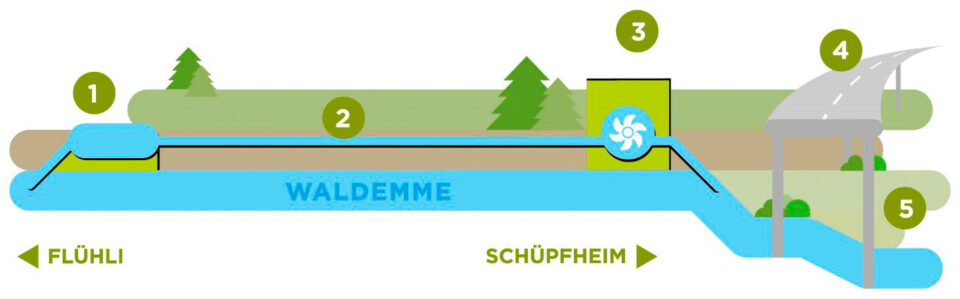
    The roughly one-year construction phase begins with the ground-breaking ceremony. The water intake is at the hamlet of Matzenbach in Flühli. From this location, part of the water from the Waldemme is routed via a 2.1-kilometer-long underground pressure line to the power plant headquarters, where ecological electricity is produced. The power plant control center is located directly in front of the Lammschlucht at the Chrutacher Bridge. Immediately afterwards, the water is fed back into the natural course of the Waldemme and flows through the Lamm Gorge. The power plant has an output of 1.4 megawatts and produces an average of 6.5 GWh of electricity. This means that clean electricity can be generated from mid-2023, which will cover the annual needs of around 1,500 average four-person households. CKW is investing CHF 12.4 million in the power plant.

    In the hamlet of Matzenbach, the water intake (1) takes part of the water from the Waldemme. In the approximately two-kilometer-long underground pressure line (2), the water is routed to the power plant center (3) at the Chrutacher Bridge (4), where it drives a turbine and generates electricity. Directly at the headquarters, the water is fed back into the natural course of the Waldemme and flows through the Lamm Gorge (5), which is untouched by the project.
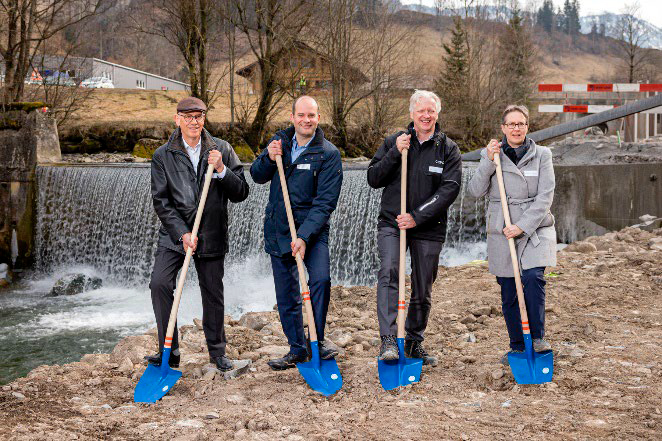
    Breaking ground at the Waldemme: (from left) Hans Lipp, Flühli municipal mayor, Fabian Peter, member of the cantonal government and head of the building, environmental and economic departments of the canton of Lucerne, Martin Schwab, CEO of CKW and Hella Schnider-Kretzmähr, Flühli municipal president.
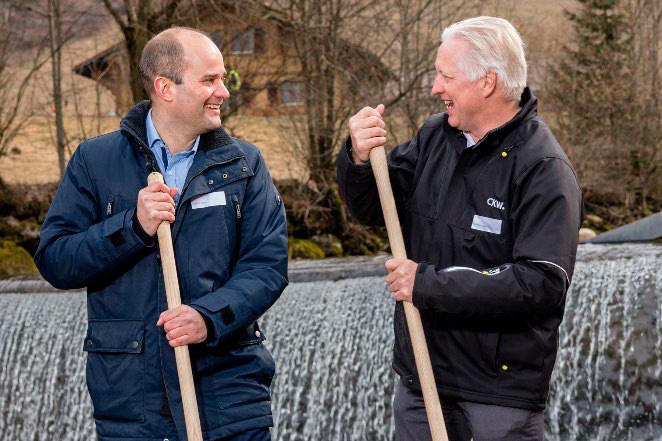
    Happy about the start of construction: Fabian Peter, member of the government and head of the building, environment and economic department of the canton of Lucerne, and Martin Schwab, CEO of CKW.

    About CKW: The CKW Group is a leading Swiss provider of integrated energy and building technology solutions. For more than 125 years, the company has been supplying electricity to over 200,000 end customers in the cantons of Lucerne, Schwyz and Uri. In addition, there are innovative products and services throughout Switzerland in the fields of connectivity & IT infrastructure, electrical engineering, energy technology, IT & communication and security. The CKW Group employs over 2,100 people. With around 350 apprentices in 14 professions, it is the largest private-sector training company in Central Switzerland.
    In the 2020/21 financial year, CKW generated sales of CHF 916 million. With 81 percent of the shares, Axpo Holding AG is the majority shareholder of CKW.
    Further information at www.ckw.ch

  • Realsmart has opened a new office in Dietikon

    Realsmart has opened a new office in Dietikon

    The real estate company Realsmart Immo AG has opened its office in Dietikon am Kirchplatz. This means that you are "now in the heart of the Limmat Valley", according to the media release on LinkedIn. Founder and managing director Beatrice Ludwig not only invites you to visit the new Dietiker office, but also to visit her own stand at the Zurich Real Estate Days from March 18th to 20th.

    According to an article in “Das Limmattal” about moving into the new office space in Dietikon, Beatrice Ludwig and her team are distinguished by their many years of expertise in real estate issues. "We show sellers what their property can really be worth and help the property to present itself properly," Beatrice Ludwig is quoted as saying in the official monthly newspaper of the Limmattal Trade Association .

    Realsmart was founded five years ago and was initially based in Baden AG and from June 2020 in Dietikon. In February, the new office at Kirchplatz was occupied. According to the article, Beatrice Ludwig feels comfortable in the comfortable office space based on Verena Mumford's home staging concept.

    A Realsmart flyer refers to the collaboration with Verena Mumford from MW Home Staging . They skillfully put a property in the best light for sale and rental or give valuable furnishing tips with housing advice. There is also a competition in the flyer. Prices include a professional real estate appraisal worth CHF 950 and housing advice for CHF 500. The completed flyer can be handed in in Dietikon or at stand 30 at the Zurich Real Estate Days.

  • Microsoft kauft CO2-Zertifikate von neustark

    Microsoft kauft CO2-Zertifikate von neustark

    Der Technologieriese Microsoft setzt bei der Reduzierung seines CO2-Fussabdrucks auf das Jungunternehmen neustark. Die Ausgliederung der Eidgenössischen Technischen Hochschule Zürich (ETH) mit Sitz in Bern hat eine Technologie entwickelt, mit der CO2 aus der Atmosphäre dauerhaft in Recyclingbeton gespeichert werden kann. Dafür wird flüssiges CO2 in Abbruchmaterial eingeleitet. Die Technologie der Firma ist bereits mehrfach in einer Pilotanlage getestet worden.

    Neustark setzt im Rahmen seines Geschäftsmodells auch auf den Verkauf von CO2-Zertifikaten. Damit können Unternehmen ihren CO2-Ausstoss kompensieren. Microsoft wird einer Medienmitteilung zufolge solche Zertifikate von neustark beziehen. Das Technologieunternehmen will bis 2030 mehr CO2 aus der Atmosphäre entfernen als es selbst ausstösst.

    „Microsoft hat sich für neustarks technologiebasierte Lösung für Carbon Removal entschieden, weil die Leistung bereits 2022 erbracht werden kann und ein erhebliches Skalierungspotenzial hat“, heisst es in der Mitteilung.

    Weiter wird Microsoft neustark auch im Rahmen seines Förderprogramms für Schweizer Start-ups unterstützen. Dabei erhält das Jungunternehmen kostenlosen Zugriff auf verschiedene Software-Lösungen von Microsoft.

  • MoneyPark forecasts falling mortgage interest rates

    MoneyPark forecasts falling mortgage interest rates

    The war in Ukraine will bring the economic recovery to a standstill, predicts MoneyPark in the latest economic and interest rate update from the fintech from Pfäffikon, which specializes in mortgages and real estate. According to him, capital market rates have already fallen significantly as a result of the outbreak of war. This development has also reached mortgage interest rates with a slight delay, writes MoneyPark.

    Specifically, between Feb. 24 and March 8, the company observed a 6 to 8 basis point cut in fixed-rate mortgage rates. By contrast, mortgages based on the SARON reference interest rate (Swiss Average Rate Overnight) remained unchanged. MoneyPark expects further slight reductions in mortgage interest rates over the next few weeks.

    “It is currently particularly important to follow the development of the capital and mortgage markets promptly,” says the update. In particular, MoneyPark anticipates that mortgage providers will launch temporary special offers “due to the intense competitive environment”.

  • Plazza remains on course for growth

    Plazza remains on course for growth

    Plazza AG had another successful financial year in 2021, writes the Zurich real estate company in a statement . Specifically, the company, which has been listed on the SIX since 2015, was able to increase its real estate income from CHF 24.6 million in 2020 to CHF 26.1 million in the year under review. At the same time, the operating result before depreciation and revaluations increased from CHF 20.0 million to CHF 20.6 million.

    In the year under review, “market-related factors” again led to “high revaluations”, Plazza explains further in the press release. They increased the real estate company’s profit from CHF 63.3 million to CHF 71.9 million year-on-year. Without revaluations, the profit increased from CHF 17.0 million to CHF 18.1 million.

    Plazza cites the high proportion of residential properties in its own portfolio as the background to the good developments. The company writes that it increased from 73 to 76 percent in 2021 compared to 2020 due to the purchase of properties in Zurich’s Im Tiergarten district. At the same time, the vacancy rate in the residential sector fell from 3.1 percent to 2.6 percent.

    In the same announcement, Plazza communicates a change in management and board of directors. At the beginning of the year, Plazza’s Chief Financial Officer, Thomas Casata, took over as CEO from Ralph Siegle, who was retiring. On the Board of Directors, Peter Lehmann is to replace Markus Kellenberger, who is stepping down when he reaches retirement age.

  • Allreal increases corporate profit

    Allreal increases corporate profit

    In the 2021 financial year, Allreal achieved a company result that was significantly higher than in the previous year, the real estate company with its own general contractor informed in a press release . Specifically, Allreal reported a profit of CHF 182.6 million, compared to CHF 167.2 million in 2020. Excluding the revaluation effect on the real estate portfolio, a profit of CHF 133.3 million was realized.

    In the real estate division, Allreal achieved “an excellent result” in the year under review, the press release goes on to explain. The company from Opfikon emphasizes the expansion of its portfolio in western Switzerland as a growth driver. He increased the market value of the investment properties to CHF 5.11 billion. In addition, rental income increased year-on-year by CHF 4 million to CHF 204.4 million.

    In general contracting, a profit of 53.4 million francs was realized in 2021, compared to 46.6 million francs in the previous year. Here the company benefited “from high sales success”, writes Allreal. The completed project volume, on the other hand, developed “less dynamically than expected”, as in 2020. The division’s result, at CHF 13.8 million, was nevertheless CHF 6 million higher than in the previous year.

    Allreal writes that the backlog of around CHF 694 million secured at the end of the year will ensure capacity utilization for around two years. For the current fiscal year, the company is assuming rising real estate income and further growth in the operating result.

  • Loanboox now enables real estate financing

    Loanboox now enables real estate financing

    The Zurich start -up Loanboox enters the brokerage of loans for housing cooperatives, real estate funds and companies. The financing expert Patrick Zurfluh is joining the company as Head of Real Estate Financing, according to a press release .

    The first pilot transactions have already been completed, including a housing cooperative from the canton of Zurich. By processing via Loanboox, the borrower was able to save 20 percent of the financing costs and more than halved her expenses.

    As Head of Real Estate Financing, Patrick Zurfluh wants to advise and support real estate companies in the future. Before that, he worked for the Raiffeisen and Credit Suisse banks as a real estate financing specialist. “It struck me that real estate financing should be made simpler and more cost-efficient. That’s why I’m with Loanboox now,” he is quoted as saying in the media release.

    Loanboox has been brokering loans from investors to public sector borrowers for five years. All parties can view and organize their documents and communications as well as deadlines via the Loanboox digital money and capital market platform. Municipalities, cities and large companies have received 2,500 loans through Loanboox to date. The company is also open to partnerships with associations and organizations.

  • Rental prices rose slightly by 0.26 percent in February

    Rental prices rose slightly by 0.26 percent in February

    The rental index of the online real estate marketplace homegate.ch in cooperation with the Zürcher Kantonalbank rose again in February. According to a press release , rental prices rose slightly by 0.26 percent. The index was thus slightly higher than in the previous month at 117 points.

    Rental prices have risen in almost all cantons and cities, above all in the canton of Graubünden by 2.15 percent. There was a drop in rents there in January, which has now been offset by the increase in February. In addition to Graubünden, Appenzell, Glarus, Schwyz and Valais also recorded an increase of more than 1 percent in February.

    With the exception of Bern and St.Gallen, rents rose in all cities in February, with the strongest increases in Lausanne at 1.7 percent and Lugano at 1.41 percent. In the respective cantons of Vaud and Ticino, on the other hand, prices rose less sharply or even fell.

    Rents in the canton of Zug have fallen by 0.56 percent. Rents rose significantly here in January. “A comparison of the cantons shows that, in addition to the majority of increases in rents, there have also been fluctuations over the last few months,” says the press release.

  • Second homes make the highest jump in price

    Second homes make the highest jump in price

    The prices of single-family houses increased in 2021 compared to the previous year by an average of 9 percent to CHF 1.42 million. The prices of condominiums rose by an average of 8.3 percent to CHF 0.91 million. This is shown by the figures from the Home Market Price Analysis presented annually by the real estate marketplace Homegate and the Swiss Real Estate Institute of the Zurich School of Economics (HWZ). As stated in a media release , this is the highest price dynamic for residential property in ten years.

    For second homes, prices rose by 35 percent compared to the previous year. “The price increases for first homes are amazing,” says Peter Ilg, head of the Swiss Real Estate Institute. “But in the case of second homes, a market has been created due to the strict limitation on supply by the second home initiative that is ideal for real estate speculation.”

    Condominiums are still the most expensive in the Zurich region, single-family homes in the Lake Geneva region. The sharp rise in prices seems to be leading to fewer sales transactions, at least for single-family homes. They fell by 10 percent.

    There are major differences between the regions at the community level: With the same budget of 3.1 million francs, for which there was a house in Erlenbach ZH, you could buy a good six single-family houses in Brugg AG. The lowest average prices for condominiums were paid in the municipality of Sainte-Croix VD at CHF 0.28 million, the highest in Zumikon ZH at CHF 2.37 million.

  • Station area Wettingen becomes a residential area

    Station area Wettingen becomes a residential area

    Under the aspect of living and working directly on the track, the SBB has announced an architectural competition for the design of their area at the railway station in Wettingen . According to the press release, the results are now available. They can be viewed in an exhibition in the foyer of the Tägi Wettingen until Tuesday, March 8th.

    The winning project is called Stadtlaube and, according to the SBB announcement at Wettingen station, envisages two long, five-storey residential buildings with service, retail and catering areas on the lower floors and a four-storey service building with public-oriented uses. The historical railway buildings are preserved.

    The two buildings to the west of the station form a boundary opposite the track field and thus create living and recreation space in a central location, according to the project announcement. The entrance areas and partly open-plan staircases are intended to provide a view of the railway tracks. There will be small squares and a play street in front of the house entrances. Flexible 2.5 to 4.5 room apartments with private outdoor areas and communal roof terraces are planned.

    A four-storey service building with shops and restaurants is planned to the east of the residential buildings and embedded in the historic station buildings. According to the announcement, the protected individual objects Lokremise, goods shed, station building and turntable will be preserved.

    The winning team of the architectural competition consists of Burkard Meyer Architects from Baden AG, ASP Landscape Architects from Zurich, MWV Civil Engineers from Baden, Leimgruber Fischer Schaub from Ennetbaden AG, Mühlebach Partner from Winterthur and Scherler AG from Lucerne.

  • Dutch central bank builds with new strength

    Dutch central bank builds with new strength

    The Dutch Central Bank uses CO2-neutral concrete in the renovation of its Amsterdam headquarters. This is made possible thanks to a collaboration between the Dutch New Horizon Urban Mining BV and the Swiss start-up neustark , according to a LinkedIn announcement .

    New Horizon’s technology makes it possible to reduce the carbon footprint of concrete by 75 percent, they say. For this, cement is obtained from concrete recycling material. The remaining footprint is offset by neustark. The start-up has developed a technology with which CO2 from the atmosphere can be permanently stored in recycled concrete. For this purpose, liquid CO2 is introduced into demolition material.

    Neustark is a spin-off from the Swiss Federal Institute of Technology in Zurich ( ETH ) based in Bern. The company works with Holcim , among others, to drive innovation and sustainability in the construction sector. As part of the collaboration, neustark is investigating the CO2 conversion potential of Holcim’s recycled demolition concrete. Holcim, in turn, optimizes the concrete produced by neustark.

  • Second Homes Act affects real estate markets less than expected

    Second Homes Act affects real estate markets less than expected

    On March 12, 2012, the Swiss population accepted the second home initiative. The corresponding Second Homes Act stipulates that no additional holiday homes or houses may be built in communities with more than 20 percent second homes. Experts feared that if the initiative were accepted, the prices for corresponding real estate in the tourist areas would explode.

    Ten years later, these fears have not been confirmed, writes the Lucerne University of Applied Sciences and Arts ( HSLU ) in a statement . Researchers at the HSLU have examined the effects of the Second Homes Act in two studies. According to the results, house prices did not increase until 2018, but instead actually decreased.

    “The acceptance of the initiative has led to a panic-like flood of last-minute building applications,” the head of the relevant study, Daniel Steffen, is quoted as saying in the statement. “Ironically, this has caused a temporary oversupply.” It was only with the outbreak of the pandemic that the demand for apartments in the tourist mountain regions increased. “Today, prices are roughly back to the level at which model calculations show they would be even without the second home initiative,” says Steffen.

    The hotel industry and mountain railways also felt only minor consequences of the new regulation, as is further explained in the communication. Only the hotel industry’s model of cross-financing renovations through the construction and sale of second homes is restricted by the Second Homes Act. In the construction industry, however, the researchers identify significant impairments for construction companies active in the affected communities. “In particular, larger, strategically broad-based companies” are already “orientated more towards the valley floor, where orders are not so heavily dependent on the construction of second homes,” the head of the corresponding study, Stefan Lüthi, is quoted in the statement.

    “Looking at all sectors, it can be expected that the effects of the Second Homes Act will only be noticeable in the coming years,” the HSLU researchers state.