Tag: immobilien

  • Werkarena Basel: NOMEN EST OMEN

    Werkarena Basel: NOMEN EST OMEN

    [smartslider3 slider=”10″]

    In spring 2022, the commercial area on Neudorfstrasse in Basel’s St. Johann district came to life with the first companies moving in. Before that, in November 2021, a public kick-off event took place in the premises, which were still in the basic construction at the time: around 60 representatives from politics and business took part in the event and were enthusiastic. However, it took a while for that to happen. After the government council granted the building permit in 2013, the architecture team led by Markus Kägi and Thomas Schnabel won the 2014 competition put out by the municipality. The municipal trade association was involved as a partner in the processes right from the start, and the relevant companies were supposed to appear together as investors. But this plan didn’t work out. Invited project developers were able to present their ideas. Steiner AG prevailed against well-known competitors. Construction work on the factory arena began in 2019, and the shell was completed in March 2021.

    An appeal to the future
    The triangular, 4316 square meter lot of the business park is located in the north of Basel and directly on the French-Swiss border with St. Louis. The Rhine flows further to the east. The port of St. Johann existed there until 2009, which was then transformed into a waterfront promenade. It showed that industry has a long tradition in the district of the same name. Today, however, ship traffic no longer dominates and the newly settled sectors are more colourful: in the immediate vicinity of Neudorfstrasse there is sometimes the gambling industry or a hotel, but also the premises of a meat and poultry producer or the customs office. The location is ideal for high-emission traders. They have increasingly left the city in recent years because their noisy productions were no longer tolerated in many places. Now they are benefiting again, also in other areas: In addition to the connections to Basel-Mulhouse-Freiburg Airport and the St. Johann through station, the motorway makes trinational long-distance traffic possible. Finally, a fast connection to Basel city center is guaranteed from the Werkarena by car, bus and soon also by tram. The building has a total of 244 parking spaces for employees and visitors.

    Architecture with silent references
    The architectural appearance of the Werkarena is reminiscent of Erich Mendelsohn’s (1887–1953) department store Schocken in Chemnitz, which was completed in 1930. This example of new building caused a sensation at the time as a kind of horizontally layered composition with careful materialization. The structure of the façade of the Werkarena is only broken up towards Neudorfstrasse on the first three floors. The ground floor and first floor have 10 meter wide galleries that can be driven on. These floors are particularly suitable for commercial companies with a large logistics or production share. The connection to the outside space, i.e. to the street, is provided here intelligently and across floors by the element of the ramp. With a room height of 3.47 to 4.37 meters, they stand out visually from the other four floors, which are 2.95 and 3 meters high. At the same time, they give the building volume a visually refreshing depth. There, the pillars, which are arranged at regular intervals, also set a vertical counterpoint to the horizontal rows of windows from the third floor upwards.

    No marketplace of vanities
    With a usable area of 19,300 square meters, the business park is intended to appeal to small and medium-sized companies. Various tenants are already on board and will move into the complex with their offices after completion. They should benefit from each other through the direct proximity and thus also from the vision of the Werkarena – the focus is on a so-called ecosystem, i.e. close (technical) cooperation between the various companies, the use of synergies and a transfer of know-how. Nathalia Szydlowski, Managing Director of Tandemworks GmbH, was enthusiastic at the kick-off event in November 2021: Her company started as a start-up and has now established itself in the construction industry. This rise also has something to do with co-working spaces, because the existing infrastructure and all the accompanying programs have always allowed her to concentrate on her core business. Now Nathalia Szydlowski wants to continue her success story in the Werkarena – this also offers services such as telephone and postal services and various shared facilities, such as office, meeting and conference rooms or catering areas that can be used collectively. Stefan Gabriel, who heads the development team at Steiner AG in Basel, adds: “Right from the start, our concept was aimed at developing a flexible and site-specific product for the highly competitive Basel commercial and office market.”

  • Siemens launches AI-based suite for carbon-neutral buildings

    Siemens launches AI-based suite for carbon-neutral buildings

    Siemens Smart Infrastructure is launching an open, interoperable and fully cloud-based smart building suite, the Zug-based Siemens subsidiary announced in a press release. The various interest groups such as building users, real estate investors, real estate companies and facility managers can digitally combine their building data from different sources on Building X. The smart building suite can integrate third-party software, has a range of applications based on artificial intelligence and has built-in cyber security.

    “We can now bring together all the data generated by systems in intelligent buildings in a single data pool,” Matthias Rebellius is quoted as saying in the statement. According to the board member of Siemens AG and CEO of Smart Infrastructure, this would allow “intelligent buildings to be implemented more quickly”, bringing the “vision of autonomous, climate-neutral buildings” closer. “Building X creates measurable data-based results in terms of efficiency, performance and user experience.”

    An energy manager, an operations manager, a security manager and a 360° viewer are currently available on Building X. The suite can be obtained in the form of software as a service on a subscription basis. In addition, Siemens offers the Xcelerator Building Services, a program based on Building X, in which Siemens assumes responsibility for achieving customer goals. The report mentions the reduction of energy costs and the optimization of systems as examples.

  • OMIT Group AG celebrates its 40th anniversary

    OMIT Group AG celebrates its 40th anniversary

    The real estate service provider OMIT , based in Dietikon, is celebrating its 40th anniversary this year. According to a statement on LinkedIn, the anniversary was celebrated with a staff trip to Paris. The family business, run by Oliver Mötteli in the second generation, offers real estate services in the Limmat Valley. This ranges from the management of investment properties and condominiums to the marketing of apartments, single-family houses or real estate. “With our incredibly great team we toasted 40 years of OMIT in Paris at the weekend and celebrated it appropriately,” says Oliver Mötteli, son of the company founder and current Chairman of the Board of Directors, Oskar P. Mötteli.

    Oskar P. Mötteli founded OMIT in Geroldswil ZH in 1982, according to the company’s website on the company’s history. His son Oliver has been part of the company team since 2016, which ensures that the company continues to exist as a family business with the second generation.

    Both have other functions in addition to their functions in the management and on the board of directors. For example, Oskar P. Mötteli is a rental judge at the Dietikon district rental court. Oliver Mötteli acts as an arbitrator for the arbitration authority in rental and lease matters in the Dietikon district on the landlord side. He is also an examination expert at the Swiss Real Estate Examination Commission ( SFPKIW ), delegate of the Chamber of Condominiums and board member of the Dietikon-Urdorf homeowners association.

    OMIT AG is a member of various real estate trade associations and also of the Dietikon Trade Association and the Dietikon Industry and Trade Association ( IHV ).

  • Siemens Smart Infrastructure acquires Brightly

    Siemens Smart Infrastructure acquires Brightly

    Brightly Software , a software-as-a-service (SaaS) facility and maintenance management company based in Cary, North Carolina, has acquired Siemens Smart Infrastructure . A corresponding agreement has already been signed, Siemens informed in a statement . The purchase price is $1.575 billion plus a performance-based earn-out component.

    The takeover is intended to promote the growth of the Zug-based Siemens subsidiary in the digital and software as a service divisions. In particular, the acquisition will complement the offerings of Siemens Smart Infrastructure for building technology "with established cloud-based solutions in key sectors such as public infrastructure, education and healthcare as well as manufacturing," according to the release. At the same time, Siemens wants to use Brightly's position in the American market. In addition, the Group expects synergies with a net cash value in the mid three-digit million range.

    "With Brightly, we are taking a big leap forward and are taking the operation of buildings to the next level," Matthias Rebellius, Member of the Management Board of Siemens AG and CEO of Smart Infrastructure, is quoted as saying in the press release. The acquisition of Brightly supports Siemens' vision to "create fully autonomous buildings that continuously learn from the people who live in them and adapt to their needs".

  • Photovoltaics: Economic and ecological benefits for real estate owners

    Photovoltaics: Economic and ecological benefits for real estate owners

    Enormous solar potential
    After a steady increase over the years, photovoltaics recorded a record increase in 2020. According to the "Solar energy statistics" of the Federal Office of Energy (SFOE), around 118,000 photovoltaic systems with an output of almost 3 gigawatts were installed at the end of 2020. The strong market growth continued in 2021, so that according to Swissolar, photovoltaics (PV) today covers more than 6 percent of Switzerland's electricity requirements. Experts assume that this trend will continue, not least in view of the efforts towards much more energy independence.

    Ecological and economic advantages
    Photovoltaic systems bring a whole range of advantages for owners of real estate portfolios. On the one hand, they can protect themselves against rising electricity prices. On the other hand, they already meet possible future self-production specifications today. Also with regard to subsidies, new rules will make the production of solar power more attractive in the future. In addition, portfolio owners with their own solar systems benefit from a clear reputation advantage.

    In most cases, PV power from your own roof is cheaper than power from the grid. The fact that power consumption due to heat pumps and electromobility will continue to rise in the future contributes to the financial attractiveness of PV systems. Improving the ecological balance sheet is also becoming increasingly important, because sustainability aspects are part of the strategy of more and more companies. Furthermore, PV systems are also interesting because they increase the value of real estate. If the photovoltaic systems produce more electricity than can be consumed on site, it is possible to use the solar power in other properties.

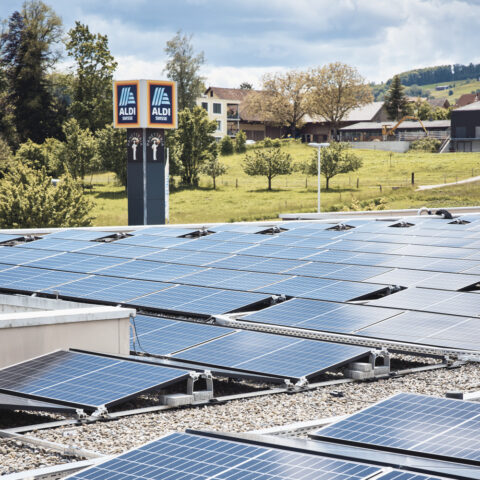
    In the ALDI SUISSE solar project, for example, sustainability and cost-effectiveness play a key role. In just over a year, ewz equipped 68 store roofs between Romanshorn and Geneva with photovoltaic systems. ALDI SUISSE uses most of the solar power itself for its own branch operations. Thanks to the large PV systems, the implemented solution enables a high solar yield with an average self-consumption of 55 to 60 percent.

    High self-consumption increases profitability
    There is already a heat pump in around 90 percent of new buildings, and new registrations of electric cars are continuing to rise sharply. However, heat pumps and electric vehicles are only really low in CO2 if they use renewable electricity. The combination with a photovoltaic system therefore makes sense: Solar power reduces CO2 emissions, and high self-consumption increases the profitability of the PV system. This is because the production costs for solar power are lower than the electricity tariff for households and because the energy suppliers pay a low tariff for the solar power fed into the grid.

    A good way of using a large part of the solar power yourself is to organize several end users in a group for self-consumption (ZEV). These are possible both in rental properties and among property owners. The degree of self-consumption of photovoltaic systems is on average 30 to 40 percent. This value can be significantly increased with self-consumption solutions.

    A large part of the electricity is used on site through the targeted control of consumers such as heat pumps or electric vehicles. The advantage for property owners and their tenants: the cost of solar power, at 8 to 16 centimes per kilowatt hour, is lower than the electricity tariff for households, which costs 15 to 25 centimes per kilowatt hour.

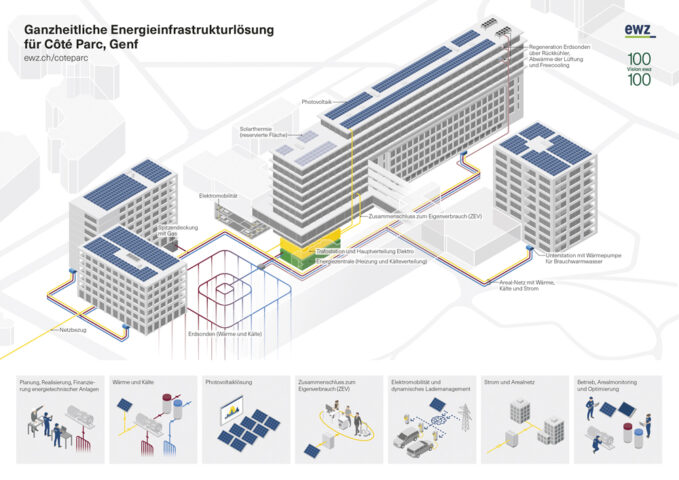
    An interesting practical example of this is the "Côté Parc" project in Geneva. 776 photovoltaic panels on the roofs of the area form the basis for an integrated solar solution with heat pumps, charging stations for electric cars and the area's own power grid, including self-consumption for the users.

    For property owners with large roof areas (from approx. 700 m2), a contracting model is an option worth considering. The provider takes over all services – from planning to financing, implementation to operation over several decades. Including the integration of photovoltaic systems, it is a holistic energy solution with heating, cooling, electromobility and self-consumption models.

    Business customers of ewz can rely on efficient and tailor-made solutions from competent teams with many years of experience. Investment, maintenance and repair costs are not incurred during the contract period. After the end of the contract period – usually 20 to 30 years – the photovoltaic system becomes the property of the customer.

  • «FRZ Zurich Airport Region – My big circle of friends»

    «FRZ Zurich Airport Region – My big circle of friends»

    To person
    Christoph Lang has been Managing Director of the business network FRZ Flughafenregion Zürich (FRZ) since it was founded in 2012. This currently includes over 750 companies and 14 cities and communities. The lawyer and location and business promoter par excellence keeps the FRZ on course for expansion – in the region and beyond. The 68-year-old is also a member of the municipal council in Rickenbach in the canton of Zurich, where he is responsible for the areas of finance, security and transport.

    Mr. Lang, how has the business network FRZ Flughafenregion Zürich (FRZ) developed over the past few years?
    The airport region has developed very well. At the beginning, in 2012, we had 49 members. In the meantime, this number has increased more than tenfold. We count over 750 companies. What makes me particularly happy: In the meantime, we have been able to grow from 8 to 14 cities and communities. Finally, the communities of Volketswil and Bachenbülach joined. The towns and communities recognize that we are only strong together and that this will make the region better known. It is becoming more attractive both for company settlements and for new residents. You can see that in Bülach, for example. The city has grown from around 14,000 to 23,000 inhabitants in the last 15 years. Thanks to the Bülach Nord development with the Glasi Areal, the number of inhabitants will soon rise to around 30,000.

    What are the advantages of the FRZ?
    The company members have realized that they receive a lot of knowledge and important information from the many FRZ events. The annual real estate summit in particular is very popular and is always a top-class and exciting event. The NZZ stated that the real estate summit had positioned itself as one of the most important real estate events in Switzerland. The other networking events also contribute to the fact that on the one hand there are many new settlements and on the other hand there is good cooperation and management among each other. A good example is the marketing success of the billion-dollar project The Circle at Zurich Airport, where over 85 percent of the space has now been marketed – and this despite the corona pandemic. This is a trend that was not expected two or three years ago. According to the latest information from the Circle, they are in contact with new interested parties. In general, we still have around ten percent of office vacancies in the region. Nevertheless, the rentals show us how attractive this space is. Incidentally, this is similar in the airport regions around the world: people want to live and work there. Accessibility is still the be-all and end-all.

    What is your definition of the Zurich airport region today?
    This is the region with around 20 towns and communities around Zurich Airport. However, the Zurich airport region in a broader sense stretches as far as the Rhine, close to Winterthur and Uster. Actually, the Zurich Oberland, the Furttal and the Limmattal are also part of it. You can also see it this way: the airport region is everywhere where people are exposed to aircraft noise, then the canton of Thurgau and central Switzerland are part of it. Air traffic brings with it a certain amount of noise pollution – but also jobs and other advantages. In the future – perhaps in 20 years – aircraft will be significantly quieter. Then aircraft noise will no longer be an issue. I am firmly convinced of that.

    How is the airport doing at the moment and what are the future business prospects?
    The airport has had two difficult years due to the corona pandemic. However, we already had good numbers on certain days in autumn 2021. In October, for example, Edelweiss Air had an occupancy rate of 90 percent. The desire to travel increases. I reckon that the average occupancy this year will be over 70 percent. Of course, this depends on other regions, whether and to what extent the previous travel restrictions are relaxed due to the development of the health and safety situation. I am confident that in 2024 passenger numbers will return to pre-corona levels. The airport invests a great deal in its development, up to one million Swiss francs a day. The entire region benefits from this. Many companies from the airport region have worked on the construction of the circle.

    And what about the sustainability aspects?
    I hope that the path of sustainability will be consistently pursued. This is possible with more efficient aircraft and alternative fuels. It is very important to me that we as a network, as a region and as a society make our contribution to achieving the global climate goals.

    What goals is the FRZ pursuing with the 2022-2025 strategy?
    Within this strategy, information and communication technology (ICT) is very important. For example, we have HP, Isolutions, Microsoft and SAP in the region. Google has its largest location outside of the United States in Zurich. Many data centers are being built in the airport region, almost as many as single-family homes. My vision is that the airport region will become a global ICT hub.

    In February 2022 you launched a so-called "tracker certificate" for the Zurich Airport Region via ZKB. Why?
    There are several thoughts behind this. The airport region has many good and attractive companies, so issuing such a financial product makes sense. If you select 15 to 20 of these successful companies, this results in a very interesting growth profile. The companies contained in the financial product grow and perform above average. Furthermore, it is about advertising for the Zurich airport region. We are the only location and business promoter in Switzerland to have launched such an initiative. For these reasons, we dared to take this step together with the Zürcher Kantonalbank. Now, of course, there is some economic uncertainty because of the unrest in Ukraine. But when the markets have calmed down again, the companies in the ZKB tracker certificate will also show an upward trend.

    The FRZ will celebrate its tenth anniversary in 2022 (…)
    (…) We are very proud that we can celebrate this anniversary with our more than 750 members and the city and community representatives. We will organize something special on the occasion of the Economic Forum, which will again take place in the Salto Natale tent. We were able to win Roland Brack, a very successful guru in online trading, as a keynote speaker. Gian-Luca Bona, longtime CEO of Empa, will honor us as the second keynote speaker.

    Where will the FRZ be in ten years?
    We will continue to be the most personal and digital network in Switzerland. We want to continue to successfully develop the location so that it attracts companies and people. Should I pause for a moment when I am no longer current, I will certainly be happy to attend as many FRZ events as possible. FRZ Zurich Airport Region – that’s my big circle of friends. We want to successfully implement the already mentioned strategy 2022-2025 and of course also grow with the FRZ. For example in the area of sponsoring, where we currently earn around half a million Swiss francs a year. My goal for 2025 is to reach the million mark in this segment and then achieve a total turnover of between three and five million with FRZ. We are currently turning over two million Swiss francs.

    Where do you see room for further real estate projects?
    There are still a multitude of options. I'm thinking of Bachenbülach or the Glasi area in Bülach, as well as the towns and communities to the east of the airport region. There are 15 to 20 major construction projects in the region with a construction volume of over 100 million francs. Everything that is possible from the construction zone is being built over in the area. In Switzerland we have an annual population growth of 40,000 to 50,000. In a few years, Switzerland will have ten million inhabitants. Many of them want to live in an area that is easily accessible. This is particularly important for younger employees. The pressure on the conurbations remains unchanged, that can be clearly seen. Considerations must be made here in Switzerland: What are we going to do with the peripheral regions? It is important to me that the infrastructures in peripheral regions are preserved and are not threatened by emigration. One of my initiatives would be closer cooperation with the Lower Engadine region via the miaEngiadina organization. This is very strong in the digital field. This is an attractive area to work in and perhaps there is also an opportunity for more companies to settle in this unique region of Switzerland.

    Thank you, Mr. Lang, for the interesting discussion.

  • «The real estate industry still has the best years of digitization ahead of it»

    «The real estate industry still has the best years of digitization ahead of it»

    About the person
    As Chief Digital Officer at Steiner AG, Giuseppe Giglio is responsible for digital transformation and the development of new digital products. Previously, he was responsible for the digitization of sales channels and the development of support platforms for private customers at Swisscom.

    Mr. Giglio, what is your job at Steiner AG?
    Together with my team of around 25 people, I am responsible for digital corporate development. Our goal: to keep the company technologically fit and to successfully establish it in new digital markets. A year ago, Steiner AG bundled the competencies for the digital area and gave me responsibility.

    You previously worked outside of the real estate industry. From your point of view, where is digitization in the real estate sector compared to other sectors?
    Other industries were able to benefit from the advantages of digitization earlier. Real estate is still at the beginning of this journey. However, in the many discussions I have had with various companies in our industry, I sense a great willingness to change. There is a kind of spirit of optimism. The real estate sector still has the best years of digitization ahead of it. It was also this circumstance that made me personally decide to switch.

    Was this spirit of optimism stimulated by the corona pandemic?
    The pandemic has certainly put some pressure on pushing digital issues. But I believe that the real estate industry would be at this point even without Corona. Companies don’t want to be left behind and remain competitive.

    Where is Steiner AG ahead in terms of digitization?
    Not least because of its modern IT infrastructure, the company was able to adapt very quickly to the new market conditions of the last two years. For example, we were able to immediately send the staff from the offices to the home office without any problems and ensure operations at all times. We came out of the pandemic more successful and stronger. Steiner AG also consistently relied on BIM for its own developments very early on. Today we can draw on more than ten years of experience in this technology and know all the tricks and pitfalls.

    Which digitization topics are currently particularly in demand?
    The energy and climate targets for 2030 challenge the industry along the entire value chain. In this respect, there is a great deal of demand for topics relating to transparency with regard to environmental indicators. In addition, online collaboration platforms – which are already standard in other sectors – are gradually gaining a foothold in the real estate industry.

    To what extent has BIM already established itself today?
    We find that BIM or parts of BIM are very often used in larger projects. We have also registered high demand for renovations and existing buildings in recent months. We have some catching up to do when it comes to smaller projects or explicitly in the area of building operations. Digitization is always associated with process changes and investments – many companies are still cautious here. We need to show decision makers the benefits of BIM and provide evidence.

    What are the advantages of BIM?
    BIM creates the basis for real networking of real estate projects. If applied consistently and consistently, planning errors can be avoided in an early phase – and it is possible to react faster and therefore more cheaply to new general conditions. Digital planning also enables efficient operation. The benefits for building operations are exponentially greater.

    « Artificial intelligence is already indispensable today »

    Can you give an example of Smart Home?
    The best-known examples are the intelligent control of building technology such as lighting, heating and security solutions, such as door locks or alarm systems. Such solutions are now widespread.

    What are the advantages of Smart Home?
    One speaks today of “Ambient Assisted Living”. Smart technology in the living area, for example, allows older people to stay longer in their own apartment or house and lead a self-determined life, even if they have health restrictions. For example, with the help of sensors that register when someone falls over and immediately trigger an alarm. There is also the option of controlling lights/blinds, etc. barrier-free via speech and not via complicated control elements. Last but not least, this topic also harbors a lot of potential on the investor side.

    Which one exactly?
    A smart home can measure and control the consumption of household technology such as heating or cooling, which leads to a reduction in electricity consumption. This results in lower operating costs.

    How and where are future technologies such as Augmented Reality (AR), Virtual Reality (VR), Artificial Intelligence (AI) already being used today?
    AR and VR are currently still niche topics that are often used as marketing tools. They are excellent for visualizing visions and are breeding ground for inspiration.

    AI, on the other hand, is already a reality more often than you think: For example, when determining costs or detecting anomalies in building operation. Since these processes are usually carried out in the background, the user often does not notice that artificial intelligence or an algorithm is involved. If you plan and build digitally today, artificial intelligence has become indispensable.

    What is necessary for AR and VR to also become suitable for everyday use?
    We have to tackle projects with a «digital first mindset». The earlier a project is tackled digitally, the more profitable it becomes overall. We need more practical examples that show that projects with this way of thinking become more successful. VR in particular is helpful in an early phase to improve cooperation and to quickly make critical decisions. I am convinced that AR and VR will prevail in the real estate sector in the next five years.

    Which digitization solutions are most in demand from partners and subcontractors of Steiner AG?
    Many companies are still at the beginning of their digitization journey. That is why training courses, BIM management and real estate inventories for the digital inventory of the real estate portfolio are currently in particularly high demand.

    In your opinion, how will digitization change the industry in the next five years?
    I believe that digitization is bringing us all closer together. Clients, the public and companies work and exchange information on the same platform and actively shape the project. This leads to a democratization of real estate projects, which in turn leads to more successful and sustainable results.

  • «Set planning framework conditions with foresight»

    «Set planning framework conditions with foresight»

    Zur Person
    Balz Halter ist Hauptaktionär und Verwaltungsratspräsident der Halter AG. Die Unternehmensgruppe der Schweizer Bau- und Immobilienwirtschaft beschäftigt rund 320 Mitarbeitende an den Standorten Schlieren, Bern, Basel, Luzern, Lausanne, Genf und St. Gallen. Der Ingenieur ETH und Jurist ist bekannt für Unternehmergeist und Innovationskraft. So hat sein Unternehmen «The Branch», ein Do-Tank und eine Kollaborationsplattform für eine innovative und integrierte Immobilienwelt, initiiert.

    Herr Halter, Ihr Unternehmen ist seit über 100 Jahren am Markt tätig. Was hat sich seither in der Stadtplanung verändert und was ist gleichgeblieben?
    Unverändert ist sicher immer noch die Anziehungskraft von Wirtschaftsmetropolen wie Zürich. Den Drang in die Stadt gab es schon vor 100 Jahren und er ist heute nicht geringer, wahrscheinlich sogar grösser. Es ist immer noch der gleiche Kampf um günstigen Wohnraum. Das wird ein ewiges Thema in allen Städten bleiben. Anders als damals macht man sich heute kaum Gedanken zu einer übergeordneten Stadtplanung und der Frage, wie sich Stadt über ihre politischen Grenzen hinaus entwickeln soll. Mit Aufkommen des Individualverkehrs und Ausbau der S-Bahnen wurde primär in Infrastrukturen gedacht und geplant. Entstanden ist die konturlose Agglomeration, die weder Dorf noch Stadt ist und ihre Identität sucht. Den Herausforderungen des Wachstums und die damit verbundene Not an zahlbaren Wohnraum begegneten unsere Ahnen vor 100 Jahren mit dem internationalen Städtebauwettbewerb Gross-Zürich, der sich weit über die damaligen Stadtgrenzen Zürichs erstreckte. Es wäre höchste Zeit, wieder einen derartigen Wettbewerb angepasst auf die aktuellen Anforderungen und Herausforderungen zu veranstalten.

    Gibt es hier vielleicht einen Wechsel durch die aufkommende Elektromobilität?
    Wir wissen, dass sich etwas verändern wird, aber wir sehen noch zu wenig klar, was da auf uns zukommt. Wie und wann sich Konzepte des Selbstfahrens, motorisierter Individualverkehr im Sharing-Modell kommen wird, wissen wir noch nicht. Wie dieser im Zusammenspiel mit öffentlichen Verkehrsträgern wie Tram, Bus und Bahn funktionieren oder diese sogar teilweise ersetzen werden, können wir noch nicht abschätzen. Es ist jedenfalls anzunehmen, dass diese Entwicklungen Auswirkungen auf die Stadtplanung haben werden, insbesondere auf den öffentlichen Raum. Möglicherweise werden weniger Parkplätze als Umschlagplätze gefragt sein.

    Im Wandel der Mobilität, von der Pferdekutsche bis zum Automobil und vielleicht sogar bis zur künftigen Drohne als individuelles Verkehrsmittel, muss man wie früher auch schon die Strukturen grosszügig planen, dann kann sich Vieles ergeben. Wir sehen gerade vor der Tür in Schlieren mit der Limmattalbahn oder auch im Glatttal die Wiedergeburt der Strassenbahn. Das ist möglich, wenn öffentliche Räume zur Verfügung stehen. Deshalb wäre es falsch, grundsätzlich von einem Paradigmenwechsel auszugehen.

    Faktor Flugzeug und Flughafen – wie strahlt das auf die Region Zürich und die Immobilienprojekte aus?
    Der Flughafen ist ein Treiber für Arbeitsplätze, Wohlstand und Prosperität. Wir verdanken wohl dem Airport Zürich auch, dass Zürich die Wirtschaftsmetropole in der Schweiz ist. Es war damals ein strategischer Entscheid, den Landesflughafen im Gebiet des damaligen Waffenplatzes Kloten-Bülach anzusiedeln. Davon profitieren wir alle heute in hohem Mass. Wir müssen diesen Vorteil weiter nutzen und dem Flughafen mit seiner Hub-Funktion Sorge tragen, so dass er direkte Verbindungen in alle Welt auch nach Corona bieten wird. Das Reisen wird wieder zunehmen, wenn auch nicht in dem rasanten Tempo, wie wir es zuvor erlebt haben. Der Flughafen Zürich hat eine enorm grosse Bedeutung und ich hoffe, dass das auch so bleibt.

    Braucht es einen Flughafenausbau, und falls ja, wie und wann?
    Im Wettbewerb der Volkswirtschaften ist die Schweiz als Binnenland und Exportnation auf diese Stärke angewiesen. Wir müssen den Flughafen als langfristiges Projekt verstehen, dass sich wandelnden Bedürfnissen anpassen kann und muss. Deshalb müssen wir planerisch und regulatorisch die Basis schaffen, dass ein weiterer Ausbau möglich bleiben wird. Ob das dann wirklich geschieht, steht auf einem anderen Blatt. Das können und müssen wir nicht heute oder morgen entscheiden. Aber die Rahmenbedingungen müssen mit Weitsicht gesetzt werden.

    Im Moment sind Lärm und Nachhaltigkeit sowie fossile Brennstoffe grosse Themen. Dank Fortschritt bei neuen Antriebsmodellen und bei der Energiegewinnung wird es auch in der Flugindustrie zu Veränderungen kommen. Es wird andere Kraftstoffe geben, die nachhaltiger sind. Die Lärmbelastung durch den Luftverkehr wird von Jahr zu Jahr weiter sinken. Auch deshalb können und sollten wir Weichen stellen, um einen Airport-Ausbau zu ermöglichen und Wachstum zuzulassen.

    In der Flughafenregion sind Sie zuhause und haben bereits eine Vielzahl an Projektentwicklungen mit Ihrer AG realisiert. Die jüngste in dieser Reihe ist eine Neuüberbauung in Wetzikon in unmittelbarer Nähe zum Bahnhof. Was ist hier der aktuelle Stand und was entsteht dort genau?
    Das Zentrum Metropol, so der Name des Projektes, ist in meinen Augen ein wegweisendes Vorhaben, das als Modell für Zentrumsüberbauungen in Subzentren dienen könnte. Aus der Sicht des Stadtentwicklers ist es deshalb spannend, weil wir es mit der Um- und Neunutzung eines Einkaufszentrums zu tun haben. Shoppingcenter kennt man aus den 1960er und 1970er Jahren und mit dem Projekt Metropol erfolgt in Wetzikon eine Neuinterpretation dieses Modells. Geplant ist ein neuartiges Einkaufskonzept, das auch nach aussen strahlt. Wir bauen einen Stadtbaustein, der die verschiedenen öffentlichen Räume vernetzt und das Leben dort unterstützt. Wir interpretieren Stadt quasi neu. Es wird nicht mehr ein in sich geschlossenes System sein, sondern ein offener, zugänglicher und vielfältiger Ort für alle. Die Nutzungen werden gemischt sein: neben Retail- entstehen Dienstleistungsflächen, Wohnungen sowie Angebote für Coworking und neue Formen des Zusammenarbeitens. Wir streben einen guten Mix an, so dass der Ort lebt, nicht nur zu Büro- oder Geschäftszeiten. Wetzikon soll an Attraktivität gewinnen, gegenüber den grossen Zentren Zürich und Winterthur, so dass die Leute in ihrer Stadt bleiben.

    Stichwort «Digitales Planen und Bauen»: Mit Raumgleiter besitzt Halter hier eine wegweisende und innovative Schwestergesellschaft. Was wird heutzutage noch analog gemacht und was bereits alles digital?
    Raumgleiter ist ein Pionier im Bereich Virtualisierung, digitaler Planungs- und Bauprozesse auf der Basis von 3D-Modellen, respektive des digitalen Zwillings eines Gebäudes. An diesen Themen arbeiten wir bei Raumgleiter, aber eigentlich in allen Unternehmen unserer Gruppe. Doch: Immobilien sind und bleiben real. Deshalb ist deren Realisierung und auch vieles im Betrieb analog und wird es auch in Zukunft bleiben. Die Digitalisierung hilft uns jedoch, die heute sehr komplexen, hoch fragmentierten Bau- und Betriebsprozesse neu zu gestalten. Das Ziel muss sein, dass Gebäude effizienter und nachhaltiger erstellt und betrieben werden können, in hoher Qualität und ausgerichtet auf die tatsächlichen Bedürfnisse ihrer Nutzer. Wir stehen noch am Anfang: die Digitalisierung bietet unserer Industrie jedoch ein enormes Potenzial.

    Welche Rolle spielt dabei der von Ihnen mitinitiierte Do-Tank «The Branch»?
    Im Branch kommen viele verschiedene Beteiligte aus der Bau- und Immobilienwirtschaft zusammen: Unternehmer, Dienstleister, Bauherren, Investoren und finanzierende Institute. Wir als Halter-Gruppe sind auf Planer und Unternehmer angewiesen, wenn es um die Entwicklung und Realisierung von Gebäuden geht. Deshalb müssen wir Partner haben, die denken wie wir und die bereit sind, neue Prozesse, Produkte und Tools zu entwickeln und auszuprobieren. Deshalb laden wir Gleichgesinnte aus der Branche ein, auf unserem Weg in die Digitalisierung mitzumachen und durch innovative Konzepte neue Geschäftsmodelle, Berufsbilder und Plattformen zu schaffen und zu gestalten. Wir sind ein Do-Tank. Es geht nicht nur darum nachzudenken, sondern konkret zu handeln. Das können gemeinsame Pilotprojekte sein oder sogar gemeinsame Unternehmungen. Diese Initiative ist auf sehr offene Ohren gestossen. Wir haben enormen Zulauf von Bauunternehmern, Zulieferern, institutionellen und privaten Investoren und Planern. Wir sind auf einem sehr guten Weg, ein neues Verständnis und neue Denkmodelle in unsere Industrie hineinzubringen. Ziel ist es, über die Innovation hinaus unsere Wirkung zu verbessern, insbesondere auch bezüglich Nachhaltigkeitsaspekten und einer zirkulären Wirtschaft.

    Vieles in der Digitalisierung hängt scheinbar von gemeinsamen Standards ab. Sollten diese national oder besser international sein?
    Ich glaube, man überschätzt die Möglichkeiten einer Standardisierung, eines technokratischen Ansatzes in einer Zeit der sich rasch wandelnden technischen Möglichkeiten. Es ist verführerisch zu sagen, wir handeln alle gleich und wir denken alle gleich. Aber die Bauindustrie ist extrem regional und wenn man diese international und global betrachtet, findet man so viele unterschiedliche Kulturen, Usancen, aber auch Normen und Standards. Man kann sehr viel Energien verschwenden, wenn man versucht, den einen gemeinsamen Standard zu bauen. Man muss sich vielmehr an der Denkweise der Softwareindustrie orientieren. Dort ist nicht die Frage, ob alles nach dem gleichen Modell funktioniert, sondern wie kann man das «Handover» zwischen den verschiedenen Lösungen mit den richtigen Programmierschnitt- stellen hinbekommen. Am Ende werden sich aus diesen technischen Innovationen auch gewisse Industriestandards formieren. Diese sind dann nicht kraft Definition entstanden, sondern aus Bewährtem im Arbeitsalltag.

    Wie schaut Raumplanung und Stadtentwicklung in 20, 50 oder gar 100 Jahren dann aus?
    Ich bin kein «Digital Native» und keiner, der sich in den «Metaverses» herumtreibt. Aber auch zukünftige Generationen werden reale Geschöpfe bleiben und in der analogen Welt leben. Daran wird sich nichts ändern. Deshalb lohnt sich ein Blick zurück und zu schauen, wie Städte vor 100 Jahren gebaut wurden. Sie sind damals menschengerecht geplant und realisiert worden. Wir leben noch heute in diesen Städten und schätzen gerade diese bewährten Stadtstrukturen und Quartiere sehr. Natürlich verändern sich Möglichkeiten und Bedürfnisse. Die Grundstrukturen funktionieren aber noch, die wesentlichen Elemente, die Stadt ausmachen, bleiben die gleichen. Das ist vor allem am öffentlichen Raum abzulesen, den man früher mit Grosszügigkeit und Weitsichtigkeit, aber auch zuweilen mit einer gewissen ‘Verengtheit’ geplant hat. Das sind heute spezifische Qualitäten, die wir sehr schätzen.

    Wenn man Bilder vom Zürcher Bellevue vor 100 Jahren anschaut: Das war ein riesiger Platz, wo nicht viel passierte. Irgendwann kam das Tram, die Pferdekutschen verschwanden und dann sind die Autos, Zweiräder und Busse dazugekommen. Das konnte alles aufgenommen werden und funktionierte. Man muss offen sein für künftige neue Bedürfnisse und auch neue technologische Möglichkeiten. Grosszügige öffentliche Räumen schaffen Identität, Flexibilität und die Chance neue Entwicklungen zuzulassen. Das ist eine Qualität, die auch den Menschen gerecht wird und die die Attraktivität der Stadt ausmacht. Wenn wir an den bewährten Grundelementen weiterarbeiten, wird die Stadt in 100 Jahren zwar grösser und vielzähliger, aber nicht deutlich anders ausschauen. Gewisse Flächen und Räume werden anders bespielt werden als heute. Aber die Anziehungskraft von Städten wird bleiben.

  • This is what office design looks like today

    This is what office design looks like today

    How and where do we like to work or work best? This is the question that occupies employees. And the challenge that companies are dealing with.

    The change from a culture of presence in hierarchical structures to a culture of trust and performance in networks is progressing. We are becoming more and more used to getting involved in common corporate goals regardless of time and place. The involuntary mass home office test in particular has shown how the definition of the workplace is changing over the long term. Companies are reactivating their offices and asking themselves: are our workspaces still up to date? It's obvious: The office with future prospects goes beyond the walls of the company headquarters. A new design normality is emerging that supports hybrid use and regards the office as part of an ecosystem.

    What does office design look like today?

    It depends on the location
    In addition to the premises, the location is decisive for how much we are motivated to commute to the office. Employees expect good accessibility by public transport and the best catering and shopping options on site.

    Cheers to diversity and freedom of choice
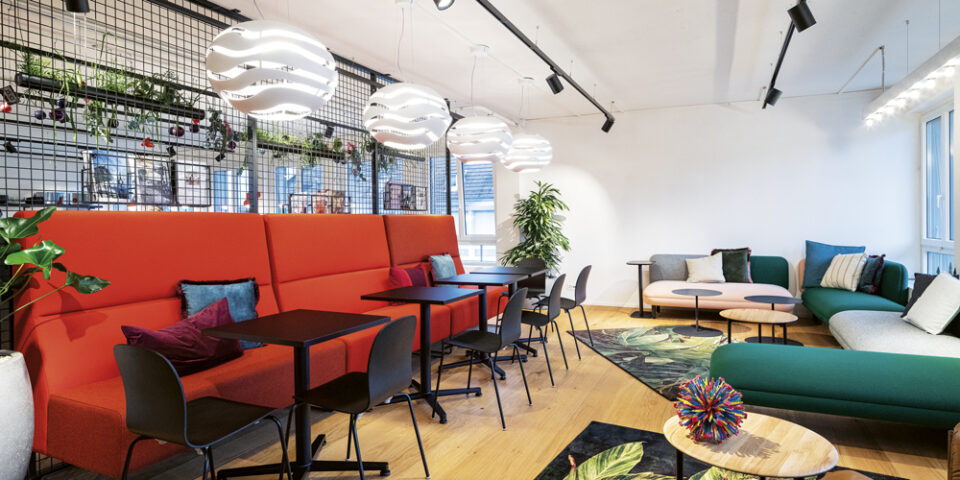
    An attractive office is a working environment in which employees can choose the zone that best suits their current activity. So a mix of project, creative, meeting and focus rooms as well as lounge-like meeting zones. And not to forget: the workplace with the height-adjustable desk for focused individual work. Alternatives such as home office, coworking space or coffee house expand the range of work outside of the office.

    The neighborhood is our territory
    So-called home bases or hubs provide orientation in the office. These are neighborhoods where teams come together. Rituals are also beneficial for mutual exchange: for example the fixed office day, the team breakfast or cooking lunch together. The office design is crucial for establishing social activities among employees.

    Do not disturb!
    Online meetings will remain an integral part of everyday work in the future. Of course it's annoying when everyone makes the calls in the open team office. The solution? Opportunities to retreat in the form of "telephone booths" with good acoustics, ventilation and lighting. Larger cubicles are perfect for one-on-one conversations or as a temporary individual office.

    Acoustically optimized workplace for collaborative teamwork.

    Preferably hybrid
    Zoom & Co. for digital meetings make the journey to the site superfluous. At the same time, we also value physical encounters. It is not a question of whether the collaboration is hybrid, but rather how much. The key lies in the spatial integration and intuitive operation of the technology.

    The office as a feel-good place
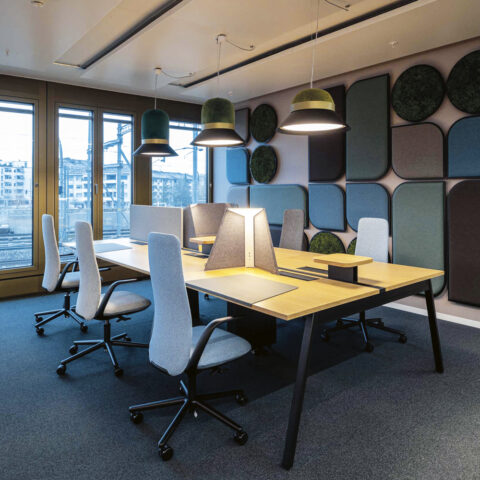
    How a room is designed demonstrably influences engagement, perceived appreciation and satisfaction. The acoustics are particularly important: Speech intelligibility should be high in meeting and communication rooms, but it should be as quiet as possible in open spaces. Targeted lighting and plants also ensure a pleasant working atmosphere.

    Office? Yes of course!
    The more natural the environment, the better we feel. Naturalness can also be achieved in the office with furniture and decoration. What is not visible at first glance, however, is the sustainability of the materials used. Wood from sustainable forestry, fabrics made from recycled materials or refurbished furniture give the office additional inner values.

    Space for chance encounters and conversations.

    Take the opportunity to shape the identity and culture of your company with the physical work environment. Show your employees why it is worth coming back to the office in the future.

    To person
    Oliver Hauri is the Vice President of Central & Eastern Europe and Managing Director at Haworth Schweiz AG.

    In his role, he is responsible for Haworth's leadership and growth in Central and Eastern Europe. The family company is one of the world's leading solution providers for furnishing inspiring learning and working environments.

    haworth.com

  • «A generalist training is well suited for a job as a location promoter»

    «A generalist training is well suited for a job as a location promoter»

    Location promoters maintain a network that ranges from companies to educational and research institutions, specialist organizations and public institutions to creative personalities. On the one hand, they promote the location through image campaigns, trade fair appearances and through personal contact with investors. On the other hand, they are committed to innovation, support company settlements, support SMEs and start-ups and thus promote continuous development, the variety of industries and the innovative strength of a business location.

    In Switzerland, around 300 people carry out the work of location promoters. There is currently no recognized professional qualification and no uniform training. The Swiss Association for Location Management (SVSM) is in the process of defining the job profile and coordinating and standardizing the training. In doing so, it relies on cooperation with universities, technical colleges and consulting firms.

    Immo!invest spoke to two experienced professionals to find out which talents and qualities are advantageous for the job of location promoter, where the challenges lie and what they advise for those starting their careers.

    To person
    Albert Schweizer has been head of real estate for the city of Schlieren since 1998 and has also been the promoter of the location since 1999. He completed an apprenticeship as a craftsman, obtained a diploma in real estate management in the very first SVIT training and completed his master's degree in real estate management at the FHS St. Gallen in 2004 as a real estate economist. From 1984 to 1998, Schweizer built up the management/purchase/sale department at a larger general contractor in eastern Switzerland. Today he is a founding member (2001) and board member of the SVSM as well as a board member of Bio-Technopark Schlieren, Start-Smart-Schlieren, IG Rietbach and Healthtechpark Zurich-Schlieren.

    How does your day-to-day work look like, described in five sentences?
    In my job as Head of Real Estate and Location Promotion for the city of Schlieren, a high level of flexibility is required above all. Since I work in a cluster system, I constantly delegate tasks to those responsible. In addition, I oversee up to 15 parallel projects that require a lot of my time and attention. For this reason, I am not always immediately available at short notice.

    What training is suitable for practicing the profession of location promoter?
    I have a master's degree in real estate from the St. Gallen University of Applied Sciences. I have also been active in the real estate scene for around 40 years. Basically, I am of the opinion that general training in the real estate sector is very well suited to working as a municipal location promoter.

    Which talents and qualities are important?
    Far-sightedness, sustainability and especially perseverance are certainly of great advantage. You have to like people and real estate and you are forced to do all the required work from A to Z yourself.

    What do you value most about your job?
    The work in the background and the chance to be able to make a difference personally.

    Where do you see the biggest challenges?
    Like so many professions, ours will change completely and become more digital. You need a very large network. Internationality and the associated languages will be a major topic in the future.

    In your opinion, how else will the job profile of location promoters change in the future?
    I think that in future there will be a need for uniform vocational training, or at least one course for the profession of location promoter with a corresponding qualification.

    What advice would you give to young professionals in order to successfully gain a foothold in their profession?
    Above all, young real estate professionals should look at job advertisements from location promoters and continue their education.

    What milestones and highlights have you achieved and experienced in your professional life so far?
    I was able to make a significant contribution to the fact that the city of Schlieren can look back from 650 company settlements in 2000 to 1200 in 2021. This pleasing development also created around 5,000 new jobs. In the city of Schlieren, I was able to successfully and sustainably introduce the biotechnology, start-up funding and medical/healthtech clusters.

    To person
    Mario Epp completed his Masters in International Affairs and Governance at the University of St. Gallen (HSG) in 2018. After his internship at the Swiss Embassy in Baku, he worked as a project manager at Limmatstadt. Most recently, he was a campaign employee for the FDP before the Uri native took over his current job as project manager for location promotion for the canton of Uri in December 2021.

    What training is suitable for practicing the profession of location promoter?
    The activity as a location promoter covers a wide range. That's why a generalist education, like the one I was able to enjoy at the University of St. Gallen (HSG) in International Affairs and Governance, is a great advantage. In my opinion, there is no such thing as perfect training: you don't learn how to promote a location during your studies, but through practice. I consider economic affinity, good project management skills and sociability to be key requirements.

    What do you value most about your job?
    The diversity and in more ways than one: You meet a wide range of personalities with different backgrounds from all sectors. The field of activity is just as varied: it ranges from site visits with those interested in relocating to networking events to economic policy analyses. Hardly any day is like the other. Above all, I am convinced that Uri as a business location is wrongly underestimated. For the benefit of the population and economy of Uri, I can contribute to making even better use of the canton's potential. I really appreciate doing such a meaningful job.

    Where do you see the biggest challenges?
    This certainly includes focusing on the essentials. The inquiries and concerns that are brought to the location promotion are just as varied as the profession. Assessing and prioritizing what is most likely to benefit the Uri location is a challenge.

    In your opinion, how will the job profile of location promoters develop and change in the future?
    With the emerging global minimum taxation, Switzerland is losing a location argument that should not be underestimated. But fortunately, Switzerland and especially Uri have other convincing locational advantages. As a result, I assume that competition for new business in Switzerland will intensify. In addition, fueled by digitization and the home office trend, soft factors such as the quality of living and leisure time are increasingly becoming the focus. However, soft factors are more difficult to convey. I therefore assume that the role of location promoter will become even more important and that the profession will continue to gain importance as a result.

    What advice would you give to young professionals in order to successfully gain a foothold in their profession?
    Knowing the trade of the location promoter is one thing. But what is just as important: Passion for your location. Without this passion, it will be difficult to attract companies and people to the location. I'm lucky here: I have strong ties to my home canton. That makes it easier to get people interested in the attractive Gotthard canton.

    What milestones and highlights have you achieved and experienced in your professional life so far?
    The Uri Startup Week, which will take place for the first time in autumn, should certainly be highlighted here. In this way, the location promotion wants to inspire young companies and knowledge workers for the Uri location and emphasize its advantages. Another highlight is my work for the Swiss embassy in Baku, where I gained insights into diplomacy for a year and was also able to inform Azerbaijanis about Switzerland and get them excited about our country.

  • Dynamic growth uninterrupted

    Dynamic growth uninterrupted

    Ende 2021 zählten die 14 Städte und Gemeinden 189’000 Einwohnerinnen und Einwohner, das sind 8454 oder 4,7 Prozent mehr als Ende 2018. Dabei handelt es sich um das Kerngebiet der Flughafenregion. Die entsprechenden 14 Städte und Gemeinden sind Teil der FRZ Flughafenregion Zürich, Wirtschaftsnetzwerk & Standortentwicklung. Auch die Zahl der Beschäftigten hat sich erhöht: Sie wuchs seit 2018 um 5258 oder 3,6 Prozent, verglichen mit der letzten Erhebung Ende 2020. In der gleichen Zeitspanne stieg die Zahl der Wohneinheiten um 3,2 Prozent auf 88’541. Das bedeutet, dass die Flughafenregion auch als Wohnstandort attraktiv ist. In den vergangenen zehn Jahren ist die Zahl der Einwohnerinnen und Einwohner stärker gestiegen als die Zahl der Arbeitsplätze.

    Derzeit werden in der näheren Flughafenregion Zürich viele Bauprojekte von überregionaler Bedeutung realisiert, andere sind in Planung. In Dübendorf wurde Mitte 2019 das höchste Hochhaus für Mietwohnungen in der Schweiz bezogen (JaBee Tower). In den Jahren 2020 und 2021 entstand beim Flughafen Zürich eine moderne Destination mit über 6000 Arbeitsplätzen (The Circle). Zu den Mietern gehören unter anderem: Abraxas, Dufry, Edelweiss, Flughafen Zürich, Horváth, Hyatt, Inventx, Isolutions, Jelmoli, Kieser Training, Microsoft, MSD, Neuroth, Novo Nordisk, NTT Data, Omega, Raiffeisen Schweiz, Oracle, Raiffeisen, Sablier, SAP, Singapore Airlines, Totemo, Universitätsspital Zürich und Vebego.

    Der Bau von Rechenzentren beschleunigt sich. Zwischen 2019 und 2022 werden in der Flughafenregion Zürich Rechenzentren im Wert von über einer Milliarde Franken gebaut. Zu den Investoren gehören Green Datacenter AG, Interxion, NTT Data und Equinix. Ihre grössten Kunden sind Google, Microsoft und Amazon Web Services. Der Grossraum Zürich gehört mittlerweile europaweit zu den wichtigsten Datacenter-Hubs nach London, Frankfurt, Paris, Amsterdam, Dublin und Berlin. Die Forschung und Entwicklung soll mit dem geplanten Innovationsparks Zürich am Standort Dübendorf – Teil des Schweizerischen Innovationspark – vorangetrieben werden. Die Themenschwerpunkte für den Innovationspark Zürich sind wie folgt definiert: Life Science und Lebensqualität, Engineering und Umwelt, Digitale Technologien und Kommunikation. Der Park soll die Zusammenführung des Wissens der Zürcher Hoch- und Fachhochschulen mit der Praxis- und Markterfahrung führender Unternehmen fördern.

    USP
    Die Flughafenregion Zürich gehört zu den schnellstwachsenden Regionen der Schweiz. Die hervorragende verkehrstechnische Lage ist ein wichtiger Wettbewerbsvorteil. Hier haben viele internationale Konzerne ihren Sitz. Die Hochschulen und ihre Forschungseinrichtungen sind in unmittelbarer Nähe. Das gilt ebenso für Naherholungsgebiete und Shopping Centers. Seit einigen Jahren entwickelt sich erfolgreich ein ICT-Cluster – von Datacenter-Anbietern bis Kreativwirtschaft.

    Testimonials

    Remo Weibel
    Global Sana

    Der Richtsatz für 10-jährige Festhypotheken ist seit Anfang Jahr stark gestiegen. Grund dafür ist die Zinserhöhung der US-Notenbank. Wir gehen davon aus, dass die SARON-Hypothek nach wie vor attraktiv bleibt, da noch einige Zinsschritte der SNB nötig sind, bis die Zinssätze für SARON-Hypotheken steigen.

    Gregor Meili
    Kenny’s Auto-Center AG

    Die Flughafenregion zeichnet sich durch eine hohe Dynamik aus. Das ist der Verkehrsknotenpunkt der Schweiz und in der Mobilität spielt Kenny’s Auto-Center eine wichtige Rolle. Deshalb investieren wir hier und an weiteren Standorten. Wir bauen aus, um für die Herausforderungen der Zukunft vorbereitet zu sein.

    Patrick Angioy
    Seitzmeir Immobilien AG

    «Die Flughafenregion erweist sich als leistungsfähiger Wirtschaftsstandort mit maximaler Verkehrsinfrastruktur und bietet Unternehmen jeglicher Grösse hervorragende Voraussetzungen für ein erfolgreiches Business – regional, national wie auch international. Dank eines attraktiven Steuerfusses, einer unkomplizierten Ansiedlungspraxis und innovativen Neubauprojekten wie z. B. dem WestGate (www.westgate-zurich.ch), gehört Kloten meines Erachtens bei jedem erfolgsorientierten Unternehmen auf die Watchlist bei der Suche nach einem neuen Standort.»

  • The Glattalbahn is getting longer

    The Glattalbahn is getting longer

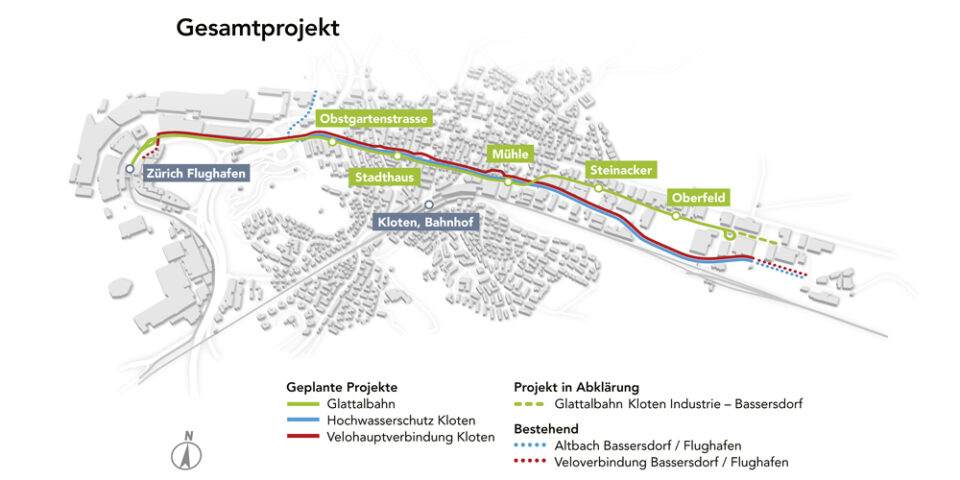
    The transport system in the Kloten region is reaching its limits. The consequences are increasing hours of traffic jams and severe noise and air pollution. The Glattalbahn extension to Kloten promises a chance for improvement, which, in addition to the extension of the tram line between the airport and the Steinacker development area in Kloten, includes two other sub-projects: A main bicycle connection with a separate footpath and flood protection for Kloten and for the airport. The spatial proximity and the dependencies of these sub-projects require joint project planning and construction. This means that the canton of Zurich can effectively and sustainably master three challenges in one project and make optimal use of synergies.

    On July 16, 2020, VBG Verkehrsbetriebe Glattal AG (VBG) submitted the application for the infrastructure concession to the Federal Office of Transport (BAV). The procedure examined whether there was a public interest in the construction and operation of the new tram connection and whether there were no significant public interests – for example environmental protection or nature and heritage protection – opposed to the granting of the concession. The Federal Council examined the application and decided to grant the license to the VBG. This decision cannot be contested. There will be opportunities for objections at a later point in time during the public approval of the plan.

    The VBG is currently working on the construction project that forms the basis for the cantonal loan approval. The decision of the cantonal council is expected in 2024. This is subject to an optional referendum. The project was submitted to the federal government in June 2021 as part of the 4th generation agglomeration programme. This will probably decide on co-financing by the end of 2023. The approval process (plan approval process under the Railway Act) is expected to run in parallel from 2023. Construction is currently expected to start in 2026, subject to legally binding planning approval and secured funding from the canton and the federal government. The construction work will take around four years.

    The Glattalbahn has big plans.
  • Schindler has set a goal of zero net emissions by 2040

    Schindler has set a goal of zero net emissions by 2040

    "Now we need climate protection measures," said Silvio Napoli, chairman of the board of directors and chief executive of Schindler. "We have probably set the most ambitious goals in our industry to accelerate the transition to a low-carbon future."

    The SBTi confirmed both Schindler's short-term and long-term goals. Schindler's short-term target for 2030 includes an absolute reduction of greenhouse gas emissions from its operations by 50%, starting from base year 2020. This includes direct emissions caused by the fleet, buildings and processes of the company (Scope 1), in addition to the indirect emissions Emissions from the purchase of electricity, heating and cooling (Scope 2). Furthermore, Schindler wants to reduce emissions in its value chain by 42% (Scope 3).

    In addition, Schindler has set a science-based, long-term emission reduction goal of achieving net zero emissions by 2040. This must be achieved through an absolute 90% reduction in greenhouse gas emissions in the fields. 1, 2 and 3, starting from base year 2020. In line with SBTi criteria and recommendations, Schindler is prioritizing decarbonisation through direct emission reduction while working to neutralize its residual emissions.

    The science goals use the latest climate science to achieve the Paris Agreement's goals: limiting global temperature rise to 1.5 ° C above pre-industrial levels. The short-term goals describe how organizations will reduce their emissions over the next five to ten years. The long-term goals indicate the level of emissions reductions organizations will need to achieve net zero emissions by 2050 at the latest. They are created by companies and validated by the Science Based Targets Initiative (SBTi), a partnership between the Carbon Disclosure Project (CDP), the United Nations Global Compact (UNGC), the World Resources Institute (WRI) and the World Wide Fund for Natura (WWF).

    Schindler also released its 2021 Sustainability Report today. It outlines its progress towards the 2022 Sustainability Roadmap and presents the results of the recently completed materiality assessment, which will feed into the 2030 Sustainability Roadmap.

    The report also illustrates how Schindler is working with clients to help them meet their climate goals and with other real estate players to drive the necessary change. Schindler has been publishing a sustainability report every year since 2011.

    Source group.schindler.com for download

  • Negative effects of the Ukraine war on the real estate industry in Switzerland

    Negative effects of the Ukraine war on the real estate industry in Switzerland

    The Ukraine war has global economic ramifications. How do you feel it in the local real estate market? PriceHubble investigated this question with a survey of real estate professionals from all areas of the real estate industry.

    55 percent of the real estate professionals who took part in the current study "Effects of the Ukraine War on the Real Estate Industry in Switzerland" believe that the Ukraine crisis could have a negative impact on their company over the next twelve months. 31 percent think there will be no impact. In contrast, 14 percent of respondents see a positive development for their business.

    According to those surveyed, the reasons for a change are the increase in construction costs, rising mortgage interest rates and a stagnating or declining buyer's market. As one real estate manager comments: «The increase in material costs and delivery times affects both the construction sites and the purchase prices. As a result, buyers will resort to existing goods and abandon construction projects.”

    In general, more real estate professionals (28 percent) see a decrease in the number of mandates over the next twelve months than an increase (17 percent). More than 55 percent of those surveyed do not expect any change in the number of mandates.

    50 percent of the respondents are of the opinion that projects will not be postponed because of the Ukraine war. 9 percent expect a postponement of up to 6 months, 12 percent a delay of 6 to 12 months, 26 percent of 12 to 18 months, 2 percent a postponement of the projects by 18 to 24 months and another 2 percent even by up to to 24 to 30 months.

    Development of luxury properties difficult to predict
    In the case of luxury real estate, 34 percent of those surveyed stated that they expected prices to rise. In contrast, 31 percent believe that a decline is to be expected. 35 percent are of the opinion that the prices in this segment will not change.

    In the comments column to this question, many of the respondents indicated that they expected a decrease in general interest in objects in this segment. Others are of the opinion that luxury real estate is crisis-resistant and that the strong demand will remain. Many are also convinced that the supply will remain stable.

    "Luxury real estate in Switzerland, especially in exclusive locations, will always tend to find buyers (both domestically and abroad) and it is therefore possible that the prices for them remain the same or may even rise," comments one broker.

    Price development of energy-efficient objects remains exciting
    When it comes to the question of whether a greater price change is to be expected when buying properties with a high energy efficiency class (A or A+), there is a tie: 50 percent say "yes" and 50 percent say "no".

    With regard to the demand for real estate with a high energy efficiency class since the beginning of the Ukraine crisis, 68 percent of the real estate experts surveyed stated that they had not noticed any change. "But it will come, people are slowly becoming sensitive to it," a real estate manager commented on this question. 32 percent of those surveyed believe that demand has already increased.

    Regarding rental prices for properties with a high energy efficiency class (A or A+): 69 percent of the participants stated that there will be no changes. In contrast, 31 percent expect a change.

    Further results, for example on the impact of rising mortgage interest rates, the development of rents or sales prices of residential properties can be found in the complete study.

  • Popety.io is expanding into German-speaking Switzerland

    Popety.io is expanding into German-speaking Switzerland

    Popety.io specializes in digital solutions for real estate acquisition. Specifically, the PropTech based in Plan-les-Ouates has developed a digital tool for collecting and processing real estate data. After successfully establishing itself in French-speaking Switzerland, Popety.io now also wants to open up the German-speaking Swiss market. To this end, Popety.io has already set up its first office in Zurich.

    The Vaudoise Insurance Group supports Popety.io in its expansion plans. “Popety.io is revolutionizing the Swiss real estate market with the help of artificial intelligence,” says Stefan Schürmann, Head of Corporate Development and M&A at Vaudoise, in a statement by the insurance company. “We keep a close eye on innovations in the real estate sector and are convinced of the development potential of the young company in the German-speaking Swiss market.”

    Two years ago, Popety.io won first prize at the Real Estate & New Technology Awards, the statement said. “With Vaudoise Insurance, we can develop further and gain credibility,” Popety.io founder Thibault Clément is quoted there as saying. The PropTech also takes part in The Big Handshake . The congress for real estate professionals will take place on June 21st in Schlieren ZH.

  • Catalog recommends materials against urban heat islands

    Catalog recommends materials against urban heat islands

    The federal government has presented a reference work for new buildings and buildings to be renovated that shows the effect of building materials on the heat in urban and densely populated areas. It was created by the University of Applied Sciences Northwestern Switzerland on behalf of the Federal Office for Housing ( BWO ).

    According to a media release by the BWO, the catalog compares materials for outdoor use such as floor coverings and facades and explains their effect on the outside temperature. It also takes into account other properties of the materials, such as how they reflect sunlight or how much water floor coverings allow to seep away.

    The BWO calls on planners, developers and house owners to consult this material catalog when choosing suitable materials. In addition, the Office invites the scientific community to further develop and research the topic. Because according to the latest climate scenarios, the average temperatures in Switzerland will be 2.5 to 4.5 degrees higher by 2060 than in the period from 1981 to 2010. This means that the buildings that are being built or renovated today will be the microclimate of tomorrow shape.

  • FHNW strengthens the Institute for Digital Building

    FHNW strengthens the Institute for Digital Building

    The Institute for Digital Building at the FHNW has won Eder Martinez as a professor. According to a press release , the focus of his teaching will be on digital twins and the information lifecycle. “Anyone who wants to build with digital support and needs-oriented in the future must be able to collect, automate, map and process information in a targeted manner,” explains Manfred Huber, head of the institute, explaining the background to the focus.

    Martinez received his master’s and doctorate degrees in Civil and Environmental Engineering from the University of California, Berkeley (UCB). Among other things, he worked as a civil engineer and specialist for cooperation processes on construction sites in Chile and Ecuador. He has also supported companies such as Hilti and Implenia in digital construction projects.

    The FHNW only founded the Institute for Digital Building in 2018. According to the university, it has grown significantly since then. With Martinez, the second professorship in the field of information management will be filled this year.

  • Holcim partners with Madaster

    Holcim partners with Madaster

    Holcim Switzerland wants to do more for the circular economy in the construction industry. In this context, the building materials company has entered into a partnership with Madaster , according to a press release .

    Madaster is working on so-called material passports for new and existing buildings. With these material passports, construction waste is given an identity and can be cataloged and reused as resources. The aim is to avoid waste and promote the circular economy in the construction and real estate sector.

    The Madaster platform can also be used during the design phase of buildings to compare different construction methods and material options. Manufacturers of building materials – such as Holcim – can compare and present their products with the product databases on Madaster. They can also trace their products to enable reuse if necessary. Madaster’s services are marketed in Switzerland by Madaster Services Switzerland AG, based in Zurich.

    Holcim Switzerland has set itself the goal of producing only climate-neutral and fully recyclable building materials by 2050. The new partnership should now help to achieve this goal. “By using Madaster when planning buildings, the right decisions for recyclable and resource-saving materials can already be made today,” says Christophe Berset, Team Lead New Solutions at Holcim Switzerland, in the press release. “The more transparency there is at the product level, the more future-proof buildings can be planned, built and dismantled, and materials and products can be used in further phases of use,” he adds.

  • The dream of a family home in the country is becoming more and more of a dream

    The dream of a family home in the country is becoming more and more of a dream

    Das Einfamilienhaus erweist sich einmal mehr als Wohntraum Nummer 1 in der Schweiz. Bei Personen im Alter von 25 bis 30 Jahren ist der Wert mit 64 Prozent am höchsten. Stehen soll es auf dem Land. Ländliche Gegenden bleiben mit 48 Prozent Zustimmung auch in diesem Jahr die bevorzugte Wohnumgebung. 90 Prozent der Menschen, die auf dem Land leben, wollen auch in Zukunft dortbleiben. Bei der Stadtbevölkerung zeigt sich ein anderes Bild: Nur 65 Prozent der Befragten erachten die aktuelle Wohnumgebung als den bevorzugten Wohnort. Finanzielle Gründe sind die am meisten genannte Hürde (40%), die gegen einen Umzug spricht. Der Arbeitsweg bleibt trotz vermehrtem Home-Office der zweitwichtigste Hinderungsgrund.

    Kosten und Aussenbereich dominieren bei der Wahl eines Zuhauses – nicht das Home-Office
    Wichtigstes Kriterium bei der Wahl einer Wohnung resp. eines Hauses bleiben die Wohnkosten, gefolgt vom Aussenbereich. Neu abgefragte Kriterien wie das separate Zimmer für Home-Office oder ökologische Faktoren werden kaum als entscheidend genannt, aber von rund der Hälfte der Befragten zumindest als wichtiges Kriterium angesehen. Eine Lademöglichkeit fürs E-Auto, Service-Dienst-leistungen oder Luxuseinrichtung spielen bei der Wahl eines Zuhauses kaum eine Rolle.
    Bezüglich der Lage soll die Traumimmobilie ruhig (66%) und naturnah (66%) stehen. Zudem ist eine gute Anbindung an den öffentlichen Verkehr (51%) gefragt. Hier hat sich im Vergleich zum Vorjahr wenig verändert. Die Nachbarschaft wird von 41 Prozent der Befragten als besonders wichtig angegeben und liegt damit neu auf Rang 4 – zwei Plätze höher als letztes Jahr. Und auch die Nähe zur medizinischen Versorgung gewinnt einen Platz auf Kosten der Nähe zur Kinderbetreuungsstätte oder der Schule.

    Traum vom Eigenheim ungebrochen, scheitert aber meist an Angebot und Finanzierung
    Knapp die Hälfte der Befragten (46%) träumt von einer (weiteren) eigenen Wohnimmobilie. Dabei hat sich der Wunsch bei den jüngeren Befragten im Vergleich zum Vorjahr noch einmal verstärkt. Besonders ausgeprägt ist er nach wie vor bei der heutigen Mieterschaft: 62 Prozent träumen davon, ein Eigenheim zu kaufen. Schwierigkeiten bereiten das knappe Angebot (58%) und die hohen Preise (49%). Hinzu kommen strenge Finanzierungskriterien, welche einer Überhitzung des Immobilienmarktes vorbeugen sollen, aber zunehmend in Kritik geraten. 50 Prozent der Befragten beurteilen die geltenden Kriterien als nicht mehr der heutigen Realität entsprechend und sagen, dass der Kauf auch mit weniger Einkommen möglich sein sollte. «Die Immobilienpreise sind im Vergleich zu den Löhnen überdurchschnittlich gestiegen, was mit den starren Finanzierungsregeln dazu führt, dass sich mittlerweile Neukäufer ihre erste Immobilie erst mit 44 Jahren leisten können. Jüngeren Familien und Paaren wird das Wohneigentum dadurch unter anderem auch systembedingt verwehrt», so Martin Tschopp, CEO von MoneyPark.

    Landleben macht zufrieden, Eigentum noch zufriedener
    Glücklich ist, wer bereits ein Eigenheim hat. Zwei Drittel der Eigentümerinnen und Eigentümer geben an, sehr zufrieden zu sein, während es bei den Mieterinnen und Mietern nur ein Drittel ist. Die Zufriedenheit korreliert mit den Wohnkosten: Zwei Drittel der Eigentümerinnen und Eigentümer wenden weniger als 20 Prozent ihres Einkommens fürs Wohnen auf, während dies bei den Mieterinnen und Mietern nur für einen Drittel gilt. Die Auswertung zeigt zudem, dass Bewohnerinnen und Bewohner ländlicher Regionen eine signifikant höhere Zufriedenheit mit der aktuellen Wohnsituation (58% sind sehr zufrieden) aufweisen als Agglomerations- und Stadtbewohnerinnen und -bewohner (45% resp. 41%). Zudem fällt in der Deutschschweiz (53%) die Zufriedenheit deutlich höher aus als in der Westschweiz (40%) – mit Höchstwerten in der Ostschweiz (61%) und Tiefstwerten in der Genferseeregion (39%).

    Hohe Zufriedenzeit hält vom Verkauf ab
    Wer ein Eigenheim besitzt, möchte dieses auch gerne behalten. Nur drei Prozent der befragten Eigentümerinnen und Eigentümer möchten ihre Immobilie in den nächsten drei Jahren verkaufen. Weitere 15 Prozent planen den Verkauf in vier bis acht Jahren. Ein Blick auf die Altersgruppen zeigt, dass insbesondere Eigentümerinnen und Eigentümer bis zum 40. Altersjahr (24%) und Pensionierte (23%) Verkaufsabsichten hegen. Was primär von einem Verkauf abhält, ist die Zufriedenheit mit der aktuellen Wohnsituation (73%). Auch der Wunsch, das Eigenheim in der Familie weiterzugeben (31%), die emotionale Verbundenheit (30%) und die Annahme, dass der Wert der Immobilie weiter steigen wird (16%), lassen die Befragten von einem Verkauf absehen.
    Über ein Drittel der Befragten (37%) würde eine geerbte Immobilie vermieten und ein weiteres knappes Drittel (29%) würde sie selbst bewohnen. Für einen Verkauf würde sich nur ein knappes Fünftel (19%) entscheiden. «Dass Immobilien eine attraktive Kapitalanlage darstellen, hat sich auch bei Privatpersonen herumgesprochen. Dass deshalb geerbte Liegenschaften oft vermietet und nicht verkauft werden, führt zu einer zusätzlichen Verknappung des Angebots an Wohneigentum», so Dr. Roman H. Bolliger, CEO von alaCasa.ch.

    Jede/r Zweite hat in den letzten beiden Jahren substanziell ins Eigenheim investiert
    Seit dem Ausbruch der Corona-Pandemie anfangs 2020 hat knapp die Hälfte der befragten Eigentümerinnen und Eigentümer (47%) mehr als CHF 10’000.- ins Eigenheim investiert. Jede fünfte Investition (20%) stand unter dem Einfluss der Pandemie. Entweder wurde investiert, weil das Eigenheim wichtiger geworden ist, oder weil aufgrund der Corona-Einschränkungen Geld gespart und so ins Eigenheim investiert werden konnte. Dass das private Draussen wichtiger geworden ist, zeigen sowohl die getätigten wie auch die geplanten Investitionen deutlich: In keinen anderen Bereich wurde häufiger investiert als in den eigenen Garten respektive Aussenbereich (32%). Bäder (28%) und Küchen (27%) belegen die Plätze 2 und 3, dicht gefolgt von Maler- und Gipserarbeiten (26%) sowie neuen Bodenbelägen (25%). Und es geht weiter: 54 Prozent der Eigentümerinnen und Eigentümer planen in den nächsten drei Jahren substanziell in ihr Zuhause zu investieren. Die Bedeutung der Pandemie nimmt dabei ab: Nur für sieben Prozent der geplanten Investitionen ist sie der Auslöser. Dabei zeigt sich bei Solaranlagen eine starke Zunahme von 9 auf 17 Prozent. Auch Ladestationen für Elektroautos, Fassadenrenovationen, neue Fenster und Türen sowie Investitionen in Heizung, Lüftung und Klima werden vermehrt geplant.
    «Investitionen ins eigene Zuhause sind ein ausgezeichnetes Beispiel dafür, weshalb der ganzheitliche Blick auf Eigenheim, Versicherung und Vorsorge so wichtig ist. Investitionen können den Wert einer Liegenschaft steigern oder einfach Freude machen. Im Fall von werterhaltenden Arbeiten lassen sich zudem Steuervorteile realisieren, da diese Kosten abzugsfähig sind. So oder so ist der investierte Betrag aber nicht mehr bar verfügbar. Das gilt es beispielsweise bei der Pensionsplanung zu bedenken. Und natürlich empfehlen wir nach jeder grösseren Investition, die Versicherung zu überprüfen – egal, ob bei einer Photovoltaik-Anlage oder bei einer neuen Gartenlaube», so Ralph Jeitziner, Leiter Vertrieb Schweiz, Helvetia Versicherungen.

    Grüne Hypotheken werden als attraktiv angesehen, aber es fehlt an Wissen
    Es bleibt abzuwarten, ob die aktuell vieldiskutierte Abhängigkeit von fossilen Brennstoffen zu einem weiteren Investitionsschub in energetische Massnahmen führen wird. Heute profitieren nur sieben Prozent der befragten Eigentümerinnen und Eigentümer von einer grünen Hypothek oder einem entsprechenden Abschlag bei den Hypothekarzinsen. Knapp ein Fünftel der befragten Eigentümerinnen und Eigentümer (18%) weiss nicht, ob das Eigenheim die Kriterien für eine grüne Hypothek erfüllt. Nur elf Prozent geben an, dass sich ihre Immobilie qualifiziert. Von ihnen und von all jenen, die bereits eine grüne Hypothek haben, würden 63 Prozent bei einer Verlängerung (wiederum) eine grüne Hypothek wählen.

    Über die Wohntraumstudie
    Die Wohntraumstudie von MoneyPark, alaCasa und Helvetia Versicherungen ist die grösste unabhängige Untersuchung zur Zufriedenheit und zu den Wünschen der Schweizer Bevölkerung bezüglich ihrer Wohnsituation. Seit 2015 geht die Studie einmal im Jahr der Frage nach, wie die «Wohnträume» in der Schweiz konkret aussehen. Befragt wurden 1’001 Personen mit Wohnsitz in der Schweiz mittels repräsentativer Online-Umfrage im Februar 2022.
    Die integrale Studie finden Sie unter www.moneypark.ch/wohntraumstudie

    Kontakt
    Medienanfragen:
    MoneyPark Medienstelle
    press@moneypark.ch
    044 200 75 65

    Über MoneyPark
    MoneyPark ist der führende Spezialist für Hypotheken und Immobilien in der Schweiz und beschäftigt über 300 Mitarbeitende. Das junge Fintech bietet mit der Kombination aus persönlicher Beratung und wegweisender Technologie umfassende und massgeschneiderte Hypotheken- und Immobilienlösungen. Dabei unterstützt MoneyPark seine Kundinnen und Kunden mit unabhängiger Expertise – von der Suche über die Finanzierung, während der Eigentumsphase und beim Verkauf von Immobilien. Für die Finanzierung hält MoneyPark mit Hypothekar- und Vorsorgeangeboten von mehr als 150 Anbietern, darunter Banken, Versicherungen und Pensionskassen, die grösste Finanzierungsauswahl an einem Ort bereit. Die unabhängige Beratung erfolgt entweder in einer der schweizweit mehr als 20 Filialen oder ortsunabhängig via Telefon oder online. Institutionellen Investoren bietet MoneyPark ganzheitliche Hypothekarlösungen dank einem Setup aus leistungsfähigem Vertrieb und effizienter Portfoliobewirtschaftung.

    Über alaCasa.ch
    alaCasa.ch ist ein unabhängiges Expertennetzwerk für Wohnimmobilien und engagiert sich seit über 20 Jahren für eine hohe Dienstleistungsqualität rund ums Wohneigentum. Partner von alaCasa.ch sind professionelle Immobilienexperten für Eigentumswohnungen und Einfamilienhäuser. Sie zeichnen sich aus durch eine fundierte Ausbildung und eine langjährige Berufserfahrung. Dadurch können sie ihre Kunden kompetent und sicher bei Fragen rund um ihre Liegenschaft unterstützen. alaCasa-Partner sind unabhängig, etabliert und verfügen über eine tadellose Reputation.

    Über Helvetia
    Helvetia Versicherungen mit Sitz in St. Gallen hat sich seit 1858 zu einer erfolgreichen internationalen Versicherungsgruppe mit über 12 000 Mitarbeitenden und mehr als 7 Millionen Kundinnen und Kunden entwickelt. In der Schweiz ist Helvetia die führende Schweizer Allbranchenversicherung. Seit jeher ermöglicht sie ihren Kundinnen und Kunden, Chancen wahrzunehmen und Risiken einzugehen – Helvetia ist für sie da, wenn es darauf ankommt. Helvetia ist als beste Partnerin überall dort präsent, wo Absicherungsbedürfnisse entstehen, mit Versicherungs-, Vorsorge- und Anlagelösungen aus einer Hand sowie einfachen Produkten und Prozessen. Mit ImmoWorld bietet Helvetia ihren Kundinnen und Kunden eine umfassende Immobilienplattform kombiniert mit persönlicher Beratung in allen finanziellen Belangen rund um Suche, Kauf, Besitz und Verkauf eines Eigenheims. Dabei behalten die Expertinnen und Experten stets auch Versicherung und Vorsorge im Blick.

  • Zurich airport region – digitization and development

    Zurich airport region – digitization and development

    [smartslider3 slider=”9″]

    The event was moderated by Monika Schärer, who confidently guided the guests through the afternoon. After a brief welcome, Arun Banovi, owner of immo!nvest/immoTable, and Christoph Lang, managing director of FRZ Flughafenregion Zürich, were briefly asked about the economic region and the connection with immo!nvest.

    In addition, Fabian Streiff from the Zurich Business Development Agency gave the first presentation and presented the region in more detail. From this it emerged that the canton of Zurich is a globally significant hub for artificial intelligence (AI). He also introduced us to the innovation hubs in the Zurich airport region, including the Digital Health Center (Bülach), The Circle (Kloten) and the Zurich Innovation Park (Dübenorf).

    As the second speaker, Hans Egloff, President of HEV Switzerland, brought us closer to the topic of digitization in the real estate industry. Using various examples, he explained the opportunities and risks of digitization. For example, the AHV number serves as a personal identifier in the electronic land register and this entails a large group of authorized users and thus a large potential for misuse.

    Before the break, Tindaro Milone, Head of Large Plants, presented the EKZ and explained what is currently happening in the energy sector. For example, the scarcity of resources, climate change, politics and customer needs. He then presented the future of energy, it is mainly about decarbonization, digitization and decentralization. Of course, sustainability is also a topic that is very topical and will continue to occupy you in the future. He completed his presentation on the subject of electricity storage.

    After the first part of the program there was a break that was used for the first talks. There were also cool drinks, refreshing fruits and delicious cakes.

    This was followed by Dadvan Yousuf, who introduced us to his platform “Dohrnii”, where everyone can easily learn about cryptocurrencies in a playful way. The presentation also included the Dohrnii Markplace, the DHN Token and the Dohrnii DAO. Finally, he made the connection and opportunities between cryptocurrencies and the real estate industry.

    Then Christoph Axmann, Chartered Surveyor MRICS at Wüest Partner, came on stage. With overviews of the population and employment development, he showed the demand in the Glattal-Furttal region. Then he showed which offer can be used to cover inquiries. Below that are investments, quantities, supply in relation to inventory and prices. Finally, he showed the development potential in the airport region.

    The last speaker was René Götz from the business development department of the city of Bülach. He introduced the business location Bülach, showed the positioning, spoke about the goals and available development areas. The key sectors of the region, the space requirements of companies and the Digital Health Center Bülach were also included in the presentation.

    The crowning glory was the exciting panel discussion with Doris Meier (Mayor of Bassersdorf), Christoph Lang (Managing Director of the FRZ Zurich Airport Region), Fabian Streiff (Local Promotion Canton of Zurich) and Heinz Eberhard (Eberhard companies).

    During the aperitif with delicious appetizers and ice cream, there was a lot of networking. The atmosphere was very good and relaxed. Especially when the draw for the competition was due. You could win a trip to the Top of Europe – Jungfrau Joch with overnight stay and dinner for 2 people. This great prize was sponsored by eSMart, which celebrated its 10th anniversary last year. Monika Schärer made it exciting and presented the award to the delighted winner Markus Nussbaum.

    We would like to take this opportunity to thank all guests and speakers for the exciting afternoon. A big thank you also goes to the Eventalm for the great and flexible organization, the friendly service and the delicious treats. But we don’t want to forget our partners either, without you such an event would not have been possible! Thanks to EKZ, eternit, eSMART, Seitzmeir, Sunrise, SVIT Zurich, Rigips, PropTechMarket, Woonig and FRZ.

    We hope to see some of you in Lausanne on October 6th and in Basel on November 24th. Until then, we wish you a nice summer!

  • Nüssli puts a large photovoltaic system into operation

    Nüssli puts a large photovoltaic system into operation

    Nüssli has put its photovoltaic system into operation. With its 8000 square meters, this is the fourth largest solar system in the canton of Thurgau. It is operated by the electricity company of the canton of Schaffhausen (EKS). According to a media release , this was also the impetus for the construction of this plant. The 1.5 megawatt hours of solar power produced annually by the approximately 4,100 modules are fed into the network of the Hüttwilen power station .

    This is two and a half times what the plant needs to be fully self-sufficient. The surplus is available to more than 300 four-person households in the area.

    "We realize sustainable or even self-sufficient buildings for our customers," Nüssli CEO Andy Böckli is quoted as saying. “With the new system, we are now taking on even more responsibility on our premises. We are happy to go one step further towards a sustainable future together with EKS and to be able to supply ourselves with electricity.”

  • Demand for local solar energy has doubled

    Demand for local solar energy has doubled

    According to a press release , the electricity works of the city of Zurich ( ewz ) have sold 7,544 square meters of solar space. This means that the demand for solar energy has doubled compared to the previous year. The increased popularity of sustainably produced electricity is attributed to the commitment to the net zero goal, the solar offensive launched by the city and the consequences of the Ukraine war.

    ewz announces that with the second high-alpine solar system currently under construction in Graubünden with an area of 1795 square meters, it will again rely on the willingness of the public to participate in local solar systems and thus accelerate the energy transition.

    The large-scale photovoltaic system in the high mountains is to be built in the course of the summer on the dam wall of Lago di Lei. According to the company, it has a potential of 1,000 photovoltaic modules that could generate 380 megawatt hours of electricity per year. The dam wall belongs to the power plants Hinterrhein AG, in which ewz has a stake.

    ewz customers in the city of Zurich and in the Mittelbünden supply area now have the opportunity to participate on the ewz website for as little as half a square meter for CHF 280. In return, ewz announces that it will credit 90 kilowatt hours of sustainably produced electricity from renewable energy to the bill every year for 20 years.

  • Andrea Leu will lead Group of Fifteen from July 1st

    Andrea Leu will lead Group of Fifteen from July 1st

    As of July 1st, the Group of Fifteen association will be headed by Andrea Leu. According to a media release from the merger of 24 companies in the real estate industry, the founder of the association, Heinz Specker, is stepping down as Managing Director of the Group of Fifteen after 20 years. He founded the club in 2002 together with Marina de Senarclens. Since then, Specker has established it as an important exchange platform for the Swiss real estate industry.

    “Heinz Specker, together with the board, positioned the Group of Fifteen as an important think tank. I will continue his work and take up topics that will have a significant impact on the future of the Swiss real estate industry and discuss their consequences for the industry," Andrea Leu is quoted as saying.

    The new managing director is the managing partner of Senarclens, Leu + Partner AG . The communications agency is active in the fields of technology, education and science. According to the press release, Leu is very familiar with the Group of Fifteen. Her agency has been responsible for managing the office since the founding of the Group of Fifteen and she organizes the annual symposium with around 400 participants.

    The date for the next symposium is already mentioned in the association's newsletter. The 22nd symposium of the Group of Fifteen will take place on January 25, 2023 in the garden hall of the Kongresshaus Zurich. The motto is: "I commute – therefore I am?!"

  • Heat concept from waste incineration and heat from the lake is being examined

    Heat concept from waste incineration and heat from the lake is being examined

    According to a press release , the energy supply companies Energie Kreuzlingen , Stadtwerke Konstanz , the KVA Thurgau association from Weinfelden TG and EKT AG from Arbon TG want to join forces in order to use new heat sources more optimally in a cross-border alliance.

    A heat supply concept is being considered in which the use of CO2-neutral waste heat from the waste incineration plant of the KVA via district heating line and seawater heat from the Constance funnel are combined.

    The four partners called in Swisspower AG to examine the feasibility of the project from a technical, economic, legal and organizational point of view. A result is expected in the course of the year.

    Swisspower supports municipal utilities and energy suppliers with cooperation initiatives, consulting services and networking offers on the way to energy systems without CO2 emissions.

  • Gütermetro is being implemented

    Gütermetro is being implemented

    At the end of 2021, Cargo sous terrain AG ( CST ) received the go-ahead from Parliament for plans to move part of Switzerland's freight transport underground. As a result, CST can now draw on the investors' funds for the building permit phase, the company said in a press release . The next step is to prepare the approval procedures in the cantons along the first section of the tunnel. Structure planning procedures are scheduled for the end of this year in the cantons of Aargau, Solothurn and Zurich.

    The first leg is to run from Härkingen SO to Zurich Airport. CST is currently examining suitable hub locations, according to the press release. An agreement was reached with Flughafen Zürich AG , which has a stake in the company, to connect the airport with the first leg. CST is contributing to the junction from the main tunnel and a vertical conveyor. The airport operator is responsible for the construction of the logistics terminal building.

    At the same time, work is being done on expanding the network across Switzerland. Important milestones have been reached here in recent months, writes CST. The communication mentions the connection to Eastern Switzerland. Here, CST carried out a potential analysis with the cantons of St.Gallen and Thurgau. It has shown "that the extension of the network to St.Gallen is technically and economically promising". A feasibility study in cooperation with the cantons of Vaud and Geneva has shown a corresponding potential for French-speaking Switzerland.

  • Opinion Dadvan Yousuf

    Opinion Dadvan Yousuf

    However, an MROS report that was triggered earlier is currently being investigated by the police, so only a police investigation is pending. The police are currently investigating what the MROS report means. The police then either apply to the public prosecutor to open an investigation into money laundering or to drop the preliminary proceedings.

    Reporting lacks any proportionality – media warned
    In 2021, there were 5,964 suspected cases of MROS in Switzerland (annual report MROS). Of these, 1,351 were checked as part of a police investigation. Why this fact was left out in the media and only reported about Dadvan Yousuf's MROS report in a prejudgmental way in the past few days is questionable and lacks any proportionality. Furthermore, several media did not report the legal situation correctly and were warned by lawyers to adapt their reporting to the facts. They have until May 28, 2022, 6:00 p.m. at the latest to publish a correction that has already been sent. We reserve the right to take legal action in the event that a correction is not made within the specified period, and a counter-statement was also sent for immediate publication. Handelszeitung.ch and Nau.ch have already published the correction.

    No false reports and prejudices
    It has already been mentioned in various articles in the past that Dadvan Yousuf had large amounts paid out to his bank accounts by crypto exchanges, and even "big banks turned Dadvan Yousuf away" (HZ). This circumstance alone can lead to an MROS report. Dadvan Yousuf continues to defend himself against false reports and prejudices.

    We will be happy to provide transparent information about the next steps as soon as Dadvan Yousuf has been contacted by the authorities and informed about the progress of the preliminary police investigation.

  • Housing estate receives self-sufficient lighting

    Housing estate receives self-sufficient lighting

    The outdoor lighting in the Moosbühlstrasse housing estate in Moosseedorf near Bern is no longer dependent on the power grid, BKW said in a statement . The Bernese energy and infrastructure company has installed 27 solar-powered LED lights here, which throw sufficient light onto stairs and into house entrances, but emit as little light as possible that is irritating to people and the environment. With the project, which is financially supported by the municipality , BKW is “for the first time equipping an entire settlement with sustainable solar lights,” project manager Simon Jakob from BKW is quoted as saying in the press release.

    The innovative lighting has a whole range of advantages over conventional outdoor lighting, as explained in more detail in the press release. Not only can the lamps be operated independently of the mains supply, but there is also no need to pull cables when setting up and replacing them. The solar panels attached to all four sides of the lamp posts generate enough energy to operate the lights even on dark winter days. Motion-dependent control also helps to save energy. "The trend towards as little light as necessary and the population's greater environmental awareness makes solar outdoor lighting interesting for residents and owners," says Jakob.

  • 92. immoTable in Uri

    92. immoTable in Uri

    [smartslider3 slider=”8″]

    The event was opened by Landammann and Economics Director Urban Camenzind. In his speech, he explained the positive development of the past few years: “A lot is being invested in a very small area, and private and public investments are mutually beneficial. Examples of this are the development around the new cantonal railway station in Altdorf or the tourism development in Andermatt,” says Camenzind.

    In the following presentation, Christoph Bugnon, Chairman of the Board of Management of Urner Kantonalbank, discussed the important contribution that the company is making with the new service building to the development around the cantonal railway station. Raphael Krucker, CEO of Andermatt Swiss Alps, portrayed tourism development in Andermatt in his presentation.

    Finally, Mario Epp, Uri Business Development Agency, explained the advantages of the Uri economic area: «We have an optimal cost environment, short distances to the decision-makers and are excellently developed, directly on the European north-south axis. In short: the canton of Uri offers the best conditions for entrepreneurial success.»

    The subsequent network aperitif with the construction and real estate industry rounded off the event. The current issue of our magazine «immo!invest» is linked to the event. It aims to show the positive developments in the canton of Uri and to get people interested in Uri as a location.

    We look back with satisfaction on the 92nd immoTable Uri. It was a successful event and we would like to thank all participants. Thanks also go to Monika Schärer for the great moderation and our speakers Urban Camenzind, Christoph Bugnon, Raphael Krucker and Mario Epp for the interesting and stimulating presentations. A big thank you also to our partners Canton Uri, Urner Kantonalbank, eSMART and PropTechMarket.

    On June 16, 2022, the 93rd immoTable Zurich Airport Region will continue in the Eventalm in Rümlang. This will be followed by the 94th immoTable Suisse Romandie on October 6th, 2022 in Lausanne and the 95th immoTable Basel on November 24th, 2022.

  • ZKB offers mortgages for non-profit housing developers

    ZKB offers mortgages for non-profit housing developers

    The Zürcher Kantonalbank is offering a new mortgage for housing cooperatives at favorable financing conditions. According to a press release , non-profit property developers benefit from a reduced interest rate of up to 0.5 percent. This applies both to the extension of existing loans and to a new mortgage.

    The basic requirement for the granting of the ZKB WohnPlus mortgage is that the apartment rents from the housing developer are at least 15 percent below the market rents. “We want to use this to maintain and promote non-profit and affordable housing,” Patrick Bühlmann, corporate customer advisor at Zürcher Kantonalbank, is quoted as saying in the press release. Because in the cities, above all Geneva and Zurich, rising rents are leading to a lack of affordable living space.

    In addition, applicants must meet 29 criteria, seven of which are basic criteria. If the applicant meets a further 14 criteria in stage 1, he will receive a maximum interest rate reduction of 0.3 percent. In order to receive the full 0.5 percent, he must meet a total of 21 requirements based on the United Nations Sustainable Development Goals ( SDG ), the Swiss Sustainable Building Standard ( SNBS ) and the ten guiding principles for non-profit housing in Switzerland.

    If level 1 is initially reached in a construction project, the property developer can prove further criteria later on. In this way, the bank wants to create an incentive “to make further improvements in terms of social performance even during the term”.

  • Home prices continue to rise

    Home prices continue to rise

    The prices for residential property continued to rise in April, according to the Freiburg real estate marketplace ImmoScout24 , which belongs to the Zurich SMG Swiss Marketplace Group . According to the latest Swiss Real Estate Offer Index compiled by the group in cooperation with the real estate consultancy IAZI , prices for single-family homes rose by 0.6 percent in April compared to March. An increase of 8.3 percent was measured over the last twelve months.

    Condominium prices rose even more sharply in April, up 1.4 percent month-on-month. Compared to April 2021, the analysts of the index have observed a price increase of 8.1 percent. In April, however, rents throughout Switzerland remained almost unchanged in both a monthly and year-on-year comparison. A slight decline in asking rents in the greater Zurich region offset increases in eastern Switzerland, north-western Switzerland and Ticino.

    For the future, the analysts are assuming a weakening of the price dynamics for residential property. “De facto, mortgage interest rates have been rising for several months, making real estate financing more expensive,” explains Martin Waeber, Managing Director Real Estate, SMG Swiss Marketplace Group, in the press release. “The more these costs rise, the more likely it is that prices will calm down.” The SMG Swiss Marketplace Group combines the digital marketplaces of TX Group , Ringier and Mobiliar .