Tag: immobilien

  • HSG inaugurates the Square learning center

    HSG inaugurates the Square learning center

    On Sunday, February 13, the HSG inaugurates its new learning center. Square represents a “prototype of the university of the future” and should serve as a “place for surprising encounters and mutual inspiration”, writes the HSG in a statement . “The new learning and teaching formats that are being developed in Square are intended to inspire the entire university and prepare our students as best as possible for practice,” HSG Rector Bernhard Ehrenzeller is quoted as saying.

    Square’s work is based on three pillars that faculty, alumni and students have developed together. On the one hand, the learning center is intended to serve as an experimental field for new formats which, if successful, can be implemented at the HSG and other universities. For the spring semester beginning on February 21, 80 existing courses were selected to be carried out and evaluated in the square.

    On the other hand, Square will take on the role of a base camp for an exchange between students, alumni and researchers. The HSG has planned to include personalities from various professions and social groups. Paul Achleitner, Chairman of the Supervisory Board at Deutsche Bank, Gabriele Fischer, Editor-in-Chief and publisher of the German business magazine “Brand eins”, and Federal Chancellor Walter Thurnherr, among others, have confirmed for the spring semester.

    Last but not least, Square should also serve as a public space for a critical discourse by and with those who are not directly connected to the HSG. In order to attract residents of St.Gallen and guests from near and far, Square wants to present itself as a marketplace with an open atmosphere. Music, barista coffee and beer brewed especially for Square are also offered.

  • Empa shows the advantages of high-performance insulating materials

    Empa shows the advantages of high-performance insulating materials

    Researchers at the Swiss Federal Laboratories for Materials Testing and Research ( Empa ) have investigated when an investment in costly high-performance insulating materials such as aerogels can be worthwhile for builders. According to a media release , the 25 most expensive cities in Europe, North America and Asia were initially compared. The research team found out that the lucrative area gain through the more expensive aerogels at a square meter price of more than 8000 francs exceeds the additional costs of the thinner insulation variant.

    The reason given is that high-performance insulation achieves the same insulating effect as conventional mineral wool, but only requires half to a quarter of the material used. Against the background of rising real estate prices and dense construction in cities, high-performance insulating materials such as aerogels could promote economical construction. Because the thinner the outer shell of a building, the more space is available inside.

    The economic advantages calculated using an equation could have been shown in the 15 most expensive cities – including the four Swiss cities of Zurich, Geneva, Lugano and Basel with the highest prices per square meter in Europe. Amortization was determined in the 14 most expensive cities in North America and in the ten most expensive cities in Asia. The knowledge could also support future planners when deciding on the appropriate insulation material.

  • Schindler and ISS become partners in vertical mobility

    Schindler and ISS become partners in vertical mobility

    According to a press release, Schindler and the building service provider ISS , headquartered in Zurich, have signed a global framework agreement to optimize ISS’ vertical mobility solutions. The cooperation makes the Ebikon-based provider of elevators and escalators the “preferred partner for the maintenance and modernization of elevators and escalators” in ISS buildings worldwide.

    In particular, Schindler’s “real-time performance and maintenance monitoring” is to be used in ISS services. ISS specializes in the design of workspaces and building management and has buildings in more than 30 countries.

    According to the media release, the focus of the partnership is on “tailor-made solutions to optimize the flow of people in buildings managed by ISS worldwide and thus make the stay in these buildings more pleasant”.

    The cooperation should also help to support ISS in its sustainability efforts, according to Paolo Compagna, operational manager at Schindler. The Schindler Port 4D product will be used to achieve the intended net-zero emissions. It can reduce the energy consumption of an elevator group by up to 40 percent. Further support for achieving the sustainability goals should bring “modernization and the introduction of adaptive maintenance solutions”.

  • Portfolio value of the HSC Fund slightly higher than in the previous year

    Portfolio value of the HSC Fund slightly higher than in the previous year

    The acquisitions from the previous year contributed to earnings for the whole year for the first time. This led to an 8.2% increase in rental income from CHF 38.8 million to CHF 42.0 million. The market value of the real estate portfolio increased by 0.8% to CHF 750 million at the end of the previous year. This increase in market value was mainly achieved through letting successes and dedicated asset management. Due to various acquisitions in the 2020 financial year and the associated one-off increases in value, last year’s investment return was 6.9%. Since there were no acquisitions in 2021, correspondingly fewer revaluations were achieved with slightly higher net returns, resulting in an investment return of 5.4% in 2021.

    As of December 31, 2021, the fund comprised 35 properties with a total rentable area of over 300,000m2. Further information on the HSC Fund can be found in the factsheet as of December 31, 2021. The annual report will be published on March 15, 2022.

  • Asking rents remain largely stable

    Asking rents remain largely stable

    The monthly rental index collected by the digital real estate marketplace homegate.ch from the TX Group in cooperation with the Zürcher Kantonalbank increased by 0.3 points to 116.7 points in January compared to December 2021, homegate.ch explains in a corresponding statement . The analysts explain that the asking rents in most cantons have not increased at all or only slightly. On average, however, there is an increase of 0.26 percent.

    The analysts registered above-average increases of 1.45 and 3.85 percent in the cantons of Nidwalden and Zug in the reporting period. In contrast, asking rents in the cantons of Graubünden, Valais, Schaffhausen and Geneva were between 2.01 and 0.08 percent lower than in December 2021.

    In contrast, the analysts observed rising rents almost everywhere in the cities surveyed. The only exceptions were St.Gallen and Lucerne. Here, the asking rents were 0.77 and 0.40 percent lower than in December 2021. The city of Bern showed the highest increase in a monthly comparison with 0.96 percent.

    When recording the rental price changes for the rental index, the rental prices are corrected for different quality, location and size of the apartments, the communication explains. This makes it possible to record the actual rental price development.

  • Heart Neuro Center Lake Constance is inaugurated

    Heart Neuro Center Lake Constance is inaugurated

    On February 7th, the key handover ceremony for the new Heart Neuro Center Lake Constance on the Münsterlingen hospital campus took place. A department for neurological early rehabilitation from the Rehabilitation Clinic Zihlschlacht will also start work there in March.

    The move of the patients from Kreuzlingen TG had taken place two weeks earlier without any problems, according to a media release . The Heart Neuro Center in Münsterlingen has been in regular operation since January 24th. Since then, 50 interventions have already been carried out.

    Government Councilor Urs Martin and Mayor René Walther delivered greetings. As a sign of their “lived partnership”, the flags of the two sponsors and the canton of Thurgau were hoisted.

    The CEO and owner of the real estate service provider HRS Real Estate in Frauenfeld, Martin Kull, handed over the symbolic key to the two operators. HRS “entered the demanding construction project” at the end of 2021, “after the new clinic building threatened to fail due to massive construction delays”. According to the information provided, Professor Dierk Maass, Chairman of the Board of Directors of the client, confirmed to the HRS team that they had “achieved a great deal in an enormous race to catch up” during the final sprint.

  • Paperi's first "2000-watt area" in the canton of Zug

    Paperi's first "2000-watt area" in the canton of Zug

    The paper mill shaped the community of Cham and the Zug West region for more than 360 years. A new living and working quarter with industrial charm is now being built on the former industrial site. Formative existing buildings are being supplemented with striking new buildings directly on the Lorze and implemented sustainably. The story continues and bridges are built between past and future, between people and nature, between living and working. “Sustainability” has played an important role as an overall topic since the beginning of the site development. As the client, the Cham Group committed itself to the goals of the 2000-watt society early on in the planning process and made the decision to use fossil-free heat supply out of conviction and even before the intention of certification. As the crowning glory of the ongoing sustainability efforts, the Papieri was the first area in the canton of Zug to be awarded the “2000 Watt Area” certificate today. On behalf of the Swiss Federal Office of Energy, Daniel Kellenberger thanked the Cham Group for their commitment and perseverance in not only talking about energy and CO 2 targets, but actually implementing them with the “2000 Watt Area” certificate, among other things.

    Zero CO2 emissions
    The Papieri area offers completely new foundations for an energy-efficient, climate-neutral and sustainable society. This makes it a pioneering project throughout Switzerland. Practically from the beginning of the development of the site, the Cham Group decided to completely dispense with fossil fuels for heat generation and to rely fully on the favorable location factors with hydropower, geothermal probe fields and photovoltaics. The highlight of the area is the completely CO 2 -free energy system. The entire energy supply on the site is based on 100% renewable energies. This is achieved by means of geothermal probes and a river water catchment, which each serve a central heating and cooling network via heat pumps. Thanks to a ZEV (association for self-consumption) with the renovated small hydroelectric power plant on the Lorze and large-scale photovoltaic systems of 6,500m2 on the new buildings, around 40% of the total energy required can be generated on site. “Moreover, other aspects of comprehensive sustainability are explored in practically every project, be it through “building recycling”, ie intelligent conversion of the existing building, the use of CO 2 -optimized construction principles such as timber construction, or through intelligent sharing offers in the field of mobility,” explains Lukas Fehr, Head of Development at the Cham Group.

    Lighthouse character for municipality and canton
    So far, only 43 areas in Switzerland have been certified with this label by the Swiss Federal Office of Energy –
    26 of them as a 2000-watt area “in development”. Government Councilor Florian Weber is also pleased that the canton of Zug is playing a role in this. “100 percent for 2000 watts: the Cham Group is opening up a new era of comprehensive and sustainable energy concepts for large-scale developments at the Papieri site,” says the construction director. As Energy City Gold, the municipality of Cham also celebrates the award of the papers as a “2000-watt area”. “The award is a seal of quality for the Cham Group’s site development, an incentive for others and at the same time corresponds to the community’s commitment to climate protection. After all, Cham wants to become climate-neutral internally by 2030; by 2050, “net zero” greenhouse gas emissions should even be achieved for the entire municipality,” explains Drin Alaj, Head of Traffic and Safety for the Cham municipality. And Mayor Georges Helfenstein adds: “We see the developments on the Papieri site as an opportunity and are pleased about this certification and about the new, vibrant and now also certified sustainable quarter”.

    Marketing start of the first office and commercial space
    On February 10, 2022, the rental of the shop, office and commercial space on the ground floors of the properties in the first construction phase, which will be ready for occupancy at the end of 2022, will start on the papieri-cham.ch website. The Papieri area offers space for every business model and company of different sizes. Not interchangeable and arbitrary, but sustainable, well thought out and in the middle of a lively district.

  • Another location for start-ups is being created in the greater Zurich area

    Another location for start-ups is being created in the greater Zurich area

    As a first step, Elektron AG is making around 1,100 square meters available to the Wädenswil start-up organization grow . Two fast-growing life science start-ups will move in there: Araris Biotech AG , a spin-off from the Swiss Federal Institute of Technology Zurich ( ETH ) and the Paul Scherrer Institute ( PSI ), and Nemis Technologies AG . This is already a fourth location for ambitious young companies in the local area of Wädenswil.

    The technology company Elektron will finance the conversion to laboratory and office space. “The cooperation with grow fits perfectly with our philosophy of combining modern technologies and sustainability,” Elektron CEO Enrico Baumann is quoted as saying in a statement from grow. “For us, the settlement of the two start-ups is an investment in the future and a commitment to the Wädenswil workplace.”

    Araris Biotech is researching novel anti-cancer antibody compounds. Nemis develops diagnostic solutions to detect pathogenic bacteria in food. Both have completed successful financing rounds. Araris was able to earn over 15 million francs in October 2020, Nemis only recently 7.75 million francs.

    “In the past five years, growth has accelerated significantly,” says Wädenswil Mayor Philipp Kutter. He is also a member of the board of trustees of grow. Despite the corona pandemic, there are signs of further growth, “which is extremely positive for research and business in and around Wädenswil”.

  • Walo installs new flooring at Stadler

    Walo installs new flooring at Stadler

    Walo Bertschinger has provided the Stadler Rail production halls in St. Margrethen with a new floor covering. According to a message on Facebook, an area of 19,000 square meters was covered with the Haypanol-D covering in the production halls for the assembly of trains. The Haypanol-D epoxy coating developed by Walo has been tried and tested in industrial buildings and parks for years. The finally hardened epoxy forms together with the scattered material of the quartz sand a very hard, clean and even surface structure.

    According to a technical explanation on Walo’s special website for floor coverings, the seamless Haypanol-D litter coverings have high mechanical and chemical resistance. The property profile of the industrial floor coverings is adapted to the respective stress class. The anti-slip properties of the covering are coordinated according to the customer’s requirements. In addition, the system can also be designed as an antistatic or electrically conductive covering. The flooring has a longevity of up to 25 years.

    The Stadler site in St.Margrethen in the border triangle is the competence center for double-deck multiple units within the Stadler Group, according to the Stadler Group website. After more than 20 years in Altenrhein, this production was moved to the newly built plant in St.Margrethen in 2020.

  • New apps offer 3D views of Zurich

    New apps offer 3D views of Zurich

    The city of Zurich is making a 3D city model accessible to the general public. According to a media release , two applications have been developed for this. According to the information provided, the Zurich virtual app allows freely selectable views of buildings, trees, forests and bridges. The Zurich 4D app focuses on structural development in space and time. Current building construction projects, design plans and completed architectural competitions should be visualized there. Both apps are freely available to the public, including schools, as open data.

    According to the city, they are primarily aimed at planners and specialists from architecture and engineering. Functions such as measuring the height of buildings or casting shadows will be of professional interest to them. The documentation of real estate is also possible with it.

    As the city of Zurich also reports, the underlying technologies are already being used within the administration for the visualization of noise simulations, in the context of architectural competitions and for the integral presentation of civil engineering and building construction projects.

    As the city of Zurich also reports, the two apps were created as part of the city council’s strategy focus on the digital city. They are part of the so-called digital twin, the digital representation of the city of Zurich.

  • AFIAA Anlagestiftung erwirbt Büro- und Geschäftshaus in Lissabon

    AFIAA Anlagestiftung erwirbt Büro- und Geschäftshaus in Lissabon

    Das zwölfgeschossige Gebäude mit rund 9600 Quadratmetern Gesamtmietfläche wurde im Jahr 1969 erbaut und 2018/2019 umfassend modernisiert. Es hat ein «Energy Performance Certificate» der Stufe A, was der zweitbesten Klassifizierung entspricht. Der Standort zeichnet sich durch seine repräsentative Lage im Prime-CBD von Lissabon sowie durch eine hervorragende Verkehrsanbindung aus. Die Flächen sind derzeit zu 98 Prozent vermietet, überwiegend an das Versicherungsunternehmen Generali Seguros Portugal. Die Immobilie ist für das Portfolio AFIAA Global bestimmt. Es handelt sich um das zweite Investment von AFIAA in der portugiesischen Hauptstadt.


    «Wir haben uns aufgrund des langfristigen Mietvertrages mit einem bonitätsstarken Hauptmieter und der hohen Bauqualität für den Ankauf entschieden. Die im betreffenden Teilmarkt herrschende Flächenknappheit lässt zudem eine hohe Wertstabilität und mittel- bis langfristiges Wertsteigerungspotenzial erwarten. Für Lissabon sprechen das im Vergleich mit anderen europäischen Core-Märkten attraktive Rendite-Risiko-Verhältnis, positive wirtschaftliche Aussichten und eine bemerkenswerte Resilienz. Selbst während der Corona-Pandemie gab es hier eine stabile Nachfrage nach Büroflächen», sagt Sebastian Feix, Head of Transactions von AFIAA.


    AFIAA wurde bei der Transaktion von Cushman & Wakefield sowie rechtlich von Morais Leitão beraten.

  • Residential real estate in Switzerland

    Residential real estate in Switzerland

    “Im Anschluss an einen historischen Anstieg der Immobilienpreise in der Schweiz im Jahr 2021 stellen wir im vierten Quartal eine Verlangsamung des Preisanstiegs fest”, bemerkt Jonas Wiesel, Mitbegründer von RealAdvisor. Es ist interessant zu beobachten, dass die Preise ausserhalb der Ballungsräume im Laufe des Jahres stärker gestiegen sind. “Die Käufer wollen in grosszügigeren Räumen leben und sind bereit, sich von den Stadtzentren zu entfernen. Dieser Trend ist seit Beginn der Pandemie sehr ausgeprägt” (siehe Einzelheiten im Anhang).

    Die Preise für Einfamilienhäuser schiessen in die Höhe, vor allem ausserhalb der Ballungsräume
    Da die Nachfrage unvermindert ist und der Wohnbestand in der Nähe der Ballungsräume kaum zunehmen wird, ziehen Käufer vermehrt Gemeinden in Betracht, die weiter von den grossen Stadtzentren entfernt sind. Insbesondere in den Kantonen Aargau, Thurgau, Solothurn und Bern steigen die Preise mehr als im Schweizer Durchschnitt.

    Tourismusregionen als grosse Gewinner
    Drei Alpenkantone stechen im Ranking der Top 5 der stärksten Preisanstiege hervor: Glarus (+13.6%), Graubünden (+12.8%) und Nidwalden (+12.3%). “Der Wunsch der Käufer, einen Zweit- oder sogar Erstwohnsitz in den Bergen zu besitzen, kommt allen alpinen Tourismusregionen zugute”, sagt Joan Rodriguez, Mitbegründer von RealAdvisor. Im Wallis sind die Preise nach mehreren Jahren Stagnation wieder angestiegen (Häuser +5,6%, Wohnungen +4,8%). In der Region Tessin übersteigen die Preise nach mehreren Jahren des Rückgangs zum ersten Mal das Niveau von 2017.

    Im Jahr 2022 dürfte sich der Preisanstieg fortsetzen, aber es ist unwahrscheinlich, dass er die 2021 festgestellte Wachstumsrate erreichen wird. Siehe : https://realadvisor.ch/de/schweizer-immobilienpreis-barometer-q4-2021

  • Kantonsspital Winterthur moves into a new building

    Kantonsspital Winterthur moves into a new building

    After ten years of planning and five years of construction, the new building of the Cantonal Hospital Winterthur (KSW) has been officially opened. According to a press release from the engineering and consulting company HKG , operations should definitely start in the coming week after the moving day on Thursday.

    According to the KSW, the new bed and operation wing will replace the existing high-rise building. After 55 years of operation it will be demolished. According to the KSW , the new building has 61,000 square meters of floor space, 13 floors, 213 rooms, seven operating theaters, 95 treatment rooms and 240 parking spaces. The RA-B architects working group (Rapp Architekten AG and Butscher Architekten AG) created the new KSW building under the direction of the cantonal building authority.

    The new building has a simple design with a lightweight travertine facade. Fully automatic building shading enables a pleasant climate in the rooms despite the large window areas. Like the facade, the KSW also designed the public park in front of the new building together with the Winterthur urban design specialist group.

    According to the announcement, the cantonal hospital invested CHF 350 million in the approximately ten years of planning and construction. CFO Hansjörg Lehmann, who will replace the current CEO Rolf Zehnder as Chairman of the Management Board in May, refers to the special features of the financing. “The KSW was the first hospital in Switzerland to place a green bond on the capital market and at the lowest conditions ever seen,” he is quoted as saying. The successful realization of the new building is “a milestone in the history of KSW”.

    Because a public celebration of the commissioning was not possible due to the pandemic, the KSW has provided videos with a virtual insight into the new building on a special website .

  • Brivo integrates alarm management from Sitasys

    Brivo integrates alarm management from Sitasys

    Brivo, Inc. from the US state of Maryland has entered into a partnership with Sitasys AG from Solothurn. The North American inventor of cloud-based access control and the so-called Smart Spaces technology integrates the cloud-based alarm management evalink talos from Sitasys into its platform. This integration is available on evalink marketplace .

    “For customers who value central monitoring, we are pleased about the partnership with Sitasys AG’s evalink technology,” said Brivo founder and CEO Steve Van Till in a press release . This would allow security professionals to manage access, alarms and video surveillance more easily and save time, “without sacrificing performance”.

    The Brivo integration combines alarm centers, tracking systems, cameras and access control in a unified security platform called Brivo Access. It uses analytics, business intelligence, and machine learning “to generate actionable insights from big data.”

    “We are convinced that the integration of Brivo with our evalink technology will strengthen our overall offering and create added value for our joint customers,” says Peter Monte, CEO and founder of Sitasys AG. “The integration of cloud systems makes it easier for users to work in different tools within one platform and thus more efficiently.”

  • Climate-friendly concrete

    Climate-friendly concrete

    The construction project in the Tech Cluster Zug is the largest construction project to date in which CO2-enriched concrete is used. For this purpose, CO2 from Switzerland is used for the first time, which the ETH spin-off neustark obtains from the wastewater treatment plant of ara region bern AG. In addition to binding CO2, the client also required the use of high-quality recycled concrete. In this way, V-Zug relies on the efficient use of concrete. "For example, the ceiling systems were optimized in terms of material consumption, and hollow core ceilings are planned in places with low static stress," says Christoph Graf, "Zephyr Ost" project manager at Tech Cluster Zug AG.

    The recycled concrete EvopactRecarb is manufactured and supplied by Holcim. Using state-of-the-art technologies, the company processes regional mineral demolition material into high-quality secondary raw materials, which flow back into the building material cycle in cement and concrete production. "We are delighted to be taking a step closer to our vision of climate-neutral and circular concrete production with the help of the innovative neustark process," adds Giovanni Barbarani, Head of Concrete Performance at Holcim Switzerland. "This project is a milestone on the way to sustainable construction in Switzerland, also thanks to its regionality and short transport routes."

  • The new old Maag site

    The new old Maag site

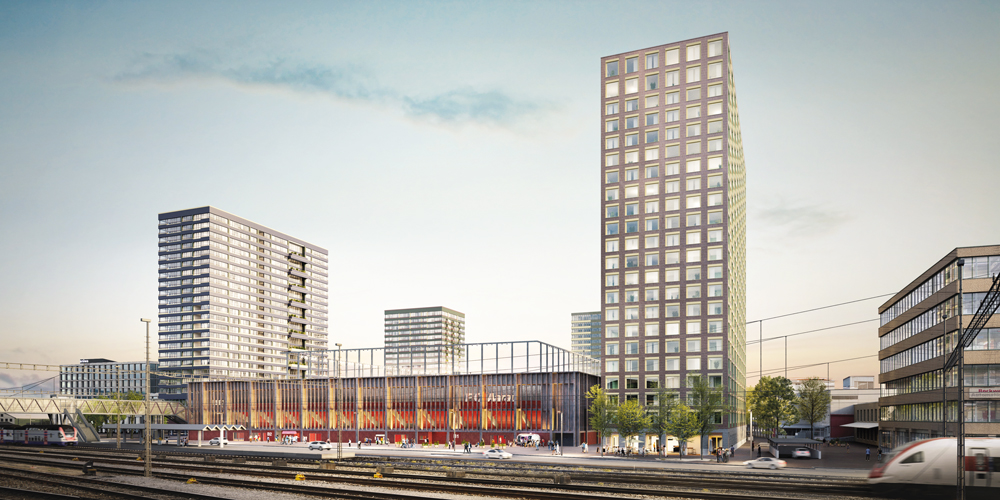
    Maaglive is a project on the Maag Areal near Zurich Hardbrücke train station. It complements the office uses that characterize the area today with attractive residential uses, cultural and gastronomic offers: "We got involved with the planning team in the preliminary project in the third quarter of 2021," says Johanna Gerum, project manager for the Maaglive project at Swiss Prime Site. “At the same time, we are developing a promising cultural vision for Maaglive together with the cultural organizer and producer Michel Pernet. Artists, representatives from the creative industries, those responsible for culture in the city of Zurich and interested interest groups from the neighborhood are involved in the use of these areas.»

    The public-intensive uses distributed throughout the day enliven the Maag Areal and create a place in the middle of Zurich West where people like to spend time.

    The Maaglive project consists of the residential tower, the cultural center and the future listed building K. The three buildings are arranged around a tree-lined square which, together with other green spaces, contributes to reducing the heat in Zurich West. In addition, Maaglive opens up the quarter and offers new non-motorised traffic connections. The three very different solitaire buildings should form an ensemble. In between there is a public space with a high quality of stay as the new center of the area. A pleasant microclimate can be created by planting tall trees. The coordinated uses on the ground floors will also enliven the space. The residential tower can be used flexibly, and where the noise pollution is too great, flexible work studios complement the small apartments.

    "Sauerbruch Hutton implemented the guiding principles of the Swiss Prime Site for the Maaglive project most aptly," Johanna Gerum concludes: "Diversification of use: apartments, culture, gastronomy and in particular the so-called third places, which stand for future-oriented quality of use – this on the inside – like outdoor area.»

    This is what the Maag Areal in Zurich should look like one day.
  • A lighthouse at the gateway to Bern

    A lighthouse at the gateway to Bern

    Das neue Gewerbe- und Dienstleistungsgebäude am östlichen Tor zur Stadt Bern soll durch verschiedenste Nutzungen an Lebendigkeit gewinnen. Neben konventionellen Büroräumlichkeiten, flexibel buchbaren Büroräumen für Kleinmietende und Start-ups sowie einem zukunftsorientierten Gastronomie- und Eventbereich sind auch Gewerbeflächen für die Nutzung im Gesundheitsbereich möglich.

    BERN 131 wurde als Multispace konzipiert, wodurch grösstmögliche Flexibilität in der Innenraumgestaltung besteht. Multispace ist ein modulares Raumkonzept mit offenen Bürostrukturen und verschiedenen Sonderflächen – etwa für den Austausch, Pausen oder Rückzugsmöglichkeiten. Diese Raumvielfalt macht Multispace attraktiv und eignet sich gut für die neue, individualisierte Arbeitswelt. Gespräche mit verschiedenen Mietinteressierten sind im Gange.
    Die Architektur und die geschickte Planung von BERN 131 garantieren eine hohe Qualität des Arbeitsumfelds trotz der exponierten Lage. Der geplante Neubau profitiert von einer hohen Sichtbarkeit und der unmittelbaren Nachbarschaft zur Wankdorf City. In diesem jungen und aufstrebenden Stadtquartier sind zwei von drei Bauetappen abgeschlossen. Die SBB, die Schweizerische Post und andere Grossfirmen haben hier neue Hauptsitze bezogen. Rund um BERN 131 gibt es ausserdem verschiedene Gastronomie-Angebote, Supermärkte und Business-Unterkünfte. Der Bahnhof Wankdorf ist in rund fünf Gehminuten, diverse Autobahnanschlüsse sind in zwei Fahrminuten erreichbar.

    Das Gebäude in der Form eines Kreisbogendreiecks wird sechs Etagen haben. Die einzelnen Etagen können durch die drei Erschliessungskerne und einen Ring, der sich um das begrünte Atrium legt, erschlossen werden. Die Geschossflächen können flexibel auf verschiedenste Flächenbedürfnisse aufgeteilt werden. Das Gebäude wird grösstenteils in Skelettbauweise mit Holzstützen, Holzunterzügen und Holzhybridecken errichtet. Bei der horizontalen Aussteifung des Gebäudes setzt man auf Erschliessungskerne in Massivbauweise.

    Photovoltaik-Anlagen an der Fassade und auf dem Dach, Energieerzeugung über Erdwärmesonden, ein innovatives Lüftungskonzept mit Wärmerückgewinnung sowie die Nutzung von Regenwasser tragen zur Nachhaltigkeit und Energieeffizienz bei. Die Verwendung von Holz und Holzwerkstoffen schafft zudem eine schöne Raumqualität und ein angenehmes Raumklima.

    Mit seiner Architektur, seiner ausgewogenen Betriebsenergiebilanz sowie zahlreichen gebäudetechnischen Innovationen soll das Gebäude ein Vorzeige- und Leuchtturmprojekt in Sachen Nachhaltigkeit und Ingenieurskunst werden.

    Die Baueingabe erfolgte Mitte Mai 2021; die rechtskräftige Baubewilligung wird zeitnah erwartet. Der Baustart ist auf das zweite Quartal 2022 geplant. Im dritten Quartal 2024 soll BERN 131 bezugsbereit sein.

  • Schönau Wetzikon: creative and residential district in the middle of nature

    Schönau Wetzikon: creative and residential district in the middle of nature

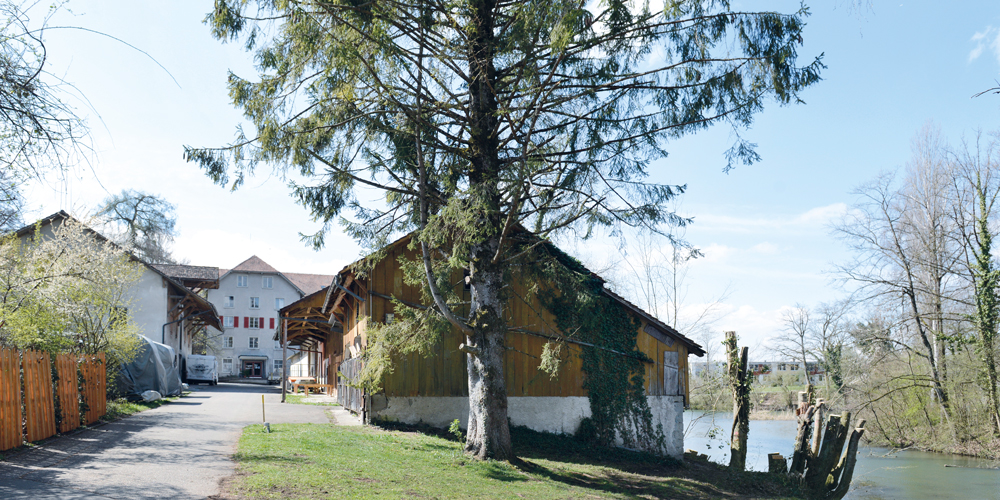
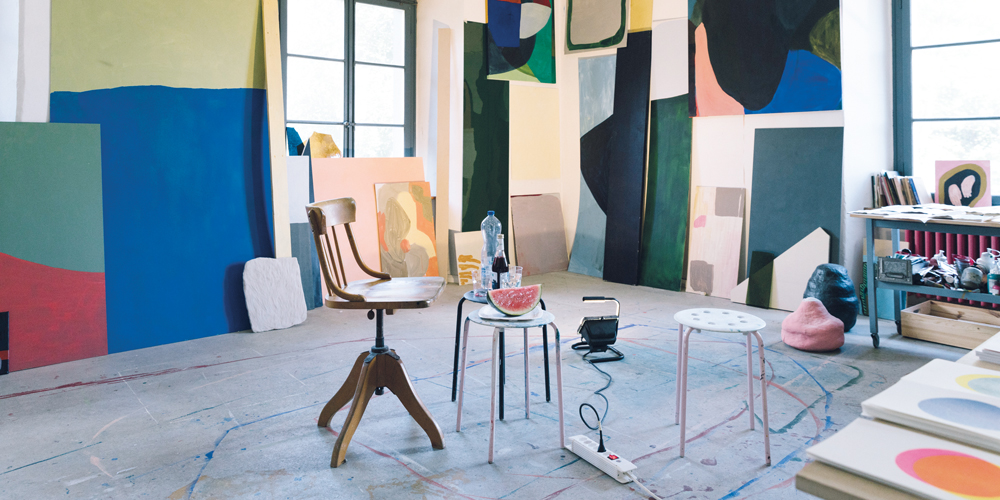
    Since the spinning mill was shut down at the end of 1991, the former Schönau textile factory site in Wetzikon has been used temporarily. A sound artist creates impressive sounding sculptures here, photographers, graphic artists, painters and sculptors have their studios here, there are cultural events, open studio days or, like last summer, a Schönau summer bar with concerts. A children's clothing store, a musical theater group, a carpenter's workshop or the job bus of the Stiftung Netzwerk also use the historic rooms, some of which are even used today. Since 2006, storks have lodged on the former factory chimney during the summer months. The natural landscape forms an idyllic setting around this colorful world of Schönau.

    Hiag intends to develop the area in stages up to 2030, taking up the character of Schönau and continuing to tell its story. There will also be room for creativity here in the future. In the heart of Schönau, new public facilities are to be created, such as a café,
    Shops, market stalls with regional products or a showroom, but also commercial premises. There will also be new residential buildings with around 100 apartments and innovative forms of housing such as studios or cluster apartments.

    The almost 200-year-old listed factory buildings are to be carefully renovated. The historical buildings lie in a spacious park and are embraced on the west side by the Schönauweiher, which is actually a technical body of water: it was dammed to generate hydroelectric power. A historic hydroelectric power plant, which is to be preserved and renovated, still bears witness to this today. There is a small raft in the pond. It was installed in 2012 as part of the Wetziker Fjord Strategy, which strengthens the natural space along the Aabach from the neighboring Kulturfabrik to the Pfäffikersee. This natural area is preserved as a place for recreation and meeting, upgraded and partly made accessible to everyone. Large parts are reserved exclusively for the animal and plant world.

    The Schönau lies on a hilltop. Wetzikon train station and Oberwetzikon town center can each be reached on foot in just under a quarter of an hour. There are various bus stops nearby.

    Participation and communication are important issues in the process. The development of the Schönau should be a project in which everyone could participate. Information events are held regularly and there are various information channels. The current tenants participate and help with projects and events.
    Since the end of 2020, the participation process for future uses in the historic cotton magazine, which is to become the public meeting place of Schönau, has been running. The collected ideas are currently being further developed into a concrete utilization concept.

    The city of Wetzikon has drawn up a public design plan for the Schönau with various experts. To ensure that his specifications are as specific and meaningful as possible, several well-known architectural offices and landscape architects have carried out a guideline project for the area. The Wetzik city parliament is expected to vote on the design plan in the first half of the year. When it is final, the new building projects will be worked out. A first construction project could be the design of the future heart of the Schönau in 2023 at the earliest – the renovation of the cotton magazine. The main building will remain in its current state until at least 2025.

    The historic buildings are to be gently renovated.
    There should also be room for creativity in Schönau in the future.
  • Up to 10,000 new jobs in Sisslerfeld

    Up to 10,000 new jobs in Sisslerfeld

    The Sisslerfeld in Fricktal should develop into a place of the future. It is the largest contiguous and zoned industrial area in the canton of Aargau. With the further development of the Sisslerfeld, more companies should settle in the area and 5,000 to 10,000 additional highly qualified jobs should be created.

    The four municipalities involved – Eiken, Münchwilen, Sisseln and Stein – the Fricktal Regio planning association and the canton of Aargau therefore decided at the end of 2018 to tackle the development of the 200-hectare work zone together and in a coordinated manner. Qualitative growth is in the foreground.
    As early as 2019, people who live or work in Sisslerfeld, as well as companies and property owners, were asked about their needs. This resulted in guiding principles for further development.

    From January to September 2020, four teams of specialist planners looked for solutions to implement the guiding principles. In this so-called test planning, the teams dealt with the question of how jobs in Sisslerfeld can grow while traffic can remain bearable and the beauty of the landscape with its local recreational value can be preserved. Experts from the fields of business, society, urban planning, mobility, open space and energy worked together on an interdisciplinary basis. They examined and compared different approaches and discussed their advantages and disadvantages.

    Their solution approaches were intensively and critically discussed by a 16-strong assessment committee in three workshops. In order to give the younger generation enough weight, very young specialists were also represented on this body. The judging panel was chaired by Rainer Klostermann, an architect and urban planner from Zurich. In the test planning, it was important for him to "consider all the ideas and findings on how the Sisslerfeld can be designed as a future place of work, but also as a place to live and play". "On the other hand," Klostermann continues, "it is important to take local needs into account, indeed to protect them." The test planning not only explored how the Sisslerfeld could be developed. "It was just as important to discuss and reconcile different perspectives."

    Following the test planning, the various concerns were brought together to form a coordinated overall picture. The judging panel approved this synthesis in early July 2021. It consists of eight directions and shows how Sisslerfeld could develop sustainably and what course can be set for this today.

    In a next step, these directions will be discussed with the municipalities, the population and the landowners. The results of this dialogue are to be transferred in 2022 to plans that are binding on the authorities and then on the landowners.

  • Successful conference on business promotion

    Successful conference on business promotion

    Due to the corona situation, the first SVSM dialogue for business development did not take place as a hybrid event as planned, but as a purely virtual event. The event conveyed specialist knowledge and networked location managers, business developers, real estate experts, room planners and other interested parties. The speakers presented impressive practical examples from a wide variety of regions – from Montreux to Uri to St. Gallen – and also reported on challenges, organizational issues and experiences in the spirit of best practice. The participants received valuable input for their daily work. Thanks to dedicated question and answer sessions and a panel discussion, professionally moderated by SVSM board member Markus Müller, the professional exchange of experience and networking were not neglected.

    Interaction between economy and tourism
    Stefan Büeler, Head of the Office for Economic Affairs and Public Transport in the Canton of Uri, demonstrated the approaches to economic development in Uri based on current projects such as tourism development in Andermatt, the Gotthard base tunnel or educational and research institutes. He also discussed which procedures and organizational forms have proven themselves in practice and which challenges need to be mastered in everyday life. Samuel Zuberbühler, head of location promotion for the city of St. Gallen, gave an insight into the "Sankt ohne Senf" campaign, with which the city in eastern Switzerland is marketing itself and residents, homesick St. Gallen and “newcomers” in a target group-oriented way. He impressively demonstrated how closely business, location promotion and tourism are related. This was also confirmed by Bernard Schmid, Managing Director of Promove. Schmid provided a glimpse of the working methods, structure and current issues of an economic development organization in French-speaking Switzerland: The Promove association aims to promote the economy in the Riviera-Lavaux region on the Swiss shore of Lake Geneva and connects authorities, business and tourism. The cooperation between the various areas, some of which are also organizationally linked, is correspondingly close. Schmid showed how this works in practice using the "Dolce Riviera" project, which was launched in 2020 and aims to integrate the entire tourism value chain in the Montreux Riviera destination.

    The start of the new series of events was a success: The consistently positive feedback from the participants on the presentations shows that the SVSM is on the right track with the new event format. The next SVSM dialogue is already being planned, this time with a focus on location management. Make a note of the date – more information will follow:
    SVSM dialogue location management: Thursday, March 31, 2022, 3 p.m. to 7 p.m

    Further information:
    Swiss association
    for site management SVSM
    office
    Ricketwilerstrasse 135
    8352 Ricketwil (Winterthur)

    Telephone 058 255 08 88
    info@svsm-standortmanagement.ch www.svsm-standortmanagement.ch

  • Peach Property posts record pre-tax profit

    Peach Property posts record pre-tax profit

    According to a statement from Peach Property , the Zurich-based real estate company, which specializes in real estate in Germany, posted a pre-tax profit of CHF 258 million in the 2021 financial year. This is the highest pre-tax profit in the company’s history, writes Peach Property. CHF 153 million was realized in the 2020 financial year.

    The value of Peach Property’s real estate portfolio increased year-on-year from CHF 2.1 billion to over CHF 2.6 billion. Rental income increased from CHF 54.7 million in 2020 to around CHF 108 million. With the help of a mandatory convertible bond issued in the year under review, the debt ratio was reduced from 57.8 to around 52 percent.

    In the financial year, Peach Property was also able to improve all external ratings, the press release explains further. Moody’s currently rates the company at Ba2 with a stable outlook, while FitchRatings gave it a BB with a stable outlook. S&P Global Ratings rates Peach Property at BB- with a stable outlook.

    “Our strategy and our business model have also proven to be outstanding in the 2021 financial year and we were able to close another year with very profitable growth,” Thomas Wolfensberger is quoted as saying in the press release. According to the CEO of Peach Property Group AG, the current financial year will primarily focus on “modernizing the residential portfolio and expanding sustainability activities”. Peach Property intends to invest around CHF 70 million in this.

  • FC Aarau's new home

    FC Aarau's new home

    How do you combine a football stadium with an attractive residential area? – "It's not always easy, but it offers great opportunities," says Ariel Arthur Dunkel, project manager for real estate development at HRS Real Estate AG. «The focus here is on the question of use and the possibilities of appropriating the diverse open spaces. The district thrives on the tension between everyday life and a festive atmosphere.» The planning is already very advanced, but it has not yet been possible to submit a building application: “We are waiting for the partial change in the usage plan of the city of Aarau, against which a complaint has been lodged, to take legal effect. Then comes the approval process for the design plan that we developed for the area together with the city of Aarau. Then comes the building permit process. Until then, the planning rests.”

    There aren't many vacant areas that are so well developed. The eastern part of Torfeld Süd is, so to speak, a missing part of the city that is now being supplemented. To the south and west, Torfeld Süd borders on lively quarters. The networking of the non-motorized traffic development and the open and green spaces is an important topic in the planning. «The project is very visible. And that's why we want it to be seen as an example of good development – in terms of architecture, the revitalization of the building base, the attractive open spaces, the high standards of sustainability and the mix of uses that people with everything important in a small radius provided."

    Ariel Dunkel would like to start building tomorrow: “However, it is understandable that numerous interests have to be coordinated with a project of this size and scope. This will need time. The difficult thing here is that the population, who always clearly supported the stadium project in the votes, now have to be so patient because of the appeals process. There is also intensive dialogue with politicians, who rightly have high expectations of the project. Personally, I am convinced that the project will create significant added value not only for the area itself, but also for the surrounding area.» The construction project was also affected by the corona pandemic. Many households would like more space so that they can work comfortably from home in the long term: “We also have studios and small apartments that can be rented. In principle, we are working from a very solid starting position due to the good development and the comprehensive supply of quarters and can easily react to changes," concludes Dunkel.

    In a project of this size, numerous interests have to be coordinated.
  • The city in the village

    The city in the village

    Schritt für Schritt wird Urdorf-Nord zu einem dichten, lebendigen und bezahlbaren Raum für innovative, nachhaltige und lokale Lebens- und Arbeitsformen. Momentan ist Urdorf-Nord in einer Phase der baulichen Verdichtung und wird mit der Limmattalbahn verkehrstechnisch noch besser an Zürich und den Kanton Aargau angeschlossen. Die Stadt im Dorf ist bereits heute eines der wichtigsten Arbeitsplatzgebiete im Limmattal und hat mit der Kantonsschule und dem angrenzenden Limmattalspital eine starke Verankerung in der Bildung und Gesundheit.

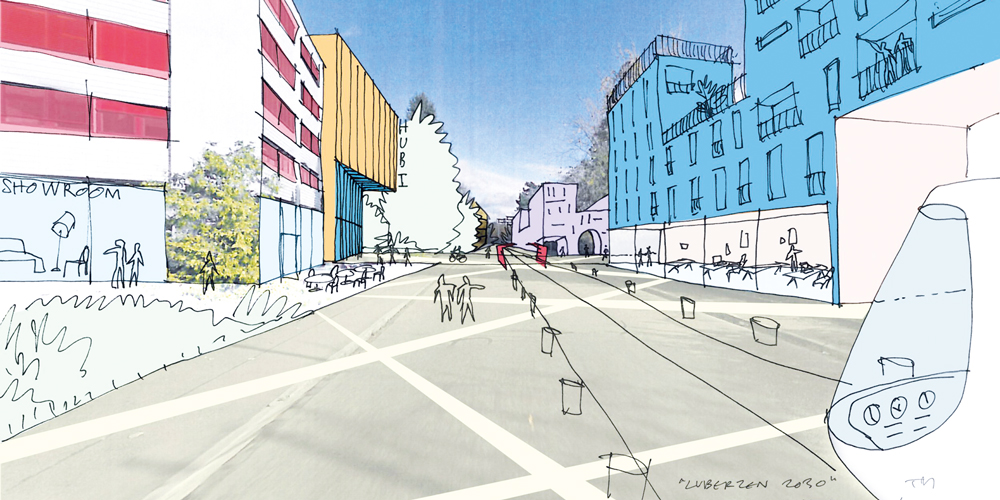
    An die Kantonsschule angrenzend ist eine Zone vorgesehen, die neben innovativem Arbeiten auch urbanes Wohnen möglich macht. Die Strasse «In der Luberzen» soll zur Flaniermeile werden, und an einer der beiden Limmattalbahn-Haltestellen ist ein Platz vorgesehen, der Urdorf-Nord mit den umliegenden Quartieren verbindet. Die Nord-Süd-Verbindung schliesst an den zentralen Platz an, der die Achse weiter zur S-Bahn-Station Glanzenberg leitet.
    Von der Maisonette über das Loft bis zur WG-Wohnung, in Urdorf-Nord soll eine vielschichtige Wohnwelt entstehen, die ein urbanes Flair hat und gleichzeitig den Dorf-Charme nicht verliert. Urdorf-Nord gehört zu den wirtschaftlich interessantesten Gebieten im Limmattal und birgt ein hohes Potenzial bezüglich Arbeits- und Wohnqualität. Die Stadt im Dorf ist topografisch wie auch verkehrstechnisch das Entrée Urdorfs im Limmattal und kann damit eine Leuchtturm-Funktion einnehmen, um innovative und zukunftsorientierte Unternehmen anzusiedeln.

    In Urdorf-Nord (www.urdorfnord.ch) soll aber nicht nur gearbeitet, sondern auch gelebt werden. Die Entwicklungsstrategie sieht vor, eine gute Balance zwischen innovativer Unternehmenskultur und urbanem Wohnen zu ermöglichen. Das Ziel ist klar: In einer umsichtigen Struktur werden sich Wohnen und Arbeiten attraktiv ergänzen, und so ergeben sich befruchtende Synergien. Darüber hinaus wird Urdorf-Nord ein optimiertes Verkehrskonzept erhalten, das den Ausbau des öffentlichen Verkehrs sowie des Langsamverkehrs gleichermassen berücksichtigt.

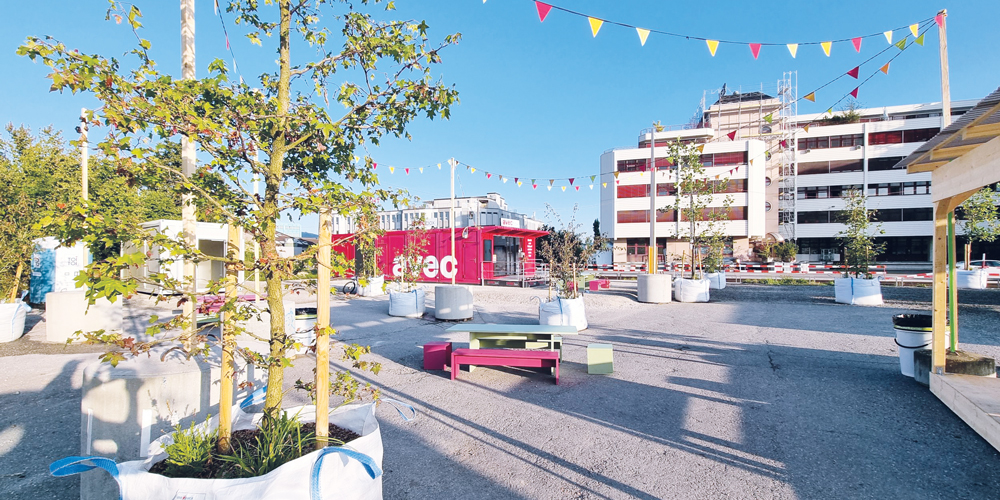
    Bereits heute ist die Stadt im Dorf erlebbar, etwa mit der Zwischennutzung #luberzenareal: Seit Mitte August 2021 bieten unterschiedliche Foodtrucks, die avec box – der modernste Convenience Store der Schweiz – und unkomplizierte Aufenthaltsmöglichkeiten erhöhte Aufenthalts- und Verpflegungsqualität.

    Die Zwischennutzung #luberzenareal lädt bereits heute zu Verpflegung und Aufenthalt ein.
    Willkommen im geplanten Urdorf-Nord.
  • New innovative business park in Altstetten

    New innovative business park in Altstetten

    Glass, metal and exposed concrete – the new commercial property Manufakt 8048 was created as a minimalist blank and at the same time a prototype for sustainable service and production facilities.

    With the concept and the brand "Manufakt", the real estate developer Steiner AG wants to offer more utility with less resource consumption. Manufactory 8048 has various “shared spaces” – common areas such as reception areas, meeting rooms or meeting areas. This reduces the direct room costs and the operating costs for additional areas. This should also attract young companies.

    The office building manages without load-bearing walls and thus offers a flexible spatial grid. In addition, Steiner AG has designed "room boxes" for individual workstations, which can be put together in modules if required.
    The new tenants in Altstetten are currently in the process of individually designing their floor plans as part of the tenant fit-out and converting the up to 4.5 m high rooms into production and office areas, laboratories and showrooms.

    The design of the building in Altstetten was developed and planned by Theo Hotz Partner Architekten. Although Theo Hotz (1928-2018) was considered one of the best-known high-tech architects in Switzerland during his lifetime, the Manufactory 8048 was designed as a "low-tech" building: the building technology and the standard of construction are minimal, the structural details are simple. The clear design language of the building results from a simple cubic outline with six floors. These can be recognized from the outside by continuous glazed ribbon windows and horizontal aluminum parapets. In the building, industrial
    tial materials such as steel, exposed concrete and seamless industrial floors together with exposed installations.

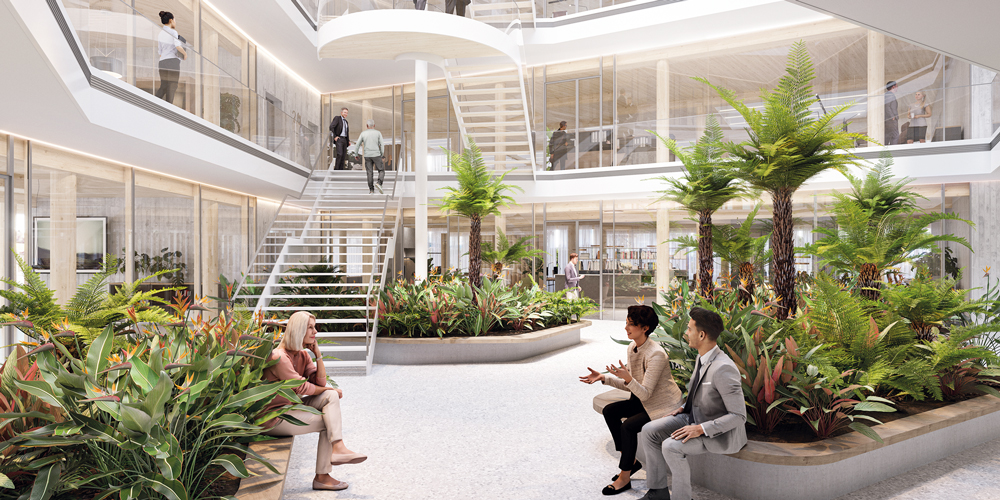
    In the center of the building is an airy atrium, which serves as an open inner courtyard for access and becomes an attraction, meeting point and relaxation area. The liveliness in the inner courtyard is supported by greenery, which is intended to contribute to a positive climate. Lifts and cantilevered arcades lead from the inner courtyard to the floors.

    In Wädenswil and Winterthur, two more industrial parks will be built in the coming years based on the Manufakt concept. An important element is the networking of the various tenants across the locations.

  • The Leuengarten district in Uitikon-Waldegg continues to grow

    The Leuengarten district in Uitikon-Waldegg continues to grow

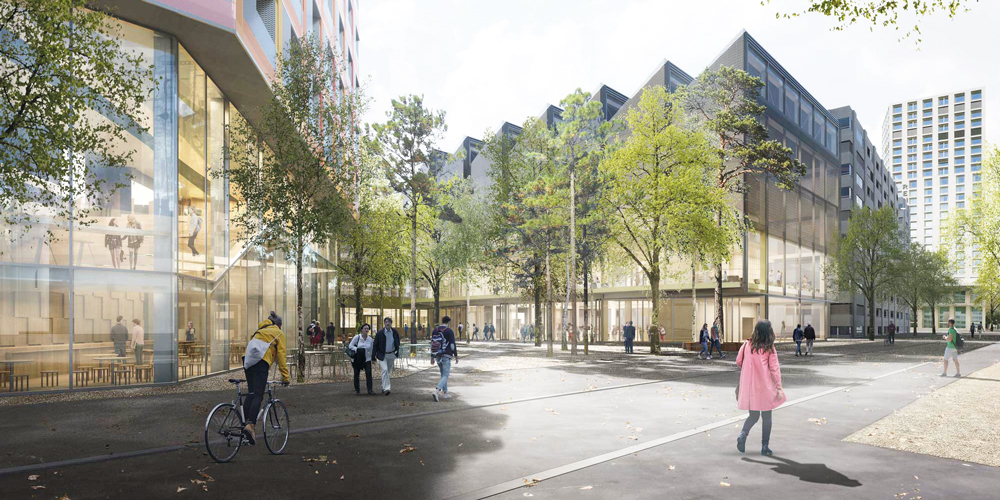
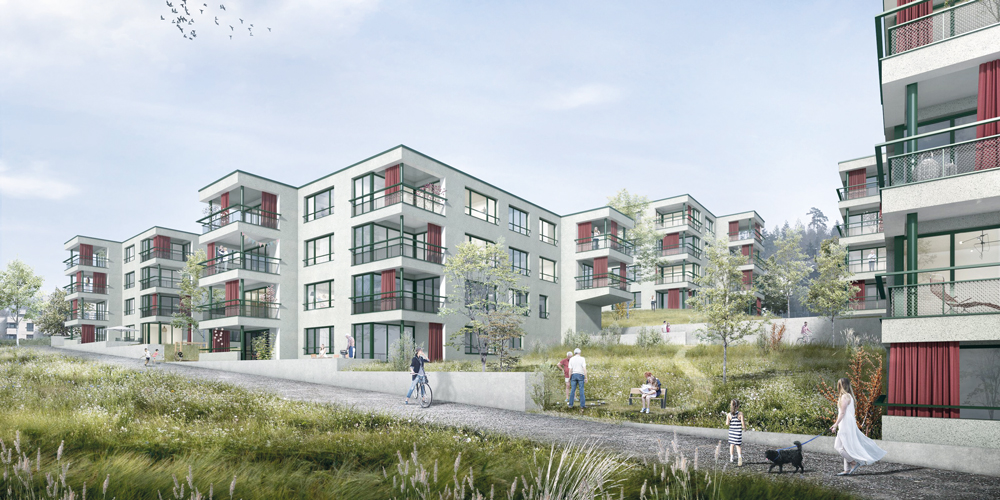
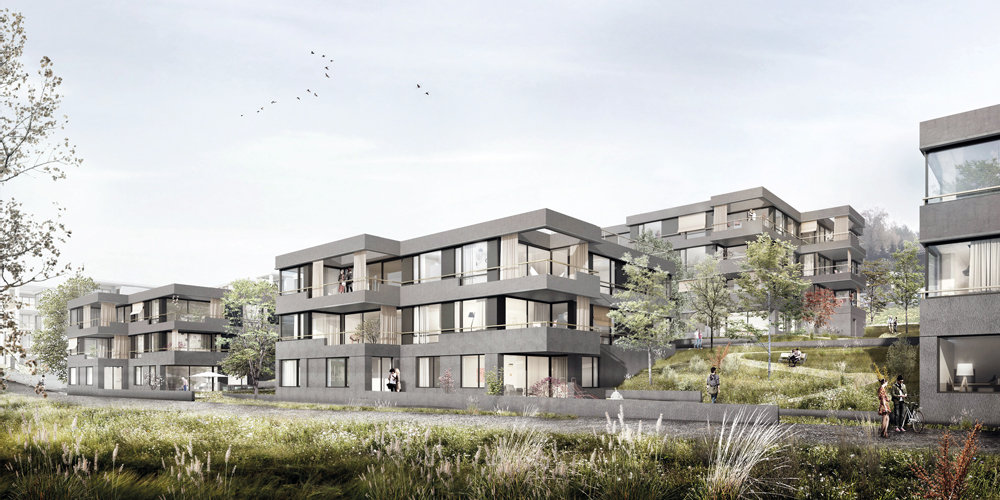
    The “Leuengarten” district in Uitikon-Waldegg, which has been developed over the past four years, is growing again: Akara will be building 17 three- and four-story apartment buildings on four construction sites by around 2023. The development is set back from Birmensdorferstrasse in a quiet location between Panoramaweg and Leuengasse. The building permits for the three construction stages have been obtained, with the permit for the construction site for the second stage being the first to be legally valid.

    Construction work is scheduled to begin with the second phase at the end of 2021. On an area of 19,303 square meters, 207 residential units, a small commercial part and 207 parking spaces will be built in the three construction phases “Leo”, “Lea” and “Leandro”. Zanoni Architects from Zurich are responsible for the first stage “Leo”, while the contract for the second stage “Lea” went to Dachtler Partner AG, Zurich and for the third “Leandro” to Atelier ww Architekten SIA AG, Zurich.

    The 1.5 to 5.5 room apartments with a focus on 2 to 4.5 rooms are designed for families, couples and singles and are tailored to their individual needs. The floor plan concepts and the use of materials are tailored to the various target groups and underline the variety of the differentiating living spaces. Each stage will reflect its own attitude towards life.

    When it comes to embodying the feeling of “self-realization”, the first stage, with the appropriate floor plans and materials, is primarily aimed at singles and expats. The surrounding landscape is incorporated into the buildings by the architects. Generous intermediate spaces are planned, which always allow an unobstructed view of nature. The optimal embedding of the building in the existing topography should ensure maximum sun exposure for all apartments. The apartments will be accessible via Leuengasse. Wooden formwork is planned for the first stage, which is based on the local agricultural buildings and reinterprets them. In order to strengthen the sense of community among the residents, a spacious launderette, a common room and two flexibly usable commercial units are planned.

    In the sign of “well-being”, the concept and designs of the buildings in the second phase are aimed at the needs of families and communities. Six point structures fit harmoniously into the environment. The planned three-span building typology with two different orientations is intended to ensure that the urban planning needs and optimal sun exposure, including a view of the Limmattal, are guaranteed. 62 rental apartments are being built on a plot area of 6,059 square meters.

    The third construction phase is tailored to the needs of two-person households with the motto “Self-determination”. In addition, barrier-free apartments for seniors or people with disabilities are planned. Here high-quality and modern residential units are to be realized. The architects Atelier ww are concentrating on the specifications of the public design plan and the claim to continue the continuity of the neighboring building sites in terms of typology and scale.

    Great importance is attached to sustainability: the SNBS gold (“Leo”) or SNBS platinum standard (“Lea” and “Leandro”) labels are being sought for the apartments. Brine-water heat pump
    pen with geothermal probes and air-water heat pumps ensure environmentally friendly electricity production. In addition, there is the self-production of electricity via photovoltaic systems on the flat roofs, whereby the electricity produced is marketed directly to the tenants in the form of a group for their own consumption. Charging stations for electric vehicles are available. In the Leuengarten there are also car sharing offers from Mobility as well as various common rooms.

    The quarter under development scores with a wide range of services such as gastronomy, vinotheque, hairdresser, daycare center and a wellness oasis. The public transport connection is also given thanks to the bus stop right in front of the door. The motorway connection to the A3 is only five minutes away by car. Residents can reach the center of Zurich within 30 minutes by public transport.

    The visualization shows the buildings of the second construction phase “Lea”, which has the lifestyle well-being on the flag.
    The third construction phase “Leandro” is dedicated to the motto of self-determination.
  • Litterna: Agreement finally reached

    Litterna: Agreement finally reached

    The people of Visper associate numerous memories with the Litterna Hall, built in 1978, as the hall was the home ground of EHC Visp from 1979 to 2019. Before the hall was demolished, the farewell was duly celebrated with a party in autumn 2019 – and at the same time the new ice sports and event hall, the Lonza Arena, was inaugurated. There has been a legally binding district plan for the Litterna site since 2018, which provides for several mixed-use residential and commercial buildings. Accordingly, the client Swiss Prime Investment Foundation planned to start construction work on the four buildings in total after the demolition of the hall in autumn 2020. However, a resident's objection to the planning application delayed the approval process. Nevertheless, the building application was approved by the Visper municipal council in December 2020, and the objection was rejected: the municipality argued that the buildings and facilities would correspond to the purpose and the district plan. The objector took his complaint further and reached the State Council in spring 2021. The Valais government also rejected the appeal against the municipality's decision, whereupon the objector went to the cantonal court as the next instance. However, before the Valais judiciary could make a further decision, the objectors and the client reached an agreement.

    The construction work on the approximately 15,700 m2 area, which is an important building block due to its location along the railway line and the proximity to the public transport hubs
    nothing stands in the way of the overarching settlement development of Visp. The four buildings will contain 138 rental apartments, commercial premises on the ground floors, a day-care center and a retail store. The first apartments should not be ready for occupancy until autumn 2023 at the earliest. The client Swiss Prime Investment Foundation is investing around 70 million Swiss francs in the Visper location. Total contractor is Eiffage Suisse, the construction work is being carried out by the Volken Group.

  • "The merger of Immoscout24 and Homegate could be a case for WEKO"

    "The merger of Immoscout24 and Homegate could be a case for WEKO"

    Mr. Egloff, to what extent do you benefit from your law studies for your work as President of the Homeowners’ Association (HEV) of Switzerland and the Canton of Zurich?
    It’s definitely helpful. The homeowner has legal problems and questions to solve again and again: From the classic area of ownership to taxes, land register to neighborhood and tenancy law, there is a wide range that is important for our members. We offer our members free legal advice – this is used very actively. But I also benefit from my legal background in political discourse.

    The abolition of the imputed rental value is currently being discussed again at the political level. Can you briefly name the disadvantages that this causes for homeowners and who is most affected?
    The imputed rental value is taxed on a fictitious income. Homeowners therefore have to pay tax on 60 to 70 percent of the potential market rent as income for their property – notably one that they do not generate in practice. This amount is in addition to regular income. This often means that those affected slide into the higher or even highest progression and thus have to pay a significantly higher amount of tax. Older homeowners in particular are negatively affected by the current practice. They have often paid off their debts so that the debt interest deduction is no longer relevant to them.

    How confident are you of the reform going through this time?
    The imputed rental value was introduced 100 years ago as a war tax. This was then repeatedly extended for a limited period until it became established as a fixed tax. We have been trying to abolish imputed rental value for 25 years. 10 years ago I was once very confident that we could be successful. The project is now up and running again, but I am not sure that it will succeed.

    Where do you see the problems?
    On the one hand, homeowners represent a minority in the voting population. On the other hand, people like having homeowners as taxpayers – the state is reluctant to do without them. There is probably no perfect solution in this case.

    Energy law initiator Martin Neukom from the Greens said that, according to a survey in the city of Zurich, less than half of the homeowners had considered alternatives to oil and gas when replacing their heating system and that binding rules were therefore needed for the replacement. What do you think of this argument?
    In recent years, energy and heating issues have been a topic in every publication of HEV Switzerland and the HEV of the Canton of Zurich. Our members have a high level of information in this regard. Greenhouse gas emissions have fallen by 34 percent over the past 30 years. And this despite the fact that living space has increased by 46 percent over the same period. Our members invest CHF 20 billion in building maintenance every year – CHF 9.5 billion each for energy-related renovations. These figures show that homeowners do take their responsibility seriously.

    The City of Zurich Tenants’ Association invalidated other arguments against the planned energy law, i.e. possible evictions, forced house sales or rent increases: the energy law does not force homeowners to comprehensively renovate properties and terminate tenancies. Were the arguments advanced by the HEV and your party, the SVP, misleading?
    The Energy Act forces property owners to replace fossil fuel heating systems with ones using renewable energies over time. Let’s take a property from the 1960s with oil heating as a technical example. If this goes out, the owner must have a heat pump installed. With this property, which is already getting on in years, this only makes sense if the building shell is renovated at the same time. If, for example, the flow temperature is no longer reached with old radiators, floor heating must also be installed. On the one hand, this leads to enormous costs. On the other hand, these renovations cannot be carried out with the tenant in the apartment.

    «
    Inside the building-
    area are
    we also without
    legal
    regulations 2050
    net zero
    »

    And what do you say about the political point of view?
    In June of this year, the President of the Swiss Tenants’ Association, Carlo Sommaruga, submitted a proposal in Bern in which he literally called for “measures under tenancy law against vacant notices in connection with energy-related renovations”. In my opinion, if the arguments we have put forward were misleading, such an approach would not be necessary.

    What contribution do you think homeowners could make to achieve the climate goals?
    I believe in personal responsibility, and the figures I mentioned above confirm that this is taken seriously. If one also draws the lowering path of the CO2
    If we push further in the building sector, you can see that we can easily achieve the climate goals of the Paris Agreement. In 2050 we will be at net zero. I therefore find a state-defined regulation superfluous in this case.

    How important and forward-looking do you personally think electromobility is?
    In principle, I am in favor of electromobility. But it brings with it many challenges. On the one hand, we have gaps in the energy supply. We cannot produce enough electricity on our own. That means we have to get nuclear power from France and coal power from Germany. On the other hand, the embodied energy in electromobility is relatively high. No sustainable solution has yet been found for the disposal of the corresponding batteries. For me, there are still a lot of unanswered questions on this topic.

    According to a study by the consulting firm EBP, an intensified sale of e-cars fails in terms of electromobility, among other things due to the lack of charging stations in properties. Why do homeowners find it difficult to carry out such an installation?
    A private homeowner who needs a charging station for himself will certainly not find it difficult to have it installed. As long as he has the wherewithal to do so. But if you have an apartment building with twelve apartments and an underground car park with ten parking spaces, the question arises as to how many charging stations you should actually install. And who pays for the investment if no tenant has an electric car afterwards? In such a case, the tenant is unlikely to agree to a rent increase. In addition, there is an increasing trend towards car-free housing estates – especially in urban areas. Installing charging stations would make no sense here. Experience has shown that the market regulates many things on its own.

    Can you elaborate on the last point?
    About 50 years ago you suddenly couldn’t rent an apartment if it didn’t have a bathtub. Or 30 years ago the scenario with apartments without a dishwasher was repeated. I am assuming that future demand will also influence supply when it comes to electromobility. At some point you will no longer be able to rent out an apartment if you cannot offer the tenant a solution tailored to their mobility needs.

    How do you assess the real estate bubble that UBS has been predicting for some time and that Zurich in particular is said to be badly affected by?
    With regard to interest rate and real estate price developments, I see one constant: the forecasts have always been wrong in recent years. The UBS index has been predicting this bubble for years – it has never burst so far. I personally see a strong real estate market with rising prices. Caution is certainly required when financing home ownership. Especially in the home sector. The portability regulations must be checked individually and comprehensively. Otherwise, a sudden sharp rise in interest rates could pose existential problems for one or the other.

    «
    an interest
    Many countries cannot afford to increase
    »

    Is there a massive rise in interest rates?
    The countries that are relevant for this, ie the EU and the USA, cannot afford an interest rate hike. On the other hand, we see clear signs of rising inflation – this could have an impact. For the real estate market, however, inflation usually means rising prices – because in this situation the need for material assets increases.

    You have retired from active politics. Which achievements would you describe as your personal milestones?
    My greatest success was definitely the abolition of inheritance and gift taxes for direct descendants in the canton of Zurich. I consider the abolition of the real estate transfer tax, which we brought about with a popular initiative, to be the second major success.

    And what milestones have you reached in the real estate industry?
    Here I would mention the good contact and exchange between the various real estate organizations. In my early days as President of HEV Switzerland, everyone primarily tilled their own little garden. It was important to me to maintain an exchange and to define common goals. Today we meet four times a year in the Federal Palace and discuss current political dossiers.

    Two major players have joined forces with Immoscout24 and Homegate. How do you rate this event?
    I’m not sure if this merger is a win for consumers. I assume that we will have to reckon with massive price increases in the future. This case should at most concern the Competition Commission (WEKO).

  • Construction and real estate projects: models of cooperation at a glance

    Construction and real estate projects: models of cooperation at a glance

    In the case of complex and challenging construction and real estate projects, partner companies can provide valuable support – be it by taking on the coordination and overall responsibility for the project or by accompanying individual project phases.

    The providers of such services can be roughly divided into the categories: overall provider, total contractor and general contractor. But which model of cooperation is the right one for which project? The information brochure "With the right cooperation model for successful project implementation" aims to help clarify this question. It provides an overview of the three models, shows which model is best suited for what, and lists important points when working together. The information brochure was prepared by the Swiss Development Industry Association. He represents companies that offer overall services in the development, planning and realization of construction and real estate projects. «We are convinced that a project with a common goal and shared responsibility can be implemented more successfully. That's why we want to show the possibilities and services of the existing cooperation models and draw attention to their potential," says Managing Director Franziska Bürki.

    The three cooperation models at a glance:
    Overall providers take over the development, planning and realization of construction and real estate projects. With interdisciplinary teams, they work on tasks throughout the process through to execution or operation. The service can have different characteristics and include, for example, usage planning, design competitions, preliminary studies and the legally prescribed approval procedures. Because a full service provider is involved early on, the potential for innovation and optimization is high. Opportunities and risks can be better identified, defined and controlled at an early stage and together. The client has the guarantee that his project will be developed, planned and implemented from a single source.

    Total contractors take on the planning and implementation of construction and real estate projects. Within a given framework, the client leaves the responsibility for the planning and implementation to the total contractor, with more or less narrow specifications. Total contractors take over a construction project either from the project planning or at least from the implementation planning. The responsibility for the tasks up to handover (including pre-existing planning) remains with the client. The potential for innovation and optimization in this model of cooperation depends heavily on how much planning and design freedom the client gives the general contractor. General contractors take on the realization of ready-to-execute construction and real estate projects. The aim is to realize a building. They assume responsibility for the turnkey realization of a construction project, their influence is essentially limited to the optimized construction process. Within this area they are responsible for quality, deadline and price. The overall and planning responsibility remains with the client. Cooperation with a general company is particularly suitable for professionally managed projects with a specifically formulated order for the general contractor.

    The content of contracts with a partner company can vary. It depends on the client's wishes, on the choice of cooperation model, but also on when the cooperation begins. "The partner company can take on more responsibility the earlier and more integrated the client involves them in the cooperation," says Franziska Bürki.

    Development Switzerland is convinced: If you want to successfully implement a project, you have to take a holistic view of it, involve all stakeholder groups and decide on the right cooperation model at an early stage and adapt it to the specific project situation.

    Franziska Burki,
    Managing Director Development Switzerland
  • Henriette Wendt elected to the CKW Board of Directors

    Henriette Wendt elected to the CKW Board of Directors

    Due to the measures to combat Covid-19, the 128th CKW General Assembly on January 28, 2022 was held in a small group. The shareholders exercised their voting and election rights in writing to the attention of the independent proxy. They approved the annual report, the consolidated financial statements and the annual financial statements for the 2020/21 financial year. The CKW Group closed the past financial year very successfully with an operating profit of CHF 174.5 million.

    Dividend increase and special dividend
    The net financial assets of the CKW Group increased by a further CHF 35 million to CHF 574 million compared to the previous year. This initial situation and the financial planning for the coming years allow the ordinary dividend to be increased from CHF 3 to CHF 6. In addition, with the conclusion of the energy tariff proceedings and the subsequent compensation for the former transmission grid in the past financial year, CKW has obtained legal certainty in two long-term proceedings. The Board of Directors has therefore decided to propose an additional one-off special dividend of CHF 15 per share to the Annual General Meeting. The shareholders followed the suggestion and approved the dividend increase as well as the special dividend.

    New name: CKW AG instead of Centralschweizerische Kraftwerke AG
    They also elected Henriette Wendt, Chief Operating Officer and member of the Executive Board of the Axpo Group, as the new member of the Board of Directors. She succeeds Michael Schmid, who has resigned from the Board of Directors. As COO of Axpo, Henriette Wendt plays an important role in the strategic and cultural development of the Axpo Group nationally and internationally. Before joining Axpo, Wendt worked for Microsoft Switzerland, where she held the role of Chief Marketing & Operations Officer.

    The General Assembly approved the actions of the members of the Board of Directors and confirmed President Christoph Brand, the government councilors Marcel Schwerzmann (Lucerne) and Dimitri Moretti (Uri), Anita Eckardt, Joris Gröflin and Hansueli Sallenbach for another one-year term as members of the Board of Directors. KPMG AG, Lucerne, was elected as auditor for another year.

    CKW has been operating under this name as a uniform brand on the market for around 5 years and enjoys the trust of customers in and outside of Central Switzerland. This strategy is now continued in the official company name. Centralschweizerische Kraftwerke AG becomes CKW AG. The AGM approved the application in terms of simplification and as a sign of modernization.

    The next General Assembly will take place on Friday, January 27, 2023.

  • Synhelion and Cemex produce the first solar concrete

    Synhelion and Cemex produce the first solar concrete

    Synhelion and Mexico’s Cemex , the world’s fifth largest cement producer in 2020, have produced the world’s first solar clinker. As both companies write in a media release of the same name, this “revolutionary innovation” is a “first step towards the development of completely solar-powered cement plants”. dr Gianluca Ambrosetti, CEO and co-founder of Synhelion, is proud to “join with Cemex to demonstrate a concrete, industrially relevant application of our fully renewable high-temperature solar heating”.

    Synhelion emerged from the Swiss Federal Institute of Technology in Zurich in 2016. The company’s technology aims to replace all types of fossil fuels with solar fuels. According to the information, it converts concentrated heat from the sun into “the hottest process heat available on the market”. Cemex wants to supply CO2-neutral concrete worldwide by 2050. A key part of this strategy is CEMEX Ventures and its research and development center in Brügg BE.

    Research teams from both companies installed a pilot plant on the premises of the Madrid Regional Government’s Imdea Energy Research Institute . There, the solar receiver from Synhelion delivered “record-breaking” temperatures of over 1500 degrees with concentrated sunlight. A gaseous heat transfer medium is thus heated. This provided the heat needed to melt limestone, clay, and other materials together.

    The clinker obtained in this way was used to manufacture cement and then processed into concrete. In the next phase of their joint research and development project, Synhelion and Cemex intend to work towards an industrial-scale pilot plant.