Category: Energy

  • Canton Zurich wants to use large roofs for solar power

    Canton Zurich wants to use large roofs for solar power

    The Zurich Cantonal Council wants to improve the security of the electricity supply with solar power and long-term storage. According to a statement, it presented two proposals to amend the cantonal energy law on 6 January.

    The first bill stipulates that roofs larger than 300 square metres must be equipped with solar panels across their entire surface. This requirement applies to new buildings and the renovation of existing roofs. The cantonal government estimates the potential of fully utilising all suitable roofs at around 6 terawatt hours of electricity per year. This corresponds to around two-thirds of the canton’s current electricity consumption. According to the cantonal government, around 60 per cent of this potential lies in large roofs.

    The second bill provides for the expansion of long-term storage facilities. Electricity grid operators are to jointly promote these in future. This promotion is to be financed by a levy on electricity consumption not exceeding 0.5 centimes per kilowatt hour. The corresponding promotion fund is to be managed by the Zurich Cantonal Electricity Works (EKZ). The cantonal government wants to use this to make the surplus solar power generated in summer available for use during the winter months.

    Both proposals will now be submitted to the Cantonal Council for deliberation.

  • Valais start-up drives district heating planning forward in Europe

    Valais start-up drives district heating planning forward in Europe

    The software solutions developed by Valais-based start-up Urbio, which supports energy suppliers in their transition to clean energy and facilitates the creation of energy plans and district heating networks, will soon be available throughout Europe. The start-up has previously supported more than 200 projects in Switzerland, Germany, France and Belgium.

    The reason for the European expansion is the considerable potential for district heating, according to a press release. District heating could cover 50 per cent of Europe’s total heating needs from renewable sources, compared with just 10 per cent at present, and even less in some large economies. Sébastien Cajot, CEO of Urbio, identifies the obstacles: “We repeatedly encounter the same weaknesses in the initial planning phases: there is a high degree of uncertainty, reliable data is scarce and financing is difficult. As a result, fossil fuels remain the standard solution for most property owners.” This is where Urbio comes in, explains the CEO: “Collecting data, analysing it and dimensioning energy infrastructures: Urbio digitises this process in a single application. Thanks to generative design, our algorithms offer the most suitable solutions according to predefined energy requirements. The solution currently includes energy planning for specific areas, feasibility studies for district heating and direct integration with third-party tools such as websites or CRMs.”

    Industry players can now create their account on urb.io and learn about examples of projects that have already been completed. The first project application of the software solution is free of charge.

  • Intelligent lighting control for sustainable buildings and cities

    Intelligent lighting control for sustainable buildings and cities

    Esave has developed two new control solutions for sustainable lighting concepts. According to a statement from the Chur-based provider of intelligent lighting solutions, these solutions are designed to ensure optimal lighting conditions in public spaces and buildings. The DT8 TC driver for white light and the DT8 RGB driver for coloured light both support the professional lighting standard DALI (Digital Addressable Lighting Interface), which allows multiple lights to be managed in a coordinated manner. The company highlights the low complexity of installation, high control precision, energy efficiency and adaptability. Operating costs could be significantly reduced with DT8, it says. Esave will present both control systems from 13 to 15 January as part of the SWISS Pavilion at the World Future Energy Summit (WFES) 2026 in Abu Dhabi.

    “With DT8 TC and RGB, esave makes lighting intelligent. Buildings and public spaces can now dynamically adjust colour and brightness to suit comfort, efficiency and mood – centrally controlled with intelligent high-performance technology,” says esave CEO Rico Kramer.

    DT8 TC is designed for architectural, industrial and public applications and offers dynamic, dimmable white light. According to the description, the system is ideally suited for human-centric lighting, where brightness and colour temperature are dynamically adjusted to the natural biorhythm of humans. This is intended to support well-being, concentration and health.

    DT8 RGB enables multi-coloured lighting with an extended spectrum and deeper colours. Esave is targeting atmospheric and decorative applications with this product. Examples include installations in the event or art sector.

    The company now has locations around the world and, according to its website, was founded by three friends: Rico Kramer, Hanno Baumgartner and Daniel Jörimann. In Switzerland, around 20 employees work for esave in development, production, support, sales and training. Production takes place exclusively in Switzerland, with great emphasis placed on sustainability.

  • Energy price sets final point with clear signals for the future

    Energy price sets final point with clear signals for the future

    PensimoFondsleitung AG, based in Zurich, is planning a capital increase of CHF 150 to 200 million for itsSwissinvest Real Estate Fund (Swissinvest) division in the first quarter of 2026. According to a press release, the fresh capital will be used to repay debt incurred in connection with the acquisition of two properties in the Zurich city area.

    The properties are a central residential and commercial property in Zurich-Wiedikon and an office property in Zurich-Oerlikon. The property in the Wiedikon district comprises 53 apartments, retail, office and storage space, and an underground car park with around 190 parking spaces. The approximately 12,500 square metres of lettable space generate an annual target rental income of CHF 4.4 million. The investment volume amounts to CHF 134 million.

    Swissinvest has acquired a 50.1 per cent co-ownership share in the property in Oerlikon. The 25,500 square metre office property has an annual target rental income of CHF 7.4 million, of which Swissinvest accounts for CHF 3.7 million. According to the press release, the property has potential for residential conversion.

    The total investment volume amounts to CHF 210 million with a target rental income of CHF 8.1 million. For the 2025/26 financial year, additional income of CHF 5 million is expected compared to the previous year. The Swissinvest Real Estate Fund’s half-year report will be published on 27 February 2026.

  • Grid takeover brings new impetus to local energy supply

    Grid takeover brings new impetus to local energy supply

    According to a statement, Turgi is changing its electricity network operator. Regionalwerke AG Baden (RWB) will take over the electricity network in Turgi on 1 January 2026. This means that the previous operator, AEW Energie AG (AEW), will discontinue its electricity supply and customer service. The new point of contact for all matters relating to electricity supply will then be the regional electricity supplier RWB.

    The takeover of the water supply was able to be carried out earlier, as the municipality was responsible for this. The electricity grid, on the other hand, belongs to AEW and will become the responsibility of RWB at the beginning of 2026, as Adrian Fuchs, Head of Electricity Supply and member of the Executive Board at RWB, explains. With this step, RWB is underlining its “regional role” and offering a reliable, secure and sustainable electricity supply for the population. In addition, electricity costs for new customers are to be lower. Compared to the previous year, this will result in savings of 10 per cent for an average annual consumption of 4,500 kilowatt hours per household.

    The change of network operator is linked to planned renovations and an expansion of the electricity grid as part of the merger of Turgi with the city of Baden in early 2024. According to the announcement, 2,000 electricity meters will be replaced by smart metering systems from mid-2026. Medium-term plans envisage connecting the electricity grids of Baden and Turgi to strengthen security of supply.

  • Watt d’Or last edition of an energy prize

    Watt d’Or last edition of an energy prize

    The Swiss Federal Office of Energy awarded the Watt d’Or for the nineteenth and final time on January 8, 2026. The prize has been awarded since 2007 as a non-endowed seal of quality for energy excellence. The aim was to make exceptional achievements in the energy sector visible and to attract business, politics and the public to innovative energy technologies. 55 applications were received for the 2026 edition, 17 projects made it to the final round, from which the jury, chaired by National Councillor Susanne Vincenz-Stauffacher, selected the four winning projects.

    Gaznat Innovation Lab “GreenGas
    Gaznat’s Innovation Lab in Aigle, where the gas supply company is working with EPFL and start-ups to test technologies for sector coupling, decarbonization and seasonal storage on an industrial scale, won in the energy technologies category. The GreenGas concept combines CHP, photovoltaics, power-to-gas (electrolysis), hydrogen storage, CO₂ capture, methanation and Gaznat’s real gas network at the Aigle site, thus building a bridge from research to industrial application.

    Endigo with alpine façade PV
    Endigo Holding AG from Fiesch, which has installed an alpine façade solar system at its new company headquarters in Goms, received an award in the renewable energy category. The lightweight timber construction with slatted façade combines architectural quality with a PV solution that utilizes the existing alpine light and reflection potential and stands for endigo’s regionally anchored, nature-loving and future-oriented energy focus.

    Electric tractor from Rigitrac
    Rigitrac Traktorenbau AG from Küssnacht am Rigi received the award for energy-efficient mobility for the SKE 40 e-direct electric tractor, the first production-ready electric tractor with European type approval. The vehicle is emission-free, quiet, maneuverable and particularly energy-efficient, making it suitable for applications where exhaust fumes and noise are undesirable. For example, in municipal maintenance, in vegetable tunnels or at indoor sports events.

    Buildings and space
    The Hobelwerk site in Oberwinterthur, which was developed by the building cooperative “mehr als wohnen”, Lemon Consult AG and the Low-Tech Lab together with other partners, received an award in the buildings and space category. The district impresses with its timber construction, the use of recycled materials, intelligent energy systems, an innovative ventilation concept, climate-oriented architecture and social diversity and is regarded as a model for forward-looking, non-profit housing construction in Switzerland.

  • Swiss deep tech at the CES 2026

    Swiss deep tech at the CES 2026

    BTRY presents a new class of ultra-thin solid-state lithium-ion batteries that have been developed for applications with extreme requirements in terms of height, safety and charging speed. The cells are available from a thickness of around 0.1 millimeters, can be fully charged in around one minute and function stably even at temperatures of up to around 150 degrees Celsius.

    Thanks to their all-solid-state architecture, they do not require liquid electrolytes, making them less of a fire hazard and allowing very fast charging without additional buffer capacitors. Target markets are small networked devices such as smart labels, wireless sensors, wearables and medical technology applications, where conventional batteries are often too bulky or too slow.

    Silent cooling for high-performance computers
    Ionic Wind is showcasing a Lenovo ThinkPad T14 at CES that is cooled using solid-state ionic wind technology rather than a fan. Instead of mechanical fans, electric fields generate a directed airflow that dissipates heat without moving parts and virtually silently.

    This technology turns air into an electrically controllable design parameter and opens up design scope for laptops, edge AI devices and compact electronics where conventional fans reach their limits. In addition to noise reduction, Ionic Wind promises greater reliability because it eliminates mechanical components that are prone to wear.

    Printed perovskite solar cells
    Perovskia Solar is continuing its presence at CES and showcasing inkjet-printed solar cells based on perovskite materials. The cells can be customized and integrated into a variety of electronic devices and sensors – such as small appliances, wearables or autonomous IoT sensors.

    Perovskite solar cells are characterized by high efficiency at low manufacturing costs and great design freedom. The company demonstrates how energy generation can be integrated directly into device surfaces, which reduces the load on batteries and enables new, energy-autonomous applications.

    Significance for Empa and Switzerland as a hardware location
    The joint presence of BTRY, Ionic Wind and Perovskia Solar at CES shows that Empa is not only conducting basic research, but is increasingly producing deep-tech start-ups that are scaling up in global markets. The projects address areas in which incremental improvements are reaching their limits, such as battery technology, electronic cooling and photovoltaics.

    Empa and Switzerland are thus distinguishing themselves as a location for hardware innovations that flow directly into industrial applications. The start-ups combine scientific excellence with international visibility, customer validation and global growth ambitions, shifting the focus from “research in the lab” to “products on the world stage”.

  • Zurich strengthens energy future with solar and storage obligation

    Zurich strengthens energy future with solar and storage obligation

    The largest unused power plant is located on Zurich’s roofs. Around 6 terawatt hours of solar power could be generated annually, almost two thirds of the canton’s electricity requirements. The cantonal government wants to exploit this potential. In future, all suitable roofs over 300 square meters are to be fully covered with solar systems. New buildings are subject to the obligation from the time of construction, existing buildings when the roof is replaced.

    In this way, Zurich is focusing on proven structures. Solar energy is generated locally, can be implemented quickly and hardly encounters any resistance. It strengthens self-sufficiency, especially if surplus summer electricity can be stored.

    Storage as a bridge to winter
    The way to a secure winter supply is through storage. Three quarters of solar power is generated in the summer months. A surplus that should be available for long-term use in the future. The Government Council wants to oblige grid operators to promote long-term storage in a technology-neutral way.

    A moderate levy of no more than 0.5 centimes per kilowatt hour will feed the subsidy fund, which will be administered by the EKZ. For households and businesses, this means around two percent higher electricity costs. Hardship regulations protect electricity-intensive companies.

    Law with a sense of proportion
    Where systems are uneconomical, financial hardship exists or there is no grid connection, exceptions remain possible and the obligation does not apply. Protective interests for the landscape and townscape are also weighed up.

    Zurich is thus sending out a pragmatic signal. Instead of hoping for large-scale projects in the Alps or wind farms, the potential is being used locally. The combination of nationwide solar production and a storage strategy forms the backbone of a secure, renewable energy future in the canton.

  • Innovative energy technology combines summer surplus with winter warmth

    Innovative energy technology combines summer surplus with winter warmth

    According to a press release, Matica AG from Wagenhausen and Lucerne University of Applied Sciences and Arts have founded SeasON Energy AG. The aim is to industrialise and commercialise the SeasON sorption heat pump technology, which was jointly developed by the two partners over the past three years. It stores surplus renewable energy in summer using a thermochemical process and provides heating energy in winter with almost no additional electricity.

    “The founding of the spin-off SeasON Energy AG marks another important step in the further development of this pioneering technology and its market launch,” said Matica CEO Marc Lüthi. He will take over the operational management of the Zurich-based green tech start-up.

    “The first pilot plant, which has been in operation for a year at the animal carcass collection point in Frauenfeld, has proven that the technology works,” explains Benjamin Fumey, member of the board of directors of SeasON Energy and head of the CC Thermal Energy Systems and Process Engineering research group at the Institute of Mechanical and Energy Engineering at the Lucerne University of Applied Sciences and Arts – Technology & Architecture.

    A second pilot plant is located at the postal delivery point in Kaltenbach TG and a third in a residential building in the German state of North Rhine-Westphalia. SeasON Energy plans to implement around a dozen further pilot projects over the next 12 to 18 months. The aim is to demonstrate the performance and economic efficiency of the technology.

    In 2025, the SeasON project was awarded the Prix Watt d’OR and the Greenovation Award. SeasON was also one of the three finalists in the Industry Innovation category ofthe Swiss Technology Award.

  • Renewable heating with district heating

    Renewable heating with district heating

    District heating is an important part of Basel’s climate strategy. Over 6,500 households and businesses are now supplied with environmentally friendly heat via 130 kilometers of district heating pipes. This is largely generated by using waste heat from the waste incineration plant and wood-fired power stations, which significantly reduces CO² emissions. By 2037, the network will grow to 180 kilometers and supply a large part of the city. The cycle works efficiently by heating hot water centrally, transporting it to customers, collecting it there and feeding it back into the plants.

    Innovative production
    A master plan forms the basis for ensuring that only renewable sources and waste heat are used to generate heat from 2035 onwards. IWB is relying on a large heat pump, which will use and label waste heat from wastewater treatment, to meet the increase in heat sales resulting from customer growth.

    Decarbonization and coordinated expansion
    The political mandate is clear. The canton of Basel-Stadt must become climate-neutral by 2037. IWB is investing over 450 million Swiss francs in the expansion of the district heating network and the associated infrastructure. At the same time, the gas network will be decommissioned in stages. For gas-heated properties, the transition will be planned early and transparently. The owners are informed at least three to four years before the shutdown and can apply for subsidies to replace the heating system. An interim solution can also be used to bridge the gap until district heating is connected.

    Planning the network expansion is a logistical and organizational feat. The expansion of district heating is coordinated with road renovations, greening, the renewal of electricity and water pipes and traffic planning measures. In densely populated districts, optimized construction times and efficient work processes are crucial. From planning to implementation, the Department of Construction and Transport, IWB and Basler Verkehrs-Betriebe work in partnership and in close coordination.

    Attractive connection solutions for owners
    Whether individual, multiple or shared connections, district heating can be obtained according to customer requirements. Cooperative connection models are becoming increasingly important, particularly in Basel’s city center, but also in densely populated districts. In the case of multiple connections, neighboring buildings are connected via house-to-house lines; in the case of community connections, several properties share a central heating station, which saves space and costs. Each property remains technically independent, but benefits from attractive conditions and efficient operation.

    Basel as a role model for the urban heat transition
    With the ambitious expansion of district heating and the gradual phasing out of fossil fuels, Basel-Stadt is focusing on a climate-friendly heat supply in the urban environment. The combination of renewable production, intelligent grids, coordinated expansion and cooperative connection models makes the transformation a successful example of a sustainable energy policy. For Basel, the region and Switzerland.

  • New management confirmed for Stadtwerk Winterthur

    New management confirmed for Stadtwerk Winterthur

    The Winterthur City Council has confirmed Martin Emmenegger as the new Director of Stadtwerk Winterthur, according to a press release. Emmenegger is currently Head of the Networks Division and a member of the Executive Board of Elektrizitätswerk Zürich(ewz). He was previously Head of the Electricity and Telecommunications Division at Stadtwerk Winterthur for four years.

    Emmenegger has a degree in electrical engineering from the Zurich University of Applied Sciences. The 57-year-old succeeds Marco Gabathuler, who has managed the municipal utility since 2017 and will retire in January 2026.

    “With Martin Emmenegger, we have chosen a motivating personality who can successfully lead Stadtwerk Winterthur into the future,” said City Councillor Stefan Fritschi in the press release.

  • PV flexibility becomes a new source of income

    PV flexibility becomes a new source of income

    Switzerland is pursuing ambitious solar targets and is planning to increase PV electricity production fivefold. On sunny days, however, surpluses overload the grids, which is why the 3% rule allows distribution grid operators to throttle systems by up to 30 percent of their output without compensation. sun2wheel and convoltas are reversing this principle. They bundle PV systems into a virtual power plant and market the flexibility in Swissgrid’s balancing energy market. Instead of suffering losses, operators receive premiums for targeted feed-in reductions.

    20 percent increase in yield
    In the current Swissgrid pilot project PV4Balancing, the system has been delivering impressive figures since June 2025. Operators generate around CHF 10 in additional income per installed kilowatt, which corresponds to a 20% increase in yield. Throttling only takes place for 4 to 8 hours a month, mostly at weekends or in changeable weather conditions. “Our customers earn more with flexibility than with pure feed-in,” emphasizes Fabian Gloor. More than 100 large-scale systems have already been contracted.

    AI-controlled virtual power plant
    The companies are the first providers to offer PV flexibility outside of the pilot on the balancing energy market. AI-based software recognizes surplus times, controls systems in minutes and integrates medium-sized systems without expensive sensors. “We network PV systems, storage systems and e-charging stations to create a flexible energy system,” explains CEO Sandro Schopfer. In future, small systems for single-family homes will also be included.

    Grid stability meets solar yield
    The solution supports the 3% rule by automatically diverting production peaks to storage systems or e-vehicles. Grid operators receive stability, PV operators additional income and solar production grows without grid overloads. The “profit-plus” model shows how technological innovation and market mechanisms are driving the energy transition forward. Flexibility is becoming the new currency that makes solar systems more economical and grid-friendly.

  • Flexible billing systems strengthen local energy communities

    Flexible billing systems strengthen local energy communities

    The software company zevvy AG and Elektrizitätswerk der Stadt Zürich(ewz) are joining forces for electricity billing solutions. In future, ewz will also use the flexible billing platform, which calculates energy flows in multi-party buildings and neighbourhoods, as detailed in a press release. The zevvy software enables the billing of solar power for self-consumption (ZEV), virtual ZEVs (vZEV), tenant electricity and local electricity communities (LEG), as well as heating and water costs and charging stations for electric vehicles. In future, the platform will be used as a white label, i.e. under the ewz logo.

    According to the press release, ewz benefits in particular from the software’s integration capability, which can be used with various building technology systems, monitoring platforms, smart home providers and Internet of Things (IoT) solutions. This versatility enables a flexible system architecture for future energy services and reduces lock-in effects. This makes it more difficult to switch to other providers or systems.

    “We are delighted that other partners from the zevvy ecosystem are contributing to our success. The software enables work in the client system. For example, dSyde SA supports French-language projects and Prola Services GmbH helps with the initial migration effort,” says Cyrill Burch, CEO of zevvy.

    The background to the partnership is the increasing importance of shared solar power and the associated services and technologies. For example, active energy management in solar energy communities and the concept of local energy communities), which will be introduced in January 2026, require new solutions. Ewz wants to use the zevvy software to expand its range of energy billing services for property portfolios.

  • New heating network combines climate protection and regional value creation

    New heating network combines climate protection and regional value creation

    The Maisprach heating network in the canton of Basel-Landschaft and the Basel-based energy supplier IWB have launched a new project to supply heat from regional raw materials. Since the beginning of December, energy has been generated from a wood-fired boiler and a biochar plant and fed into the heating network, according to a press release.

    The municipality of Maisprach laid the foundations for this step in January 2025 with the construction of a new depot. IWB initially set up new wood heating systems there. This was followed in November by the construction of the biochar plant. Every year, 250 tonnes of biochar are to be produced here from landscape conservation wood and biomass through pyrolysis. The waste heat from the charcoal production will be fed into the district heating network. The operators anticipate 900 megawatt hours of heat energy for network customers, with a further expansion of the network on the horizon. The wood-fired boiler is also fuelled by regional biomass. The biochar produced is used in the region as an additive for composting, in soil substrates and in agriculture. IWB invested CHF 3.5 million in the project.

    “IWB has experience in the construction and operation of heating plants. As part of a pilot project in Basel, IWB tested the innovative approach of utilising waste heat from a biochar plant in a heating network. We can now benefit from this,” said Dorian Wernli, Mayor of Maisprach, in the press release.

  • New standard turns buildings into tradable CO₂ sinks

    New standard turns buildings into tradable CO₂ sinks

    The Global Construction C-Sink Standard from the Frick-based company Carbon Standards International has been the basis for issuing CO2 certificates for a biogenic building for the first time. They were issued by OPENLY, according to a press release. The Widnau-based pioneer for biogenic building construction and CO2 sinks in buildings offers these CO2 certificates together with the climate protection organisation myclimate.

    As a result, the first Global Construction C-Sink was registered in the publicly accessible Global C-Sink Registry. This means that the standard has an immediate effect, as the carbon is considered to have been stored from day one. The sink is precisely localised in the building and can be traded globally. “Certifying buildings as carbon sinks creates a measurable climate benefit, promotes sustainable construction and paves the way for tradable carbon credits that drive change in the construction industry,” OPENLY CEO Andy Keel is quoted as saying.

    The Global Construction C-Sink Standard verifies buildings and structures that contain biomass-derived and carbon-storing materials. This biomass, which includes hemp, straw, wood and biochar, represents carbon sinks. Each verified building can be registered in the Global C-Sink Registry. It is recognised by the Geneva-based International Carbon Reduction and Offset Alliance ( ICROA).

    According to Carbon Standards International, Swiss Re, Shopify, Atlassian, Banque Pictet, Woolgate Exchange Unit Trust, Celonis, Arup Group, Storebrand and Zooplus are among the first companies to use C-Sink credits based on the Carbon Standards of Carbon Standards International. In addition, the operator of the CO2 sink register is currently holding internal discussions about possible partnerships and collaborations.

  • Modern site project in Sittertobel focusses on renewable energies

    Modern site project in Sittertobel focusses on renewable energies

    Sitter Projekt AG and Mettler Entwickler AG are realising the Sitter Valley in St.Gallen’s Sittertobel. The two St.Gallen companies want to develop an area of 50,000 square metres here for offices, commerce and industry with up to 600 workplaces.

    St.Gallen’s public utility company will supply the site with energy for heating and cooling. According to a press release, they are relying on a combined energy supply with a wood pellet boiler and a reversible air/water heat pump. The pellet heating system will primarily be used in the winter months. The first heat supply is scheduled for winter 2026/2027.

    The Sitter Valley is also to be equipped with photovoltaic systems. These will contribute to the site’s electricity supply.

  • Electrochemical breakthrough in the fight against contaminated sites

    Electrochemical breakthrough in the fight against contaminated sites

    According to a press release, researchers at the Swiss Federal Institute of Technology in Zurich(ETH) have achieved a breakthrough in the remediation of contaminants such as DDT and lindane. These are persistent organic pollutants, or POPs. These are toxic chemicals that were widely used in the 1940s to 1980s. They degrade very slowly and can now be found in the food chain of humans and animals. The university team led by Bill Morandi, Professor of Synthetic Organic Chemistry, has now developed a novel electrochemical process that completely dehalogenates these environmental toxins and binds them in harmless salt. The remaining organic hydrocarbons can be fed into the circular economy and thus serve as valuable raw materials for the chemical industry.

    “We wanted to solve one of the biggest environmental problems of the last century. It is unacceptable to leave the dirt to future generations,” Alberto Garrido-Castro, electrochemistry specialist and former postdoc in the group, is quoted as saying in the press release. The ETH team sees the remediation of such contaminated sites in soil, water and landfills as one of the major unresolved issues in environmental protection. The degradation of these chemicals using electrochemical processes has been investigated for some time. According to the press release, the ETH researchers have now achieved the decisive breakthrough with the use of alternating current in electrolysis. “It splits the halogen atoms into harmless salts such as NaCl (common salt) and produces valuable hydrocarbons at the same time,” explains Morandi. The hydrocarbons are benzene, diphenylethane or cyclododecatriene. Chemicals that are used in the production of plastics, paints or coatings and therefore contribute to a sustainable circular economy.

    An important prerequisite for implementation is that the new process can be applied not only to pure substances, but also to mixtures of contaminated soil, earth or sludge. The researchers are considering mobile systems that can be used on site, which would eliminate the need to transport these hazardous substances. A prototype has already been successfully tested.

  • Innovation for building refurbishment sets new standards across Europe

    Innovation for building refurbishment sets new standards across Europe

    HeiQ receives the German Sustainability Award for Products for its Xpectra technology, as detailed in a press release. The coating is sprayed onto buildings and reflects up to 74 per cent of heat radiation. According to the jury, the spray coating makes it easier to retrofit existing buildings in particular: “With this award, the jury is highlighting an innovation that shows how material-efficient technologies can simplify and accelerate the energy-efficient refurbishment of buildings and thus make an effective contribution to climate protection.”

    Xpectra is managed within the Schlieren-based HeiQ Group by HeiQ Xpectra GmbH, which is based in Regensburg, Germany. HeiQ will accept the award on 4 December in Düsseldorf. The company is now planning to scale the technology in Europe, North America and the Asia-Pacific region. “The German Sustainability Award is a successful example of HeiQ as an innovator of deep-tech materials and of our joint commitment to innovation and sustainability,” Oliver Zech is quoted as saying. He is the CEO of HeiQ RAS AG, which is also based in Regensburg. “The award strengthens our position on the market and opens up new opportunities for joint marketing.”

    HeiQ is a spin-off of the Swiss Federal Institute of Technology in Zurich, is based at the IJZ Innovation and Young Entrepreneur Centre and is a member of Start Smart Schlieren.

  • Switzerland rethinks electric mobility

    Switzerland rethinks electric mobility

    The principle is familiar from smartphones. A transmitter coil transmits energy to a receiver coil via a magnetic field without the need for a plug. In the case of electric cars, this means that all you have to do is park and the charging process starts automatically. In the “INLADE” pilot project, Empa and energy supplier Eniwa AG tested this technology for the first time under everyday Swiss conditions. The project was supported by the Swiss Federal Office of Energy and the cantons of Zurich and Aargau.

    Practical test passed
    Even in snow, rain and slight parking deviations, inductive charging achieves an efficiency of around 90 percent, comparable to the classic cable. AMAG and other partners equipped existing vehicles with receiver coils and integrated interfaces for charging management. Following extensive safety tests, the vehicles were granted individual approval for Swiss roads. They are among the world’s first electric cars with an inductive system that are suitable for everyday use.

    Mobile storage for the energy transition
    The real revolution lies in the potential. Electric cars are stationary for an average of 23 hours a day. If they were automatically connected to the grid during this time, their batteries could compensate for fluctuations in the electricity grid and stabilize renewable energies. Bidirectional charging, i.e. feeding electricity back into the grid, also works inductively. Vehicles are connected more frequently without users having to take any active steps. This makes every parking space a potential hub of a decentralized energy system.

    Economically attractive
    Intelligent charging reduces electricity costs, especially when charging during the day when photovoltaic systems feed a lot of energy into the grid. The combination of convenience, efficiency and grid integration makes inductive charging a promising building block for the mobility of tomorrow.

  • Hydrogen plant in Seewen suspended – market development remains crucial

    Hydrogen plant in Seewen suspended – market development remains crucial

    According to a press release, ebs Wasserstoff AG is suspending its project to produce hydrogen at the site of the surfacing plant in Seewen. The reason given for the decision is that sales and profitability are currently insufficient. However, the market situation is being monitored. Should demand increase, the project could be resumed.

    The Schwyz-based energy supplier ebs Energie AG holds a 60 per cent stake in ebs Wasserstoff AG, the road and civil engineering company A. Käppeli’s Söhne AG Schwyz holds a 25 per cent stake and the Basel-based energy supplier IWB holds a 15 per cent stake. Together, they submitted a planning application for a production plant in Seewen in 2022.

    According to a breakdown by ebs, the plant would produce hydrogen with a capacity of 5 to 6 megawatts for up to 100 lorries a day. This would have been sufficient for 11.1 million lorry kilometres per year and would have saved 7.8 million kilograms of CO2. The investment costs were estimated at CHF 16.8 million.

    Some of the hydrogen could also have been fed into the gas grid by ebs Erdgas Biogas AG. The waste heat from the electrolysis process could have been utilised in the surfacing plant.

  • Schlieren remains an Energy City Gold

    Schlieren remains an Energy City Gold

    Schlieren has been recognised as a Gold Energy City for the second time since 2021, as detailed in a press release from the city. The award is valid for four years. Schlieren has been recognised as an Energy City since 2008. “Being awarded the Energy City Gold label once again is a great honour and shows us that we are on the right path as a city,” said Beat Kilchenmann, City Councillor and Head of the Works, Utilities and Facilities Department, in the press release.

    The Energy City Gold label serves to recognise particularly ambitious energy and climate protection goals. The city cites the specific measures that were defined in various fields of action as part of the net-zero strategy adopted in 2023 with the target year 2040. These measures served as a programme of activities for recertification as an Energy City Gold. They include the expansion of the district heating network, the use of renewable energy in municipal properties and strengthening the circular economy.

  • Digital energy hub strengthens solar industry

    Digital energy hub strengthens solar industry

    The Swiss Federal Technology Fund has granted Solarify a guarantee. Together with the commitment of the Abendrot Foundation, the developer and operator of swarm-financed solar systems based in Wabern will be able to further develop its Digital Energy Hub, according to a press release.

    The Solarify Digital Energy Hub is used for the intelligent management and optimisation of solar systems in a flexible energy system. It aims to integrate the systems into a sustainable and stable energy system.

    Solarify’s business model enables interested parties to invest in solar energy without having to build and own solar systems themselves. A system is realised as soon as enough investors have been found for the project. Solarify takes care of the maintenance of the systems and markets the electricity produced. Every three months, the participants receive a share of the profits from the sale of electricity.

  • Walensee: Steep face solar project to be cancelled

    Walensee: Steep face solar project to be cancelled

    The rock face on the north side of Lake Walen will not receive a solar installation in the foreseeable future. As the project partners EKZ and SAK write in a press release, they are no longer pursuing the Felsenstrom solar project.

    The electricity suppliers of the cantons of Zurich, St.Gallen and Appenzell justify their decision on the one hand with delays in the authorisation process. Adjustments to the project as a result of objections would require a new public enquiry. Secondly, the installation of free-hanging modules on the steep face would be challenging, complex and time-consuming.

    The project partners therefore no longer expect to be able to complete the project by the end of 2030. However, this would be a prerequisite for it to be able to benefit from the facilitations and subsidies under the Solar Express programme.

    The plant would be built at the former Schnür quarry. The solar modules with an area of 44,000 square metres should generate around 12 gigawatt hours of electricity per year, according to the public building notification from September 2024.

  • New heating centre strengthens energy supply in Villmergen

    New heating centre strengthens energy supply in Villmergen

    After around two years of construction and CHF 15 million invested, the AEW heat network in Villmergen provides sustainable heat for local companies, as detailed in a press release. The heat network, which combines renewable heat from regional waste wood and wood from cascade utilisation with modern storage and control technology, strengthens regional supply security as part of the Energy Strategy 2050, according to the press release.

    At the centre of the heating centre is an efficient waste wood boiler with an output of 2,000 kilowatts. A further waste wood boiler, heat pumps and a peak load boiler are also planned, which will generate a total output of up to 10,000 kilowatts.

    A modern heat storage tank with a volume of 160,000 litres will ensure operational efficiency, while a photovoltaic system with an annual output of 220 megawatt hours (MWh) will produce sustainable electricity. 145 MWh of the electricity produced is used for the plant’s own consumption. Using power-to-heat technology, the system converts surplus electricity into heat and thus adapts to fluctuations in the energy system. This leads to particularly efficient energy utilisation, while at the same time supporting the stability of the power grid, explains AEW.

    Once completed, the heating centre will supply up to 14,500 MWh of heat per year and cover the needs of around 700 single-family homes. This will save around 710,000 cubic metres of natural gas and 1,500 tonnes of CO2 per year, explains Daniel Wernli, Head of Heat Production at AEW.

    From planning to construction and operation, AEW has deliberately commissioned companies from the region. The local population will also be involved: in spring 2026, AEW will organise an open day at the heating network and explain how sustainable heat is produced from regional wood.

  • Startups provide impetus for a sustainable energy future

    Startups provide impetus for a sustainable energy future

    The Energy Startup Day took place on November 19 at the Kultur & Kongresshaus Aarau. The event offered start-ups the opportunity to present themselves and make contacts. Several presentations were also on the program. And finally, five start-ups were awarded prizes.

    Borobotics AG, based in Technopark Winterthur, won the Jury Award and with it an Energate PR & Event Package. The company is working on a new type of geothermal drill for use in urban areas. The first of two Swissolar Awards went to SmartHelio from Prilly VD for its artificial intelligence-based software for the use of photovoltaic systems. The start-up won a Swissolar Marketing & Event Package. The second Swissolar Award, and with it a Swissolar Event Package, went to Synergi Solutions from Helsinki. The Finnish start-up has developed an app to optimize energy consumption.

    Voltiris from Epalinges VD won the Audience Award and with it a Communication Package from Zurich University of Applied Sciences (ZHAW), Electrosuisse and Swisspower. Voltiris develops modules for agrivoltaics in greenhouses. And the Investor Award went to SensorXSolutions, which won the SICTIC (Swiss ICT Investor Club) prize, which is equivalent to an invitation to an investor event. The young company from Sarnen has developed intelligent systems for detecting and handling gases such as methane in order to curb the greenhouse effect.

    The organizers welcomed a total of around 230 participants. ZHAW, Electrosuisse and Swisspower organized the event and were supported by numerous partners.

  • New pipe bridge strengthens regional district heating network

    New pipe bridge strengthens regional district heating network

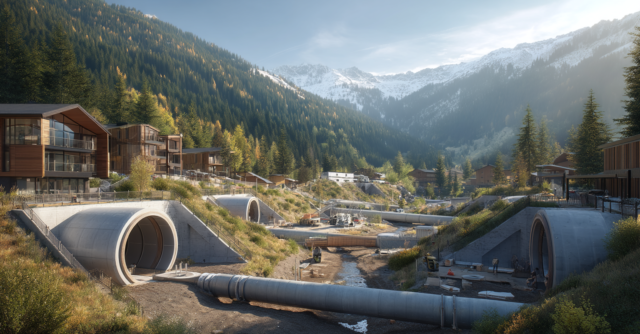
    BRUGG Pipes from Kleindöttingen, part of the Brugg-based BRUGG Group AG, has supplied pre-insulated district heating pipes for a crossing of the A4 highway. The bridge element between Holzhäusern and Rotkreuz was lifted into place at the end of October, according to a press release. During assembly, two 48-metre-long pipes suitable for bridge structures were installed. They weigh 4.9 tons without water.

    The pipe bridge connects existing and new sections of the Ennetsee heating network. Further districts and commercial locations in Rotkreuz ZG, Cham ZG and neighboring areas are to be connected to the district heating network. The client for the project is WWZ. The company B S AG was responsible for the planning and construction management of the bridge, supported by Hodel SHLK AG as the pipe constructor. “I am delighted with how WWZ, B S, Hodel SHLK and the other partners implemented this project in a spirit of partnership and with the utmost precision. Laying our pipes like this with our own bridge is definitely not an everyday occurrence. I am all the more pleased that the installation was successful and that our pre-insulated pipe systems are now supporting the expansion of the Ennetsee heating network and decarbonization,” said Martin Rigaud, CEO of BRUGG Pipes, in the press release.

    WWZ uses the waste heat from the Renergia waste incineration plant in Perlen LU as a heat source. Cham is also to be supplied with district heating from the project by fall 2026. Overall, the expansion of the network is expected to save around 12,000 tons of carbon dioxide per year.

  • Renewable gas strengthens local supply

    Renewable gas strengthens local supply

    Since October, some of the sewage gas from the wastewater treatment plant (WWTP) of the Aargau and Surroundings Wastewater Association(AVAU) in Telli in Aarau has also been used to supply heat locally. According to a press release, Green Power Aarau AG processes the gas, which is then fed into the natural gas network of Eniwa AG.

    This replaces fossil natural gas with renewable gas. According to the press release, the quantities are currently still manageable. However, they should be significantly increased with the ARA expansion.

    “With this project, we are demonstrating how the by-product sewage gas can be turned into a valuable energy source,” said Hans-Kaspar Scherrer, CEO of Eniwa and Chairman of the Board of Directors of Green Power Aarau AG, in the press release. “The collaboration between AVAU, Green Power Aarau and Eniwa is a strong example of how the circular economy works in practice in the region.” According to Scherrer, the three companies are jointly contributing to a sustainable energy supply and the reduction of CO2 emissions, as well as strengthening local value creation.

  • Central Switzerland’s first alpine solar plant goes online

    Central Switzerland’s first alpine solar plant goes online

    energieUri has connected the first alpine solar plant in Central Switzerland to the grid on the Sidenplangg in the municipality of Spiringen, according to a press release. The plant at an altitude of 1,800 to 2,000 meters is set to generate 12.5 gigawatt hours of electricity per year with a total output of 8 megawatts when fully expanded. Almost half of this will be produced in winter.

    The plant currently supplies 13 percent of the planned electricity. This qualifies it for funding under the Solarexpress program. Work is due to resume in spring and be completed by the end of 2028.

    APV Sidenplangg AG is owned by the Uri-based energy supplier energieUri AG as the initiator and aventron AG, based in Münchenstein BL. “Such power plant projects create and secure highly qualified jobs in the region – be it in the planning, realization or future operation and energy management by energieUri,” says Werner Jauch. CEO of energieUri and Chairman of the Board of Directors of APV Sidenplangg AG, is quoted in the press release.

  • New tracker makes the Swiss power-to-X landscape visible

    New tracker makes the Swiss power-to-X landscape visible

    Renewable electricity can be stored in chemical energy carriers such as hydrogen, synthetic fuel and methane (Power-to-X). According to a press release from the Swiss Power-to-X Collaborative Innovation Network SPIN, more than 50 projects in this area are already underway in Switzerland.

    Together with the Coalition for Green Energy & Storage(CGES), SPIN is therefore launching a tracker that provides an overview of known projects in Switzerland. The resulting map makes visible those projects that have gone beyond laboratory tests and have already become demonstration projects or even commercial applications. SPIN collects the data, CGES visualizes it.

    “The tracker facilitates collaboration by providing a structured database that promotes synergies between stakeholders and supports decision-making,” Christoph Sutter and Antonello Nesci, co-directors of CGES, are quoted as saying in the press release.

    Martin Bäumle sees power-to-X technologies as the key to defossilizing the economy. “With the tracker, we are creating transparency, strengthening collaboration and helping to turn promising ideas into scalable solutions,” said the National Councillor (Green Liberal/ZH) and Co-President of SPIN. “Reliable data can help policy makers to adapt regulations and investors to identify new opportunities.”

    The map will be presented at the CGES annual event, which will take place on November 21 at Swissgrid in Aarau. CGES is a coalition of partners from business, academia and the public sector for green energy, founded by the ETH Domain.

  • Double use of space increases solar power production

    Double use of space increases solar power production

    According to a press release, ARA Thunersee has inaugurated HORIZON, the largest movable solar folding roof in the world. It was realized by the cleantech company dhp Technology from Zizers. With an installed capacity of 3.6 megawatts peak and around 3 gigawatt hours of electricity, the system will supply 700 households.

    According to ARA Thunersee, the more than 20,000 square meter plant is based on technology from dhp Technology. dhp CEO Gian Andri Diem sees great potential in generating energy on existing areas. “This is how we create progress without taking up additional space,” he is quoted as saying.

    According to dhp’s project description, efficient use of space is relevant in order to make progress with the energy transition through photovoltaics. Wastewater treatment plants, logistics areas, waterworks and parking areas are particularly suitable for solar power production due to their previously unused areas. According to Ingo Schoppe, Managing Director of ARA Thunersee, “intelligent land use makes an active contribution to security of supply, economic efficiency and climate protection”.

    The solar folding roof spans several clarifiers and makes double use of existing infrastructure areas – for wastewater treatment on the ground and for solar power generation above. The electricity generated there is intended for wastewater treatment and local supply.

    Based on Swiss cable car technology, the roof is able to react to extreme weather conditions. It folds up automatically in the event of storms, snow or hail. This allows operational safety and energy production to be achieved without having to intervene in ongoing processes.