Category: People

  • Until the chemistry is right

    Until the chemistry is right

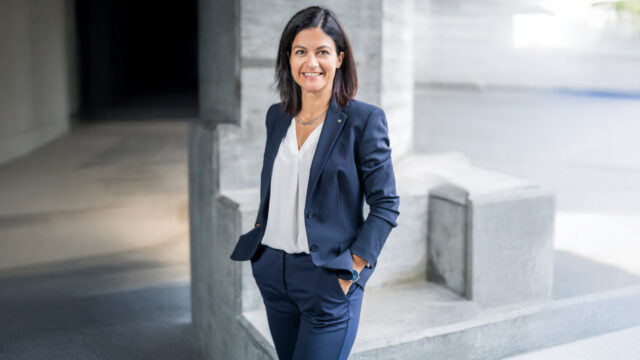
    The fact that she has mastered her field from A to Z is, as she points out, also thanks to know-how built up by colleagues at Empa – such as engineer Gabor Kovac. He pushed the production of stack actuators with expandable silicone discs for many years and developed them to operational maturity with his partner Lukas Düring until their spin-off “CTsystems” was recently taken over by the Daetwyler Group.

    “The devices for measuring how actuators stretch in different electric fields were developed by them,” Opris says, “we were early on this topic, and that helped me enormously.” Unlike her colleagues, however, the chemist is working less on the technology for printing such components, but one “floor below” – on the synthesis of novel polymers that are suitable as non-conductive layers for stacked transistors, elastic films for power generation and other elements.

    The desired profile: as thin as possible, with the long-term goal of many layers only ten micrometres thick; easily stretchable, sensitive to low current voltage and robust at the same time. And above all: printable, i.e. without solvents for the conductive layers between which the polymers lie. “Solvents can damage the polymer layers. Besides, the material would have to dry for a long time in order not to give off harmful vapours,” explains Opris, “so we try to do without them – with the right chemistry.”

    There are many different requirements that researchers all over the world are dealing with. Suitable compounds that raise hopes are polysiloxanes, which the Empa specialist is also working on. An important advantage of these polymers: they are relatively easy to synthesise; the “backbone” of their strands is very mobile – and they can be specifically manipulated with polar groups, i.e. plus-minus charged molecules.

    Snake-like molecules
    What is difficult for laypeople to understand, Dorina Opris explains with a vivid image: “You can imagine these polysiloxanes like a pot full of snakes that want to move all the time.” The polar groups have a twofold effect on them. On the one hand, they make the molecular snakes more sensitive to electric fields so that they respond to low voltages. On the other hand, they act like a kind of glue between the molecules; this “stiffens” them and thus reduces the important elasticity. It is necessary to fine-tune both effects to achieve maximum success. For a practical application, the transition from the solid to the elastic state at low temperatures is important so that the technology can later be used at room temperature. In addition, such polymer structures still have to be chemically “cross-linked” so that they can become elastic layers – for example by UV light and with the help of so-called end groups: quasi molecular “hats” that the snakes wear at their ends. But in laboratory practice, it has so far proved tricky to reliably provide these polymers with defined end groups. “That annoys me already!” admits Opris with a smile.

    Healthy ambition is needed for the TRANS project, which the chemist herself calls “very, very ambitious”. The team is optimistic because earlier work has already produced encouraging results; for example, a polysiloxane compound that reacted to a voltage of only 300 volts and deformed strongly – an extremely low value. Printing capacitor layers without solvents has also already been achieved. And a doctoral student recently developed a piezo-electric elastomer that, when stretched, shows a significantly higher electrical response than other compounds currently in use.

    Creativity and team spirit for success
    Of course, many more steps are needed to achieve usable successes – and those qualities that have brought Dorina Opris to Empa and ETH Zurich. Not only stamina and the ability to turn failed attempts into progress, but also to create an inspiring environment for employees that allows open debate and also mistakes so that good ideas emerge.

    And above all: optimism. The boss believes that young researchers should be given exciting and challenging projects and then be allowed to work independently so that they remain motivated. Her advice to talented women based on her own biography: “Don’t wait until someone pushes you to do research. You have to be self-motivated and strong, and go for it! And also take a risk sometimes.”

  • Fabian Streiff becomes Head of the Office for Economic Affairs – Hans Rupp Head of the Office for Employment

    Fabian Streiff becomes Head of the Office for Economic Affairs – Hans Rupp Head of the Office for Employment

    In the coming years, the economic challenges will continue to increase. Competition among locations is intensifying, while the world of work is changing rapidly. The digital transformation, more flexible and location-independent working models, as well as the labour shortage pose major challenges for companies, the labour market and the entire economy. In order to be prepared for these in the best possible way, the existing economic and labour market policy competences in the currently broadly structured Office of Economic Affairs and Labour (AWA) will be strengthened organisationally. Therefore, at the request of the Department of Economic Affairs, the Government Council decided last year to transfer the AWA into two independent offices as of 1 January 2024: an Office for Economic Affairs (AWI) and an Office for Labour (AFA).

    The AWI will be responsible for location promotion, economic policy, work permits, working conditions, housing promotion and national economic supply. The AFA will be responsible for the labour market, unemployment insurance and the unemployment fund.

    Hans Rupp with many years of operational and strategic leadership
    Hans Rupp will be the new head of the Labour Office. After studying at the University of Zurich, the 57-year-old gained professional experience in various organisations and companies. Most recently he was managing director of building and housing cooperatives and in the real estate sector. In addition to these operational tasks, Hans Rupp has held various mandates in the area of strategic management. He has many years of experience in operational and strategic management. Among other degrees, Hans Rupp holds an Executive MBA from the University of Zurich.

    Fabian Streiff: From Head of Location Promotion to Head of the Office of Economic Affairs
    Dr. Fabian Streiff will be Head of the Office of Economic Affairs. After completing his studies in geography and economics at the University of Zurich, the 39-year-old first worked as a consultant in the fields of strategy development, sustainability issues and economic promotion before earning his doctorate in economic geography and regional development at the University of Bern. He then headed up location promotion in Basel-Stadt before becoming Director of Healthcare Innovation / DayOne at BaselArea.swiss. Since December 2020, Dr Fabian Streiff has been head of location promotion for the Canton of Zurich at the Office of Economic Affairs and Employment.

    Dr Fabian Streiff and Hans Rupp will take up their posts on 1 January 2024.

    Source: zh.ch

  • Andrea Wegmüller appointed new Head of Property Management at Zug Estates

    Andrea Wegmüller appointed new Head of Property Management at Zug Estates

    Andrea Wegmüller has worked for PRIVERA AG since 2016, initially as Regional Head of Property Management East and since the beginning of 2022 in the role of COO / Head of Property Management Switzerland. Prior to that, he worked for Livit AG for five years in various functions. Andrea Wegmüller is a qualified real estate trustee and holds a Master of Advanced Studies (MAS) in Real Estate Management from the Hochschule für Wirtschaft Zürich (HWZ). Andrea Wegmüller takes over as Head of Property Management from Pascal Arnold, who has decided to take on a new professional challenge after nine successful years with Zug Estates. The Board of Directors of Zug Estates Holding AG thanks Pascal Arnold for his great and professional commitment and wishes him every success for the future.

    Source: Zug Estates

  • Relevance of social sustainability in institutional real estate portfolios

    Relevance of social sustainability in institutional real estate portfolios

    Ms Zimmerli, you are developing criteria for assessing the social sustainability of institutional real estate portfolios. What are your motives?
    In recent years, many institutional owners have set climate targets that go beyond the legal requirements as part of their ESG strategies. After the “E”, the “S” is now slowly coming into focus. The problem is that nobody really knows what constitutes social sustainability. We observe that a lot is projected into the “S”, and the big social contexts are often pushed into the background. We have therefore decided to test with partners from academia, real estate associations and institutional investors on the basis of various portfolios what an operationalisation of social sustainability might look like. Our goal is to define a few clear, easily interpretable and comparable key figures for social performance, to create short checklists to complement them, and thus to give more room to competition for good ideas.

    Many portfolio and asset managers are currently busy preparing reliable energy and emissions data. What prompts you to develop key figures for social sustainability right now?
    It is true that the focus of the real estate industry is still on the collection of climate key figures at the moment. Thanks to the REIDA CO2 benchmark and the environmentally relevant AMAS key figures, there is now a clear orientation framework and good instruments. We want to take both the momentum and the focus on the essentials of these instruments with us, because we are convinced that the real estate industry simply cannot afford to reduce sustainability to environmental issues. The heated debates on the reference interest rate, housing protection and major development projects show that the public and politicians also expect sustainable real estate portfolios to provide answers to social questions.

    In the industry, there is currently no consensus on what is meant by the “S” or how societal-social sustainability should be measured. How do you see it?
    Against the background of the current political discussions, the “S” is not complicated: At the societal level, it is about providing housing to broad segments of the population, about socially mixed living environments and about well-functioning neighbourhoods and districts. For institutional owners, it is about how property portfolios are structured and how the available living space is distributed. For new construction and renewal projects, the question is what happens to existing tenants, for which target groups additional living space is created and how neighbourhoods and districts can be strengthened. Of course, there are countless other needs. However, we believe that key figures should refer to the major social levers and that the market should play a role in individual needs.

    How can and should the “social performance” of a real estate portfolio be effectively measured or assessed?
    We are guided by the philosophy of the environmentally relevant key figures of AMAS and REIDA: “Keep it simple”. In essence, social performance can be measured simply with hard-testable key figures: We are currently testing how data on the portfolio structure and on first-time lettings and re-letting can be collected and evaluated as simply as possible. In addition, we are developing questionnaires that owners can use in their tenant surveys to obtain reliable findings on satisfaction with the neighbourhood, flat or property management. Finally, we use classic key figures on fluctuations and vacancies, which are usually already collected and evaluated.

    The optimisation of ecological criteria often requires high investments. This creates incentives to sell properties with a poor ecological balance. Do properties with poor social ratings face the same fate?

    No, from our point of view there is no danger of stranded assets in terms of social sustainability. We are convinced that basically every property can be transformed in a socially sustainable way with reasonable effort. The most important levers here are renewal planning and management. Renewal planning determines when which properties are to be adapted to current needs and market prices. In management, decisions are made as to who will receive affordable or barrier-free living space. We have selected key figures that can be directly influenced by portfolio and asset managers. We understand social sustainability as the result of far-sighted portfolio and asset management and consistent marketing and management, and not as a property or location attribute. We are also convinced that properties with strong social qualities can compensate for environmental weaknesses.

    Many owners find it difficult that innovative ideas and approaches with which they want to stand out from competitors disappear in extensive checklists and indicator sets of sustainability labels. How can this be prevented?
    By separating obligation from freestyle. We pursue the same goal with social sustainability as REIDA does with ecological aspects: A few uniform key figures should make it visible and comparable how well a portfolio fulfils the mandatory programme. In addition, there are topics for which there are no standardised specifications. Fund management companies and asset managers should be free to decide and communicate how they want to ensure, for example, good neighbourhood care, good cohabitation or good tenant management. We see the “how” as a freestyle; this is where competition, creativity and innovation should play a role. In other words, we want more goal orientation and less micromanagement. In a highly regulated world, ESG should not be a tighter corset, but a springboard with which the real estate industry can prove what it can achieve with yield-oriented portfolios.

    Where do you stand with the key performance indicator set?
    We are currently working on concretising and validating our approach on the basis of four funds of our partners. We will present the findings and a first consolidated draft on 28 September 2023 at the symposium “Measuring social sustainability in ESG – what is it all about?” and discuss it with owners, managers and experts. Interested readers can register here . I would be pleased if we could welcome you at the HWZ in Zurich.

    Source: ssrei.ch

  • “Sustainable and smart city with a high quality of life”

    “Sustainable and smart city with a high quality of life”

    Ms Furrer, what is the task of urban development?
    We deal with the four topics of economy, housing, smart city and social urban development. We contribute our topics to various development processes. In doing so, we rely on trend and potential analyses and data, among other things. We provide information, advice and support projects and services related to these core topics.

    What tasks do you take on with regard to location development?
    We deal with this topic holistically and proactively. Housing and the economy, for example, cannot be considered individually, they influence each other. Location development is a joint task.

    Currently, we are primarily concerned with the business location, including the following two aspects: The first point is the profiling of workplace areas. To this end, we are pursuing the approach of innovation ecosystems and are developing the corresponding foundations. Here we still have some development work ahead of us. Secondly, the companies that are already here, but also other actors, should be able to bring in their concerns and interests and develop further. In this regard, we are in the process of setting up a so-called business service desk.

    What are the concrete goals of Winterthur’s urban development?
    Winterthur should be a sustainable and smart city with a high quality of life, characterised by respectful coexistence and good conditions for business. The population participates in social development, new technologies are promoted. Winterthur continues to develop its good reputation as a liveable city – not least thanks to a diverse range of housing for a wide variety of needs. In the future, however, we also want to position ourselves as a location for technology and innovation. The city should also see itself as a real laboratory (WinLab) for the promotion of innovations and use the competences gained from this. Another goal is data monitoring for our core topics. And we would like to promote Open Government Data.

    What are the biggest challenges for Winterthur at the moment?
    As everywhere, the big issues in Winterthur are the net zero target or digitalisation. And Winterthur is growing. We need more space for housing, jobs, schools, sports and other needs. At the same time, land is in short supply.

    With the “Spatial Development Perspective Winterthur 2040”, the city shows where the greatest potential for densification lies and how it wants to use it: it is about areas with a variety of uses and about workplace areas. Investors and private landowners are showing great interest. This opens up opportunities for the business location, but also challenges us.

    What are the most popular locations for companies?
    That depends entirely on the needs of the companies. Depending on the needs of the company, the accessibility, the zoning, the development potential, the surroundings or the land and rental prices play a greater or lesser role. I would venture to say that demand is generally increasing in the direction of central and well-supplied locations. Of course, there are also companies that prefer a peripheral location because of land consumption or noise emissions. In general, it is important to preserve industrial and commercial zones for the future.

    How doesWinterthur score as a location for companies?
    Firstly, Winterthur is excellently connected: Zurich Airport can be reached in a few minutes, the train connections to Zurich and Eastern Switzerland are optimal. And with the planned Brüttener Tunnel and the expansion of the A1 motorway, transport access will be even better in the future. Secondly, we can score points with successful technology companies that are well equipped for the future. These include large, partly listed companies such as Rieter, Sulzer, Burckhardt Compression and Kistler, as well as a large number of innovative start-ups. The latter are specifically promoted, for example by Technopark Winterthur, the Home of Innovation and the Entrepreneur Club Winterthur. A third plus point is the Zurich University of Applied Sciences (ZHAW). Through its research and development, it ensures the transfer of knowledge, contributes to local innovation and, as a university, produces valuable specialists. In addition, the ETH and the University of Zurich are also not far away.

    What makes Winterthur attractive as a place to live?
    The already mentioned high quality of life and its own charm. The large number of gardens, an intact, historic old town and the wide range of cultural activities contribute to this. In my opinion, there is another, underestimated quality: From almost anywhere in the city, you can reach the countryside in about ten minutes. Last but not least, the moderate prices compared to nearby Zurich and the good transport connections to eastern Switzerland make Winterthur a very attractive place to live.
    What is the situation with free housing in Winterthur?
    Free housing has been rare in growing Winterthur for some time: the vacancy rate last year was 0.37 per cent, which corresponds to just 212 flats. There is a lot of building going on, now and in the near future, as far as we can estimate today. We are concerned with the topic of housing, but we are not alone in this: affordable housing is generally a big issue in Swiss cities.

    Personal details
    Bettina Furrer has been Head of the Office for Urban Development of the City of Winterthur since December 2020. She studied environmental sciences at ETH Zurich and received her doctorate in 2010. From 2004 to 2018 she worked for the ZHAW School of Engineering, first as a lecturer and later as a professor and head of the Institute for Sustainable Development. Bettina Furrer grew up in Winterthur and still lives in the city with her family.

  • Outlook with the Innovation Park in Dübendorf

    Outlook with the Innovation Park in Dübendorf

    Mr Thöny, where does the structural development stand?
    We are currently in development stage 1, the peripheral zone of the airfield site, where we are meeting the space requirements of our research partners ETH Zurich and the University of Zurich as well as initial users from business and industry. In addition, there are test and meeting areas as well as flexible and temporary facilities in front of the hangars. At the same time, we are working intensively on the development and planning of stage 2, i.e. the first stage of new buildings.

    How will the Innovation Park become an inspiring place for researchers?
    We are working on the vision of this “research city of the future”. When you enter the Innovation Park Zurich in the near future, you will immediately feel and see that this is an exceptional place for research and development. We are creating a unique environment for researchers. The companies and research partners will have the opportunity to bring their employees into a context that otherwise only very large tech companies like Apple can offer. At the same time, the historical heritage, the former military airfield, remains recognisable as such and can be experienced.
    We see the Innovation Park as a “Cognitive City”, a digitally highly networked urban space with outstanding and sustainable architecture and landscape architecture and an attractive range of different campus uses that will grow over the years, where people can work, do research, meet and exchange ideas, eat and drink, relax and do sports. In other words, a place with a high quality of stay and life, where the focus is always on people. At the same time, a new, diverse range of services, leisure and recreation facilities is being created for the population of the surrounding communities and the entire region.

    What is the next milestone on the way to realising this vision?
    Last year we launched an architectural competition in which renowned national and international offices as well as three up-and-coming firms participated. From the 28 designs submitted, we will select seven projects together with a jury, which will then be developed as part of the first major new building phase. In the second half of the year we will be able to show a concrete picture of the future Innovation Park site for the first time.

    New premises are being built on the site.
    What does the development & realisation phase look like?

    We are working on an “Industrial Hub” with ETH Zurich and a “Space Hub” with the University of Zurich. Both are very exciting projects and in themselves “small innovation parks” in the Innovation Park. In addition, various smaller buildings and projects are being planned for the start and the first tenants.

    About the person
    Andrea Claudio Thöny is an architect ETH. After working as an architect and in real estate consulting, he joined HRS in 2018 and has been Head of Real Estate Development since 2020. His focus is on the development of special projects in the areas of research and development, commercial and special uses, as well as business development, M&A and restructuring. Since 2019, he has been responsible for the Innovation Park Zurich as overall project manager, and since 2023 additionally as managing director of IPZ Property AG.

  • “The city of Winterthur is often underestimated”

    “The city of Winterthur is often underestimated”

    Mr Roth, you are qualified to practise law, were head of department at the Financial Intelligence Unit of the Principality of Liechtenstein in Vaduz and managed the Musikkollegium Winterthur. What prompted you to accept the position of Director of the House of Winterthur in 2020?
    Samuel Roth: I found it very exciting to be working at the interface between business, education, tourism and culture and to be so committed to the Winterthur region.

    What have you been able to achieve in the almost three years since you took office?
    Roth: It was important to me to focus our activities on our core competences of communication and networking. This enables us to raise the region’s profile as a technology location, education centre and cultural city. To this end, we have put together an attractive programme of around 40 events per year. The “Tech Lunches” are particularly popular: our guests can visit production companies or attend the events on the topic of “House Culture”, where we visit the Winterthur Music Festival with our members, for example.

    Ms Lomoro, House of Winterthur was created in 2017 from the two associations Winterthur Tourismus and Standortförderung Region Winterthur. The city is thus operating a special model: topics such as business, tourism, education and culture are united under one roof. What are the advantages?
    Antonietta Lomoro: The various stakeholders now only have one point of contact for location promotion issues instead of two, as was previously the case. Marketing for the region now comes from a single source. We also promote mutual networking between the various stakeholder groups.

    What synergies have been achieved through the joint presence?
    Lomoro: Today’s workforce attaches more importance to a good work-life balance. They appreciate the great leisure and cultural activities on offer in the Winterthur region. Employers make sure that their employees can work in an attractive location where the quality of life is right as well as the economic conditions. It therefore makes sense to promote these locational advantages from a single source.

    How many people does House of Winterthur employ? What is the budget?
    Lomoro: House of Winterthur currently employs 20 people in full-time equivalents. The budget is CHF 3.5 million.

    Winterthur has a diverse economy, a lively old town, a high-calibre cultural offering and a prestigious university of applied sciences. Why is it necessary to market a city that has so much to offer?
    Roth: Winterthur may be the sixth largest city in Switzerland, but it is often underestimated. It is therefore important that House of Winterthur showcases the region’s qualities as an outstanding technology location, practice-oriented education centre and great cultural city.

    How is House of Winterthur being received by the population and companies?
    Lomoro: The population of Winterthur approved the establishment of House of Winterthur by a clear majority in 2017. After the original subsidy agreement with the city expired, the city parliament extended the agreement for a further five years without a dissenting vote. The activities of House of Winterthur have met with a positive response from companies, as evidenced by the lively participation in our events.

    How have House of Winterthur’s membership figures developed over the last three years?
    Lomoro: Since the beginning of 2020, the number of members has risen by 20 per cent to a total of 420.

    “Tourism has recovered almost completely since corona

    How attractive is Winterthur as a business location?
    Roth: Every year, we conduct a business survey in which over 300 companies take part. The last survey showed that almost 87 per cent of companies are fairly or very satisfied with the general conditions in Winterthur. This is due to the proximity to universities and the good availability of skilled labour. the city is also attractive for start-ups. For example, the “Start-up Nights”, Switzerland’s largest start-up event, takes place in Winterthur every year.
    What measures are you taking to further increase its attractiveness?
    Lomoro: With “Winterthur 2040”, the city council has defined how it wants to make Winterthur fit for the future. Our task is to emphasise the advantages and opportunities of the entire region.

    Which sites, properties and locations are currently most sought after by companies?
    Lomoro: We have received many enquiries – namely for the Sulzer site in the city centre and The Valley in Kemptthal. We are currently seeing a strong increase in interest in space in Neuhegi and in the centre of Effretikon.

    Which regulations are in urgent need of adjustment?
    Roth: For the economy, any regulation is one too many. Sometimes, however, regulations are needed to promote the interaction between living and working, to enable short distances and to revitalise public spaces and achieve a high level of diversity of use.

    How do you expect Winterthur as a business location to develop over the next 10 years?
    Roth: The number of jobs has developed in proportion to the population growth of around one per cent per year in recent years. We therefore assume that not only construction activity will contribute to further economic growth, but also that new technology companies will settle in Winterthur. In addition, our company survey has shown that almost half of the companies surveyed are planning to invest in the coming years. The Winterthur region can therefore look forward to rosy times.

    How is the city positioned in terms of tourism and where is it today?
    Lomoro: Tourism has almost completely recovered since coronavirus and – measured by the number of overnight stays – is only 15 per cent below the record year of 2019. The most important tourist attractions in the region include the Rhine Falls and Technorama, followed surprisingly by the Skills Park in third place. FC Winterthur and Pfadi Winterthur are also crowd-pullers. The city of culture scores with the international appeal of its museums, the wide variety of festivals and the International Short Film Festival, as well as the Casino Theatre and the Musikkollegium Winterthur.

    Last year, House of Winterthur reduced the number of board members. What were the reasons for this?
    Roth: With the previous 15 to 16 board members, the board was too large. This meant that the individual Board members were not able to contribute enough. According to the Articles of Association, the Board may now only have a maximum of 9 members, which greatly increases the efficiency of the Board’s activities.

    Are further internal changes planned in the coming years?
    Roth: House of Winterthur is basically on track. The Annual General Meeting will elect a new Board of Directors on 25 May. It will review the strategy and make any necessary adjustments.

  • Reto Zeidler becomes Head of Cyber Security at Inventx

    Reto Zeidler becomes Head of Cyber Security at Inventx

    As an IT and digitalisation partner for Swiss banks and insurance companies, Inventx addresses the steadily growing customer demand for security expertise with a comprehensive solution portfolio. The company advises customers in the areas of information security, cyber crime, cyber risks, secure enterprise architectures and zone concepts as well as future-oriented risk management. Thanks to its independent Cyber Resilience Centre with highly trained analysts, it keeps its finger on the pulse of current cyber-crime trends around the clock.

    Reto Zeidler joins Inventx from process and digitalisation consultant Pragmatica, where as Head of Information and Cyber Security he was responsible for the company’s consulting expertise in these areas and led security projects as Principal Consultant. Before that, Reto Zeidler was Chief Managed Services Officer and a member of the executive board at the IT security service provider ISPIN. Other stations in his career included Associate Partner / Executive Advisor for IBM Security and Head of Cloud Security Services at Swisscom.

    As an active member of the cyber security community, he is involved in the Information Security Society Switzerland (ISSS) and the Cloud Security Alliance. He is also a lecturer and expert in information security at the Lucerne University of Applied Sciences and Arts.

    At Inventx, Reto Zeidler is responsible for the entire cyber security cluster, ensures sustainable and high-quality service provision and strategically aligns it with customer needs. He continuously develops the area and expands it in terms of personnel and technology.

    Fabio Cortesi, CTO and Member of the Executive Board of Inventx AG, welcomes the new Head of Cyber Security: “We are pleased to have gained an experienced and highly competent security expert. Reto combines technical and leadership expertise at the highest level, always with a clear view of current and future customer needs.”

    Reto Zeidler on his new role: “I am very much looking forward to taking the Cyber Security Cluster even further forward for our customers together with my team. We can build on an excellent foundation. Now we want to take the next development step.”

    Source www.inventx.ch

  • “A big city with small-town charm”

    “A big city with small-town charm”

    Where do you currently see the biggest challenges for the city?
    Winterthur is experiencing strong growth. This brings opportunities, but also challenges. More and more people want to move to Winterthur. This requires a greater number of available jobs, because short commutes mean quality of life. In addition, we have to provide more transport and educational infrastructure. This entails costs – even if we generate more tax revenue due to the growing number of residents. Nevertheless, larger investments are necessary to absorb the growth. With “Winterthur 2040” we have defined where densification is to take place. We expect around 135,000 residents by 2040.


    You have already mentioned it: the city of Winterthur currently has over 120,000 inhabitants. Last year you recorded the strongest population growth in decades. Why is that?

    Winterthur is simply a great city! We are excellently located. We offer a lot of green spaces, a high quality of life and a wide range of cultural activities. Our educational institutions also attract young people in particular. This brings well-trained professionals to the regional labour market. Of course, we also benefit from our affiliation with the Zurich economic region.
    And we are a modern technology city, which is interesting for companies. In short: Winterthur is a big city that offers everything, but still retains its small-town charm.

    How is the city’s housing market doing in view of the sharp rise in the number of inhabitants?
    Like all cities, we are struggling with a very low vacancy rate. But we still have a few municipal and some private building reserves to fall back on. The current building and zoning regulations still allow for a lot. There is a lot of building going on, as we can see from the number of building permits. Basically, we are striving for a well-mixed city. That’s why we try to offer both affordable housing and housing for higher incomes. In my opinion, however, the housing market should not be regulated by the city, it should function as independently as possible.


    You have set up the Smart City office. What does it deal with and how does it work?

    We were the first city in Switzerland to have a Smart City strategy at the city council level. The Smart City uses social and technological innovations in a targeted way to ensure quality of life, conserve resources and promote sustainable development. In other words, it is about using modern technologies to simplify everyday life for the population and to make the city well connected. For this purpose, we have founded the Smart City Winterthur office. In addition, the city of Winterthur is positioning itself as a Living Lab (WinLab), a real laboratory or test city, in which social and technological innovations for the benefit of sustainable urban development can be tried out, systematically tested and, if successful, scaled up. Partners from research and development, business and civil society are invited to actively participate.


    Sustainability is an important keyword in this context.
    True. Researchers from a wide range of disciplines agree that the city of the future must be a sustainable city. This means that the city must be designed in such a way that it can adapt to changing conditions. This concerns not only the “hardware” such as infrastructure, buildings and open spaces, but also the “software”, i.e. the social and economic structures. A sustainable city is therefore economically successful, ecologically compatible, socially stable and thus: resilient. The sustainable Winterthur should therefore also be an ecological city, in the sense of quality of life for its inhabitants. This includes as few emissions as possible, sufficient green spaces, open space and flexible and diverse mobility. With regard to social resilience, it is important for us to strengthen networks and address existing disadvantages.


    What has been done specifically in the area of digital transformation of the city administration and what is still planned?
    In order to be able to approach the digital transformation in a targeted and holistic manner, the city is currently developing a digitalisation strategy. This is geared to the needs of the various stakeholders and is based on the available means and resources. Our goal is to create a faster and as low-threshold contact to the population as possible. Currently, the city offers over 90 e-services that can be accessed via a central portal. We also want to make our internal work processes even more efficient. The highest priority is not only ease of use, but also data protection and data security. The greatest challenge, however, is and remains the speed at which digitalisation is advancing. It is important to keep pace here. We have not yet reached our goal, but we are well on our way.


    In 2017 you initiated the merger of the associations Winterthur Tourism and Location Promotion Winterthur Region. The result is the new organisation House of Winterthur. What is your conclusion some six years later?
    With House of Winterthur we have founded an association that allows us to conduct integrated location marketing. At the time, we were the first city to try this. We want to do marketing for the city and the region of Winterthur from a single source, so to speak, and generate a higher added value. We got off to a good start with a very broad sponsorship. The sponsorship is very broad with the canton, municipalities, companies, hotels, restaurants, cultural institutions and the city; meeting the different demands was a very big challenge. We certainly haven’t done everything optimally here. We have had a new director for a year and a half and are in the process of reorganising the board. I am still convinced of the idea, but we still have to optimise and adjust it.

  • Data protection and real estate – more topical than ever before

    Data protection and real estate – more topical than ever before

    What is data protection and what is not?
    There is no regulation on the handling of factual data, such as the use of defined data formats or specifications on data consistency in construction projects. Unfortunately, such a regulation is largely lacking today, ultimately to the detriment of property owners. The Data Protection Act (DSG) regulates the processing of personal data by private individuals and companies, among others. In principle, every person should be able to determine the use of their data themselves. Swiss data protection law is designed in such a way that the processing of personal data by private individuals is generally permitted, provided that the principles laid down in the FADP (e.g. purpose limitation, data minimisation) are observed. The revised FADP will enter into force on 1 September 2023. In a real estate cycle, there are numerous starting points for handling personal data. Some areas are highlighted below:

    Marketing by estate agents
    Through their activities, estate agents come into contact with interested parties whose customer and personal data they process. Brokers are therefore now legally obliged to draw up a data protection declaration. In it, they must inform the data subject, among other things, about what data is collected or processed for what purpose, what the processing modalities are and what rights he or she is entitled to. The declaration can be published on the website or in the GTC. If tenant profiles are used for the sales process, caution is required. Either personal data must be blacked out or the tenants must explicitly agree to the disclosure to prospective buyers or the tenancy agreements contain clauses that allow the disclosure in the sales process.

    Management data
    Data is often processed as part of the management process: Tenant checks before conclusion of the contract, user data on the operation of a property, data from access controls (outside the property or to the tenant unit), network data, electronic concierge or smart solutions offered by the landlord (such as tablets in rented rooms, smart homes, etc.). The DPA creates an obligation for every service provider to account for the data they process and to ensure that it is handled in accordance with the law. It is therefore recommended to conduct an individualised data protection analysis. Such an analysis must take into account, among other things, the specific circumstances and data flows, the type of data and service provision, as well as the storage locations. The tenants must be informed of all processing of their personal data, unless there is a corresponding basis in the tenancy agreement.

    Offer abroad
    If offers for sale are also made to persons in the EU area, the provisions of the European Data Protection Regulation (GDPR) must be observed. These are much stricter in some points than the regulations of the DSG. If necessary, the use of geo-blockers should be examined.

    Seidel & Partner Rechtsanwälte AG specialises in legal issues for construction, planning and real estate. Our focus is on value-added and solution-oriented support for SMEs, investors, cooperatives and authorities. We strive for economically sensible solutions; litigation typical of lawyers is only a last resort for us.

    Contact
    Dr. Wolf S. Seidel &
    Lic. iur. Simon Kohler
    Seidel & Partner Rechtsanwälte AG
    Balz-Zimmermann-Strasse 7
    8302 Kloten
    Phone 044 590 20 12
    info@seidelpartner.ch
    www.seidelpartner.ch

  • “The central location is a big plus”

    “The central location is a big plus”

    Mr. Zettel, what are the goals of the Lucerne Economic Development Agency?

    We pursue three main goals. The first is exciting and good jobs for our population. The second is to generate tax revenue for the services provided by the canton and municipalities. And the third is the positive perception of Lucerne as a business location, both internally and externally.

    What are your responsibilities as Head of Corporate Development?

    As Head of Corporate Development, my main focus is on the existing companies of the Canton of Lucerne. We have just over 30,000 companies and support them in developing positively. Most of our projects with companies revolve around their location. For example, when a company grows, its needs change. In this context, questions about expansions or a change of location may arise. What are currently the biggest challenges facing companies? Issues around limited resources such as building land and commercial space often pose challenges to businesses. Another major issue is currently the shortage of skilled workers and labour. There are currently major uncertainties, such as the Ukraine war or inflation. This also includes issues such as energy prices and supply bottlenecks. These challenges show us once again how dependent we are on what happens outside Switzerland.

    What are currently the most important construction projects in the canton of Lucerne?

    The entire canton of Lucerne has a high level of construction dynamism. A lot is currently going on in the two development focal points of Lucerne North and Lucerne South. The new central cantonal administration is being built in the Smart City Lucerne North. In Lucerne South, many projects are already underway, such as the Nidfeld site or the Pilatus Arena with the Pilatus Tower, Lucerne’s tallest skyscraper. The Horw campus of the Lucerne University of Applied Sciences and Arts will be expanded and renovated by the end of this decade.

    What makes Canton Lucerne an attractive place to live?

    In Canton Lucerne there is something for everyone. We have great places to live and very different regions and landscapes. We have a great city with a wonderful cultural offer. We have lakes, mountains and a tourist offer that is also available to the population. All this makes Lucerne an attractive overall package. Moreover, Lucerne is a manageable place in terms of size. You can integrate well here, we have many clubs and great events. Overall, the quality of life in Lucerne is outstanding.

    What about free and affordable housing in the
    Canton of Lucerne?

    Housing is also an issue in Lucerne. We have a vacancy rate of just under one percent. That is an average value: some communities have practically no vacant flats, in others there are definitely offers. It’s the same with prices: while housing in the city of Lucerne, for example, is relatively expensive, there are also municipalities where there are cheaper offers. At the same time, a lot is being built. That is also the most important thing at the moment: that construction projects are realised and new flats come onto the market quickly.

    Besides the city of Lucerne, which municipalities are particularly popular with companies?

    We have 80 great municipalities in the canton of Lucerne, and each municipality has its own strengths. In terms of the number of companies, the large municipalities in the agglomeration such as Emmen, Kriens, Horw and Ebikon are important locations in addition to the city of Lucerne. Sursee, the second centre of the canton, is also attractive for companies due to its location. But there are also many great companies in regions such as Willisau or Hochdorf, especially in industry. This broad and diverse economic structure is one of Lucerne’s strengths.

    Why should a company come to Lucerne instead of Zurich, Bern or Basel?

    The central location in the middle of Switzerland is a big plus. You can get to Basel or Zurich quickly, but also to Italy or Germany. In addition, we have very attractive corporate taxes, a broad educational landscape and a good skilled workforce.

    Where does Canton Lucerne stand in terms of digitalisation?

    I look at the topic primarily from the perspective of the economic structure. For example, we have many IT service providers who specialise in digitalisation. For most companies, the topic has been around for a long time. But digitisation doesn’t stop there. The transformation into a digital business model is ongoing, and new topics are constantly being added. We also take up these topics. Last year, for example, we co-founded a hub for artificial intelligence. This makes the topic of AI visible and helps companies in its application. We also support companies in networking with suitable partners for digitalisation projects.

    As an economic developer, you have a relatively young profession. What distinguishes this profession for you?

    I come into contact with an incredible number of interesting people – be it from companies, from politics or from the administration. In addition, we are at the source of new ideas and projects. Professionally, this job also has many facets: from business administration to spatial planning and real estate to politics and communication. For me, it is a privilege to be able to do this work.

  • “With the revision of the tax law, we remain an attractive business location.”

    “With the revision of the tax law, we remain an attractive business location.”

    You have been a member of the government since 2011 and are running for a fourth term in April. What do you like about your current position as Finance Director of the Canton of Lucerne?

    Even after 12 years, I consider it a privilege to be a government councillor in the Canton of Lucerne. For me, it is an exciting, varied and challenging task. As Finance Director, I take care of IT, real estate and personnel in addition to finances. I enjoy these cross-sectional functions and the resulting responsibilities. Our department is allowed to provide the resources that the other departments need in order to provide the corresponding services to the population.

    Where do you see the greatest challenges at the moment?

    From an overarching perspective, mobility and sustainability are among them, along with health care. Within the Finance Department, we have several interesting real estate projects that we are allowed to push ahead with – for example, the expansion of the Horw campus. With a budget of 365 million francs, this is the largest project in the Canton of Lucerne to date. We have also just submitted the building application for the cantonal administration at Seetalplatz in Emmen. We want to bundle the administration in this new building for about 175 million francs. One of the challenging tasks is the ongoing search for a location in the city of Lucerne for the Lucerne Museum and the Cantonal Court. Since we need several thousand square metres of space for both, the project is not entirely simple.


    You are currently working on the revision of the Tax Act 2025. Are global uncertainties such as the climate problem or the war in Ukraine being taken into account?

    In the Canton of Lucerne we are registering a very positive development. The tax law reform is intended to create the conditions for the Canton of Lucerne to remain an attractive location for natural persons and legal entities and to develop optimally. In 2000, we still had debts of 2.5 billion francs – today we have net assets of more than 300 million francs. We have achieved this thanks to an ambitious and demanding tax and financial policy. In parliament, we discussed a climate and energy report and are implementing the corresponding measures. The situation in Ukraine naturally affects many areas. Taking the current situation into account, we have created a stable foundation for the tax law reform and are looking forward to it positively.

    You see yourself as a bridge builder between city and country. Where do the discrepancies lie?

    In addition to the city and the agglomeration as an urban centre, there are many agricultural regions, especially in Lucerne’s hinterland. It is precisely this diversity that makes the canton interesting. We are centrally located, easily accessible and can offer attractive local recreation areas. In this respect, I don’t want to talk about discrepancies, but about different starting points. It is our task to keep these differences in mind in all decisions. An agglomeration city has different needs than a rural community in the Entlebuch. Thanks to the cantonal financial equalisation system, we can offer comparable services to the population in all municipalities.

    You completed an apprenticeship as a draughtsman and then studied to become a civil engineer. To what extent does the knowledge you acquired then flow into your current job?

    I am a great friend of the dual education system: vocational training is not better or worse than the academic path. It is simply different. During my apprenticeship, I learned to take responsibility for the work I do and to do it very accurately. This benefits me in my current job as finance director. Especially in the real estate sector, I know how construction projects are set up and I know the processes. Basically, an education like the one I enjoyed is a good basis for a broad range of tasks.

    What strategy are you pursuing in your department in terms of digitalisation?

    I am convinced that the digital transformation is an important basis for the further development of our society and economy. In this respect, we have developed a digital strategy that is geared towards the entire canton and is intended to ensure its future-oriented development. Within the administration, we want to provide our services in a contemporary – i.e. digital – manner. We have launched the service portal together with the Lucerne municipalities. It is intended to offer communal and cantonal services online. The plan is to create a digital gateway for all public services in the Canton of Lucerne. Our aim is not only to find an optimal solution for the administration, but also one that makes life easier for the residents.

    What makes the Canton of Lucerne attractive for companies?

    We offer good framework conditions, for example in profit taxation, which we halved in 2012. As a result, we were the canton with the lowest profit taxation of legal entities for several years – this has had a positive effect. With the planned revision of the tax law, we are ensuring that we will continue to be an attractive business location in the future. But our educational institutions are also an important factor. We have consciously invested in education and belong to the rather younger education cantons. We also benefit from our central location and the sufficient space available for businesses. We are aware that we are in a competitive environment with the neighbouring cantons. We have to move constantly in order to remain attractive.

    The Canton of Lucerne relies on a special model for economic development.

    Correct. We are the only canton in Switzerland that does not regulate business promotion at the cantonal level, but has outsourced it to a foundation. The companies are represented there as partners of the cantons and municipalities. We are convinced that it is important that the business community has a say in decision-making and feels valued. That is why we attach great importance to the maintenance of the existing business community and want to ensure good framework conditions for the private sector. We strive for qualitative growth and receive good feedback for our model.

    What is the situation regarding urban sprawl in the Canton of Lucerne and what is being done about it?

    We support the economical use of land and try to promote this with legal foundations. Densified building is the order of the day in our structure plan and in the communal zoning plans. Due to the Federal Spatial Planning Act, we now have 21 municipalities that have to reduce their building zones by up to 70 hectares – so-called rezoning municipalities. This is not an easy process, but we are keeping at it. With our structure plan, we want to enable development and at the same time take care of our cultural landscape.

    There is a housing shortage, especially in the centres. What measures must be taken to alleviate the situation?

    The public sector alone cannot solve this problem. What is needed here is interaction between the private sector, investors and the public sector. We create incentives for dense building by allowing higher utilisation. In addition, we make suitable areas available for residential buildings, such as at Seetalplatz or in Ebikon. In this way, around 200 flats can be realised.

  • Patrick Berger takes over management of DBU Facility Services

    Patrick Berger takes over management of DBU Facility Services

    Patrick Berger has been the new Managing Director of DBU Facility Services AG in Schlieren since 1 January. The 30-year-old is not only the new head of the family business, but also a partner in DBU, according to a media release from the company specialising in facility management. Patrick Berger takes over the company management from his father Daniel Berger.

    He joined DBU in 2020 to assist with the introduction of the Abacus ERP software. Enterprise Resource Planning (ERP) covers the areas of personnel, resources, capital, operating resources, materials and information and communication technology. For more than two years, Patrick Berger has been working to further digitalisation within the DBU.

    “It is a huge privilege and not at all self-evident that I can take on such a great responsibility at my young age,” Patrick Berger, who has a Master’s degree in business administration, is quoted as saying. “Thanks to this succession solution, the responsibility for DBU remains in the hands of the owners,” Daniel Berger is quoted as saying.

    In addition to the new managing director, DBU has also brought other young executives into the team. in 2021, Joanna Schneider took over as Head of Administration and Human Resources. She joined DBU as a commercial apprentice and has worked her way up to become a member of the management team.

    Sandro De Nardo, Head of Finance and responsible for Information and Communication Technology (ICT), is a new, young face who joined the DBU in 2021. In spring 2022, Reto Langenegger, an experienced facility management employee, joined the company as operational head of Facility Services. With the strong management team, the new managing director wants to concentrate on overarching topics and strengthen the DBU’s position in the market.

  • Rückblick 94. immoTable Suisse Romandie

    Rückblick 94. immoTable Suisse Romandie

    Anne Chessaux, stellte uns die höchst interessanten Aktivitäten der Romandie mit «Facts and Figures» vor, Thierry Müller von HRS präsentierte uns den Werdegang und die Hintergründe des Projekts «Coté Gare» in Bussigny, auch Stefan Zanetti, Allthings Technologies AG, erläuterte die Komplexität von digitalen Dienstleistungen an den Projekten Bussigny und Coté Gare. Die beiden Referenten David Faehndrich und Dominique Perritaz, von Energie 360° zeigten die Herausforderungen und neuen Wege die beim Projekt «Pont.rouge-Lancy» im Energiebereich zu lösen waren.  

    Wir hoffen Sie am 24. November in Basel begrüssen zu dürfen. Bis dahin wünschen wir Ihnen schöne, erholsame Herbsttag.

  • Velux Group appoints Lars Petersson as new CEO to succeed David Briggs who is retiring

    Velux Group appoints Lars Petersson as new CEO to succeed David Briggs who is retiring

    Lars Petersson comes from a position as President and CEO at Hempel, a global coatings company based in Denmark. Before Hempel, Lars Petersson held managerial positions at Inwido, a Swedish window and door manufacturer, and the French flooring manufacturer Tarkett. Since 2019, Lars Petersson has been a member of the Board of Directors at Dovista, which, like Velux, is owned by VKR Holding A/S.

    “Lars Petersson brings extensive experience and a strong track record from global manufacturing companies in related industries. Under his leadership, Hempel has successfully launched an ambitious growth strategy with a clear focus on customers and an equally strong commitment to providing leadership in sustainability. I am confident that in Lars Petersson we have found the right person to lead the further development of VELUX», says Jørgen Jensen, CEO of the VELUX Group.

    «I feel honored and happy that I have the opportunity to continue to lead the VELUX Group. Having worked in the building materials industry for two decades, I have always admired Velux for its strong brand and quality. The company has shaped an entire industry while maintaining a strong sense of social responsibility. I am very much looking forward to becoming part of VELUX and helping to achieve the ambitions outlined in the company’s recently launched strategy to grow the company while raising the bar of running a sustainable business,” says Lars Petersson. The future CEO is 53 years old and Swedish. He lives near Copenhagen with his wife Annica, with whom he has two adult children.

    David Briggs says goodbye to Velux and retires
    After five years at the helm of the Velux Group, David Briggs will step down as CEO in September. «David can look back on almost 30 years of successful career at Velux. Under his five-year leadership as CEO, the Velux success story has continued and accelerated. I regret that he is leaving us, but I respect his desire to spend more time with his family,” says VELUX Chairman Jørgen Jensen. “Together with the Board and a strong management team, David has developed an exciting strategy aimed at achieving significant growth by 2030 and becoming a true sustainability leader in the construction sector. We stick to the principles of this strategy», continues Jørgen Jensen.

    “It has been the greatest honor and privilege of my life to lead Velux and to represent this great company and all my excellent colleagues. Since 2018, we’ve achieved results we can all be proud of – results far beyond what many thought possible. And that is thanks to the commitment of my colleagues, but also to our partners, our suppliers and of course our customers,” says CEO David Briggs. “I firmly believe that the best is yet to come for Velux as set out in the corporate strategy that we launched in 2021 and which is already showing strong results. It’s hard to let go of something I love and believe in so much. But I feel the time is right for me and my family. With a strong Board of Directors backed by Velux’s incredibly supportive, long-term shareholders, I have no doubt that Velux will continue to grow and be probably the best building materials company in the world for many years to come.”

  • CBRE continues to expand Hotels & Operational Real Estate Team in Switzerland

    CBRE continues to expand Hotels & Operational Real Estate Team in Switzerland

    In her new position, Wyss, together with Alessia Breda, is responsible for the further development of the hotels & operational real estate business in Switzerland and supports investors, developers and operators in their hotel and other operational real estate investments. The team is supported by Mona Walder, who was announced as a new addition in March.

    «Last year, CBRE supported our clients with sales and advisory mandates for hotel properties worth around CHF 1.5 billion. Our goal is to continue to grow in the Hotel & Operational Real Estate sector and with Julia Wyss and Alessia Breda we are excellently positioned to advise our customers accordingly and drive our growth forward, »says Florian Kuprecht, Managing Director at CBRE in the Switzerland.

    «Hotels and other operational real estate are increasingly becoming the focus of our customers. I look forward to supporting you in making decisions in these areas and to further expanding our platform together with Alessia and Mona. This internal change with CBRE also means a return home for me – I’m happy, »says Wyss.

  • EPFL student turns plastic waste into bricks for building

    EPFL student turns plastic waste into bricks for building

    For her master’s thesis in civil engineering, Selina Heiniger developed a method for the more sustainable production of building material. According to a press release from the Swiss Federal Institute of Technology in Lausanne ( EPFL ), she uses plastic waste, concrete that has already been used and terracotta bricks that have been made small.

    In her master’s thesis, Heiniger wanted to tackle two related challenges: reducing environmental pollution from plastic waste and developing construction methods that use fewer raw materials.

    She developed bricks made from recycled plastic – polypropylene (PP), polyvinyl chloride (PVC) and high-density polyethylene (HDPE) – as well as crushed terracotta bricks and recycled concrete. Their bricks are designed to interlock, so no mortar is required. Initial tests are encouraging, but the invention is still in the prototype stage. If successful, Heiniger’s work could make a significant contribution to reducing the construction industry’s carbon footprint.

    Heiniger graduated from high school in the canton of Bern and then enrolled at the EPFL to study civil engineering. At first she only studied part-time, as she also worked in a civil engineering company in Lausanne.

    Selina Heiniger’s master’s thesis was jointly developed by Corentin Fivet, head of EPFL’s Laboratory for Structural Exploration in the Faculty of Architecture, Civil and Environmental Engineering, and Yves Leterrier, a senior scientist at EPFL’s Laboratory for Advanced Composites Processing in the Faculty of engineering, supervised.

  • Change of management at Allreal

    Change of management at Allreal

    Roger Herzog has significantly shaped Allreal in recent years, initially as CFO and since 2015 as CEO. Under his leadership, the business model with the two business areas of real estate and general contracting was consistently further developed and the real estate portfolio expanded in line with strategy.

    Until his departure in spring 2023, Roger Herzog will continue to perform his duties as CEO and ensure an orderly handover to his successor.

    The Board of Directors of Allreal Holding AG regrets Roger Herzog’s decision, thanks him in advance for his committed and valuable work and wishes him continued success for the future. The search for his successor has been initiated.

  • Real Estate City of Zurich with a new director

    Real Estate City of Zurich with a new director

    dr Jennifer Dreyer (48) grew up in Giessen, Hesse, and completed her studies in Darmstadt, Stuttgart and Zurich. She is a civil engineer with a second degree in business administration and an ETH doctorate in public-private partnership. dr Jennifer Dreyer has been working for IMMO since 2016: initially as head of staff, since 2019 as head of the newly founded school buildings department and as deputy director. Previously, she was a member of the management board of a Zurich consulting office for maintenance management in structural and civil engineering.

    dr On November 1, 2022, Jennifer Dreyer will succeed Cornelia Mächler, who will concentrate on managing major strategic projects in the future. Cornelia Mächler will also assume the position of deputy director as of November 1st. Cornelia Mächler has worked for IMMO since it was founded in 2001 and has headed it for the past 17 years.

    City councilor André Odermatt, head of the building construction department, thanks Cornelia Mächler for her great commitment to setting up and continuously developing her service department: “Today, IMMO is one of the leading public owner representations in Switzerland. This is largely thanks to Cornelia Mächler.” At the same time, he is pleased about the new appointment to the IMMO management position: “Dr. Jennifer Dreyer knows the challenges of a growing city. She has proven her competence, among other things, with the launch of the school room offensive. »

  • Luzerner Kantonalbank: Simon Kauth becomes a new member of the Executive Board

    Luzerner Kantonalbank: Simon Kauth becomes a new member of the Executive Board

    In January 2022, LUKB announced that it would adapt its organizational structure in order to increase its clout in the areas of IT and digitization. The IT department, which currently reports to CFO Marcel Hurschler, will move to the previous Market Services department on January 1, 2023. At the same time, the asset management area will be moved from the Market Services department to Marcel Hurschler’s responsibility and the area of special advice (financial planning, pension, tax and inheritance law advice) will be reassigned to sales, i.e. to the Corporate Customers & Private Banking department. In the future, the Market Services department will focus even more on IT and digitization and will bear the new name “Technology & Services” from 2023.

    In the course of this reorganization there will also be personnel changes: Leo Grüter, who has been a member of the management board of Luzerner Kantonalbank AG (LUKB) since 2010, will leave the management board at the end of 2022. The successor as Head of Corporate Customers & Private Banking will be Beat Hodel, who will head the previous Market Services department until the end of 2022.

    As of January 1, 2023, Simon Kauth will take over management of the newly structured Department of Technology & Services. Simon Kauth received his doctorate in economics from the University of St. Gallen HSG in 1997. He has many years of professional experience both in banking and on the side of the providers of core banking software (Avaloq and Finnova), most recently at management level. Born in Thurgau, Simon Kauth lives with his family in Zollikon ZH.

    “With his profile and his previous track record, Simon Kauth optimally fulfills our catalog of requirements for the management of the Department of Technology & Services: Strong IT background and profound know-how in banking,” says LUKB CEO Daniel Salzmann, explaining the choice of the new member of the management board. LUKB carried out a multi-stage selection process under the direction of Daniel Salzmann and with the support of external specialists.

  • New branch manager in Solothurn

    New branch manager in Solothurn

    The PRIVERA branch in Solothurn will be managed by Matthias Räber from August 1st, 2022. Mr. Räber is a real estate manager with a Swiss Federal Diploma. Specialist certificate and has been supporting PRIVERA since October 2021 as a senior manager. He previously worked as head of property management at a well-known real estate company in the Olten/Gäu/Solothurn region and has many years of experience in the real estate industry.

    Matthias Räber is taking over from Roger Kiefer. Mr. Kiefer is leaving PRIVERA at the end of July 2022 to take on a new professional challenge. Until Matthias Räber took up his post, the time was optimally used for the handover. «Being able to fill the branch management in Solothurn internally is an asset for PRIVERA. Matthias Räber will continue to run the branch with great commitment,» says Andrea Jürg Wegmüller, COO of PRIVERA.

  • Hansueli Loosli is elected to the Avobis Board of Directors

    Hansueli Loosli is elected to the Avobis Board of Directors

    According to the media release , the election of Hansueli Loosli completes the Board of Directors of Avobis Group AG . The former CEO and Chairman of the Board of Directors of the Coop Group brings with him entrepreneurial thinking and technical expertise as well as an extensive network. He will help drive Avobis’ growth and innovation strategy.

    In addition to other areas, Avobis is also investing in the Limmat Valley. According to a report in the “Badener Tagblatt”, this is happening via the two real estate service providers Rimaplan and Centerio, who are building in an attractive location in Wettingen AG and operating the Center Passage. The Avobis Group bought both in 2021. Rimaplan AG had its headquarters in Würenlingen AG until the beginning of 2020 and then in Zug. She is involved as a project developer in the Häfliger area on Wettinger Landstrasse, where, among other things, two five-storey apartment buildings with a total of 35 apartments and a small commercial part are to be built. At the beginning of 2016, Rimaplan took over the management of the Center Passage shopping center in Wettingen. This was taken over by Centerio AG in 2019.

    Hansueli Loosli brings “great strategic experience and diverse skills and is a valuable addition to today’s board,” says Thomas Abegg, Chairman of the Board of Directors of Avobis Group AG. Avobis is an “agile, innovative and bold company that has been successfully revolutionizing the real estate market in Switzerland for 25 years,” says Hansueli Loosli, who is chairing the Customers and Market Committee on the Board of Directors and thus taking on the strategic processing of the market and support responsible for large partnerships.

    Loosli was Swiss Entrepreneur of the Year in 2010 and received the SwissAward in 2003.

  • Sustainable living quarters: big leaps instead of small steps

    Sustainable living quarters: big leaps instead of small steps

    The energy transition can only be achieved with the housing industry. Because almost 40 percent of the world’s CO 2 emissions come from buildings, and most of it from residential buildings. In order to achieve the climate protection goals, European and national regulations are therefore increasingly aimed at the construction and housing sectors.

    However, it is not only increasingly stringent regulations that are forcing builders and owners to pay attention to sustainability. Irrespective of this, investors are increasingly demanding that ecological and social criteria be taken into account in real estate projects, and the EU Disclosure Regulation ensures more transparency in this regard. Properties that fail to meet sustainability criteria will lose value and find it increasingly difficult to find buyers and tenants.

    In this way, the market creates incentives for builders and owners to make their properties more sustainable. The “impact” idea is becoming more and more important: It is not about complying with the regulations with the least possible effort, but about creating the greatest possible benefit for the environment and society with reasonable effort.

    It is not primarily a question of planning new buildings at the drawing board according to the latest ecological standards. Because most of the houses that we will be living in in ten, 20 or 30 years have already been built. And many of them have the energetic standard of the seventies and therefore no features to keep energy consumption and greenhouse gas emissions within limits. Demolition and new construction are often not financially viable. In addition, there is the so-called gray energy, which is used for the extraction, production and transport of building materials and the construction itself. A refurbishment with unspectacular but intelligent measures often has more ecological impact than an ecological model new building.

    Strong Lever
    Quarters, i.e. entire building ensembles or districts, offer special opportunities to achieve impact. On the one hand, of course, because such projects include a large number of residential units. This multiplies the effect of measures at building level, such as improved insulation, installing better insulating windows or replacing the heating system with more energy-efficient technology.

    Above all, however, thanks to the economies of scale, the construction of complex systems is considerably cheaper because several buildings can share a common infrastructure. Energy-efficient combined heat and power plants can thus become just as economical as the use of solar energy, small wind turbines or geothermal energy. Electromobility concepts, which include, for example, charging infrastructure for electric cars or bicycles, can be implemented much more easily in a neighborhood than in a single building. Other possibilities concern common green areas that improve the microclimate or accommodate biotopes for plants and insects.

    In addition, larger neighborhood projects have spillover effects on the neighborhood and possibly even beyond. This applies in particular to the social component. In this way, facilities such as kindergartens or doctor’s surgeries, which are being planned as part of the development of the district, can also be used by residents from the wider area. The planning therefore includes the social structure beyond the boundaries of the quarter and should be carried out in close coordination with the municipality and residents. For larger projects, there should also be traffic planning in cooperation with external bodies, which works towards pedestrian and bicycle friendliness and greater use of local public transport and electromobility.

    The more a project has an impact on the neighborhood, the greater the weight that builders and owners have in negotiations with municipalities and authorities. This can also lead to urban planning decisions that increase the sustainability and thus the market value of the project, for example when a new tram stop is built for a new or redesigned quarter.

    Good contacts and negotiating power in the exchange with authorities are also important in order to influence or accelerate bureaucratic processes in terms of the sustainability of the project. One example is environmental protection, which often prevents environmentally harmful heating systems from being replaced by more efficient technology. However, authorities have some leeway when it comes to permits and are more likely to use this leeway if a permit for a large-scale project will bring significant environmental benefits.

    Possible conflicts between ecological and social sustainability must be taken into account. It is conceivable that energy-related renovations will increase rents. On the other hand, tenants are relieved of the ancillary costs, which is more important due to the recent sharp rise in energy costs. With state aid, it is conceivable to make energy-related renovations neutral in terms of overall rent.

    Climate protection is one of the most important challenges of our time, and the real estate industry has a special responsibility here. In the case of neighborhood projects, the actors have a particularly strong lever in their hands to quickly achieve noticeable effects.

  • SVIT Swiss Real Estate Forum 2022 – focus on digitization, disruption and flood of data

    SVIT Swiss Real Estate Forum 2022 – focus on digitization, disruption and flood of data

    After the official SVIT delegates’ meeting on Thursday morning, the strategy and innovation consultant Maks Giordano gave a lecture in the conference room of the Swiss Museum of Transport in Lucerne. He showed what happens and how one can react “when the future comes in exponential steps”. Giordano is convinced that after mobile communications and the World Wide Web, our industries are now being fundamentally changed again by the third wave of digital disruption and its exponential developments in technology. “In these times of hyper-innovation and hyper-growth, it is imperative that we all learn the necessary skills to manage this change,” he said.

    Comedy and political gossip
    Afterwards, comedian Kaya Yanar offered a “best of” of his previous work in the television and comedy scene, before the first panel discussion took place in the afternoon. SVIT Forum moderator Urs Gredig welcomed the politicians Hans Egloff (SVP, President HEV Switzerland) and Michael Töngi (Greens, Vice President of the Swiss Tenants’ Association) as well as Martin Tschirren , Director of the BWO Federal Office for Housing, on stage. Together they analyzed the current political and social mood with regard to a possible total revision of Swiss tenancy law, which dates back to 1990. In general, given the majority in the National Council, they only consider minor changes to be possible, even if Egloff and Töngi demanded fundamental modifications and partial revisions. Federal Office Director Tschirren pointed out that the housing shortage is threatening to worsen in the period ahead. This is primarily to be seen in the large cities and centers.

    The Federal Council sees a need for action on rents
    At the end of the first day of the SVIT Forum 2022, Federal Councilor Guy Parmelin , Head of the Federal Department of Economics, Education and Research and President of the Swiss Confederation in 2021, addressed a message of welcome to the SVIT delegates and guests. He emphasized the new meaning for living as a result of the corona pandemic. In view of home office and video conferencing from home, office workers in particular have now given more thought to their living situation. Today it is important to react to sharply rising housing and energy prices. In addition, the home ownership rate in Switzerland is again in reverse gear: While it was still 38.4 percent in 2015, it was only 36.4 percent in 2019, Parmelin quoted from the figures from the BFS and the Federal Office for Housing. He sees a “certain need for action” when it comes to structuring rents. Specifically, he was in a possible review of the site and neighborhood customary. There will soon be a group of experts to deal with this topic. Regarding the latest developments on the interest side, Parmelin said: “The Swiss National Bank is getting back to normal.”

    Boat ride and roller coaster
    The first day of the event was rounded off with a boat trip on Lake Lucerne on the MS Diamant. The second day of the SVIT Forum 2022 on Friday began with an impressive keynote speech by the former AMD boss and current start-up investor Carsten Maschmeyer , who described the ups and downs of his business career and shared his “success formula through opportunities and crises for a fulfilled life» revealed.

    Data rights of digitized service providers
    The second panel discussion, moderated by “Immobilia” editor Ivo Cathomen , dealt with the future of real estate service providers. He had invited Oliver Hofmann , CEO of Wincasa AG, Béatrice Schaeppi , head of the family company of the same name, and Severin Krebs , managing director of Pfannenstiel Immobilien AG, to the podium. The three company leaders described how digitization influences and determines the work of the manager in many ways today. They identified data sovereignty and data protection as well as the satisfaction of different customer needs and the recruitment of specialist staff as the most important construction sites for services in the real estate industry.

    The SVIT Swiss Real Estate Forum 2022 ended on Friday afternoon in the Verkehrshaus Luzern with a farewell by SVIT President Andreas Ingold and finally with a Thai stand-up lunch in the foyer, while the first major thunderstorm of the day fell outside.

  • «FRZ Zurich Airport Region – My big circle of friends»

    «FRZ Zurich Airport Region – My big circle of friends»

    To person
    Christoph Lang has been Managing Director of the business network FRZ Flughafenregion Zürich (FRZ) since it was founded in 2012. This currently includes over 750 companies and 14 cities and communities. The lawyer and location and business promoter par excellence keeps the FRZ on course for expansion – in the region and beyond. The 68-year-old is also a member of the municipal council in Rickenbach in the canton of Zurich, where he is responsible for the areas of finance, security and transport.

    Mr. Lang, how has the business network FRZ Flughafenregion Zürich (FRZ) developed over the past few years?
    The airport region has developed very well. At the beginning, in 2012, we had 49 members. In the meantime, this number has increased more than tenfold. We count over 750 companies. What makes me particularly happy: In the meantime, we have been able to grow from 8 to 14 cities and communities. Finally, the communities of Volketswil and Bachenbülach joined. The towns and communities recognize that we are only strong together and that this will make the region better known. It is becoming more attractive both for company settlements and for new residents. You can see that in Bülach, for example. The city has grown from around 14,000 to 23,000 inhabitants in the last 15 years. Thanks to the Bülach Nord development with the Glasi Areal, the number of inhabitants will soon rise to around 30,000.

    What are the advantages of the FRZ?
    The company members have realized that they receive a lot of knowledge and important information from the many FRZ events. The annual real estate summit in particular is very popular and is always a top-class and exciting event. The NZZ stated that the real estate summit had positioned itself as one of the most important real estate events in Switzerland. The other networking events also contribute to the fact that on the one hand there are many new settlements and on the other hand there is good cooperation and management among each other. A good example is the marketing success of the billion-dollar project The Circle at Zurich Airport, where over 85 percent of the space has now been marketed – and this despite the corona pandemic. This is a trend that was not expected two or three years ago. According to the latest information from the Circle, they are in contact with new interested parties. In general, we still have around ten percent of office vacancies in the region. Nevertheless, the rentals show us how attractive this space is. Incidentally, this is similar in the airport regions around the world: people want to live and work there. Accessibility is still the be-all and end-all.

    What is your definition of the Zurich airport region today?
    This is the region with around 20 towns and communities around Zurich Airport. However, the Zurich airport region in a broader sense stretches as far as the Rhine, close to Winterthur and Uster. Actually, the Zurich Oberland, the Furttal and the Limmattal are also part of it. You can also see it this way: the airport region is everywhere where people are exposed to aircraft noise, then the canton of Thurgau and central Switzerland are part of it. Air traffic brings with it a certain amount of noise pollution – but also jobs and other advantages. In the future – perhaps in 20 years – aircraft will be significantly quieter. Then aircraft noise will no longer be an issue. I am firmly convinced of that.

    How is the airport doing at the moment and what are the future business prospects?
    The airport has had two difficult years due to the corona pandemic. However, we already had good numbers on certain days in autumn 2021. In October, for example, Edelweiss Air had an occupancy rate of 90 percent. The desire to travel increases. I reckon that the average occupancy this year will be over 70 percent. Of course, this depends on other regions, whether and to what extent the previous travel restrictions are relaxed due to the development of the health and safety situation. I am confident that in 2024 passenger numbers will return to pre-corona levels. The airport invests a great deal in its development, up to one million Swiss francs a day. The entire region benefits from this. Many companies from the airport region have worked on the construction of the circle.

    And what about the sustainability aspects?
    I hope that the path of sustainability will be consistently pursued. This is possible with more efficient aircraft and alternative fuels. It is very important to me that we as a network, as a region and as a society make our contribution to achieving the global climate goals.

    What goals is the FRZ pursuing with the 2022-2025 strategy?
    Within this strategy, information and communication technology (ICT) is very important. For example, we have HP, Isolutions, Microsoft and SAP in the region. Google has its largest location outside of the United States in Zurich. Many data centers are being built in the airport region, almost as many as single-family homes. My vision is that the airport region will become a global ICT hub.

    In February 2022 you launched a so-called "tracker certificate" for the Zurich Airport Region via ZKB. Why?
    There are several thoughts behind this. The airport region has many good and attractive companies, so issuing such a financial product makes sense. If you select 15 to 20 of these successful companies, this results in a very interesting growth profile. The companies contained in the financial product grow and perform above average. Furthermore, it is about advertising for the Zurich airport region. We are the only location and business promoter in Switzerland to have launched such an initiative. For these reasons, we dared to take this step together with the Zürcher Kantonalbank. Now, of course, there is some economic uncertainty because of the unrest in Ukraine. But when the markets have calmed down again, the companies in the ZKB tracker certificate will also show an upward trend.

    The FRZ will celebrate its tenth anniversary in 2022 (…)
    (…) We are very proud that we can celebrate this anniversary with our more than 750 members and the city and community representatives. We will organize something special on the occasion of the Economic Forum, which will again take place in the Salto Natale tent. We were able to win Roland Brack, a very successful guru in online trading, as a keynote speaker. Gian-Luca Bona, longtime CEO of Empa, will honor us as the second keynote speaker.

    Where will the FRZ be in ten years?
    We will continue to be the most personal and digital network in Switzerland. We want to continue to successfully develop the location so that it attracts companies and people. Should I pause for a moment when I am no longer current, I will certainly be happy to attend as many FRZ events as possible. FRZ Zurich Airport Region – that’s my big circle of friends. We want to successfully implement the already mentioned strategy 2022-2025 and of course also grow with the FRZ. For example in the area of sponsoring, where we currently earn around half a million Swiss francs a year. My goal for 2025 is to reach the million mark in this segment and then achieve a total turnover of between three and five million with FRZ. We are currently turning over two million Swiss francs.

    Where do you see room for further real estate projects?
    There are still a multitude of options. I'm thinking of Bachenbülach or the Glasi area in Bülach, as well as the towns and communities to the east of the airport region. There are 15 to 20 major construction projects in the region with a construction volume of over 100 million francs. Everything that is possible from the construction zone is being built over in the area. In Switzerland we have an annual population growth of 40,000 to 50,000. In a few years, Switzerland will have ten million inhabitants. Many of them want to live in an area that is easily accessible. This is particularly important for younger employees. The pressure on the conurbations remains unchanged, that can be clearly seen. Considerations must be made here in Switzerland: What are we going to do with the peripheral regions? It is important to me that the infrastructures in peripheral regions are preserved and are not threatened by emigration. One of my initiatives would be closer cooperation with the Lower Engadine region via the miaEngiadina organization. This is very strong in the digital field. This is an attractive area to work in and perhaps there is also an opportunity for more companies to settle in this unique region of Switzerland.

    Thank you, Mr. Lang, for the interesting discussion.

  • «The real estate industry still has the best years of digitization ahead of it»

    «The real estate industry still has the best years of digitization ahead of it»

    About the person
    As Chief Digital Officer at Steiner AG, Giuseppe Giglio is responsible for digital transformation and the development of new digital products. Previously, he was responsible for the digitization of sales channels and the development of support platforms for private customers at Swisscom.

    Mr. Giglio, what is your job at Steiner AG?
    Together with my team of around 25 people, I am responsible for digital corporate development. Our goal: to keep the company technologically fit and to successfully establish it in new digital markets. A year ago, Steiner AG bundled the competencies for the digital area and gave me responsibility.

    You previously worked outside of the real estate industry. From your point of view, where is digitization in the real estate sector compared to other sectors?
    Other industries were able to benefit from the advantages of digitization earlier. Real estate is still at the beginning of this journey. However, in the many discussions I have had with various companies in our industry, I sense a great willingness to change. There is a kind of spirit of optimism. The real estate sector still has the best years of digitization ahead of it. It was also this circumstance that made me personally decide to switch.

    Was this spirit of optimism stimulated by the corona pandemic?
    The pandemic has certainly put some pressure on pushing digital issues. But I believe that the real estate industry would be at this point even without Corona. Companies don’t want to be left behind and remain competitive.

    Where is Steiner AG ahead in terms of digitization?
    Not least because of its modern IT infrastructure, the company was able to adapt very quickly to the new market conditions of the last two years. For example, we were able to immediately send the staff from the offices to the home office without any problems and ensure operations at all times. We came out of the pandemic more successful and stronger. Steiner AG also consistently relied on BIM for its own developments very early on. Today we can draw on more than ten years of experience in this technology and know all the tricks and pitfalls.

    Which digitization topics are currently particularly in demand?
    The energy and climate targets for 2030 challenge the industry along the entire value chain. In this respect, there is a great deal of demand for topics relating to transparency with regard to environmental indicators. In addition, online collaboration platforms – which are already standard in other sectors – are gradually gaining a foothold in the real estate industry.

    To what extent has BIM already established itself today?
    We find that BIM or parts of BIM are very often used in larger projects. We have also registered high demand for renovations and existing buildings in recent months. We have some catching up to do when it comes to smaller projects or explicitly in the area of building operations. Digitization is always associated with process changes and investments – many companies are still cautious here. We need to show decision makers the benefits of BIM and provide evidence.

    What are the advantages of BIM?
    BIM creates the basis for real networking of real estate projects. If applied consistently and consistently, planning errors can be avoided in an early phase – and it is possible to react faster and therefore more cheaply to new general conditions. Digital planning also enables efficient operation. The benefits for building operations are exponentially greater.

    « Artificial intelligence is already indispensable today »

    Can you give an example of Smart Home?
    The best-known examples are the intelligent control of building technology such as lighting, heating and security solutions, such as door locks or alarm systems. Such solutions are now widespread.

    What are the advantages of Smart Home?
    One speaks today of “Ambient Assisted Living”. Smart technology in the living area, for example, allows older people to stay longer in their own apartment or house and lead a self-determined life, even if they have health restrictions. For example, with the help of sensors that register when someone falls over and immediately trigger an alarm. There is also the option of controlling lights/blinds, etc. barrier-free via speech and not via complicated control elements. Last but not least, this topic also harbors a lot of potential on the investor side.

    Which one exactly?
    A smart home can measure and control the consumption of household technology such as heating or cooling, which leads to a reduction in electricity consumption. This results in lower operating costs.

    How and where are future technologies such as Augmented Reality (AR), Virtual Reality (VR), Artificial Intelligence (AI) already being used today?
    AR and VR are currently still niche topics that are often used as marketing tools. They are excellent for visualizing visions and are breeding ground for inspiration.

    AI, on the other hand, is already a reality more often than you think: For example, when determining costs or detecting anomalies in building operation. Since these processes are usually carried out in the background, the user often does not notice that artificial intelligence or an algorithm is involved. If you plan and build digitally today, artificial intelligence has become indispensable.

    What is necessary for AR and VR to also become suitable for everyday use?
    We have to tackle projects with a «digital first mindset». The earlier a project is tackled digitally, the more profitable it becomes overall. We need more practical examples that show that projects with this way of thinking become more successful. VR in particular is helpful in an early phase to improve cooperation and to quickly make critical decisions. I am convinced that AR and VR will prevail in the real estate sector in the next five years.

    Which digitization solutions are most in demand from partners and subcontractors of Steiner AG?
    Many companies are still at the beginning of their digitization journey. That is why training courses, BIM management and real estate inventories for the digital inventory of the real estate portfolio are currently in particularly high demand.

    In your opinion, how will digitization change the industry in the next five years?
    I believe that digitization is bringing us all closer together. Clients, the public and companies work and exchange information on the same platform and actively shape the project. This leads to a democratization of real estate projects, which in turn leads to more successful and sustainable results.

  • «Set planning framework conditions with foresight»

    «Set planning framework conditions with foresight»

    Zur Person
    Balz Halter ist Hauptaktionär und Verwaltungsratspräsident der Halter AG. Die Unternehmensgruppe der Schweizer Bau- und Immobilienwirtschaft beschäftigt rund 320 Mitarbeitende an den Standorten Schlieren, Bern, Basel, Luzern, Lausanne, Genf und St. Gallen. Der Ingenieur ETH und Jurist ist bekannt für Unternehmergeist und Innovationskraft. So hat sein Unternehmen «The Branch», ein Do-Tank und eine Kollaborationsplattform für eine innovative und integrierte Immobilienwelt, initiiert.

    Herr Halter, Ihr Unternehmen ist seit über 100 Jahren am Markt tätig. Was hat sich seither in der Stadtplanung verändert und was ist gleichgeblieben?
    Unverändert ist sicher immer noch die Anziehungskraft von Wirtschaftsmetropolen wie Zürich. Den Drang in die Stadt gab es schon vor 100 Jahren und er ist heute nicht geringer, wahrscheinlich sogar grösser. Es ist immer noch der gleiche Kampf um günstigen Wohnraum. Das wird ein ewiges Thema in allen Städten bleiben. Anders als damals macht man sich heute kaum Gedanken zu einer übergeordneten Stadtplanung und der Frage, wie sich Stadt über ihre politischen Grenzen hinaus entwickeln soll. Mit Aufkommen des Individualverkehrs und Ausbau der S-Bahnen wurde primär in Infrastrukturen gedacht und geplant. Entstanden ist die konturlose Agglomeration, die weder Dorf noch Stadt ist und ihre Identität sucht. Den Herausforderungen des Wachstums und die damit verbundene Not an zahlbaren Wohnraum begegneten unsere Ahnen vor 100 Jahren mit dem internationalen Städtebauwettbewerb Gross-Zürich, der sich weit über die damaligen Stadtgrenzen Zürichs erstreckte. Es wäre höchste Zeit, wieder einen derartigen Wettbewerb angepasst auf die aktuellen Anforderungen und Herausforderungen zu veranstalten.

    Gibt es hier vielleicht einen Wechsel durch die aufkommende Elektromobilität?
    Wir wissen, dass sich etwas verändern wird, aber wir sehen noch zu wenig klar, was da auf uns zukommt. Wie und wann sich Konzepte des Selbstfahrens, motorisierter Individualverkehr im Sharing-Modell kommen wird, wissen wir noch nicht. Wie dieser im Zusammenspiel mit öffentlichen Verkehrsträgern wie Tram, Bus und Bahn funktionieren oder diese sogar teilweise ersetzen werden, können wir noch nicht abschätzen. Es ist jedenfalls anzunehmen, dass diese Entwicklungen Auswirkungen auf die Stadtplanung haben werden, insbesondere auf den öffentlichen Raum. Möglicherweise werden weniger Parkplätze als Umschlagplätze gefragt sein.

    Im Wandel der Mobilität, von der Pferdekutsche bis zum Automobil und vielleicht sogar bis zur künftigen Drohne als individuelles Verkehrsmittel, muss man wie früher auch schon die Strukturen grosszügig planen, dann kann sich Vieles ergeben. Wir sehen gerade vor der Tür in Schlieren mit der Limmattalbahn oder auch im Glatttal die Wiedergeburt der Strassenbahn. Das ist möglich, wenn öffentliche Räume zur Verfügung stehen. Deshalb wäre es falsch, grundsätzlich von einem Paradigmenwechsel auszugehen.

    Faktor Flugzeug und Flughafen – wie strahlt das auf die Region Zürich und die Immobilienprojekte aus?
    Der Flughafen ist ein Treiber für Arbeitsplätze, Wohlstand und Prosperität. Wir verdanken wohl dem Airport Zürich auch, dass Zürich die Wirtschaftsmetropole in der Schweiz ist. Es war damals ein strategischer Entscheid, den Landesflughafen im Gebiet des damaligen Waffenplatzes Kloten-Bülach anzusiedeln. Davon profitieren wir alle heute in hohem Mass. Wir müssen diesen Vorteil weiter nutzen und dem Flughafen mit seiner Hub-Funktion Sorge tragen, so dass er direkte Verbindungen in alle Welt auch nach Corona bieten wird. Das Reisen wird wieder zunehmen, wenn auch nicht in dem rasanten Tempo, wie wir es zuvor erlebt haben. Der Flughafen Zürich hat eine enorm grosse Bedeutung und ich hoffe, dass das auch so bleibt.

    Braucht es einen Flughafenausbau, und falls ja, wie und wann?
    Im Wettbewerb der Volkswirtschaften ist die Schweiz als Binnenland und Exportnation auf diese Stärke angewiesen. Wir müssen den Flughafen als langfristiges Projekt verstehen, dass sich wandelnden Bedürfnissen anpassen kann und muss. Deshalb müssen wir planerisch und regulatorisch die Basis schaffen, dass ein weiterer Ausbau möglich bleiben wird. Ob das dann wirklich geschieht, steht auf einem anderen Blatt. Das können und müssen wir nicht heute oder morgen entscheiden. Aber die Rahmenbedingungen müssen mit Weitsicht gesetzt werden.

    Im Moment sind Lärm und Nachhaltigkeit sowie fossile Brennstoffe grosse Themen. Dank Fortschritt bei neuen Antriebsmodellen und bei der Energiegewinnung wird es auch in der Flugindustrie zu Veränderungen kommen. Es wird andere Kraftstoffe geben, die nachhaltiger sind. Die Lärmbelastung durch den Luftverkehr wird von Jahr zu Jahr weiter sinken. Auch deshalb können und sollten wir Weichen stellen, um einen Airport-Ausbau zu ermöglichen und Wachstum zuzulassen.

    In der Flughafenregion sind Sie zuhause und haben bereits eine Vielzahl an Projektentwicklungen mit Ihrer AG realisiert. Die jüngste in dieser Reihe ist eine Neuüberbauung in Wetzikon in unmittelbarer Nähe zum Bahnhof. Was ist hier der aktuelle Stand und was entsteht dort genau?
    Das Zentrum Metropol, so der Name des Projektes, ist in meinen Augen ein wegweisendes Vorhaben, das als Modell für Zentrumsüberbauungen in Subzentren dienen könnte. Aus der Sicht des Stadtentwicklers ist es deshalb spannend, weil wir es mit der Um- und Neunutzung eines Einkaufszentrums zu tun haben. Shoppingcenter kennt man aus den 1960er und 1970er Jahren und mit dem Projekt Metropol erfolgt in Wetzikon eine Neuinterpretation dieses Modells. Geplant ist ein neuartiges Einkaufskonzept, das auch nach aussen strahlt. Wir bauen einen Stadtbaustein, der die verschiedenen öffentlichen Räume vernetzt und das Leben dort unterstützt. Wir interpretieren Stadt quasi neu. Es wird nicht mehr ein in sich geschlossenes System sein, sondern ein offener, zugänglicher und vielfältiger Ort für alle. Die Nutzungen werden gemischt sein: neben Retail- entstehen Dienstleistungsflächen, Wohnungen sowie Angebote für Coworking und neue Formen des Zusammenarbeitens. Wir streben einen guten Mix an, so dass der Ort lebt, nicht nur zu Büro- oder Geschäftszeiten. Wetzikon soll an Attraktivität gewinnen, gegenüber den grossen Zentren Zürich und Winterthur, so dass die Leute in ihrer Stadt bleiben.

    Stichwort «Digitales Planen und Bauen»: Mit Raumgleiter besitzt Halter hier eine wegweisende und innovative Schwestergesellschaft. Was wird heutzutage noch analog gemacht und was bereits alles digital?
    Raumgleiter ist ein Pionier im Bereich Virtualisierung, digitaler Planungs- und Bauprozesse auf der Basis von 3D-Modellen, respektive des digitalen Zwillings eines Gebäudes. An diesen Themen arbeiten wir bei Raumgleiter, aber eigentlich in allen Unternehmen unserer Gruppe. Doch: Immobilien sind und bleiben real. Deshalb ist deren Realisierung und auch vieles im Betrieb analog und wird es auch in Zukunft bleiben. Die Digitalisierung hilft uns jedoch, die heute sehr komplexen, hoch fragmentierten Bau- und Betriebsprozesse neu zu gestalten. Das Ziel muss sein, dass Gebäude effizienter und nachhaltiger erstellt und betrieben werden können, in hoher Qualität und ausgerichtet auf die tatsächlichen Bedürfnisse ihrer Nutzer. Wir stehen noch am Anfang: die Digitalisierung bietet unserer Industrie jedoch ein enormes Potenzial.

    Welche Rolle spielt dabei der von Ihnen mitinitiierte Do-Tank «The Branch»?
    Im Branch kommen viele verschiedene Beteiligte aus der Bau- und Immobilienwirtschaft zusammen: Unternehmer, Dienstleister, Bauherren, Investoren und finanzierende Institute. Wir als Halter-Gruppe sind auf Planer und Unternehmer angewiesen, wenn es um die Entwicklung und Realisierung von Gebäuden geht. Deshalb müssen wir Partner haben, die denken wie wir und die bereit sind, neue Prozesse, Produkte und Tools zu entwickeln und auszuprobieren. Deshalb laden wir Gleichgesinnte aus der Branche ein, auf unserem Weg in die Digitalisierung mitzumachen und durch innovative Konzepte neue Geschäftsmodelle, Berufsbilder und Plattformen zu schaffen und zu gestalten. Wir sind ein Do-Tank. Es geht nicht nur darum nachzudenken, sondern konkret zu handeln. Das können gemeinsame Pilotprojekte sein oder sogar gemeinsame Unternehmungen. Diese Initiative ist auf sehr offene Ohren gestossen. Wir haben enormen Zulauf von Bauunternehmern, Zulieferern, institutionellen und privaten Investoren und Planern. Wir sind auf einem sehr guten Weg, ein neues Verständnis und neue Denkmodelle in unsere Industrie hineinzubringen. Ziel ist es, über die Innovation hinaus unsere Wirkung zu verbessern, insbesondere auch bezüglich Nachhaltigkeitsaspekten und einer zirkulären Wirtschaft.

    Vieles in der Digitalisierung hängt scheinbar von gemeinsamen Standards ab. Sollten diese national oder besser international sein?
    Ich glaube, man überschätzt die Möglichkeiten einer Standardisierung, eines technokratischen Ansatzes in einer Zeit der sich rasch wandelnden technischen Möglichkeiten. Es ist verführerisch zu sagen, wir handeln alle gleich und wir denken alle gleich. Aber die Bauindustrie ist extrem regional und wenn man diese international und global betrachtet, findet man so viele unterschiedliche Kulturen, Usancen, aber auch Normen und Standards. Man kann sehr viel Energien verschwenden, wenn man versucht, den einen gemeinsamen Standard zu bauen. Man muss sich vielmehr an der Denkweise der Softwareindustrie orientieren. Dort ist nicht die Frage, ob alles nach dem gleichen Modell funktioniert, sondern wie kann man das «Handover» zwischen den verschiedenen Lösungen mit den richtigen Programmierschnitt- stellen hinbekommen. Am Ende werden sich aus diesen technischen Innovationen auch gewisse Industriestandards formieren. Diese sind dann nicht kraft Definition entstanden, sondern aus Bewährtem im Arbeitsalltag.

    Wie schaut Raumplanung und Stadtentwicklung in 20, 50 oder gar 100 Jahren dann aus?
    Ich bin kein «Digital Native» und keiner, der sich in den «Metaverses» herumtreibt. Aber auch zukünftige Generationen werden reale Geschöpfe bleiben und in der analogen Welt leben. Daran wird sich nichts ändern. Deshalb lohnt sich ein Blick zurück und zu schauen, wie Städte vor 100 Jahren gebaut wurden. Sie sind damals menschengerecht geplant und realisiert worden. Wir leben noch heute in diesen Städten und schätzen gerade diese bewährten Stadtstrukturen und Quartiere sehr. Natürlich verändern sich Möglichkeiten und Bedürfnisse. Die Grundstrukturen funktionieren aber noch, die wesentlichen Elemente, die Stadt ausmachen, bleiben die gleichen. Das ist vor allem am öffentlichen Raum abzulesen, den man früher mit Grosszügigkeit und Weitsichtigkeit, aber auch zuweilen mit einer gewissen ‘Verengtheit’ geplant hat. Das sind heute spezifische Qualitäten, die wir sehr schätzen.

    Wenn man Bilder vom Zürcher Bellevue vor 100 Jahren anschaut: Das war ein riesiger Platz, wo nicht viel passierte. Irgendwann kam das Tram, die Pferdekutschen verschwanden und dann sind die Autos, Zweiräder und Busse dazugekommen. Das konnte alles aufgenommen werden und funktionierte. Man muss offen sein für künftige neue Bedürfnisse und auch neue technologische Möglichkeiten. Grosszügige öffentliche Räumen schaffen Identität, Flexibilität und die Chance neue Entwicklungen zuzulassen. Das ist eine Qualität, die auch den Menschen gerecht wird und die die Attraktivität der Stadt ausmacht. Wenn wir an den bewährten Grundelementen weiterarbeiten, wird die Stadt in 100 Jahren zwar grösser und vielzähliger, aber nicht deutlich anders ausschauen. Gewisse Flächen und Räume werden anders bespielt werden als heute. Aber die Anziehungskraft von Städten wird bleiben.

  • This is what office design looks like today

    This is what office design looks like today

    How and where do we like to work or work best? This is the question that occupies employees. And the challenge that companies are dealing with.

    The change from a culture of presence in hierarchical structures to a culture of trust and performance in networks is progressing. We are becoming more and more used to getting involved in common corporate goals regardless of time and place. The involuntary mass home office test in particular has shown how the definition of the workplace is changing over the long term. Companies are reactivating their offices and asking themselves: are our workspaces still up to date? It's obvious: The office with future prospects goes beyond the walls of the company headquarters. A new design normality is emerging that supports hybrid use and regards the office as part of an ecosystem.

    What does office design look like today?

    It depends on the location
    In addition to the premises, the location is decisive for how much we are motivated to commute to the office. Employees expect good accessibility by public transport and the best catering and shopping options on site.

    Cheers to diversity and freedom of choice
    An attractive office is a working environment in which employees can choose the zone that best suits their current activity. So a mix of project, creative, meeting and focus rooms as well as lounge-like meeting zones. And not to forget: the workplace with the height-adjustable desk for focused individual work. Alternatives such as home office, coworking space or coffee house expand the range of work outside of the office.

    The neighborhood is our territory
    So-called home bases or hubs provide orientation in the office. These are neighborhoods where teams come together. Rituals are also beneficial for mutual exchange: for example the fixed office day, the team breakfast or cooking lunch together. The office design is crucial for establishing social activities among employees.

    Do not disturb!
    Online meetings will remain an integral part of everyday work in the future. Of course it's annoying when everyone makes the calls in the open team office. The solution? Opportunities to retreat in the form of "telephone booths" with good acoustics, ventilation and lighting. Larger cubicles are perfect for one-on-one conversations or as a temporary individual office.

    Acoustically optimized workplace for collaborative teamwork.

    Preferably hybrid
    Zoom & Co. for digital meetings make the journey to the site superfluous. At the same time, we also value physical encounters. It is not a question of whether the collaboration is hybrid, but rather how much. The key lies in the spatial integration and intuitive operation of the technology.

    The office as a feel-good place
    How a room is designed demonstrably influences engagement, perceived appreciation and satisfaction. The acoustics are particularly important: Speech intelligibility should be high in meeting and communication rooms, but it should be as quiet as possible in open spaces. Targeted lighting and plants also ensure a pleasant working atmosphere.

    Office? Yes of course!
    The more natural the environment, the better we feel. Naturalness can also be achieved in the office with furniture and decoration. What is not visible at first glance, however, is the sustainability of the materials used. Wood from sustainable forestry, fabrics made from recycled materials or refurbished furniture give the office additional inner values.

    Space for chance encounters and conversations.

    Take the opportunity to shape the identity and culture of your company with the physical work environment. Show your employees why it is worth coming back to the office in the future.

    To person
    Oliver Hauri is the Vice President of Central & Eastern Europe and Managing Director at Haworth Schweiz AG.

    In his role, he is responsible for Haworth's leadership and growth in Central and Eastern Europe. The family company is one of the world's leading solution providers for furnishing inspiring learning and working environments.

    haworth.com

  • «A generalist training is well suited for a job as a location promoter»

    «A generalist training is well suited for a job as a location promoter»

    Location promoters maintain a network that ranges from companies to educational and research institutions, specialist organizations and public institutions to creative personalities. On the one hand, they promote the location through image campaigns, trade fair appearances and through personal contact with investors. On the other hand, they are committed to innovation, support company settlements, support SMEs and start-ups and thus promote continuous development, the variety of industries and the innovative strength of a business location.

    In Switzerland, around 300 people carry out the work of location promoters. There is currently no recognized professional qualification and no uniform training. The Swiss Association for Location Management (SVSM) is in the process of defining the job profile and coordinating and standardizing the training. In doing so, it relies on cooperation with universities, technical colleges and consulting firms.

    Immo!invest spoke to two experienced professionals to find out which talents and qualities are advantageous for the job of location promoter, where the challenges lie and what they advise for those starting their careers.

    To person
    Albert Schweizer has been head of real estate for the city of Schlieren since 1998 and has also been the promoter of the location since 1999. He completed an apprenticeship as a craftsman, obtained a diploma in real estate management in the very first SVIT training and completed his master's degree in real estate management at the FHS St. Gallen in 2004 as a real estate economist. From 1984 to 1998, Schweizer built up the management/purchase/sale department at a larger general contractor in eastern Switzerland. Today he is a founding member (2001) and board member of the SVSM as well as a board member of Bio-Technopark Schlieren, Start-Smart-Schlieren, IG Rietbach and Healthtechpark Zurich-Schlieren.

    How does your day-to-day work look like, described in five sentences?
    In my job as Head of Real Estate and Location Promotion for the city of Schlieren, a high level of flexibility is required above all. Since I work in a cluster system, I constantly delegate tasks to those responsible. In addition, I oversee up to 15 parallel projects that require a lot of my time and attention. For this reason, I am not always immediately available at short notice.

    What training is suitable for practicing the profession of location promoter?
    I have a master's degree in real estate from the St. Gallen University of Applied Sciences. I have also been active in the real estate scene for around 40 years. Basically, I am of the opinion that general training in the real estate sector is very well suited to working as a municipal location promoter.

    Which talents and qualities are important?
    Far-sightedness, sustainability and especially perseverance are certainly of great advantage. You have to like people and real estate and you are forced to do all the required work from A to Z yourself.

    What do you value most about your job?
    The work in the background and the chance to be able to make a difference personally.

    Where do you see the biggest challenges?
    Like so many professions, ours will change completely and become more digital. You need a very large network. Internationality and the associated languages will be a major topic in the future.

    In your opinion, how else will the job profile of location promoters change in the future?
    I think that in future there will be a need for uniform vocational training, or at least one course for the profession of location promoter with a corresponding qualification.

    What advice would you give to young professionals in order to successfully gain a foothold in their profession?
    Above all, young real estate professionals should look at job advertisements from location promoters and continue their education.

    What milestones and highlights have you achieved and experienced in your professional life so far?
    I was able to make a significant contribution to the fact that the city of Schlieren can look back from 650 company settlements in 2000 to 1200 in 2021. This pleasing development also created around 5,000 new jobs. In the city of Schlieren, I was able to successfully and sustainably introduce the biotechnology, start-up funding and medical/healthtech clusters.

    To person
    Mario Epp completed his Masters in International Affairs and Governance at the University of St. Gallen (HSG) in 2018. After his internship at the Swiss Embassy in Baku, he worked as a project manager at Limmatstadt. Most recently, he was a campaign employee for the FDP before the Uri native took over his current job as project manager for location promotion for the canton of Uri in December 2021.

    What training is suitable for practicing the profession of location promoter?
    The activity as a location promoter covers a wide range. That's why a generalist education, like the one I was able to enjoy at the University of St. Gallen (HSG) in International Affairs and Governance, is a great advantage. In my opinion, there is no such thing as perfect training: you don't learn how to promote a location during your studies, but through practice. I consider economic affinity, good project management skills and sociability to be key requirements.

    What do you value most about your job?
    The diversity and in more ways than one: You meet a wide range of personalities with different backgrounds from all sectors. The field of activity is just as varied: it ranges from site visits with those interested in relocating to networking events to economic policy analyses. Hardly any day is like the other. Above all, I am convinced that Uri as a business location is wrongly underestimated. For the benefit of the population and economy of Uri, I can contribute to making even better use of the canton's potential. I really appreciate doing such a meaningful job.

    Where do you see the biggest challenges?
    This certainly includes focusing on the essentials. The inquiries and concerns that are brought to the location promotion are just as varied as the profession. Assessing and prioritizing what is most likely to benefit the Uri location is a challenge.

    In your opinion, how will the job profile of location promoters develop and change in the future?
    With the emerging global minimum taxation, Switzerland is losing a location argument that should not be underestimated. But fortunately, Switzerland and especially Uri have other convincing locational advantages. As a result, I assume that competition for new business in Switzerland will intensify. In addition, fueled by digitization and the home office trend, soft factors such as the quality of living and leisure time are increasingly becoming the focus. However, soft factors are more difficult to convey. I therefore assume that the role of location promoter will become even more important and that the profession will continue to gain importance as a result.

    What advice would you give to young professionals in order to successfully gain a foothold in their profession?
    Knowing the trade of the location promoter is one thing. But what is just as important: Passion for your location. Without this passion, it will be difficult to attract companies and people to the location. I'm lucky here: I have strong ties to my home canton. That makes it easier to get people interested in the attractive Gotthard canton.

    What milestones and highlights have you achieved and experienced in your professional life so far?
    The Uri Startup Week, which will take place for the first time in autumn, should certainly be highlighted here. In this way, the location promotion wants to inspire young companies and knowledge workers for the Uri location and emphasize its advantages. Another highlight is my work for the Swiss embassy in Baku, where I gained insights into diplomacy for a year and was also able to inform Azerbaijanis about Switzerland and get them excited about our country.

  • SVSM visits the Glattpark

    SVSM visits the Glattpark

    During a tour of the Glattpark development area in Opfikon on June 15, the board of directors of the Swiss Association for Site Management ( SVSM ) and leading members and consultants inspected the development . The meeting organized by Schlierem location promoter Albert Schweizer was part of the site development initiative – the supreme discipline of location promotion. It is about the interaction between the public sector, investors, architects, area management, users and associations of different interests in the development of a common vision and strategy.

    The two-hour tour was led by Beny Ruhstaller, Glattpark Area Manager and SVSM President. He edited the publication ” Glattpark – a city is created “. The participants visited the different neighborhoods, looked at the inner courtyards, appraised the architecture and visited the lake and park.

    Arun Banovi, publisher of Immoinvest and media partner of the SVSM, also took part in the visit. Likewise the former SVSM board member Beat Ritschard and Alexandra Vogel, the managing director of the SVSM in Winterthur, as well as Jasmina Ritz, managing director of the Limmatstadt AG location promotion.

    For the purpose of the event, the initiators said that the SVSM board actively cultivates relationships with its senior members and experienced experts. It is about preserving the great wealth of knowledge and network of these personalities. And with such invitations, it is also about the appreciation of their merits for the benefit of the association and the entire industry. The SVSM sponsors are also invited to events such as those in the Glattpark.

    After the visit in the afternoon, an aperitif and dinner was scheduled for 5 p.m. in the Casa Cosi restaurant.