Category: Glarus

  • Wooden giant and landmark of the ESAF 2025

    Wooden giant and landmark of the ESAF 2025

    The idea was born in 2021 in the “Säntis Innovation Cluster Wood”. The “Holzvision Max” became a major project involving over 220 companies and institutions, supported by a patronage committee with representatives from business, politics, tourism and sport. Around 1000 specialists from forestry, the timber industry, timber construction and carpentry worked on the project, including many apprentices who produced individual elements in inter-company courses. The wood, mainly spruce and fir, comes from Swiss forests as part of regular forestry operations.

    Technology and construction
    Supports and trusses in the body and legs ensure stability. The frame is partially covered with board shingles, while the wall elements are open. A total of 18,727 screws were used. The supporting structure consists of 40 cubic meters of glulam, supplemented by round timber from Toggenburg. The project is designed for a service life of up to 25 years.

    Financing and cooperation
    The total costs are around CHF 4 million. Thanks to the broad support from the industry in the form of material donations, work and financial participation, the project is secure. A buyer is being sought for the subsequent use. The residual value is around 1.3 million francs, plus costs for storage and reconstruction.

    Tourism prospects
    After the ESAF, Muni Max could be set up in tourist destinations such as Elm, Braunwald or Herisau. The plan is to make it accessible with stairs, an elevator, exhibition areas and a viewing platform. In this way, it will not only serve as a symbol of Swiss wood and craftsmanship, but also as a sustainable visitor magnet.

    Symbol for the industry
    Muni Max is more than just an eye-catcher. It shows how the Swiss timber industry combines tradition and innovation, strengthens the regional value chain and involves young specialists in an ambitious project. At the ESAF in Mollis, it will visually tower over the actual stadium, the largest temporary stadium in the world with 56,500 seats.

    With Muni Max, the Swiss wood industry has created a project that radiates far beyond the event, a strong symbol of craftsmanship, cooperation and the future viability of a traditional raw material.

  • Energy location with future potential

    Energy location with future potential

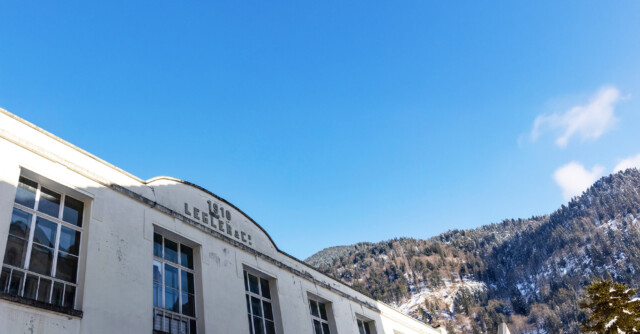
    With the purchase of the former Legler site by Hochdruckkraftwerk Diesbach AG and the simultaneous participation of the municipality of Glarus Süd, a new chapter has begun for the traditional factory site in Glarnerland. The operator of the local hydroelectric power plant has secured the site, including the power plant centre. At the same time, the municipality is acquiring agricultural land from the previous owner and will become the largest shareholder with a 40% stake.

    Energy meets site development
    The acquisition not only serves to preserve the historic power plant, but also opens up new opportunities for long-term site development. “We can offer areas ranging from 50 to several 1,000 square metres,” says Chairman of the Board of Directors Weber-Thedy.

    The municipality of Glarus Süd has secured two seats on the Board of Directors and an important land reserve of almost 30,000 square metres of agricultural land, which is earmarked for replacement measures or ecological compensation areas. The municipality is thus creating space for future developments.

    Long-term perspective with interim utilisation
    The potential of the Legler site is undisputed, but a new use takes time and requires careful planning. The aim is a mixed-use development with residential and office space that fits in with the landscape and the municipality. The first steps towards realisation are not expected before the next ten years.
    Until then, the site will be put to sensible interim use. The large halls will be rented out as storage space. They can be divided up flexibly, even if they are only suitable for certain purposes due to structural restrictions.

    Sustainability as a guiding principle
    The high-pressure power plant is focussing on environmentally friendly energy production and will renovate the plant to the latest standards in 2025. Earlier discussions about the expansion were postponed in favour of a sensitive approach to the landscape, but the roar of the Diesbach Falls is to be preserved.

    A boost for the Glarus region
    The acquisition of the Legler site is more than just a change of ownership. It is an example of forward-looking site development, supported by local energy production, public participation and a long-term perspective. The municipality of Glarus Süd is actively committed to the development of the site and at the same time minimises the risk of a prominent property falling into disrepair.

    The combination of energy infrastructure, property development and public involvement makes the project a beacon for the region and a role model for comparable sites in Switzerland.

  • Digital guest platform strengthens Glarus as a business location

    Digital guest platform strengthens Glarus as a business location

    The GlarnerlandPass combines the registration system, guest card and travel guide in an integrated system and links tourism, culture and trade on a common platform. It is being implemented as part of the realignment of tourism, which began with the merger of all organisations in 2024. Under the new umbrella brand “Glarnerland”, an overall Alpine experience with a strong regional identity is being created just outside Zurich, which will be digitally visible, combinable and bookable.

    Guest centricity and digital proximity
    The application accompanies the guest along the entire customer journey and enables interactive communication in real time. Not only overnight guests are taken into account, but also day guests, second home owners and locals. For guests staying overnight, public transport throughout the canton is included in the pass. A strong signal for sustainable mobility.

    Added value through local networking
    Tourism companies, businesses and cultural institutions are actively involved. A common understanding of digital processes is created in workshops and focus groups, new products are developed and additional sales channels are opened up. This close collaboration strengthens the regional economy and creates real added value in the Glarus region.

    Sustainable management and modern technology
    The platform allows flexible management of visitor flows and provides valuable impetus for sustainable destination development through the data collected. Technologically, the system is based on proven, modular solutions from leading destinations and utilises the connection to discover.swiss.

    Visibility through ESAF 2025
    The Swiss Wrestling and Alpine Festival 2025 offers an ideal opportunity to present the pass to a wide audience. The combination of Alpine authenticity, digital innovation and an integrative location strategy makes the project a showcase for the future of tourism.

  • The Landolt site in transition

    The Landolt site in transition

    What significance does the development of the Landolt site have for Glarus as a business location? What specific impetus do you expect for the local economy and the creation of new jobs?
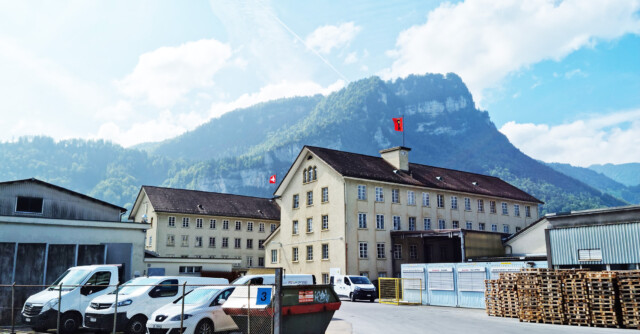
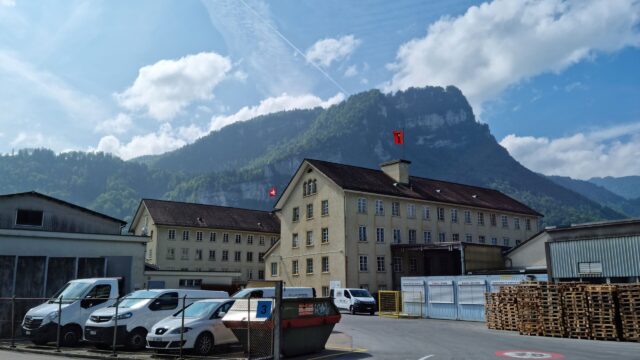
    The site is already well utilised with many different SMEs. When the Landolt company moves out in the medium term, the old stock will be freed up. The Shedhalle, which we have already renovated and equipped the roof with a large PV system, is particularly interesting. We are in the process of attracting new tenants and offer a very attractive location with optimal logistics connections. Attractive new jobs are being created here.

    Temporary uses such as the planned mobility hub are a central element of the concept. What opportunities do you see in these temporary uses to revitalise the site during the development phase?
    This is one of the most important parts of the transformation. We would like to keep all of the existing tenants if possible. We maintain direct contact with them so that they can continue to develop within the site. The buildings with interim uses are let cheaply but not for long, whether as storage, car parks or hubs, but without major investment on our part. There is also room for creativity here.

    How are the canton of Glarus and the location promotion organisation involved in the project? Is there strategic coordination with cantonal development goals?
    We are in regular dialogue with the location promotion agency and are confident that the good location and the size of the space on offer will also attract larger SMEs to the canton of Glarus. Several companies are already interested in setting up here.

    Participatory planning is emphasised. How were local residents and businesses able to get involved and what findings from this process will be incorporated into the next steps?
    With well-supported representation from the authorities and a specialist committee from the worlds of business and urban planning, as well as an international team of planners, the urban design, the relationships with the neighbours and the use and building distribution of the site were reworked. Many of the old spinning mill buildings are to be preserved and given a new lease of life.

    The current purely commercial area will be supplemented with various commercial offerings, and a small proportion of housing will also be possible. The very attractive location between the Chli Linthli and Mühlibach streams also invites walkers and residents to experience this beautiful and idyllic place.

    The planners are currently working with the design commission and the heritage conservation organisation to draw up the basic project. By the summer of 2025, it will be possible to show the future shape of the site, the expanded commercial offer and the variety of flats. We are very pleased with the excellent cooperation and are convinced that the careful handling of the existing buildings and the new buildings will create great added value for the users of the site, as well as for local residents.

    The development will take place in four stages. How will you ensure that the site remains lively, usable and attractive in the intermediate phases and does not become a long-term construction site?
    As already mentioned, part of the existing industrial buildings will be used for new purposes. The very old existing buildings, which will be vacant in the medium term after the Landolt company moves out, are to be rented out again quickly after conversion or modernisation. The various talent zones were defined for this purpose, and these form the stages. The development will be successively finalised with the completion of the respective zones.

    The innovation campus at Chli Linthli is intended to develop independently and in line with demand. Which target groups would you like to address here and which sectors could settle here?
    This site is already fully occupied with a wide range of businesses. The needs of the future will be accommodated here. The idea is to create a diverse range of businesses that require good networking within this area and function like a campus. However, we are also open to other ideas. Only time will tell what these are.

    How do you create long-term identity and loyalty on the site? What role do social, cultural or ecological offerings play for future users?
    The site already has a rich history. You can see this everywhere here. With a new use and the right approach, the culture will be preserved but also redefined. With our goal of sustainability, this process will also conserve resources. The use of natural building materials and simple architecture will create affordable working and living space that is healthy and worth living in. With its watercourses, green spaces, newly created neighbourhood squares, etc., the site offers a lot of spatial quality, but also a very attractive place to work, live and stay.

  • The Möbeliareal Glarus is taking shape

    The Möbeliareal Glarus is taking shape

    Following the rezoning from industrial to mixed residential and commercial use, the foundation for a new use was laid. With the submission of the development plan, this vision is now becoming a reality.

    Dialogue as the basis for sustainable development
    An intensive dialogue process, which was launched in 2022, formed the basis for the current indicative project. In this collaborative process, key issues relating to urban development, the mix of uses, open spaces and ecology were discussed together with experts, neighbours and interested parties. The results have led to careful planning that strives for a balance between historical buildings and new architectural elements. The former production buildings of ag möbelfabrik horgenglarus will become available from 2027 and can be integrated into the first construction phase.

    A new urban building block in the centre of Glarus
    Möbeliareal ag’s aim with the project is to create a lively, open and mixed-use area. Existing buildings such as the renovated former upholstery shop, a Hans Leuzinger building and the established RAUMSTATION coworking space already show how new uses can be integrated into existing structures. The planned new building complements the complex with exciting open spaces and gives the area a new urban legibility.

    Planned start of construction in 2027
    The development plan, based on the indicative project by agps architecture ltd. and Böe Studio GmbH, was submitted to the municipality for a preliminary review at the end of 2023. The legally binding plan is expected following any revisions. The first building applications could then follow, with construction scheduled to start in stages from 2027. This marks the continuation of a development process that has been prepared with in-depth market analyses and planning studies and is now moving into a concrete realisation phase.

    Prospects for urban living spaces
    The Möbeliareal is an exemplary project in the centre of the cantonal capital. Historically rooted, socially mixed, architecturally far-sighted and economically viable. The carefully orchestrated transition from an industrial production site to a diverse living space is an example of how site development can succeed in the area of tension between tradition and the future.

  • From a peripheral area to an urban neighbourhood with a vision

    From a peripheral area to an urban neighbourhood with a vision

    Buchholz stands for a new urban beginning. On an area of around 36,300 m², an independent urban quarter is being created that combines living, working, exercise and socialising. The previously heterogeneous structure is giving way to a clearly organised mix of uses that combines spatial quality with ecological responsibility. The centrepiece of the development is the “green centre”. A centre with a school, sports facilities and open space, framed by high-rise residential and commercial buildings.

    From industrial site to lively neighbourhood
    The development is the result of a successful study commissioned by the Zurich architecture and planning office helsinkizurich. This formed the basis for a finely balanced indicative project with a development strategy that provides for a staged, in-depth planning process. Realisation will take place in three phases – tailored to the different interests of the owners. Particular attention will be paid to the architectural heritage: elements such as the listed powder tower will be carefully incorporated and respectfully integrated into the urban context.

    Neighbourhood life at the bottom, quality of life at the top
    Commercial uses and communal areas in the plinth zones along Buchholzstrasse characterise the public face of the neighbourhood. Above, light-flooded flats open up wide views of the landscape. Meeting spaces, courtyards and access axes promote social interaction. The graduated public realm allows both retreat and participation, a principle that does justice to urban life.

    Blue-green infrastructure as the backbone
    In the Buchholz neighbourhood, sustainability is not a promise, but a reality. Well thought-out water management with rainwater retention and evaporation areas relieves the burden on the infrastructure and improves the microclimate. Green roofs, permeable paving and climate-active open spaces create quality of life, are ecologically effective and have a convincing design.

    Strong identity, clear address
    The new promenade along Buchholzstrasse not only creates a functional access route, but also an identity-forming address for the new neighbourhood. The district thus positions itself between the scenic Linth area and the urban centre – open, permeable, forward-looking.

    Urban development with impact
    Buchholz is an example of urban development that thinks long-term and takes a differentiated approach. The project creates new living space and a modern form of urban quality on the outskirts of Glarus – networked, sustainable and with a view to the big picture.

  • Building the future means taking responsibility

    Building the future means taking responsibility

    Mr Binkert, you have been working in property development for decades. What drives you personally and what is your vision for the future of architecture and property development?property development is also spatial development. With every building, we change our environment, the space around us. This change should be an improvement, not a deterioration. I am concerned with the question of the rules that we must observe to ensure that our built environment remains sustainable, liveable and fit for the future. I see the future of property development in creative, holistic planning that combines social needs with technological possibilities and puts people and the environment at the centre.

    Which project has had a particular impact on you?
    Every project broadens the horizon of experience – but Greencity Zurich was a turning point for me. It was the first time we developed concrete rules for Losinger Marazzi on how a neighbourhood has to be planned, built and operated in order to be considered truly sustainable. This project showed me how profound an impact sustainability can have when it is systematically thought through and implemented. The fact that Losinger Marazzi emerged as Switzerland’s first “green general contractor” was a strong sign that sustainability can also be a model for economic success.

    As President of the 2000-Watt Smart Cities Association, you are committed to sustainable and energy-efficient cities. How do you specifically integrate sustainability aspects into your projects?
    In Greencity Zurich, we developed comprehensive rules for the planning, construction and operation of a sustainable urban district for the first time. This resulted in the “2000-Watt-Areal” label, which has certified over 50 urban neighbourhoods throughout Switzerland. Today, we are developing it further under the authorisation of the Swiss Federal Office of Energy – with a view to the smart city. We were recently able to certify the first project in India.

    The biggest challenge remains the balance between ecological, social and economic sustainability – especially internationally. In China, social demands are difficult to realise, in Brazil there is often a lack of environmental understanding, in the Emirates economic efficiency is not an issue. In Switzerland, too, it takes empathy, understanding and perseverance to implement viable, sustainable solutions.

    You have international experience, including in the USA and India. What differences and similarities do you see in urban development between Switzerland and these countries?
    The main difference lies in the pace of growth: emerging countries with rapidly growing populations need a lot of new space quickly and cheaply – often at the expense of quality. There, sustainability is a promise for the future that is often met with scepticism. Sustainability costs a lot in the short term, but only yields returns in the long term, but then, according to our assumptions, it covers the costs many times over.

    In the western world – where growth is stagnating or declining – other values take centre stage: social justice, the circular economy, biodiversity. Here, sustainable development is increasingly seen as a prerequisite for quality of life. However, the demand that the West must also pay for sustainable development in emerging countries is also pushing wealthy countries like Switzerland to their limits.

    What trends do you see in future urban and area development and how do you envisage the forms of housing of the future, particularly with regard to demographic change, increasing urbanisation and densification?
    We are at a turning point. The construction industry urgently needs to catch up in areas such as digitalisation, automation and artificial intelligence. We are still building “brick and mortar” – as in Roman times. While basic human needs have hardly changed, the technical possibilities certainly have. The megatrends – demographic change, health, the future of work, the climate crisis – require new answers to the question of how we live. We must have the courage to question the status quo, break new ground and try out solutions that did not exist in the past.

    The “housingisation of Switzerland” cannot continue. What used to work in a Switzerland with 6 million inhabitants and limited mobility is now leading to collapse. We need to see ourselves more as part of the universe again, in which we are just one of many species – not as dominators. Every day we see the consequences of our short-sighted use of finite resources, diminishing biodiversity and the waste of energy.

    In future, we will move closer together, make space for others, live more efficiently and with greater sufficiency. To ensure that this does not diminish our quality of life, we need to make better use of the technological opportunities that are already available to us today and those that we will develop in the future. We will live more urbanised lives than we do today, we will meet our daily needs within walking distance and we will be better connected.

    We have now reached 9 million inhabitants in Switzerland. The property industry has been talking about a Switzerland of 10 million for some time now. In your opinion, are we sufficiently prepared for this and where do you still see a need to catch up?
    The idea of a Switzerland of 10 million is already outdated. If we want to enable our ageing society to live comfortably, we need an additional young and well-educated workforce – we need a 12-million-strong Switzerland! We must offer sustainable solutions to the expected migration flows of climate refugees and war refugees without jeopardising our culture and history. The faster and better we prepare for this, the more we will be able to benefit from it.

    We are ill-prepared for the exogenous paradigm shifts. Although we are aware of the pull of the big cities, we do not offer any alternatives. We still work with zoning plans, even though these are no longer able to reflect our production and our way of life. We stare spellbound at the successful crowd-pullers of Zurich, Basel and Geneva instead of recognising and exploiting the dormant qualities of small towns such as Lenzburg, Brugg, Wetzikon or Glarus. There is an urgent need to catch up here.

    Our vision of Smart City Switzerland is not a megacity with a sprawling agglomeration – quite the opposite: we are proposing to become more compartmentalised again. It is not the large Swiss cities that should grow, but the medium-sized and well-connected smaller cities that should become denser and more urbanised – with plenty of green space in between. Urbanisation includes the improvement of amenities, cultural enhancement and, in particular, the creation of new jobs. And where research on settlement development identifies gaps in the urban network, we must also have the courage to build new cities.

    What roles and long-term vision do you see for the Glarus economic region and which key projects will characterise the coming years?
    Glarus North is the economic backbone of the canton – with its location, infrastructure and proximity to the Zurich economic area, it offers enormous potential for production and services. Glarus South, on the other hand, scores highly in terms of nature, recreational value and quality of life. These two areas should be considered much more in terms of a functional symbiosis. The Glarus 2030 vision shows clear prospects for this, but it needs to be supported more broadly. Key projects in Näfels-Mollis and Niederurnen-Oberurnen would be ideal catalysts, but have so far been underutilised – not even in the recently adopted municipal structure planning. Narrow cantonal and federal regulations on building zone dimensions are slowing down development – there needs to be room for manoeuvre for future-oriented solutions.

    One of your students’ Master’s theses analyses Glarus North as a potential sub-centre in the Zurich economic region. How do you assess the development potential of this region, particularly with regard to infrastructure, industries, jobs
    and housing?

    The potential of Glarus North is impressive. Our studies on Smart City Switzerland show that there is space for a medium-sized city on both sides of Lake Walen – but whether this is created in Glarus North, Ausserschwyz or Sarganserland ultimately depends on the political will of the residents.
    The aforementioned HSLU master’s thesis examines the relationship between the large city of Zurich and the surrounding sub-centres (nodes of second centrality). The current situation of the brain drain and the salary mercenaries who commute back and forth between rural Glarus and urban Zurich is contrasted with the vision of the 15-minute town of Glarus Nord. The master’s thesis confirms the interdependence of spatial planning and economic development, of densification and diversity of use, of jobs and living space.

    What needs to happen from a planning and political perspective so that Glarus not only grows, but also helps to shape the future?
    From the perspective of Smart City Switzerland, the Federal Office for Spatial Development ARE must revise spatial planning throughout Switzerland and create new open spaces for densified settlement development. On this basis, existing cities can be densified or even new regional cities (nodes of second centrality) and small towns (nodes of third centrality) can be developed.

    For Glarus, this specifically means active lobbying in Bern to position Glarus North as a business location. This is the only way for the canton to free itself from the role of passive follower in financial equalisation. A clear decision needs to be made between a wait-and-see approach and active participation. If you want to help shape the future, you have to invest – in planning and development, infrastructure, location marketing and political persuasion.

    What role does the cantonal structure plan play in this and what influence can be exerted at communal level?
    The cantonal structure plan reflects the current situation and takes a linear approach. It does not reflect the paradigm shifts that we will be facing in the coming years. The structure plan also offers insufficient flexibility to be able to react to the new exogenous and endogenous challenges.

    The scope for influencing the overarching structure plan is limited. The municipality is dependent on the canton, and the canton in turn is dependent on the federal government. In addition, the requirement for planning consistency makes any innovation difficult. The reaction times are too long. Nevertheless, there are levers: pilot projects and development centres (ESP) make it possible to test innovative ideas and try out new urban models.

    Today’s 105th immoTable in Glarus makes an important contribution to the urgently needed discussion on whether Glarus wants to become a location for the future.

  • Erlenpark Näfels creates new living space

    Erlenpark Näfels creates new living space

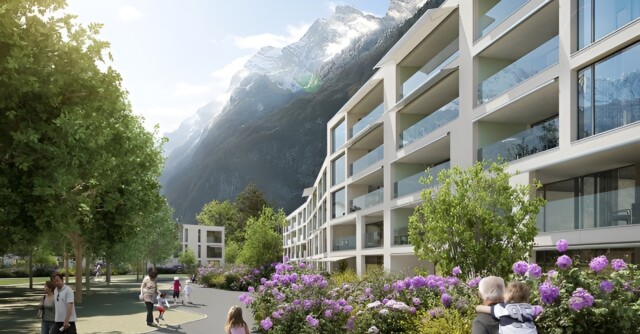
    On the 16,000 m² “Feld” site in Näfels, the municipality of Glarus Nord is realising a pioneering residential development together with FT3 Architekten AG. A total of ten apartment blocks with around 98 flats are being built in three rows of buildings. The flats are between 1½ and 5½ rooms in size and are aimed at people at all stages of life – from singles and families to senior citizens. The diverse range of apartments is intended to promote a social mix and revitalise the neighbourhood.

    Quiet inner courtyard as the centrepiece of the development
    The special geometry of the plot results in a diamond-shaped arrangement of the buildings, which enclose a green inner courtyard measuring around 6,800 m². It acts as the centre of the car-free development and offers space for people to meet and relax – protected from the noise of the surrounding traffic routes. The staggered residential buildings also provide a rhythmic structure and create architectural quality as well as optimal sunlight for the flats.

    Car-free and central access
    A central feature of the project is its consistently traffic-free design. Access and all parking facilities are bundled at a central point, keeping the entire residential area free of motorised traffic. This increases safety, creates attractive, liveable open spaces and meets the current requirements for residential and urban development.

    Signal for site development and building culture
    Municipal president Fritz Staub sees Erlenpark as a strong signal for municipal development. Shortly after the overall revision of the NUP II land use planning came into force, the project is an example of how high-quality, space-efficient residential construction projects can be realised in the canton of Glarus. The ground-breaking ceremony took place in April 2025 and the first construction phase will be completed by summer 2027, followed by the second and third phases by autumn 2028.

    Modern construction with high standards
    The planning and realisation by FT3 Architekten AG follows a clear architectural approach. Towards the street, the buildings appear closed and compact, while they open up towards the inner courtyard with generous balconies. The staggering of the storeys supports the natural lighting and gives the buildings a clear structure. Erlenpark is thus a successful example of modern, high-quality construction in the Glarus region. A project with a signal effect for site development in rural centres.

  • Rethinking linen

    Rethinking linen

    The Biäsche work area combines location qualities that are rare in this form. The motorway junction, a goods station and natural recreational areas are right on the doorstep. Between municipal boundaries, transport axes and the natural environment lies an area that is to be economically considered, intelligently planned and sustainably utilised. The plots are in public, private and cantonal ownership. A constellation that requires integrative development.

    From area to function
    There is currently a lack of maturity in terms of planning and building law. Without development and development planning, the potential remains unutilised. For this reason, a test planning procedure examined various utilisation scenarios and development strategies. The aim was to create a clearly positioned, marketable economic area that is ready for low-emission, high value-added businesses. Staging this development is key. The site can only be developed sustainably in the long term with flexible, compatible concepts.

    One location, many interests
    The municipality of Glarus Nord holds 3.8 hectares of undeveloped employment zone land in the Unterflechsen sub-area. The canton of Glarus owns a further 2.7 ha in the neighbouring Mittelflechsen area. There are specific interests for this area. A salmon farm and a new penal centre are under discussion. The area is supplemented by private land and existing uses. This diversity makes spatial coordination a key planning task.

    Infrastructure as a driver of development
    Biäsche is ideally positioned in terms of transport links. The area is served by national transport routes operated by SBB and FEDRO. However, future-proof development requires that motorised traffic, public transport, pedestrian and bicycle traffic as well as supply and disposal infrastructures are coordinated and planned with foresight. This is the only way to create a location that is economically attractive and ecologically responsible.

    Indicative project as the key to progress
    After the test planning for the Biäsche site development was completed in June 2023, the concepts of Ernst Niklaus Fausch Partner AG and Studio Vulkan Landschaftsarchitektur AG will be further developed into an indicative project by August 2025 as part of a synthesis phase. As a synthesis, the indicative project summarises the parameters of the site development that the signatories consider to be correct and shows the main features of how the site should develop in the short, medium and long term. This serves as the basis for the subsequent development plan and perimeter procedure.

  • The Glarus South residential park sets new standards

    The Glarus South residential park sets new standards

    In the centre of Glarnerland, nestled in the alpine landscape and with a direct S-Bahn connection to Zurich, a pioneering project is taking shape. The Glarus Süd residential park is ready for realisation. The building permit has been granted, the concept has been finalised and the surrounding area is ideally developed. The site is already home to an established health and prevention centre, a café, a hairdressing and beauty salon and versatile event spaces. Schools, shopping facilities, Spitex services and the railway to Braunwald are all within walking distance. The location combines living close to nature with urban connections.

    A pioneering project for new ways of living
    The project focuses on multi-generational living, supplemented by co-living and co-working facilities. The 51 flats are part of a holistic concept that is geared towards social mixing, encounters and shared use. The residential park is operated CO2-neutrally. The energy comes from its own production. The concept addresses key challenges such as demographic change, climate protection and the increasing need for flexible ways of living and working, while at the same time offering attractive prospects for investors who focus on valuable, socially relevant projects.

    Experience meets vision
    Hacontex AG from Zollikon is behind the project. The company, which has its roots in the textile industry, has consistently transformed itself over the last few decades. Today, Hacontex is active in sustainable energy production and property development. Managing Director Hans-Peter Keller and his team rely on entrepreneurial courage, regional roots and economic foresight. With projects in the Zurich agglomeration, in the canton of Schwyz and in Glarnerland, the company addresses future-oriented topics, always in the area of conflict between nature, technology and society.

    A project with a signalling effect
    The Glarus Süd residential park is more than just a property project. It is a stimulus for the region and a model for the sustainable transformation of rural areas. A place for all generations, for work, health, community and innovation is being created in the middle of the mountains. The combination of modern infrastructure, local roots and ecological responsibility makes the project an investment target with long-term added value.

    Now that construction is ready, the go-ahead is imminent. An investor is now being sought who shares the vision and has the courage to back a project that not only promises the future, but also builds it.

  • From industrial site to garden neighbourhood

    From industrial site to garden neighbourhood

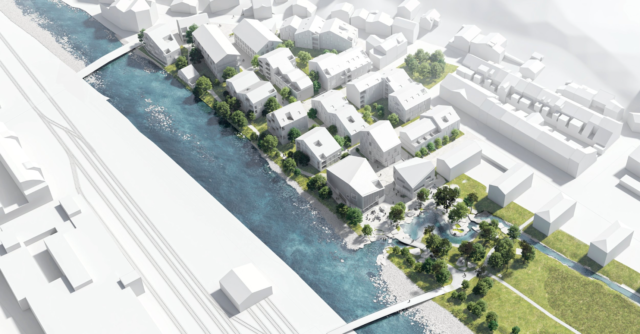
    The Kartoni neighbourhood shows how visionary urban development can succeed. On a former industrial site, a green residential neighbourhood with around 150 flats is being created, complemented by service and cultural facilities. What still exists as a planning sketch today will develop in several stages into a diverse living space that is open to all generations and lifestyles. The historical backdrop of Glarus will not only form the framework, but will also be further developed through modern architecture and sustainable construction methods.

    Town and country reconnected
    Glarus is more than just the canton’s capital, it is a way of life. Only an hour away from Zurich or St. Gallen, Glarus offers urban density and natural recreation at the same time. The Kartoni neighbourhood reinforces this quality. It builds a bridge between the district of Ennenda and the town centre, creating new paths and meeting places both spatially and socially. The municipal merger that took place in 2011 thus takes on a tangible architectural dimension.

    Water as a connecting element
    In future, the Linth will become the lifeline of the neighbourhood. Where previously sealed surfaces dominated, a public riverside space with direct access to the water is being created. The renaturalised canal interweaves with the river landscape and creates a playful counterpart to the structured design of the nearby Volksgarten. The area becomes a meeting place for walks, relaxation and shared experiences.

    Car-free garden neighbourhood
    The Kartoni neighbourhood relies on an underground solution for mobility. Directly after the Linth Bridge, an access road leads to a spacious underground car park, which means that the entire neighbourhood remains car-free above ground. The result is a garden neighbourhood that is open, green and criss-crossed by paths. The car-free design not only promotes peace and safety, but also sends out a strong signal in favour of a new way of living together in densely populated areas.

    The courage to take stages and a plan with a vision
    The development of the neighbourhood does not follow a rigid timetable, but reacts flexibly to political, economic and social conditions. Several planning strands are currently running in parallel: from the Hängg Tower to residential areas and the integration of a music school. The already approved development plan is being adapted to new requirements, particularly in relation to the neighbouring Dorfbach project in Ennenda.

  • Owner participation “Ziegelbrückstrasse” in Glarus North

    Owner participation “Ziegelbrückstrasse” in Glarus North

    The municipality of Glarus Nord would like to motivate developers to carry out participatory processes for more complex construction projects. Its “Participation and communication guidelines for planning processes” outline how the needs of the population and future users can be anticipated at an early stage for various planning situations. To set a good example, the municipality initiated a participatory process for the “Ziegelbrückstrasse” development area between Ziegelbrücke railroad station, the Jennyareal and the village center of Niederurnen: between October 2024 and February 2025, it involved the affected owners in the development of a mission statement, which served as the basis for the development of an outline plan for the area.

    Shaping the framework conditions for development
    The mission statement was intended to define the structural dimensions and the mix of uses. As the area is one of the densification and upgrading areas that characterize the village, qualitative key points of a development that does justice to the character and history of the area were also up for discussion. The municipality also saw the public sector as having a duty and therefore set out its expectations regarding the design and upgrading of the cantonal road that runs through the area. This provided the municipality with a broad-based basis for discussions with the canton, which is responsible for the renovation of the road.

    The jointly developed model served the municipality as the basis for a binding framework plan. The framework plan in turn defines the guidelines for how buildings may be constructed along Ziegelbrückstrasse in future under the new owner-binding land-use plan. The owners involved helped to shape how and what they can build on their properties in the future by participating in the master plan.

    A streamlined participation process
    The owners in the area were invited to take part in two evening events with the municipality. The first evening was for information and participation, the second for the presentation of the results. Over 56 owners of 127 plots took the opportunity to participate in the events themselves or with a representative.

    In the first workshop, they were given an insight into the planned planning instrument and were consulted on various options for future development possibilities. By prioritizing the options, they were able to influence the decision on the desired model. In the second workshop, the municipality presented the framework plan developed on the basis of the desired variant.

    A worthwhile effort for the municipality
    Participatory processes are complex and cost time, money and political capital. For the municipality, the time-consuming process was worthwhile because it increases the chances of owners becoming active: By being informed about more construction options at an early stage, they can adjust their investment planning and align any existing intentions with the municipality’s development plans.

    The discussion about the vision helps to orient owners towards a common vision of the future of the densification and development area and to convey to them that issues such as the addressing of buildings to the street, the granularity of the development, the design of the base storey or the materialization are not just private matters, but also have an effect on the image of the district and thus influence the attractiveness and value of the location for everyone.

    The participatory process offered the municipality the opportunity to draw attention to its building advice and increase the likelihood that landowners with investment intentions will discuss and coordinate their plans with the municipality at an early stage, before they have drawn up a preliminary or construction project that can hardly be adapted. In the best-case scenario, the process encourages some owners to think bigger and enter into cooperation with other landowners or jointly tackle issues such as the provision of parking spaces in construction projects.

    The municipality was also able to use the events to coordinate upgrades on public land with the needs and ideas of the owners and to test the acceptance of measures such as greened medians on the road or a speed reduction on certain road sections.

    More planning security for landowners
    Participatory processes also cost the participants time. In the case of Ziegelbrückstrasse, the effort was worthwhile for the property owners simply because they were able to influence decisions on issues that are binding for the property owners by participating in the framework plan that is binding for the authorities: the fundamental question of the design of the density and mix of uses possible with the new land use planning. The framework plan also offers owners more planning security, as it strengthens equal treatment in the approval process.

    As part of the process, the owners gained a better understanding of what the municipality expects from structural developments and were able to gain inspiration as to what contributions they can make to neighborhood upgrading in addition to structural developments – for example with the design of gardens and street front zones or smaller renovation projects. The opportunity to find out about their neighbors’ plans at the event ultimately gives owners more certainty that they are not alone in their investments.

  • How Glarus became an architectural jewel

    How Glarus became an architectural jewel

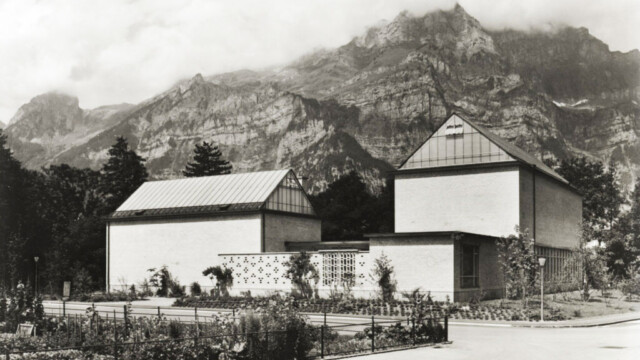
    When the art historian and diplomat Gustav Schneeli was looking for a location for his own museum in 1942, he found the perfect place in Glarus. The Glarus Art Association, which had been considering the idea of its own museum for decades, recognised the opportunity for collaboration. Schneeli made his Symbolist and Impressionist-influenced works available and promised 250,000 francs for a foundation. The foundation stone for today’s Kunsthaus.

    Architectural clarity with vision
    After Schneeli’s death in 1944, the architect Hans Leuzinger developed a project of remarkable consistency. The path led from classical approaches through numerous variations to a finely tuned lighting design. Scandinavian influences, careful site inspections and creative foresight formed a building that consciously distanced itself from monumental representational intentions and blended sensitively into the Glarus valley basin.

    Political hurdles, patient negotiations
    The realisation was anything but straightforward. Disputes over the location, delays caused by the war, critical voices from the administration and the community of heirs as well as the threat of the foundation’s withdrawal jeopardised the project on several occasions. It was only through diplomatic skill, architectural persuasion and tireless commitment that construction could begin on the last possible day, 15 July 1950.

    Art and architecture as a sign of the times
    The opening in 1952 was not only an architectural success, but also a strong signal for Glarus as a cultural centre. A cultural attitude manifested itself in a simple but expressive building that continues to have an impact today. Architect Reto Fuchs’ research reveals this masterpiece and its eventful construction history. The Kunsthaus Glarus stands for masterful architecture, the courage to take a stand and the idea of thinking big about culture in rural areas.

  • Master plan for the Jenny site

    Master plan for the Jenny site

    The approximately 30-hectare Jenny site of Fritz Caspar Jenny AG is deeply rooted in the industrial history of the Glarus region. Where textile production has taken place since 1834, a multi-layered site with new prospects is being created today. The proximity to Ziegelbrücke railroad station, the size of the site and the existing infrastructure make the area a key location for economic and urban development in the canton.

    Planning with vision and participation
    A strategic master plan was developed as part of a multi-stage process, based on comprehensive test planning with four interdisciplinary teams. The resulting findings form the basis for a long-term development that is aligned with regional spatial planning, economic potential and social diversity. The winning design by Blättler Dafflon Architekten with Tony Fretton Architects and Studio Vulkan impressed with its strong combination of nature, building culture and open spaces.

    Diverse use as a location strategy
    The site already combines a variety of uses. From the Carlsberg Supply Company to creative work and residential forms such as Loft Z25 and the Glarus cantonal vocational school. The master plan builds on this diversity and expands it to include new educational, service and residential facilities. A hotel project is also being examined. The aim is to permanently establish and sustainably revitalize the Jenny site as a business, residential and educational location.

    Building culture as an identity-forming element
    Respectful treatment of the architectural heritage is central to the development. The site is part of the inventory of sites worthy of protection in Switzerland. Existing buildings of architectural and historical significance are to be preserved and integrated in a targeted manner. The listed riding stable, for example, is intended to enrich the new site concept as a defining element and contribute to the identity of the location.

    Focus on the legal framework
    The implementation of the master plan requires adapted land use planning. The project is currently awaiting the legal validity of land use planning II of the municipality of Glarus Nord. The first steps towards rezoning have been taken, but key legal requirements are still outstanding. Once this process has been completed, the development potential of the Jenny site can be fully exploited. A decisive step for the future of the site.

  • Business location and living space Canton Glarus – A truly fabulous lifestyle

    Business location and living space Canton Glarus – A truly fabulous lifestyle

    The canton of Glarus has a long industrial tradition. What impetus are you providing to strengthen economic competitiveness and create sustainable jobs?
    The canton of Glarus has always been extremely business-friendly. We were one of the first Swiss cantons to regulate economic development by law (1978). Glarus is also a Swiss pioneer in social legislation with the Factory Act (1864) and compulsory old-age insurance (1916). Against this background, Glarnerland is traditionally a modern business location with competitive advantages for employers and employees that may only become apparent at second glance. For example, the Glarnerland is large enough to offer companies sufficient space, but also small enough to make decisions quickly and unbureaucratically. The contact point for business provides pragmatic and reliable support to both company founders and existing companies or companies wishing to relocate. In our three large municipalities, which have merged in an exemplary manner throughout Switzerland, investors can find affordable real estate and employers can find well-trained, motivated employees who enjoy living in an intact environment with the advantages of a modern environment.

    How does the Department of Economic Affairs promote innovative digital business ideas?
    On the one hand, the possibilities of digital transformation serve to redesign processes and products, but they also form the basis for the circular economy. This involves both greater resource efficiency and data management. As a result, tomorrow’s employees will know which materials were used in which processes. Supply chains are another opportunity: New digital processes enable a more robust, efficient and transparent supply chain. With this in mind, we are supporting the digital transformation in the Glarus economy with digitalization loans. The funding program has two million francs available until the end of 2027. Funding is available for innovative projects that incorporate new technologies in processes and production, create new products and business models and establish collaborations. Specifically, we carry out an analysis of the current situation in participating companies with the expertise of the Innovation Network Eastern Switzerland (INOS). The analysis is financed by the new regional policy (NRP) and includes an assessment of the current situation, including an action plan and roadmap for implementation. This basis is required for the application for financial support of up to CHF 100,000 for individual companies and CHF 300,000 for inter-company and/or industry-wide projects.

    How do you think the real estate sector will develop in the industrial and commercial sector?
    The pressure from the agglomeration is noticeable in Glarnerland. However, population growth is moderate, which is conducive to sustainable development. The municipality of Glarus North has particularly high capacities in terms of industrial and commercial space, which are currently being used in several projects at the Bilten site. With active land management, we are focusing on sustainable development with high-quality industrial and commercial projects.

    What trends do you see in the development of supply and demand in the residential sector?
    The majority of new residential construction projects are being implemented in the municipalities of Glarus and Glarus North. This also has to do with land use planning, which can take a holistic and progressive view thanks to the municipal merger. In Glarus South, land use planning is still undergoing a challenging political process, which is also being monitored by the canton.

    How can you ensure that the development of the real estate market meets the needs of the population?
    Anyone who lives in one of our 29 villages, towns or districts appreciates the special features of their place of residence. These are reflected, for example, in the location or club life. Life is completely different in Elm or Braunwald than in the cantonal capital or in Näfels. And there again different from the Kerenzerberg or Lake Walen. This creates a sense of identity and solidarity, which keeps people here. This is consistent with the moderate pace of population growth and the comparatively stable real estate prices.

    How can you ensure that your real estate market develops sustainably?
    With our unique combination of closeness to nature and urban proximity, with its manageable size and compact living and economic area, Glarnerland scores highly. Careful management of these advantages is therefore essential – they are our resources, our capital.

    What infrastructure projects are planned by FEDRO and SBB and what potential for improvement do you see?
    Glarnerland is perceived as a rural region, but thanks to its location between Zurich and Chur, it has very good transport connections. The city of Zurich and the airport are only an hour away by car or train, one of the most important north-south axes runs through the canton, and private planes and helicopters can take off and land in Mollis.

    Naturally, the canton of Glarus is also dealing with the increasing mobility requirements. In recent years, the canton has implemented three of four major road construction projects, in particular to provide future-oriented access to the Mollis airfield development focus. The fourth project to optimize access to the industrial area in the south of the municipality of Glarus is currently in the planning phase. The focus of our efforts is close cooperation with the federal government on the bypass projects to relieve congestion on the current main axis. We have received assurances from the federal government that the Netstal and Glarus bypasses will be combined into one overall project under the leadership of FEDRO. The aim is to relieve the canton of Glarus of all its road traffic problems.

    In terms of public transport, we have had a new legal basis for future public transport services since the Landsgemeinde 2025. Our region is already well connected today with direct connections to Zurich and Rapperswil as well as transfer options in Ziegelbrücke to St. Gallen, Chur and Zurich. Our population and businesses depend on this convenience and the continuous half-hourly service agreed at the Landsgemeinde 2025. We are working hard to achieve this with the federal government and in cooperation with SBB and SOB. We are actively cooperating with companies to make commuting by public transport more attractive for employees – for example, the Bonus Pass creates incentives to switch from car to public transport.

    Short distances within and between our localities also play a key role in mobility. For example, it only takes 20 minutes to cycle from Näfels, Glarus North, or from Schwanden, Glarus South, to the cantonal capital. The trend towards cycling is also reflected in the cantonal Cycle Path Act, which was passed by the Landsgemeinde 2024.

    How does location promotion help to present Glarus as a liveable and future-oriented region?
    The canton of Glarus is the third most financially attractive place to live: in addition to low housing costs, we offer a moderate tax burden and comparatively low health insurance premiums. These are our major advantages in terms of financial factors. Added to this is the high quality of the living environment, which combines the advantages of the countryside with urban amenities. This is evident at first glance when you arrive in the canton of Glarus. Together with the impressive mountain scenery, the witnesses of early industrialization shape the landscape and life in our canton. The historic industrial areas, factory owners’ villas and workers’ settlements from the 19th century and the landscape are also the backdrop for films and TV series for good reason. In people’s everyday lives, this is reflected in a contrasting and lively environment with contemporary settlements for professionals and families who value living, working, culture and leisure in our modern communities.
    With this in mind, Glarus has been actively marketing the canton in a targeted manner for over ten years. This year, we are using our role as host of the Swiss Wrestling and Alpine Festival (ESAF) to put the spotlight on the canton of Glarus as a center of life. With the upcoming major event, the whole of Switzerland is turning its attention to the Glarus region. Under the motto “Really fabulous”, the focus is on working, living and leisure. The face of the campaign is the popular Glarus chef and influencer Noah Bachofen. He and his colleague are accompanied on their mission to create an authentic image film about the Glarus region. The campaign aims to make the unique Glarus lifestyle visible and tasty.

    Why do skilled workers stay in the region and what does location promotion contribute to this?
    Of course, a good campaign alone is not enough. The municipal location promotion agencies make a major contribution to the high quality of life. They continue to develop their residential and leisure areas with new projects and in cooperation with investors – examples include the optimally developed development focal points at the Näfels/Mollis and Glarus railroad stations. The municipalities provide modern schools and supplementary family services, operate sports facilities and offer retail, gastronomy, medical care, industry, commerce and culture space for a lively and functioning everyday life. The canton ensures the operation of the cantonal school, the sports school, the vocational schools, the cantonal hospital, security and social services. The lean administrative structures enable an efficient and direct exchange between the cantonal specialist offices and those responsible at municipal level.

    What is your long-term vision for Glarus as a business location?
    In the coming years, it is crucial for the canton of Glarus that the initiated development is implemented in a coordinated manner. It is important to support and accompany the private initiatives and at the same time create the right framework conditions for companies and skilled workers. If this succeeds, the canton of Glarus will be a secure, networked and economically strong canton with a strong middle class, surrounded by unspoiled nature.

    Future-oriented and efficient structures are decisive for the success of a company. This also applies to the public sector. Glarus is the only canton that has consistently adapted its own structures to the new circumstances. With today’s highly efficient administration, we are fit for the future.

  • immoTable Glarus shows prospects for the Alpine region

    immoTable Glarus shows prospects for the Alpine region

    [smartslider3 slider=”48″]

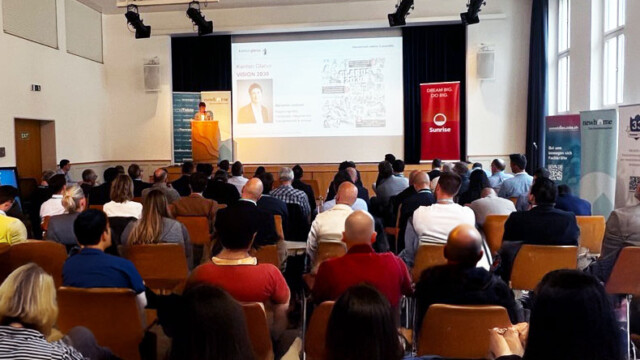
    Monika Schärer opened the event with a clear impulse. The Glarus region is ready to reinvent itself and serve as a model for urban development in the Alpine region. Andreas Binkert, architect, lecturer and board member of the Nüesch Group, led the guests through the Spatial Concept Switzerland 2050, emphasizing the need for polycentric structures, forward-looking site development and environmentally friendly mobility and energy solutions. According to the SIA, a development strategy for the whole of Switzerland up to 2070 is needed, which serves as a binding basis for prioritization, weighing up interests and investment security.

    Smart Valley Glarus
    The focus was on the question of how alpine regions such as Glarus can benefit from change. The vision of a “Smart Valley Glarus” was outlined, not as an artificially created city, but as a cluster-like spatial structure with high density, mixed use and seamless integration of existing villages. Education, the circular economy, digitalization and energy-efficient construction form the basis for this. Glarus could thus become a pilot region for an Alpine smart city in which sustainable ways of living and working are created.

    Location quality and pioneering spirit
    Marianne Lienhard, the canton’s Director of Economic Affairs, emphasized the strong pioneering spirit and high location quality in her talk. The canton of Glarus is an “industrial pearl with a down-to-earth attitude” that is economically strong and at the same time offers space for quality of life, recreation and innovation. The heterogeneity of the localities and the close connection of the population to their places of residence are decisive locational advantages that strengthen social cohesion.

    Active location development
    Andreas Mächler from the cantonal contact point for the economy showed how actively location development is being pursued. Thanks to revised land use planning, several hectares of building land are available in Glarus North. Well developed, centrally located and significantly cheaper than the national average. Companies benefit from attractive framework conditions, short distances to the administration and a dynamic relocation policy.

    Real estate market analysis
    Andrea Bernhard from Wüst und Partner analyzed the current situation on the Glarus real estate market. Despite growing demand and an almost empty supply, the price level is stagnating compared to other regions. In Glarus South in particular, new construction activity is low and most of the housing stock is outdated. But this is precisely where the opportunities lie. Densification, flexible building zones and targeted development could provide new impetus, provided a balance can be struck between growth and identity.

    Real Estate Award
    To conclude, Tim Caspar from Real Estate Award AG presented the upcoming award event on October 2, 2025. With over 400 decision-makers, a gala and awards ceremony in five categories, the innovative strength of the industry will be made visible here. A strong starting point for all those who want to help shape the future.

    The immoTable Glarus has shown that the canton is at the beginning of a new stage. With a clear attitude, an open mind for cooperation and the courage to transform, Glarus can become a role model for sustainable development in the Alpine region, as a space for investment, innovation and a good life.

  • Glarus – truly fabulous

    Glarus – truly fabulous

    The canton of Glarus is also progressive at other levels, for example in terms of digitalization. The MINTGL initiative promotes enthusiasm for the subjects of mathematics, IT, natural sciences and technology among children and young people. Coverage with UHB Internet via mobile communications or fiber optics has increased significantly and is being continuously expanded. And the economy benefits from subsidies for the digital transformation of its products and business models.

    Room for development
    Glarus has exceptionally large reserves of building land as a result of the municipal structural reform. Thanks to its geographical proximity to Zurich, St. Gallen, Graubünden and Liechtenstein, companies have access to the expertise of universities, dynamic economic areas and skilled workers.

    The implemented land use plans in Glarus and Glarus North enable the targeted development of key areas and an unbureaucratic response to the needs of the population and companies. The areas around the Glarus, Näfels and Ziegelbrücke railroad stations offer enormous development potential – in the immediate vicinity of the town center and with excellent transport links. There are 170,000 square meters of land reserves available in the employment zones. At the same time, over 2,000 new apartments are planned in the canton of Glarus – state-of-the-art living space for around 6,000 people. This corresponds to around 15 percent of the current population.

    The contact point for the economy supports investors in their search for suitable sites and land reserves. This is based on work zone management, which provides information on building maturity, development and possible natural hazards. In the case of strategically important sites, the canton can become active itself – either by investing directly in their development or by acting as a partner.

    Skilled workers for success
    If you want to attract companies, you need space – including space for skilled workers. This is exactly what Glarus offers. Here, people have the opportunity to live where they work: to enjoy lunch with the family, to experience nature after work – and all this with a low cost of living, a relaxed real estate market and in a safe, socially intact environment. Glarnerland thus combines the economic strength of the “Greater Zurich Area” with a quality of life close to nature.

    The canton of Glarus is also committed to education and training. With the Work 4.0 pilot project, it is specifically strengthening the employability of skilled workers by co-financing training and further education. This commitment is complemented by three cantonal vocational schools, two technical colleges in Ziegelbrücke and the proximity to the universities and colleges in Zurich, Rapperswil, St. Gallen and Chur. Together with offers in adult education, vocational and career counseling, people in Glarnerland have access to almost every training and further education path. The smartglarus.com platform offers a compact overview of educational opportunities, support programs and services – a digital showcase for anyone who wants to learn, work or develop in Glarus.

    Innovation for the future
    It is often said that innovation mainly originates at universities and colleges. This is only partly true. Start-ups need more than just good ideas: They are dependent on partners from industry and business who can drive product development forward with their experience and know-how. This is exactly what the Glarus economy offers. When it comes to growth, practical factors count: affordable space, qualified specialists and continued access to universities. The canton of Glarus combines all of this. And is therefore an ideal location for start-ups with ambitions.

    Innovation promotion is broadly based in the canton of Glarus – thanks in part to cooperation with strong partners such as InnoSuisse and the Innovation Network Eastern Switzerland (INOS). Start-ups and companies benefit from coaching, expertise and financial support for the development of their products and services. One example: the fast-growing drone manufacturer ANAVIA made a conscious decision to locate in Näfels – a clear sign of how innovation-friendly the Glarus region is.

    Circular economy in the food and packaging industry

    In Glarnerland, the circular economy is a way of life – from the development of energy-efficient machines and innovative packaging solutions to food production and recycling: the economic area combines industrial strength with ecological responsibility. The result is a regional ecosystem that not only thinks about sustainability, but also puts it into practice.

    It all started with Netstal Maschinen AG, which develops high-performance injection molding machines. These are used at Resilux Schweiz AG in Bilten – together with high-precision molds from Glaroform AG. Resilux uses them to produce preforms, i.e. PET preforms, as well as finished bottles. These in turn are filled at the mineral springs in Elm.

    After use, the cycle starts all over again: the empty bottles end up at the Resilux recycling plant, where they are processed back into high-quality recyclate – ready for the next round of production. This creates a regional ecosystem based on innovation, efficiency and resource conservation. The companies benefit from each other’s expertise and thus drive the circular economy forward.

    Rethinking plastics
    Kunststoff Schwanden AG is also part of this sustainable network: it develops and manufactures sophisticated plastic parts using multi-component injection molding – with a focus on recyclates and energy-efficient processes.

    Where ideas take shape in corrugated cardboard and paper runs in circles
    Müller Kartonagen AG supplies customized solutions. Its corrugated cardboard packaging made from renewable raw materials is manufactured regionally – efficiently, in a resource-saving manner and tailored to customer requirements, such as those of Läderach. The raw material comes from the Netstal paper mill, which produces around 50,000 tons of recycled paper every year – from waste paper, most of which comes from Switzerland, and is processed using closed material and water cycles.

    Packaging is just the beginning. In Glarus, the contents are also produced responsibly: In the food industry, regional ingredients meet modern processing – sustainably and efficiently.

    Traditionally, Glarner Schabziger stands for local food production. Today, the spectrum is broader. Foodstuffs from chocolate to salmon are taking the lead. The entire region benefits from the growing potential of the food industry.

    Chocolate art with global success
    Since the invention of the Truffes hollow ball in 1970, Läderach has expanded steadily – and is now present in Europe, Asia and North America. The new factory in Bilten makes it possible to control the entire value chain – from the cocoa bean to the end product.

    Also from Bilten, GUMA AG distributes the traditional Stalden cream – a Swiss dessert classic in four varieties with over 120 years of history.

    Mexican bite with Glarus roots
    MiAdelita has been producing fresh corn tortillas and potato chips since 1995 – and is now the largest supplier of its kind in Switzerland. Now in its second generation of management, the company consistently focuses on regionality: the corn comes from the Landolt mill in nearby Näfels. Together with the delicatessen supplier IMEX, a new production site with around 40 jobs is being built in Bilten.

    North Atlantic salmon from land-based farming
    Swiss Blue Salmon AG is planning the largest land-based fish farm in Switzerland in Mollis. With a market share of seven percent, it will make an important contribution to climate-friendly food supplies. The recirculation system will be supplied with water from Lake Walen and passively cooled – ideal conditions for sustainable salmon farming. The location in the “Biäsche” industrial area also offers first-class transport links to Zurich and Chur.

    High-flyer – the aviation industry in Glarus

    Flying has a long tradition in the canton of Glarus. in 1939, the first flight day attracted thousands of onlookers to watch the daredevils in their flying boxes. Today, aviation is one of the main areas of development in the canton of Glarus. With the zoning of additional building land, the Mollis airfield offers new space for aviation companies.

    The municipality of Glarus North is drawing up a master plan for the structural development of the site by summer 2025. Also in summer, athletes take to the skies at Mollis airfield – and land unerringly in the sawdust: 150,000 visitors are expected every day at the Swiss Wrestling and Alpine Festival (ESAF).

    Flying high – with a firm footing on Glarus soil
    Everything around the Mollis airfield revolves around precision and high-altitude flights. What the companies based here have in common: They use the synergies of a specialized cluster. First and foremost the Kopter Group. The helicopter manufacturer wants to establish itself internationally with the single-engine AW09. The location offers space for test flights, short assembly routes and a technology-friendly environment.

    Anavia is one of the youngest aviation companies in Glarus. The start-up develops unmanned helicopters – such as the HT-100, which flies for up to six hours, carries 60 kilograms and is ideal for border surveillance, infrastructure inspections or rescue missions. Founder and Co-CEO Jon Andri Jörg says: “Glarus is ideally suited to our needs. We have access to highly qualified specialists. And the proximity to Mollis airfield offers an ideal location for both production and testing.”

    Another start-up has made a conscious decision to locate in Glarus in 2025: Marenco Aviation is working on a new generation of lightweight helicopters with a focus on alternative propulsion systems.
    A proven player is Rega, which has been operating its own base in Mollis since 2010. The strategically favorable location allows for quick missions in the Alps. The expansion into a permanent station shows how central the location has become for air rescue.

    Heli-Linth AG has been operating here since 1972. It flies tourists over glaciers, supplies alpine huts, transports materials – and occasionally rescues cows from rough terrain. Comprehensive aircraft management is provided by the internationally active Linth Air Service AG, which has been anchored at the site for over 20 years. The Ecoflight flight school also takes off from here.

    Only Sauter, Bachmann AG remains on the ground, and with good reason: the Netstal-based specialist for gears and drive systems also supplies the aviation industry and benefits from direct contact with partners at the airfield, the technical expertise in the region and the industrial tradition of the Glarus region.

    Together, these companies focus on quality, proximity and a clear commitment to the Glarus region. They take off and yet remain grounded.

  • New life on the Landolt site

    New life on the Landolt site

    Nestled between Mühlebach and Kleinlinthli, the Landolt site impresses with its central location. Accessible by rail and the A3 highway, the site offers an ideal starting point for future-oriented neighborhood development. Its proximity to historic ensembles and open spaces lends the project a special charm. The initial planning study shows a target image that provides for structural densification and develops open space sequences out of the landscape. An interior space is created from the west and east, characterized by waterscapes, green streetscapes and areas that can be used in a variety of ways.

    Participation and planning as a prelude to transformation

    The participatory planning study process was completed at the end of 2024 and a final report is to be produced by mid-2025. An indicative project is already planned for the end of 2025, which will be converted into a design plan from 2026. This process will be accompanied in collaboration with the spatial planning office and the design commission of the Canton of Glarus. The planning will take place in parallel with the renovation of the existing buildings, which will avoid vacancies and preserve existing “treasures”.

    Staged development with a clear strategy

    The project will be implemented in coordinated stages. Initially, the focus will be on the space that will become available in the medium term following the departure of the Landolt company. Existing buildings will be put to valuable interim use during this phase, for example as a mobility hub or as alternative space for the existing tenants. The phasing will take place with the involvement of the existing commercial tenants.

    In a further phase, the first new uses and solid, permanent open spaces will be created within the so-called talent zones. Materials that have been dismantled and defined for further use will be temporarily stored on site and reused in the subsequent construction phases.

    The final stage involves targeted densification along the cantonal road. This not only increases the quality of stay, but also creates a better network within the site thanks to the newly planned Fabrikgasse. The final stage is the innovation campus and the multi-talent at Chli Linthli, which will be developed independently of each other in line with demand.

    Space for innovation, identity and the future

    The Landolt site is not only being densified, but rethought. Historical substance meets flexible spatial structures. Squares and compact retreats create a lively, diverse quarter. The vision is a mixed-use, sustainably developed and identity-creating area for regional businesses and now also a small proportion of mixed-use housing.

  • New solar system supplies solar power for sports and leisure activities

    New solar system supplies solar power for sports and leisure activities

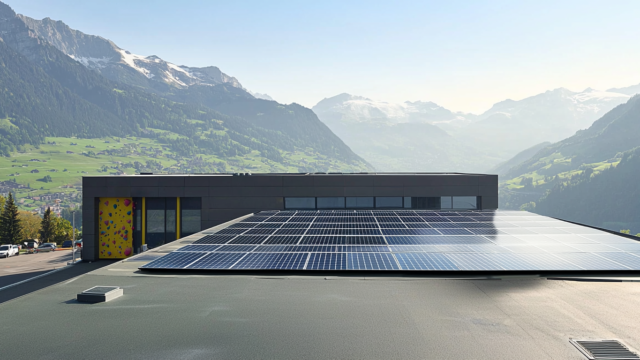
    The Münchenstein-based electricity producer aventron AG opened its new solar power plant in Näfels on March 27, according to a press release. The system is located on the roof of the bouldering hall, which is part of the Lintharena building complex. While the Verein Kletteranlagen Linthgebiet (VKL) has made the roof of the bouldering hall available for the solar system, the system itself is fully owned by aventron.

    The solar system has an area of 660 square meters and an output of 145 kilowatts. This means that around 124 megawatt hours of solar power can be generated each year, all of which will flow to Lintharena AG and cover around 10 percent of its electricity requirements. According to Samuel Leuzinger from VKL, the solar system has a double benefit for the association: “We receive additional income from the roof rental from aventron and are doing something for climate protection and the energy transition,” Leuzinger is quoted as saying in the press release.

    The construction of this and another solar installation in neighbouring Mollis was supported by the organizing committee of the Swiss Wrestling and Alpine Festival (ESAF) 2025. Aventron is an energy partner of the ESAF in Glarnerland. Through this partnership, the ESAF organizing committee put aventron in touch with suitable roof owners such as the VKL. “We are implementing this photovoltaic system in cooperation with our partners, the Lintharena, VKL and the ESAF in Glarnerland,” commented aventron CEO Eric Wagner on the new system, according to a press release. “This is an important step towards more Swiss solar power and the implementation of the Energy Strategy 2050.”

    Aventron generates its electricity exclusively from renewable sources. The company now has a nationwide solar capacity of around 65 megawatts. The aim is to increase this to an output of 100 megawatts by 2027.

  • Glarus North mobilises building land – opportunities for investors and developers

    Glarus North mobilises building land – opportunities for investors and developers

    The municipality of Glarus North has given the go-ahead for a comprehensive mobilisation of municipal land. The focus is on sites in Filzbach and Oberurnen. This initiative follows the newly defined guidelines for the allocation of building land and properties and emphasises the municipality’s commitment to sustainable and needs-based development.

    Attractive plots on offer
    Specifically, three plots of building land in the residential zone in Filzbach are being advertised for sale. In Oberurnen, the 5,084 m² Schranerwiese in the work zone is being allocated under building rights. These plots offer a wide range of opportunities for residential and commercial projects and are therefore of interest to a broad spectrum of investors and developers.

    Transparent and structured process
    The tendering process is clearly defined and transparent. Interested parties can find all relevant documents on the municipal website (www.glarus-nord.ch) and in the official gazette of the Canton of Glarus. A registration form is available for applications, which ensures a fair and objective evaluation based on the defined award criteria.
    The closing date for applications is 30 May at 16:00.

    Focus on future-oriented development
    The mobilisation of building zone areas is a central component of Glarus Nord’s new land use planning. The municipality is thus consistently implementing the requirements of the Spatial Planning Act and creating the conditions for orderly and future-oriented development. The continuous tendering of municipal land makes an important contribution to strengthening the location and creating attractive living and working space.

  • Rents and prices for residential property in the canton of Glarus remain on an upward trend

    Rents and prices for residential property in the canton of Glarus remain on an upward trend

    “Canton Glarus remains a popular residential region”, writes Glarner Kantonalbank in a press release on the 2024 property market report for the canton of Glarus. It was compiled by the cantonal bank in collaboration with Wüest Partner AG from Zurich. The report shows the current trends and forecasts how rents and prices for residential property will develop in the canton.

    The housing market in the canton of Glarus is currently characterised by stable demand and a short supply. As a result, prices for condominiums have continued to rise. Specifically, they were up 2.1 per cent year-on-year in the second quarter of 2024. At the same time, prices for single-family homes fell slightly year-on-year. However, according to the experts at Kantonalbank and the real estate service provider, the recent fall in interest rates will continue to stimulate demand for residential property. They therefore expect the slight upward trend to continue.

    The experts have observed a 4.5 per cent increase in rents over the past year. However, they should “remain stable for the time being” following the latest increases in April, according to the report. The full report can be viewed on the Kantonalbank website.

  • Landsgemeinde decides on Braunwald’s development

    Landsgemeinde decides on Braunwald’s development

    The future development of Braunwald will be determined by the Landsgemeinde 2025. Following intensive political and public discussions, a revision of the law on public transport will allow citizens to decide on the development option. The cantonal government favours the modernisation of the funicular railway as the most economical solution with low procedural risk and shorter construction time.

    The favoured solution
    After a long evaluation phase, the cantonal government opted for a new funicular railway, which is considered the most cost-effective and practicable option. It involves investment costs of CHF 24 million and operating costs of CHF 3 million per year. Compared to a gondola lift, which would be almost twice as expensive to build and would take up to ten years to complete, the funicular railway offers clear advantages. An automated funicular railway would also enable use independent of the timetable.

    Legal amendments to involve the Landsgemeinde
    The cantonal government has decided to include the development of Braunwald in a new article of the Public Transport Act, which will enable a discussion and vote at the Landsgemeinde 2025. This will give the population the final say on this important infrastructural decision. Should the Landsgemeinde vote in favour of an alternative gondola lift, the cantonal government would initiate the corresponding planning adjustments.

    Investments and future prospects
    The planned investments of CHF 24 million for the construction of the funicular railway and CHF 3 million for its operation will create sustainable and future-oriented access for Braunwald. The cantonal government expects that the decision of the Landsgemeinde will be an important step towards economic and environmentally friendly mobility, which will strengthen the region in the long term and promote tourism.

  • Canton Glarus defines settlement and extraction areas in the structure plan

    Canton Glarus defines settlement and extraction areas in the structure plan

    As part of the communal land use planning of Glarus North, the Department of Building and Environment of the Canton of Glarus has officially defined the settlement area of the municipality in the cantonal structure plan. This follows an in-depth review of the utilisation of the residential, mixed and core zones, which now comply with the strict federal and cantonal requirements for building zone dimensioning. This stipulation supports the aim of preventing urban sprawl and preserving the landscape, while at the same time offering landowners in Glarus North long-term planning and legal certainty, which is of considerable importance for the economic development of the canton.

    Expansion of the Haltengut mining area in Mollis
    In addition to the designation of the settlement area, the Haltengut mining area in the district of Mollis was expanded in the cantonal structure plan. This measure is the result of careful coordination of land-use planning by the municipality of Glarus Nord, which has demonstrated the environmental compatibility of the project. The expansion of the extraction area contributes to the needs-based supply and disposal and represents an important spatial planning co-operation between the canton and the municipality.

    Approval procedure at federal level
    The updates to the 2018 cantonal structure plan were submitted to the Federal Office for Spatial Development for approval following consultation with neighbouring cantons. With the determination of the settlement and extraction areas, the canton of Glarus has completed a significant step in the approval process for the communal utilisation planning of Glarus North. The decisions are binding with immediate effect and create a clear framework for the future development of the region.

  • Glarner Kantonalbank seeks projects for sustainability award

    Glarner Kantonalbank seeks projects for sustainability award

    The Glarner Kantonalbank(GLKB) awards the Glarus Sustainability Prize once a year. With this award, GLKB aims to promote projects and initiatives by Glarus residents that contribute to sustainable development in the canton. The prize is endowed with CHF 10,000. According to GLKB, applications for the third edition of the prize can be submitted from now until 30 June.

    Projects that deal with at least one of the three pillars of environment, society and economy can be submitted. The environment includes the reduction of greenhouse gases and renewable energies, energy efficiency, conservation of resources, reduction of harmful substances or biodiversity. In the area of society, the projects should deal with fairness and justice, social commitment or the promotion of Glarus culture. For economic development, ideas are sought that contribute to the creation of local jobs or include sustainable business models with development potential and innovative technologies.

    Private individuals and legal entities such as associations can take part. Research projects and applications for scientific work are also eligible, provided they “have a clear sustainability impact on the canton of Glarus” or, in the case of supra-regional impact, the designated prize winners have a direct connection to the canton of Glarus, according to the press release.

    Last year, the Obstalden heating network won the prize. The heating network is fuelled solely by local and renewable energies and secures jobs. The project was selected from a total of 21 entries.